
MEMBERS :
 1) MUHAMMAD ALIFF BIN ABDUL RAHMAN
 2) MUHAMMAD HANIF BIN AB. LATIFF
 3) NUR ‘IZZATI BINTI IBRAHIM
 4) RABIATUL ZAHIDAH BINTI MOHD ZAIDI
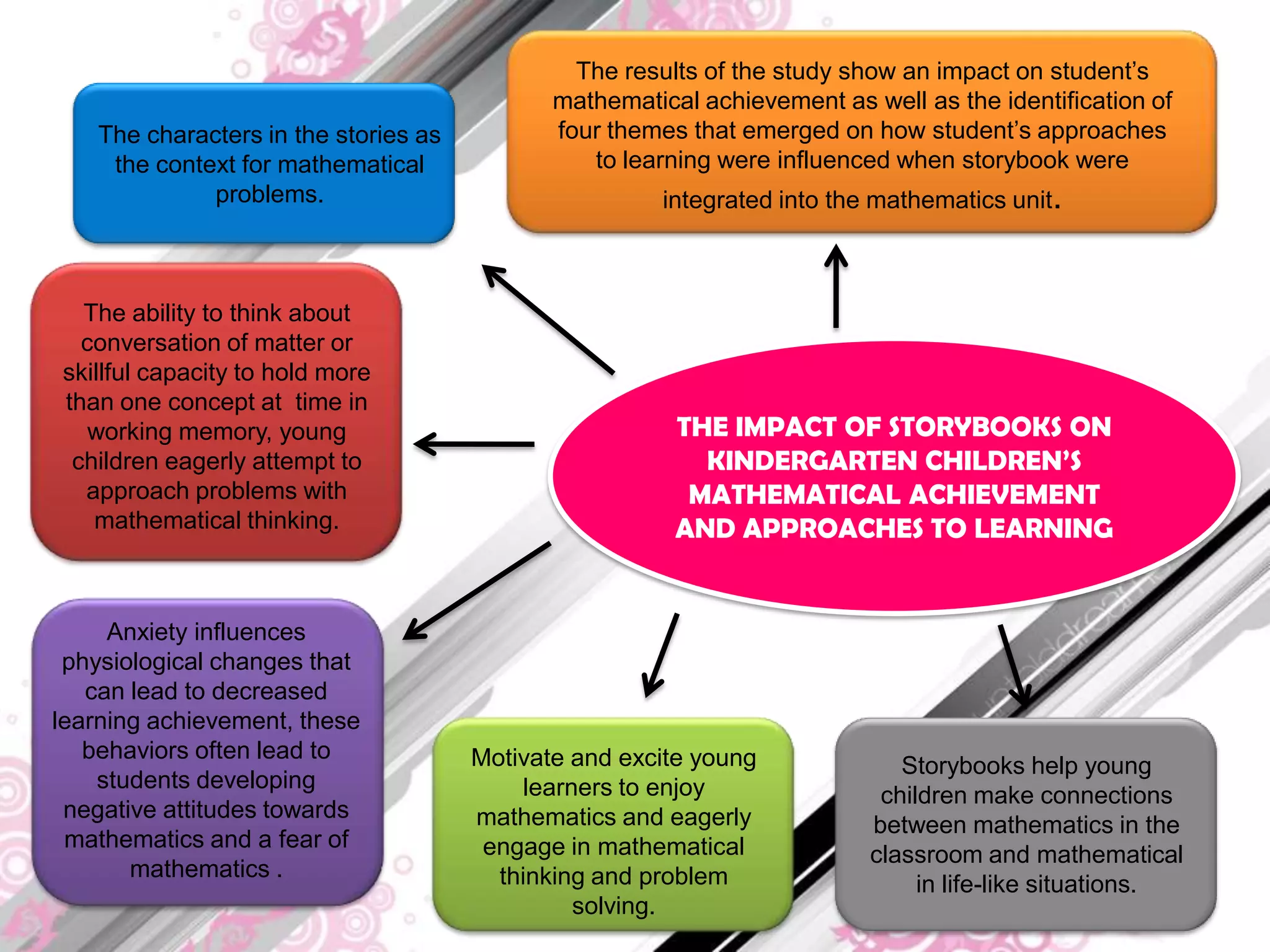
The results of the study show an impact on student’s
                                              mathematical achievement as well as the identification of
    The characters in the stories as          four themes that emerged on how student’s approaches
     the context for mathematical                to learning were influenced when storybook were
              problems.                                 integrated into the mathematics unit.


  The ability to think about
  conversation of matter or
skillful capacity to hold more
than one concept at time in
   working memory, young                                 THE IMPACT OF STORYBOOKS ON
 children eagerly attempt to                               KINDERGARTEN CHILDREN’S
  approach problems with                                  MATHEMATICAL ACHIEVEMENT
   mathematical thinking.                                AND APPROACHES TO LEARNING


     Anxiety influences
 physiological changes that
   can lead to decreased
learning achievement, these
   behaviors often lead to             Motivate and excite young              Storybooks help young
    students developing                     learners to enjoy               children make connections
 negative attitudes towards            mathematics and eagerly             between mathematics in the
 mathematics and a fear of              engage in mathematical             classroom and mathematical
       mathematics .                     thinking and problem                   in life-like situations.
                                                 solving.
An implementation quality evaluation as described by Patton (1990,
p.109).


The nuances and details of children’s achievement of objectives and
also of their attitudes and approaches to learning were explored in a
mathematics unit in which storybooks were integrated.
A corresponding contrast has been described between the
mathematical confidence that children exhibit when they enter
kindergarten compared with the lack of mathematical confidence
and feelings of fear .
The traditional methods identified as antithetical to foster positive
attitudes about mathematics and ineffective in facilitating meaningful
mathematical literacy.
Important for teachers of young children to target instruction to
facilitate mathematical achievement and also foster positive
approaches on learning mathematics.
Teachers with identified pedagogical problems may actively
choose professional behaviors that focus on “reflection as a given”
and “practice-specified acquisitions of pedagogical kn0wledge and
thinking”. (Mrazik, 2009, n.p.)

Effective learners are “anthusiastic about learning” and “enganged
in the learning process”. (Hyson)
The purpose of this study was to understand how
storybooks might influence both achievement of learning
objectives and positive approaches to learning
mathematics in three kindergarten classes.
Three kindergarten teachers and their students (n=70) from three
school districts in an urban, rural and suburban setting in Central
Pennsylvania.

Focus on a unit of study related to money.

Read storybooks with mathematical content related to money to the
children each day.
Students written and drawn work in response to
problems; photographs of classroom centers; teacher
journals and researcher journals; survey results; and
interview and focus group transcripts.
For the first research question – determined by a statistical analysis
of pre- and post-test scores.

For the second research question – determined by a thematic
analysis of student and teacher documentation, surveys, interview
recordings.
Resource in mathematics

Resource in mathematics

  • 1.
    MEMBERS : 1)MUHAMMAD ALIFF BIN ABDUL RAHMAN 2) MUHAMMAD HANIF BIN AB. LATIFF 3) NUR ‘IZZATI BINTI IBRAHIM 4) RABIATUL ZAHIDAH BINTI MOHD ZAIDI
  • 2.
    The results ofthe study show an impact on student’s mathematical achievement as well as the identification of The characters in the stories as four themes that emerged on how student’s approaches the context for mathematical to learning were influenced when storybook were problems. integrated into the mathematics unit. The ability to think about conversation of matter or skillful capacity to hold more than one concept at time in working memory, young THE IMPACT OF STORYBOOKS ON children eagerly attempt to KINDERGARTEN CHILDREN’S approach problems with MATHEMATICAL ACHIEVEMENT mathematical thinking. AND APPROACHES TO LEARNING Anxiety influences physiological changes that can lead to decreased learning achievement, these behaviors often lead to Motivate and excite young Storybooks help young students developing learners to enjoy children make connections negative attitudes towards mathematics and eagerly between mathematics in the mathematics and a fear of engage in mathematical classroom and mathematical mathematics . thinking and problem in life-like situations. solving.
  • 3.
    An implementation qualityevaluation as described by Patton (1990, p.109). The nuances and details of children’s achievement of objectives and also of their attitudes and approaches to learning were explored in a mathematics unit in which storybooks were integrated.
  • 4.
    A corresponding contrasthas been described between the mathematical confidence that children exhibit when they enter kindergarten compared with the lack of mathematical confidence and feelings of fear . The traditional methods identified as antithetical to foster positive attitudes about mathematics and ineffective in facilitating meaningful mathematical literacy. Important for teachers of young children to target instruction to facilitate mathematical achievement and also foster positive approaches on learning mathematics.
  • 5.
    Teachers with identifiedpedagogical problems may actively choose professional behaviors that focus on “reflection as a given” and “practice-specified acquisitions of pedagogical kn0wledge and thinking”. (Mrazik, 2009, n.p.) Effective learners are “anthusiastic about learning” and “enganged in the learning process”. (Hyson)
  • 6.
    The purpose ofthis study was to understand how storybooks might influence both achievement of learning objectives and positive approaches to learning mathematics in three kindergarten classes.
  • 7.
    Three kindergarten teachersand their students (n=70) from three school districts in an urban, rural and suburban setting in Central Pennsylvania. Focus on a unit of study related to money. Read storybooks with mathematical content related to money to the children each day.
  • 8.
    Students written anddrawn work in response to problems; photographs of classroom centers; teacher journals and researcher journals; survey results; and interview and focus group transcripts.
  • 9.
    For the firstresearch question – determined by a statistical analysis of pre- and post-test scores. For the second research question – determined by a thematic analysis of student and teacher documentation, surveys, interview recordings.