ITS HYPOTHESIS:
The hypothesis that Bruner puts forth for discovery
learning is:
Any subject (as Science, Mathematics) can be
taught effectively in some intellectual honest
form to any child at any stage of development.
Bruner concludes that the basic concepts in
science and the humanities can be grasped by
children at an earlier age that has been thought
possible.
It is important to stimulate in the child the
desire to learn . The best stimulus to learning is
interest in the material. This is far better than
external grades or goals.
Bruner stresses the acquisition of learning the
processes through discovery. Learning by discovery
usually begins with a problem or a situation that is
puzzling.
The three levels of representation that the
child goes through in learning can be represented
through a cone.
This is represented by a set of
actions appropriate for achieving a
certain result. The child manipulates
materials directly.
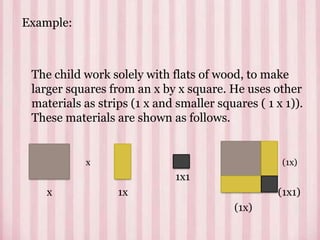
Example:
The child work solely with flats of wood, to make
larger squares from an x by x square. He uses other
materials as strips (1 x and smaller squares ( 1 x 1)).
These materials are shown as follows.
x (1x)
1x1
x 1x (1x1)
(1x)
It summarizes events by the selective
organization of percepts and of images, by
the spatial, temporal, and qualitative
structures of the perceptual field and their
transformed images.
Example:
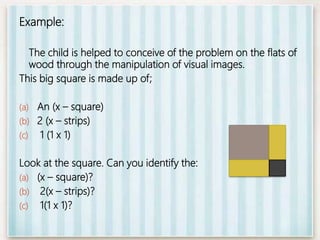
The child is helped to conceive of the problem on the flats of
wood through the manipulation of visual images.
This big square is made up of;
(a) An (x – square)
(b) 2 (x – strips)
(c) 1 (1 x 1)
Look at the square. Can you identify the:
(a) (x – square)?
(b) 2(x – strips)?
(c) 1(1 x 1)?
3. Symbolic Representation
This is represented by a set of symbolic or
logical propositions drawn from a symbolic
system.
Example:
The child is helped to write down and/or
verbalize the statement.
(x (x + 2) + 1) or
(x2 + 2x + 1) = (x + 1) (x + 1)
Its Major
Outcomes
There are 4 major outcomesof discovery
learning:
1. Intellectual potency of the learner is
increased
2. Dependence on rewards shifts from external
rewards to dependence on internal rewards.
3. Transfer values is enhanced by the mastery
of the ways of discovery.
4. Ability to remember is enhanced.

Bruner and discovery learning

  • 3.
    ITS HYPOTHESIS: The hypothesisthat Bruner puts forth for discovery learning is: Any subject (as Science, Mathematics) can be taught effectively in some intellectual honest form to any child at any stage of development.
  • 4.
    Bruner concludes thatthe basic concepts in science and the humanities can be grasped by children at an earlier age that has been thought possible. It is important to stimulate in the child the desire to learn . The best stimulus to learning is interest in the material. This is far better than external grades or goals.
  • 5.
    Bruner stresses theacquisition of learning the processes through discovery. Learning by discovery usually begins with a problem or a situation that is puzzling.
  • 6.
    The three levelsof representation that the child goes through in learning can be represented through a cone.
  • 7.
    This is representedby a set of actions appropriate for achieving a certain result. The child manipulates materials directly.
  • 8.
    Example: The child worksolely with flats of wood, to make larger squares from an x by x square. He uses other materials as strips (1 x and smaller squares ( 1 x 1)). These materials are shown as follows. x (1x) 1x1 x 1x (1x1) (1x)
  • 9.
    It summarizes eventsby the selective organization of percepts and of images, by the spatial, temporal, and qualitative structures of the perceptual field and their transformed images.
  • 10.
    Example: The child ishelped to conceive of the problem on the flats of wood through the manipulation of visual images. This big square is made up of; (a) An (x – square) (b) 2 (x – strips) (c) 1 (1 x 1) Look at the square. Can you identify the: (a) (x – square)? (b) 2(x – strips)? (c) 1(1 x 1)?
  • 11.
    3. Symbolic Representation Thisis represented by a set of symbolic or logical propositions drawn from a symbolic system. Example: The child is helped to write down and/or verbalize the statement. (x (x + 2) + 1) or (x2 + 2x + 1) = (x + 1) (x + 1)
  • 12.
    Its Major Outcomes There are4 major outcomesof discovery learning: 1. Intellectual potency of the learner is increased 2. Dependence on rewards shifts from external rewards to dependence on internal rewards. 3. Transfer values is enhanced by the mastery of the ways of discovery. 4. Ability to remember is enhanced.