Resolving Data Collision in CSMA via ProtocolsPresented by:                                                       Anurag Pratap Singh                            CS -64                                     2912210001
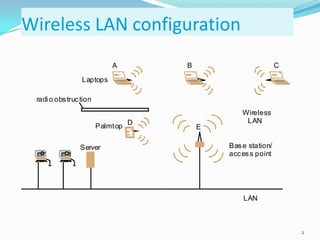
Wireless LAN configuration2
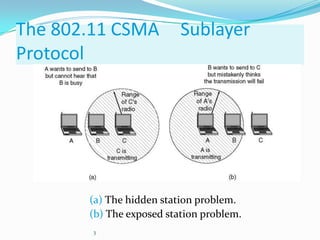
3The 802.11 CSMA	 Sublayer Protocol(a) The hidden station problem.(b) The exposed station problem.
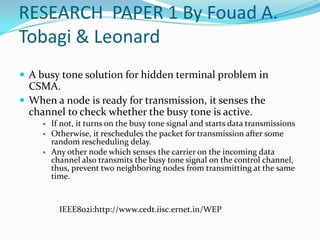
RESEARCH  PAPER 1 By Fouad A. Tobagi & Leonard A busy tone solution for hidden terminal problem in CSMA. When a node is ready for transmission, it senses the channel to check whether the busy tone is active. If not, it turns on the busy tone signal and starts data transmissionsOtherwise, it reschedules the packet for transmission after some random rescheduling delay.Any other node which senses the carrier on the incoming data channel also transmits the busy tone signal on the control channel, thus, prevent two neighboring nodes from transmitting at the same time.                   IEEE802i:http://www.cedt.iisc.ernet.in/WEP
RESEARCH  PAPER 2 by HossamHassanein and Chi-Hsiang YehIt assign priority for packets.it can enable different packets with different priority to access the  media and thus gain QoS.http://www.isaac.cs.berkeley.edu/isaac/wep-faq.html
RASEARCH PAPER 3 BY Tiantong You AND HossamHassaneinAn Adaptive Distributed ID Assignment Scheme for CSMA/IC.Achieving collision free medium access in  CSMA/IC only requires that the nodal ID is unique in its preventing range, while the nodal MAC ID (48 bits long) could guarantee uniqueness in the entire   network.IEEE 802.15.4. Part 15.4 :Wireless medium access control (MAC) and physical layer (PHY) specifications for low-rate wireless personal area networks (LR-WPANs).
RESEARCH PAPER 4 BY Zhenyu Tang and J. J. Garcia-Luna-AcevesHop reservation multiple access protocol (HRMA)  introduceda multichannel MAC protocol which is based on half-duplex, very slow frequency-hopping spread spectrum (FHSS) radiosuses a reservation and handshake mechanism to enable a pair of communicating nodes to reserve a frequency hop, thereby guaranteeing collision-free data transmission.can be viewed as a time slot reservation protocol where each time slot is assigned a separate frequency channel.IEEE: http://www.ieee802.org/1/files/public/docs2000/P8021XOverview.PDFORiNOCO security paper v2.2 <6> Copyright© 2003
RESEARCH PAPER 5 BY by J. D. Angelopoulos, N. Leligou, Th. Orphanoudakis, G. PikrammenosMACA with Piggy-Backed Reservation (MACA/PR)Provide real-time traffic support in multi-hop wireless networksBased on the MACAW protocol with non-persistent CSMAhttp://www.blackhat.com/html/bh-usa-02/bh-usa-02 speakers.html#Bruce%20PotterProblem domainContinuous  checking More wait for low priority dataID assignment deals only with hidden surface problem.HRMA have problem of low efficiency and throughput.
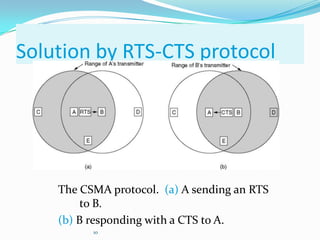
10Solution by RTS-CTS protocolThe CSMA protocol.  (a) A sending an RTS to B.(b) B responding with a CTS to A.
11CSMAWVariants of this method can be found in IEEE 802.11 as DFWCSMA (Distributed Foundation Wireless CSMA),CSMAW (CSMA for Wireless) is a revision of CSMA.The sender senses the carrier to see and transmits a RTS (Request To Send) frame if no nearby station transmits a RTS.The receiver replies with a CTS (Clear To Send) frame.Neighborssee CTS, then keep quiet.see RTS but not CTS, then keep quiet until the CTS is back to the sender.The receiver sends an ACK when receiving an frame.Neighbors keep silent until see ACK.CollisionsThere is no collision detection.The senders know collision when they don’t receive CTS.They each wait for the exponential backoff time.
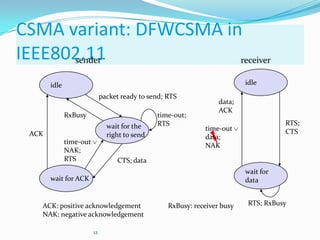
12CSMA variant: DFWCSMA in IEEE802.11senderreceiveridleidlepacket ready to send; RTSdata; ACKtime-out; RTSRxBusywait for the right to sendRTS; CTStime-out  data; NAKACKtime-out  NAK;RTSCTS; datawait fordatawait for ACKRTS; RxBusyACK: positive acknowledgementNAK: negative acknowledgementRxBusy: receiver busy
13Examples ACACCSMA  avoids the problem of hidden terminalsA and C want to send to BA sends RTS firstC waits after receiving CTS from BCSMA avoids the problem of exposed terminalsB wants to send to A, C to another terminalnow C does not have to wait for it cannot receive CTS from ARTSCTSCTSBRTSRTSCTSB
References[1] 1st Research Paper:The Institute of Electrical and Electronics Engineers, Inc. IEEE Std 802.11 - Wireless LAN Medium Access Control (MAC) and Physical Layer (PHY) specifications, 1999 edition. [2] 2nd Research Paper: B. Leiner, D. Nielson, and F. A. Tobagi, Eds.,Proceedings of IEEE GLOBECOM, Special issue on packet radio networks [3] 3rd Research Paper: T.You, C.-H. Yeh, and H. Hassanein, “CSMA/IC: A New Class of Collision-free MAC Protocols for Ad Hoc Wireless Networks,” Proc. IEEE Int'l Symp Computer Communications (IEEE ISCC'03), June/July 2003 [4] 4th Research Paper : WINGs for the Internet project and SPARROW project. http://www.cse.ucsc.edu/research/ccrg/, Santa Cruz, CA, 1998.  .
[5] 5th  Research Paper:; J. D. Angelopoulos, N. I. Lepidas, E. K. Fragoulopoulos, I.S. Venieris,“TDMA multiplexing of  ATM cells in a residential access SuperPON”, IEEE Journal on Selected Areas in Comm., Special issue on high capacity optical transport networks, Vol. 16, No. 7, September, 1998[6]www.google.com/lectures/IEEE 802.11 Media Access Control and Network Layer Standards[7]Chapter 6 of EE136 textbook:A. Leon-Garcia, I. Widjaja, “Communication Networks,” McGraw Hill.[8]The IEEE 802.11 specification – posted on my.poly.edu – reference materials[9]P. Brenner, “A Technical Tutorial on the IEEE 802.11 Protocol,” http://www.sss-mag.com/pdf/802_11tut.pdf
ANY
THANK YOU
Resolving data collision in csma via protocols

Resolving data collision in csma via protocols

  • 1.
    Resolving Data Collisionin CSMA via ProtocolsPresented by: Anurag Pratap Singh CS -64 2912210001
  • 2.
  • 3.
    3The 802.11 CSMA Sublayer Protocol(a) The hidden station problem.(b) The exposed station problem.
  • 4.
    RESEARCH PAPER1 By Fouad A. Tobagi & Leonard A busy tone solution for hidden terminal problem in CSMA. When a node is ready for transmission, it senses the channel to check whether the busy tone is active. If not, it turns on the busy tone signal and starts data transmissionsOtherwise, it reschedules the packet for transmission after some random rescheduling delay.Any other node which senses the carrier on the incoming data channel also transmits the busy tone signal on the control channel, thus, prevent two neighboring nodes from transmitting at the same time. IEEE802i:http://www.cedt.iisc.ernet.in/WEP
  • 5.
    RESEARCH PAPER2 by HossamHassanein and Chi-Hsiang YehIt assign priority for packets.it can enable different packets with different priority to access the media and thus gain QoS.http://www.isaac.cs.berkeley.edu/isaac/wep-faq.html
  • 6.
    RASEARCH PAPER 3BY Tiantong You AND HossamHassaneinAn Adaptive Distributed ID Assignment Scheme for CSMA/IC.Achieving collision free medium access in CSMA/IC only requires that the nodal ID is unique in its preventing range, while the nodal MAC ID (48 bits long) could guarantee uniqueness in the entire network.IEEE 802.15.4. Part 15.4 :Wireless medium access control (MAC) and physical layer (PHY) specifications for low-rate wireless personal area networks (LR-WPANs).
  • 7.
    RESEARCH PAPER 4BY Zhenyu Tang and J. J. Garcia-Luna-AcevesHop reservation multiple access protocol (HRMA) introduceda multichannel MAC protocol which is based on half-duplex, very slow frequency-hopping spread spectrum (FHSS) radiosuses a reservation and handshake mechanism to enable a pair of communicating nodes to reserve a frequency hop, thereby guaranteeing collision-free data transmission.can be viewed as a time slot reservation protocol where each time slot is assigned a separate frequency channel.IEEE: http://www.ieee802.org/1/files/public/docs2000/P8021XOverview.PDFORiNOCO security paper v2.2 <6> Copyright© 2003
  • 8.
    RESEARCH PAPER 5BY by J. D. Angelopoulos, N. Leligou, Th. Orphanoudakis, G. PikrammenosMACA with Piggy-Backed Reservation (MACA/PR)Provide real-time traffic support in multi-hop wireless networksBased on the MACAW protocol with non-persistent CSMAhttp://www.blackhat.com/html/bh-usa-02/bh-usa-02 speakers.html#Bruce%20PotterProblem domainContinuous checking More wait for low priority dataID assignment deals only with hidden surface problem.HRMA have problem of low efficiency and throughput.
  • 9.
    10Solution by RTS-CTSprotocolThe CSMA protocol. (a) A sending an RTS to B.(b) B responding with a CTS to A.
  • 10.
    11CSMAWVariants of thismethod can be found in IEEE 802.11 as DFWCSMA (Distributed Foundation Wireless CSMA),CSMAW (CSMA for Wireless) is a revision of CSMA.The sender senses the carrier to see and transmits a RTS (Request To Send) frame if no nearby station transmits a RTS.The receiver replies with a CTS (Clear To Send) frame.Neighborssee CTS, then keep quiet.see RTS but not CTS, then keep quiet until the CTS is back to the sender.The receiver sends an ACK when receiving an frame.Neighbors keep silent until see ACK.CollisionsThere is no collision detection.The senders know collision when they don’t receive CTS.They each wait for the exponential backoff time.
  • 11.
    12CSMA variant: DFWCSMAin IEEE802.11senderreceiveridleidlepacket ready to send; RTSdata; ACKtime-out; RTSRxBusywait for the right to sendRTS; CTStime-out  data; NAKACKtime-out  NAK;RTSCTS; datawait fordatawait for ACKRTS; RxBusyACK: positive acknowledgementNAK: negative acknowledgementRxBusy: receiver busy
  • 12.
    13Examples ACACCSMA avoids the problem of hidden terminalsA and C want to send to BA sends RTS firstC waits after receiving CTS from BCSMA avoids the problem of exposed terminalsB wants to send to A, C to another terminalnow C does not have to wait for it cannot receive CTS from ARTSCTSCTSBRTSRTSCTSB
  • 13.
    References[1] 1st ResearchPaper:The Institute of Electrical and Electronics Engineers, Inc. IEEE Std 802.11 - Wireless LAN Medium Access Control (MAC) and Physical Layer (PHY) specifications, 1999 edition. [2] 2nd Research Paper: B. Leiner, D. Nielson, and F. A. Tobagi, Eds.,Proceedings of IEEE GLOBECOM, Special issue on packet radio networks [3] 3rd Research Paper: T.You, C.-H. Yeh, and H. Hassanein, “CSMA/IC: A New Class of Collision-free MAC Protocols for Ad Hoc Wireless Networks,” Proc. IEEE Int'l Symp Computer Communications (IEEE ISCC'03), June/July 2003 [4] 4th Research Paper : WINGs for the Internet project and SPARROW project. http://www.cse.ucsc.edu/research/ccrg/, Santa Cruz, CA, 1998.  .
  • 14.
    [5] 5th Research Paper:; J. D. Angelopoulos, N. I. Lepidas, E. K. Fragoulopoulos, I.S. Venieris,“TDMA multiplexing of ATM cells in a residential access SuperPON”, IEEE Journal on Selected Areas in Comm., Special issue on high capacity optical transport networks, Vol. 16, No. 7, September, 1998[6]www.google.com/lectures/IEEE 802.11 Media Access Control and Network Layer Standards[7]Chapter 6 of EE136 textbook:A. Leon-Garcia, I. Widjaja, “Communication Networks,” McGraw Hill.[8]The IEEE 802.11 specification – posted on my.poly.edu – reference materials[9]P. Brenner, “A Technical Tutorial on the IEEE 802.11 Protocol,” http://www.sss-mag.com/pdf/802_11tut.pdf
  • 15.
  • 16.