CSE 461: Multiple Access Networks
This Lecture
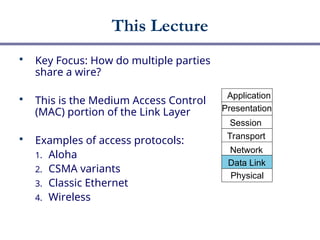
 Key Focus: How do multiple parties
share a wire?
 This is the Medium Access Control
(MAC) portion of the Link Layer
 Examples of access protocols:
1. Aloha
2. CSMA variants
3. Classic Ethernet
4. Wireless
Physical
Data Link
Network
Transport
Session
Presentation
Application
1. ALOHA
 Wireless links between the Hawaiian islands in the 70s
 Want distributed allocation
 no special channels, or single point of failure
 Aloha protocol:
 Just send when you have data!
 There will be some collisions of course …
 Detect error frames and retransmit a random time
later
 Simple, decentralized and works well for low load
 For many users, analytic traffic model, max efficiency is
18%
2. Carrier Sense Multiple Access
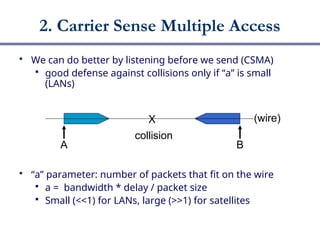
 We can do better by listening before we send (CSMA)
 good defense against collisions only if “a” is small
(LANs)
 “a” parameter: number of packets that fit on the wire
 a = bandwidth * delay / packet size
 Small (<<1) for LANs, large (>>1) for satellites
X
collision
(wire)
A B
What if the Channel is Busy?
 1-persistent CSMA
 Wait until idle then go for it
 Blocked senders can queue up and collide
 p-persistent CSMA
 If idle send with prob p until done; assumed
slotted time
 Choose p so p * # senders < 1; avoids collisions at
cost of delay
CSMA with Collision Detection
 Even with CSMA there can still be collisions.
 For wired media we can detect all collisions and abort
(CSMA/CD):
 Requires a minimum frame size (“acquiring the medium”)
 B must continue sending (“jam”) until A detects collision
X
collision
(wire)
A B
Time for B to detect A’s transmission
3. Classic Ethernet
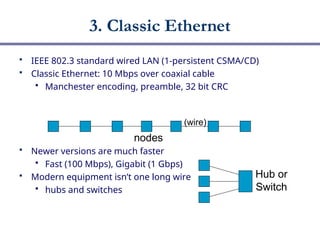
 IEEE 802.3 standard wired LAN (1-persistent CSMA/CD)
 Classic Ethernet: 10 Mbps over coaxial cable
 Manchester encoding, preamble, 32 bit CRC
 Newer versions are much faster
 Fast (100 Mbps), Gigabit (1 Gbps)
 Modern equipment isn’t one long wire
 hubs and switches
nodes
(wire)
Hub or
Switch
Modern (Ethernet II) Frames
 Min frame 64 bytes, max 1500 bytes
 Max length 2.5km, max between stations 500m (repeaters)
 Addresses unique per adaptor; 6 bytes; globally assigned
 Broadcast media is readily tapped:
 Promiscuous mode; multicast addresses
CRC (4)
Type (2)
Preamble (8) Payload (var)
Source (6)
Dest (6) Pad (var)
Binary Exponential Backoff
 Build on 1-persistent CSMA/CD
 On collision: jam and exponential backoff
 Backoff:
 First collision: wait 0 or 1 frame times at random
and retry
 Second time: wait 0, 1, 2, or 3 frame times
 Nth time (N<=10): wait 0, 1, …, 2N
-1 times
 Max wait 1023 frames, give up after 16 attempts
 Scheme balances average wait with load
Ethernet Capture
 Randomized access scheme is not fair
 Stations A and B always have data to send
 They will collide at some time
 Suppose A wins and sends, while B backs off
 Next time they collide and B’s chances of winning
are halved!
Ethernet Performance
 Much better than Aloha or CSMA
 Works very well in practice
 Source of protocol inefficiency: collisions
 More efficient to send larger frames
• Acquire the medium and send lots of data
 Less efficient as the network grows in terms of frames
• recall “a” = delay * bandwidth / frame size
• “a” grows as the path gets longer (satellite)
• “a” grows as the bit rates increase (Fast, Gigabit Ethernet)
4. Wireless Communication
Wireless is more complicated than wired …
1. Cannot detect collisions
 Transmitter swamps co-located receiver
2. Different transmitters have different coverage areas
 Asymmetries lead to hidden/exposed terminal
problems
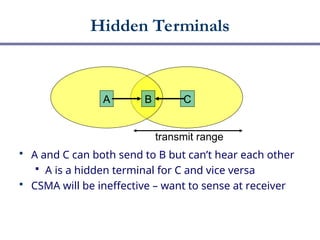
 A and C can both send to B but can’t hear each other
 A is a hidden terminal for C and vice versa
 CSMA will be ineffective – want to sense at receiver
Hidden Terminals
A B C
transmit range
Exposed Terminals
 B, C can hear each other but can safely send to A, D
A B C
transmit range
D
CSMA with Collision Avoidance
 Since we can’t detect collisions, we avoid them
 CSMA/CA as opposed to CSMA/CD
 Not greedy like Ethernet
 CS: listen before transmitting.
 When medium busy, choose random backoff interval
 Wait for that many idle timeslots to pass before sending
 CA: transmit short “jamming” signal before sending frame
 essentially reserves medium, let’s others know your intent to
transmit
 Collisions can be inferred
 Use CRC and ACK from receiver to infer “no collision”
 on collision, binary exponential backoff like Ethernet
1. B stimulates C with Request To Send (RTS)
2. A hears RTS and defers to allow the CTS
3. C replies to B with Clear To Send (CTS)
4. D hears CTS and defers to allow the data
5. B sends to C
RTS / CTS Protocols (MACA)
B C D
RTS
CTS
A
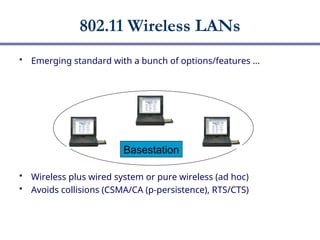
 Emerging standard with a bunch of options/features …
 Wireless plus wired system or pure wireless (ad hoc)
 Avoids collisions (CSMA/CA (p-persistence), RTS/CTS)
802.11 Wireless LANs
Basestation
5. Contention-free Protocols
 Collisions are the main difficulty with random schemes
 Inefficiency, limit to scalability
 Q: Can we avoid collisions?
 A: Yes. By taking turns or with reservations
 Token Ring / FDDI, DQDB
 More generally, what else might we want?
 Deterministic service, priorities/QOS, reliability
Token Ring (802.5)
 Token rotates permission to send around node
 Sender injects packet into ring and removes later
 Maximum token holding time (THT) bounds access time
 token release after sending data
 Round robin service, acknowledgments and priorities
 Monitor nodes ensure health of ring
A
B
C
D
nodes
Direction of
transmission
FDDI (Fiber Distributed Data
Interface)
 Roughly a large, fast token ring
 100 Mbps and 200km vs 4/16 Mbps and local
 Dual counter-rotating rings for redundancy
 Complex token holding policies for voice etc.
traffic
 Token ring advantages
 No contention, bounded access delay
 Supports fair, reserved, priority access
 Disadvantages
 Complexity, reliability, scalability
Break!
Key Concepts
 Wireless communication is relatively complex
 No collision detection, hidden and exposed
terminals
 There are contention-free MAC protocols
 Based on turn taking and reservations, not
randomization

multiple access networks _lecture_01.ppt

  • 1.
    CSE 461: MultipleAccess Networks
  • 2.
    This Lecture  KeyFocus: How do multiple parties share a wire?  This is the Medium Access Control (MAC) portion of the Link Layer  Examples of access protocols: 1. Aloha 2. CSMA variants 3. Classic Ethernet 4. Wireless Physical Data Link Network Transport Session Presentation Application
  • 3.
    1. ALOHA  Wirelesslinks between the Hawaiian islands in the 70s  Want distributed allocation  no special channels, or single point of failure  Aloha protocol:  Just send when you have data!  There will be some collisions of course …  Detect error frames and retransmit a random time later  Simple, decentralized and works well for low load  For many users, analytic traffic model, max efficiency is 18%
  • 4.
    2. Carrier SenseMultiple Access  We can do better by listening before we send (CSMA)  good defense against collisions only if “a” is small (LANs)  “a” parameter: number of packets that fit on the wire  a = bandwidth * delay / packet size  Small (<<1) for LANs, large (>>1) for satellites X collision (wire) A B
  • 5.
    What if theChannel is Busy?  1-persistent CSMA  Wait until idle then go for it  Blocked senders can queue up and collide  p-persistent CSMA  If idle send with prob p until done; assumed slotted time  Choose p so p * # senders < 1; avoids collisions at cost of delay
  • 6.
    CSMA with CollisionDetection  Even with CSMA there can still be collisions.  For wired media we can detect all collisions and abort (CSMA/CD):  Requires a minimum frame size (“acquiring the medium”)  B must continue sending (“jam”) until A detects collision X collision (wire) A B Time for B to detect A’s transmission
  • 7.
    3. Classic Ethernet IEEE 802.3 standard wired LAN (1-persistent CSMA/CD)  Classic Ethernet: 10 Mbps over coaxial cable  Manchester encoding, preamble, 32 bit CRC  Newer versions are much faster  Fast (100 Mbps), Gigabit (1 Gbps)  Modern equipment isn’t one long wire  hubs and switches nodes (wire) Hub or Switch
  • 8.
    Modern (Ethernet II)Frames  Min frame 64 bytes, max 1500 bytes  Max length 2.5km, max between stations 500m (repeaters)  Addresses unique per adaptor; 6 bytes; globally assigned  Broadcast media is readily tapped:  Promiscuous mode; multicast addresses CRC (4) Type (2) Preamble (8) Payload (var) Source (6) Dest (6) Pad (var)
  • 9.
    Binary Exponential Backoff Build on 1-persistent CSMA/CD  On collision: jam and exponential backoff  Backoff:  First collision: wait 0 or 1 frame times at random and retry  Second time: wait 0, 1, 2, or 3 frame times  Nth time (N<=10): wait 0, 1, …, 2N -1 times  Max wait 1023 frames, give up after 16 attempts  Scheme balances average wait with load
  • 10.
    Ethernet Capture  Randomizedaccess scheme is not fair  Stations A and B always have data to send  They will collide at some time  Suppose A wins and sends, while B backs off  Next time they collide and B’s chances of winning are halved!
  • 11.
    Ethernet Performance  Muchbetter than Aloha or CSMA  Works very well in practice  Source of protocol inefficiency: collisions  More efficient to send larger frames • Acquire the medium and send lots of data  Less efficient as the network grows in terms of frames • recall “a” = delay * bandwidth / frame size • “a” grows as the path gets longer (satellite) • “a” grows as the bit rates increase (Fast, Gigabit Ethernet)
  • 12.
    4. Wireless Communication Wirelessis more complicated than wired … 1. Cannot detect collisions  Transmitter swamps co-located receiver 2. Different transmitters have different coverage areas  Asymmetries lead to hidden/exposed terminal problems
  • 13.
     A andC can both send to B but can’t hear each other  A is a hidden terminal for C and vice versa  CSMA will be ineffective – want to sense at receiver Hidden Terminals A B C transmit range
  • 14.
    Exposed Terminals  B,C can hear each other but can safely send to A, D A B C transmit range D
  • 15.
    CSMA with CollisionAvoidance  Since we can’t detect collisions, we avoid them  CSMA/CA as opposed to CSMA/CD  Not greedy like Ethernet  CS: listen before transmitting.  When medium busy, choose random backoff interval  Wait for that many idle timeslots to pass before sending  CA: transmit short “jamming” signal before sending frame  essentially reserves medium, let’s others know your intent to transmit  Collisions can be inferred  Use CRC and ACK from receiver to infer “no collision”  on collision, binary exponential backoff like Ethernet
  • 16.
    1. B stimulatesC with Request To Send (RTS) 2. A hears RTS and defers to allow the CTS 3. C replies to B with Clear To Send (CTS) 4. D hears CTS and defers to allow the data 5. B sends to C RTS / CTS Protocols (MACA) B C D RTS CTS A
  • 17.
     Emerging standardwith a bunch of options/features …  Wireless plus wired system or pure wireless (ad hoc)  Avoids collisions (CSMA/CA (p-persistence), RTS/CTS) 802.11 Wireless LANs Basestation
  • 18.
    5. Contention-free Protocols Collisions are the main difficulty with random schemes  Inefficiency, limit to scalability  Q: Can we avoid collisions?  A: Yes. By taking turns or with reservations  Token Ring / FDDI, DQDB  More generally, what else might we want?  Deterministic service, priorities/QOS, reliability
  • 19.
    Token Ring (802.5) Token rotates permission to send around node  Sender injects packet into ring and removes later  Maximum token holding time (THT) bounds access time  token release after sending data  Round robin service, acknowledgments and priorities  Monitor nodes ensure health of ring A B C D nodes Direction of transmission
  • 20.
    FDDI (Fiber DistributedData Interface)  Roughly a large, fast token ring  100 Mbps and 200km vs 4/16 Mbps and local  Dual counter-rotating rings for redundancy  Complex token holding policies for voice etc. traffic  Token ring advantages  No contention, bounded access delay  Supports fair, reserved, priority access  Disadvantages  Complexity, reliability, scalability Break!
  • 21.
    Key Concepts  Wirelesscommunication is relatively complex  No collision detection, hidden and exposed terminals  There are contention-free MAC protocols  Based on turn taking and reservations, not randomization