iSchool Society
Research Writing:
How, What, Where, When?
By the end of this session, you will be able to:
• Identify the challenges and pitfalls of the writing process
• Formulate a clear hypothesis and plan to work towards
• Map your research project and develop a realistic and
productive writing strategy
Learning Outcomes
© The University of Sheffield*
Behavioural
Writer’s BASE:
http://writersdiet.com/base.php
© The University of Sheffield*
Social
Emotional
Artisanal/skill
Air & Light & Time & Space:
How Successful Academics
Write, Helen Sword
© The University of Sheffield18/07/2018
What are the main
challenges of the
writing process?
When is the right time to start writing?
• Writing is part of the planning process
• Writing is part of the thinking process
• Writing runs in parallel to data collection and analysis
• Writing is part of the research process…not a
separate skill set
Writing Up…When?
© The University of Sheffield*
What is your target word count?
What is your deadline?
• Work out how many days you have until your
deadline
• Take away weekends, holidays, conferences and
other anticipated ‘days off’
• Divide your word count by the number of
days remaining
Writing Up…How?
© The University of Sheffield*
How productively can you write?
In five minutes…
For example:
• I am writing a dissertation about…
• I think this is interesting because…
• The main challenges of my research are…
• The main aims of my research are…
So…start writing!
© The University of Sheffield*
5 minutes
Voice in
Research Writing
Voice in Research
© The University of Sheffield*
Hyland K. (2002) Options of identity in academic writing.
ELT Journal 56/4: 351-58.
The process of learning to write at university often involves the
process of creating a new identity (Fan Shen 1988) which fits the
expectations of the subject teachers who represent a student’s
discipline. The author’s explicit appearance in a text, or its
absence, works to create a plausible academic identity, and a
voice with which to present an argument.
Average frequency of writer pronouns (per journal article)
Voice in Research
© The University of Sheffield*
What is your stance?
• Write in the first person (e.g. I argue…; I propose…;
my research suggests…; my research is important
because…)
• Use language accessible to a non-specialist (i.e. a
‘lay summary’)
• Boil it down to 2-3 sentences
• Own your research!
Mapping
Your Writing
What are the main sections of your project?
• Identify the main sections and subsections of your
project
• Use post-it notes to plan a flexible structure
• Do the sections flow logically from one to the next?
Mapping Your Writing
© The University of Sheffield*
Writing
Strategy
Where does writing fit into your day?
• Get out your diaries or use the week planner
template
• Identify ten one-hour slots over the next two weeks
• Commit this time to the writing process
Making the time
© The University of Sheffield*
Plan ahead; what will you write?
• Look back at your project map
• Identify which part of the project you will write about
in each of the ten one-hour slots
• Hit the ground running!
Making the time
© The University of Sheffield*
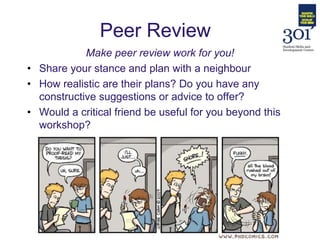
Peer Review
Make peer review work for you!
• Share your stance and plan with a neighbour
• How realistic are their plans? Do you have any
constructive suggestions or advice to offer?
• Would a critical friend be useful for you beyond this
workshop?
Peer Review
© The University of Sheffield*
Useful Resources: TUOS
© The University of Sheffield*
301
Study Skills
Tutorials
Thesis
Mentoring
Scheme
MASH
Service
ELTC
Writing
Advisory
Service
Manchester University
Academic Phrasebank
Useful Resources: Websites
© The University of Sheffield*
The Thesis
Whisperer
The Writer’s Diet,
Helen Sword
Useful Resources: Apps
© The University of Sheffield*
The Most Dangerous
Writing App
Hemingway Editor
Grammarlay Ilys
iSchool Society
Research Writing:
How, What, Where, When?

Research writing: How, What, Where, When

  • 1.
  • 2.
    By the endof this session, you will be able to: • Identify the challenges and pitfalls of the writing process • Formulate a clear hypothesis and plan to work towards • Map your research project and develop a realistic and productive writing strategy Learning Outcomes © The University of Sheffield*
  • 3.
    Behavioural Writer’s BASE: http://writersdiet.com/base.php © TheUniversity of Sheffield* Social Emotional Artisanal/skill Air & Light & Time & Space: How Successful Academics Write, Helen Sword
  • 4.
    © The Universityof Sheffield18/07/2018 What are the main challenges of the writing process?
  • 5.
    When is theright time to start writing? • Writing is part of the planning process • Writing is part of the thinking process • Writing runs in parallel to data collection and analysis • Writing is part of the research process…not a separate skill set Writing Up…When? © The University of Sheffield*
  • 6.
    What is yourtarget word count? What is your deadline? • Work out how many days you have until your deadline • Take away weekends, holidays, conferences and other anticipated ‘days off’ • Divide your word count by the number of days remaining Writing Up…How? © The University of Sheffield*
  • 7.
    How productively canyou write? In five minutes… For example: • I am writing a dissertation about… • I think this is interesting because… • The main challenges of my research are… • The main aims of my research are… So…start writing! © The University of Sheffield* 5 minutes
  • 8.
  • 9.
    Voice in Research ©The University of Sheffield* Hyland K. (2002) Options of identity in academic writing. ELT Journal 56/4: 351-58. The process of learning to write at university often involves the process of creating a new identity (Fan Shen 1988) which fits the expectations of the subject teachers who represent a student’s discipline. The author’s explicit appearance in a text, or its absence, works to create a plausible academic identity, and a voice with which to present an argument. Average frequency of writer pronouns (per journal article)
  • 10.
    Voice in Research ©The University of Sheffield* What is your stance? • Write in the first person (e.g. I argue…; I propose…; my research suggests…; my research is important because…) • Use language accessible to a non-specialist (i.e. a ‘lay summary’) • Boil it down to 2-3 sentences • Own your research!
  • 11.
  • 12.
    What are themain sections of your project? • Identify the main sections and subsections of your project • Use post-it notes to plan a flexible structure • Do the sections flow logically from one to the next? Mapping Your Writing © The University of Sheffield*
  • 13.
  • 14.
    Where does writingfit into your day? • Get out your diaries or use the week planner template • Identify ten one-hour slots over the next two weeks • Commit this time to the writing process Making the time © The University of Sheffield*
  • 15.
    Plan ahead; whatwill you write? • Look back at your project map • Identify which part of the project you will write about in each of the ten one-hour slots • Hit the ground running! Making the time © The University of Sheffield*
  • 16.
  • 17.
    Make peer reviewwork for you! • Share your stance and plan with a neighbour • How realistic are their plans? Do you have any constructive suggestions or advice to offer? • Would a critical friend be useful for you beyond this workshop? Peer Review © The University of Sheffield*
  • 18.
    Useful Resources: TUOS ©The University of Sheffield* 301 Study Skills Tutorials Thesis Mentoring Scheme MASH Service ELTC Writing Advisory Service
  • 19.
    Manchester University Academic Phrasebank UsefulResources: Websites © The University of Sheffield* The Thesis Whisperer The Writer’s Diet, Helen Sword
  • 20.
    Useful Resources: Apps ©The University of Sheffield* The Most Dangerous Writing App Hemingway Editor Grammarlay Ilys
  • 21.