URDANETACITYUNIVERSITY
COLLEGE OF ENGINEERING AND ARCHITECTURE
Q044-ARCH 415
RESEARCH METHODS IN ARCHITECTURE
Requirement No.:
RSW N0.1
Requirement Title:
DIFFERENT KINDS OF FORMAT IN RESEARCH WRITING
Date Due:
September 22, 2023
Submitted by:
Name:
Lawrenz Dave Aquino
Student No.:
20200733
Submitted to:
Arch’t. Maria Teresa Cuares-Velasco, MA EHURP
CEA- Instructor
i
Page
COVER PAGE -
TABLE OF
CONTENTS
i
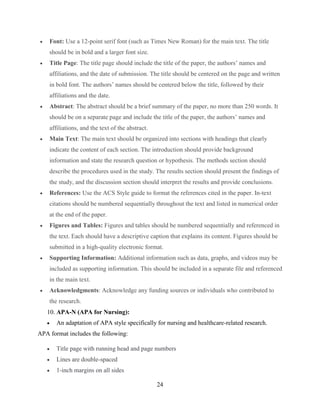
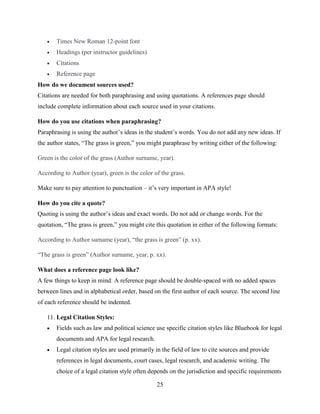
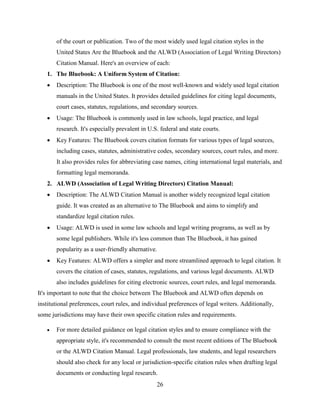
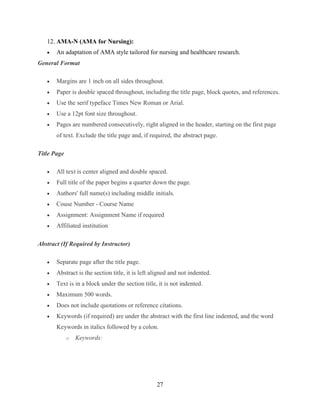
Questions
1 Introduction about Research 1-2
2 The Essential Building Blocks of Research
Writing
2
3 What Is a Writing Style, and Which Formats
Could You Use?
3
4 Why Do You Need to Choose the Right
Research Paper Style?
4-5
5 Advice for Writing and Formatting 5-7
6 DIFFERENT KINDS OF FORMAT IN RESEARCH
WRITING
7-31
References 32
1
DIFFERENT KINDS OF FORMAT IN RESEARCH WRITING
INTRODUCTION
What is Research Writing - Research writing is a form of academic and professional writing
that involves conducting an in-depth investigation into a particular topic or question and
presenting the findings in a structured and coherent manner. It is a systematic and organized
process of gathering, analyzing, and interpreting information from various sources to contribute
new knowledge, insights, or solutions to a specific field of study or area of interest.
Key characteristics of research writing include:
Research Question or Hypothesis: Research begins with a clear and well-defined question or
hypothesis that the writer intends to explore or test. This question guides the entire research
process.
Data Collection: Researchers gather relevant data and information through various methods,
such as experiments, surveys, interviews, observations, literature reviews, or archival research.
Analysis: Data collected is analyzed and interpreted to draw meaningful conclusions. This often
involves statistical analysis, qualitative analysis, or other methods depending on the nature of the
research.
Citation of Sources: Research writers must give proper credit to the sources they consult by
citing them accurately. This is crucial to avoid plagiarism and to provide credibility to the work.
Structured Format: Research papers typically follow a specific structure, including an
introduction, literature review, methodology, results, discussion, and conclusion. The format may
vary depending on the style guide or academic discipline.
Evidence-Based: Research writing relies on evidence and facts to support arguments and claims.
It should be objective and impartial, drawing conclusions based on the data rather than personal
opinions.
Contributing to Knowledge: The ultimate goal of research writing is to contribute to the
existing body of knowledge in a specific field. This can involve confirming, challenging, or
expanding upon existing theories and ideas.
2
Peer Review: In academia, research papers often undergo a peer-review process, where experts
in the field evaluate the quality and validity of the research before it is published.
Clarity and Precision: Research writing should be clear, concise, and precise. It should
communicate complex ideas in a way that is understandable to the target audience.
The Essential Building Blocks of Research Writing
1. Do real research
1. Begin from a question to which you don’t know the answer and that can’t be
answered just by going to the appropriate reference source. That is, begin from a
research question, not a homework question.
2. Decide what kind of information or data will be needed in order to build the answer
to the question.
3. Gather information and/or collect data.
4. Work with the information/data to derive or construct your answer.
This is the research process, and it happens before you begin to write your paper. No
research, no research writing, so don’t shortchange this part of the process.
2. Create a one-sentence answer to your research question.
1. This will be the thesis statement/main point/controlling idea of your research paper.
3. Share your answer to research questions in a way that make it believable,
understandable, and usable for your readers. To do this
1. Include plentiful and well-chosen examples from the data/information you gathered
2. Indicate the validity of your data by accurately reporting your research method (field
or lab research)
3. Indicate the quality of your information by accurately citing your sources (source-
based research)
4. Provide the reasoning and explanation that will let your readers completely
understand how the evidence adds up to your answer.
3
What Is a Writing Style, and Which Formats Could You Use?
As a writer of academic papers, every student must document any source of information they use
in their research papers, articles, presentations, and any kind of scientific project. If you properly
document the original works of other authors on which you base your ideas, it allows the readers
to see and consult the resources used. Accurate and proper quoting will help avoid plagiarism,
considered a serious breach of academic conduct.
There are 3 different writing formats for including other writers’ work in your paper. They are
called citing or quoting, paraphrasing, and summarizing.
1. Citing. The purpose of the citing/quoting is that it should repeat the original text word-
for-word and include a reference to the original writer of the source document. You
should decide which approach to use when incorporating another author’s ideas into your
text. You should use direct quotations during research when the exact wording of a
passage is important to ensure you have reproduced the original accurately. You might
also use citations if the original statement is well-formulated and you feel it will enrich
your writing.
2. Paraphrasing in research is basically retelling a passage of the original text using your
own words and sentence structures. The original author must also be referenced.
Paraphrasing is widely used in research papers and argumentative essays, showing your
supervisors you understand a source text and may reformulate it and find and emphasize
its main points. It also helps change the stylistic characteristics of your source, adapting it
to the readers (e.g., if you use it for a presentation of some scientific topic before your
class) and omitting unnecessary details.
3. Summarizing in research means reproducing only the source’s most important ideas and
main points in your own words. It usually summarizes a larger statement in the form of a
shorter explanation. However, the original source must be referenced, too. The purpose of
a summary is similar to that of a paraphrasing. Still, it helps to shorten a long text,
explaining a lengthy chapter, article, or book in a brief essay or even a single paragraph.
4
Why Do You Need to Choose the Right Research Paper Style?
Each university has its own citation rules. Moreover, they may differ depending on the teacher or
subject. Therefore, before writing each work, you must check with your teacher the citation type
for a given paper. Each has its paper formatting styles and standards; you will see them in more
detail later.
The main thing to remember is that if you use some source, either quote or paraphrase, indicate
the author. Otherwise, these thoughts can be assessed as plagiarism.
What is Research Paper - A research paper is an expanded essay that presents your own
interpretation or evaluation or argument. When you write an essay, you use everything that you
personally know and have thought about a subject. When you write a research paper you build
upon what you know about the subject and make a deliberate attempt to find out what experts
know. A research paper involves surveying a field of knowledge in order to find the best possible
information in that field. And that survey can be orderly and focused, if you know how to
approach it.
Research papers are essential in academia, the sciences, law, and other fields where you must
share detailed information backed by solid research.
Writing a research paper can be daunting if you’re not experienced with the process. Getting the
proper format is one of the most challenging aspects of the task. Reviewers will immediately
dismiss a paper that doesn't comply with standard formatting, regardless of the valuable content
it contains.
A research paper is a document that provides a thorough analysis of a topic, usually for an
academic institution or professional organization. A research paper may be of any length, but
they are typically 2,000–10,000 words.
Unlike less formal papers, such as articles or essays, empirical evidence and data are key to
research papers. In addition to students handing in papers, scientists, attorneys, medical
researchers, and independent scholars may need to produce research papers.
5
People typically write research papers to prove a particular point or make an argument. This
could support or disprove a theoretical point, legal case, scientific theory, or an existing piece of
research on any topic.
One of the distinguishing characteristics of research papers is that they contain citations to prior
research. Citing sources using the correct format is essential for creating a legitimate research
paper.
Advice for Writing and Formatting
When it comes to writing and learning how to do a research paper, there are no quick fixes or
fill-in-the-blank templates that will allow you to complete your paper without investing a little
time and effort. The key to any research style is learning to manage your time and effectively
organize your source material. In the preceding paragraphs, you will find helpful information on
how to write a good research paper. If you are looking for more detailed guidelines on writing a
research paper, consult the books and manuals recommended further down in the article.
DO NOT PROCRASTINATE;
The key to any successful research paper is remembering to start as early as possible. If you are
told early in the semester about a research essay deadline – don’t wait until the last moment to
start. Take advantage of every day available to pick your topic (if one is not assigned), conduct
your research, and develop your research paper outline format. If you are unsure how to start a
research paper, ask for guidance or research ideas online. Remember, if you decide to wait until
the paper is due to get started, you might have difficulty finding research material, or you may
find that other students have already picked your preferred topic. Not to mention that a looming
deadline and a lack of finished paper will ultimately result in unneeded stress.
CHOOSE AN INTERESTING TOPIC;
Next, you should select your topic and paper format unless the teacher has provided one. The
best choice is to select a topic that interests you, even if it seems complex or difficult. By
choosing to work with a topic you have even a small interest in, you are more likely to continue
to be motivated to delve deeper into your research and will be able to engage more with your
6
readers. That is difficult to do when the subject matter is dry or mediocre. It will help add
genuine value to your paper. Your readers may often feel if the topic was interesting to you. If it
was, that may make the readers more interested and expecting to find something valuable in your
paper and thus continue reading. Remember that there will be times when you will be assigned to
unfamiliar topics. In such types of format in research, it is helpful to read up on the topic.
Journals, encyclopedias, guidebooks, and libraries are all excellent resources for finding
background material on almost every topic.
DO PRELIMINARY RESEARCH;
One of the most important things when learning how to write a paper is how to research for your
paper. Despite the widespread access to information, largely attributed to easy Internet
accessibility, there are just as many non-credible sources as credible ones. The trick is learning
how to differentiate between the two. One way is to use only verified sources like trade
publications, scholarly articles, journals, or books from the local library.
CREATE AN OUTLINE;
After you have concluded and organized your research, it’s time to create an outline and style of
writing research report. The best way to start your outline is to draft your thesis statement.
The thesis is often a single-sentence opener and the most important part of the entire paper. The
thesis should present the main idea of your paper. It lays the groundwork for everything that
follows and presents your argument to the reader. You should ensure it’s clear and concise. Next,
you’ll group your research notes into sections that correlate with the various aspects of your
topic or argument. You might rearrange these several times until you find a format that seems the
most logical.
PREPARE A DRAFT;
After you’ve concluded your outline for your research paper, you begin to write your paper. The
first draft is simply an opportunity to get your ideas out there, so don’t worry too much about
grammar or syntax format – just focus on getting the words on the paper. You will proofread,
edit and rewrite later. Your only concern is ensuring you have found the most logical progression
7
for your argument and the corresponding supporting material. Once you’ve finished your rough
draft, read it to ensure it reads as you would like. If you are satisfied, begin to correct any
grammatical, format, spelling, or punctuation errors you find and add text as needed. It might
also be helpful to have someone else read your paper just to give it a fresh perspective.
EDIT, PROOFREAD, AND FORMAT;
If satisfied, open your word processor to a blank page and type up your final version. You will
want to be mindful of any specific spacing or formatting rules in the assignment details and make
certain you are creating any supplementary pages that might be necessary. For example, a cover
page. Even if it has not been specifically requested to use different formats of writing, it is in
good practice to always include a Works Cited or Reference page. This is where you list every
source you’ve used in your research or cited in your paper to credit the originating author and
satisfy anti-plagiarism policies and guidelines. This is the point where it is better to be safe than
sorry.
DIFFERENT KINDS OF FORMAT IN RESEARCH WRITING
In research writing, there are several different formats and styles that researchers can use
depending on the discipline, the specific requirements of the assignment, and the intended
audience. Here are some of the most common formats:
1. APA (American Psychological Association) Format:
 This is commonly used in the social sciences. It provides guidelines for formatting
papers, citing sources, and creating reference lists.
A particular research paper writing style can simplify the editors’ work because authors adhere to
the same citation format. It also makes it easier for the audience to follow the author’s ideas
because they are organized according to a familiar structure. Demonstrating that you know and
follow the research style requirements of your field will also make your work more credible and
trusted.
APA Style is often used for citation, research, and formatting in social sciences (Psychology,
Sociology, Linguistics, Economics, Criminology, Business, and Nursing). It also deals with the
overall research paper styles, content organization, and preparation of a paper for publication.
8
Thus, we recommend having a look at their manual as well as other online sources.
 Publication Manual of the American Psychological Association – Get a quick
orientation to APA, Create APA parenthetical citations, Create an APA reference list,
Format a paper using APA guidelines, Format APA headings for a research paper,
Review APA usage and research paper writing styles guidelines, and Locate other
APA resources on the Web.
 The Basics of APA Style – From APA Online, American Psychological Association,
Washington, DC. A useful tutorial following the 6th Edition of APA’s Publication
Manual, 2009. There are also some useful FAQs.
 Understanding Electronic Sources from American Psychological Association
(APA) – Excerpted from the new 6th edition of the APA Publication Manual.
The sciences typically use APA format, including physical sciences such as physics and social
sciences such as psychology. Simply Psychology provides examples of APA formatting. The
following are the most important rules of the APA format.
 Begin the paper with a title page, which is not required for MLA.
 Use double-line spacing.
 Indent new paragraphs 1/2 inch.
 Use a running head for each page in the upper right-hand corner, which consists of
the paper's title in capital letters followed by the page number.
 The citations page at the end should be titled "References."
 In-text citations should include the publication date: (Smith, 1999, p. 50). Note also
that there's a "p" for "page," whereas in MLA, you write the page number without a
"p."
 As with MLA, use title case for headings, as in "Most Popular Treatments for
Cognitive Disorders."
 Use sentence case for titles of sources, as in "History of the decline and fall of the
Roman empire." Note "Roman" starts with a capital because it's a proper noun.
9
 When citing in-text references, use the author's last name and the first and middle
initials.
 Always use the Oxford comma. This comma goes before the words "or" and "and" in
a list. For example, "At the store, I bought oranges, paper towels, and pasta."
Here is a general APA format for a research paper:
 Title Page: The title page should include the title of your paper, your name, and your
institutional affiliation. It should also include a running head, which is a shortened version
of the title, and a page number in the upper right-hand corner.
 Abstract: The abstract is a brief summary of your paper, typically 150-250 words. It should
include the purpose of your research, the main findings, and any implications or conclusions
that can be drawn.
 Introduction: The introduction should provide background information on your topic, state
the purpose of your research, and present your research question or hypothesis. It should
also include a brief literature review that discusses previous research on your topic.
 Methods: The methods section should describe the procedures you used to collect and
analyze your data. It should include information on the participants, the materials and
instruments used, and the statistical analyses performed.
 Results: The results section should present the findings of your research in a clear and
concise manner. Use tables and figures to help illustrate your results.
 Discussion: The discussion section should interpret your results and relate them back to
your research question or hypothesis. It should also discuss the implications of your findings
and any limitations of your study.
 References: The references section should include a list of all sources cited in your paper.
Follow APA formatting guidelines for your citations and references.
Some additional tips for formatting your APA research paper:
 Use 12-point Times New Roman font throughout the paper.
 Double-space all text, including the references.
 Use 1-inch margins on all sides of the page.
 Indent the first line of each paragraph by 0.5 inches.
10
 Use a hanging indent for the references (the first line should be flush with the left margin,
and all subsequent lines should be indented).
 Number all pages, including the title page and references page, in the upper right-hand
corner.
2. MLA (Modern Language Association) Format:
 MLA is often used in humanities fields such as literature and language. It specifies
guidelines for citing sources and formatting papers.
MLA Style of citation and research formatting is widely used in Art, Liberal Arts, and
Humanities.
Its approach is to give a writer a universal formatting tool that can be applied to various kinds of
sources (citing different kinds of sources, like research papers, articles, essays, government
publications, newspapers, manuscripts, maps, charts, spoken interviews, sound recordings, web
sites, films and illustrations and more). With the development of the Internet, texts may be found
online in any college writing formats, and new designs and presentation forms are invented. That
is why MLA format offers a writer several general principles, finding them more important than
a rigid set of rules for every particular source.
Again, there are research manuals you can use:
 The Modern Language Association has the authority on research and writing while documenting
sources.
 Citing Film and Video in a slightly adapted version of MLA style of research with examples.
 Citing TV and Radio with research examples by Gary Handman, Media Resources Center,
Library, University of California, Berkeley, CA.
We have also prepared articles on particular subjects available on the AResearchGuide website:
 Guidelines on How to Write a Bibliography in MLA Style
 Works Cited, References, Bibliography – What’s the Difference?
11
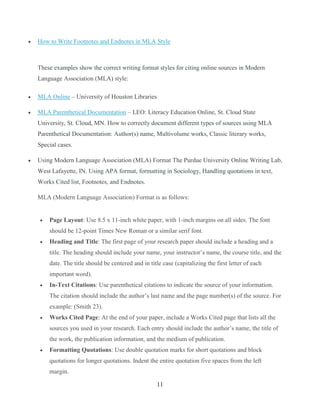
 How to Write Footnotes and Endnotes in MLA Style
These examples show the correct writing format styles for citing online sources in Modern
Language Association (MLA) style:
 MLA Online – University of Houston Libraries
 MLA Parenthetical Documentation – LEO: Literacy Education Online, St. Cloud State
University, St. Cloud, MN. How to correctly document different types of sources using MLA
Parenthetical Documentation: Author(s) name, Multivolume works, Classic literary works,
Special cases.
 Using Modern Language Association (MLA) Format The Purdue University Online Writing Lab,
West Lafayette, IN. Using APA format, formatting in Sociology, Handling quotations in text,
Works Cited list, Footnotes, and Endnotes.
MLA (Modern Language Association) Format is as follows:
 Page Layout: Use 8.5 x 11-inch white paper, with 1-inch margins on all sides. The font
should be 12-point Times New Roman or a similar serif font.
 Heading and Title: The first page of your research paper should include a heading and a
title. The heading should include your name, your instructor’s name, the course title, and the
date. The title should be centered and in title case (capitalizing the first letter of each
important word).
 In-Text Citations: Use parenthetical citations to indicate the source of your information.
The citation should include the author’s last name and the page number(s) of the source. For
example: (Smith 23).
 Works Cited Page: At the end of your paper, include a Works Cited page that lists all the
sources you used in your research. Each entry should include the author’s name, the title of
the work, the publication information, and the medium of publication.
 Formatting Quotations: Use double quotation marks for short quotations and block
quotations for longer quotations. Indent the entire quotation five spaces from the left
margin.
12
 Formatting the Body: Use a clear and readable font and double-space your text throughout.
The first line of each paragraph should be indented one-half inch from the left margin.
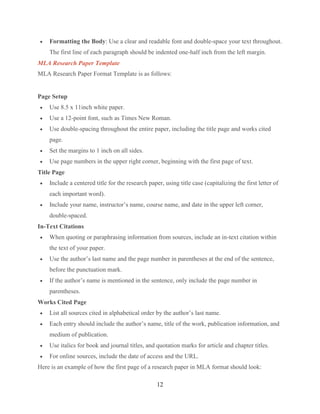
MLA Research Paper Template
MLA Research Paper Format Template is as follows:
Page Setup
 Use 8.5 x 11inch white paper.
 Use a 12-point font, such as Times New Roman.
 Use double-spacing throughout the entire paper, including the title page and works cited
page.
 Set the margins to 1 inch on all sides.
 Use page numbers in the upper right corner, beginning with the first page of text.
Title Page
 Include a centered title for the research paper, using title case (capitalizing the first letter of
each important word).
 Include your name, instructor’s name, course name, and date in the upper left corner,
double-spaced.
In-Text Citations
 When quoting or paraphrasing information from sources, include an in-text citation within
the text of your paper.
 Use the author’s last name and the page number in parentheses at the end of the sentence,
before the punctuation mark.
 If the author’s name is mentioned in the sentence, only include the page number in
parentheses.
Works Cited Page
 List all sources cited in alphabetical order by the author’s last name.
 Each entry should include the author’s name, title of the work, publication information, and
medium of publication.
 Use italics for book and journal titles, and quotation marks for article and chapter titles.
 For online sources, include the date of access and the URL.
Here is an example of how the first page of a research paper in MLA format should look:
13
[Your Name] [Instructor’s Name] [Course Name] [Date] [Title in Title Case] [Text of your
research paper begins here…]
Headings and Subheadings
 Use headings and subheadings to organize your paper and make it easier to read.
 Use numerals to number your headings and subheadings (e.g. 1, 2, 3), and capitalize the first
letter of each word.
 The main heading should be centered and in boldface type, while subheadings should be
left-aligned and in italics.
 Use only one space after each period or punctuation mark.
Quotations
 Use quotation marks to indicate direct quotes from a source.
 If the quote is more than four lines, format it as a block quote, indented one inch from the
left margin and without quotation marks.
 Use ellipses (…) to indicate omitted words from a quote, and brackets ([…]) to indicate
added words.
Works Cited Examples
 Book: Last Name, First Name. Title of Book. Publisher, Publication Year.
 Journal Article: Last Name, First Name. “Title of Article.” Title of Journal, volume number,
issue number, publication date, page numbers.
 Website: Last Name, First Name. “Title of Webpage.” Title of Website, publication date,
URL. Accessed date.
Here is an example of how a works cited entry for a book should look:
Smith, John. The Art of Writing Research Papers. Penguin, 2021.
3. Chicago Manual of Style:
 This format is used in a variety of disciplines and provides two distinct citation styles:
one for humanities and one for sciences.
 Chicago Style and Turabian research formats are also similar. They are designed to be
used, first of all, in history and economics. Turabian Style is basically a modification of
the Chicago Style for student needs. It is used in history, literature, arts, scientific field,
and natural and social sciences. The Turabian format guide includes the notes,
bibliography style, and author-date research format.
14
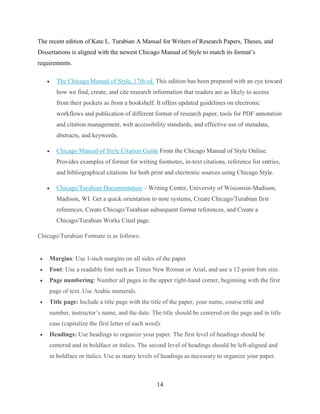
The recent edition of Kate L. Turabian A Manual for Writers of Research Papers, Theses, and
Dissertations is aligned with the newest Chicago Manual of Style to match its format’s
requirements.
 The Chicago Manual of Style, 17th ed. This edition has been prepared with an eye toward
how we find, create, and cite research information that readers are as likely to access
from their pockets as from a bookshelf. It offers updated guidelines on electronic
workflows and publication of different format of research paper, tools for PDF annotation
and citation management, web accessibility standards, and effective use of metadata,
abstracts, and keywords.
 Chicago Manual of Style Citation Guide From the Chicago Manual of Style Online.
Provides examples of format for writing footnotes, in-text citations, reference list entries,
and bibliographical citations for both print and electronic sources using Chicago Style.
 Chicago/Turabian Documentation – Writing Center, University of Wisconsin-Madison,
Madison, WI. Get a quick orientation to note systems, Create Chicago/Turabian first
references, Create Chicago/Turabian subsequent format references, and Create a
Chicago/Turabian Works Cited page.
Chicago/Turabian Formate is as follows:
 Margins: Use 1-inch margins on all sides of the paper.
 Font: Use a readable font such as Times New Roman or Arial, and use a 12-point font size.
 Page numbering: Number all pages in the upper right-hand corner, beginning with the first
page of text. Use Arabic numerals.
 Title page: Include a title page with the title of the paper, your name, course title and
number, instructor’s name, and the date. The title should be centered on the page and in title
case (capitalize the first letter of each word).
 Headings: Use headings to organize your paper. The first level of headings should be
centered and in boldface or italics. The second level of headings should be left-aligned and
in boldface or italics. Use as many levels of headings as necessary to organize your paper.
15
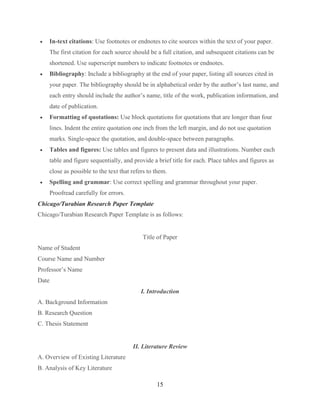
 In-text citations: Use footnotes or endnotes to cite sources within the text of your paper.
The first citation for each source should be a full citation, and subsequent citations can be
shortened. Use superscript numbers to indicate footnotes or endnotes.
 Bibliography: Include a bibliography at the end of your paper, listing all sources cited in
your paper. The bibliography should be in alphabetical order by the author’s last name, and
each entry should include the author’s name, title of the work, publication information, and
date of publication.
 Formatting of quotations: Use block quotations for quotations that are longer than four
lines. Indent the entire quotation one inch from the left margin, and do not use quotation
marks. Single-space the quotation, and double-space between paragraphs.
 Tables and figures: Use tables and figures to present data and illustrations. Number each
table and figure sequentially, and provide a brief title for each. Place tables and figures as
close as possible to the text that refers to them.
 Spelling and grammar: Use correct spelling and grammar throughout your paper.
Proofread carefully for errors.
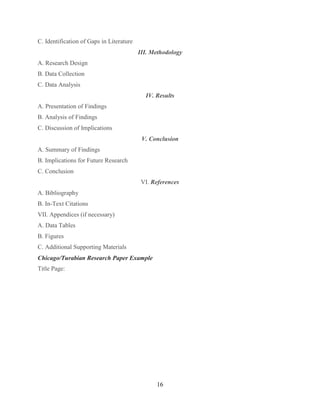
Chicago/Turabian Research Paper Template
Chicago/Turabian Research Paper Template is as follows:
Title of Paper
Name of Student
Course Name and Number
Professor’s Name
Date
I. Introduction
A. Background Information
B. Research Question
C. Thesis Statement
II. Literature Review
A. Overview of Existing Literature
B. Analysis of Key Literature
16
C. Identification of Gaps in Literature
III. Methodology
A. Research Design
B. Data Collection
C. Data Analysis
IV. Results
A. Presentation of Findings
B. Analysis of Findings
C. Discussion of Implications
V. Conclusion
A. Summary of Findings
B. Implications for Future Research
C. Conclusion
VI. References
A. Bibliography
B. In-Text Citations
VII. Appendices (if necessary)
A. Data Tables
B. Figures
C. Additional Supporting Materials
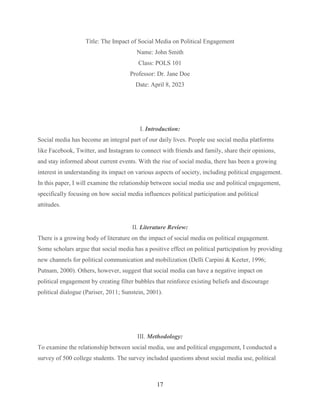
Chicago/Turabian Research Paper Example
Title Page:
17
Title: The Impact of Social Media on Political Engagement
Name: John Smith
Class: POLS 101
Professor: Dr. Jane Doe
Date: April 8, 2023
I. Introduction:
Social media has become an integral part of our daily lives. People use social media platforms
like Facebook, Twitter, and Instagram to connect with friends and family, share their opinions,
and stay informed about current events. With the rise of social media, there has been a growing
interest in understanding its impact on various aspects of society, including political engagement.
In this paper, I will examine the relationship between social media use and political engagement,
specifically focusing on how social media influences political participation and political
attitudes.
II. Literature Review:
There is a growing body of literature on the impact of social media on political engagement.
Some scholars argue that social media has a positive effect on political participation by providing
new channels for political communication and mobilization (Delli Carpini & Keeter, 1996;
Putnam, 2000). Others, however, suggest that social media can have a negative impact on
political engagement by creating filter bubbles that reinforce existing beliefs and discourage
political dialogue (Pariser, 2011; Sunstein, 2001).
III. Methodology:
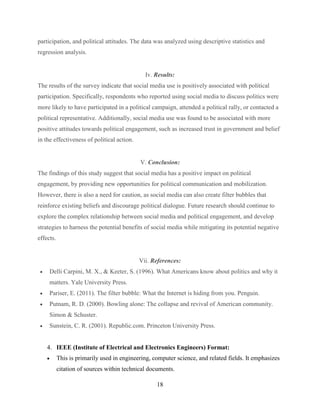
To examine the relationship between social media, use and political engagement, I conducted a
survey of 500 college students. The survey included questions about social media use, political
18
participation, and political attitudes. The data was analyzed using descriptive statistics and
regression analysis.
Iv. Results:
The results of the survey indicate that social media use is positively associated with political
participation. Specifically, respondents who reported using social media to discuss politics were
more likely to have participated in a political campaign, attended a political rally, or contacted a
political representative. Additionally, social media use was found to be associated with more
positive attitudes towards political engagement, such as increased trust in government and belief
in the effectiveness of political action.
V. Conclusion:
The findings of this study suggest that social media has a positive impact on political
engagement, by providing new opportunities for political communication and mobilization.
However, there is also a need for caution, as social media can also create filter bubbles that
reinforce existing beliefs and discourage political dialogue. Future research should continue to
explore the complex relationship between social media and political engagement, and develop
strategies to harness the potential benefits of social media while mitigating its potential negative
effects.
Vii. References:
 Delli Carpini, M. X., & Keeter, S. (1996). What Americans know about politics and why it
matters. Yale University Press.
 Pariser, E. (2011). The filter bubble: What the Internet is hiding from you. Penguin.
 Putnam, R. D. (2000). Bowling alone: The collapse and revival of American community.
Simon & Schuster.
 Sunstein, C. R. (2001). Republic.com. Princeton University Press.
4. IEEE (Institute of Electrical and Electronics Engineers) Format:
 This is primarily used in engineering, computer science, and related fields. It emphasizes
citation of sources within technical documents.
19
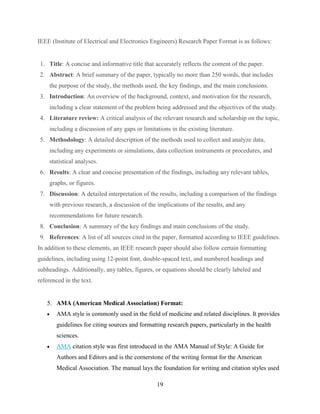
IEEE (Institute of Electrical and Electronics Engineers) Research Paper Format is as follows:
1. Title: A concise and informative title that accurately reflects the content of the paper.
2. Abstract: A brief summary of the paper, typically no more than 250 words, that includes
the purpose of the study, the methods used, the key findings, and the main conclusions.
3. Introduction: An overview of the background, context, and motivation for the research,
including a clear statement of the problem being addressed and the objectives of the study.
4. Literature review: A critical analysis of the relevant research and scholarship on the topic,
including a discussion of any gaps or limitations in the existing literature.
5. Methodology: A detailed description of the methods used to collect and analyze data,
including any experiments or simulations, data collection instruments or procedures, and
statistical analyses.
6. Results: A clear and concise presentation of the findings, including any relevant tables,
graphs, or figures.
7. Discussion: A detailed interpretation of the results, including a comparison of the findings
with previous research, a discussion of the implications of the results, and any
recommendations for future research.
8. Conclusion: A summary of the key findings and main conclusions of the study.
9. References: A list of all sources cited in the paper, formatted according to IEEE guidelines.
In addition to these elements, an IEEE research paper should also follow certain formatting
guidelines, including using 12-point font, double-spaced text, and numbered headings and
subheadings. Additionally, any tables, figures, or equations should be clearly labeled and
referenced in the text.
5. AMA (American Medical Association) Format:
 AMA style is commonly used in the field of medicine and related disciplines. It provides
guidelines for citing sources and formatting research papers, particularly in the health
sciences.
 AMA citation style was first introduced in the AMA Manual of Style: A Guide for
Authors and Editors and is the cornerstone of the writing format for the American
Medical Association. The manual lays the foundation for writing and citation styles used
20
by the medical and research communities. The most recent edition was updated and
includes additions such as the correct citation format of online blogs, quizzes, and regular
tips from the editors.
AMA MANUAL OF STYLE: A GUIDE FOR AUTHORS AND EDITORS 11TH EDITION
This book is a must-have resource for anyone involved in medical, health, and scientific
publishing. An expert committee of JAMA editors wrote it and addresses issues that authors,
editors, and publishers face in the digital age.
AMA STYLE – OWL – PURDUE UNIVERSITY
This resource discusses references page formatting for AMA style sheets, including templates
and research style example.
 AMA Manual of Style Citation Guide by Library of Ohio State University.
 St. Catherine University Libraries provide AMA Citation Style Quick Guide. This
handout serves as a quick reference to using the American Medical Association style for
citing common information sources.
AMA (American Medical Association) Style Research Paper Format:
1. Title Page: This page includes the title of the paper, the author’s name, institutional
affiliation, and any acknowledgments or disclaimers.
2. Abstract: The abstract is a brief summary of the paper that outlines the purpose, methods,
results, and conclusions of the study. It is typically limited to 250 words or less.
3. Introduction: The introduction provides a background of the research problem, defines the
research question, and outlines the objectives and hypotheses of the study.
4. Methods: The methods section describes the research design, participants, procedures, and
instruments used to collect and analyze data.
5. Results: The results section presents the findings of the study in a clear and concise manner,
using graphs, tables, and charts where appropriate.
6. Discussion: The discussion section interprets the results, explains their significance, and
relates them to previous research in the field.
21
7. Conclusion: The conclusion summarizes the main points of the paper, discusses the
implications of the findings, and suggests future research directions.
8. References: The reference list includes all sources cited in the paper, listed in alphabetical
order by author’s last name.
In addition to these sections, the AMA format requires that authors follow specific guidelines for
citing sources in the text and formatting their references. The AMA style uses a superscript
number system for in-text citations and provides specific formats for different types of sources,
such as books, journal articles, and websites.
6. Turabian Style:
 Similar to Chicago style, Turabian is often used in history and some other humanities
fields. It's a simpler version of Chicago style and is often used by students.
7. Harvard Style:
 This is a generic author-date citation style that can be used across various disciplines. It
focuses on in-text citations and the reference list.
Harvard citation style is quite similar to the APA format in terms of use. It is used mostly in
research in the humanities field. While APA is common in the USA, Harvard Style is popular in
the UK and Australia.
 The Bluebook: A Uniform System of Citation, aka “Harvard Citator,” published by
Harvard Law Review Association in conjunction with Columbia Law Review, University
of Pennsylvania Law Review, and Yale Law Journal 2019 edition
 Interactive Citation Workbook for The Bluebook: A Uniform System of Citation and
ALWD Citation Manual by Tracy L. McGaugh (Book)
 Reference Styles & Essay Writing Guide King’s College, London. Essay Writing,
Locating Information – Effective Reading, Selecting Information – Note Taking,
Bibliographies, Examples of Bibliographic Entries, Points to Remember, and Textual
References or Citations (including Parenthetical Reference examples).
Harvard Style Research Paper format is as follows:
22
 Title page: This should include the title of your paper, your name, the name of your
institution, and the date of submission.
 Abstract: This is a brief summary of your paper, usually no more than 250 words. It should
outline the main points of your research and highlight your findings.
 Introduction: This section should introduce your research topic, provide background
information, and outline your research question or thesis statement.
 Literature review: This section should review the relevant literature on your topic,
including previous research studies, academic articles, and other sources.
 Methodology: This section should describe the methods you used to conduct your research,
including any data collection methods, research instruments, and sampling techniques.
 Results: This section should present your findings in a clear and concise manner, using
tables, graphs, and other visual aids if necessary.
 Discussion: This section should interpret your findings and relate them to the broader
research question or thesis statement. You should also discuss the implications of your
research and suggest areas for future study.
 Conclusion: This section should summarize your main findings and provide a final
statement on the significance of your research.
 References: This is a list of all the sources you cited in your paper, presented in alphabetical
order by author name. Each citation should include the author’s name, the title of the source,
the publication date, and other relevant information.
In addition to these sections, a Harvard Style research paper may also include a table of contents,
appendices, and other supplementary materials as needed. It is important to follow the specific
formatting guidelines provided by your instructor or academic institution when preparing your
research paper in Harvard Style.
8. Vancouver Style:
 Commonly used in biomedical and scientific research, the Vancouver style emphasizes
numerical citations in the order they appear in the text.
Vancouver Style Research Paper format is as follows:
23
The Vancouver citation style is commonly used in the biomedical sciences and is known for its
use of numbered references. Here is a basic format for a research paper using the Vancouver
citation style:
 Title page: Include the title of your paper, your name, the name of your institution, and the
date.
 Abstract: This is a brief summary of your research paper, usually no more than 250 words.
 Introduction: Provide some background information on your topic and state the purpose of
your research.
 Methods: Describe the methods you used to conduct your research, including the study
design, data collection, and statistical analysis.
 Results: Present your findings in a clear and concise manner, using tables and figures as
needed.
 Discussion: Interpret your results and explain their significance. Also, discuss any
limitations of your study and suggest directions for future research.
 References: List all of the sources you cited in your paper in numerical order. Each
reference should include the author’s name, the title of the article or book, the name of the
journal or publisher, the year of publication, and the page numbers.
9. ACS (American Chemical Society) Style:
 Used in the field of chemistry, ACS style provides guidelines for citing sources and
formatting research papers.
ACS (American Chemical Society) Style Research Paper format is as follows:
The American Chemical Society (ACS) Style is a citation style commonly used in chemistry and
related fields. When formatting a research paper in ACS Style, here are some guidelines to
follow:
 Paper Size and Margins: Use standard 8.5″ x 11″ paper with 1-inch margins on all sides.
24
 Font: Use a 12-point serif font (such as Times New Roman) for the main text. The title
should be in bold and a larger font size.
 Title Page: The title page should include the title of the paper, the authors’ names and
affiliations, and the date of submission. The title should be centered on the page and written
in bold font. The authors’ names should be centered below the title, followed by their
affiliations and the date.
 Abstract: The abstract should be a brief summary of the paper, no more than 250 words. It
should be on a separate page and include the title of the paper, the authors’ names and
affiliations, and the text of the abstract.
 Main Text: The main text should be organized into sections with headings that clearly
indicate the content of each section. The introduction should provide background
information and state the research question or hypothesis. The methods section should
describe the procedures used in the study. The results section should present the findings of
the study, and the discussion section should interpret the results and provide conclusions.
 References: Use the ACS Style guide to format the references cited in the paper. In-text
citations should be numbered sequentially throughout the text and listed in numerical order
at the end of the paper.
 Figures and Tables: Figures and tables should be numbered sequentially and referenced in
the text. Each should have a descriptive caption that explains its content. Figures should be
submitted in a high-quality electronic format.
 Supporting Information: Additional information such as data, graphs, and videos may be
included as supporting information. This should be included in a separate file and referenced
in the main text.
 Acknowledgments: Acknowledge any funding sources or individuals who contributed to
the research.
10. APA-N (APA for Nursing):
 An adaptation of APA style specifically for nursing and healthcare-related research.
APA format includes the following:
 Title page with running head and page numbers
 Lines are double-spaced
 1-inch margins on all sides
25
 Times New Roman 12-point font
 Headings (per instructor guidelines)
 Citations
 Reference page
How do we document sources used?
Citations are needed for both paraphrasing and using quotations. A references page should
include complete information about each source used in your citations.
How do you use citations when paraphrasing?
Paraphrasing is using the author’s ideas in the student’s words. You do not add any new ideas. If
the author states, “The grass is green,” you might paraphrase by writing either of the following:
Green is the color of the grass (Author surname, year).
According to Author (year), green is the color of the grass.
Make sure to pay attention to punctuation – it’s very important in APA style!
How do you cite a quote?
Quoting is using the author’s ideas and exact words. Do not add or change words. For the
quotation, “The grass is green,” you might cite this quotation in either of the following formats:
According to Author surname (year), “the grass is green” (p. xx).
“The grass is green” (Author surname, year, p. xx).
What does a reference page look like?
A few things to keep in mind: A reference page should be double-spaced with no added spaces
between lines and in alphabetical order, based on the first author of each source. The second line
of each reference should be indented.
11. Legal Citation Styles:
 Fields such as law and political science use specific citation styles like Bluebook for legal
documents and APA for legal research.
 Legal citation styles are used primarily in the field of law to cite sources and provide
references in legal documents, court cases, legal research, and academic writing. The
choice of a legal citation style often depends on the jurisdiction and specific requirements
26
of the court or publication. Two of the most widely used legal citation styles in the
United States Are the Bluebook and the ALWD (Association of Legal Writing Directors)
Citation Manual. Here's an overview of each:
1. The Bluebook: A Uniform System of Citation:
 Description: The Bluebook is one of the most well-known and widely used legal citation
manuals in the United States. It provides detailed guidelines for citing legal documents,
court cases, statutes, regulations, and secondary sources.
 Usage: The Bluebook is commonly used in law schools, legal practice, and legal
research. It's especially prevalent in U.S. federal and state courts.
 Key Features: The Bluebook covers citation formats for various types of legal sources,
including cases, statutes, administrative codes, secondary sources, court rules, and more.
It also provides rules for abbreviating case names, citing international legal materials, and
formatting legal memoranda.
2. ALWD (Association of Legal Writing Directors) Citation Manual:
 Description: The ALWD Citation Manual is another widely recognized legal citation
guide. It was created as an alternative to The Bluebook and aims to simplify and
standardize legal citation rules.
 Usage: ALWD is used in some law schools and legal writing programs, as well as by
some legal publishers. While it's less common than The Bluebook, it has gained
popularity as a user-friendly alternative.
 Key Features: ALWD offers a simpler and more streamlined approach to legal citation. It
covers the citation of cases, statutes, regulations, and various legal documents. ALWD
also includes guidelines for citing electronic sources, court rules, and legal memoranda.
It's important to note that the choice between The Bluebook and ALWD often depends on
institutional preferences, court rules, and individual preferences of legal writers. Additionally,
some jurisdictions may have their own specific citation rules and requirements.
 For more detailed guidance on legal citation styles and to ensure compliance with the
appropriate style, it's recommended to consult the most recent editions of The Bluebook
or the ALWD Citation Manual. Legal professionals, law students, and legal researchers
should also check for any local or jurisdiction-specific citation rules when drafting legal
documents or conducting legal research.
27
12. AMA-N (AMA for Nursing):
 An adaptation of AMA style tailored for nursing and healthcare research.
General Format
 Margins are 1 inch on all sides throughout.
 Paper is double spaced throughout, including the title page, block quotes, and references.
 Use the serif typeface Times New Roman or Arial.
 Use a 12pt font size throughout.
 Pages are numbered consecutively, right aligned in the header, starting on the first page
of text. Exclude the title page and, if required, the abstract page.
Title Page
 All text is center aligned and double spaced.
 Full title of the paper begins a quarter down the page.
 Authors' full name(s) including middle initials.
 Couse Number - Course Name
 Assignment: Assignment Name if required
 Affiliated institution
Abstract (If Required by Instructor)
 Separate page after the title page.
 Abstract is the section title, it is left aligned and not indented.
 Text is in a block under the section title, it is not indented.
 Maximum 500 words.
 Does not include quotations or reference citations.
 Keywords (if required) are under the abstract with the first line indented, and the word
Keywords in italics followed by a colon.
o Keywords:
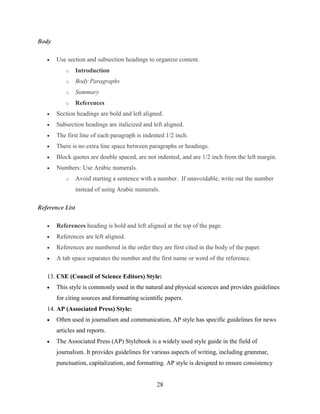
28
Body
 Use section and subsection headings to organize content.
o Introduction
o Body Paragraphs
o Summary
o References
 Section headings are bold and left aligned.
 Subsection headings are italicized and left aligned.
 The first line of each paragraph is indented 1/2 inch.
 There is no extra line space between paragraphs or headings.
 Block quotes are double spaced, are not indented, and are 1/2 inch from the left margin.
 Numbers: Use Arabic numerals.
o Avoid starting a sentence with a number. If unavoidable, write out the number
instead of using Arabic numerals.
Reference List
 References heading is bold and left aligned at the top of the page.
 References are left aligned.
 References are numbered in the order they are first cited in the body of the paper.
 A tab space separates the number and the first name or word of the reference.
13. CSE (Council of Science Editors) Style:
 This style is commonly used in the natural and physical sciences and provides guidelines
for citing sources and formatting scientific papers.
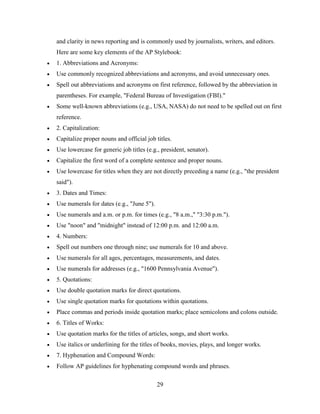
14. AP (Associated Press) Style:
 Often used in journalism and communication, AP style has specific guidelines for news
articles and reports.
 The Associated Press (AP) Stylebook is a widely used style guide in the field of
journalism. It provides guidelines for various aspects of writing, including grammar,
punctuation, capitalization, and formatting. AP style is designed to ensure consistency
29
and clarity in news reporting and is commonly used by journalists, writers, and editors.
Here are some key elements of the AP Stylebook:
 1. Abbreviations and Acronyms:
 Use commonly recognized abbreviations and acronyms, and avoid unnecessary ones.
 Spell out abbreviations and acronyms on first reference, followed by the abbreviation in
parentheses. For example, "Federal Bureau of Investigation (FBI)."
 Some well-known abbreviations (e.g., USA, NASA) do not need to be spelled out on first
reference.
 2. Capitalization:
 Capitalize proper nouns and official job titles.
 Use lowercase for generic job titles (e.g., president, senator).
 Capitalize the first word of a complete sentence and proper nouns.
 Use lowercase for titles when they are not directly preceding a name (e.g., "the president
said").
 3. Dates and Times:
 Use numerals for dates (e.g., "June 5").
 Use numerals and a.m. or p.m. for times (e.g., "8 a.m.," "3:30 p.m.").
 Use "noon" and "midnight" instead of 12:00 p.m. and 12:00 a.m.
 4. Numbers:
 Spell out numbers one through nine; use numerals for 10 and above.
 Use numerals for all ages, percentages, measurements, and dates.
 Use numerals for addresses (e.g., "1600 Pennsylvania Avenue").
 5. Quotations:
 Use double quotation marks for direct quotations.
 Use single quotation marks for quotations within quotations.
 Place commas and periods inside quotation marks; place semicolons and colons outside.
 6. Titles of Works:
 Use quotation marks for the titles of articles, songs, and short works.
 Use italics or underlining for the titles of books, movies, plays, and longer works.
 7. Hyphenation and Compound Words:
 Follow AP guidelines for hyphenating compound words and phrases.
30
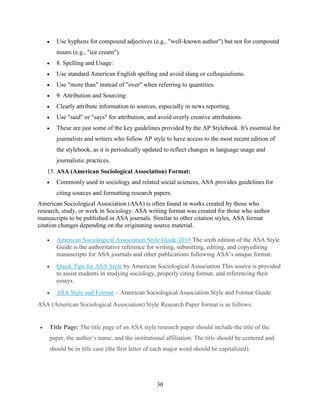
 Use hyphens for compound adjectives (e.g., "well-known author") but not for compound
nouns (e.g., "ice cream").
 8. Spelling and Usage:
 Use standard American English spelling and avoid slang or colloquialisms.
 Use "more than" instead of "over" when referring to quantities.
 9. Attribution and Sourcing:
 Clearly attribute information to sources, especially in news reporting.
 Use "said" or "says" for attribution, and avoid overly creative attributions.
 These are just some of the key guidelines provided by the AP Stylebook. It's essential for
journalists and writers who follow AP style to have access to the most recent edition of
the stylebook, as it is periodically updated to reflect changes in language usage and
journalistic practices.
15. ASA (American Sociological Association) Format:
 Commonly used in sociology and related social sciences, ASA provides guidelines for
citing sources and formatting research papers.
American Sociological Association (ASA) is often found in works created by those who
research, study, or work in Sociology. ASA writing format was created for those who author
manuscripts to be published in ASA journals. Similar to other citation styles, ASA format
citation changes depending on the originating source material.
 American Sociological Association Style Guide 2019 The sixth edition of the ASA Style
Guide is the authoritative reference for writing, submitting, editing, and copyediting
manuscripts for ASA journals and other publications following ASA’s unique format.
 Quick Tips for ASA Style by American Sociological Association This source is provided
to assist students in studying sociology, properly citing format, and referencing their
essays.
 ASA Style and Format – American Sociological Association Style and Format Guide.
ASA (American Sociological Association) Style Research Paper format is as follows:
 Title Page: The title page of an ASA style research paper should include the title of the
paper, the author’s name, and the institutional affiliation. The title should be centered and
should be in title case (the first letter of each major word should be capitalized).
31
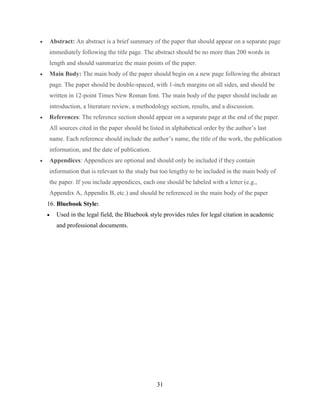
 Abstract: An abstract is a brief summary of the paper that should appear on a separate page
immediately following the title page. The abstract should be no more than 200 words in
length and should summarize the main points of the paper.
 Main Body: The main body of the paper should begin on a new page following the abstract
page. The paper should be double-spaced, with 1-inch margins on all sides, and should be
written in 12-point Times New Roman font. The main body of the paper should include an
introduction, a literature review, a methodology section, results, and a discussion.
 References: The reference section should appear on a separate page at the end of the paper.
All sources cited in the paper should be listed in alphabetical order by the author’s last
name. Each reference should include the author’s name, the title of the work, the publication
information, and the date of publication.
 Appendices: Appendices are optional and should only be included if they contain
information that is relevant to the study but too lengthy to be included in the main body of
the paper. If you include appendices, each one should be labeled with a letter (e.g.,
Appendix A, Appendix B, etc.) and should be referenced in the main body of the paper
16. Bluebook Style:
 Used in the legal field, the Bluebook style provides rules for legal citation in academic
and professional documents.
32
REFERENCES
https://www.aresearchguide.com/styles-formats-research-paper.html
https://www.aresearchguide.com/4format.html
https://researchmethod.net/research-paper-format/
https://dovetail.com/research/research-paper-
format/#:~:text=Formatting%20a%20research%20paper%3A%20MLA,may%20apply%20to%2
0particular%20fields.
https://www.sunyempire.edu/online-writing-support/resources/research/research-paper/
https://www.chamberlain.edu/blog/how-to-use-apa-format-a-nursing-student-s-guide
https://owl.purdue.edu/owl/research_and_citation/ama_style/index.html
https://library.south.edu/c.php?g=1025656&p=8087032
https://irsc.libguides.com/c.php?g=146552&p=962531
https://guides.lib.uw.edu/research/citations/cse-
style#:~:text=What%20is%20CSE%20Style%3F,paper%20with%20complete%20source%20inf
ormation.

RSW01-RM_aaaaaaaaaaaaaaaaaaaaaaaaaaa.pdf

  • 1.
    URDANETACITYUNIVERSITY COLLEGE OF ENGINEERINGAND ARCHITECTURE Q044-ARCH 415 RESEARCH METHODS IN ARCHITECTURE Requirement No.: RSW N0.1 Requirement Title: DIFFERENT KINDS OF FORMAT IN RESEARCH WRITING Date Due: September 22, 2023 Submitted by: Name: Lawrenz Dave Aquino Student No.: 20200733 Submitted to: Arch’t. Maria Teresa Cuares-Velasco, MA EHURP CEA- Instructor
  • 2.
    i Page COVER PAGE - TABLEOF CONTENTS i Questions 1 Introduction about Research 1-2 2 The Essential Building Blocks of Research Writing 2 3 What Is a Writing Style, and Which Formats Could You Use? 3 4 Why Do You Need to Choose the Right Research Paper Style? 4-5 5 Advice for Writing and Formatting 5-7 6 DIFFERENT KINDS OF FORMAT IN RESEARCH WRITING 7-31 References 32
  • 3.
    1 DIFFERENT KINDS OFFORMAT IN RESEARCH WRITING INTRODUCTION What is Research Writing - Research writing is a form of academic and professional writing that involves conducting an in-depth investigation into a particular topic or question and presenting the findings in a structured and coherent manner. It is a systematic and organized process of gathering, analyzing, and interpreting information from various sources to contribute new knowledge, insights, or solutions to a specific field of study or area of interest. Key characteristics of research writing include: Research Question or Hypothesis: Research begins with a clear and well-defined question or hypothesis that the writer intends to explore or test. This question guides the entire research process. Data Collection: Researchers gather relevant data and information through various methods, such as experiments, surveys, interviews, observations, literature reviews, or archival research. Analysis: Data collected is analyzed and interpreted to draw meaningful conclusions. This often involves statistical analysis, qualitative analysis, or other methods depending on the nature of the research. Citation of Sources: Research writers must give proper credit to the sources they consult by citing them accurately. This is crucial to avoid plagiarism and to provide credibility to the work. Structured Format: Research papers typically follow a specific structure, including an introduction, literature review, methodology, results, discussion, and conclusion. The format may vary depending on the style guide or academic discipline. Evidence-Based: Research writing relies on evidence and facts to support arguments and claims. It should be objective and impartial, drawing conclusions based on the data rather than personal opinions. Contributing to Knowledge: The ultimate goal of research writing is to contribute to the existing body of knowledge in a specific field. This can involve confirming, challenging, or expanding upon existing theories and ideas.
  • 4.
    2 Peer Review: Inacademia, research papers often undergo a peer-review process, where experts in the field evaluate the quality and validity of the research before it is published. Clarity and Precision: Research writing should be clear, concise, and precise. It should communicate complex ideas in a way that is understandable to the target audience. The Essential Building Blocks of Research Writing 1. Do real research 1. Begin from a question to which you don’t know the answer and that can’t be answered just by going to the appropriate reference source. That is, begin from a research question, not a homework question. 2. Decide what kind of information or data will be needed in order to build the answer to the question. 3. Gather information and/or collect data. 4. Work with the information/data to derive or construct your answer. This is the research process, and it happens before you begin to write your paper. No research, no research writing, so don’t shortchange this part of the process. 2. Create a one-sentence answer to your research question. 1. This will be the thesis statement/main point/controlling idea of your research paper. 3. Share your answer to research questions in a way that make it believable, understandable, and usable for your readers. To do this 1. Include plentiful and well-chosen examples from the data/information you gathered 2. Indicate the validity of your data by accurately reporting your research method (field or lab research) 3. Indicate the quality of your information by accurately citing your sources (source- based research) 4. Provide the reasoning and explanation that will let your readers completely understand how the evidence adds up to your answer.
  • 5.
    3 What Is aWriting Style, and Which Formats Could You Use? As a writer of academic papers, every student must document any source of information they use in their research papers, articles, presentations, and any kind of scientific project. If you properly document the original works of other authors on which you base your ideas, it allows the readers to see and consult the resources used. Accurate and proper quoting will help avoid plagiarism, considered a serious breach of academic conduct. There are 3 different writing formats for including other writers’ work in your paper. They are called citing or quoting, paraphrasing, and summarizing. 1. Citing. The purpose of the citing/quoting is that it should repeat the original text word- for-word and include a reference to the original writer of the source document. You should decide which approach to use when incorporating another author’s ideas into your text. You should use direct quotations during research when the exact wording of a passage is important to ensure you have reproduced the original accurately. You might also use citations if the original statement is well-formulated and you feel it will enrich your writing. 2. Paraphrasing in research is basically retelling a passage of the original text using your own words and sentence structures. The original author must also be referenced. Paraphrasing is widely used in research papers and argumentative essays, showing your supervisors you understand a source text and may reformulate it and find and emphasize its main points. It also helps change the stylistic characteristics of your source, adapting it to the readers (e.g., if you use it for a presentation of some scientific topic before your class) and omitting unnecessary details. 3. Summarizing in research means reproducing only the source’s most important ideas and main points in your own words. It usually summarizes a larger statement in the form of a shorter explanation. However, the original source must be referenced, too. The purpose of a summary is similar to that of a paraphrasing. Still, it helps to shorten a long text, explaining a lengthy chapter, article, or book in a brief essay or even a single paragraph.
  • 6.
    4 Why Do YouNeed to Choose the Right Research Paper Style? Each university has its own citation rules. Moreover, they may differ depending on the teacher or subject. Therefore, before writing each work, you must check with your teacher the citation type for a given paper. Each has its paper formatting styles and standards; you will see them in more detail later. The main thing to remember is that if you use some source, either quote or paraphrase, indicate the author. Otherwise, these thoughts can be assessed as plagiarism. What is Research Paper - A research paper is an expanded essay that presents your own interpretation or evaluation or argument. When you write an essay, you use everything that you personally know and have thought about a subject. When you write a research paper you build upon what you know about the subject and make a deliberate attempt to find out what experts know. A research paper involves surveying a field of knowledge in order to find the best possible information in that field. And that survey can be orderly and focused, if you know how to approach it. Research papers are essential in academia, the sciences, law, and other fields where you must share detailed information backed by solid research. Writing a research paper can be daunting if you’re not experienced with the process. Getting the proper format is one of the most challenging aspects of the task. Reviewers will immediately dismiss a paper that doesn't comply with standard formatting, regardless of the valuable content it contains. A research paper is a document that provides a thorough analysis of a topic, usually for an academic institution or professional organization. A research paper may be of any length, but they are typically 2,000–10,000 words. Unlike less formal papers, such as articles or essays, empirical evidence and data are key to research papers. In addition to students handing in papers, scientists, attorneys, medical researchers, and independent scholars may need to produce research papers.
  • 7.
    5 People typically writeresearch papers to prove a particular point or make an argument. This could support or disprove a theoretical point, legal case, scientific theory, or an existing piece of research on any topic. One of the distinguishing characteristics of research papers is that they contain citations to prior research. Citing sources using the correct format is essential for creating a legitimate research paper. Advice for Writing and Formatting When it comes to writing and learning how to do a research paper, there are no quick fixes or fill-in-the-blank templates that will allow you to complete your paper without investing a little time and effort. The key to any research style is learning to manage your time and effectively organize your source material. In the preceding paragraphs, you will find helpful information on how to write a good research paper. If you are looking for more detailed guidelines on writing a research paper, consult the books and manuals recommended further down in the article. DO NOT PROCRASTINATE; The key to any successful research paper is remembering to start as early as possible. If you are told early in the semester about a research essay deadline – don’t wait until the last moment to start. Take advantage of every day available to pick your topic (if one is not assigned), conduct your research, and develop your research paper outline format. If you are unsure how to start a research paper, ask for guidance or research ideas online. Remember, if you decide to wait until the paper is due to get started, you might have difficulty finding research material, or you may find that other students have already picked your preferred topic. Not to mention that a looming deadline and a lack of finished paper will ultimately result in unneeded stress. CHOOSE AN INTERESTING TOPIC; Next, you should select your topic and paper format unless the teacher has provided one. The best choice is to select a topic that interests you, even if it seems complex or difficult. By choosing to work with a topic you have even a small interest in, you are more likely to continue to be motivated to delve deeper into your research and will be able to engage more with your
  • 8.
    6 readers. That isdifficult to do when the subject matter is dry or mediocre. It will help add genuine value to your paper. Your readers may often feel if the topic was interesting to you. If it was, that may make the readers more interested and expecting to find something valuable in your paper and thus continue reading. Remember that there will be times when you will be assigned to unfamiliar topics. In such types of format in research, it is helpful to read up on the topic. Journals, encyclopedias, guidebooks, and libraries are all excellent resources for finding background material on almost every topic. DO PRELIMINARY RESEARCH; One of the most important things when learning how to write a paper is how to research for your paper. Despite the widespread access to information, largely attributed to easy Internet accessibility, there are just as many non-credible sources as credible ones. The trick is learning how to differentiate between the two. One way is to use only verified sources like trade publications, scholarly articles, journals, or books from the local library. CREATE AN OUTLINE; After you have concluded and organized your research, it’s time to create an outline and style of writing research report. The best way to start your outline is to draft your thesis statement. The thesis is often a single-sentence opener and the most important part of the entire paper. The thesis should present the main idea of your paper. It lays the groundwork for everything that follows and presents your argument to the reader. You should ensure it’s clear and concise. Next, you’ll group your research notes into sections that correlate with the various aspects of your topic or argument. You might rearrange these several times until you find a format that seems the most logical. PREPARE A DRAFT; After you’ve concluded your outline for your research paper, you begin to write your paper. The first draft is simply an opportunity to get your ideas out there, so don’t worry too much about grammar or syntax format – just focus on getting the words on the paper. You will proofread, edit and rewrite later. Your only concern is ensuring you have found the most logical progression
  • 9.
    7 for your argumentand the corresponding supporting material. Once you’ve finished your rough draft, read it to ensure it reads as you would like. If you are satisfied, begin to correct any grammatical, format, spelling, or punctuation errors you find and add text as needed. It might also be helpful to have someone else read your paper just to give it a fresh perspective. EDIT, PROOFREAD, AND FORMAT; If satisfied, open your word processor to a blank page and type up your final version. You will want to be mindful of any specific spacing or formatting rules in the assignment details and make certain you are creating any supplementary pages that might be necessary. For example, a cover page. Even if it has not been specifically requested to use different formats of writing, it is in good practice to always include a Works Cited or Reference page. This is where you list every source you’ve used in your research or cited in your paper to credit the originating author and satisfy anti-plagiarism policies and guidelines. This is the point where it is better to be safe than sorry. DIFFERENT KINDS OF FORMAT IN RESEARCH WRITING In research writing, there are several different formats and styles that researchers can use depending on the discipline, the specific requirements of the assignment, and the intended audience. Here are some of the most common formats: 1. APA (American Psychological Association) Format:  This is commonly used in the social sciences. It provides guidelines for formatting papers, citing sources, and creating reference lists. A particular research paper writing style can simplify the editors’ work because authors adhere to the same citation format. It also makes it easier for the audience to follow the author’s ideas because they are organized according to a familiar structure. Demonstrating that you know and follow the research style requirements of your field will also make your work more credible and trusted. APA Style is often used for citation, research, and formatting in social sciences (Psychology, Sociology, Linguistics, Economics, Criminology, Business, and Nursing). It also deals with the overall research paper styles, content organization, and preparation of a paper for publication.
  • 10.
    8 Thus, we recommendhaving a look at their manual as well as other online sources.  Publication Manual of the American Psychological Association – Get a quick orientation to APA, Create APA parenthetical citations, Create an APA reference list, Format a paper using APA guidelines, Format APA headings for a research paper, Review APA usage and research paper writing styles guidelines, and Locate other APA resources on the Web.  The Basics of APA Style – From APA Online, American Psychological Association, Washington, DC. A useful tutorial following the 6th Edition of APA’s Publication Manual, 2009. There are also some useful FAQs.  Understanding Electronic Sources from American Psychological Association (APA) – Excerpted from the new 6th edition of the APA Publication Manual. The sciences typically use APA format, including physical sciences such as physics and social sciences such as psychology. Simply Psychology provides examples of APA formatting. The following are the most important rules of the APA format.  Begin the paper with a title page, which is not required for MLA.  Use double-line spacing.  Indent new paragraphs 1/2 inch.  Use a running head for each page in the upper right-hand corner, which consists of the paper's title in capital letters followed by the page number.  The citations page at the end should be titled "References."  In-text citations should include the publication date: (Smith, 1999, p. 50). Note also that there's a "p" for "page," whereas in MLA, you write the page number without a "p."  As with MLA, use title case for headings, as in "Most Popular Treatments for Cognitive Disorders."  Use sentence case for titles of sources, as in "History of the decline and fall of the Roman empire." Note "Roman" starts with a capital because it's a proper noun.
  • 11.
    9  When citingin-text references, use the author's last name and the first and middle initials.  Always use the Oxford comma. This comma goes before the words "or" and "and" in a list. For example, "At the store, I bought oranges, paper towels, and pasta." Here is a general APA format for a research paper:  Title Page: The title page should include the title of your paper, your name, and your institutional affiliation. It should also include a running head, which is a shortened version of the title, and a page number in the upper right-hand corner.  Abstract: The abstract is a brief summary of your paper, typically 150-250 words. It should include the purpose of your research, the main findings, and any implications or conclusions that can be drawn.  Introduction: The introduction should provide background information on your topic, state the purpose of your research, and present your research question or hypothesis. It should also include a brief literature review that discusses previous research on your topic.  Methods: The methods section should describe the procedures you used to collect and analyze your data. It should include information on the participants, the materials and instruments used, and the statistical analyses performed.  Results: The results section should present the findings of your research in a clear and concise manner. Use tables and figures to help illustrate your results.  Discussion: The discussion section should interpret your results and relate them back to your research question or hypothesis. It should also discuss the implications of your findings and any limitations of your study.  References: The references section should include a list of all sources cited in your paper. Follow APA formatting guidelines for your citations and references. Some additional tips for formatting your APA research paper:  Use 12-point Times New Roman font throughout the paper.  Double-space all text, including the references.  Use 1-inch margins on all sides of the page.  Indent the first line of each paragraph by 0.5 inches.
  • 12.
    10  Use ahanging indent for the references (the first line should be flush with the left margin, and all subsequent lines should be indented).  Number all pages, including the title page and references page, in the upper right-hand corner. 2. MLA (Modern Language Association) Format:  MLA is often used in humanities fields such as literature and language. It specifies guidelines for citing sources and formatting papers. MLA Style of citation and research formatting is widely used in Art, Liberal Arts, and Humanities. Its approach is to give a writer a universal formatting tool that can be applied to various kinds of sources (citing different kinds of sources, like research papers, articles, essays, government publications, newspapers, manuscripts, maps, charts, spoken interviews, sound recordings, web sites, films and illustrations and more). With the development of the Internet, texts may be found online in any college writing formats, and new designs and presentation forms are invented. That is why MLA format offers a writer several general principles, finding them more important than a rigid set of rules for every particular source. Again, there are research manuals you can use:  The Modern Language Association has the authority on research and writing while documenting sources.  Citing Film and Video in a slightly adapted version of MLA style of research with examples.  Citing TV and Radio with research examples by Gary Handman, Media Resources Center, Library, University of California, Berkeley, CA. We have also prepared articles on particular subjects available on the AResearchGuide website:  Guidelines on How to Write a Bibliography in MLA Style  Works Cited, References, Bibliography – What’s the Difference?
  • 13.
    11  How toWrite Footnotes and Endnotes in MLA Style These examples show the correct writing format styles for citing online sources in Modern Language Association (MLA) style:  MLA Online – University of Houston Libraries  MLA Parenthetical Documentation – LEO: Literacy Education Online, St. Cloud State University, St. Cloud, MN. How to correctly document different types of sources using MLA Parenthetical Documentation: Author(s) name, Multivolume works, Classic literary works, Special cases.  Using Modern Language Association (MLA) Format The Purdue University Online Writing Lab, West Lafayette, IN. Using APA format, formatting in Sociology, Handling quotations in text, Works Cited list, Footnotes, and Endnotes. MLA (Modern Language Association) Format is as follows:  Page Layout: Use 8.5 x 11-inch white paper, with 1-inch margins on all sides. The font should be 12-point Times New Roman or a similar serif font.  Heading and Title: The first page of your research paper should include a heading and a title. The heading should include your name, your instructor’s name, the course title, and the date. The title should be centered and in title case (capitalizing the first letter of each important word).  In-Text Citations: Use parenthetical citations to indicate the source of your information. The citation should include the author’s last name and the page number(s) of the source. For example: (Smith 23).  Works Cited Page: At the end of your paper, include a Works Cited page that lists all the sources you used in your research. Each entry should include the author’s name, the title of the work, the publication information, and the medium of publication.  Formatting Quotations: Use double quotation marks for short quotations and block quotations for longer quotations. Indent the entire quotation five spaces from the left margin.
  • 14.
    12  Formatting theBody: Use a clear and readable font and double-space your text throughout. The first line of each paragraph should be indented one-half inch from the left margin. MLA Research Paper Template MLA Research Paper Format Template is as follows: Page Setup  Use 8.5 x 11inch white paper.  Use a 12-point font, such as Times New Roman.  Use double-spacing throughout the entire paper, including the title page and works cited page.  Set the margins to 1 inch on all sides.  Use page numbers in the upper right corner, beginning with the first page of text. Title Page  Include a centered title for the research paper, using title case (capitalizing the first letter of each important word).  Include your name, instructor’s name, course name, and date in the upper left corner, double-spaced. In-Text Citations  When quoting or paraphrasing information from sources, include an in-text citation within the text of your paper.  Use the author’s last name and the page number in parentheses at the end of the sentence, before the punctuation mark.  If the author’s name is mentioned in the sentence, only include the page number in parentheses. Works Cited Page  List all sources cited in alphabetical order by the author’s last name.  Each entry should include the author’s name, title of the work, publication information, and medium of publication.  Use italics for book and journal titles, and quotation marks for article and chapter titles.  For online sources, include the date of access and the URL. Here is an example of how the first page of a research paper in MLA format should look:
  • 15.
    13 [Your Name] [Instructor’sName] [Course Name] [Date] [Title in Title Case] [Text of your research paper begins here…] Headings and Subheadings  Use headings and subheadings to organize your paper and make it easier to read.  Use numerals to number your headings and subheadings (e.g. 1, 2, 3), and capitalize the first letter of each word.  The main heading should be centered and in boldface type, while subheadings should be left-aligned and in italics.  Use only one space after each period or punctuation mark. Quotations  Use quotation marks to indicate direct quotes from a source.  If the quote is more than four lines, format it as a block quote, indented one inch from the left margin and without quotation marks.  Use ellipses (…) to indicate omitted words from a quote, and brackets ([…]) to indicate added words. Works Cited Examples  Book: Last Name, First Name. Title of Book. Publisher, Publication Year.  Journal Article: Last Name, First Name. “Title of Article.” Title of Journal, volume number, issue number, publication date, page numbers.  Website: Last Name, First Name. “Title of Webpage.” Title of Website, publication date, URL. Accessed date. Here is an example of how a works cited entry for a book should look: Smith, John. The Art of Writing Research Papers. Penguin, 2021. 3. Chicago Manual of Style:  This format is used in a variety of disciplines and provides two distinct citation styles: one for humanities and one for sciences.  Chicago Style and Turabian research formats are also similar. They are designed to be used, first of all, in history and economics. Turabian Style is basically a modification of the Chicago Style for student needs. It is used in history, literature, arts, scientific field, and natural and social sciences. The Turabian format guide includes the notes, bibliography style, and author-date research format.
  • 16.
    14 The recent editionof Kate L. Turabian A Manual for Writers of Research Papers, Theses, and Dissertations is aligned with the newest Chicago Manual of Style to match its format’s requirements.  The Chicago Manual of Style, 17th ed. This edition has been prepared with an eye toward how we find, create, and cite research information that readers are as likely to access from their pockets as from a bookshelf. It offers updated guidelines on electronic workflows and publication of different format of research paper, tools for PDF annotation and citation management, web accessibility standards, and effective use of metadata, abstracts, and keywords.  Chicago Manual of Style Citation Guide From the Chicago Manual of Style Online. Provides examples of format for writing footnotes, in-text citations, reference list entries, and bibliographical citations for both print and electronic sources using Chicago Style.  Chicago/Turabian Documentation – Writing Center, University of Wisconsin-Madison, Madison, WI. Get a quick orientation to note systems, Create Chicago/Turabian first references, Create Chicago/Turabian subsequent format references, and Create a Chicago/Turabian Works Cited page. Chicago/Turabian Formate is as follows:  Margins: Use 1-inch margins on all sides of the paper.  Font: Use a readable font such as Times New Roman or Arial, and use a 12-point font size.  Page numbering: Number all pages in the upper right-hand corner, beginning with the first page of text. Use Arabic numerals.  Title page: Include a title page with the title of the paper, your name, course title and number, instructor’s name, and the date. The title should be centered on the page and in title case (capitalize the first letter of each word).  Headings: Use headings to organize your paper. The first level of headings should be centered and in boldface or italics. The second level of headings should be left-aligned and in boldface or italics. Use as many levels of headings as necessary to organize your paper.
  • 17.
    15  In-text citations:Use footnotes or endnotes to cite sources within the text of your paper. The first citation for each source should be a full citation, and subsequent citations can be shortened. Use superscript numbers to indicate footnotes or endnotes.  Bibliography: Include a bibliography at the end of your paper, listing all sources cited in your paper. The bibliography should be in alphabetical order by the author’s last name, and each entry should include the author’s name, title of the work, publication information, and date of publication.  Formatting of quotations: Use block quotations for quotations that are longer than four lines. Indent the entire quotation one inch from the left margin, and do not use quotation marks. Single-space the quotation, and double-space between paragraphs.  Tables and figures: Use tables and figures to present data and illustrations. Number each table and figure sequentially, and provide a brief title for each. Place tables and figures as close as possible to the text that refers to them.  Spelling and grammar: Use correct spelling and grammar throughout your paper. Proofread carefully for errors. Chicago/Turabian Research Paper Template Chicago/Turabian Research Paper Template is as follows: Title of Paper Name of Student Course Name and Number Professor’s Name Date I. Introduction A. Background Information B. Research Question C. Thesis Statement II. Literature Review A. Overview of Existing Literature B. Analysis of Key Literature
  • 18.
    16 C. Identification ofGaps in Literature III. Methodology A. Research Design B. Data Collection C. Data Analysis IV. Results A. Presentation of Findings B. Analysis of Findings C. Discussion of Implications V. Conclusion A. Summary of Findings B. Implications for Future Research C. Conclusion VI. References A. Bibliography B. In-Text Citations VII. Appendices (if necessary) A. Data Tables B. Figures C. Additional Supporting Materials Chicago/Turabian Research Paper Example Title Page:
  • 19.
    17 Title: The Impactof Social Media on Political Engagement Name: John Smith Class: POLS 101 Professor: Dr. Jane Doe Date: April 8, 2023 I. Introduction: Social media has become an integral part of our daily lives. People use social media platforms like Facebook, Twitter, and Instagram to connect with friends and family, share their opinions, and stay informed about current events. With the rise of social media, there has been a growing interest in understanding its impact on various aspects of society, including political engagement. In this paper, I will examine the relationship between social media use and political engagement, specifically focusing on how social media influences political participation and political attitudes. II. Literature Review: There is a growing body of literature on the impact of social media on political engagement. Some scholars argue that social media has a positive effect on political participation by providing new channels for political communication and mobilization (Delli Carpini & Keeter, 1996; Putnam, 2000). Others, however, suggest that social media can have a negative impact on political engagement by creating filter bubbles that reinforce existing beliefs and discourage political dialogue (Pariser, 2011; Sunstein, 2001). III. Methodology: To examine the relationship between social media, use and political engagement, I conducted a survey of 500 college students. The survey included questions about social media use, political
  • 20.
    18 participation, and politicalattitudes. The data was analyzed using descriptive statistics and regression analysis. Iv. Results: The results of the survey indicate that social media use is positively associated with political participation. Specifically, respondents who reported using social media to discuss politics were more likely to have participated in a political campaign, attended a political rally, or contacted a political representative. Additionally, social media use was found to be associated with more positive attitudes towards political engagement, such as increased trust in government and belief in the effectiveness of political action. V. Conclusion: The findings of this study suggest that social media has a positive impact on political engagement, by providing new opportunities for political communication and mobilization. However, there is also a need for caution, as social media can also create filter bubbles that reinforce existing beliefs and discourage political dialogue. Future research should continue to explore the complex relationship between social media and political engagement, and develop strategies to harness the potential benefits of social media while mitigating its potential negative effects. Vii. References:  Delli Carpini, M. X., & Keeter, S. (1996). What Americans know about politics and why it matters. Yale University Press.  Pariser, E. (2011). The filter bubble: What the Internet is hiding from you. Penguin.  Putnam, R. D. (2000). Bowling alone: The collapse and revival of American community. Simon & Schuster.  Sunstein, C. R. (2001). Republic.com. Princeton University Press. 4. IEEE (Institute of Electrical and Electronics Engineers) Format:  This is primarily used in engineering, computer science, and related fields. It emphasizes citation of sources within technical documents.
  • 21.
    19 IEEE (Institute ofElectrical and Electronics Engineers) Research Paper Format is as follows: 1. Title: A concise and informative title that accurately reflects the content of the paper. 2. Abstract: A brief summary of the paper, typically no more than 250 words, that includes the purpose of the study, the methods used, the key findings, and the main conclusions. 3. Introduction: An overview of the background, context, and motivation for the research, including a clear statement of the problem being addressed and the objectives of the study. 4. Literature review: A critical analysis of the relevant research and scholarship on the topic, including a discussion of any gaps or limitations in the existing literature. 5. Methodology: A detailed description of the methods used to collect and analyze data, including any experiments or simulations, data collection instruments or procedures, and statistical analyses. 6. Results: A clear and concise presentation of the findings, including any relevant tables, graphs, or figures. 7. Discussion: A detailed interpretation of the results, including a comparison of the findings with previous research, a discussion of the implications of the results, and any recommendations for future research. 8. Conclusion: A summary of the key findings and main conclusions of the study. 9. References: A list of all sources cited in the paper, formatted according to IEEE guidelines. In addition to these elements, an IEEE research paper should also follow certain formatting guidelines, including using 12-point font, double-spaced text, and numbered headings and subheadings. Additionally, any tables, figures, or equations should be clearly labeled and referenced in the text. 5. AMA (American Medical Association) Format:  AMA style is commonly used in the field of medicine and related disciplines. It provides guidelines for citing sources and formatting research papers, particularly in the health sciences.  AMA citation style was first introduced in the AMA Manual of Style: A Guide for Authors and Editors and is the cornerstone of the writing format for the American Medical Association. The manual lays the foundation for writing and citation styles used
  • 22.
    20 by the medicaland research communities. The most recent edition was updated and includes additions such as the correct citation format of online blogs, quizzes, and regular tips from the editors. AMA MANUAL OF STYLE: A GUIDE FOR AUTHORS AND EDITORS 11TH EDITION This book is a must-have resource for anyone involved in medical, health, and scientific publishing. An expert committee of JAMA editors wrote it and addresses issues that authors, editors, and publishers face in the digital age. AMA STYLE – OWL – PURDUE UNIVERSITY This resource discusses references page formatting for AMA style sheets, including templates and research style example.  AMA Manual of Style Citation Guide by Library of Ohio State University.  St. Catherine University Libraries provide AMA Citation Style Quick Guide. This handout serves as a quick reference to using the American Medical Association style for citing common information sources. AMA (American Medical Association) Style Research Paper Format: 1. Title Page: This page includes the title of the paper, the author’s name, institutional affiliation, and any acknowledgments or disclaimers. 2. Abstract: The abstract is a brief summary of the paper that outlines the purpose, methods, results, and conclusions of the study. It is typically limited to 250 words or less. 3. Introduction: The introduction provides a background of the research problem, defines the research question, and outlines the objectives and hypotheses of the study. 4. Methods: The methods section describes the research design, participants, procedures, and instruments used to collect and analyze data. 5. Results: The results section presents the findings of the study in a clear and concise manner, using graphs, tables, and charts where appropriate. 6. Discussion: The discussion section interprets the results, explains their significance, and relates them to previous research in the field.
  • 23.
    21 7. Conclusion: Theconclusion summarizes the main points of the paper, discusses the implications of the findings, and suggests future research directions. 8. References: The reference list includes all sources cited in the paper, listed in alphabetical order by author’s last name. In addition to these sections, the AMA format requires that authors follow specific guidelines for citing sources in the text and formatting their references. The AMA style uses a superscript number system for in-text citations and provides specific formats for different types of sources, such as books, journal articles, and websites. 6. Turabian Style:  Similar to Chicago style, Turabian is often used in history and some other humanities fields. It's a simpler version of Chicago style and is often used by students. 7. Harvard Style:  This is a generic author-date citation style that can be used across various disciplines. It focuses on in-text citations and the reference list. Harvard citation style is quite similar to the APA format in terms of use. It is used mostly in research in the humanities field. While APA is common in the USA, Harvard Style is popular in the UK and Australia.  The Bluebook: A Uniform System of Citation, aka “Harvard Citator,” published by Harvard Law Review Association in conjunction with Columbia Law Review, University of Pennsylvania Law Review, and Yale Law Journal 2019 edition  Interactive Citation Workbook for The Bluebook: A Uniform System of Citation and ALWD Citation Manual by Tracy L. McGaugh (Book)  Reference Styles & Essay Writing Guide King’s College, London. Essay Writing, Locating Information – Effective Reading, Selecting Information – Note Taking, Bibliographies, Examples of Bibliographic Entries, Points to Remember, and Textual References or Citations (including Parenthetical Reference examples). Harvard Style Research Paper format is as follows:
  • 24.
    22  Title page:This should include the title of your paper, your name, the name of your institution, and the date of submission.  Abstract: This is a brief summary of your paper, usually no more than 250 words. It should outline the main points of your research and highlight your findings.  Introduction: This section should introduce your research topic, provide background information, and outline your research question or thesis statement.  Literature review: This section should review the relevant literature on your topic, including previous research studies, academic articles, and other sources.  Methodology: This section should describe the methods you used to conduct your research, including any data collection methods, research instruments, and sampling techniques.  Results: This section should present your findings in a clear and concise manner, using tables, graphs, and other visual aids if necessary.  Discussion: This section should interpret your findings and relate them to the broader research question or thesis statement. You should also discuss the implications of your research and suggest areas for future study.  Conclusion: This section should summarize your main findings and provide a final statement on the significance of your research.  References: This is a list of all the sources you cited in your paper, presented in alphabetical order by author name. Each citation should include the author’s name, the title of the source, the publication date, and other relevant information. In addition to these sections, a Harvard Style research paper may also include a table of contents, appendices, and other supplementary materials as needed. It is important to follow the specific formatting guidelines provided by your instructor or academic institution when preparing your research paper in Harvard Style. 8. Vancouver Style:  Commonly used in biomedical and scientific research, the Vancouver style emphasizes numerical citations in the order they appear in the text. Vancouver Style Research Paper format is as follows:
  • 25.
    23 The Vancouver citationstyle is commonly used in the biomedical sciences and is known for its use of numbered references. Here is a basic format for a research paper using the Vancouver citation style:  Title page: Include the title of your paper, your name, the name of your institution, and the date.  Abstract: This is a brief summary of your research paper, usually no more than 250 words.  Introduction: Provide some background information on your topic and state the purpose of your research.  Methods: Describe the methods you used to conduct your research, including the study design, data collection, and statistical analysis.  Results: Present your findings in a clear and concise manner, using tables and figures as needed.  Discussion: Interpret your results and explain their significance. Also, discuss any limitations of your study and suggest directions for future research.  References: List all of the sources you cited in your paper in numerical order. Each reference should include the author’s name, the title of the article or book, the name of the journal or publisher, the year of publication, and the page numbers. 9. ACS (American Chemical Society) Style:  Used in the field of chemistry, ACS style provides guidelines for citing sources and formatting research papers. ACS (American Chemical Society) Style Research Paper format is as follows: The American Chemical Society (ACS) Style is a citation style commonly used in chemistry and related fields. When formatting a research paper in ACS Style, here are some guidelines to follow:  Paper Size and Margins: Use standard 8.5″ x 11″ paper with 1-inch margins on all sides.
  • 26.
    24  Font: Usea 12-point serif font (such as Times New Roman) for the main text. The title should be in bold and a larger font size.  Title Page: The title page should include the title of the paper, the authors’ names and affiliations, and the date of submission. The title should be centered on the page and written in bold font. The authors’ names should be centered below the title, followed by their affiliations and the date.  Abstract: The abstract should be a brief summary of the paper, no more than 250 words. It should be on a separate page and include the title of the paper, the authors’ names and affiliations, and the text of the abstract.  Main Text: The main text should be organized into sections with headings that clearly indicate the content of each section. The introduction should provide background information and state the research question or hypothesis. The methods section should describe the procedures used in the study. The results section should present the findings of the study, and the discussion section should interpret the results and provide conclusions.  References: Use the ACS Style guide to format the references cited in the paper. In-text citations should be numbered sequentially throughout the text and listed in numerical order at the end of the paper.  Figures and Tables: Figures and tables should be numbered sequentially and referenced in the text. Each should have a descriptive caption that explains its content. Figures should be submitted in a high-quality electronic format.  Supporting Information: Additional information such as data, graphs, and videos may be included as supporting information. This should be included in a separate file and referenced in the main text.  Acknowledgments: Acknowledge any funding sources or individuals who contributed to the research. 10. APA-N (APA for Nursing):  An adaptation of APA style specifically for nursing and healthcare-related research. APA format includes the following:  Title page with running head and page numbers  Lines are double-spaced  1-inch margins on all sides
  • 27.
    25  Times NewRoman 12-point font  Headings (per instructor guidelines)  Citations  Reference page How do we document sources used? Citations are needed for both paraphrasing and using quotations. A references page should include complete information about each source used in your citations. How do you use citations when paraphrasing? Paraphrasing is using the author’s ideas in the student’s words. You do not add any new ideas. If the author states, “The grass is green,” you might paraphrase by writing either of the following: Green is the color of the grass (Author surname, year). According to Author (year), green is the color of the grass. Make sure to pay attention to punctuation – it’s very important in APA style! How do you cite a quote? Quoting is using the author’s ideas and exact words. Do not add or change words. For the quotation, “The grass is green,” you might cite this quotation in either of the following formats: According to Author surname (year), “the grass is green” (p. xx). “The grass is green” (Author surname, year, p. xx). What does a reference page look like? A few things to keep in mind: A reference page should be double-spaced with no added spaces between lines and in alphabetical order, based on the first author of each source. The second line of each reference should be indented. 11. Legal Citation Styles:  Fields such as law and political science use specific citation styles like Bluebook for legal documents and APA for legal research.  Legal citation styles are used primarily in the field of law to cite sources and provide references in legal documents, court cases, legal research, and academic writing. The choice of a legal citation style often depends on the jurisdiction and specific requirements
  • 28.
    26 of the courtor publication. Two of the most widely used legal citation styles in the United States Are the Bluebook and the ALWD (Association of Legal Writing Directors) Citation Manual. Here's an overview of each: 1. The Bluebook: A Uniform System of Citation:  Description: The Bluebook is one of the most well-known and widely used legal citation manuals in the United States. It provides detailed guidelines for citing legal documents, court cases, statutes, regulations, and secondary sources.  Usage: The Bluebook is commonly used in law schools, legal practice, and legal research. It's especially prevalent in U.S. federal and state courts.  Key Features: The Bluebook covers citation formats for various types of legal sources, including cases, statutes, administrative codes, secondary sources, court rules, and more. It also provides rules for abbreviating case names, citing international legal materials, and formatting legal memoranda. 2. ALWD (Association of Legal Writing Directors) Citation Manual:  Description: The ALWD Citation Manual is another widely recognized legal citation guide. It was created as an alternative to The Bluebook and aims to simplify and standardize legal citation rules.  Usage: ALWD is used in some law schools and legal writing programs, as well as by some legal publishers. While it's less common than The Bluebook, it has gained popularity as a user-friendly alternative.  Key Features: ALWD offers a simpler and more streamlined approach to legal citation. It covers the citation of cases, statutes, regulations, and various legal documents. ALWD also includes guidelines for citing electronic sources, court rules, and legal memoranda. It's important to note that the choice between The Bluebook and ALWD often depends on institutional preferences, court rules, and individual preferences of legal writers. Additionally, some jurisdictions may have their own specific citation rules and requirements.  For more detailed guidance on legal citation styles and to ensure compliance with the appropriate style, it's recommended to consult the most recent editions of The Bluebook or the ALWD Citation Manual. Legal professionals, law students, and legal researchers should also check for any local or jurisdiction-specific citation rules when drafting legal documents or conducting legal research.
  • 29.
    27 12. AMA-N (AMAfor Nursing):  An adaptation of AMA style tailored for nursing and healthcare research. General Format  Margins are 1 inch on all sides throughout.  Paper is double spaced throughout, including the title page, block quotes, and references.  Use the serif typeface Times New Roman or Arial.  Use a 12pt font size throughout.  Pages are numbered consecutively, right aligned in the header, starting on the first page of text. Exclude the title page and, if required, the abstract page. Title Page  All text is center aligned and double spaced.  Full title of the paper begins a quarter down the page.  Authors' full name(s) including middle initials.  Couse Number - Course Name  Assignment: Assignment Name if required  Affiliated institution Abstract (If Required by Instructor)  Separate page after the title page.  Abstract is the section title, it is left aligned and not indented.  Text is in a block under the section title, it is not indented.  Maximum 500 words.  Does not include quotations or reference citations.  Keywords (if required) are under the abstract with the first line indented, and the word Keywords in italics followed by a colon. o Keywords:
  • 30.
    28 Body  Use sectionand subsection headings to organize content. o Introduction o Body Paragraphs o Summary o References  Section headings are bold and left aligned.  Subsection headings are italicized and left aligned.  The first line of each paragraph is indented 1/2 inch.  There is no extra line space between paragraphs or headings.  Block quotes are double spaced, are not indented, and are 1/2 inch from the left margin.  Numbers: Use Arabic numerals. o Avoid starting a sentence with a number. If unavoidable, write out the number instead of using Arabic numerals. Reference List  References heading is bold and left aligned at the top of the page.  References are left aligned.  References are numbered in the order they are first cited in the body of the paper.  A tab space separates the number and the first name or word of the reference. 13. CSE (Council of Science Editors) Style:  This style is commonly used in the natural and physical sciences and provides guidelines for citing sources and formatting scientific papers. 14. AP (Associated Press) Style:  Often used in journalism and communication, AP style has specific guidelines for news articles and reports.  The Associated Press (AP) Stylebook is a widely used style guide in the field of journalism. It provides guidelines for various aspects of writing, including grammar, punctuation, capitalization, and formatting. AP style is designed to ensure consistency
  • 31.
    29 and clarity innews reporting and is commonly used by journalists, writers, and editors. Here are some key elements of the AP Stylebook:  1. Abbreviations and Acronyms:  Use commonly recognized abbreviations and acronyms, and avoid unnecessary ones.  Spell out abbreviations and acronyms on first reference, followed by the abbreviation in parentheses. For example, "Federal Bureau of Investigation (FBI)."  Some well-known abbreviations (e.g., USA, NASA) do not need to be spelled out on first reference.  2. Capitalization:  Capitalize proper nouns and official job titles.  Use lowercase for generic job titles (e.g., president, senator).  Capitalize the first word of a complete sentence and proper nouns.  Use lowercase for titles when they are not directly preceding a name (e.g., "the president said").  3. Dates and Times:  Use numerals for dates (e.g., "June 5").  Use numerals and a.m. or p.m. for times (e.g., "8 a.m.," "3:30 p.m.").  Use "noon" and "midnight" instead of 12:00 p.m. and 12:00 a.m.  4. Numbers:  Spell out numbers one through nine; use numerals for 10 and above.  Use numerals for all ages, percentages, measurements, and dates.  Use numerals for addresses (e.g., "1600 Pennsylvania Avenue").  5. Quotations:  Use double quotation marks for direct quotations.  Use single quotation marks for quotations within quotations.  Place commas and periods inside quotation marks; place semicolons and colons outside.  6. Titles of Works:  Use quotation marks for the titles of articles, songs, and short works.  Use italics or underlining for the titles of books, movies, plays, and longer works.  7. Hyphenation and Compound Words:  Follow AP guidelines for hyphenating compound words and phrases.
  • 32.
    30  Use hyphensfor compound adjectives (e.g., "well-known author") but not for compound nouns (e.g., "ice cream").  8. Spelling and Usage:  Use standard American English spelling and avoid slang or colloquialisms.  Use "more than" instead of "over" when referring to quantities.  9. Attribution and Sourcing:  Clearly attribute information to sources, especially in news reporting.  Use "said" or "says" for attribution, and avoid overly creative attributions.  These are just some of the key guidelines provided by the AP Stylebook. It's essential for journalists and writers who follow AP style to have access to the most recent edition of the stylebook, as it is periodically updated to reflect changes in language usage and journalistic practices. 15. ASA (American Sociological Association) Format:  Commonly used in sociology and related social sciences, ASA provides guidelines for citing sources and formatting research papers. American Sociological Association (ASA) is often found in works created by those who research, study, or work in Sociology. ASA writing format was created for those who author manuscripts to be published in ASA journals. Similar to other citation styles, ASA format citation changes depending on the originating source material.  American Sociological Association Style Guide 2019 The sixth edition of the ASA Style Guide is the authoritative reference for writing, submitting, editing, and copyediting manuscripts for ASA journals and other publications following ASA’s unique format.  Quick Tips for ASA Style by American Sociological Association This source is provided to assist students in studying sociology, properly citing format, and referencing their essays.  ASA Style and Format – American Sociological Association Style and Format Guide. ASA (American Sociological Association) Style Research Paper format is as follows:  Title Page: The title page of an ASA style research paper should include the title of the paper, the author’s name, and the institutional affiliation. The title should be centered and should be in title case (the first letter of each major word should be capitalized).
  • 33.
    31  Abstract: Anabstract is a brief summary of the paper that should appear on a separate page immediately following the title page. The abstract should be no more than 200 words in length and should summarize the main points of the paper.  Main Body: The main body of the paper should begin on a new page following the abstract page. The paper should be double-spaced, with 1-inch margins on all sides, and should be written in 12-point Times New Roman font. The main body of the paper should include an introduction, a literature review, a methodology section, results, and a discussion.  References: The reference section should appear on a separate page at the end of the paper. All sources cited in the paper should be listed in alphabetical order by the author’s last name. Each reference should include the author’s name, the title of the work, the publication information, and the date of publication.  Appendices: Appendices are optional and should only be included if they contain information that is relevant to the study but too lengthy to be included in the main body of the paper. If you include appendices, each one should be labeled with a letter (e.g., Appendix A, Appendix B, etc.) and should be referenced in the main body of the paper 16. Bluebook Style:  Used in the legal field, the Bluebook style provides rules for legal citation in academic and professional documents.
  • 34.