Research Publishing
STEM CORE and TTU Libraries
Introduction
• About Me
• What does Scholarly Communication mean??
• New Developments
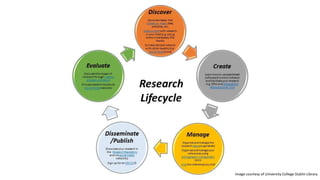
Image courtesy of University College Dublin Library
Copyright Issues
• Author’s Rights
• Acquiring Articles, Books, etc.
• Use of materials in teaching
• Fair Use
• Open Access
Open Science
• Open Access
• Hybrid Journals
• Funding
• Open Peer Review
• Publishing Negative Results
• Retractions
Disciplinary Repositories & Publishers
• Public Library of Science
• ArXiv
• Pubmed
• Biomed Central
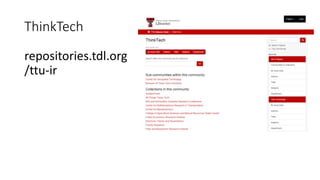
ThinkTech
repositories.tdl.org
/ttu-ir
Data Management
• Public Access Mandates
• Funder Repositories
• IR
• Help with access plans for grants
• Data Repositories
• guides.library.ttu.edu/datamanagement
Research Impact
• Tenure and beyond
• ORCID unique ID
• Citation Impact
• Social Media
• Teaching Materials
• Digital Scholarship
Questions?
Camille Thomas
Scholarly Communication Librarian
camille.thomas@ttu.edu
Data Management Team
libraries.datamanagement@ttu.edu

Research Publishing for STEM

Editor's Notes

  • #3 Newly hired at Tech Libraries I’ve been working in scholarly communications for 2 years, at Florida State University. Gave a lot of consultations and worked on projects. What is scholarly communication? = publishing and managing impact of research among colleagues and the public “STEM people that they don’t use the library” You don’t have to be in the building to be using the library. I want to talk about some services that can specifically help STEM faculty and students
  • #4 In the past, research has been seen as a linear process. Study>experiment>write>publish>present But in actuality, it is cyclical. There are new developing models for the aspects for researching. The library can assist in many of those stages. Just because you do not come into the building doesn’t mean you are not using the library. Library = people Not library = books Image via University College Dublin Library
  • #5 I DO NOT OFFER LEGAL ADVICE. I AM NOT A LAWYER. IF THERE IS A LEGAL MATTER I’M HAPPY TO REFER YOU TO GENERAL COUNCIL. I pay attention to what is happening in the academic publishing world and let you know your options, according to best practices. Copyright seems like hard and fast rules than you hear about in a legal battle, but in reality, it operates on a case by case basis. often people make mistakes because they are unaware of the many options for use of materials and act without being informed
  • #6 31% of retracted papers are not noted by publishers (Journal of Medical Ethics) -retractions due to invalid results, breach of ethics Science Hub- Russian neuroscientist illegally shared millions of copies of scientific articles, being sued by publisher ElSevier but refuses to shut the site down Open access is free and legal Authors usually retain rights Doesn’t prevent plagiarism, helpful commercialization process Intended to encourage innovation and reproducibility Increase researcher visibility and impact Open peer review is meant to prevent Peer Review fraud (Ivan Oranksy reviewed and published his own work)
  • #8 Institutional Repository Perfectly Legal Indexed in Google Scholar Often researchers will put a version permissible by publishers in the IR This is a way to publish in a highly ranked journal and still make your research open
  • #9 Often people will write in their plans that data is on their computer hard drive Raw data is factual and NOT copyrightable, but compilations are “Trade secrets” and sharing can be done according to the owner & field Help with metadata- there are many different standards that will help with sharing, reuse and even personal organization & efficiency
  • #10 -more ways for your work to speak for itself and credit you -Wider world for information means you can reach people who can’t make it to a conference presentation or have a paywall to your article -makerspace open to entire TTU community coming soon (outside my office) -article level metrics: PLOS, Biomed, Forntiers, Nature