Prof. Keshab Datt Awasthi (Ph.D.)
Academic Director
U-TEC
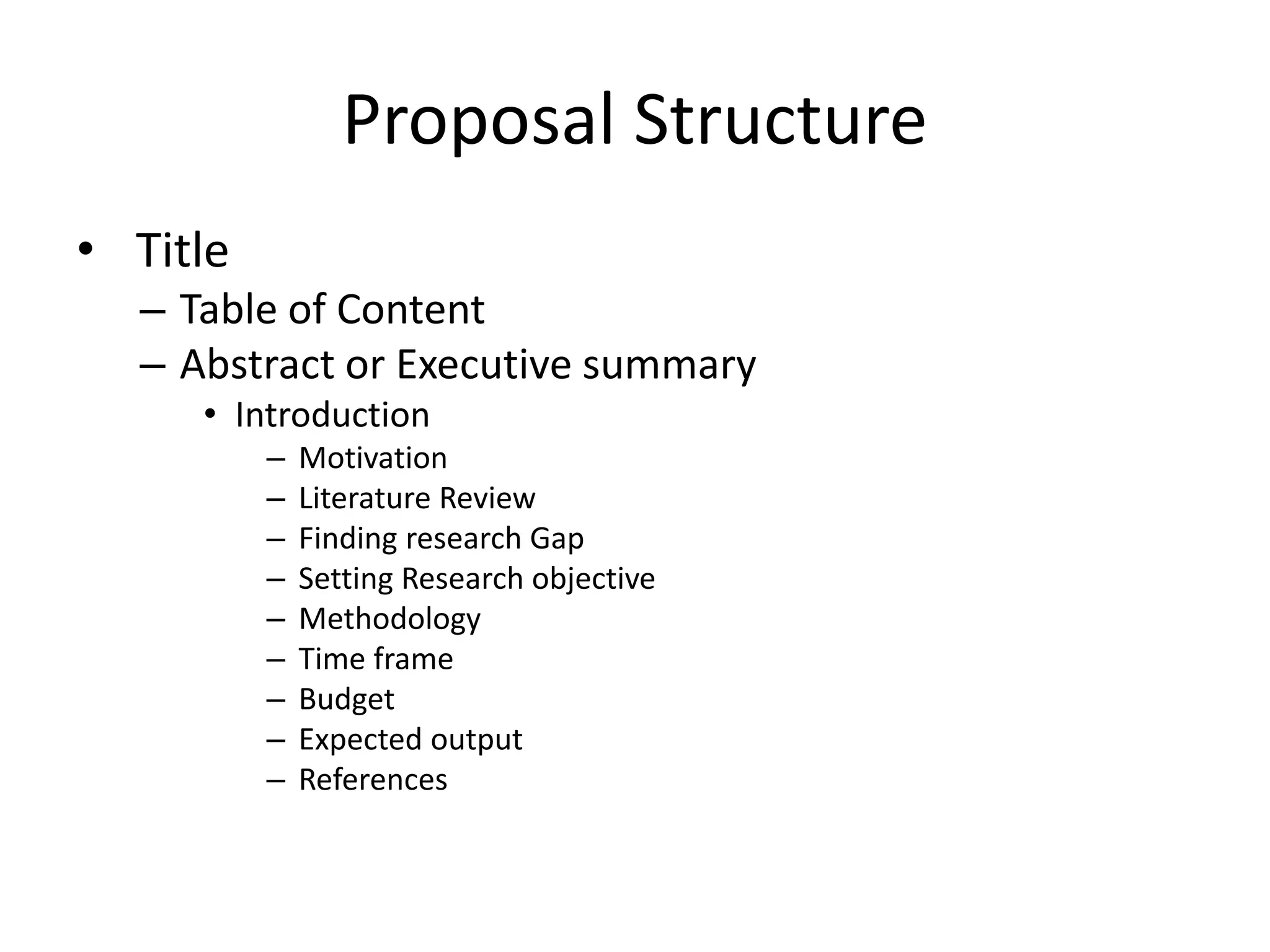
Proposal Structure
• Title
– Table of Content
– Abstract or Executive summary
• Introduction
– Motivation
– Literature Review
– Finding research Gap
– Setting Research objective
– Methodology
– Time frame
– Budget
– Expected output
– References
Title
• Keep following in mind while selecting the
title
1. Choose something that interests you
2. Choose a topic that is feasible
3. Choose a topic that is “research-worthy”
Choose something that interests you
• Research takes a long time, often much more
time than you expect, so do not choose a topic or
jump onto someone’s research project unless you
are truly interested in the subject matter.
• Investigating something that does not excite you
makes the research process far more difficult,
and you will likely regret it.
• Research can also be frustrating as you usually
run into unforeseen obstacles consuming more
time
Choose a topic that is feasible
• Since every researcher has different limitations or
restrictions, the question of feasibility often depends on
the individual researcher, but some questions you can ask
yourself are:
• Do you have the budget needed to conduct this research?
• Do you have the know-how needed to conduct this
research?
• Do you have access or can you obtain access to whatever it
is you want to research?
• Speaking to “choosing something that interests you,” do
you have the time needed to devote to this research?
Choose a topic that is “research-
worthy”
• You may be very interested in a topic, but if it
does not meet your intended audience’s
needs, then it is probably not a good topic to
select.
• Moreover, it will be extremely difficult to
receive funding for research that does not
generate others’ interest.
More about title
• brainstorm for ideas
• choose a topic that will enable you to read and
understand the literature
• ensure that the topic is manageable and that
material is available
• make a list of key words
• be flexible
• define your topic as a focused research question
• research and read more about your topic
Introduction
• Describe in general the problem/issue that
you seek to research.
• Why is it an issue?
• How is the problem/issue being developed in
brief?
• Define any key terms, which may be useful for
the reader
• For example……..
Research motivation
• Define the reasons behind the selection of this
research topic.
• Basic motivations of the work may include:
interest; challenge; learning; extensive public
benefit… etc.
Review of literature
• Here, we want a bit of a description about the type of
literature that you will review. At this stage, it is
expected that you would have an idea about the areas of
literature that you will need to review. You should also
know the main theorists/writers and any major
controversies.
• It is expected that at 20 references. Whereas, the PhD
student cites more than 30 references in this section
only.
• Arrange the research papers from oldest to newest.
• Classified literature papers into groups. Each group
discuss the same point and it has subtitle.
• Pictures, tables and figures are allowed here.
Research gap
• This part is a conclusion of the previous
section (Review of literature). The student
comes with research gap after reading and go
through many researches discuss the same
topic.
• Why research gap? Because you will want to
show to the reader that you are not
duplicating existing research.
Research objectives
The formulation of objectives will help you to:
• Focus the study (narrowing it down to
essentials);
• Avoid the collection of data which are not
strictly necessary for understanding and
solving the problem you have identified;
• Organize the study in clearly defined parts or
phases.
Research methodology
• Describe in full every detail of the proposed
methodology. This is needed to ensure that it
is a researchable project, and to enable
assessment of the ethical considerations.
• Describe in full every detail of the proposed
methodology. This is needed to ensure that it
is a researchable project, and to enable
assessment of the ethical considerations.
Cont…..
• If your methodology is new and innovative
then you have to write more of a justification
so that others understand what you are trying
to do and why it is important to do it this new
way.
• Data analysis
• Say some thing about tools used in database
preparation and data analysis and output
Research outcomes and significance
• Say something about the expected outputs
(results, equations, relations between
variables, … etc.), and any other outcomes
that might be achieved.
• In addition, you should mention the
importance of your results to academic
research.
Timeline
• Describe in full every detail of the proposed
methodology according to the available time.
This will inform the reader how you are going
to manage your activities against time. The
timeline includes the proposal writing and
thesis writing items.
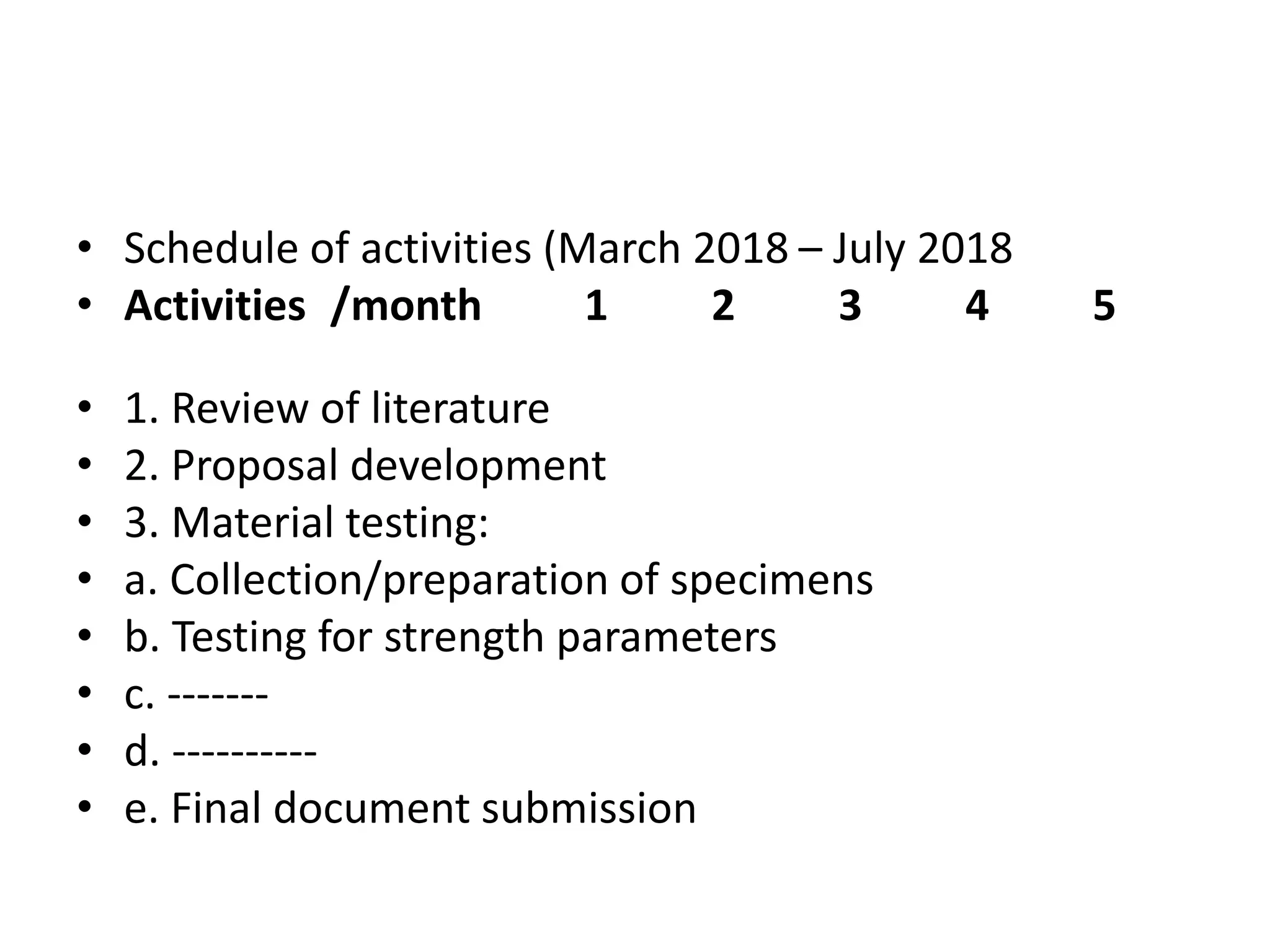
• Schedule of activities (March 2018 – July 2018
• Activities /month 1 2 3 4 5
• 1. Review of literature
• 2. Proposal development
• 3. Material testing:
• a. Collection/preparation of specimens
• b. Testing for strength parameters
• c. -------
• d. ----------
• e. Final document submission
Budget
• Outline what all the costs of the research will
be. Also provide a justification/explanation
References
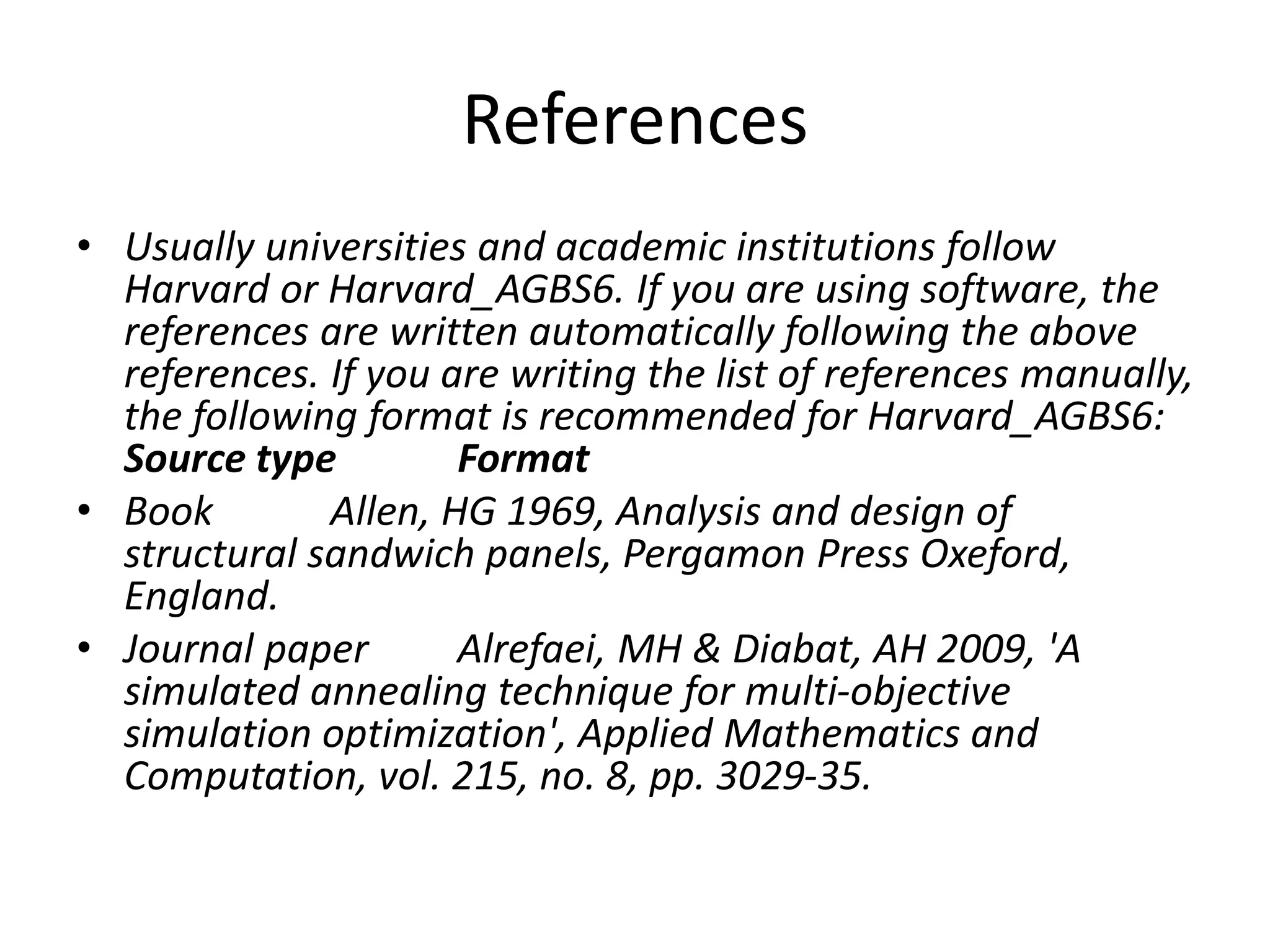
• Usually universities and academic institutions follow
Harvard or Harvard_AGBS6. If you are using software, the
references are written automatically following the above
references. If you are writing the list of references manually,
the following format is recommended for Harvard_AGBS6:
Source type Format
• Book Allen, HG 1969, Analysis and design of
structural sandwich panels, Pergamon Press Oxeford,
England.
• Journal paper Alrefaei, MH & Diabat, AH 2009, 'A
simulated annealing technique for multi-objective
simulation optimization', Applied Mathematics and
Computation, vol. 215, no. 8, pp. 3029-35.
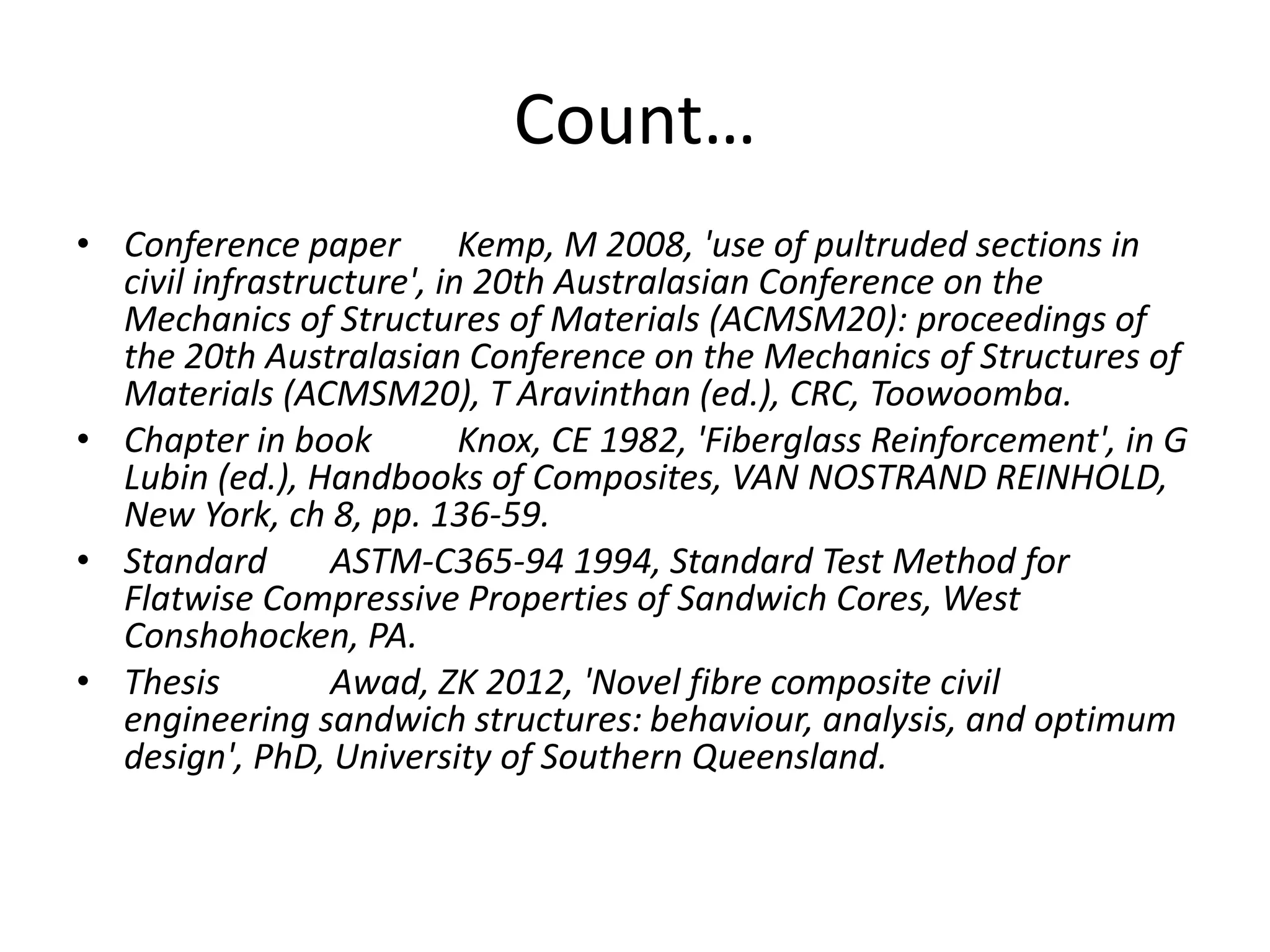
Count…
• Conference paper Kemp, M 2008, 'use of pultruded sections in
civil infrastructure', in 20th Australasian Conference on the
Mechanics of Structures of Materials (ACMSM20): proceedings of
the 20th Australasian Conference on the Mechanics of Structures of
Materials (ACMSM20), T Aravinthan (ed.), CRC, Toowoomba.
• Chapter in book Knox, CE 1982, 'Fiberglass Reinforcement', in G
Lubin (ed.), Handbooks of Composites, VAN NOSTRAND REINHOLD,
New York, ch 8, pp. 136-59.
• Standard ASTM-C365-94 1994, Standard Test Method for
Flatwise Compressive Properties of Sandwich Cores, West
Conshohocken, PA.
• Thesis Awad, ZK 2012, 'Novel fibre composite civil
engineering sandwich structures: behaviour, analysis, and optimum
design', PhD, University of Southern Queensland.
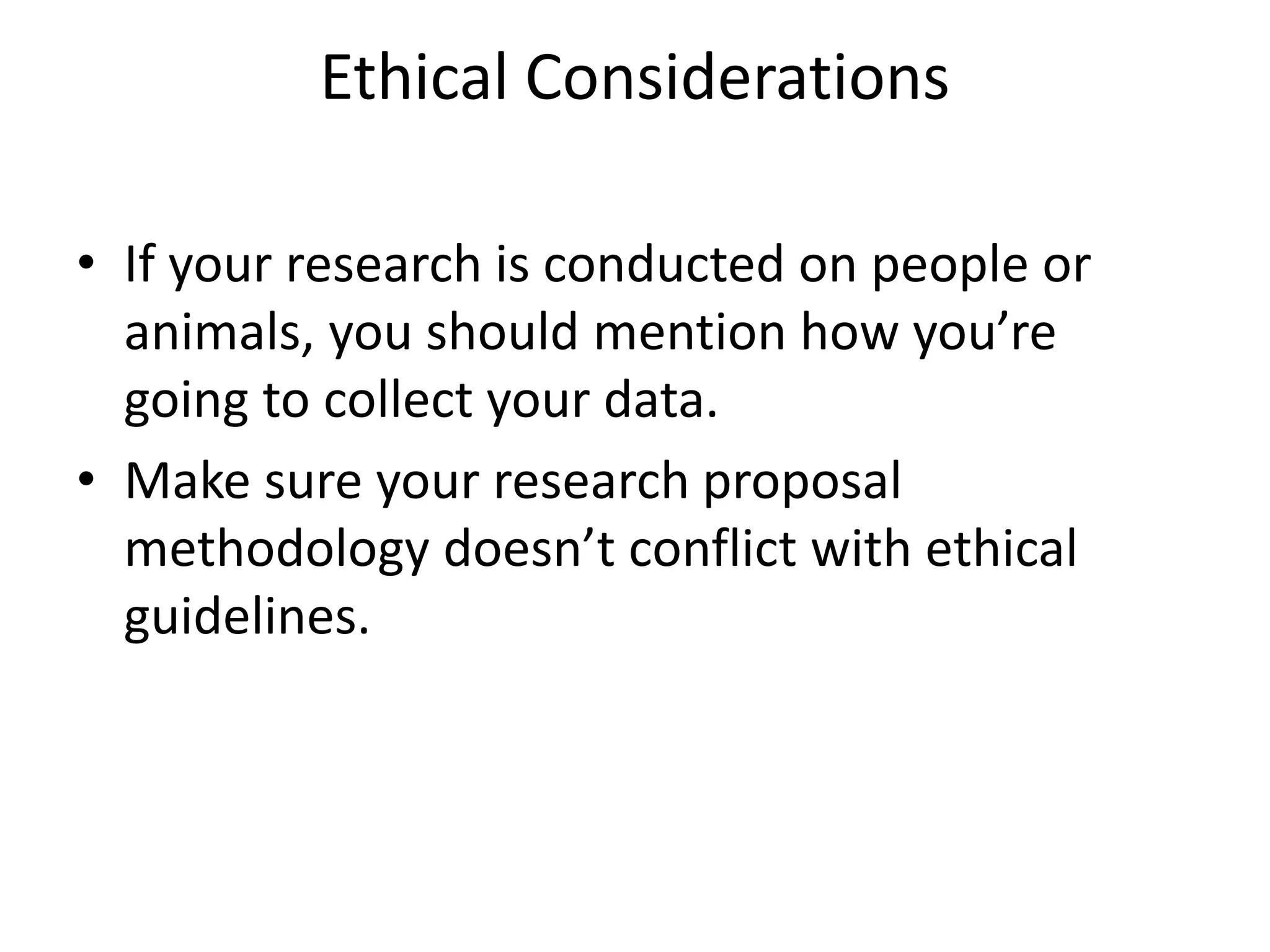
Ethical Considerations
• If your research is conducted on people or
animals, you should mention how you’re
going to collect your data.
• Make sure your research proposal
methodology doesn’t conflict with ethical
guidelines.

Example of method of proposal writing.pptx

  • 1.
    Prof. Keshab DattAwasthi (Ph.D.) Academic Director U-TEC
  • 2.
    Proposal Structure • Title –Table of Content – Abstract or Executive summary • Introduction – Motivation – Literature Review – Finding research Gap – Setting Research objective – Methodology – Time frame – Budget – Expected output – References
  • 3.
    Title • Keep followingin mind while selecting the title 1. Choose something that interests you 2. Choose a topic that is feasible 3. Choose a topic that is “research-worthy”
  • 4.
    Choose something thatinterests you • Research takes a long time, often much more time than you expect, so do not choose a topic or jump onto someone’s research project unless you are truly interested in the subject matter. • Investigating something that does not excite you makes the research process far more difficult, and you will likely regret it. • Research can also be frustrating as you usually run into unforeseen obstacles consuming more time
  • 5.
    Choose a topicthat is feasible • Since every researcher has different limitations or restrictions, the question of feasibility often depends on the individual researcher, but some questions you can ask yourself are: • Do you have the budget needed to conduct this research? • Do you have the know-how needed to conduct this research? • Do you have access or can you obtain access to whatever it is you want to research? • Speaking to “choosing something that interests you,” do you have the time needed to devote to this research?
  • 6.
    Choose a topicthat is “research- worthy” • You may be very interested in a topic, but if it does not meet your intended audience’s needs, then it is probably not a good topic to select. • Moreover, it will be extremely difficult to receive funding for research that does not generate others’ interest.
  • 7.
    More about title •brainstorm for ideas • choose a topic that will enable you to read and understand the literature • ensure that the topic is manageable and that material is available • make a list of key words • be flexible • define your topic as a focused research question • research and read more about your topic
  • 8.
    Introduction • Describe ingeneral the problem/issue that you seek to research. • Why is it an issue? • How is the problem/issue being developed in brief? • Define any key terms, which may be useful for the reader • For example……..
  • 9.
    Research motivation • Definethe reasons behind the selection of this research topic. • Basic motivations of the work may include: interest; challenge; learning; extensive public benefit… etc.
  • 10.
    Review of literature •Here, we want a bit of a description about the type of literature that you will review. At this stage, it is expected that you would have an idea about the areas of literature that you will need to review. You should also know the main theorists/writers and any major controversies. • It is expected that at 20 references. Whereas, the PhD student cites more than 30 references in this section only. • Arrange the research papers from oldest to newest. • Classified literature papers into groups. Each group discuss the same point and it has subtitle. • Pictures, tables and figures are allowed here.
  • 11.
    Research gap • Thispart is a conclusion of the previous section (Review of literature). The student comes with research gap after reading and go through many researches discuss the same topic. • Why research gap? Because you will want to show to the reader that you are not duplicating existing research.
  • 12.
    Research objectives The formulationof objectives will help you to: • Focus the study (narrowing it down to essentials); • Avoid the collection of data which are not strictly necessary for understanding and solving the problem you have identified; • Organize the study in clearly defined parts or phases.
  • 13.
    Research methodology • Describein full every detail of the proposed methodology. This is needed to ensure that it is a researchable project, and to enable assessment of the ethical considerations. • Describe in full every detail of the proposed methodology. This is needed to ensure that it is a researchable project, and to enable assessment of the ethical considerations.
  • 14.
    Cont….. • If yourmethodology is new and innovative then you have to write more of a justification so that others understand what you are trying to do and why it is important to do it this new way. • Data analysis • Say some thing about tools used in database preparation and data analysis and output
  • 15.
    Research outcomes andsignificance • Say something about the expected outputs (results, equations, relations between variables, … etc.), and any other outcomes that might be achieved. • In addition, you should mention the importance of your results to academic research.
  • 16.
    Timeline • Describe infull every detail of the proposed methodology according to the available time. This will inform the reader how you are going to manage your activities against time. The timeline includes the proposal writing and thesis writing items.
  • 17.
    • Schedule ofactivities (March 2018 – July 2018 • Activities /month 1 2 3 4 5 • 1. Review of literature • 2. Proposal development • 3. Material testing: • a. Collection/preparation of specimens • b. Testing for strength parameters • c. ------- • d. ---------- • e. Final document submission
  • 18.
    Budget • Outline whatall the costs of the research will be. Also provide a justification/explanation
  • 19.
    References • Usually universitiesand academic institutions follow Harvard or Harvard_AGBS6. If you are using software, the references are written automatically following the above references. If you are writing the list of references manually, the following format is recommended for Harvard_AGBS6: Source type Format • Book Allen, HG 1969, Analysis and design of structural sandwich panels, Pergamon Press Oxeford, England. • Journal paper Alrefaei, MH & Diabat, AH 2009, 'A simulated annealing technique for multi-objective simulation optimization', Applied Mathematics and Computation, vol. 215, no. 8, pp. 3029-35.
  • 20.
    Count… • Conference paperKemp, M 2008, 'use of pultruded sections in civil infrastructure', in 20th Australasian Conference on the Mechanics of Structures of Materials (ACMSM20): proceedings of the 20th Australasian Conference on the Mechanics of Structures of Materials (ACMSM20), T Aravinthan (ed.), CRC, Toowoomba. • Chapter in book Knox, CE 1982, 'Fiberglass Reinforcement', in G Lubin (ed.), Handbooks of Composites, VAN NOSTRAND REINHOLD, New York, ch 8, pp. 136-59. • Standard ASTM-C365-94 1994, Standard Test Method for Flatwise Compressive Properties of Sandwich Cores, West Conshohocken, PA. • Thesis Awad, ZK 2012, 'Novel fibre composite civil engineering sandwich structures: behaviour, analysis, and optimum design', PhD, University of Southern Queensland.
  • 21.
    Ethical Considerations • Ifyour research is conducted on people or animals, you should mention how you’re going to collect your data. • Make sure your research proposal methodology doesn’t conflict with ethical guidelines.