• Research Methods in Anthropology:
What to Research:
Research Model:
I) Identifying a problem & Selecting a
topic:
II) Defining the problem:
III) Reviewing the literature:
IV) Formulating the Hypothesis:
Hypothesis:
Statement to be tested.
V) Choosing the research method(design):
VI) Collecting the data:
Data: Facts/figures in processed form.
Types:
Primary & Secondary
Qualities:
Validity & Reliability
VII) Analyzing the data
VIII) Sharing data(results)
(Presentation and Citation Method in APA style)
Research Methods(Design):
Seven Methods or designs:
I) Surveys:
a) Questionnaires:
Types of Questions:
i) Neutral
ii) Unbiased
iii) Open ended
iv) Close ended
b) Interviews:
i) Direct
ii) Indirect
Sampling Method:
Selecting a sample:
Universe
Population
Sample
Respondent
Types of Sample:
i)Random Sample
ii) Stratified random sample
II) Participant Observation(Fieldwork)
in Anthropology:
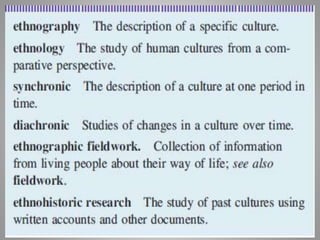
1) Ethnographic Methods:
a) Ethnographic fieldwork
b) Ethnohistory
Fieldwork as a Rite of Passage:
(Participation of fieldwork in daily routine of ethnic group
and not to interfere in their way of life)
Problems and issues in Research
Ethics in field research
2) Comparative Methods:
a) Cross-Cultural Comparisons
b) Controlled Comparisons
II) Participant Observation(Fieldwork):
Steps:
a) Mind mapping:
b) Diagrams and flow charts:
c) Taking notes
d) Evaluating information:
e) Summarizing information:
Research tools of Cultural Anthropologists:
a) Finding informant
b) Interview
c) Counting articles, people, etc
d) Photography
e) Mapping
f) Learning cultures
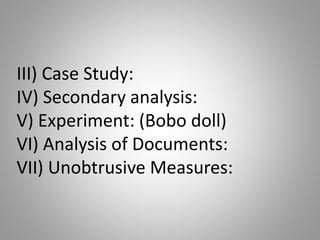
III) Case Study:
IV) Secondary analysis:
V) Experiment: (Bobo doll)
VI) Analysis of Documents:
VII) Unobtrusive Measures:

Research methods in anthropology

  • 1.
    • Research Methodsin Anthropology: What to Research: Research Model: I) Identifying a problem & Selecting a topic: II) Defining the problem: III) Reviewing the literature: IV) Formulating the Hypothesis: Hypothesis: Statement to be tested.
  • 2.
    V) Choosing theresearch method(design): VI) Collecting the data: Data: Facts/figures in processed form. Types: Primary & Secondary Qualities: Validity & Reliability VII) Analyzing the data VIII) Sharing data(results) (Presentation and Citation Method in APA style)
  • 3.
    Research Methods(Design): Seven Methodsor designs: I) Surveys: a) Questionnaires: Types of Questions: i) Neutral ii) Unbiased iii) Open ended iv) Close ended b) Interviews: i) Direct ii) Indirect
  • 4.
    Sampling Method: Selecting asample: Universe Population Sample Respondent Types of Sample: i)Random Sample ii) Stratified random sample
  • 5.
    II) Participant Observation(Fieldwork) inAnthropology: 1) Ethnographic Methods: a) Ethnographic fieldwork b) Ethnohistory Fieldwork as a Rite of Passage: (Participation of fieldwork in daily routine of ethnic group and not to interfere in their way of life) Problems and issues in Research Ethics in field research 2) Comparative Methods: a) Cross-Cultural Comparisons b) Controlled Comparisons
  • 7.
    II) Participant Observation(Fieldwork): Steps: a)Mind mapping: b) Diagrams and flow charts: c) Taking notes d) Evaluating information: e) Summarizing information: Research tools of Cultural Anthropologists: a) Finding informant b) Interview c) Counting articles, people, etc d) Photography e) Mapping f) Learning cultures
  • 8.
    III) Case Study: IV)Secondary analysis: V) Experiment: (Bobo doll) VI) Analysis of Documents: VII) Unobtrusive Measures: