“LANGUAGE LEARNING STRATEGIES (LLS)
USED BY ESL LEARNERS AND COURSE
PERFORMANCE OF KOLEJ POLY-TECH MARA
IPOH.”
RESEARCH METHODOLOGY
Presentation by:
Hamizah binti Hj. Osman
2014742455
1.0 INTRODUCTION
English in Malaysia is viewed as:
•Despite of its prominence, the acquisition level of the
language is not encouraging, even sometimes frustrating.
• The government has taken many measures over the
decades to rectify the problem.
 - very important
- an asset / factor for development and to acquire knowledge,
- widely used in business sectors as well as institutions of higher
learning.
•More English teachers are trained locally and abroad.
•The ministry from time to time conduct short and long term courses for
teachers nationwide.
•Course-wares, laptops and projectors that cost millions are also provided to
enhance the teaching techniques.
3 years contract (2010-2013) Brighton’s teaching English Language and
Literacy (TELL) program deploys 120 English language experts from
around the world to mentor and coach approximately 2200 primary school
English teachers. (The Sun 3, July 2012; cited in Thirusanku & Yunus,
2014).
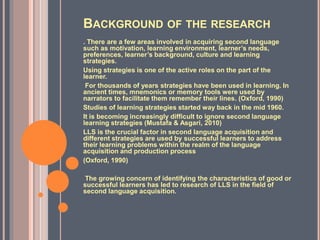
BACKGROUND OF THE RESEARCH
. There are a few areas involved in acquiring second language
such as motivation, learning environment, learner’s needs,
preferences, learner’s background, culture and learning
strategies.
Using strategies is one of the active roles on the part of the
learner.
For thousands of years strategies have been used in learning. In
ancient times, mnemonics or memory tools were used by
narrators to facilitate them remember their lines. (Oxford, 1990)
Studies of learning strategies started way back in the mid 1960.
It is becoming increasingly difficult to ignore second language
learning strategies (Mustafa & Asgari, 2010)
LLS is the crucial factor in second language acquisition and
different strategies are used by successful learners to address
their learning problems within the realm of the language
acquisition and production process
(Oxford, 1990)
The growing concern of identifying the characteristics of good or
successful learners has led to research of LLS in the field of
second language acquisition.
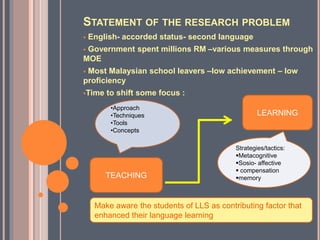
STATEMENT OF THE RESEARCH PROBLEM
 English- accorded status- second language
 Government spent millions RM –various measures through
MOE
 Most Malaysian school leavers –low achievement – low
proficiency
Time to shift some focus :
TEACHING
LEARNING
•Approach
•Techniques
•Tools
•Concepts
Strategies/tactics:
Metacognitive
Sosio- affective
 compensation
memory
Make aware the students of LLS as contributing factor that
enhanced their language learning.
RESEARCH OBJECTIVES
i. To discover the most frequent LLS used by Kolej
Poly-Tech MARA Ipoh students
ii. To determine which group that uses more LLS between
the higher and lower scorer.
iii. To identify the strategies most frequently used by the
successful learners.
RESEARCH QUESTIONS
i. What are the most frequent LLS used by Kolej Poly-Tech
MARA students?
ii. Do more successful learners using more LLS than the less
successful students?
iii. What strategies are frequently used by the successful
students?
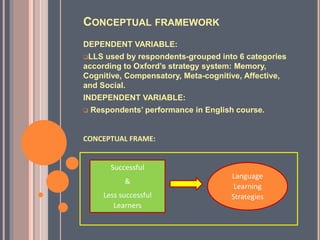
CONCEPTUAL FRAMEWORK
DEPENDENT VARIABLE:
LLS used by respondents-grouped into 6 categories
according to Oxford’s strategy system: Memory,
Cognitive, Compensatory, Meta-cognitive, Affective,
and Social.
INDEPENDENT VARIABLE:
 Respondents’ performance in English course.
CONCEPTUAL FRAME:
Successful
&
Less successful
Learners
Language
Learning
Strategies
RESEARCH DESIGN
-a descriptive investigation
-aim to compile knowledge about students’ strategies
- very objective - using questionnaires
- using mostly data
QUANTITATIVE APPROACH
Can be
accurately
measured
using
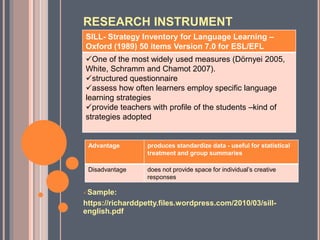
RESEARCH INSTRUMENT
Sample:
https://richarddpetty.files.wordpress.com/2010/03/sill-
english.pdf
Advantage produces standardize data - useful for statistical
treatment and group summaries
Disadvantage does not provide space for individual’s creative
responses
SILL- Strategy Inventory for Language Learning –
Oxford (1989) 50 items Version 7.0 for ESL/EFL
One of the most widely used measures (Dörnyei 2005,
White, Schramm and Chamot 2007).
structured questionnaire
assess how often learners employ specific language
learning strategies
provide teachers with profile of the students –kind of
strategies adopted
DATA ANALYSIS
Descriptive statistics -to analyze the data collected
by questionnaires (4 point Likert scale) such as:
- Mean ( ), Standard Deviation (SD), t test
The criteria for interpreting the mean of learning
strategies used will be set as follows:
The criteria for interpreting the mean of the
effectiveness of the strategies will be set as follows:
Always true of me: 3.51 – 4.00;
Usually true of me: 2.51 – 3.50;
Usually not true of me: 1.51 – 2.50;
Never true of me: 1.00 – 1.50.
Very useful: 3.51 – 4.00;
Somewhat useful: 2.51 – 3.50;
Not very useful: 1.51 – 2.50;
Not at all useful: 1.00 – 1.50.

Research method presentation

  • 1.
    “LANGUAGE LEARNING STRATEGIES(LLS) USED BY ESL LEARNERS AND COURSE PERFORMANCE OF KOLEJ POLY-TECH MARA IPOH.” RESEARCH METHODOLOGY Presentation by: Hamizah binti Hj. Osman 2014742455
  • 2.
    1.0 INTRODUCTION English inMalaysia is viewed as: •Despite of its prominence, the acquisition level of the language is not encouraging, even sometimes frustrating. • The government has taken many measures over the decades to rectify the problem.  - very important - an asset / factor for development and to acquire knowledge, - widely used in business sectors as well as institutions of higher learning. •More English teachers are trained locally and abroad. •The ministry from time to time conduct short and long term courses for teachers nationwide. •Course-wares, laptops and projectors that cost millions are also provided to enhance the teaching techniques. 3 years contract (2010-2013) Brighton’s teaching English Language and Literacy (TELL) program deploys 120 English language experts from around the world to mentor and coach approximately 2200 primary school English teachers. (The Sun 3, July 2012; cited in Thirusanku & Yunus, 2014).
  • 3.
    BACKGROUND OF THERESEARCH . There are a few areas involved in acquiring second language such as motivation, learning environment, learner’s needs, preferences, learner’s background, culture and learning strategies. Using strategies is one of the active roles on the part of the learner. For thousands of years strategies have been used in learning. In ancient times, mnemonics or memory tools were used by narrators to facilitate them remember their lines. (Oxford, 1990) Studies of learning strategies started way back in the mid 1960. It is becoming increasingly difficult to ignore second language learning strategies (Mustafa & Asgari, 2010) LLS is the crucial factor in second language acquisition and different strategies are used by successful learners to address their learning problems within the realm of the language acquisition and production process (Oxford, 1990) The growing concern of identifying the characteristics of good or successful learners has led to research of LLS in the field of second language acquisition.
  • 4.
    STATEMENT OF THERESEARCH PROBLEM  English- accorded status- second language  Government spent millions RM –various measures through MOE  Most Malaysian school leavers –low achievement – low proficiency Time to shift some focus : TEACHING LEARNING •Approach •Techniques •Tools •Concepts Strategies/tactics: Metacognitive Sosio- affective  compensation memory Make aware the students of LLS as contributing factor that enhanced their language learning.
  • 5.
    RESEARCH OBJECTIVES i. Todiscover the most frequent LLS used by Kolej Poly-Tech MARA Ipoh students ii. To determine which group that uses more LLS between the higher and lower scorer. iii. To identify the strategies most frequently used by the successful learners.
  • 6.
    RESEARCH QUESTIONS i. Whatare the most frequent LLS used by Kolej Poly-Tech MARA students? ii. Do more successful learners using more LLS than the less successful students? iii. What strategies are frequently used by the successful students?
  • 7.
    CONCEPTUAL FRAMEWORK DEPENDENT VARIABLE: LLSused by respondents-grouped into 6 categories according to Oxford’s strategy system: Memory, Cognitive, Compensatory, Meta-cognitive, Affective, and Social. INDEPENDENT VARIABLE:  Respondents’ performance in English course. CONCEPTUAL FRAME: Successful & Less successful Learners Language Learning Strategies
  • 8.
    RESEARCH DESIGN -a descriptiveinvestigation -aim to compile knowledge about students’ strategies - very objective - using questionnaires - using mostly data QUANTITATIVE APPROACH Can be accurately measured using
  • 9.
    RESEARCH INSTRUMENT Sample: https://richarddpetty.files.wordpress.com/2010/03/sill- english.pdf Advantage producesstandardize data - useful for statistical treatment and group summaries Disadvantage does not provide space for individual’s creative responses SILL- Strategy Inventory for Language Learning – Oxford (1989) 50 items Version 7.0 for ESL/EFL One of the most widely used measures (Dörnyei 2005, White, Schramm and Chamot 2007). structured questionnaire assess how often learners employ specific language learning strategies provide teachers with profile of the students –kind of strategies adopted
  • 10.
    DATA ANALYSIS Descriptive statistics-to analyze the data collected by questionnaires (4 point Likert scale) such as: - Mean ( ), Standard Deviation (SD), t test The criteria for interpreting the mean of learning strategies used will be set as follows: The criteria for interpreting the mean of the effectiveness of the strategies will be set as follows: Always true of me: 3.51 – 4.00; Usually true of me: 2.51 – 3.50; Usually not true of me: 1.51 – 2.50; Never true of me: 1.00 – 1.50. Very useful: 3.51 – 4.00; Somewhat useful: 2.51 – 3.50; Not very useful: 1.51 – 2.50; Not at all useful: 1.00 – 1.50.