













Students’ Age at which EFL is Introduced in Schools and Educational Outcomes Written by: Chuzaimah Dahlan Diem Presented by: Nurbaiti Eka Permanasari
Introduction Regarding to the issue debated; EFL should be nationally introduced in the curriculum starting from elementary school in order to face the globalization era. Successful in second language acquisition or foreign language learning needs several factors, such as, age (d’Anglejan,1990), language aptitude (McLaughin, 1990), attitudes and motivation (McGoarty,1996),
social-psychologicalfactors (Freeman& McElhinny, 1996; Rickford, 1996), Personality, cognitive style, hemisphere specialization(Larsen-Freeman & Long,1991 :153), parents’ education(Zakiyah, 2002), learning strategies (Ihsan&Diem,1997)and gender (Freeman & McElhinny, 1996) The study will be focused on the age factor related to students’ achievement.
The Aim of the Research  To see whether students’ age is statistically related to English outcomes. To see whether the addition of some factors such as teacher education level, years ELT experience, intensity of instruction, and students’ SES on students achievement in learning EFL.
Research Questions Is there a significant correlation among students’ age and related variables  on students’ outcomes? Is there a significant difference  between the English achievement of the students elementary school and junior high school with other variables?
Method   It is Quantitative – correlational study
Setting Place:  Several schools of Elementary schools and Junior High school in Palembang
Subject The population consists of two groups of students who learn English started at 10 and at 13 years of age which are 5 th  and 8 th  graders. The sample of the study or 229 students that have learned English for more or less 2 years and never took any English courses other than those provided in class at their schools following the curriculum suggested.
Instrument A set of English test mostly reading comprehension, vocabulary, and a little bit grammar was used to measure the students’ English achievement.
Sources of Data Students’ English test score Other variables that relate to educational process such as curriculum, intensity of instruction, teacher education level, years of ELT experience, and Class size The background of students such as socio-economic-status and gender
Data Analysis All of quantitative data are analyzed using Pearson-Product Moment and Multiple regression analyses Hypotheses are tested by F-statistics using an alpha level of .05
Research Process All the data are tested, analyzed, classified and interpreted  based on the data collection of students’ English test, the educational process and the background of students.
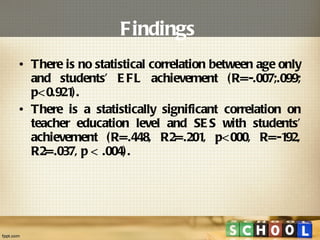
Findings  There is no statistical correlation between age only and students’ EFL achievement (R=-.007;.099; p<0.921). There is a statistically significant correlation on teacher education level and SES with students’ achievement (R=.448, R2=.201, p<000, R=-192, R2=.037, p < .004).
Discussion   Children that start earlier in EFL learning is better in EFL achievement than older learners. Success in ELT cannot only be judged by the teacher education level and years of teaching experience but also from process teaching and learning in the classroom. Success of students in EFL learning is not determined by the wealth of their parents.
Implications To theory :the early age serves as a vital factor that makes the EFL learning successful. To policy: it can be used a new consideration that English subject in the Elementary school be officially stated in the National Curriculum as a Compulsory subject To practice: this study could enhance the more intense practice of English at schools and among children and for the teachers keep up participating on seminars and workshop

Students' Age and Educational outcomes

  • 1.
    Students’ Age atwhich EFL is Introduced in Schools and Educational Outcomes Written by: Chuzaimah Dahlan Diem Presented by: Nurbaiti Eka Permanasari
  • 2.
    Introduction Regarding tothe issue debated; EFL should be nationally introduced in the curriculum starting from elementary school in order to face the globalization era. Successful in second language acquisition or foreign language learning needs several factors, such as, age (d’Anglejan,1990), language aptitude (McLaughin, 1990), attitudes and motivation (McGoarty,1996),
  • 3.
    social-psychologicalfactors (Freeman& McElhinny,1996; Rickford, 1996), Personality, cognitive style, hemisphere specialization(Larsen-Freeman & Long,1991 :153), parents’ education(Zakiyah, 2002), learning strategies (Ihsan&Diem,1997)and gender (Freeman & McElhinny, 1996) The study will be focused on the age factor related to students’ achievement.
  • 4.
    The Aim ofthe Research To see whether students’ age is statistically related to English outcomes. To see whether the addition of some factors such as teacher education level, years ELT experience, intensity of instruction, and students’ SES on students achievement in learning EFL.
  • 5.
    Research Questions Isthere a significant correlation among students’ age and related variables on students’ outcomes? Is there a significant difference between the English achievement of the students elementary school and junior high school with other variables?
  • 6.
    Method It is Quantitative – correlational study
  • 7.
    Setting Place: Several schools of Elementary schools and Junior High school in Palembang
  • 8.
    Subject The populationconsists of two groups of students who learn English started at 10 and at 13 years of age which are 5 th and 8 th graders. The sample of the study or 229 students that have learned English for more or less 2 years and never took any English courses other than those provided in class at their schools following the curriculum suggested.
  • 9.
    Instrument A setof English test mostly reading comprehension, vocabulary, and a little bit grammar was used to measure the students’ English achievement.
  • 10.
    Sources of DataStudents’ English test score Other variables that relate to educational process such as curriculum, intensity of instruction, teacher education level, years of ELT experience, and Class size The background of students such as socio-economic-status and gender
  • 11.
    Data Analysis Allof quantitative data are analyzed using Pearson-Product Moment and Multiple regression analyses Hypotheses are tested by F-statistics using an alpha level of .05
  • 12.
    Research Process Allthe data are tested, analyzed, classified and interpreted based on the data collection of students’ English test, the educational process and the background of students.
  • 13.
    Findings Thereis no statistical correlation between age only and students’ EFL achievement (R=-.007;.099; p<0.921). There is a statistically significant correlation on teacher education level and SES with students’ achievement (R=.448, R2=.201, p<000, R=-192, R2=.037, p < .004).
  • 14.
    Discussion Children that start earlier in EFL learning is better in EFL achievement than older learners. Success in ELT cannot only be judged by the teacher education level and years of teaching experience but also from process teaching and learning in the classroom. Success of students in EFL learning is not determined by the wealth of their parents.
  • 15.
    Implications To theory:the early age serves as a vital factor that makes the EFL learning successful. To policy: it can be used a new consideration that English subject in the Elementary school be officially stated in the National Curriculum as a Compulsory subject To practice: this study could enhance the more intense practice of English at schools and among children and for the teachers keep up participating on seminars and workshop