Getting Started with Research Karen Belfer, VCC Tannis Morgan, BCIT
Introductions Our experiences Your interests What brought you to this session today?
Why bother? Motivations “ research” vs investigation as part of own faculty development Research in your discipline or educational research?
Overview SOTL, applied research, and research The research process Research ethics Tools Funding Questions?
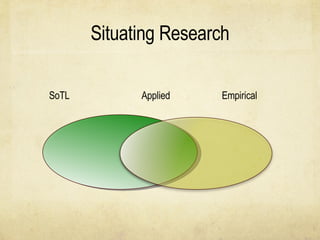
Situating Research SoTL  Applied Empirical
Scholarship of Teaching and Learning (SOTL) Research:  Where it starts Who am I as an instructor? Are my exam questions too hard? Does a course weblog help students feel connected? Is group work helping first year math students? Are employers satisfied with graduates of our program?
Scholarship of Teaching and Learning (SOTL) Research Teaching Expanded Planned reflection and analysis Shortest “distance” from current practice Systematic investigation or exploration via a research process Manageable scope--scalable Teaching context as a laboratory Focus on student learning
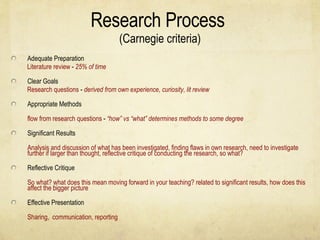
Research Process  (Carnegie criteria) Adequate Preparation  Literature review  -  25% of time Clear Goals  Research questions  -  derived from own experience, curiosity, lit review   Appropriate Methods  flow from research questions  -  “how” vs “what” determines methods to some degree Significant Results  Analysis and discussion of what has been investigated, finding flaws in own research, need to investigate further if larger than thought, reflective critique of conducting the research, so what? Reflective Critique  So what? what does this mean moving forward in your teaching? related to significant results, how does this affect the bigger picture Effective Presentation  Sharing,  communication, reporting
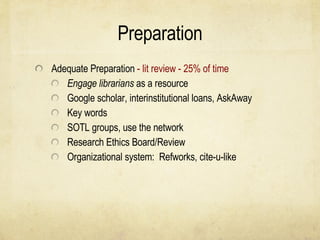
Preparation Adequate Preparation  - lit review - 25% of time Engage librarians  as a resource Google scholar, interinstitutional loans, AskAway Key words SOTL groups, use the network Research Ethics Board/Review Organizational system:  Refworks, cite-u-like
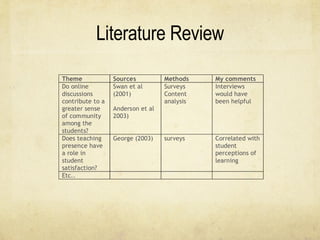
Literature Review
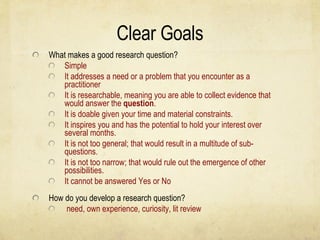
Clear Goals What makes a good research question? Simple It addresses a need or a problem that you encounter as a practitioner It is researchable, meaning you are able to collect evidence that would answer the  question . It is doable given your time and material constraints. It inspires you and has the potential to hold your interest over several months. It is not too general; that would result in a multitude of sub-questions. It is not too narrow; that would rule out the emergence of other possibilities. It cannot be answered Yes or No How do you develop a research question? need, own experience, curiosity, lit review
Your questions Share an observation, and what you would like to know What would this look like as a research question?
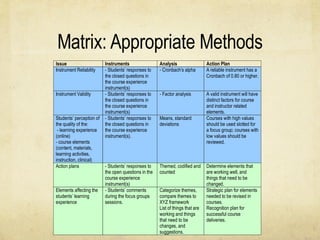
Appropriate Methods How are you going to investigate your question? Flow from research questions - “how” vs “what” determines methods to some degree Does your discipline influence your methods? Instruments Process/research design Organizing and documenting it all
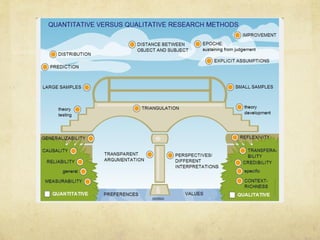
Research Design & Methods Qualitative--How? Why? Eg.  Case studies, ethnographies, grounded theory Quantitative--What? Eg. (Quasi-)Experimental, correlational, surveys Mixed--combination Evaluation studies--typically program, institutional, or innovation focussed with a clear purpose of assessing the quality and effectiveness
Qualitative Methods Used to “understand” more deeply.  Typically results do not seek to generalize widely. May involve one or more of the following: focus groups/interviews text or discourse analysis observations
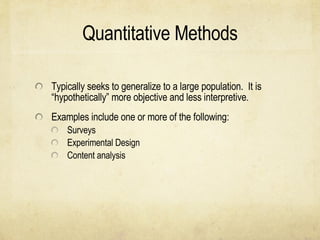
Quantitative Methods Typically seeks to generalize to a large population.  It is “hypothetically” more objective and less interpretive.  Examples include one or more of the following: Surveys Experimental Design Content analysis
 
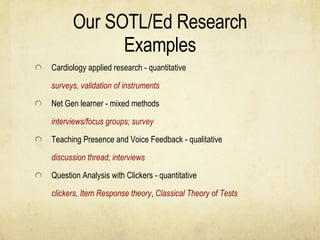
Our SOTL/Ed Research Examples Cardiology applied research - quantitative surveys, validation of instruments   Net Gen learner - mixed methods interviews/focus groups; survey   Teaching Presence and Voice Feedback - qualitative discussion thread; interviews   Question Analysis with Clickers - quantitative clickers, Item Response theory ,  Classical Theory of Tests
Matrix: Appropriate Methods
Tools Data Gathering Digital:  Text, audio, video, surveys Backups! Security and privacy (ethics) Data Analysis SPSS/NVIVO/MaxQDA/Microsoft Word Notes Data visualization tools
Brainstorm Select one of your research questions and discuss with your partner/group how you would gather evidence/data What are the challenges you would be faced with?  What kinds of roadblocks would you anticipate?
Results Analysis and discussion of what has been investigated Finding flaws in own research need to investigate further if larger than thought reflective critique of conducting the research so what?
Reflective Critique So what?  What does this mean moving forward in your teaching?  How does this affect the bigger picture?
Effective Presentation Sharing Communication Reporting
Research Ethics Human dignity Free informed consent Vulnerable persons Justice and inclusiveness Minimizing (balancing) harm Privacy and confidentiality Audio recording vs video recording Security of data
Funding Funding Calendar (Science focussed) 	http:// www.bcit.ca/appliedresearch/funding/fundingcalendar.shtml Funding Opportunities (Social Science focussed) http://ltcollaboratory.org/funding
Support Peer support Mentor support Collaboration - with students, with other institutions Role of Teaching and Learning Centres? http://ltcollaboratory.org/
Summary Think about your orientation (and your disciplinary orientation) to doing research Think about your comfort level with qualitative and quantitative methods Think about your question Think about the forms of evidence/data you might want to access or collect
Parting Words We believe the time has come to move beyond the tired old "teaching versus research" debate and give the familiar and honorable term "scholarship" a broader, more capacious meaning, one that brings legitimacy to the full scope of academic work. Surely, scholarship means engaging in original research. But the work of the scholar also means stepping back from one's investigation, looking for connections, building bridges between theory and practice, and communicating one's knowledge effectively to students.  E. L. Boyer
Thanks View/download the presentation and access the resources at  	http://researchworkshop.wordpress.com
Models Boyer 1990 Examples in relation to model
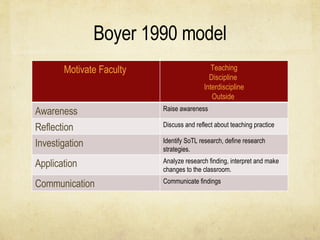
Boyer 1990 model Motivate Faculty   Teaching Discipline  Interdiscipline Outside  Awareness Raise awareness  Reflection Discuss and reflect about teaching practice Investigation Identify SoTL research, define research strategies. Application Analyze research finding, interpret and make changes to the classroom. Communication Communicate findings
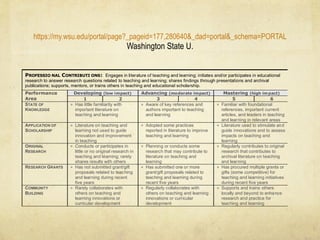
https://my.wsu.edu/portal/page?_pageid=177,280640&_dad=portal&_schema=PORTAL Washington State U.
Resources Good explanation of Evaluation research  http://www.edu.plymouth.ac.uk/resined/evaluation/index.htm

Getting started with research

  • 1.
    Getting Started withResearch Karen Belfer, VCC Tannis Morgan, BCIT
  • 2.
    Introductions Our experiencesYour interests What brought you to this session today?
  • 3.
    Why bother? Motivations“ research” vs investigation as part of own faculty development Research in your discipline or educational research?
  • 4.
    Overview SOTL, appliedresearch, and research The research process Research ethics Tools Funding Questions?
  • 5.
    Situating Research SoTL Applied Empirical
  • 6.
    Scholarship of Teachingand Learning (SOTL) Research: Where it starts Who am I as an instructor? Are my exam questions too hard? Does a course weblog help students feel connected? Is group work helping first year math students? Are employers satisfied with graduates of our program?
  • 7.
    Scholarship of Teachingand Learning (SOTL) Research Teaching Expanded Planned reflection and analysis Shortest “distance” from current practice Systematic investigation or exploration via a research process Manageable scope--scalable Teaching context as a laboratory Focus on student learning
  • 8.
    Research Process (Carnegie criteria) Adequate Preparation Literature review - 25% of time Clear Goals Research questions - derived from own experience, curiosity, lit review   Appropriate Methods flow from research questions - “how” vs “what” determines methods to some degree Significant Results Analysis and discussion of what has been investigated, finding flaws in own research, need to investigate further if larger than thought, reflective critique of conducting the research, so what? Reflective Critique So what? what does this mean moving forward in your teaching? related to significant results, how does this affect the bigger picture Effective Presentation Sharing,  communication, reporting
  • 9.
    Preparation Adequate Preparation - lit review - 25% of time Engage librarians as a resource Google scholar, interinstitutional loans, AskAway Key words SOTL groups, use the network Research Ethics Board/Review Organizational system: Refworks, cite-u-like
  • 10.
  • 11.
    Clear Goals Whatmakes a good research question? Simple It addresses a need or a problem that you encounter as a practitioner It is researchable, meaning you are able to collect evidence that would answer the question . It is doable given your time and material constraints. It inspires you and has the potential to hold your interest over several months. It is not too general; that would result in a multitude of sub-questions. It is not too narrow; that would rule out the emergence of other possibilities. It cannot be answered Yes or No How do you develop a research question? need, own experience, curiosity, lit review
  • 12.
    Your questions Sharean observation, and what you would like to know What would this look like as a research question?
  • 13.
    Appropriate Methods Howare you going to investigate your question? Flow from research questions - “how” vs “what” determines methods to some degree Does your discipline influence your methods? Instruments Process/research design Organizing and documenting it all
  • 14.
    Research Design &Methods Qualitative--How? Why? Eg. Case studies, ethnographies, grounded theory Quantitative--What? Eg. (Quasi-)Experimental, correlational, surveys Mixed--combination Evaluation studies--typically program, institutional, or innovation focussed with a clear purpose of assessing the quality and effectiveness
  • 15.
    Qualitative Methods Usedto “understand” more deeply. Typically results do not seek to generalize widely. May involve one or more of the following: focus groups/interviews text or discourse analysis observations
  • 16.
    Quantitative Methods Typicallyseeks to generalize to a large population. It is “hypothetically” more objective and less interpretive. Examples include one or more of the following: Surveys Experimental Design Content analysis
  • 17.
  • 18.
    Our SOTL/Ed ResearchExamples Cardiology applied research - quantitative surveys, validation of instruments Net Gen learner - mixed methods interviews/focus groups; survey Teaching Presence and Voice Feedback - qualitative discussion thread; interviews Question Analysis with Clickers - quantitative clickers, Item Response theory , Classical Theory of Tests
  • 19.
  • 20.
    Tools Data GatheringDigital: Text, audio, video, surveys Backups! Security and privacy (ethics) Data Analysis SPSS/NVIVO/MaxQDA/Microsoft Word Notes Data visualization tools
  • 21.
    Brainstorm Select oneof your research questions and discuss with your partner/group how you would gather evidence/data What are the challenges you would be faced with? What kinds of roadblocks would you anticipate?
  • 22.
    Results Analysis anddiscussion of what has been investigated Finding flaws in own research need to investigate further if larger than thought reflective critique of conducting the research so what?
  • 23.
    Reflective Critique Sowhat? What does this mean moving forward in your teaching? How does this affect the bigger picture?
  • 24.
    Effective Presentation SharingCommunication Reporting
  • 25.
    Research Ethics Humandignity Free informed consent Vulnerable persons Justice and inclusiveness Minimizing (balancing) harm Privacy and confidentiality Audio recording vs video recording Security of data
  • 26.
    Funding Funding Calendar(Science focussed) http:// www.bcit.ca/appliedresearch/funding/fundingcalendar.shtml Funding Opportunities (Social Science focussed) http://ltcollaboratory.org/funding
  • 27.
    Support Peer supportMentor support Collaboration - with students, with other institutions Role of Teaching and Learning Centres? http://ltcollaboratory.org/
  • 28.
    Summary Think aboutyour orientation (and your disciplinary orientation) to doing research Think about your comfort level with qualitative and quantitative methods Think about your question Think about the forms of evidence/data you might want to access or collect
  • 29.
    Parting Words Webelieve the time has come to move beyond the tired old "teaching versus research" debate and give the familiar and honorable term "scholarship" a broader, more capacious meaning, one that brings legitimacy to the full scope of academic work. Surely, scholarship means engaging in original research. But the work of the scholar also means stepping back from one's investigation, looking for connections, building bridges between theory and practice, and communicating one's knowledge effectively to students. E. L. Boyer
  • 30.
    Thanks View/download thepresentation and access the resources at http://researchworkshop.wordpress.com
  • 31.
    Models Boyer 1990Examples in relation to model
  • 32.
    Boyer 1990 modelMotivate Faculty Teaching Discipline Interdiscipline Outside Awareness Raise awareness Reflection Discuss and reflect about teaching practice Investigation Identify SoTL research, define research strategies. Application Analyze research finding, interpret and make changes to the classroom. Communication Communicate findings
  • 33.
  • 34.
    Resources Good explanationof Evaluation research http://www.edu.plymouth.ac.uk/resined/evaluation/index.htm