Obstructive sleep
apnea (OSA) and
obesity
hypoventilation
syndrome (OHS)
PRESENTED BY: DR. HAFSA
Outlines
 Brief introduction of sleep apnea and it’s types
 Obstructive sleep apnea ( intro, Risk factors, clinical presentation,
pathogenesis, D/D , diagnosis , treatment )
 Obesity hypoventilation syndrome ( intro , clinical features ,
pathogenesis, diagnosis , treatment, epidemiology, prognosis )
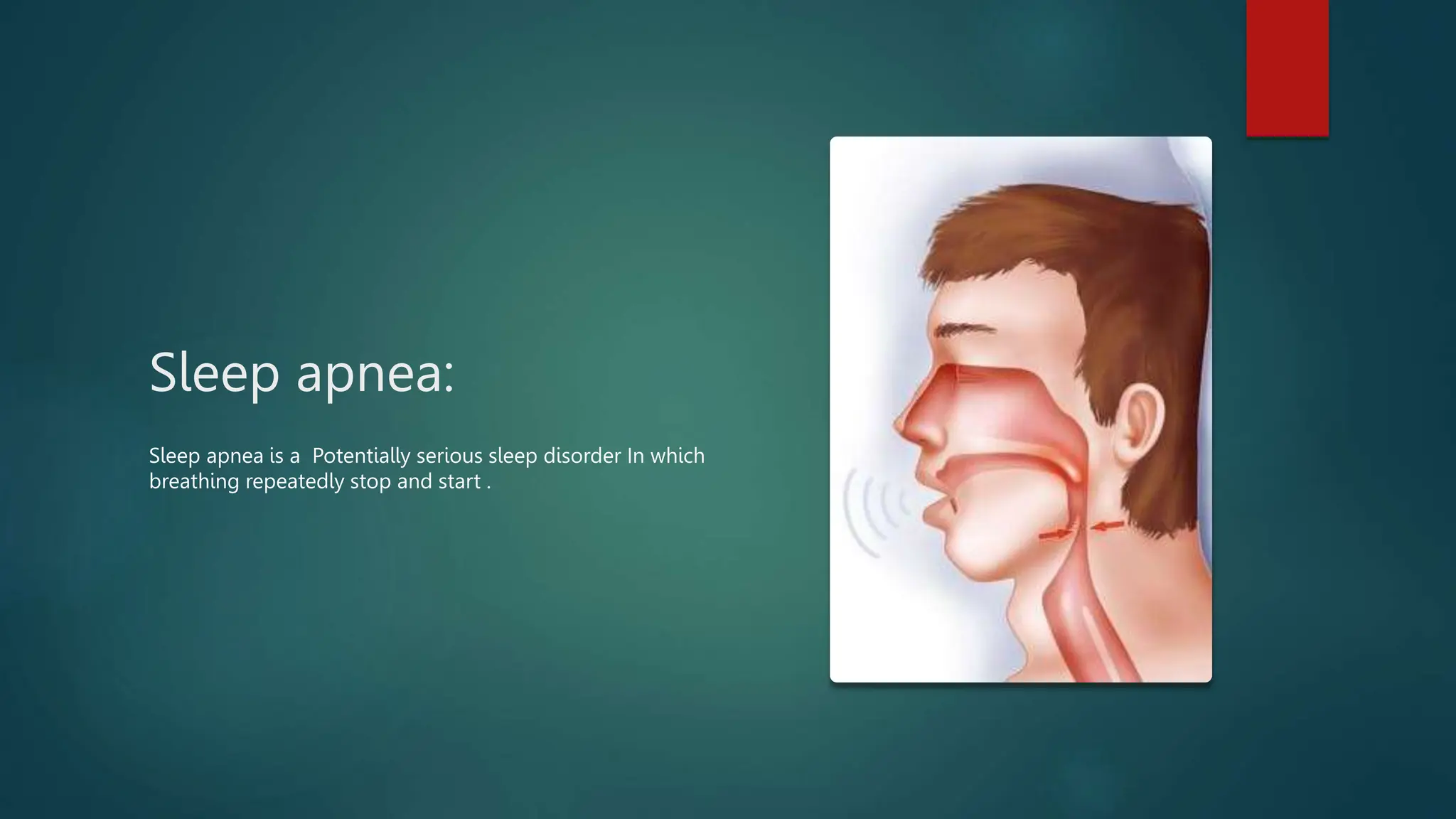
Sleep apnea:
Sleep apnea is a Potentially serious sleep disorder In which
breathing repeatedly stop and start .
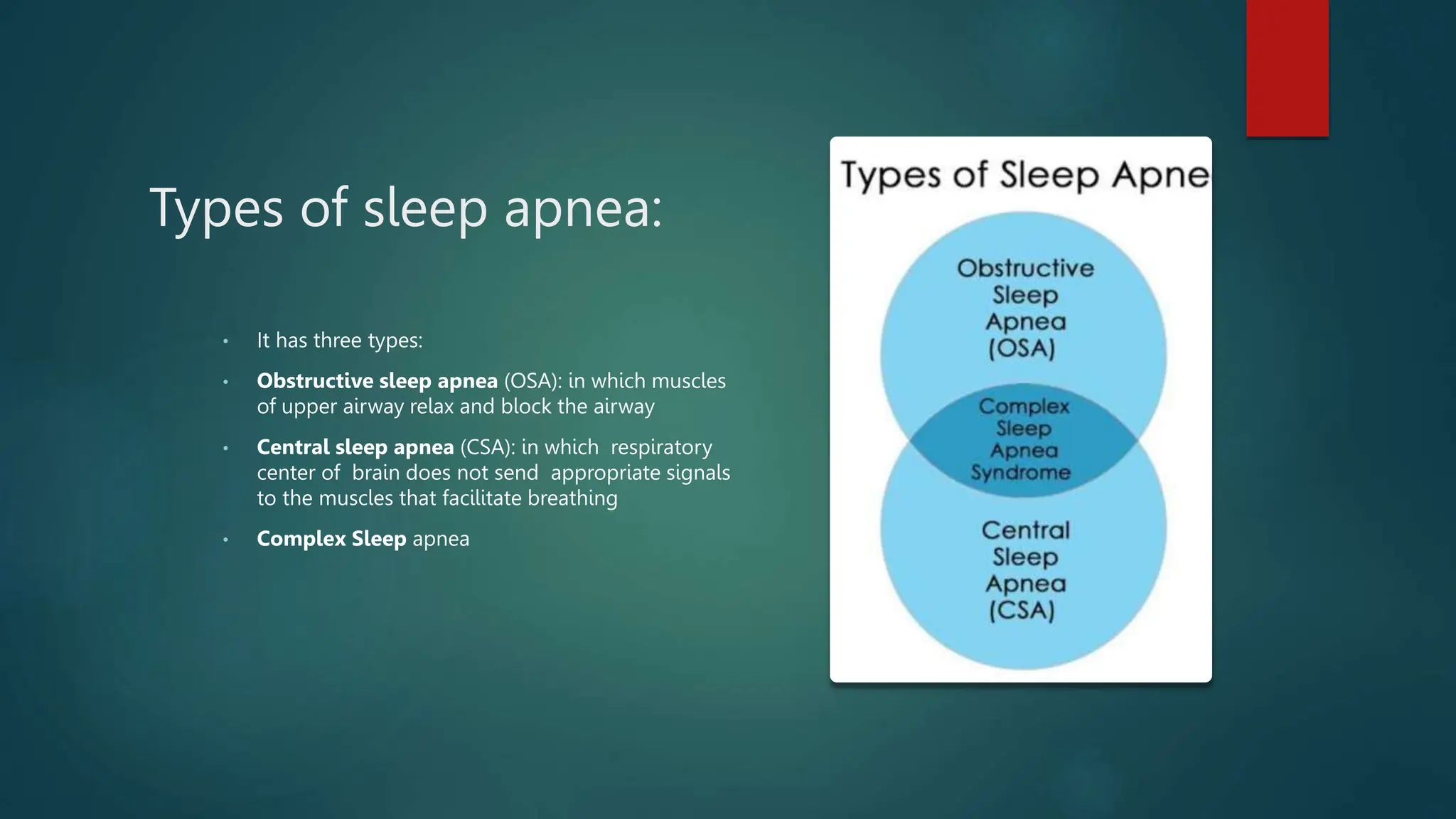
Types of sleep apnea:
• It has three types:
• Obstructive sleep apnea (OSA): in which muscles
of upper airway relax and block the airway
• Central sleep apnea (CSA): in which respiratory
center of brain does not send appropriate signals
to the muscles that facilitate breathing
• Complex Sleep apnea
Obstructive sleep
apnea:
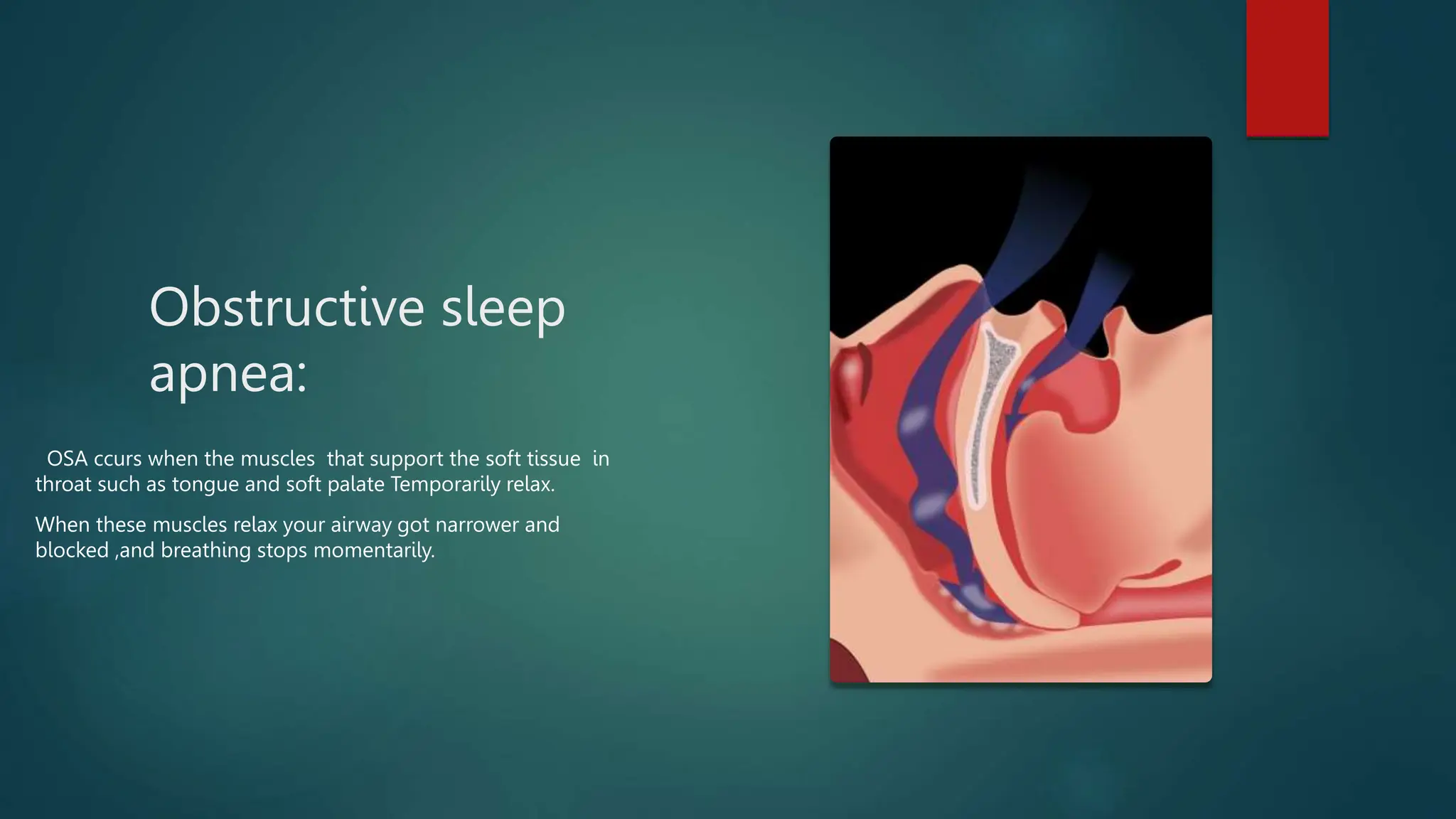
OSA ccurs when the muscles that support the soft tissue in
throat such as tongue and soft palate Temporarily relax.
When these muscles relax your airway got narrower and
blocked ,and breathing stops momentarily.
Risk factors for OSA :
 Obesity
 Lifestyle factors ( such as smoking )
 Old age ( often accompanied by muscular and neurological loss of muscle
tone in upper airway.)
 Genetics
 Craniofacial syndromes( Down syndrome)
Clinical presentation :
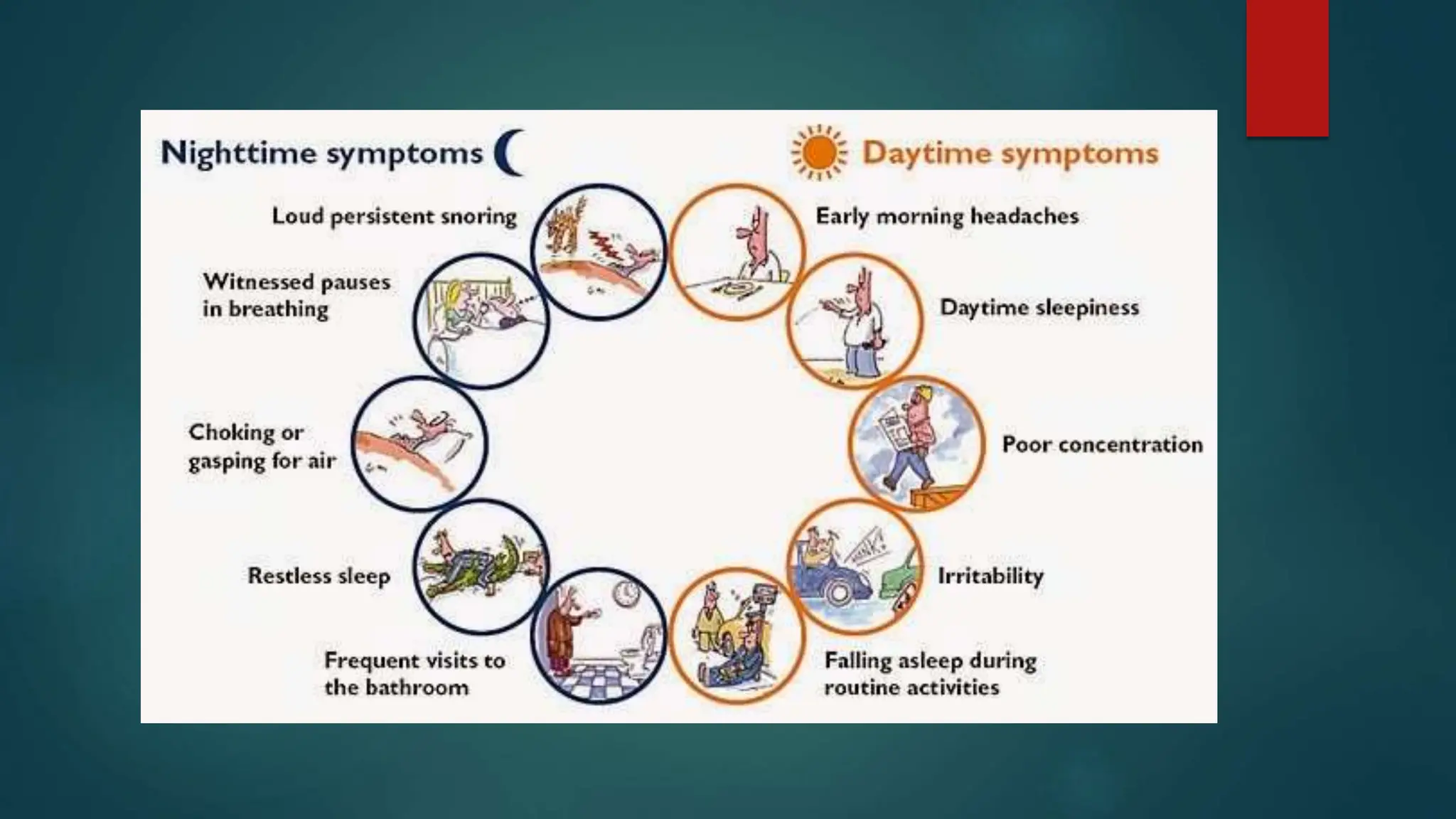
OSA symptoms begin insidiously and they are as follow;
 Nocturnal symptoms ;
 Snoring, usually loud, habitual and bothersome to others.
 Witnessed apneas
 Gasping and choking sensations
 Nocturia
 Insomnia
 Restless sleep .
Cont.
 Daytime Symptoms;
 Nonrestorative sleep
 Morning headache
 Excessive daytime sleepiness ( EDS)
 Fatigue
 Cognitive deficits
 Mood changes such as anxiety and depression.
 GERD
 Hypertension
On physical examination;
 On physical xamination findings may include following;
 Obesity: BMI more than 30kg/m2
 Large neck circumference ( more than 43cm in men and 37 cm in females
.
 Enlarged tonsils ( 3+ or 4+ )
 Microganthia
 High arched hard palate
 Pulmonary hypertension
 Metabolic syndrome
Cont.
 STOP_ BANG questionare is helpful in prediction of OSA.
 It is given as follow;
 STOP;
 S: Do you snore loud enough to be heard even by closed door ?
 T: Do you feel tired during daytime almost everyday ?
 O: Has anyone observed that you stoped breathing during sleep?
 Do you have hx of high BP with or without treatment?
 And BANG questionare . It is given as follow :
 B: BMI more than 35
 A: Age more than 50
 N: Neck circumference more than 43cm
 G: Gender male
 If criteria from both STOP_ BANG mnemonic is met, the sensitivity of pt. Having AHI more than 5 is 93°|°
and more than 15 is 87°|° , which is quite helpful in prediction of OSA .
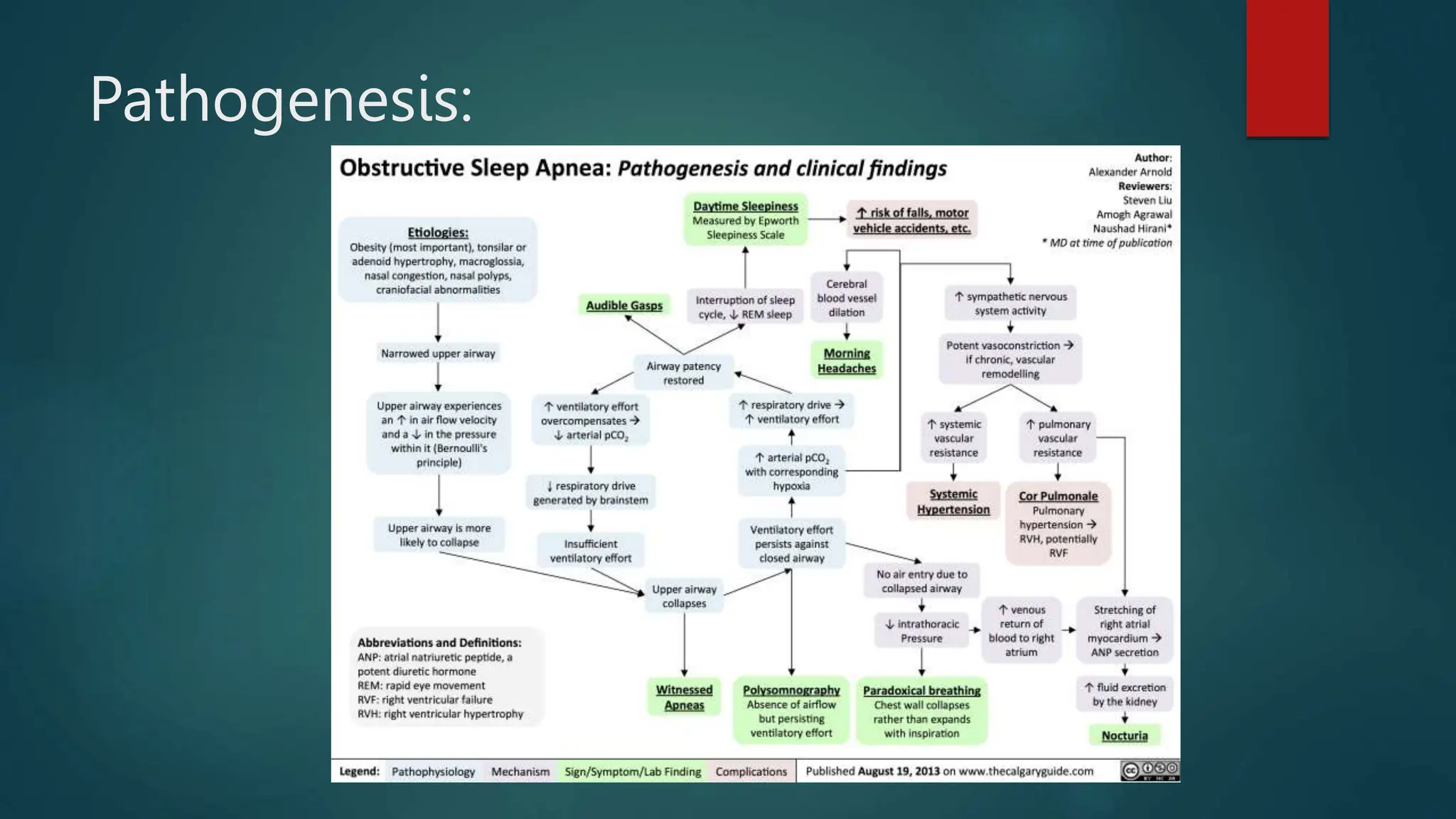
Pathogenesis:
D/D :
 These are as follow:
 Asthma
 Central sleep apnea syndrome
 COPD
 Depression
 GERD
 Hypothyroidism.
 Narcolepsy .
Diagnosis:
 Diagnosis of OSA is made when a person shows recurrent episodes of
partial or conplete block of upper airway during sleep resulting in apnea.
American Academy of sleep medicine (AASM) defines apnea; as a
reduction in airflow of About more than 90•|• lasting at least 10 sec .
 To define the severity , Apnea- hypoaonea index ( AHI) and respiratory
disturbance index (RDI) are Used. These indices are given below .
 STOP_BANG questionare is also a very helpful tool in prediction and
diagnosis of OSA .
AHI :
RDI :
Treatment :
It includes ;
 Lifestyle changes
 Physical intervention
 Surgeries
 Medicines
Lifestyle changes:
 It includes;
 Weight loss
 Avoiding alcohol and smoking
 Sleeping position, on a side is recommended rather than on back .
Cont.
Physical intervention includes ;
 CPAP
 BiPAP
 nasal EPAP ( which is a bandage like device placed over nostrils )
 Oral appliances or splints
Cont.
 Surgeries include;
 Septoplasty
 Tonsillectomy or adenoidectomy
 Uvulopalatopharangoplasty ( UVPP)
 Genioglossus advancement
 Hyoid suspension
 Maxillomandibular advancement
 Bariatric surgery
Cont.
 Evidence is insufficient to support the use of medicines for OSA treatment
. This includes the use of fluoxetine , paroxetine , Acetazolamide,
tryptophan
Obesity hypoventilation
syndrome :
It is a condition in which Severely overweight people fail to breathe deeply and
rapidly enough resulting in low O2 and High CO2 levels .
Clinical features:
 The clinical features of OSA and OHS aquite similar .
 In OHS , sleepiness may be worsened due to increased CO2 levels. ( i-e
CO2 narcosis )
 Other features include depression, HTN , headache which may worsen in
morning .
 The low O2 level lead to physiological constriction of pulmonary arteries
leading to cor- pulmonale, RHF , edema , ascites .
Mechanism :
 It is not fully understood, but
 Firstly , breathing Work is increased as adipose tissue Restrict the normal
movement of chest wall.
 Obese people tend to have increased level of hormone leptin secreted by
adipose tissue, which Increases ventilation.
 Also , Chronic low levels of O2 in blood cause more release of
erythropoietin, increased erythropoiesis, and polycythemia and increased
hematocrit levels .
Diagnosis :
 Criteria for diagnosis of OHS includes;
 BMI over 30 kg/ m2
 Arterial CO2 level over 45mmHg or 6 kPa in ABG report
 No alternative explanation for hypoventilation such as use of narcotics ,
Obstructive or restrictive lung disease , Kyphoscoliosis,Or congenital
hypoventilation syndrome.
 To distinguish various subtypes , Polysomnography is used .
 To distinguish from other lung disease . Chest x-ray , CT scan , MRI chest ,
spirometry are used .
Treatment :
 It includes;
 Weight loss ( either by diet modification , exercise or bariatric surgery)
 Positive airway pressure ( CPAP or BiPAP more preferably) .
 Other treatment may include tracheotomy.
Epidemiology :
 American black people are more likely to be obese than American white
people, but Obese Asian Are More likely to develop OHS than other
ethnicities, at a lower BMI due to physical characteristics.
Prognosis :
 Those with abnormalities Severe enough to warrant treatment have
increased risk of death , about 23•|• over 18 months and 46•|• over 50
months .
 The risk is reduced to less than 10•|• in those Receiving treatment with
PAP .
Thank you

Obstructive sleep apnea (OSA) and Obesity hypoventilation syndrome (OHS)

  • 1.
    Obstructive sleep apnea (OSA)and obesity hypoventilation syndrome (OHS) PRESENTED BY: DR. HAFSA
  • 2.
    Outlines  Brief introductionof sleep apnea and it’s types  Obstructive sleep apnea ( intro, Risk factors, clinical presentation, pathogenesis, D/D , diagnosis , treatment )  Obesity hypoventilation syndrome ( intro , clinical features , pathogenesis, diagnosis , treatment, epidemiology, prognosis )
  • 3.
    Sleep apnea: Sleep apneais a Potentially serious sleep disorder In which breathing repeatedly stop and start .
  • 4.
    Types of sleepapnea: • It has three types: • Obstructive sleep apnea (OSA): in which muscles of upper airway relax and block the airway • Central sleep apnea (CSA): in which respiratory center of brain does not send appropriate signals to the muscles that facilitate breathing • Complex Sleep apnea
  • 5.
    Obstructive sleep apnea: OSA ccurswhen the muscles that support the soft tissue in throat such as tongue and soft palate Temporarily relax. When these muscles relax your airway got narrower and blocked ,and breathing stops momentarily.
  • 6.
    Risk factors forOSA :  Obesity  Lifestyle factors ( such as smoking )  Old age ( often accompanied by muscular and neurological loss of muscle tone in upper airway.)  Genetics  Craniofacial syndromes( Down syndrome)
  • 7.
    Clinical presentation : OSAsymptoms begin insidiously and they are as follow;  Nocturnal symptoms ;  Snoring, usually loud, habitual and bothersome to others.  Witnessed apneas  Gasping and choking sensations  Nocturia  Insomnia  Restless sleep .
  • 8.
    Cont.  Daytime Symptoms; Nonrestorative sleep  Morning headache  Excessive daytime sleepiness ( EDS)  Fatigue  Cognitive deficits  Mood changes such as anxiety and depression.  GERD  Hypertension
  • 10.
    On physical examination; On physical xamination findings may include following;  Obesity: BMI more than 30kg/m2  Large neck circumference ( more than 43cm in men and 37 cm in females .  Enlarged tonsils ( 3+ or 4+ )  Microganthia  High arched hard palate  Pulmonary hypertension  Metabolic syndrome
  • 11.
    Cont.  STOP_ BANGquestionare is helpful in prediction of OSA.  It is given as follow;  STOP;  S: Do you snore loud enough to be heard even by closed door ?  T: Do you feel tired during daytime almost everyday ?  O: Has anyone observed that you stoped breathing during sleep?  Do you have hx of high BP with or without treatment?  And BANG questionare . It is given as follow :  B: BMI more than 35  A: Age more than 50  N: Neck circumference more than 43cm  G: Gender male  If criteria from both STOP_ BANG mnemonic is met, the sensitivity of pt. Having AHI more than 5 is 93°|° and more than 15 is 87°|° , which is quite helpful in prediction of OSA .
  • 13.
  • 15.
    D/D :  Theseare as follow:  Asthma  Central sleep apnea syndrome  COPD  Depression  GERD  Hypothyroidism.  Narcolepsy .
  • 16.
    Diagnosis:  Diagnosis ofOSA is made when a person shows recurrent episodes of partial or conplete block of upper airway during sleep resulting in apnea. American Academy of sleep medicine (AASM) defines apnea; as a reduction in airflow of About more than 90•|• lasting at least 10 sec .  To define the severity , Apnea- hypoaonea index ( AHI) and respiratory disturbance index (RDI) are Used. These indices are given below .  STOP_BANG questionare is also a very helpful tool in prediction and diagnosis of OSA .
  • 17.
  • 18.
  • 19.
    Treatment : It includes;  Lifestyle changes  Physical intervention  Surgeries  Medicines
  • 20.
    Lifestyle changes:  Itincludes;  Weight loss  Avoiding alcohol and smoking  Sleeping position, on a side is recommended rather than on back .
  • 21.
    Cont. Physical intervention includes;  CPAP  BiPAP  nasal EPAP ( which is a bandage like device placed over nostrils )  Oral appliances or splints
  • 24.
    Cont.  Surgeries include; Septoplasty  Tonsillectomy or adenoidectomy  Uvulopalatopharangoplasty ( UVPP)  Genioglossus advancement  Hyoid suspension  Maxillomandibular advancement  Bariatric surgery
  • 25.
    Cont.  Evidence isinsufficient to support the use of medicines for OSA treatment . This includes the use of fluoxetine , paroxetine , Acetazolamide, tryptophan
  • 26.
    Obesity hypoventilation syndrome : Itis a condition in which Severely overweight people fail to breathe deeply and rapidly enough resulting in low O2 and High CO2 levels .
  • 27.
    Clinical features:  Theclinical features of OSA and OHS aquite similar .  In OHS , sleepiness may be worsened due to increased CO2 levels. ( i-e CO2 narcosis )  Other features include depression, HTN , headache which may worsen in morning .  The low O2 level lead to physiological constriction of pulmonary arteries leading to cor- pulmonale, RHF , edema , ascites .
  • 28.
    Mechanism :  Itis not fully understood, but  Firstly , breathing Work is increased as adipose tissue Restrict the normal movement of chest wall.  Obese people tend to have increased level of hormone leptin secreted by adipose tissue, which Increases ventilation.  Also , Chronic low levels of O2 in blood cause more release of erythropoietin, increased erythropoiesis, and polycythemia and increased hematocrit levels .
  • 29.
    Diagnosis :  Criteriafor diagnosis of OHS includes;  BMI over 30 kg/ m2  Arterial CO2 level over 45mmHg or 6 kPa in ABG report  No alternative explanation for hypoventilation such as use of narcotics , Obstructive or restrictive lung disease , Kyphoscoliosis,Or congenital hypoventilation syndrome.  To distinguish various subtypes , Polysomnography is used .  To distinguish from other lung disease . Chest x-ray , CT scan , MRI chest , spirometry are used .
  • 30.
    Treatment :  Itincludes;  Weight loss ( either by diet modification , exercise or bariatric surgery)  Positive airway pressure ( CPAP or BiPAP more preferably) .  Other treatment may include tracheotomy.
  • 31.
    Epidemiology :  Americanblack people are more likely to be obese than American white people, but Obese Asian Are More likely to develop OHS than other ethnicities, at a lower BMI due to physical characteristics.
  • 32.
    Prognosis :  Thosewith abnormalities Severe enough to warrant treatment have increased risk of death , about 23•|• over 18 months and 46•|• over 50 months .  The risk is reduced to less than 10•|• in those Receiving treatment with PAP .
  • 33.