




RESEARCH AND BILL DRAFTING FOR
MEMBERS OF THE REGIONAL LEGISLATIVE
ASSEMBLY OF THE ARMM
By:
ATTY. ROSARIO H. AMATONG-BUENDIA
September 6, 2013
INTRODUCTION

Scope
A. Power s, functions and
responsibilities of the
Re gional Assembly with
sample of bills
B. Resear ch and Bill Dr afting
Procedur e
C. How to amend an existing
law
PERSONAL REQUIREMENTS OF A MEMBER
OF CONGRESS/LEGISLATIVE ASSEMBLY

 Knowledge

of political,
economic, social and cultural
aspects of life.

 Knowledge

of the districts or
province they are
representing.
Knowledge

of official
parliamentary
procedures.
Excellent communication
and listening skills
POWERS OF THE
MEMBERS OF THE
REGIONAL
LEGISLATIVE
ASSEMBLY
General Plenary Powers
Legislative

power or
law making power
(Art. VI Sec.1 ARMM)
Art. VI Sec.1 (ARMM)
The Regional Assembly- The
Legislative power of the
autonomous government shall
be vested in the Regional
Assembly except to the extent
that is reserved to the people
by provisions on initiative and
referendum as provided by
law.
HOUSE BILL NO. 2300
“ An Act Instituting the Philippine
Code of Crimes to further strengthen
the criminal justice system,
repealing for the purpose book one
of Act No. 3815, as amended,
otherwise known as the Revised
Penal Code of the Philippines and
other Special Laws”
The Initiative and
Referendum Act

R.A. 6735




Initiative – the power of the people to
directly propose, enact, approve or reject
the Constitution, laws, ordinances or
resolutions past by any legislative body
Santiago v. Comelec GR 127325 Mar. 25
1997, The Law on Initiative is inadequate,
incomplete and wanting in essential terms
insofar as amendments to the constitution
is concerned.
 Power

to raise money for
public use
(Taxation) (Art. XI, Secs. 1, 7,
13, ARMM)
Art. IX, Sec. 1 (ARMM)

The Regional Government
shall have the power to
create its own sources of
revenues and to levy taxes,
fees, and charges, subject
to the provisions of the
Constitution and this
Organic Act.
Art. IX, Sec. 7 (ARMM )
Extent of Tax Powers;
Exceptions. – Unless
otherwise provided herein, the
taxing power of the regional
government and of the
provinces, cities,
municipalities, and barangays
located therein shall not
extend to the following:
(a) Income tax, except when levied on
banks and other financial institutions;
(b) Documentary stamps tax;
(c) Taxes on estate, inheritance, gifts,
legacies, and other acquisition mortis
causa, except as otherwise provided by
law;
(d) Customs duties, registration fees of
vessels and wharfage and other charges.
HOUSE BILL NO. 00127
“An Act Imposing an Excise Tax, To be

Known as Environmental Levy on the
use of Plastic Bags in shops,
supermarkets, service stations, stores
and/or sales outlets, creating the
Environmental Support Fund”
HOUSE BLL NO. 3343
“ An Act Providing for a
Standard Rate of Fees
and Charges for
Automated Teller
Machines”
House Bill 4438


An Act Prohibiting the
Imposition of Fees and
Charges on Dormant
Accounts and for other
purposes
Article IX, Sec. 13

Regional Tax Exemptions.
The Regional Assembly,
by a vote of absolute
majority of all its
members, may grant
exemptions from
regional taxes.
RA 10143






An Act Establishing The Philippine Tax
Academy, Definings Its Powers and Functions
Sec. 13. Income, Legacies, Gifts, Donations,
Foreign Aids and Grants
For the benefit of the Philipppine Tax
Academy or for its operations , administration
and support or maintenance shall be exempt
from all forms of taxes, fees, assessments
and other charges of the government, its
agencies, instrumentalities, branches and
subdivisions
RA 10026
“ An Act Granting Income Tax Exemption
to Local Water Districts by Amending
Section 27(C) of the National Revenue
Code (NIRC) of 1997, as amended, and
adding Section 289-A to the Code, for
the purpose” (Lapsed into Law on
March 11. 2010)
 Power

to provide how
that money should be
used
(Appropriations)
(Art VI, Sec 20, ARMM)
Art VI, Sec 20 (ARMM)
Annual Budget and Infrastructure
Funds. – The annual budget of the
Regional Government shall be
enacted by Regional Assembly.
Funds for infrastructure in the
autonomous region allocated by the
central government or national
government shall be appropriated
through a Regional Assembly Public
Works Act.
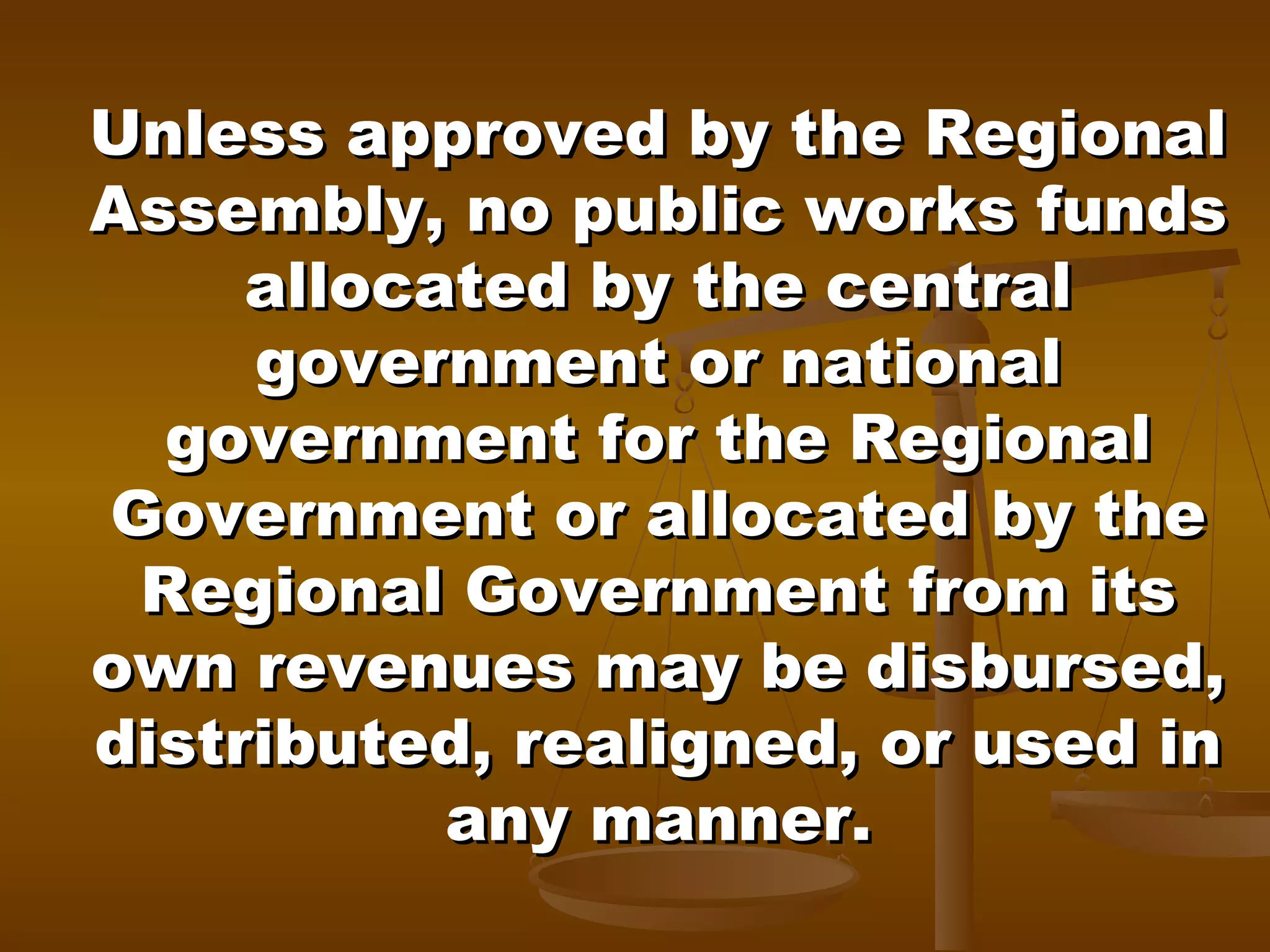
Unless approved by the Regional
Assembly, no public works funds
allocated by the central
government or national
government for the Regional
Government or allocated by the
Regional Government from its
own revenues may be disbursed,
distributed, realigned, or used in
any manner.
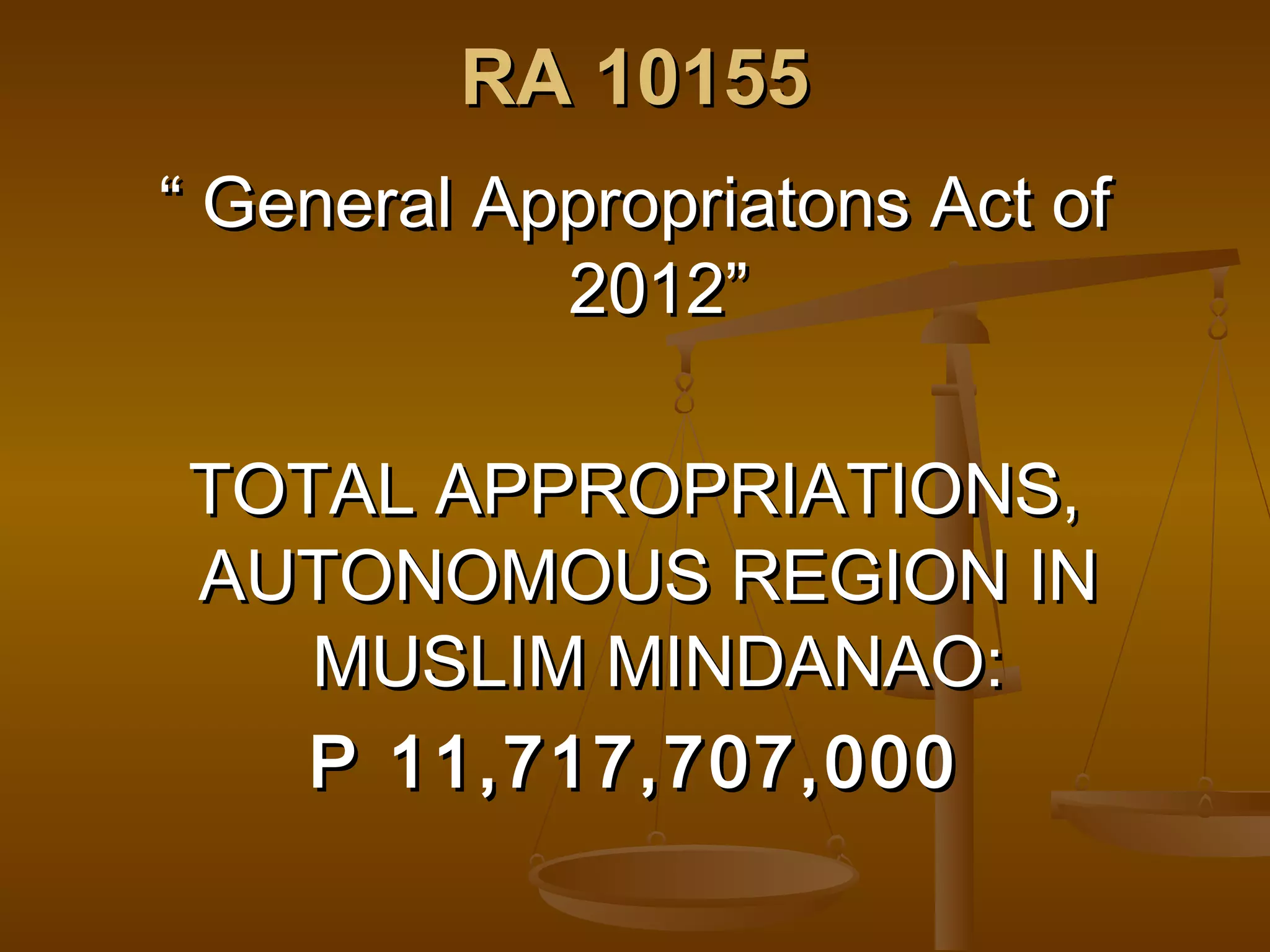
RA 10155
“ General Appropriatons Act of
2012”
TOTAL APPROPRIATIONS,
AUTONOMOUS REGION IN
MUSLIM MINDANAO:
P 11,717,707,000
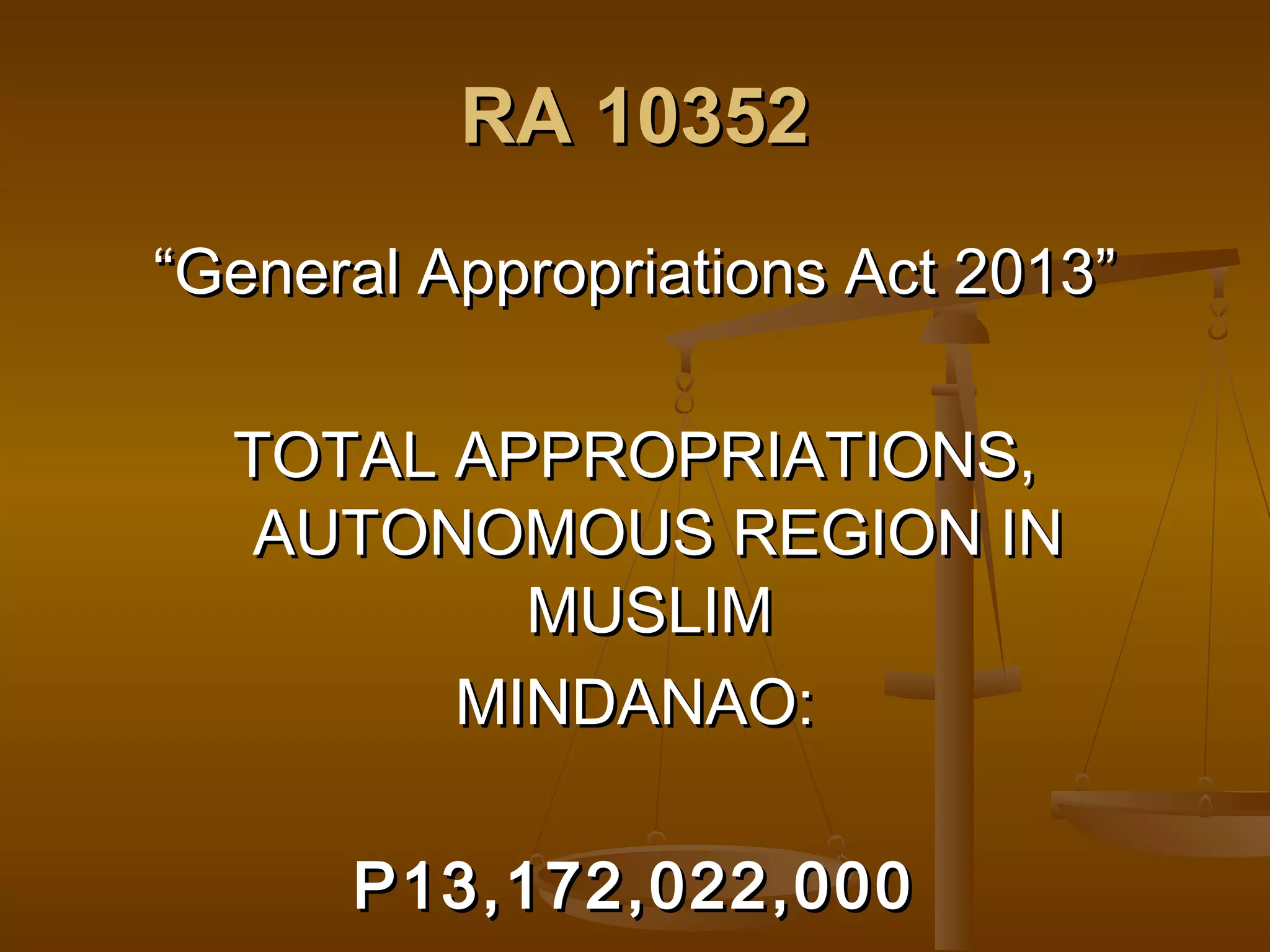
RA 10352
“General Appropriations Act 2013”
TOTAL APPROPRIATIONS,
AUTONOMOUS REGION IN
MUSLIM
MINDANAO:
P13,172,022,000
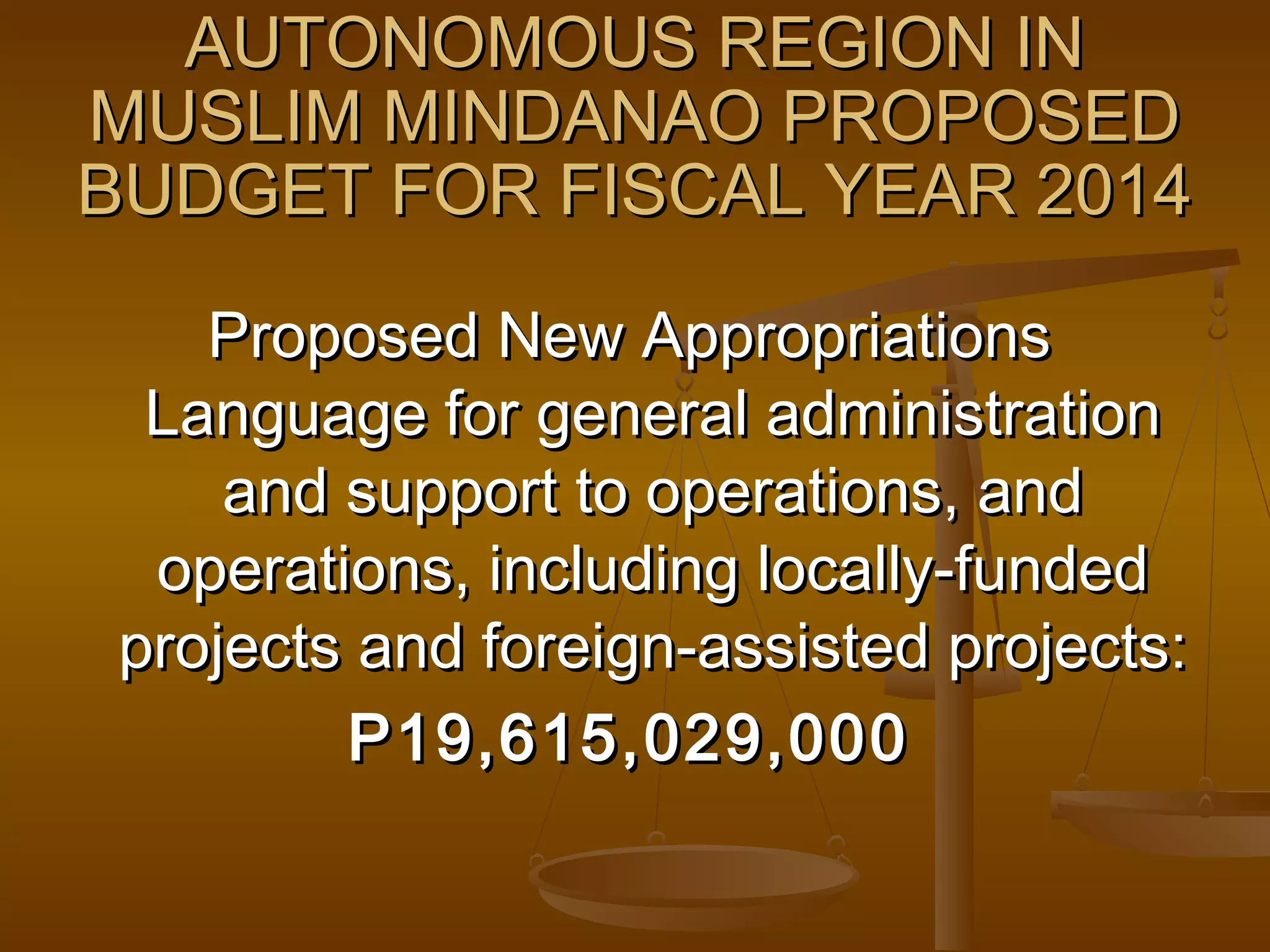
AUTONOMOUS REGION IN
MUSLIM MINDANAO PROPOSED
BUDGET FOR FISCAL YEAR 2014
Proposed New Appropriations
Language for general administration
and support to operations, and
operations, including locally-funded
projects and foreign-assisted projects:
P19,615,029,000
Non-Legislative
Powers

The power of
removal
(Art. VII Sec. 13)
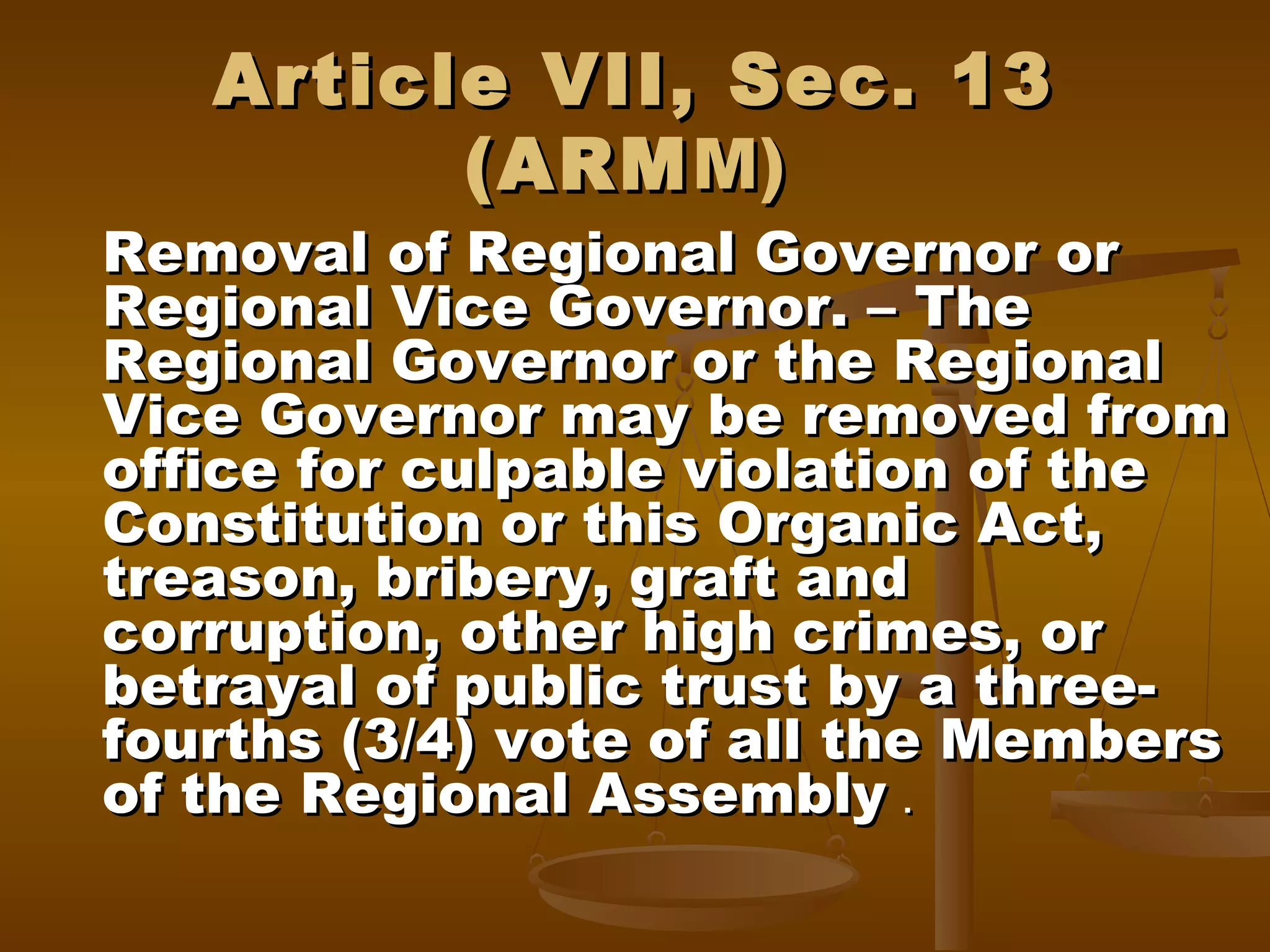
Article VII, Sec. 13
(ARM M)

Removal of Regional Governor or
Regional Vice Governor. – The
Regional Governor or the Regional
Vice Governor may be removed from
office for culpable violation of the
Constitution or this Organic Act,
treason, bribery, graft and
corruption, other high crimes, or
betrayal of public trust by a threefourths (3/4) vote of all the Members
of the Regional Assembly .
The power to
propose
amendments to the
Constitution
(Art. XVII Sec. 2
ARMM)
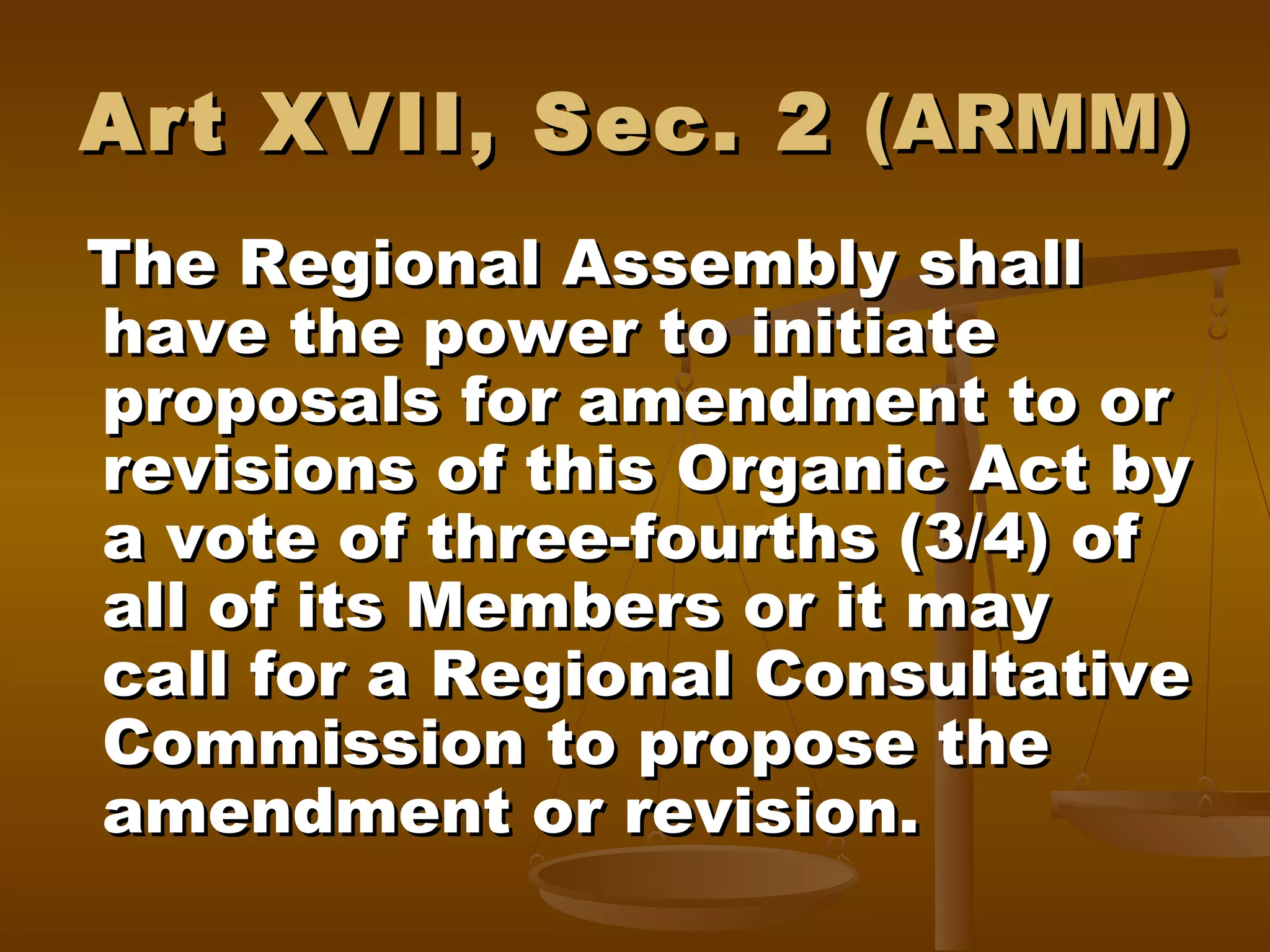
Art XVII, Sec. 2 (ARMM)
The Regional Assembly shall
have the power to initiate
proposals for amendment to or
revisions of this Organic Act by
a vote of three-fourths (3/4) of
all of its Members or it may
call for a Regional Consultative
Commission to propose the
amendment or revision.
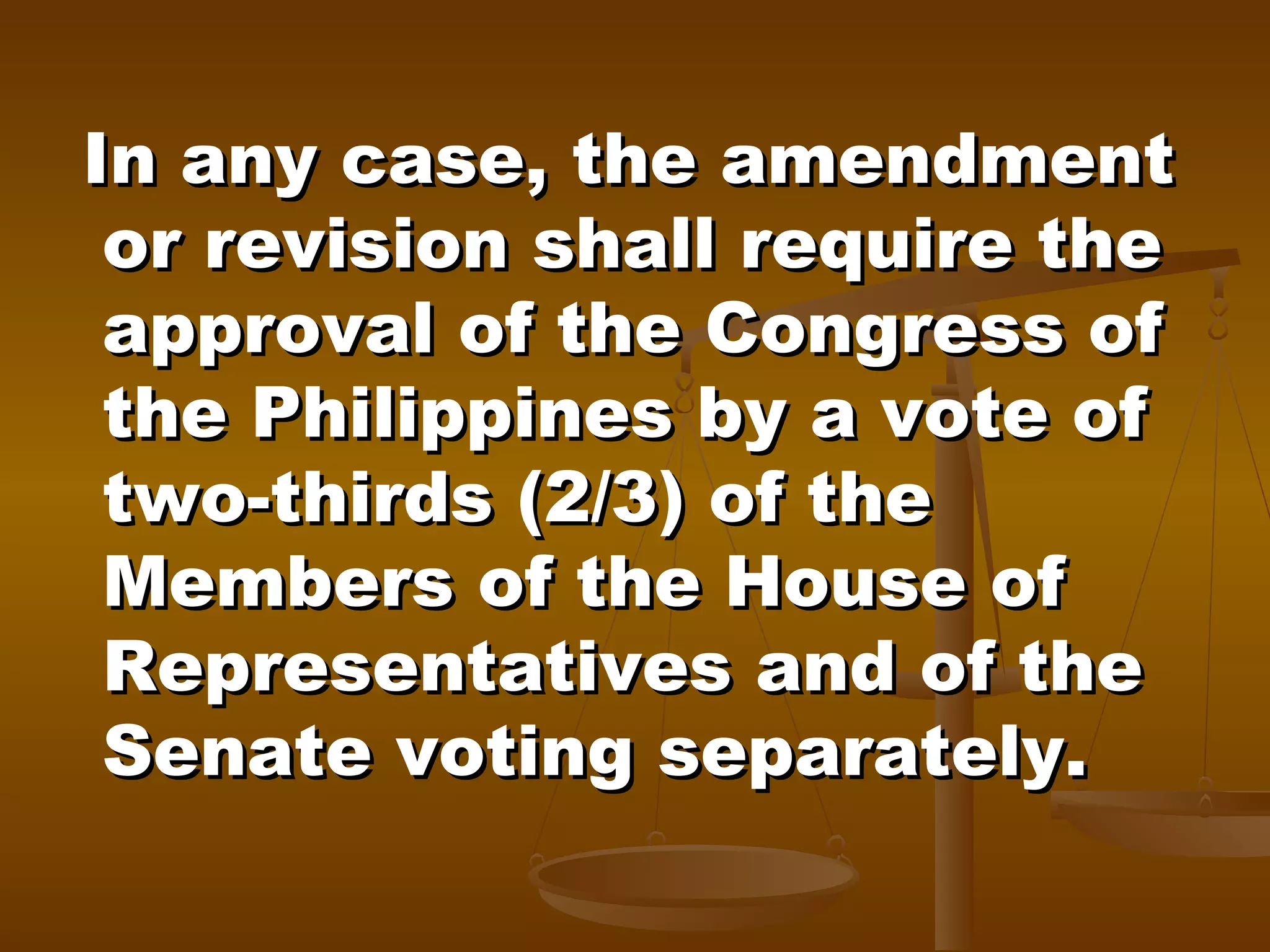
In any case, the amendment
or revision shall require the
approval of the Congress of
the Philippines by a vote of
two-thirds (2/3) of the
Members of the House of
Representatives and of the
Senate voting separately.
HR 00730
“ Resolution to Constitute the Senate
and the House of Representatives
into a Constituent Assembly for the
purpose of drafting and proposing
amendments to, or revision of, the
1987 Constitution particularly to
establish a unicameral Congress”
HOUSE CONCURRENT
RESOLUTION NO. 0017
“ A Concurrent Resolution calling
for a Constitutional Convention to
propose amendments to, or
revision of, the 1987 Constitution
of the Republic of the Philippines”
HOUSE CONCURRENT
RESOLUTION NO. 0026

“ Concurrent Resolution
Submitting to the People the
Question of Calling a
Constitutional Convention”
Implied Powers
Power

to punish
contempt/ Power

for

of

inquiry and
investigation (Art. VI, Sec.
13 par. 5 ARMM)
Arnault v. Nazareno
.R. No. L-3820 July 18, 1950






The Senate has the power to punish for
contempt for refusing to reveal the name of
person to whom Pesos 440,000 was given
because information is often unavailing,
inaccurate and incomplete so some
compulsion is essential
Senate has authority to commit petitioner in
contempt beyond its legislative session
Arnault cannot invoke his right to selfincrimination; it is for the court to determine
Art. VI, Sec. 13 par. 5
(ARMM)

The Regional Assembly or any of its
committees may conduct inquiries or
public consultations in aid of
legislation in accordance with its
rules. In connection therewith, it
shall have the power to issue
subpoenae or subpoenae duces tecum
to compel the attendance of and the
production of papers, documents or
things by witnesses or persons under
investigation by the assembly, itself,
or by any of its committees.
It shall also have the right to cite
witnesses or persons under
investigation for contempt for
refusal to testify before it or
before any of its committees or to
produce papers, documents or
things required by the assembly
or any of its committees. The
rights of persons appearing in or
affected by such inquiries shall be
respected.
Question

Hour
(Art VI, Sec. 14
ARMM)
Art. VI, Sec. 14
(ARMM)

Questioning Cabinet Members and
Other Officials. – The Regional
Assembly may, in aid of legislation
and with the express consent of the
Regional Governor, require the
presence of the regional cabinet
members or their deputies as its
rules shall provide, for questioning on
matters falling within the scope of
their powers and functions.
The Regional Assembly
may require any regional
commission, office, or
agency of the central
government or national
government with offices
in the autonomous region
to explain matters
relating to the exercise of
its powers and functions.
To

Confirm Certain
Appointments ( Art. VII
Sec. 2, par. 3 ARMM)
Art. VII, Sec. 2, p. 3
(ARMM)

The Regional Governor
shall appoint the
members of the
cabinet subject to
confirmation by the
Regional Assembly.
 Power

with Regard to
Utilization of Natural
Resources (Art. XII, Sec.
1 and Art. XII Sec. 8 ARMM)
Art. XII Sec. 1 (ARMM)
Regional Economy and
Conservation of Patrimony –
Consistent with the Constitution
and existing laws the Regional
Assembly may enact laws
pertaining to the regional
economy and patrimony that are
responsive to the needs of the
region.
The Regional Government
may not lower the standards
required by the central
government or national
government for the
protection, conservation,
and enhancement of the
natural resources.
Art. XII, Sec. 8
(ARMM )

Rules, Regulations and Fees. –
The Regional Assembly shall by
law regulate the exploration,
utilization, development, and
protection of the natural
resources, including the mines,
and minerals, except the
strategic minerals as provided in
this Organic Act.
The Regional
Government shall,
pursuant to the said law
prescribe the rules and
regulations and impose
regulatory fees in
connection therewith.
Upon the enactment of the
said law and the effectivity
of such rules and
regulations, the fees
imposed by the Regional
Government shall replace
those that had been
imposed by the central
government or national
government.
LEGISLATIVE RESEARCH:
AN ESSENTIAL TOOL OF
PARLIAMENTARY
DRAFTING
GUIDE
QUESTIONS IN
LEGISLATIVE
RESEARCH AND
BILL DRAFTING




What is the prevailing law
governing the subject matter of
the research or bill and
resolution?
What provisions of the
constitution are relevant to the
subject matter?




What is the controlling
jurisprudence?
What is the government
policy on the matter?


What is the stand of the
concerned government
agency, the NGOs, interest
groups and other
stakeholders on the
subject?




Had there been a similar bill
filed in the previous
Congresses?
Has a bill been filed in the
present Congress?
SOURCES OF INFORMATION
WHERE -

when one sets about
searching for legal
information where does
the person go?


Libraries



School Libraries
Government Libraries (National
Library, Senate Library, House
of Representatives Library,
Supreme Court Library, etc.)











Computer-based legal research
system
On-line source/Web Source
Research
www. congress.gov.ph
www. senate.gov.ph
www. judiciary.gov.ph
www. chanrobles.com
www.lawphil.net
www.gov.ph
Software Programs
 LEX

LIBRIS

 LEXIS

- (Latest software programs
that provide Philippine Laws and
Jurisprudence together with U.S.
Federal and state court cases,
legislation, law reviews and journals)


Government
Agency/Stakeholders
concerned
WHO

–

Research work can be
expedited by consulting
the right people
 Librarian

 Colleague

 Professors

 Consultant
 Lecturer

 Government

Employees
WHEN

–
The information may be
obtained by attending or
participating in:
Seminars

Symposia

Conventions

Conferences
Dialogues
WHAT

–
The information may be
in any type of legal
materials, such as:
 Textbooks
 Legal

Forms
 Text of law
 Journals
 Citators
 Dictionaries
 Law Reports
STEPS IN PREPARING RESEARCH
REPORTS


STEP 1. The First Step is always to determine
the primary authority that governs the subject
matter.

PRIMARY AUTHORITY
All three branches of government generate
primary authority






The statutes passed by
Congress;
The rules promulgated by the
Executive;
The decisions of the Supreme
Court are primary authority.
 The

Constitution

The first and foremost source of
primary authority is the
Constitution. It is the supreme
law of the land.
(The Organic Act for the
Autonomous Region in the Muslim
Mindanao is the Primary Authority
for the ARMM)
Treaties

When properly ratified
and brought into force
a treaty may not be
infringed by domestic
legislation.
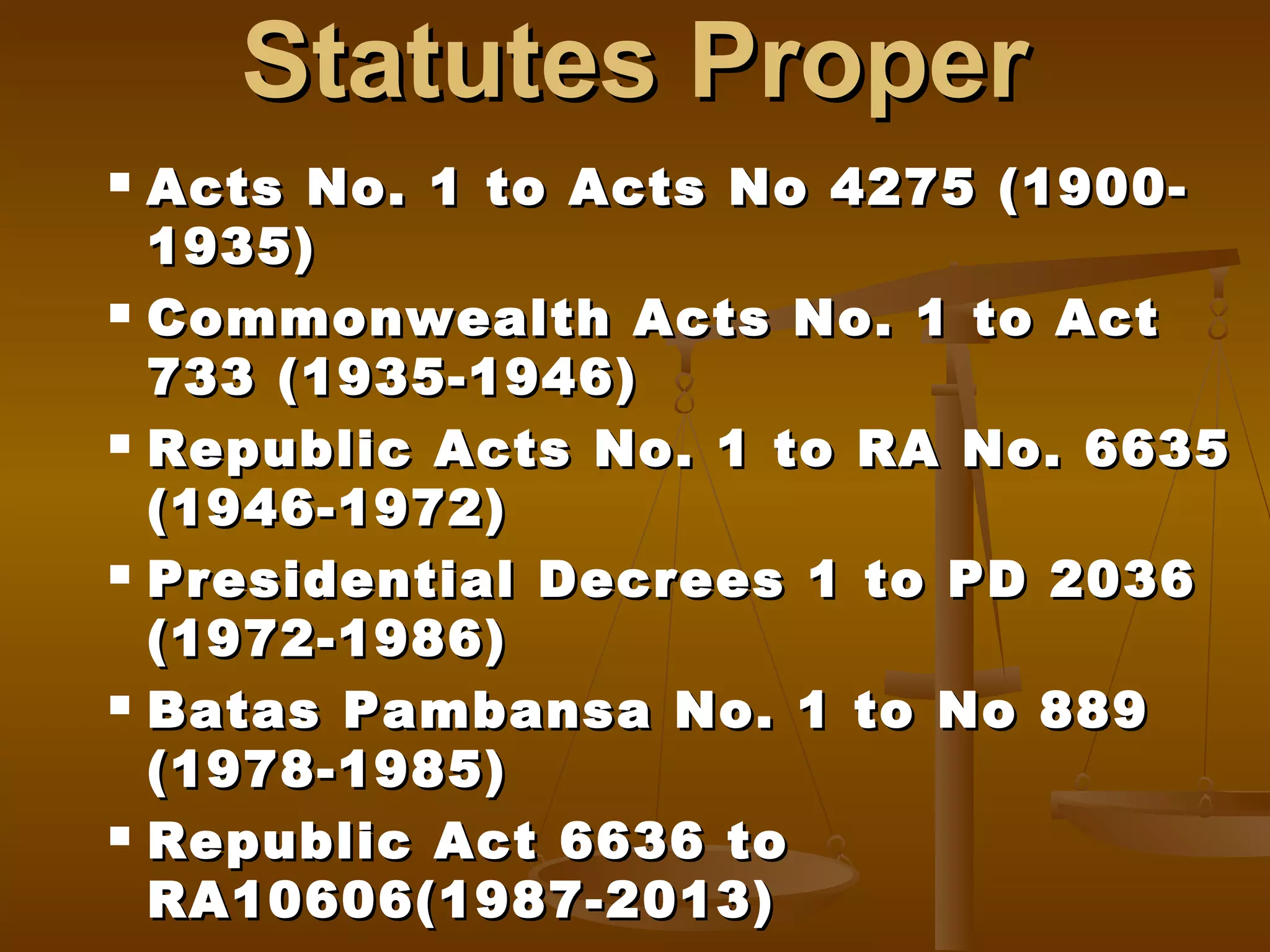
Statutes Proper
Acts No. 1 to Acts No 4275 (19001935)
 Commonwealth Acts No. 1 to Act
733 (1935-1946)
 Republic Acts No. 1 to RA No. 6635
(1946-1972)
 Presidential Decrees 1 to PD 2036
(1972-1986)
 Batas Pambansa No. 1 to No 889
(1978-1985)
 Republic Act 6636 to
RA10606(1987-2013)

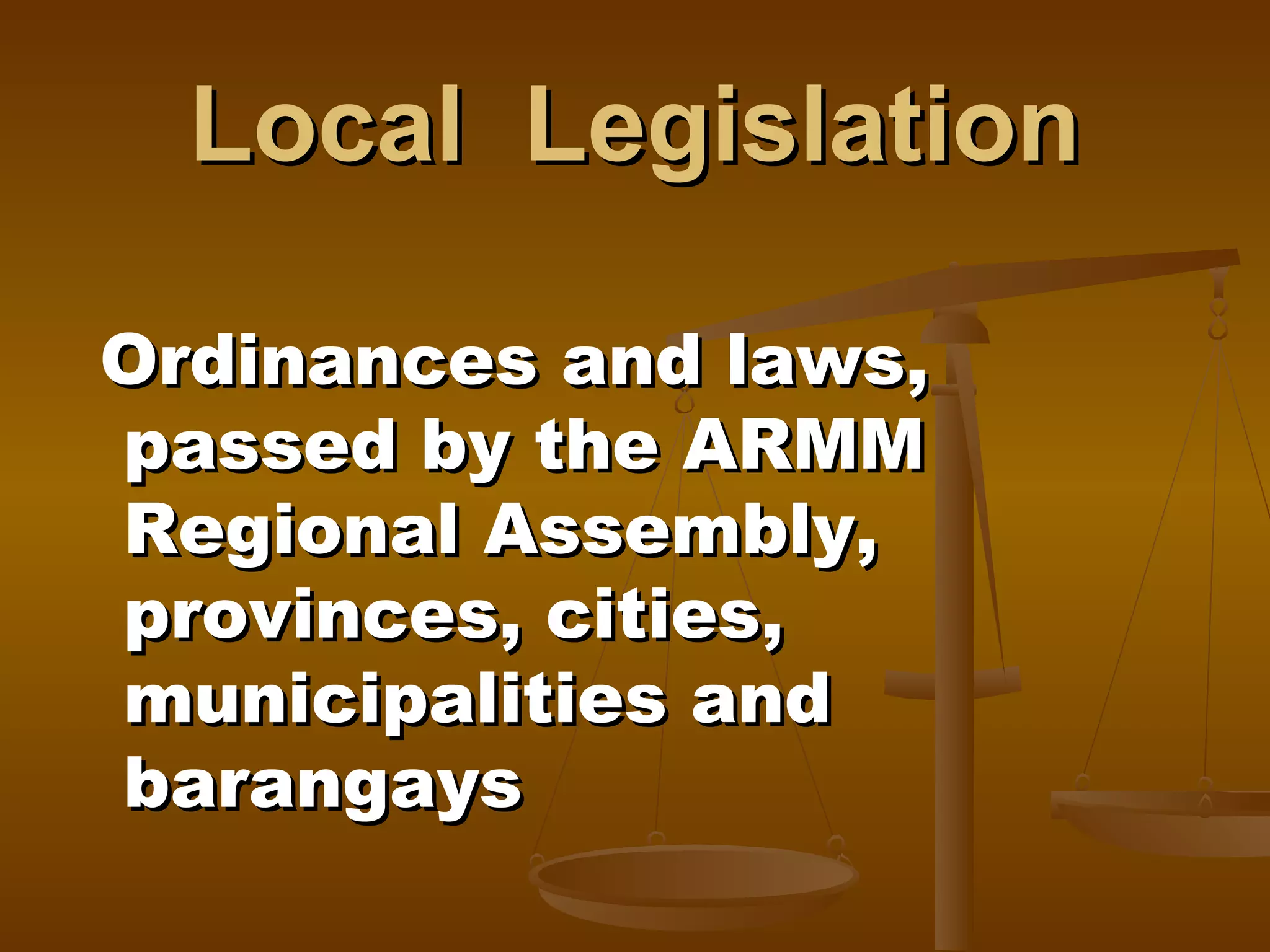
Local Legislation
Ordinances and laws,
passed by the ARMM
Regional Assembly,
provinces, cities,
municipalities and
barangays
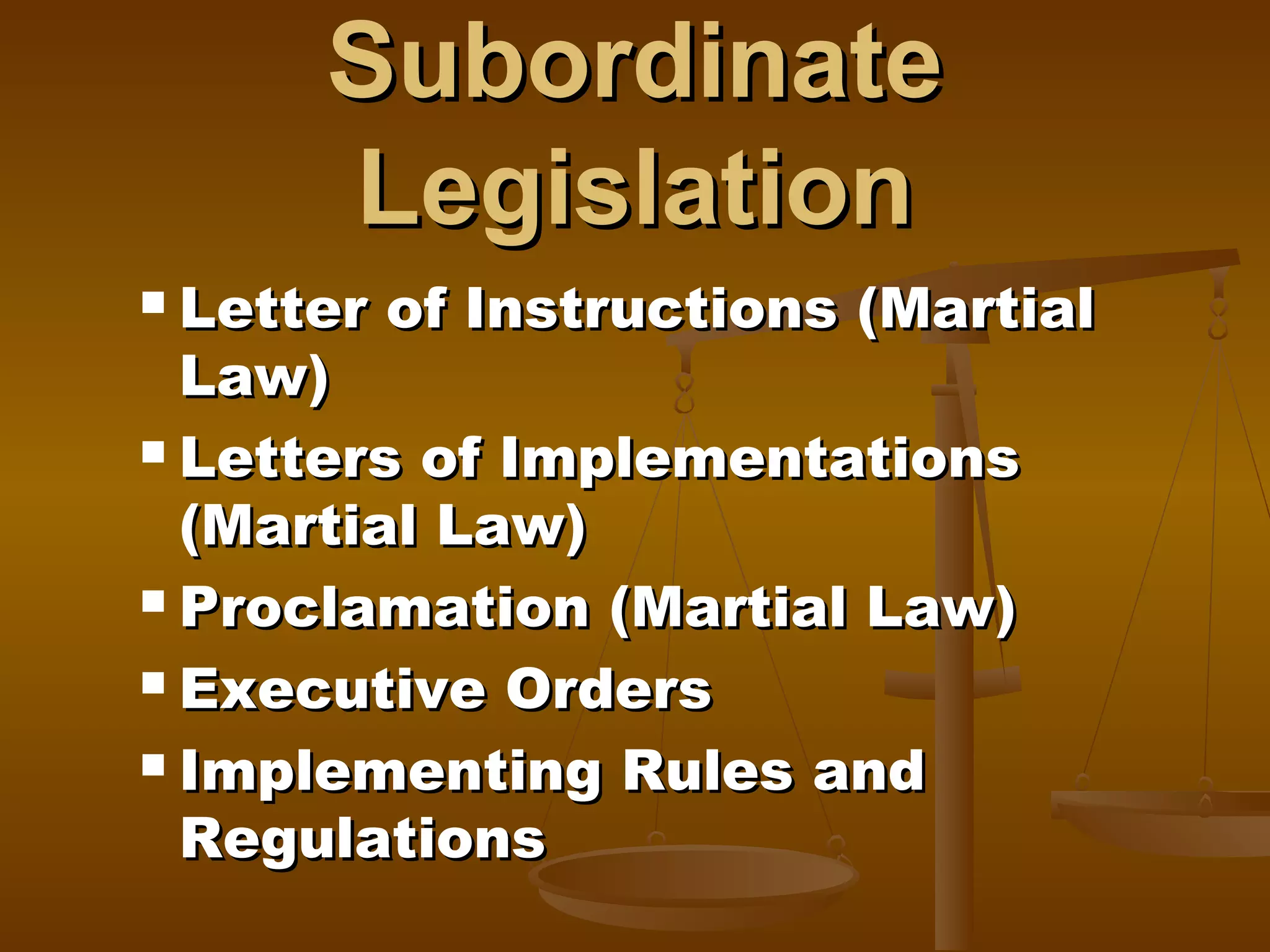
Subordinate
Legislation
Letter of Instructions (Martial
Law)
 Letters of Implementations
(Martial Law)
 Proclamation (Martial Law)
 Executive Orders
 Implementing Rules and
Regulations

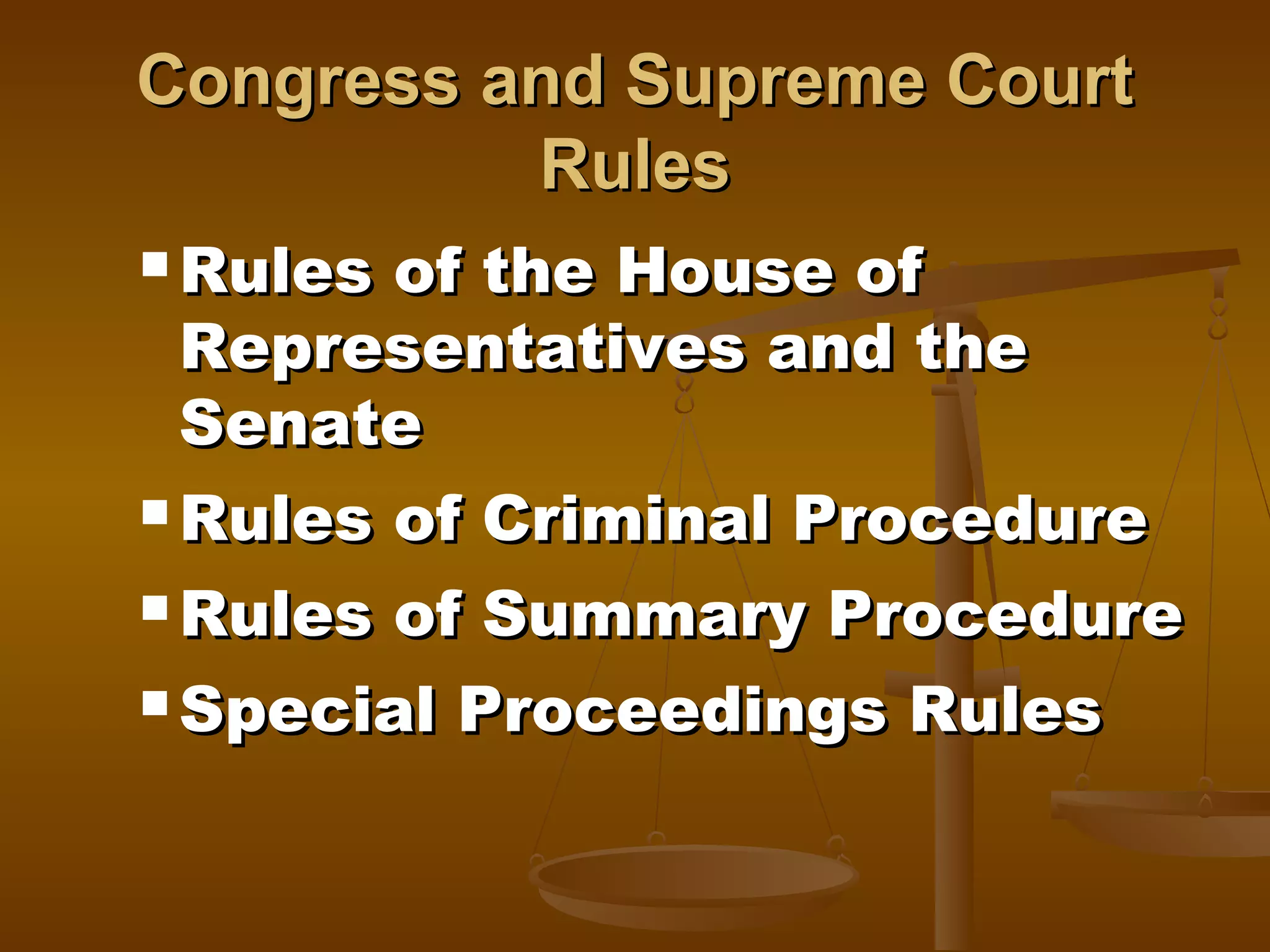
Congress and Supreme Court
Rules
 Rules

of the House of
Representatives and the
Senate
 Rules of Criminal Procedure
 Rules

of Summary Procedure
 Special Proceedings Rules
Judicial Precedents
 Philippine

Reports
 Supreme Court Reports
Annotated (SCRA) (1961Present)
 Supreme Court Advance
Decisions (SCAD)
STEP 2. The next step is finding
secondary authority
 SECONDARY

AUTHORITY
is anything other than primary
authority that could be used as
basis when the primary
authority is unclear or
unavailable. This includes:
 Records

of the
Constitutional
Commission,
Constitutional
Convention, Constituent
Assembly
 Legislative History of a
Statute
 Commentaries

of legal experts
as found in legal books and
journals of law schools
 Case digests
 Encyclopedias
 Dictionaries
 STEP

3. The third step

is to find other research
materials. These
materials could be used
to provide other
information which may
have been overlooked.
These materials include:






Loose Leaf Pamphlets from
Government Agencies;
Periodicals
Major Studies from agencies,
associations, public interest
groups, unions
Proposals from groups that
have interest in the subject.
THE CHECKLIST OF THE BILL
DRAFTER
 Constitutionality

Check
 Existing Law Check
 Identical Bill Check
 Foreign Law Check
 Other sources
PARTS OF A
BILL
The Explanatory Note
That part which serves to
explain the intention of the
lawmaking body in
presenting the bill and
which announces the
purposes or objects of the
bill.
G.R. NO. 169435,
February 27, 2008
MUNICIPALITY OF NUEVA ERA, ILOCOS NORTE,
represented by its Municipal Mayor, CAROLYN
ARZADON-GARVIDA, petitioner, vs.
MUNICIPALITY OF MARCOS, ILOCOS NORTE,
represented by its Municipal Mayor, SALVADOR
PILLOS, and the HONORABLE COURT OF
APPEALS, respondents
According to the decision of the
Supreme Court: (T) his conclusion on

the intention of the legislature is
bolstered by the explanatory note of
the bill which paved the way for the
creation of Marcos. Said
explanatory note mentioned only
Dingras as the mother municipality
of Marcos.
Where there is ambiguity in the statute, as in this
case, courts may resort to the explanatory note
to clarify the ambiguity and ascertain the
purpose and intent of the statute.
(Agapalo, Statutory Construction, 3rd ed., 1995,
p. 73 citing Basiana v Luna, G.R. No. 34135,
February 24, 1981, 103 SCRA 49 [1981];
Libares v. Exe. Secretary, G.R. No. 21505,
October 24, 1963, 9 SCRA 261 [1963]; People
v. Olarte, 108 Phil. 756 [1960].)
The Title
Announces the subject of a bill
 The purpose is to apprise the legislators
of the purposes, nature and scope of the
law
 To prevent the enactment of matters
which have not received the notice,
action and study of the legislators and
 The public










Not part of the law
Not the law but the name given to
the law by the makers
Does not create , repeal or put
the Act into effect
An aid in the interpretation as to
the intent of legislators
Must be made concise but broad enough
to indicate the scope of the bill
The Enacting Clause
That part of the bill immediately
preceding the body of the proposed
measure which secures uniformity
on the style of the proposed law
and identifies the authority by
which the same in enacted. The
form of enacting clause used by
Congress is “Be it enacted by the
Senate and the House of
Representatives of the Philippines
in Congress Assembled”
The Body of the Bill

The principal
portion of the bill
containing the
proposed law
itself.
Questions when drafting the body
of a bill









What will the law do?
Who will do it? Must an office be created
to perform it?
How will it be done?
Is there a period or time within which to
perform the law?
Liabilities of persons, Penalties, Fines?
Appropriations, sources of money, fund?
The Effectivity
Clause
That portion which
provides for the time
when the proposed law
once approved shall
take effect.
New Civil Code of the
Philippines

“ Art. 2. Laws shall take effect
after fifteen days following the
completion of their publication in
the Official Gazette, unless it is
otherwise provided. “
“ This Code shall take effect one
year after its publication.”
Jurisprudence
Tañada V. Tuvera, 136 SCRA 27 (April 25,
1985); Id., Motion for Reconsideration)
146 SCRA 446 (December 29, 1986)
In the case of Tañada v. Tuvera, the
Supreme Court had the occasion to
interpret the phrase “unless otherwise
provided” found in Article 2 of the Civil
Code. The Court debunked the argument
that publication is not necessary when
the laws (decrees) themselves declare
that they are to become effective
immediately upon their approval.
Executive
292 (July

Order No.
25, 1987)

“Sec. 18. When Laws Take
Effect. – Laws shall take effect
after fifteen (15) days following
the completion of their
publication in the Official
Gazette or in a newspaper of
general circulation, unless it is
otherwise provided.”


TOPIC

:

ANCESTRAL DOMAIN AND MINING
CLAIMS
II. CONSTITUTIONAL PROVISION:
Sec.12, Art. XII (National Economy
and Patrimony) (1987 Constitution)
III.


LAWS:

R.A. 8371 – AN ACT TO RECOGNIZE,
PROTECT AND PROMOTE THE RIGHTS
OF INDIGENOUS CULTURAL
COMMUNITIES/INDIGENOUS
PEOPLES, CREATING A NATIONAL
COMMISSION ON INDIGENEOUS
PEOPLES, ESTABLISHING
IMPLEMENTING MECHANISMS,
APPROPRIATING FUNDS THEREFORE,
AND FOR OTHER PURPOSES
R.A. 7942 – AN ACT
INSTITU TING A NEW
SYSTEM OF MINERAL
RESOURCES
EXPLORATION,
DEVELOPMENT,
UTILIZATION AND
CONSERVATION
JURISPRUDENCE
ISAGANI CRUZ V.
SECRETARY
OF
ENVIRONMENT
AND
NATURAL
RESOURCES,
ETAL. G.R. NO. 135385,
DECEMBER 6, 2000
HOW TO
AMEND A LAW
Ramseyer Rule (1929)
 US Congress
Is a legislative drafting rule which provides
that whenever a committee reports a bill
or joint resolution repealing or amending
any statute or part thereof to be
repealed, as well as a comparative print
showing the proposed omissions and
insertions by striken-through type and
italics, parallel columns, or other
appropriate typographical devices.

PURPOSE

The purpose of the
Ramseyer rule is to inform
Members of any changes in
existing law to occur
through proposed
legislation.
In Congress, all proposed
amendatory bills comply with the
rule by enclosing in brackets all
words, phrases, numbers and
punctuation marks sought to be
deleted and printing in all capital
letters those intended to be added
or inserted.
The object is to be fairly
apprise the legislators of the
changes proposed to be made
on existing laws, thereby
affording them more
exhaustive and intelligent
deliberations on bills under
consideration.
Sample of an
Amendatory Bill
‘AN ACT PROVIDING FOR STIFFER FINES
AND PENALTIES FOR THE ILLEGAL
DISPOSAL OF WASTE MATERIALS,
AMENDING FOR THE PURPOSE REPUBLIC
ACT 9003 KNOWN AS THE “ECOLOGICAL
SOLID WASTE MANAGEMENT ACT OF
2000”
Section 1. Section 49 of Republic
Act 9003, is hereby amended to
read as follows:
“Sec.49. Fines and Penalties. – (a) Any person who
violates Sec. 48 paragraph (1) shall, upon conviction,
be punished with a fine of not less the [Three] FIVE
hundred pesos [(P300.00)] (P500.00) but not more
than One Thousand FIVE HUNDRED Pesos
[(P1,000.00)] (P1,500.00) or render community
service for not less than [one] FIFTEEN [(1)] (15)
dayS to not more than [fifteen] THIRTY [(15)] (30)
days to LGU where such prohibited acts are
committed, or both;…..
THANK YOU
AND GOD
BLESS!

Research and Bill Drafting

  • 1.
    RESEARCH AND BILLDRAFTING FOR MEMBERS OF THE REGIONAL LEGISLATIVE ASSEMBLY OF THE ARMM By: ATTY. ROSARIO H. AMATONG-BUENDIA September 6, 2013
  • 2.
    INTRODUCTION Scope A. Power s,functions and responsibilities of the Re gional Assembly with sample of bills B. Resear ch and Bill Dr afting Procedur e C. How to amend an existing law
  • 3.
    PERSONAL REQUIREMENTS OFA MEMBER OF CONGRESS/LEGISLATIVE ASSEMBLY  Knowledge of political, economic, social and cultural aspects of life.  Knowledge of the districts or province they are representing.
  • 4.
  • 5.
    POWERS OF THE MEMBERSOF THE REGIONAL LEGISLATIVE ASSEMBLY
  • 6.
    General Plenary Powers Legislative poweror law making power (Art. VI Sec.1 ARMM)
  • 7.
    Art. VI Sec.1(ARMM) The Regional Assembly- The Legislative power of the autonomous government shall be vested in the Regional Assembly except to the extent that is reserved to the people by provisions on initiative and referendum as provided by law.
  • 8.
    HOUSE BILL NO.2300 “ An Act Instituting the Philippine Code of Crimes to further strengthen the criminal justice system, repealing for the purpose book one of Act No. 3815, as amended, otherwise known as the Revised Penal Code of the Philippines and other Special Laws”
  • 9.
    The Initiative and ReferendumAct R.A. 6735   Initiative – the power of the people to directly propose, enact, approve or reject the Constitution, laws, ordinances or resolutions past by any legislative body Santiago v. Comelec GR 127325 Mar. 25 1997, The Law on Initiative is inadequate, incomplete and wanting in essential terms insofar as amendments to the constitution is concerned.
  • 10.
     Power to raisemoney for public use (Taxation) (Art. XI, Secs. 1, 7, 13, ARMM)
  • 11.
    Art. IX, Sec.1 (ARMM) The Regional Government shall have the power to create its own sources of revenues and to levy taxes, fees, and charges, subject to the provisions of the Constitution and this Organic Act.
  • 12.
    Art. IX, Sec.7 (ARMM ) Extent of Tax Powers; Exceptions. – Unless otherwise provided herein, the taxing power of the regional government and of the provinces, cities, municipalities, and barangays located therein shall not extend to the following:
  • 13.
    (a) Income tax,except when levied on banks and other financial institutions; (b) Documentary stamps tax; (c) Taxes on estate, inheritance, gifts, legacies, and other acquisition mortis causa, except as otherwise provided by law; (d) Customs duties, registration fees of vessels and wharfage and other charges.
  • 14.
    HOUSE BILL NO.00127 “An Act Imposing an Excise Tax, To be Known as Environmental Levy on the use of Plastic Bags in shops, supermarkets, service stations, stores and/or sales outlets, creating the Environmental Support Fund”
  • 15.
    HOUSE BLL NO.3343 “ An Act Providing for a Standard Rate of Fees and Charges for Automated Teller Machines”
  • 16.
    House Bill 4438  AnAct Prohibiting the Imposition of Fees and Charges on Dormant Accounts and for other purposes
  • 17.
    Article IX, Sec.13 Regional Tax Exemptions. The Regional Assembly, by a vote of absolute majority of all its members, may grant exemptions from regional taxes.
  • 18.
    RA 10143    An ActEstablishing The Philippine Tax Academy, Definings Its Powers and Functions Sec. 13. Income, Legacies, Gifts, Donations, Foreign Aids and Grants For the benefit of the Philipppine Tax Academy or for its operations , administration and support or maintenance shall be exempt from all forms of taxes, fees, assessments and other charges of the government, its agencies, instrumentalities, branches and subdivisions
  • 19.
    RA 10026 “ AnAct Granting Income Tax Exemption to Local Water Districts by Amending Section 27(C) of the National Revenue Code (NIRC) of 1997, as amended, and adding Section 289-A to the Code, for the purpose” (Lapsed into Law on March 11. 2010)
  • 20.
     Power to providehow that money should be used (Appropriations) (Art VI, Sec 20, ARMM)
  • 21.
    Art VI, Sec20 (ARMM) Annual Budget and Infrastructure Funds. – The annual budget of the Regional Government shall be enacted by Regional Assembly. Funds for infrastructure in the autonomous region allocated by the central government or national government shall be appropriated through a Regional Assembly Public Works Act.
  • 22.
    Unless approved bythe Regional Assembly, no public works funds allocated by the central government or national government for the Regional Government or allocated by the Regional Government from its own revenues may be disbursed, distributed, realigned, or used in any manner.
  • 23.
    RA 10155 “ GeneralAppropriatons Act of 2012” TOTAL APPROPRIATIONS, AUTONOMOUS REGION IN MUSLIM MINDANAO: P 11,717,707,000
  • 24.
    RA 10352 “General AppropriationsAct 2013” TOTAL APPROPRIATIONS, AUTONOMOUS REGION IN MUSLIM MINDANAO: P13,172,022,000
  • 25.
    AUTONOMOUS REGION IN MUSLIMMINDANAO PROPOSED BUDGET FOR FISCAL YEAR 2014 Proposed New Appropriations Language for general administration and support to operations, and operations, including locally-funded projects and foreign-assisted projects: P19,615,029,000
  • 26.
  • 27.
    Article VII, Sec.13 (ARM M) Removal of Regional Governor or Regional Vice Governor. – The Regional Governor or the Regional Vice Governor may be removed from office for culpable violation of the Constitution or this Organic Act, treason, bribery, graft and corruption, other high crimes, or betrayal of public trust by a threefourths (3/4) vote of all the Members of the Regional Assembly .
  • 28.
    The power to propose amendmentsto the Constitution (Art. XVII Sec. 2 ARMM)
  • 29.
    Art XVII, Sec.2 (ARMM) The Regional Assembly shall have the power to initiate proposals for amendment to or revisions of this Organic Act by a vote of three-fourths (3/4) of all of its Members or it may call for a Regional Consultative Commission to propose the amendment or revision.
  • 30.
    In any case,the amendment or revision shall require the approval of the Congress of the Philippines by a vote of two-thirds (2/3) of the Members of the House of Representatives and of the Senate voting separately.
  • 31.
    HR 00730 “ Resolutionto Constitute the Senate and the House of Representatives into a Constituent Assembly for the purpose of drafting and proposing amendments to, or revision of, the 1987 Constitution particularly to establish a unicameral Congress”
  • 32.
    HOUSE CONCURRENT RESOLUTION NO.0017 “ A Concurrent Resolution calling for a Constitutional Convention to propose amendments to, or revision of, the 1987 Constitution of the Republic of the Philippines”
  • 33.
    HOUSE CONCURRENT RESOLUTION NO.0026 “ Concurrent Resolution Submitting to the People the Question of Calling a Constitutional Convention”
  • 34.
    Implied Powers Power to punish contempt/Power for of inquiry and investigation (Art. VI, Sec. 13 par. 5 ARMM)
  • 35.
    Arnault v. Nazareno .R.No. L-3820 July 18, 1950    The Senate has the power to punish for contempt for refusing to reveal the name of person to whom Pesos 440,000 was given because information is often unavailing, inaccurate and incomplete so some compulsion is essential Senate has authority to commit petitioner in contempt beyond its legislative session Arnault cannot invoke his right to selfincrimination; it is for the court to determine
  • 36.
    Art. VI, Sec.13 par. 5 (ARMM) The Regional Assembly or any of its committees may conduct inquiries or public consultations in aid of legislation in accordance with its rules. In connection therewith, it shall have the power to issue subpoenae or subpoenae duces tecum to compel the attendance of and the production of papers, documents or things by witnesses or persons under investigation by the assembly, itself, or by any of its committees.
  • 37.
    It shall alsohave the right to cite witnesses or persons under investigation for contempt for refusal to testify before it or before any of its committees or to produce papers, documents or things required by the assembly or any of its committees. The rights of persons appearing in or affected by such inquiries shall be respected.
  • 38.
  • 39.
    Art. VI, Sec.14 (ARMM) Questioning Cabinet Members and Other Officials. – The Regional Assembly may, in aid of legislation and with the express consent of the Regional Governor, require the presence of the regional cabinet members or their deputies as its rules shall provide, for questioning on matters falling within the scope of their powers and functions.
  • 40.
    The Regional Assembly mayrequire any regional commission, office, or agency of the central government or national government with offices in the autonomous region to explain matters relating to the exercise of its powers and functions.
  • 41.
    To Confirm Certain Appointments (Art. VII Sec. 2, par. 3 ARMM)
  • 42.
    Art. VII, Sec.2, p. 3 (ARMM) The Regional Governor shall appoint the members of the cabinet subject to confirmation by the Regional Assembly.
  • 43.
     Power with Regardto Utilization of Natural Resources (Art. XII, Sec. 1 and Art. XII Sec. 8 ARMM)
  • 44.
    Art. XII Sec.1 (ARMM) Regional Economy and Conservation of Patrimony – Consistent with the Constitution and existing laws the Regional Assembly may enact laws pertaining to the regional economy and patrimony that are responsive to the needs of the region.
  • 45.
    The Regional Government maynot lower the standards required by the central government or national government for the protection, conservation, and enhancement of the natural resources.
  • 46.
    Art. XII, Sec.8 (ARMM ) Rules, Regulations and Fees. – The Regional Assembly shall by law regulate the exploration, utilization, development, and protection of the natural resources, including the mines, and minerals, except the strategic minerals as provided in this Organic Act.
  • 47.
    The Regional Government shall, pursuantto the said law prescribe the rules and regulations and impose regulatory fees in connection therewith.
  • 48.
    Upon the enactmentof the said law and the effectivity of such rules and regulations, the fees imposed by the Regional Government shall replace those that had been imposed by the central government or national government.
  • 49.
    LEGISLATIVE RESEARCH: AN ESSENTIALTOOL OF PARLIAMENTARY DRAFTING
  • 50.
  • 51.
      What is theprevailing law governing the subject matter of the research or bill and resolution? What provisions of the constitution are relevant to the subject matter?
  • 52.
      What is thecontrolling jurisprudence? What is the government policy on the matter?
  • 53.
     What is thestand of the concerned government agency, the NGOs, interest groups and other stakeholders on the subject?
  • 54.
      Had there beena similar bill filed in the previous Congresses? Has a bill been filed in the present Congress?
  • 55.
    SOURCES OF INFORMATION WHERE- when one sets about searching for legal information where does the person go?
  • 56.
     Libraries   School Libraries Government Libraries(National Library, Senate Library, House of Representatives Library, Supreme Court Library, etc.)
  • 57.
            Computer-based legal research system On-linesource/Web Source Research www. congress.gov.ph www. senate.gov.ph www. judiciary.gov.ph www. chanrobles.com www.lawphil.net www.gov.ph
  • 58.
    Software Programs  LEX LIBRIS LEXIS - (Latest software programs that provide Philippine Laws and Jurisprudence together with U.S. Federal and state court cases, legislation, law reviews and journals)
  • 59.
  • 60.
    WHO – Research work canbe expedited by consulting the right people
  • 61.
     Librarian  Colleague Professors  Consultant  Lecturer  Government Employees
  • 62.
    WHEN – The information maybe obtained by attending or participating in:
  • 63.
  • 64.
    WHAT – The information maybe in any type of legal materials, such as:
  • 65.
     Textbooks  Legal Forms Text of law  Journals  Citators  Dictionaries  Law Reports
  • 66.
    STEPS IN PREPARINGRESEARCH REPORTS  STEP 1. The First Step is always to determine the primary authority that governs the subject matter. PRIMARY AUTHORITY All three branches of government generate primary authority
  • 67.
       The statutes passedby Congress; The rules promulgated by the Executive; The decisions of the Supreme Court are primary authority.
  • 68.
     The Constitution The firstand foremost source of primary authority is the Constitution. It is the supreme law of the land. (The Organic Act for the Autonomous Region in the Muslim Mindanao is the Primary Authority for the ARMM)
  • 69.
    Treaties When properly ratified andbrought into force a treaty may not be infringed by domestic legislation.
  • 70.
    Statutes Proper Acts No.1 to Acts No 4275 (19001935)  Commonwealth Acts No. 1 to Act 733 (1935-1946)  Republic Acts No. 1 to RA No. 6635 (1946-1972)  Presidential Decrees 1 to PD 2036 (1972-1986)  Batas Pambansa No. 1 to No 889 (1978-1985)  Republic Act 6636 to RA10606(1987-2013) 
  • 71.
    Local Legislation Ordinances andlaws, passed by the ARMM Regional Assembly, provinces, cities, municipalities and barangays
  • 72.
    Subordinate Legislation Letter of Instructions(Martial Law)  Letters of Implementations (Martial Law)  Proclamation (Martial Law)  Executive Orders  Implementing Rules and Regulations 
  • 73.
    Congress and SupremeCourt Rules  Rules of the House of Representatives and the Senate  Rules of Criminal Procedure  Rules of Summary Procedure  Special Proceedings Rules
  • 74.
    Judicial Precedents  Philippine Reports Supreme Court Reports Annotated (SCRA) (1961Present)  Supreme Court Advance Decisions (SCAD)
  • 75.
    STEP 2. Thenext step is finding secondary authority  SECONDARY AUTHORITY is anything other than primary authority that could be used as basis when the primary authority is unclear or unavailable. This includes:
  • 76.
     Records of the Constitutional Commission, Constitutional Convention,Constituent Assembly  Legislative History of a Statute
  • 77.
     Commentaries of legalexperts as found in legal books and journals of law schools  Case digests  Encyclopedias  Dictionaries
  • 78.
     STEP 3. Thethird step is to find other research materials. These materials could be used to provide other information which may have been overlooked. These materials include:
  • 79.
       Loose Leaf Pamphletsfrom Government Agencies; Periodicals Major Studies from agencies, associations, public interest groups, unions Proposals from groups that have interest in the subject.
  • 80.
    THE CHECKLIST OFTHE BILL DRAFTER  Constitutionality Check  Existing Law Check  Identical Bill Check  Foreign Law Check  Other sources
  • 81.
  • 82.
    The Explanatory Note Thatpart which serves to explain the intention of the lawmaking body in presenting the bill and which announces the purposes or objects of the bill.
  • 83.
    G.R. NO. 169435, February27, 2008 MUNICIPALITY OF NUEVA ERA, ILOCOS NORTE, represented by its Municipal Mayor, CAROLYN ARZADON-GARVIDA, petitioner, vs. MUNICIPALITY OF MARCOS, ILOCOS NORTE, represented by its Municipal Mayor, SALVADOR PILLOS, and the HONORABLE COURT OF APPEALS, respondents
  • 84.
    According to thedecision of the Supreme Court: (T) his conclusion on the intention of the legislature is bolstered by the explanatory note of the bill which paved the way for the creation of Marcos. Said explanatory note mentioned only Dingras as the mother municipality of Marcos.
  • 85.
    Where there isambiguity in the statute, as in this case, courts may resort to the explanatory note to clarify the ambiguity and ascertain the purpose and intent of the statute. (Agapalo, Statutory Construction, 3rd ed., 1995, p. 73 citing Basiana v Luna, G.R. No. 34135, February 24, 1981, 103 SCRA 49 [1981]; Libares v. Exe. Secretary, G.R. No. 21505, October 24, 1963, 9 SCRA 261 [1963]; People v. Olarte, 108 Phil. 756 [1960].)
  • 86.
    The Title Announces thesubject of a bill  The purpose is to apprise the legislators of the purposes, nature and scope of the law  To prevent the enactment of matters which have not received the notice, action and study of the legislators and  The public 
  • 87.
         Not part ofthe law Not the law but the name given to the law by the makers Does not create , repeal or put the Act into effect An aid in the interpretation as to the intent of legislators Must be made concise but broad enough to indicate the scope of the bill
  • 88.
    The Enacting Clause Thatpart of the bill immediately preceding the body of the proposed measure which secures uniformity on the style of the proposed law and identifies the authority by which the same in enacted. The form of enacting clause used by Congress is “Be it enacted by the Senate and the House of Representatives of the Philippines in Congress Assembled”
  • 89.
    The Body ofthe Bill The principal portion of the bill containing the proposed law itself.
  • 90.
    Questions when draftingthe body of a bill       What will the law do? Who will do it? Must an office be created to perform it? How will it be done? Is there a period or time within which to perform the law? Liabilities of persons, Penalties, Fines? Appropriations, sources of money, fund?
  • 91.
    The Effectivity Clause That portionwhich provides for the time when the proposed law once approved shall take effect.
  • 92.
    New Civil Codeof the Philippines “ Art. 2. Laws shall take effect after fifteen days following the completion of their publication in the Official Gazette, unless it is otherwise provided. “ “ This Code shall take effect one year after its publication.”
  • 93.
    Jurisprudence Tañada V. Tuvera,136 SCRA 27 (April 25, 1985); Id., Motion for Reconsideration) 146 SCRA 446 (December 29, 1986) In the case of Tañada v. Tuvera, the Supreme Court had the occasion to interpret the phrase “unless otherwise provided” found in Article 2 of the Civil Code. The Court debunked the argument that publication is not necessary when the laws (decrees) themselves declare that they are to become effective immediately upon their approval.
  • 94.
    Executive 292 (July Order No. 25,1987) “Sec. 18. When Laws Take Effect. – Laws shall take effect after fifteen (15) days following the completion of their publication in the Official Gazette or in a newspaper of general circulation, unless it is otherwise provided.”
  • 95.
     TOPIC : ANCESTRAL DOMAIN ANDMINING CLAIMS II. CONSTITUTIONAL PROVISION: Sec.12, Art. XII (National Economy and Patrimony) (1987 Constitution)
  • 96.
    III.  LAWS: R.A. 8371 –AN ACT TO RECOGNIZE, PROTECT AND PROMOTE THE RIGHTS OF INDIGENOUS CULTURAL COMMUNITIES/INDIGENOUS PEOPLES, CREATING A NATIONAL COMMISSION ON INDIGENEOUS PEOPLES, ESTABLISHING IMPLEMENTING MECHANISMS, APPROPRIATING FUNDS THEREFORE, AND FOR OTHER PURPOSES
  • 97.
    R.A. 7942 –AN ACT INSTITU TING A NEW SYSTEM OF MINERAL RESOURCES EXPLORATION, DEVELOPMENT, UTILIZATION AND CONSERVATION
  • 98.
  • 99.
  • 100.
    Ramseyer Rule (1929) US Congress Is a legislative drafting rule which provides that whenever a committee reports a bill or joint resolution repealing or amending any statute or part thereof to be repealed, as well as a comparative print showing the proposed omissions and insertions by striken-through type and italics, parallel columns, or other appropriate typographical devices. 
  • 101.
    PURPOSE The purpose ofthe Ramseyer rule is to inform Members of any changes in existing law to occur through proposed legislation.
  • 102.
    In Congress, allproposed amendatory bills comply with the rule by enclosing in brackets all words, phrases, numbers and punctuation marks sought to be deleted and printing in all capital letters those intended to be added or inserted.
  • 103.
    The object isto be fairly apprise the legislators of the changes proposed to be made on existing laws, thereby affording them more exhaustive and intelligent deliberations on bills under consideration.
  • 104.
  • 105.
    ‘AN ACT PROVIDINGFOR STIFFER FINES AND PENALTIES FOR THE ILLEGAL DISPOSAL OF WASTE MATERIALS, AMENDING FOR THE PURPOSE REPUBLIC ACT 9003 KNOWN AS THE “ECOLOGICAL SOLID WASTE MANAGEMENT ACT OF 2000”
  • 106.
    Section 1. Section49 of Republic Act 9003, is hereby amended to read as follows: “Sec.49. Fines and Penalties. – (a) Any person who violates Sec. 48 paragraph (1) shall, upon conviction, be punished with a fine of not less the [Three] FIVE hundred pesos [(P300.00)] (P500.00) but not more than One Thousand FIVE HUNDRED Pesos [(P1,000.00)] (P1,500.00) or render community service for not less than [one] FIFTEEN [(1)] (15) dayS to not more than [fifteen] THIRTY [(15)] (30) days to LGU where such prohibited acts are committed, or both;…..
  • 107.