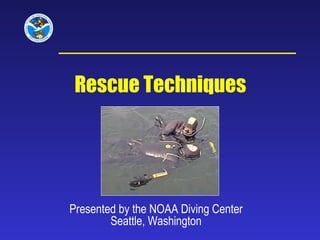
Presented by the NOAA Diving Center Seattle, Washington Rescue Techniques
Global View Preventing accidents  What causes accidents Panicked diver at the surface Panicked diver underwater Unconscious diver at the surface Unconscious diver underwater Removing the diver from the water Post rescue care Key Points
Introduction Need & Value:   Every diver must be able to save himself, his buddy, and other divers.  You need to be able to recognize and prevent problems before they escalate to an emergency.  You need to learn what to do for various rescue situations, so you will be prepared to save yourself or another diver when called upon to respond. Effect:   You will learn to recognize situations that require interventions and proven actions to take to rectify potential emergencies.  You will be prepared to apply rescue skills.
Preventing Accidents - 1 Physical fitness Proper training Proper equipment Equipment properly serviced Pre-dive safety checks Diving within your training and experience level Following proper diving procedures Staying together as buddy teams
Preventing Accidents - 2 Thorough pre-dive safety checks are the most important part of the dive. This is your opportunity to diffuse potential problems before you enter the water.  Always check: The cylinder is full Air is all the way on quarter turn off Cylinder cam band was dipped in water before it was attached to the cylinder The cam band is not at an angle and is very tight Low pressure inflator hose is connected to the BCD and / or the dry suit all the way, and the inflator works
Preventing Accidents - 3 Your weight belts are on correctly – right hand release and will not become trapped in any piece of equipment if it becomes necessary to drop the belt  You know how to release all of the weight you and your dive buddy are wearing Both BCDs inflate and hold air You know where your buddies alternate air source is and how to use it You both have a knife and it can be reached with either hand You are diving within your training and within your physical abilities
Factors That Contribute to Accidents Stress Anxiety Fatigue Fear Panic Equipment problems Buddy separation Diving beyond our training and abilities  Poor pre-dive safety checks
Stressors Example: the unknown or unexpected can  cause apprehension.  Some divers may  respond in ways inappropriate to survival Diver stressors: exposure, illness, exhaustion, injury, personality, experience, fears, equipment problems, poor visibility, buddy separation, depth, darkness, currents, disorientation, entanglement, narcosis, hypoxia, dehydration
Anxiety & Panic Stress, anxiety, panic & fatigue: Adrenalin excites the body’s flight or fight mechanism Increases breathing, heart rate, nervous system activity As anxiety increases, awareness & performance decreases Left unchecked this leads to panic or the uncontrolled & irrational reaction to perceived danger  Active versus inactive panic  Critical factor in the progressive steps of panic is whether or not a problem arises after one is stressed Will victim be able to self-rescue? Rescuer alert for signs of change  (fatigue, etc.) in victim’s behavior
Emergency Signs & Signals Day Waving arm(s) over head Unresponsive Obvious signs of struggle Out of air signal Rocking of outstretched hand Mask on forehead at surface Night  Rapid up and down motion of light Mask on forehead at surface
Self-Rescue - 1 Self rescue steps:  Recognize and assess the situation The problem may be solvable underwater Don’t panic / don’t hold your breath and bolt to the surface Once at the surface / establish positive buoyancy inflate BCD / dry suit / drop weight belt  Reduce physical activity Gain control of respiration If assistance is needed, wave your arms above your head / shout for assistance
Self-Rescue - 2 Know how to handle equipment failure, loss, out-of-air options Where is your buddy? Your buddy is your alternate air source Physiological Minimize exposure risks Energy and body-heat conservation Decompression & surface intervals Exertion Hydration level and cramp removal Level of fitness and experience
Panicked Diver at the Surface - 1 A diver in distress at the surface will usually put their mask on their forehead and spit out their regulator If they are beginning to panic they may forget to do the one thing that will most likely solve the problem Establish positive buoyancy  Shout at the diver “inflate your BC, drop your weight belt” If they do not respond, offer them another source of buoyancy
Panicked Diver at the Surface - 2 Undesirable “Natural” aquatic responses: Body in vertical position, head back and above water, mouth open  Rapid breathing or breath-holding Arms flailing above the water Clinging and climbing Ineffective leg kicks
Panicked Diver at the Surface - 3 If the panicked diver does not respond to your commands, don’t offer yourself as flotation Establish ample buoyancy for yourself Approach the panicked diver from behind With your left hand grab hold of the tank valve Grab the scuba bottle between your knees With your right hand, reach around in front and release the weight belt
Panicked Diver at the Surface - 4 If a panicked diver gets a hold of you and won’t let go you may have to deflate your BCD and go back under water Then, from underwater you can approach the diver from in front and release their weight belt
Panicked Diver at the Surface - 5 Defenses & releases: Block grasping attempts Get behind victim and hold tank valve Push yourself down and push victim upward Tuck head and push victim’s elbows upward Put knee against diver and push backward Submerge and swim away
Panicked Diver at the Surface - 6 Always maintain a visual bearing on victim Spotters, head above water entry Assess situation, determine plan of action Rescue swimmer: Dressed for exposure and recovery Rescue swim - pace yourself Assess victim’s condition, establish communication Extend flotation or establish victim buoyancy If victim does not grab float, physically support victim and establish buoyancy at surface  Recognize the problem, severely distressed divers may not signal for help  Act quickly.  The panicked diver struggles for approx. 60 seconds.  Self-help is not always possible
Panicked Diver Underwater - 1 Be prepared to use your alternate air source, the panicked diver may take your primary regulator Try to approach them from the front so you don’t startle them and compound the problem Try and calm the diver / hold on to them firmly and assist with the problem  Anticipate early in entanglement situations, assistance and more air for the trapped diver may be needed
Panicked Diver Underwater - 2 Use of up / down line for reference Support from side or back if panicky Alternate air sources Octopus Spare air Poor man’s octopus Control the bolt for the surface…..
Panicked Diver Underwater - 3 Flexibility to think and adapt skills & equipment  Pre-dive planning with buddy Scenarios Problem solving
Conscious Diver at the Surface For a conscious diver: Call for assistance, establish communication Assess mental state: rational or irrational Establish buoyancy Assess problem. Can diver self-rescue? Transport distressed victim Tank tow Talk to person being assisted Account for buddies Tired swimmer push (option)
Surfacing Unconscious Diver - 1 Breathing victim Modified “head lock” Arm around head  Hold airway open and regulator in mouth Vertical Swimming Ascent Rescuer elbow in base of chest Hold regulator in mouth with hand Hold onto tank valve with other hand for control
Surfacing Unconscious Diver - 2 Swim Victim Up Remove mask if flooded and pinch nose Swim to surface as fast and as safe as possible
Surfacing Unconscious Diver - 1 Non- breathing victim Approach victim Check responsiveness Remove weight belt Establish positive buoyancy Position head for open airway Surface using vertical swimming ascent  with ‘do-si-do’ position Flare fins or victim to control ascent rate
Surfacing Unconscious Diver - 2 Must get victim to surface quickly and safely DO NOT DELAY ASCENT! Protect yourself, release victim if uncontrolled ascent develops!! Or use “send him up” technique “Send him up” – last option Make victim positively buoyant and release to surface Not recommended if direct access to surface is obstructed (kelp, cave, wreck, ledge, etc.)
Non-Breathing Diver at Surface - 1 Use “do-si-do” hold (rescuer’s left arm under victims left arm and grasping tank valve / BCD or head cradle position Push up with left arm and push down on forehead with upper arm, pinching nose during rescue breaths  Tilt victim toward rescuer Airway clear of water, mucous, blood Pinch nose, seal mouth, and  deliver slow rescue breath  Pocket mask is useful for ARB.  Can be carried in BC pocket
Non-Breathing Diver at  Surface - 2 Objectives: Maintain dry, open airway  Minimal interruption of rescue breathing Rate: 1 breath every 5 seconds or 2 breaths every 10 seconds CPR cannot be done effectively in the water Do not attempt pulse check. Ventilate and transport Unable to feel a pulse through wet suit  material Hands encumbered by gloves, numb  from cold
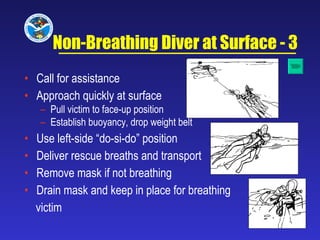
Non-Breathing Diver at Surface - 3 Call for assistance Approach quickly at surface Pull victim to face-up position Establish buoyancy, drop weight belt Use left-side “do-si-do” position Deliver rescue breaths and transport Remove mask if not breathing Drain mask and keep in place for breathing victim
Equipment Removal Be familiar with buddy’s equipment Release weight belt to aid buoyancy Removal of other equipment necessary prior to exiting? Remove equipment in 5-10 second steps, ventilating victim between Equipment retained  for analysis
Rescue Exits Considerations: Victim kept as horizontal as possible Minimal interruption of rescue breathing Recovery equipment on site and ready Fatigued Rescuer Recommended methods: Horizontal float and drag 3-person hammock carry Parbuckling Ladder or backboard lift
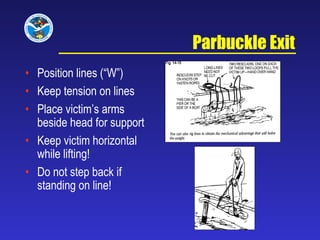
Parbuckle Exit Position lines (“W”) Keep tension on lines Place victim’s arms beside head for support Keep victim horizontal while lifting! Do not step back if standing on line!
Specific Exits - 3 For small boat exits: A levered backboard Ladder and BC carry or ladder carry If victim unconscious, rescuer exits  first If victim conscious, victim exits first
Specific Exits - 4 For large vessels, piers, or cliffs: Use a backboard / multiple lifting lines for  control Use proper straps, slings and hardware Deck crane & safety / cargo netting
Specific Exits - 5 For surf or rocky shore exits: Time period of swells Turn into breaking waves Seal victim’s mouth & nose before  waves break Ride swell onto rocks Drag or roll victim up rocks Quickly move to less exposed platform
Post-Rescue Stabilize victim, control shock and hypothermia  Transfer to next level of care as required Investigate events leading up to accident Evaluate how the situation could have been prevented  Evaluate victim’s and rescue team actions Identify correct / incorrect actions Address deficiencies in events Have equipment inspected Review rescue  If necessary, improve / update emergency action plan
Rescue Training Preparation: Training: CPR & First Aid Oxygen First Aid Scuba Diving First Aid Rescue techniques Rescue equipment  Personnel Review emergency procedures & accident response plans Plan & delegate Transportation Drills & skill maintenance (required annually)
Skill Proficiency Frequently review & practice rescue skills so they are easily recalled (if you are in doubt = time to refresh) Maintain certifications, attend advanced training Rescue techniques will vary with circumstances Practice skills under a variety of scenarios & conditions Plan and organize for emergencies  before every dive Inspect & maintain readiness of  support equipment
Rescue Equipment Rescue floatation Marker buoy Throwing line Search lines Recovery system  Rescue breathing mask Diver’s first aid kit Blankets & water Oxygen delivery system Personnel delegated Communications & emergency contact information  Designated chase boat Accident Management Evacuation plan (each location)
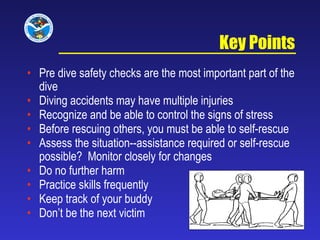
Key Points Pre dive safety checks are the most important part of the dive Diving accidents may have multiple injuries Recognize and be able to control the signs of stress Before rescuing others, you must be able to self-rescue Assess the situation--assistance required or self-rescue possible?  Monitor closely for changes Do no further harm Practice skills frequently Keep track of your buddy Don’t be the next victim

Diving Rescue

  • 1.
    Presented by theNOAA Diving Center Seattle, Washington Rescue Techniques
  • 2.
    Global View Preventingaccidents What causes accidents Panicked diver at the surface Panicked diver underwater Unconscious diver at the surface Unconscious diver underwater Removing the diver from the water Post rescue care Key Points
  • 3.
    Introduction Need &Value: Every diver must be able to save himself, his buddy, and other divers. You need to be able to recognize and prevent problems before they escalate to an emergency. You need to learn what to do for various rescue situations, so you will be prepared to save yourself or another diver when called upon to respond. Effect: You will learn to recognize situations that require interventions and proven actions to take to rectify potential emergencies. You will be prepared to apply rescue skills.
  • 4.
    Preventing Accidents -1 Physical fitness Proper training Proper equipment Equipment properly serviced Pre-dive safety checks Diving within your training and experience level Following proper diving procedures Staying together as buddy teams
  • 5.
    Preventing Accidents -2 Thorough pre-dive safety checks are the most important part of the dive. This is your opportunity to diffuse potential problems before you enter the water. Always check: The cylinder is full Air is all the way on quarter turn off Cylinder cam band was dipped in water before it was attached to the cylinder The cam band is not at an angle and is very tight Low pressure inflator hose is connected to the BCD and / or the dry suit all the way, and the inflator works
  • 6.
    Preventing Accidents -3 Your weight belts are on correctly – right hand release and will not become trapped in any piece of equipment if it becomes necessary to drop the belt You know how to release all of the weight you and your dive buddy are wearing Both BCDs inflate and hold air You know where your buddies alternate air source is and how to use it You both have a knife and it can be reached with either hand You are diving within your training and within your physical abilities
  • 7.
    Factors That Contributeto Accidents Stress Anxiety Fatigue Fear Panic Equipment problems Buddy separation Diving beyond our training and abilities Poor pre-dive safety checks
  • 8.
    Stressors Example: theunknown or unexpected can cause apprehension. Some divers may respond in ways inappropriate to survival Diver stressors: exposure, illness, exhaustion, injury, personality, experience, fears, equipment problems, poor visibility, buddy separation, depth, darkness, currents, disorientation, entanglement, narcosis, hypoxia, dehydration
  • 9.
    Anxiety & PanicStress, anxiety, panic & fatigue: Adrenalin excites the body’s flight or fight mechanism Increases breathing, heart rate, nervous system activity As anxiety increases, awareness & performance decreases Left unchecked this leads to panic or the uncontrolled & irrational reaction to perceived danger Active versus inactive panic Critical factor in the progressive steps of panic is whether or not a problem arises after one is stressed Will victim be able to self-rescue? Rescuer alert for signs of change (fatigue, etc.) in victim’s behavior
  • 10.
    Emergency Signs &Signals Day Waving arm(s) over head Unresponsive Obvious signs of struggle Out of air signal Rocking of outstretched hand Mask on forehead at surface Night Rapid up and down motion of light Mask on forehead at surface
  • 11.
    Self-Rescue - 1Self rescue steps: Recognize and assess the situation The problem may be solvable underwater Don’t panic / don’t hold your breath and bolt to the surface Once at the surface / establish positive buoyancy inflate BCD / dry suit / drop weight belt Reduce physical activity Gain control of respiration If assistance is needed, wave your arms above your head / shout for assistance
  • 12.
    Self-Rescue - 2Know how to handle equipment failure, loss, out-of-air options Where is your buddy? Your buddy is your alternate air source Physiological Minimize exposure risks Energy and body-heat conservation Decompression & surface intervals Exertion Hydration level and cramp removal Level of fitness and experience
  • 13.
    Panicked Diver atthe Surface - 1 A diver in distress at the surface will usually put their mask on their forehead and spit out their regulator If they are beginning to panic they may forget to do the one thing that will most likely solve the problem Establish positive buoyancy Shout at the diver “inflate your BC, drop your weight belt” If they do not respond, offer them another source of buoyancy
  • 14.
    Panicked Diver atthe Surface - 2 Undesirable “Natural” aquatic responses: Body in vertical position, head back and above water, mouth open Rapid breathing or breath-holding Arms flailing above the water Clinging and climbing Ineffective leg kicks
  • 15.
    Panicked Diver atthe Surface - 3 If the panicked diver does not respond to your commands, don’t offer yourself as flotation Establish ample buoyancy for yourself Approach the panicked diver from behind With your left hand grab hold of the tank valve Grab the scuba bottle between your knees With your right hand, reach around in front and release the weight belt
  • 16.
    Panicked Diver atthe Surface - 4 If a panicked diver gets a hold of you and won’t let go you may have to deflate your BCD and go back under water Then, from underwater you can approach the diver from in front and release their weight belt
  • 17.
    Panicked Diver atthe Surface - 5 Defenses & releases: Block grasping attempts Get behind victim and hold tank valve Push yourself down and push victim upward Tuck head and push victim’s elbows upward Put knee against diver and push backward Submerge and swim away
  • 18.
    Panicked Diver atthe Surface - 6 Always maintain a visual bearing on victim Spotters, head above water entry Assess situation, determine plan of action Rescue swimmer: Dressed for exposure and recovery Rescue swim - pace yourself Assess victim’s condition, establish communication Extend flotation or establish victim buoyancy If victim does not grab float, physically support victim and establish buoyancy at surface Recognize the problem, severely distressed divers may not signal for help Act quickly. The panicked diver struggles for approx. 60 seconds. Self-help is not always possible
  • 19.
    Panicked Diver Underwater- 1 Be prepared to use your alternate air source, the panicked diver may take your primary regulator Try to approach them from the front so you don’t startle them and compound the problem Try and calm the diver / hold on to them firmly and assist with the problem Anticipate early in entanglement situations, assistance and more air for the trapped diver may be needed
  • 20.
    Panicked Diver Underwater- 2 Use of up / down line for reference Support from side or back if panicky Alternate air sources Octopus Spare air Poor man’s octopus Control the bolt for the surface…..
  • 21.
    Panicked Diver Underwater- 3 Flexibility to think and adapt skills & equipment Pre-dive planning with buddy Scenarios Problem solving
  • 22.
    Conscious Diver atthe Surface For a conscious diver: Call for assistance, establish communication Assess mental state: rational or irrational Establish buoyancy Assess problem. Can diver self-rescue? Transport distressed victim Tank tow Talk to person being assisted Account for buddies Tired swimmer push (option)
  • 23.
    Surfacing Unconscious Diver- 1 Breathing victim Modified “head lock” Arm around head Hold airway open and regulator in mouth Vertical Swimming Ascent Rescuer elbow in base of chest Hold regulator in mouth with hand Hold onto tank valve with other hand for control
  • 24.
    Surfacing Unconscious Diver- 2 Swim Victim Up Remove mask if flooded and pinch nose Swim to surface as fast and as safe as possible
  • 25.
    Surfacing Unconscious Diver- 1 Non- breathing victim Approach victim Check responsiveness Remove weight belt Establish positive buoyancy Position head for open airway Surface using vertical swimming ascent with ‘do-si-do’ position Flare fins or victim to control ascent rate
  • 26.
    Surfacing Unconscious Diver- 2 Must get victim to surface quickly and safely DO NOT DELAY ASCENT! Protect yourself, release victim if uncontrolled ascent develops!! Or use “send him up” technique “Send him up” – last option Make victim positively buoyant and release to surface Not recommended if direct access to surface is obstructed (kelp, cave, wreck, ledge, etc.)
  • 27.
    Non-Breathing Diver atSurface - 1 Use “do-si-do” hold (rescuer’s left arm under victims left arm and grasping tank valve / BCD or head cradle position Push up with left arm and push down on forehead with upper arm, pinching nose during rescue breaths Tilt victim toward rescuer Airway clear of water, mucous, blood Pinch nose, seal mouth, and deliver slow rescue breath Pocket mask is useful for ARB. Can be carried in BC pocket
  • 28.
    Non-Breathing Diver at Surface - 2 Objectives: Maintain dry, open airway Minimal interruption of rescue breathing Rate: 1 breath every 5 seconds or 2 breaths every 10 seconds CPR cannot be done effectively in the water Do not attempt pulse check. Ventilate and transport Unable to feel a pulse through wet suit material Hands encumbered by gloves, numb from cold
  • 29.
    Non-Breathing Diver atSurface - 3 Call for assistance Approach quickly at surface Pull victim to face-up position Establish buoyancy, drop weight belt Use left-side “do-si-do” position Deliver rescue breaths and transport Remove mask if not breathing Drain mask and keep in place for breathing victim
  • 30.
    Equipment Removal Befamiliar with buddy’s equipment Release weight belt to aid buoyancy Removal of other equipment necessary prior to exiting? Remove equipment in 5-10 second steps, ventilating victim between Equipment retained for analysis
  • 31.
    Rescue Exits Considerations:Victim kept as horizontal as possible Minimal interruption of rescue breathing Recovery equipment on site and ready Fatigued Rescuer Recommended methods: Horizontal float and drag 3-person hammock carry Parbuckling Ladder or backboard lift
  • 32.
    Parbuckle Exit Positionlines (“W”) Keep tension on lines Place victim’s arms beside head for support Keep victim horizontal while lifting! Do not step back if standing on line!
  • 33.
    Specific Exits -3 For small boat exits: A levered backboard Ladder and BC carry or ladder carry If victim unconscious, rescuer exits first If victim conscious, victim exits first
  • 34.
    Specific Exits -4 For large vessels, piers, or cliffs: Use a backboard / multiple lifting lines for control Use proper straps, slings and hardware Deck crane & safety / cargo netting
  • 35.
    Specific Exits -5 For surf or rocky shore exits: Time period of swells Turn into breaking waves Seal victim’s mouth & nose before waves break Ride swell onto rocks Drag or roll victim up rocks Quickly move to less exposed platform
  • 36.
    Post-Rescue Stabilize victim,control shock and hypothermia Transfer to next level of care as required Investigate events leading up to accident Evaluate how the situation could have been prevented Evaluate victim’s and rescue team actions Identify correct / incorrect actions Address deficiencies in events Have equipment inspected Review rescue If necessary, improve / update emergency action plan
  • 37.
    Rescue Training Preparation:Training: CPR & First Aid Oxygen First Aid Scuba Diving First Aid Rescue techniques Rescue equipment Personnel Review emergency procedures & accident response plans Plan & delegate Transportation Drills & skill maintenance (required annually)
  • 38.
    Skill Proficiency Frequentlyreview & practice rescue skills so they are easily recalled (if you are in doubt = time to refresh) Maintain certifications, attend advanced training Rescue techniques will vary with circumstances Practice skills under a variety of scenarios & conditions Plan and organize for emergencies before every dive Inspect & maintain readiness of support equipment
  • 39.
    Rescue Equipment Rescuefloatation Marker buoy Throwing line Search lines Recovery system Rescue breathing mask Diver’s first aid kit Blankets & water Oxygen delivery system Personnel delegated Communications & emergency contact information Designated chase boat Accident Management Evacuation plan (each location)
  • 40.
    Key Points Predive safety checks are the most important part of the dive Diving accidents may have multiple injuries Recognize and be able to control the signs of stress Before rescuing others, you must be able to self-rescue Assess the situation--assistance required or self-rescue possible? Monitor closely for changes Do no further harm Practice skills frequently Keep track of your buddy Don’t be the next victim