MADRIDEJOS COMMUNITY COLLEGE
Prepared by:
Larajean V. Illusorio
-BSED MAPEH 3B-
Submitted to:
Mr. Junrie Bandolon
-
Instructor-
“Group huddle technique
is one way to attract
attention and also
provides body heat from

hypothermia….”
SWIMMING SAFETY TIPS:
Learn to swim
Swim near a lifeguard
Never swim alone
Lookout for children closely, do not pass the
responsibility to lifeguards.
Don’t rely on flotation devices. PFD are not
substitute for swimming ability
DROWNING
•Is defined by INTERNATIONAL
LIFESAVING SOCIETY (ILS) as
the process of experiencing
respiratory impairment
submersion/immersion in liquid.
ARE YOU FAMILIAR OF
THE AQUA CODE?
 Together…….
 afloat and wave……..
 REACH for the rescue……..
BE AWARE DON’T DRINK & DROWN
Impaired judgement
Impaired vision , coordination , and muscle function
Disorientation
Blood vessel dilation
Inhibited reflexes
OTHER DANGER:
o Cramps
o Electric Shock
o Panic
o Exhaustions
o Hyperventilation
o Inappropriate Clothing
o Animals in the area
o Uncontrolled long hair
PERSONAL PROTECTIVE
EQUIPMENT:
Life jackets
Gloves
Booties/Swim fins
Goggles/Facemask
Snorkel
Submersible Helmet
Life preservers/PFD
Wet suit/Dry suit (Neoprene)
CHARACTERISTIC:
Non swimmer
-> vertical in the water only concern is breathing.
Weak swimmer
-> head may have submerge periodically.
Injured person
-> awkward position.
Unconscious
-> completely limp.
FOUR GENERAL CATEGORIES OF PEOPLE
DIFFICULTY:
• NON SWIMMER
• WEAK SWIMMER
• INJURED PERSON
• UNCONSCIOUS
REMEMBER
•A person in difficulty will
not necessarily fit
precisely into one of the
four categories.
SOME WATER SAFETY TIPS
 Call or wave your hands for help in
trouble.
 Observe beach/pool regulations and
lifeguard directions.
 Swim parallel and near to shore.
 Scuba dive only if trained and certified
and within the limits of your experience
and training.
 Bicycle
 Side Kick
 Jelly Fish ( 1 & 2 foot )
 Floating
RESCUE TECHNIQUES
 There are two (2) types of
techniques:
 NON SWIMMING RESCUES
 SWIMMING RESCUES
TALK
-> the safest form of rescue.
 REACH
-> both effective and safe to the rescuer.
 THROW
-> used by weak or non swimmer.
 WADE
-> used when there is permissible safety depth.
 ROW
-> using small craft.
TYPES OF WATER ENTERIES
 Wade-in
Slide-in
 Step-in
Compact Jump
Dive
Stride Entry
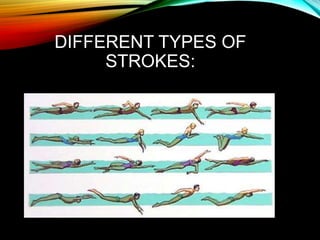
DIFFERENT TYPES OF
STROKES:
DIFFERENT TYPES OF STROKE
WITH THEIR CORRESPONDING
MEANING:
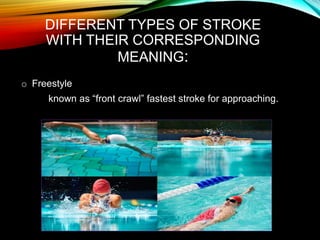
o Freestyle
known as “front crawl” fastest stroke for approaching.
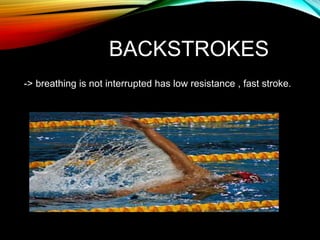
BACKSTROKES
-> breathing is not interrupted has low resistance , fast stroke.
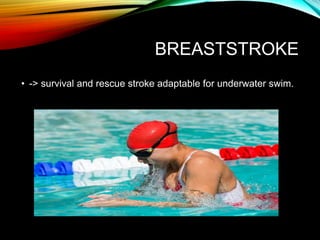
BREASTSTROKE
• -> survival and rescue stroke adaptable for underwater swim.
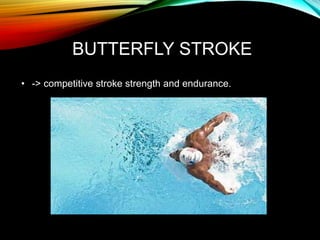
BUTTERFLY STROKE
• -> competitive stroke strength and endurance.
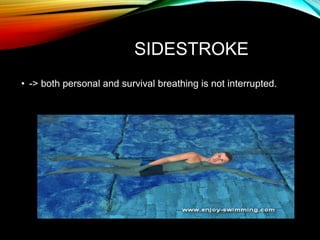
SIDESTROKE
• -> both personal and survival breathing is not interrupted.
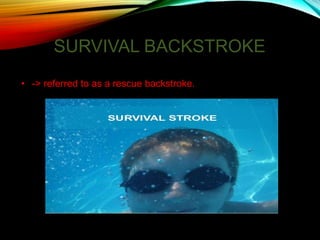
SURVIVAL BACKSTROKE
• -> referred to as a rescue backstroke.
LIFE SAVING
TECHNIQUES
Life Saving --- immediate assistance rendered
to a person in actual distress.
Approaches to Victim
Defences against Victim
Carries for Victim
Releases and Escapades
SWIMMING RESCUES
• Front Approach
*maintain proper distance
*talk to the Victim
*use of timing when approaching
• Underwater Approach
*5 ft. apart to start swimming underwater
*safest approach
• Back Approach
*advantageous to the rescuer
*easy maneuvarability
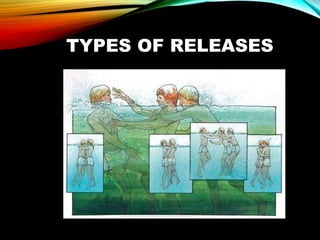
TYPES OF RELEASES
DEFENSES
-> Techniques to PREVENT the victim from grabbing the rescuer.
 BLOCK
-Prevent the hands of victim from holding or grabbing the rescuer.
-Push the victim away and make another approach.
 BLOCK & CARRY
-When victims grasp your hand , immediately carry either of your hand straight to the
victim’s chest.
-Let him hold your hand while you swim to the surface.
 BLOCK & TURN
-When victim tries to grab you block his hand and turn him around.
-Immediately use one of the carries.
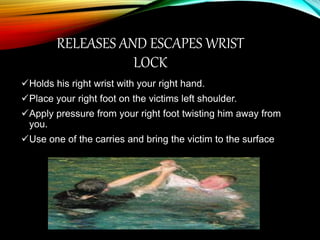
RELEASES AND ESCAPES WRIST
LOCK
Holds his right wrist with your right hand.
Place your right foot on the victims left shoulder.
Apply pressure from your right foot twisting him away from
you.
Use one of the carries and bring the victim to the surface
If the victim is holding over the left shoulder of the
rescuer.
Place your right hand over the victims left chin
and hold his elbow by your left hand.
Twist his elbow while freeing yourself from his
grip.
Surface the victim immediately using one of the
carries.
BACK STRANGLE
HOLD/REAR HOLD
RELEASES
Grasps the victims hand sliding them to the
victims right elbows while holding the victims
right wrist with the rescuer left hand.
Twist the victims wrist down and the same
time push up his right elbow.
Bring the victim’s right hand to his/her back.
TYPES OF TOWS:
 Non-contact tow
 Contact tow
A contact rescue is only recommended for
an unconscious person.
Cross chest tow
Head tow
Clothing tow
Double armpit tow
Double shoulder tow
Vice grip tow
Support tow
Wrist tow
Armpit tow
THINGS CONSIDERED
FREQUENTLY IN RESCUE
SWIMMING
•TYPES OF APPROACH
* Defence Techniques
* Blocking Techniques
* Search methods
* Swimming strokes
REMEMBER
• Always maintain a
good distance
between the rescuer
and the person in
difficulty….
THANK YOU
AND
GODBLESS

AQUATICS

  • 1.
    MADRIDEJOS COMMUNITY COLLEGE Preparedby: Larajean V. Illusorio -BSED MAPEH 3B- Submitted to: Mr. Junrie Bandolon - Instructor-
  • 3.
    “Group huddle technique isone way to attract attention and also provides body heat from hypothermia….”
  • 5.
    SWIMMING SAFETY TIPS: Learnto swim Swim near a lifeguard Never swim alone Lookout for children closely, do not pass the responsibility to lifeguards. Don’t rely on flotation devices. PFD are not substitute for swimming ability
  • 6.
    DROWNING •Is defined byINTERNATIONAL LIFESAVING SOCIETY (ILS) as the process of experiencing respiratory impairment submersion/immersion in liquid.
  • 8.
    ARE YOU FAMILIAROF THE AQUA CODE?  Together…….  afloat and wave……..  REACH for the rescue……..
  • 9.
    BE AWARE DON’TDRINK & DROWN Impaired judgement Impaired vision , coordination , and muscle function Disorientation Blood vessel dilation Inhibited reflexes
  • 10.
    OTHER DANGER: o Cramps oElectric Shock o Panic o Exhaustions o Hyperventilation o Inappropriate Clothing o Animals in the area o Uncontrolled long hair
  • 11.
    PERSONAL PROTECTIVE EQUIPMENT: Life jackets Gloves Booties/Swimfins Goggles/Facemask Snorkel Submersible Helmet Life preservers/PFD Wet suit/Dry suit (Neoprene)
  • 12.
    CHARACTERISTIC: Non swimmer -> verticalin the water only concern is breathing. Weak swimmer -> head may have submerge periodically. Injured person -> awkward position. Unconscious -> completely limp.
  • 13.
    FOUR GENERAL CATEGORIESOF PEOPLE DIFFICULTY: • NON SWIMMER • WEAK SWIMMER • INJURED PERSON • UNCONSCIOUS
  • 14.
    REMEMBER •A person indifficulty will not necessarily fit precisely into one of the four categories.
  • 15.
    SOME WATER SAFETYTIPS  Call or wave your hands for help in trouble.  Observe beach/pool regulations and lifeguard directions.  Swim parallel and near to shore.  Scuba dive only if trained and certified and within the limits of your experience and training.
  • 16.
     Bicycle  SideKick  Jelly Fish ( 1 & 2 foot )  Floating
  • 17.
    RESCUE TECHNIQUES  Thereare two (2) types of techniques:  NON SWIMMING RESCUES  SWIMMING RESCUES
  • 18.
    TALK -> the safestform of rescue.  REACH -> both effective and safe to the rescuer.  THROW -> used by weak or non swimmer.  WADE -> used when there is permissible safety depth.  ROW -> using small craft.
  • 19.
    TYPES OF WATERENTERIES  Wade-in Slide-in  Step-in Compact Jump Dive Stride Entry
  • 20.
  • 21.
    DIFFERENT TYPES OFSTROKE WITH THEIR CORRESPONDING MEANING: o Freestyle known as “front crawl” fastest stroke for approaching.
  • 22.
    BACKSTROKES -> breathing isnot interrupted has low resistance , fast stroke.
  • 23.
    BREASTSTROKE • -> survivaland rescue stroke adaptable for underwater swim.
  • 24.
    BUTTERFLY STROKE • ->competitive stroke strength and endurance.
  • 25.
    SIDESTROKE • -> bothpersonal and survival breathing is not interrupted.
  • 26.
    SURVIVAL BACKSTROKE • ->referred to as a rescue backstroke.
  • 27.
    LIFE SAVING TECHNIQUES Life Saving--- immediate assistance rendered to a person in actual distress. Approaches to Victim Defences against Victim Carries for Victim Releases and Escapades
  • 28.
    SWIMMING RESCUES • FrontApproach *maintain proper distance *talk to the Victim *use of timing when approaching • Underwater Approach *5 ft. apart to start swimming underwater *safest approach • Back Approach *advantageous to the rescuer *easy maneuvarability
  • 29.
  • 30.
    DEFENSES -> Techniques toPREVENT the victim from grabbing the rescuer.  BLOCK -Prevent the hands of victim from holding or grabbing the rescuer. -Push the victim away and make another approach.  BLOCK & CARRY -When victims grasp your hand , immediately carry either of your hand straight to the victim’s chest. -Let him hold your hand while you swim to the surface.  BLOCK & TURN -When victim tries to grab you block his hand and turn him around. -Immediately use one of the carries.
  • 31.
    RELEASES AND ESCAPESWRIST LOCK Holds his right wrist with your right hand. Place your right foot on the victims left shoulder. Apply pressure from your right foot twisting him away from you. Use one of the carries and bring the victim to the surface
  • 32.
    If the victimis holding over the left shoulder of the rescuer. Place your right hand over the victims left chin and hold his elbow by your left hand. Twist his elbow while freeing yourself from his grip. Surface the victim immediately using one of the carries.
  • 33.
    BACK STRANGLE HOLD/REAR HOLD RELEASES Graspsthe victims hand sliding them to the victims right elbows while holding the victims right wrist with the rescuer left hand. Twist the victims wrist down and the same time push up his right elbow. Bring the victim’s right hand to his/her back.
  • 34.
    TYPES OF TOWS: Non-contact tow  Contact tow A contact rescue is only recommended for an unconscious person.
  • 35.
    Cross chest tow Headtow Clothing tow Double armpit tow Double shoulder tow Vice grip tow Support tow Wrist tow Armpit tow
  • 36.
    THINGS CONSIDERED FREQUENTLY INRESCUE SWIMMING •TYPES OF APPROACH * Defence Techniques * Blocking Techniques * Search methods * Swimming strokes
  • 37.
    REMEMBER • Always maintaina good distance between the rescuer and the person in difficulty….
  • 38.