UNDERSTANDING
REPUTATION MANAGEMENT
&
THE REPUTATION ECONOMY
Kimberley R. Barker, MLIS
Librarian for Digital Life
MY PERSPECTIVE
•REPUTATION MANAGEMENT IS NOT FOR:
– ERASING THE DEEDS OF CONVICTED
CRIMINALS
– ERASING INSTITUTIONAL HISTORY
– ERASING FACTUAL, NEGATIVE BUSINESS
REVIEWS
◦ In this presentation:
•Define “reputation management”, “reputation economy”,
“reputation cost”
•Define “Google Truth”
•Understand how Google works
•Define online reputation management services
–Individual
–Corporate
- Discipline-wide
•Understand
how to establish a reputation management plan
the real-life ramifications of reputation damage
the process of reputation restoration
•Further resources
What is reputation management?
◦The practice of shaping public perception of an
individual or institutional reputation, particularly
with regard to digital presence
◦Managing public presence so that it matches an
individual's or institution's values
◦ The digital equivalent of interview preparation and
personal hygiene
What is the reputation economy?
◦Refers to the way in which the standing of a
product/person/institution/business is shaped by the
contributions of end users.
◦The fact that your reputation affects your ability to work
◦“wisdom of crowds”/crowdsourcing
◦Changes in technology mean that we use computers
instead of the telephone or writing letters
Reputation Cost
◦ “the various forms of economic and other harm that an
entity may experience as a result of damage to
its reputation with customers or others.”
Consider your own habits
◦ How many of you Google the following?
- Job candidates
– Dates
- Children’s friends/counselors/teachers
– Doctors
– Products
– Hotels
– Restaurants
• How much are you influenced by what you find?
◦ Incidentally…
◦ 2011 report on Yelp ratings by Harvard
Business School assistant professor Michael
Luca:
◦ a one-star increase in the rating of an
independent restaurant leads to a 5 to 9
percent increase in revenue.
http://www.hbs.edu/faculty/Publication%20File
s/12-016.pdf
◦Why Google?
“Google Truth”
•the automatic acceptance of Google
results as an accurate representation of
reality
Google
dominates
the North
American
search
engine
market.
Google
dominates
the global
search
engine
market.
Aboutthestatistics:
“Statsarebasedonaggregatedata
collectedbystatcounteronasample
exceeding10billionpageviewspermonth
collectedfromacrossthestatcounter
networkofmorethan2millionwebsites.
Statsareupdatedandmadeavailableevery
day,howeveraresubjecttoquality
assurancetestingandrevisionfor45days
frompublication.”
https://gs.statcounte
r.com/about
How Google works (1 of 7)
◦ Google is comprised of three distinct parts:
◦ Googlebot
◦ Indexer
◦ Query processor
*Each part has its own specific and unique function.
How Google works (2 of 7)
◦ Googlebot
◦ Composed of 1000’s of computers
engaged in parallel processing:
◦ Requests & retrieves 1000’s of different
pages simultaneously; does this two
ways
◦ “Add URL” forms
◦ Find links via web crawling
◦ Fresh crawls
◦ Deep crawls
How Google works (3 of 7)
◦ Indexer
◦ Receives full texts of pages from Googlebot; stores them in
databases
◦ Index sorts search terms alphabetically
◦ Ignores “stop words”
◦ Converts all text to lower-case
◦ Each entry in index stores list of documents with that search
term and also the location within the text of that search
term
How Google works (4 of 7)
◦Query processor has multiple parts:
◦Search box
◦“engine” that evaluates, searches, and
matches to relevant documents
◦Results formatter
How Google works (5 of 7)
How Google works (6 of 7)
(It’s a popularity contest… sort of)
◦ PageRank
◦ Link analysis algorithm
◦ Page with higher rank displays higher in results list
◦ Google uses over 100 factors to determine rank
◦ How is PR calculated?
◦ Basically, the more times that a page is linked to determines its PR
◦ Built from this algorithm, which is used iteratively:
◦ PR(A) = (1-d) + d (PR(T1)/C(T1) + … + PR(Tn)/C(Tn))
How Google works (7 of 7)
Hummingbird
◦ Google replaced its algorithm in August, 2013
◦ The preceding seven slides are still valid
◦ Hummingbird is semantic; i.e., based on natural language queries
◦ Conversational search technology
◦ Uses Google’s Knowledge Graph
◦ Google is looking towards future
◦ 60% of Americans access Internet on mobile device
◦ Spoken searches
Hummingbird: Mobile-Friendly Update
•April 21, 2015
–Mobile-friendliness
•Tappable buttons
•Easy to navigate from a small screen
•Important information front & center
–Mobile speed
–Desktop
July 2021 Update
◦ Google stated that this update was, "… a core algorithm update is one that
introduces changes across a wide range of the indexing and ranking
processes"- and not much else.
◦ Businesses, social platforms, and SEO experts have reported different results
and experiences since the update.
◦ https://www.searchenginejournal.com/google-july-2021-core-algorithm-update/413204/#close
Why did I just spend that time on
Google?
◦ If you understand how Google works, you will
understand how to:
◦ Positively increase your online presence
◦ Monitor your reputation
◦ Formulate a basic reputation restoration plan
◦ Understand when you need to seek professional help
ONLINE REPUTATION
MANAGEMENT
What is
ORM?
◦ Basically, “…the practice of making people and
businesses look their best on the Internet.”
www.reputation.com
• For whom is this service?
– Individuals
– Professionals
– Institutions
•Who can perform this service?
•People just like you
•Reputation management professionals
ORM is Big Business
◦ ORM market revenue in 2019: $923 Million (USD)
◦ By 2023, ORM market revenue is expected to reach
$1354 Million (USD)
Other Services
◦ Content removal services
◦ Permanent deletion of problematic content, instead of pushing
it lower in search results
◦ Reputation Profile platforms
◦ Claim to be on the side of the consumer
◦ Protection from liars and criminals
◦ “Better than background checks”
mylife
The mylife sales pitch
An example of a MyLife report
Should individuals and
institutions concern
themselves with ORM?
YES!
◦Monitor your reputation with the same
diligence that you monitor your credit and
identity.
However, traditional RM services are
expensive.
◦ Do-it-yourself options have cropped up
– Brand Yourself
– Reputation-Fix
Why should healthcare
providers care about
reputation management?
◦ Only 3% of people* DON’T use
social media
*Across 34 countries, among
people aged
16-64.
Why should you care? (1)
◦ “… 77 percent of patients conduct an online search before making an appointment with a physician,
meaning most prospective patients' first impression of a provider or healthcare organization occurs
online, before they even step foot inside the facility.”*
◦ “According to Mr. Rainey, 47 percent of patients are willing to go out of network based on reviews.
‘When doctors are missing star ratings and reviews, more than 50 percent of people searching for
doctors will not choose those providers,’ he added.”*
*“How first impressions online affect patient acquisition and hospital revenue” (2017)
https://www.beckershospitalreview.com/hospital-management-administration/how-first-impressions-
online-affect-patient-acquisition-and-hospital-revenue.html
Why should you care? (2)
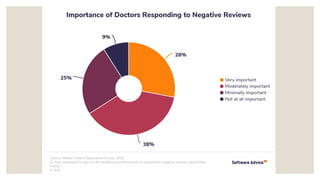
◦ Forty percent reported that physician rating sites were “very important” when choosing a
physician, although rating sites were endorsed less frequently than other factors, including word
of mouth from family and friends
◦ Awareness of online physician ratings (65 percent) was lower than for consumer goods such as
cars (87 percent) and non-health care service providers (71 percent)
◦ Among those who sought online physician ratings in the past year, 35 percent reported
selecting a physician based on good ratings and 37 percent had avoided a physician with
bad ratings
◦ For those who had not sought online physician ratings, 43 percent reported a lack of trust in the
information on the sites.
Study Examines Public Awareness, Use of Online Physician Rating Sites:
https://media.jamanetwork.com/news-item/study-examines-public-awareness-use-of-online-physician-
rating-sites/ (2012; 2014)
2012
Threats to your reputation
◦ Nearly one in four physicians reports online harassment
◦ Out of 464 respondents in an invited case study series
◦ “Physicians reported verbal abuse, death threats, contacting employers and
certifying boards, and sharing of personally identifying information on public forums
in these comments.” - https://www.healthgrades.com/pro/nearly-one-in-four-
doctors-report-harassment-on-social-
media?tpc=cardiology?CID=64embrdTINL012621
Yelp again
•Study shows high Yelp rating correlates with better Hospital
Outcomes
–BardachNS, Asteria-peñalozaR, BoscardinWJ, Adams Dudley,
R. The relationship between commercial website ratings and
traditional hospital performance measures in the USA. BMJ
QualSaf. 2012.
http://www.imedicalapps.com/2013/02/yelp-hospital-outcomes/
But then there’s this:
◦“Fake It Till You Make It: Reputation, Competition,
and Yelp Review Fraud”
– Investigated economic incentives for creating fake
reviews for self or competitor
http://people.hbs.edu/mluca/fakeittillyouma keit.pdf
Establishing a reputation management plan (1)
•Begin monitoring your online presence
•Search for your name at least once per month
•Create a search alert for your name
•Check your privacy settings on all social media
•Feed your online presence with positive content
-Blogging, Tweeting, profile sites, YouTube, professional
directories, newsletters, etc.
• Be aware of who might be looking for information
about you; consider to what sites Google will direct
searchers
• E.g., those searching for information on clinicians will
be directed to sites such as HealthGrades, etc
• Review the information about you on those sites; take
steps to correct it if necessary
• Accept the fact that NO information does NOT equal a
positive image and, in fact, can be viewed with suspicion
Establishing a reputation management plan (2)
Establishing a reputation management plan (3)
•“6 Steps To Managing Your Online Reputation”
–Search yourself
–Buy your domain name
–Create one central place for your content
–Join social networks
–Optimize your presence on those sites
–Keep private things private; assume nothing is
private
Reputation Restoration (1)
•First steps
–Take time to process your emotions
–You will need the support of family and friends, and your
professional network
–Realize that you are not the first person whose
reputation has been damaged-you are not alone.
Reputation Restoration (2)
◦ Assess the damage; if severe, consult a professional
reputation management consultant immediately.
◦ Accept that you cannot repair the damage on your
own and that the issue won’t just go away.
– Consider carefully before responding.
In conclusion, for successful reputation
management:
◦ Accept
◦ It’s necessary, and no one else will do it for you
◦ Discover
◦ Search for yourself on physician rating sites
◦ Set search alerts for your name
◦ Be proactive
◦ Create a reputation restoration plan BEFORE one is needed
◦ Manage
◦ Check your social media privacy settings once/month
◦ Feed your reputation with positive/neutral content; post regularly (80/20 rule)
Resources
◦ The Trust Prescription for Healthcare: Building Your Reputation with Consumers; David A. Shore;
https://www.worldcat.org/title/trust-prescription-for-healthcare-building-your-reputation-with-
consumers/oclc/1075724837
◦ Prevalence of Personal Attacks and Sexual Harassment of Physicians on Social Media
◦ doi:10.1001/jamainternmed.2020.7235
◦ People will pay 22% more for certain products if the company has a good reputation-
https://www.marketwatch.com/story/people-will-pay-22-more-for-certain-products-if-the-
company-has-a-good-reputation-2018-12-14
◦ Reputation Management for Doctors- https://partners.healthgrades.com/blog/reputation-
management-for-doctors
◦ How Online Ratings Affect Healthcare’s Bottom Lines-
https://www.physicianspractice.com/view/how-online-ratings-affect-healthcares-bottom-line
◦ 100 Reputation Management Stats for 2020; https://statuslabs.com/reputation-management-
stats-2020/
◦ Advertising with Healthgrades
◦ https://partners.healthgrades.com/advertise-with-healthgrades/audience-reach
Resources
◦ Google July 2021 Update is Over – What
Happened? https://www.searchenginejournal.com/google-july-2021-core-algorithm-
update/413204/#close
◦ 77 Online Reputation Statistics for 2021 https://statuslabs.com/reputation-
management-stats-2021/
◦ Online Reputation Management Market Size 2021: Analysis By Leading Players,
Impact of COVID-19, Regional Revenue, Demands, Future Trends, Growth Factors,
Business Strategy, Price and Gross Margin till
2025 https://www.thecowboychannel.com/story/43765293/online-reputation-
management-market-size-2021-analysis-by-leading-players-impact-of-covid-19-
regional-revenue-demands-future-trends-growth-factors
◦ How Patients use Online Reviews-
https://www.softwareadvice.com/resources/how-patients-use-online-reviews/

Reputation Management- August 2021

  • 1.
    UNDERSTANDING REPUTATION MANAGEMENT & THE REPUTATIONECONOMY Kimberley R. Barker, MLIS Librarian for Digital Life
  • 2.
    MY PERSPECTIVE •REPUTATION MANAGEMENTIS NOT FOR: – ERASING THE DEEDS OF CONVICTED CRIMINALS – ERASING INSTITUTIONAL HISTORY – ERASING FACTUAL, NEGATIVE BUSINESS REVIEWS
  • 3.
    ◦ In thispresentation: •Define “reputation management”, “reputation economy”, “reputation cost” •Define “Google Truth” •Understand how Google works •Define online reputation management services –Individual –Corporate - Discipline-wide •Understand how to establish a reputation management plan the real-life ramifications of reputation damage the process of reputation restoration •Further resources
  • 4.
    What is reputationmanagement? ◦The practice of shaping public perception of an individual or institutional reputation, particularly with regard to digital presence ◦Managing public presence so that it matches an individual's or institution's values ◦ The digital equivalent of interview preparation and personal hygiene
  • 5.
    What is thereputation economy? ◦Refers to the way in which the standing of a product/person/institution/business is shaped by the contributions of end users. ◦The fact that your reputation affects your ability to work ◦“wisdom of crowds”/crowdsourcing ◦Changes in technology mean that we use computers instead of the telephone or writing letters
  • 6.
    Reputation Cost ◦ “thevarious forms of economic and other harm that an entity may experience as a result of damage to its reputation with customers or others.”
  • 7.
    Consider your ownhabits ◦ How many of you Google the following? - Job candidates – Dates - Children’s friends/counselors/teachers – Doctors – Products – Hotels – Restaurants • How much are you influenced by what you find?
  • 8.
    ◦ Incidentally… ◦ 2011report on Yelp ratings by Harvard Business School assistant professor Michael Luca: ◦ a one-star increase in the rating of an independent restaurant leads to a 5 to 9 percent increase in revenue. http://www.hbs.edu/faculty/Publication%20File s/12-016.pdf
  • 9.
  • 10.
    “Google Truth” •the automaticacceptance of Google results as an accurate representation of reality
  • 11.
  • 12.
  • 13.
  • 14.
    How Google works(1 of 7) ◦ Google is comprised of three distinct parts: ◦ Googlebot ◦ Indexer ◦ Query processor *Each part has its own specific and unique function.
  • 15.
    How Google works(2 of 7) ◦ Googlebot ◦ Composed of 1000’s of computers engaged in parallel processing: ◦ Requests & retrieves 1000’s of different pages simultaneously; does this two ways ◦ “Add URL” forms ◦ Find links via web crawling ◦ Fresh crawls ◦ Deep crawls
  • 16.
    How Google works(3 of 7) ◦ Indexer ◦ Receives full texts of pages from Googlebot; stores them in databases ◦ Index sorts search terms alphabetically ◦ Ignores “stop words” ◦ Converts all text to lower-case ◦ Each entry in index stores list of documents with that search term and also the location within the text of that search term
  • 17.
    How Google works(4 of 7) ◦Query processor has multiple parts: ◦Search box ◦“engine” that evaluates, searches, and matches to relevant documents ◦Results formatter
  • 18.
  • 19.
    How Google works(6 of 7) (It’s a popularity contest… sort of) ◦ PageRank ◦ Link analysis algorithm ◦ Page with higher rank displays higher in results list ◦ Google uses over 100 factors to determine rank ◦ How is PR calculated? ◦ Basically, the more times that a page is linked to determines its PR ◦ Built from this algorithm, which is used iteratively: ◦ PR(A) = (1-d) + d (PR(T1)/C(T1) + … + PR(Tn)/C(Tn))
  • 20.
  • 21.
    Hummingbird ◦ Google replacedits algorithm in August, 2013 ◦ The preceding seven slides are still valid ◦ Hummingbird is semantic; i.e., based on natural language queries ◦ Conversational search technology ◦ Uses Google’s Knowledge Graph ◦ Google is looking towards future ◦ 60% of Americans access Internet on mobile device ◦ Spoken searches
  • 22.
    Hummingbird: Mobile-Friendly Update •April21, 2015 –Mobile-friendliness •Tappable buttons •Easy to navigate from a small screen •Important information front & center –Mobile speed –Desktop
  • 23.
    July 2021 Update ◦Google stated that this update was, "… a core algorithm update is one that introduces changes across a wide range of the indexing and ranking processes"- and not much else. ◦ Businesses, social platforms, and SEO experts have reported different results and experiences since the update. ◦ https://www.searchenginejournal.com/google-july-2021-core-algorithm-update/413204/#close
  • 24.
    Why did Ijust spend that time on Google? ◦ If you understand how Google works, you will understand how to: ◦ Positively increase your online presence ◦ Monitor your reputation ◦ Formulate a basic reputation restoration plan ◦ Understand when you need to seek professional help
  • 25.
  • 26.
    What is ORM? ◦ Basically,“…the practice of making people and businesses look their best on the Internet.” www.reputation.com • For whom is this service? – Individuals – Professionals – Institutions •Who can perform this service? •People just like you •Reputation management professionals
  • 27.
    ORM is BigBusiness ◦ ORM market revenue in 2019: $923 Million (USD) ◦ By 2023, ORM market revenue is expected to reach $1354 Million (USD)
  • 28.
    Other Services ◦ Contentremoval services ◦ Permanent deletion of problematic content, instead of pushing it lower in search results ◦ Reputation Profile platforms ◦ Claim to be on the side of the consumer ◦ Protection from liars and criminals ◦ “Better than background checks”
  • 29.
  • 30.
  • 31.
    An example ofa MyLife report
  • 32.
    Should individuals and institutionsconcern themselves with ORM?
  • 33.
    YES! ◦Monitor your reputationwith the same diligence that you monitor your credit and identity.
  • 34.
    However, traditional RMservices are expensive. ◦ Do-it-yourself options have cropped up – Brand Yourself – Reputation-Fix
  • 35.
    Why should healthcare providerscare about reputation management?
  • 36.
    ◦ Only 3%of people* DON’T use social media *Across 34 countries, among people aged 16-64.
  • 37.
    Why should youcare? (1) ◦ “… 77 percent of patients conduct an online search before making an appointment with a physician, meaning most prospective patients' first impression of a provider or healthcare organization occurs online, before they even step foot inside the facility.”* ◦ “According to Mr. Rainey, 47 percent of patients are willing to go out of network based on reviews. ‘When doctors are missing star ratings and reviews, more than 50 percent of people searching for doctors will not choose those providers,’ he added.”* *“How first impressions online affect patient acquisition and hospital revenue” (2017) https://www.beckershospitalreview.com/hospital-management-administration/how-first-impressions- online-affect-patient-acquisition-and-hospital-revenue.html
  • 38.
    Why should youcare? (2) ◦ Forty percent reported that physician rating sites were “very important” when choosing a physician, although rating sites were endorsed less frequently than other factors, including word of mouth from family and friends ◦ Awareness of online physician ratings (65 percent) was lower than for consumer goods such as cars (87 percent) and non-health care service providers (71 percent) ◦ Among those who sought online physician ratings in the past year, 35 percent reported selecting a physician based on good ratings and 37 percent had avoided a physician with bad ratings ◦ For those who had not sought online physician ratings, 43 percent reported a lack of trust in the information on the sites. Study Examines Public Awareness, Use of Online Physician Rating Sites: https://media.jamanetwork.com/news-item/study-examines-public-awareness-use-of-online-physician- rating-sites/ (2012; 2014)
  • 39.
  • 42.
    Threats to yourreputation ◦ Nearly one in four physicians reports online harassment ◦ Out of 464 respondents in an invited case study series ◦ “Physicians reported verbal abuse, death threats, contacting employers and certifying boards, and sharing of personally identifying information on public forums in these comments.” - https://www.healthgrades.com/pro/nearly-one-in-four- doctors-report-harassment-on-social- media?tpc=cardiology?CID=64embrdTINL012621
  • 43.
    Yelp again •Study showshigh Yelp rating correlates with better Hospital Outcomes –BardachNS, Asteria-peñalozaR, BoscardinWJ, Adams Dudley, R. The relationship between commercial website ratings and traditional hospital performance measures in the USA. BMJ QualSaf. 2012. http://www.imedicalapps.com/2013/02/yelp-hospital-outcomes/
  • 44.
    But then there’sthis: ◦“Fake It Till You Make It: Reputation, Competition, and Yelp Review Fraud” – Investigated economic incentives for creating fake reviews for self or competitor http://people.hbs.edu/mluca/fakeittillyouma keit.pdf
  • 45.
    Establishing a reputationmanagement plan (1) •Begin monitoring your online presence •Search for your name at least once per month •Create a search alert for your name •Check your privacy settings on all social media •Feed your online presence with positive content -Blogging, Tweeting, profile sites, YouTube, professional directories, newsletters, etc.
  • 46.
    • Be awareof who might be looking for information about you; consider to what sites Google will direct searchers • E.g., those searching for information on clinicians will be directed to sites such as HealthGrades, etc • Review the information about you on those sites; take steps to correct it if necessary • Accept the fact that NO information does NOT equal a positive image and, in fact, can be viewed with suspicion Establishing a reputation management plan (2)
  • 47.
    Establishing a reputationmanagement plan (3) •“6 Steps To Managing Your Online Reputation” –Search yourself –Buy your domain name –Create one central place for your content –Join social networks –Optimize your presence on those sites –Keep private things private; assume nothing is private
  • 51.
    Reputation Restoration (1) •Firststeps –Take time to process your emotions –You will need the support of family and friends, and your professional network –Realize that you are not the first person whose reputation has been damaged-you are not alone.
  • 52.
    Reputation Restoration (2) ◦Assess the damage; if severe, consult a professional reputation management consultant immediately. ◦ Accept that you cannot repair the damage on your own and that the issue won’t just go away. – Consider carefully before responding.
  • 53.
    In conclusion, forsuccessful reputation management: ◦ Accept ◦ It’s necessary, and no one else will do it for you ◦ Discover ◦ Search for yourself on physician rating sites ◦ Set search alerts for your name ◦ Be proactive ◦ Create a reputation restoration plan BEFORE one is needed ◦ Manage ◦ Check your social media privacy settings once/month ◦ Feed your reputation with positive/neutral content; post regularly (80/20 rule)
  • 55.
    Resources ◦ The TrustPrescription for Healthcare: Building Your Reputation with Consumers; David A. Shore; https://www.worldcat.org/title/trust-prescription-for-healthcare-building-your-reputation-with- consumers/oclc/1075724837 ◦ Prevalence of Personal Attacks and Sexual Harassment of Physicians on Social Media ◦ doi:10.1001/jamainternmed.2020.7235 ◦ People will pay 22% more for certain products if the company has a good reputation- https://www.marketwatch.com/story/people-will-pay-22-more-for-certain-products-if-the- company-has-a-good-reputation-2018-12-14 ◦ Reputation Management for Doctors- https://partners.healthgrades.com/blog/reputation- management-for-doctors ◦ How Online Ratings Affect Healthcare’s Bottom Lines- https://www.physicianspractice.com/view/how-online-ratings-affect-healthcares-bottom-line ◦ 100 Reputation Management Stats for 2020; https://statuslabs.com/reputation-management- stats-2020/ ◦ Advertising with Healthgrades ◦ https://partners.healthgrades.com/advertise-with-healthgrades/audience-reach
  • 56.
    Resources ◦ Google July2021 Update is Over – What Happened? https://www.searchenginejournal.com/google-july-2021-core-algorithm- update/413204/#close ◦ 77 Online Reputation Statistics for 2021 https://statuslabs.com/reputation- management-stats-2021/ ◦ Online Reputation Management Market Size 2021: Analysis By Leading Players, Impact of COVID-19, Regional Revenue, Demands, Future Trends, Growth Factors, Business Strategy, Price and Gross Margin till 2025 https://www.thecowboychannel.com/story/43765293/online-reputation- management-market-size-2021-analysis-by-leading-players-impact-of-covid-19- regional-revenue-demands-future-trends-growth-factors ◦ How Patients use Online Reviews- https://www.softwareadvice.com/resources/how-patients-use-online-reviews/