 homosexual
 heterosexual
 bisexual
 asexual
 straight
 gay
 Lesbian
 pansexual
Can you think of examples from TV drama?
 …..A name for the sexual feelings and behaviour of a
person
 .….When applied to groups of people (e.g.
heterosexuals/homosexuals/bisexuals) ideas of social
attitude and organisation are implied. (Nelmes, J.,
Introduction to Film Studies (Routledge 2007) )
 Despite changing equality laws and a wider acceptance of different
sexualities within much of society, TV has always remained quite
conservative as they are scared of offending their viewers.
 Heterosexual (straight) characters are represented as the “norm”
and homosexual (gay) characters are often represented as being
different, strange, or separate from mainstream society.
 Some critics say that when TV does feature gay characters, they are
never just characters that “happen to be gay.” Their sexuality
always plays a key part in their storylines and they don’t seem to
have any issues outside of their sexuality.
 Heterosexual women
 Heterosexual men
 Homosexual women (lesbian)
 Homosexual men (gay)
 Make your own notes, remember you may think of other
common stereotypes!
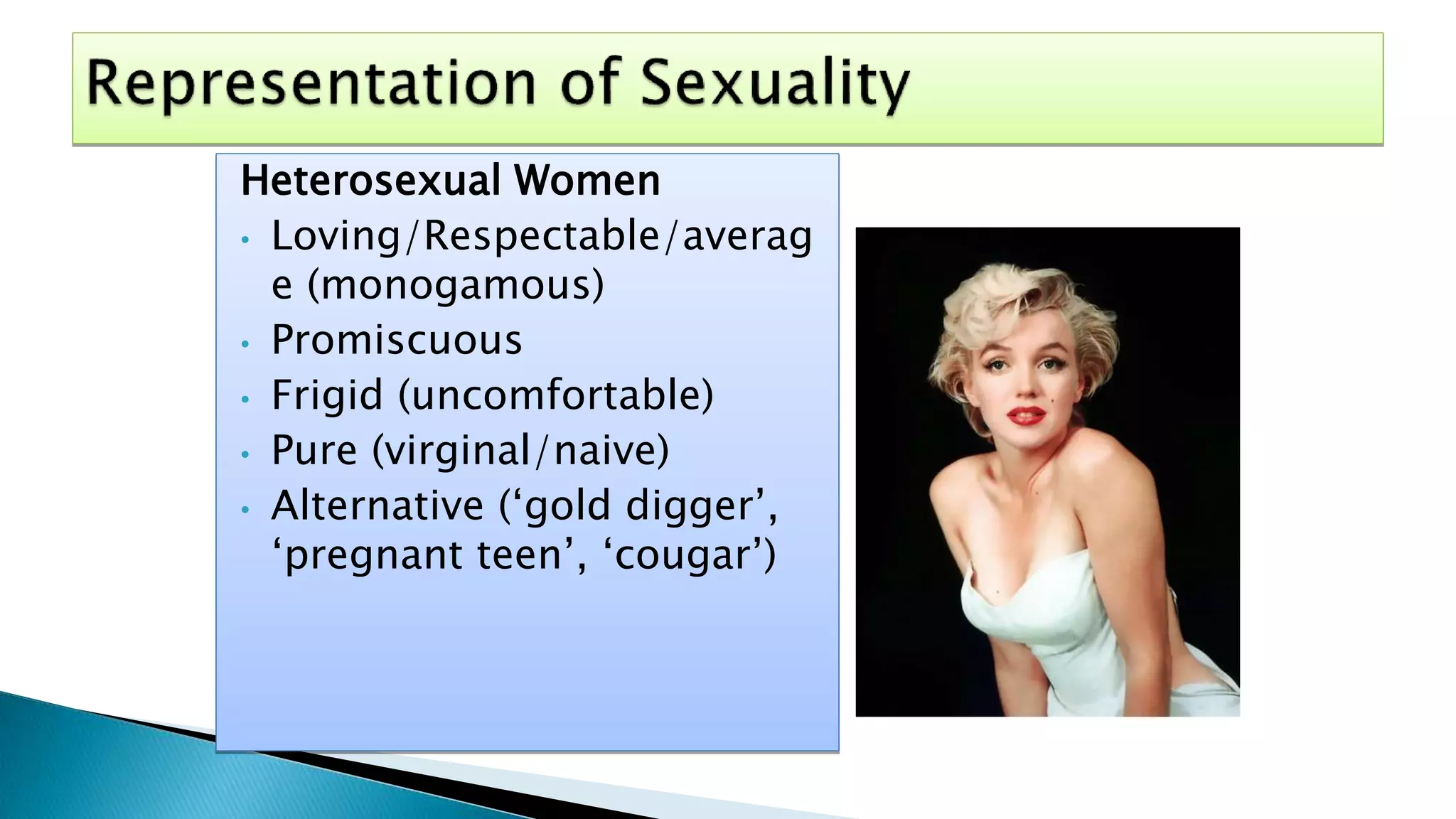
Heterosexual Women
• Loving/Respectable/averag
e (monogamous)
• Promiscuous
• Frigid (uncomfortable)
• Pure (virginal/naive)
• Alternative (‘gold digger’,
‘pregnant teen’, ‘cougar’)
Heterosexual Men
• Respectable (monogamous)
• Promiscuous
• ‘Ladies Man’, ‘Heart throb’
• Bumbling man who has
trouble talking to women
Homosexual women (Lesbian)
• Monogamous
• Promiscuous
• Embarrassed (In the closet)
Homosexual Males
(Gay)
• Promiscuous
• Monogamous
• Overbearing
• Embarrassed (In the
closet)
Important points to consider
• Gender closely ties in with
sexuality.
• Sexuality is often expressed
through physical means;
clothes, props, setting, acting.
• Understanding how a particular
characters gender is constructed
will help you analyse how their
sexuality is being represented.
 As society has developed, and times have changed,
so has the representation of sexuality in TV
Dramas.
 However, Gay and lesbian characters are often
marginalised and are seen as supporting
characters.
 It is sometimes difficult for the characters to grow
and develop.
 Fears coming out to his
family
 Displays some
stereotypical attributes of
gay behaviour such as
dancing in a theatrical way
and being flamboyant.
 http://www.youtube.com/
watch?v=ikQlhm6QQuA
 The Colourful Gay Man – Stanford Blatch –
Sex and the City
 Some feminine qualities
 Best friends with women
 Like to talk about fashion and feelings
 http://www.youtube.com/watch?v=w_M3R
wF2UN8&feature=related
The Butch Lesbian
Shane in the L Word
 Masculine Dress
 Masculine behaviour?
 Man in the
relationship?
Feminine Lesbian
Santana in Glee
 Concerned with feelings
and love over sex.
 Dress feminine
http://www.youtube.com/wa
tch?v=UERsZImECTk&featu
re=related
 Can I identify what the sexualities of the characters are?
 Are people of different sexualities shown as having different
interests, personalities, attitudes, behaviours? If so, how?
 Is their sexuality represented as being important in their life?
 Are particular sexualities represented as being normal / powerful /
better? If so, how?
 Are particular sexualities represented as being abnormal? If so,
how?
 What is the message the clip is trying to portray about sexuality?
 Don’t forget that “straight” is a sexuality too. Don’t ignore the
straight characters as they need to be analysed too!
Key words:
 homosexual
 heterosexual
 bisexual
 asexual
 straight
 gay
 lesbian

Representation sexuality

  • 2.
     homosexual  heterosexual bisexual  asexual  straight  gay  Lesbian  pansexual Can you think of examples from TV drama?
  • 3.
     …..A namefor the sexual feelings and behaviour of a person  .….When applied to groups of people (e.g. heterosexuals/homosexuals/bisexuals) ideas of social attitude and organisation are implied. (Nelmes, J., Introduction to Film Studies (Routledge 2007) )
  • 4.
     Despite changingequality laws and a wider acceptance of different sexualities within much of society, TV has always remained quite conservative as they are scared of offending their viewers.  Heterosexual (straight) characters are represented as the “norm” and homosexual (gay) characters are often represented as being different, strange, or separate from mainstream society.  Some critics say that when TV does feature gay characters, they are never just characters that “happen to be gay.” Their sexuality always plays a key part in their storylines and they don’t seem to have any issues outside of their sexuality.
  • 5.
     Heterosexual women Heterosexual men  Homosexual women (lesbian)  Homosexual men (gay)  Make your own notes, remember you may think of other common stereotypes!
  • 6.
    Heterosexual Women • Loving/Respectable/averag e(monogamous) • Promiscuous • Frigid (uncomfortable) • Pure (virginal/naive) • Alternative (‘gold digger’, ‘pregnant teen’, ‘cougar’)
  • 7.
    Heterosexual Men • Respectable(monogamous) • Promiscuous • ‘Ladies Man’, ‘Heart throb’ • Bumbling man who has trouble talking to women
  • 8.
    Homosexual women (Lesbian) •Monogamous • Promiscuous • Embarrassed (In the closet)
  • 9.
    Homosexual Males (Gay) • Promiscuous •Monogamous • Overbearing • Embarrassed (In the closet)
  • 10.
    Important points toconsider • Gender closely ties in with sexuality. • Sexuality is often expressed through physical means; clothes, props, setting, acting. • Understanding how a particular characters gender is constructed will help you analyse how their sexuality is being represented.
  • 11.
     As societyhas developed, and times have changed, so has the representation of sexuality in TV Dramas.  However, Gay and lesbian characters are often marginalised and are seen as supporting characters.  It is sometimes difficult for the characters to grow and develop.
  • 12.
     Fears comingout to his family  Displays some stereotypical attributes of gay behaviour such as dancing in a theatrical way and being flamboyant.  http://www.youtube.com/ watch?v=ikQlhm6QQuA
  • 13.
     The ColourfulGay Man – Stanford Blatch – Sex and the City  Some feminine qualities  Best friends with women  Like to talk about fashion and feelings  http://www.youtube.com/watch?v=w_M3R wF2UN8&feature=related
  • 14.
    The Butch Lesbian Shanein the L Word  Masculine Dress  Masculine behaviour?  Man in the relationship?
  • 15.
    Feminine Lesbian Santana inGlee  Concerned with feelings and love over sex.  Dress feminine http://www.youtube.com/wa tch?v=UERsZImECTk&featu re=related
  • 16.
     Can Iidentify what the sexualities of the characters are?  Are people of different sexualities shown as having different interests, personalities, attitudes, behaviours? If so, how?  Is their sexuality represented as being important in their life?  Are particular sexualities represented as being normal / powerful / better? If so, how?  Are particular sexualities represented as being abnormal? If so, how?  What is the message the clip is trying to portray about sexuality?  Don’t forget that “straight” is a sexuality too. Don’t ignore the straight characters as they need to be analysed too!
  • 17.
    Key words:  homosexual heterosexual  bisexual  asexual  straight  gay  lesbian