Representations of sexuality in 
the media 
To understand how sexuality is 
represented by mass media 
To evaluate changes in media 
representations of sexuality
Topical Teaser 
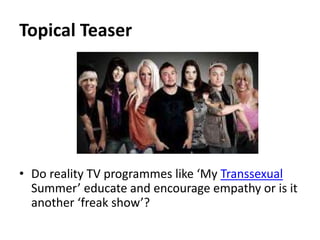
• Do reality TV programmes like ‘My Transsexual 
Summer’ educate and encourage empathy or is it 
another ‘freak show’?
Representations of gay parenting has 
gone mainstream 
• A popular US sitcom ‘Modern Family’ has 
been used as an example of acceptance of 
same sex families 
• The film ‘The Kids are Alright’ was made by 
Hollywood for a mainstream audience 
• Gay tv and films continue to push the 
boundaries with ‘Orange is the New Black’ and 
‘Blue is the warmest colour’
Sexuality: a gay-friendly media? 
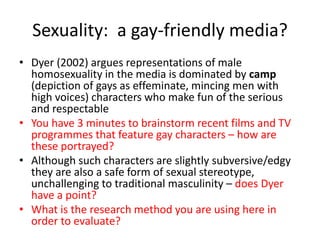
• Dyer (2002) argues representations of male 
homosexuality in the media is dominated by camp 
(depiction of gays as effeminate, mincing men with 
high voices) characters who make fun of the serious 
and respectable 
• You have 3 minutes to brainstorm recent films and TV 
programmes that feature gay characters – how are 
these portrayed? 
• Although such characters are slightly subversive/edgy 
they are also a safe form of sexual stereotype, 
unchallenging to traditional masculinity – does Dyer 
have a point? 
• What is the research method you are using here in 
order to evaluate?
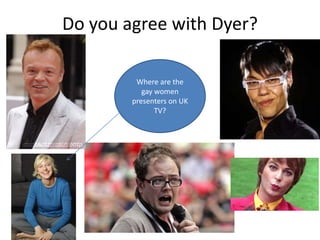
Do you agree with Dyer? 
Where are the 
gay women 
presenters on UK 
TV?
How far have representations of 
sexuality in the media moved on? 
Do films like ‘Brokeback Mountain 
and ‘Weekend’ 
And TV series like the L word prove 
that the media has moved on?
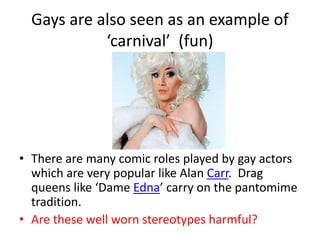
Gays are also seen as an example of 
‘carnival’ (fun) 
• There are many comic roles played by gay actors 
which are very popular like Alan Carr. Drag 
queens like ‘Dame Edna’ carry on the pantomime 
tradition. 
• Are these well worn stereotypes harmful?
Is it inclusion or tokenism? 
• Is the media responding to legislative pressure to 
portray gay and transgendered people in a non-discriminatory 
way? 
• Is the media including gay and transgendered 
people as tokens because it has to? 
• Is the media reflecting more tolerant and liberal 
attitudes towards gay and transgendered people? 
• Is the media helping to blaze a trail for gay rights? 
• Use your skills of evaluation and analysis to justify 
the point of view you most agree with and use 
evidence to strengthen your argument 
• Be ready to peer assess your answers!
Other media depictions 
have been more 
negative......... 
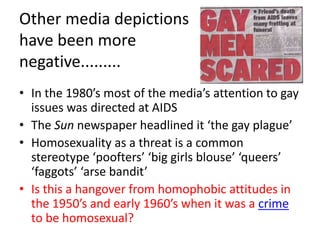
• In the 1980’s most of the media’s attention to gay 
issues was directed at AIDS 
• The Sun newspaper headlined it ‘the gay plague’ 
• Homosexuality as a threat is a common 
stereotype ‘poofters’ ‘big girls blouse’ ‘queers’ 
‘faggots’ ‘arse bandit’ 
• Is this a hangover from homophobic attitudes in 
the 1950’s and early 1960’s when it was a crime 
to be homosexual?
In recent years TV drama and films 
have been more realistic..... 
• Brookside and Friends have featured lesbian 
relationships in a sympathetic way and Eastenders has 
featured major homosexual characters 
• However, the plots tend to focus on homosexuality as a 
problem and on gays coming to terms with their 
sexuality 
• Homosexual characters are constructed for a 
heterosexual audience and viewed through a 
heterosexual gaze (homosexual issues are presented 
by the media from a heterosexual viewpoint) 
• Male homosexuals are often white and middle class – 
where are all the ordinary gay folk?
Queer as Folk - 1999 TV Series 
• This TV series was ground-breaking in its 
treatment of homosexuality 
• The main characters were young, stylish and gay, 
sex was explicit and the gay characters far from 
nice 
• Russell Davies, the gay creator of the series 
argued that the series showed that gay 
representations in the media ‘had grown up’ – 
gays could now be selfish and bad.....real people 
• Do you think this was a necessary step in order to 
combat gay stereotypes?
So what about lesbians? 
• Lesbianism has received less attention from the 
media than gay men 
• There are stock characters – dungaree-wearing, 
man-hating, hairy-legged dykes 
• Lesbian relationships are implicit rather than 
explicit – Why? 
• Xena, Warrior Princess has a ‘special’ relationship 
with her young female companion Gabrielle 
relying on the audience to interpret this as they 
wish –some saw lesbianism, some saw an 
adventure story
Why so little lesbian exposure in the 
media? 
• Perhaps the limited portrayal of lesbianism has 
reflected the threat it poses to concepts of 
traditional masculinity – how far would you agree 
with this view? 
• A distinct and popular genre of pornography 
features lesbian sex for the gratification of men 
• Even ‘ground-breaking’ films such as Kissing 
Jessica Stein feature images that have nothing to 
do with the way lesbians perceive each other and 
more to do with male heterosexual fantasies
But times are changing! 
• Series such as The L Word show that explicit lesbian 
issues can now be sold to heterosexuals so this makes 
the topic a viable option for TV programmers and film 
companies 
• Do you think this reflects societal attitudes towards 
lesbians? 
• Is it fashionable to be a ‘lipstick lesbian’? 
• How far do trends affect media representations of 
sexuality? 
• Mainstream films have even featured lesbian 
relationships as a part of family life in ‘The Kids are 
Alright’
Analysis and Evaluation of source 
material 
• Read the article ‘Gay roles on television need 
to be real’ 
• Identify what you think are the three main 
points of the argument 
• Evaluate whether this article argues these 
points convincingly 
• Analyse if there is enough evidence to justify 
the claims made in the article
Is there ever going to be a time when 
gay is part of the norm? 
• Why is the media continuing to highlight a 
person’s sexuality? 
• Klein (2000) argues that increasing diversification 
of society has been recognised by the media 
because it is forced to follow public sentiment 
rather than pass judgement 
• Is there now a new genre of films and 
programmes that show everyday gay life rather 
than concentrating on gay issues (e.g. ‘Milk’ and 
‘Brokeback Mountain’)
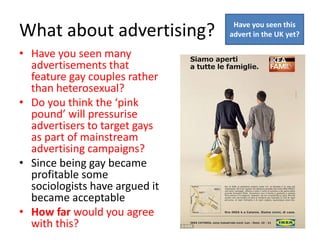
What about advertising? 
• Have you seen many 
advertisements that 
feature gay couples rather 
than heterosexual? 
• Do you think the ‘pink 
pound’ will pressurise 
advertisers to target gays 
as part of mainstream 
advertising campaigns? 
• Since being gay became 
profitable some 
sociologists have argued it 
became acceptable 
• How far would you agree 
with this? 
Have you seen this 
advert in the UK yet?
How far does the internet make a 
difference to the portrayal of 
sexuality? 
• ‘How far’ is a ‘command’ word for longer answer 
examination questions 
• What is ‘how far’ asking you to do? 
• To answer ‘how far’ needs skills of analysis and 
evaluation 
• You have 5 minutes to write a paragraph that answers 
the above question 
• Use your knowledge and understanding of the 
following: citizen journalism and independent media, 
social networking sites, you tube, blogs
Make a plan! 
• Using the notes from this power point you are going to 
share a mini essay plan that would answer this 
question: 
• How far have media depictions of gay characters and 
issues changed in recent years? (33 marks) 
• Bullet points needed for: Introduction, main body of 
the essay where content is analysed and evaluated, 
concluding comments 
• We will spend 5 minutes on each section of the essay 
• Every person needs to write one bullet point for each 
section 
• We will use these points to make an individual plan
What should you include: 
• Theories of mass media effects – briefly (e.g. 
Hypodermic syringe, uses and gratifications, decoding, 
reception theory) 
• Usefulness of stereotypes for the media - briefly 
• How stereotypes are linked to labelling - briefly 
• Social construction and hegemony 
• Descriptions of evidence relating to the media and 
sexuality and evaluation of these 
• Linking content of media to advertising 
• How far media representation follows societal changes 
• Postmodernist perspective regarding a variety of 
identities and lifestyle choices

A2 representations of sexuality

  • 1.
    Representations of sexualityin the media To understand how sexuality is represented by mass media To evaluate changes in media representations of sexuality
  • 2.
    Topical Teaser •Do reality TV programmes like ‘My Transsexual Summer’ educate and encourage empathy or is it another ‘freak show’?
  • 3.
    Representations of gayparenting has gone mainstream • A popular US sitcom ‘Modern Family’ has been used as an example of acceptance of same sex families • The film ‘The Kids are Alright’ was made by Hollywood for a mainstream audience • Gay tv and films continue to push the boundaries with ‘Orange is the New Black’ and ‘Blue is the warmest colour’
  • 4.
    Sexuality: a gay-friendlymedia? • Dyer (2002) argues representations of male homosexuality in the media is dominated by camp (depiction of gays as effeminate, mincing men with high voices) characters who make fun of the serious and respectable • You have 3 minutes to brainstorm recent films and TV programmes that feature gay characters – how are these portrayed? • Although such characters are slightly subversive/edgy they are also a safe form of sexual stereotype, unchallenging to traditional masculinity – does Dyer have a point? • What is the research method you are using here in order to evaluate?
  • 5.
    Do you agreewith Dyer? Where are the gay women presenters on UK TV?
  • 6.
    How far haverepresentations of sexuality in the media moved on? Do films like ‘Brokeback Mountain and ‘Weekend’ And TV series like the L word prove that the media has moved on?
  • 7.
    Gays are alsoseen as an example of ‘carnival’ (fun) • There are many comic roles played by gay actors which are very popular like Alan Carr. Drag queens like ‘Dame Edna’ carry on the pantomime tradition. • Are these well worn stereotypes harmful?
  • 8.
    Is it inclusionor tokenism? • Is the media responding to legislative pressure to portray gay and transgendered people in a non-discriminatory way? • Is the media including gay and transgendered people as tokens because it has to? • Is the media reflecting more tolerant and liberal attitudes towards gay and transgendered people? • Is the media helping to blaze a trail for gay rights? • Use your skills of evaluation and analysis to justify the point of view you most agree with and use evidence to strengthen your argument • Be ready to peer assess your answers!
  • 9.
    Other media depictions have been more negative......... • In the 1980’s most of the media’s attention to gay issues was directed at AIDS • The Sun newspaper headlined it ‘the gay plague’ • Homosexuality as a threat is a common stereotype ‘poofters’ ‘big girls blouse’ ‘queers’ ‘faggots’ ‘arse bandit’ • Is this a hangover from homophobic attitudes in the 1950’s and early 1960’s when it was a crime to be homosexual?
  • 10.
    In recent yearsTV drama and films have been more realistic..... • Brookside and Friends have featured lesbian relationships in a sympathetic way and Eastenders has featured major homosexual characters • However, the plots tend to focus on homosexuality as a problem and on gays coming to terms with their sexuality • Homosexual characters are constructed for a heterosexual audience and viewed through a heterosexual gaze (homosexual issues are presented by the media from a heterosexual viewpoint) • Male homosexuals are often white and middle class – where are all the ordinary gay folk?
  • 11.
    Queer as Folk- 1999 TV Series • This TV series was ground-breaking in its treatment of homosexuality • The main characters were young, stylish and gay, sex was explicit and the gay characters far from nice • Russell Davies, the gay creator of the series argued that the series showed that gay representations in the media ‘had grown up’ – gays could now be selfish and bad.....real people • Do you think this was a necessary step in order to combat gay stereotypes?
  • 12.
    So what aboutlesbians? • Lesbianism has received less attention from the media than gay men • There are stock characters – dungaree-wearing, man-hating, hairy-legged dykes • Lesbian relationships are implicit rather than explicit – Why? • Xena, Warrior Princess has a ‘special’ relationship with her young female companion Gabrielle relying on the audience to interpret this as they wish –some saw lesbianism, some saw an adventure story
  • 13.
    Why so littlelesbian exposure in the media? • Perhaps the limited portrayal of lesbianism has reflected the threat it poses to concepts of traditional masculinity – how far would you agree with this view? • A distinct and popular genre of pornography features lesbian sex for the gratification of men • Even ‘ground-breaking’ films such as Kissing Jessica Stein feature images that have nothing to do with the way lesbians perceive each other and more to do with male heterosexual fantasies
  • 14.
    But times arechanging! • Series such as The L Word show that explicit lesbian issues can now be sold to heterosexuals so this makes the topic a viable option for TV programmers and film companies • Do you think this reflects societal attitudes towards lesbians? • Is it fashionable to be a ‘lipstick lesbian’? • How far do trends affect media representations of sexuality? • Mainstream films have even featured lesbian relationships as a part of family life in ‘The Kids are Alright’
  • 15.
    Analysis and Evaluationof source material • Read the article ‘Gay roles on television need to be real’ • Identify what you think are the three main points of the argument • Evaluate whether this article argues these points convincingly • Analyse if there is enough evidence to justify the claims made in the article
  • 16.
    Is there evergoing to be a time when gay is part of the norm? • Why is the media continuing to highlight a person’s sexuality? • Klein (2000) argues that increasing diversification of society has been recognised by the media because it is forced to follow public sentiment rather than pass judgement • Is there now a new genre of films and programmes that show everyday gay life rather than concentrating on gay issues (e.g. ‘Milk’ and ‘Brokeback Mountain’)
  • 17.
    What about advertising? • Have you seen many advertisements that feature gay couples rather than heterosexual? • Do you think the ‘pink pound’ will pressurise advertisers to target gays as part of mainstream advertising campaigns? • Since being gay became profitable some sociologists have argued it became acceptable • How far would you agree with this? Have you seen this advert in the UK yet?
  • 18.
    How far doesthe internet make a difference to the portrayal of sexuality? • ‘How far’ is a ‘command’ word for longer answer examination questions • What is ‘how far’ asking you to do? • To answer ‘how far’ needs skills of analysis and evaluation • You have 5 minutes to write a paragraph that answers the above question • Use your knowledge and understanding of the following: citizen journalism and independent media, social networking sites, you tube, blogs
  • 19.
    Make a plan! • Using the notes from this power point you are going to share a mini essay plan that would answer this question: • How far have media depictions of gay characters and issues changed in recent years? (33 marks) • Bullet points needed for: Introduction, main body of the essay where content is analysed and evaluated, concluding comments • We will spend 5 minutes on each section of the essay • Every person needs to write one bullet point for each section • We will use these points to make an individual plan
  • 20.
    What should youinclude: • Theories of mass media effects – briefly (e.g. Hypodermic syringe, uses and gratifications, decoding, reception theory) • Usefulness of stereotypes for the media - briefly • How stereotypes are linked to labelling - briefly • Social construction and hegemony • Descriptions of evidence relating to the media and sexuality and evaluation of these • Linking content of media to advertising • How far media representation follows societal changes • Postmodernist perspective regarding a variety of identities and lifestyle choices