Demi Wrenn, Amelia Barrett and Stephanie Webb
REPRESENTATION AND STEREOTYPES
WHAT IS REPRESENTATION?
• Representation is to describe or portrayal someone or
something.
• Representation is the way people, ideas or events are
presented to us.
REPRESENTATION IN GENDER
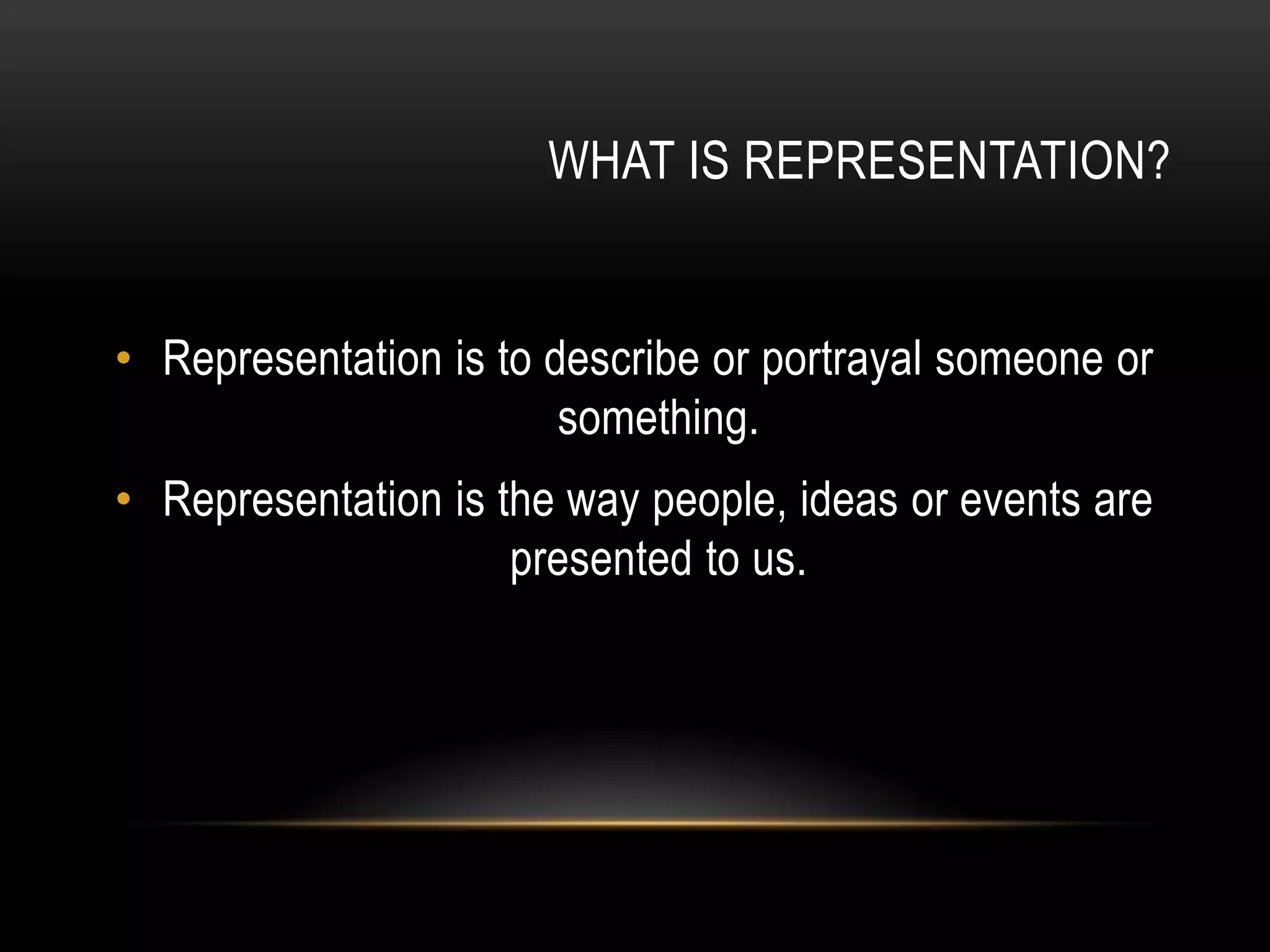
Representation in gender is how a man or a women is
presented in the media.
The media present men and women in a masculine
(strong, tough, aggressive) and feminine
(sensitive, caring, gentle) outlook.
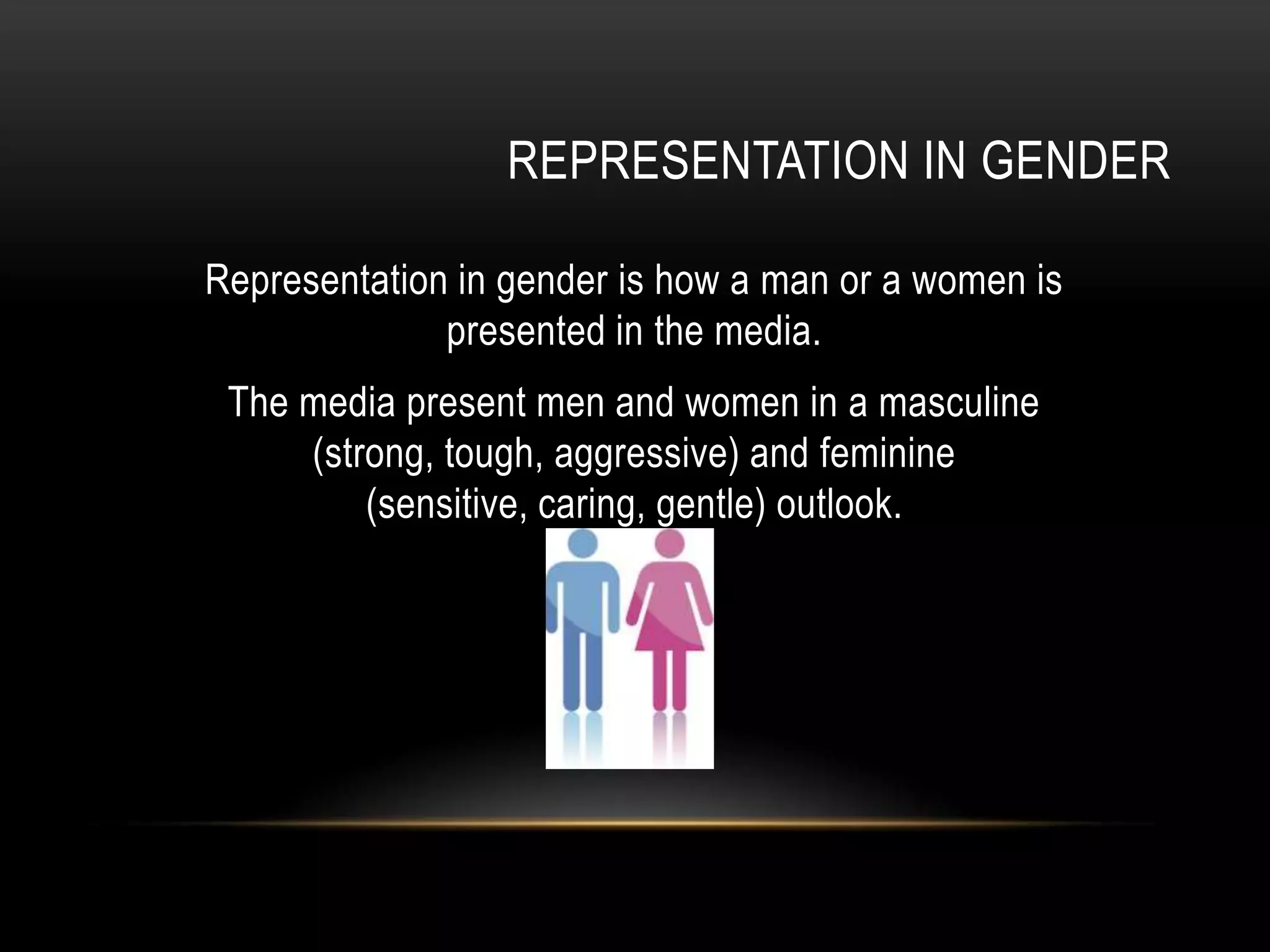
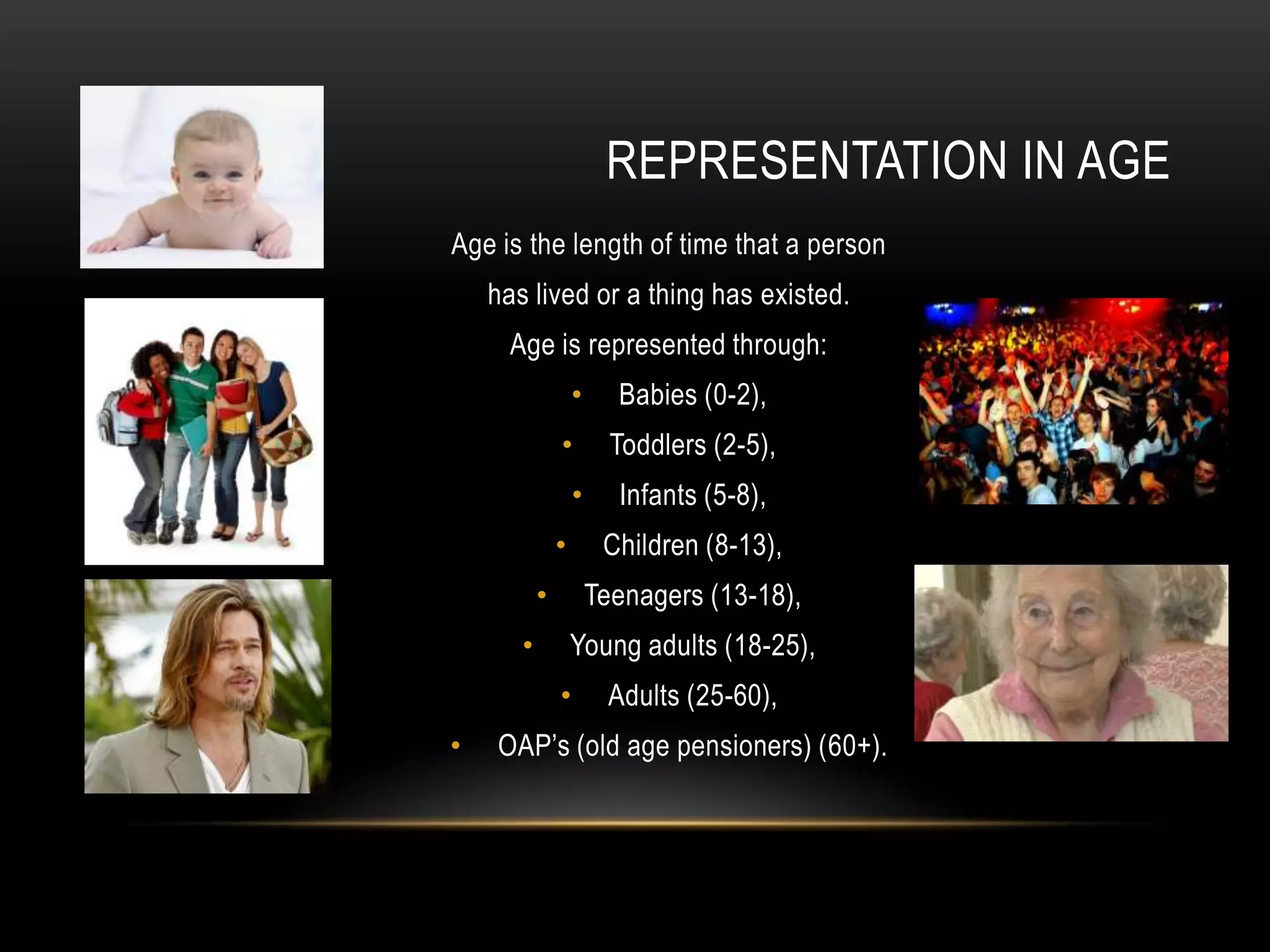
Age is the length of time that a person
has lived or a thing has existed.
Age is represented through:
• Babies (0-2),
• Toddlers (2-5),
• Infants (5-8),
• Children (8-13),
• Teenagers (13-18),
• Young adults (18-25),
• Adults (25-60),
• OAP’s (old age pensioners) (60+).
REPRESENTATION IN AGE
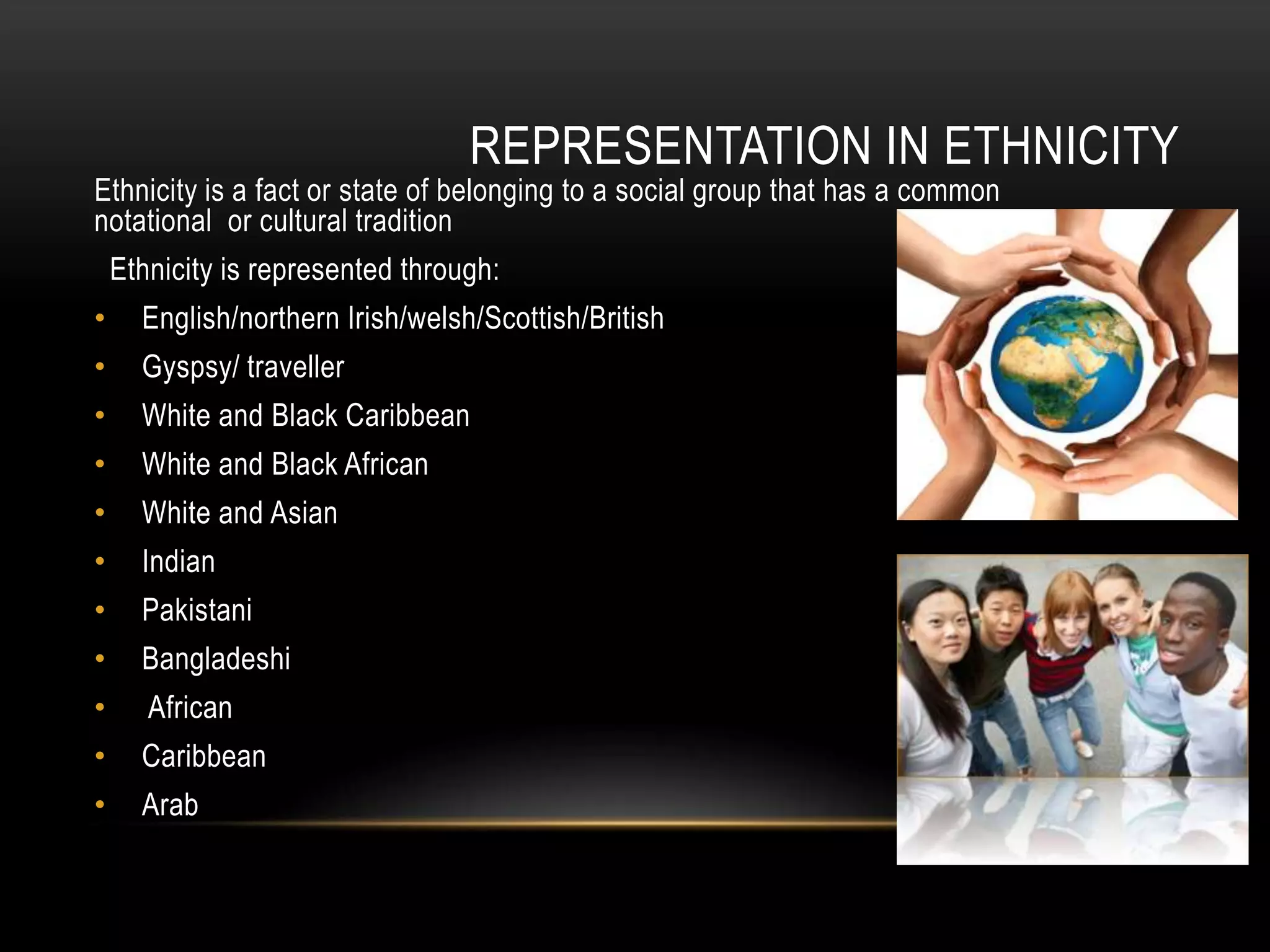
REPRESENTATION IN ETHNICITY
Ethnicity is a fact or state of belonging to a social group that has a common
notational or cultural tradition
Ethnicity is represented through:
• English/northern Irish/welsh/Scottish/British
• Gyspsy/ traveller
• White and Black Caribbean
• White and Black African
• White and Asian
• Indian
• Pakistani
• Bangladeshi
• African
• Caribbean
• Arab
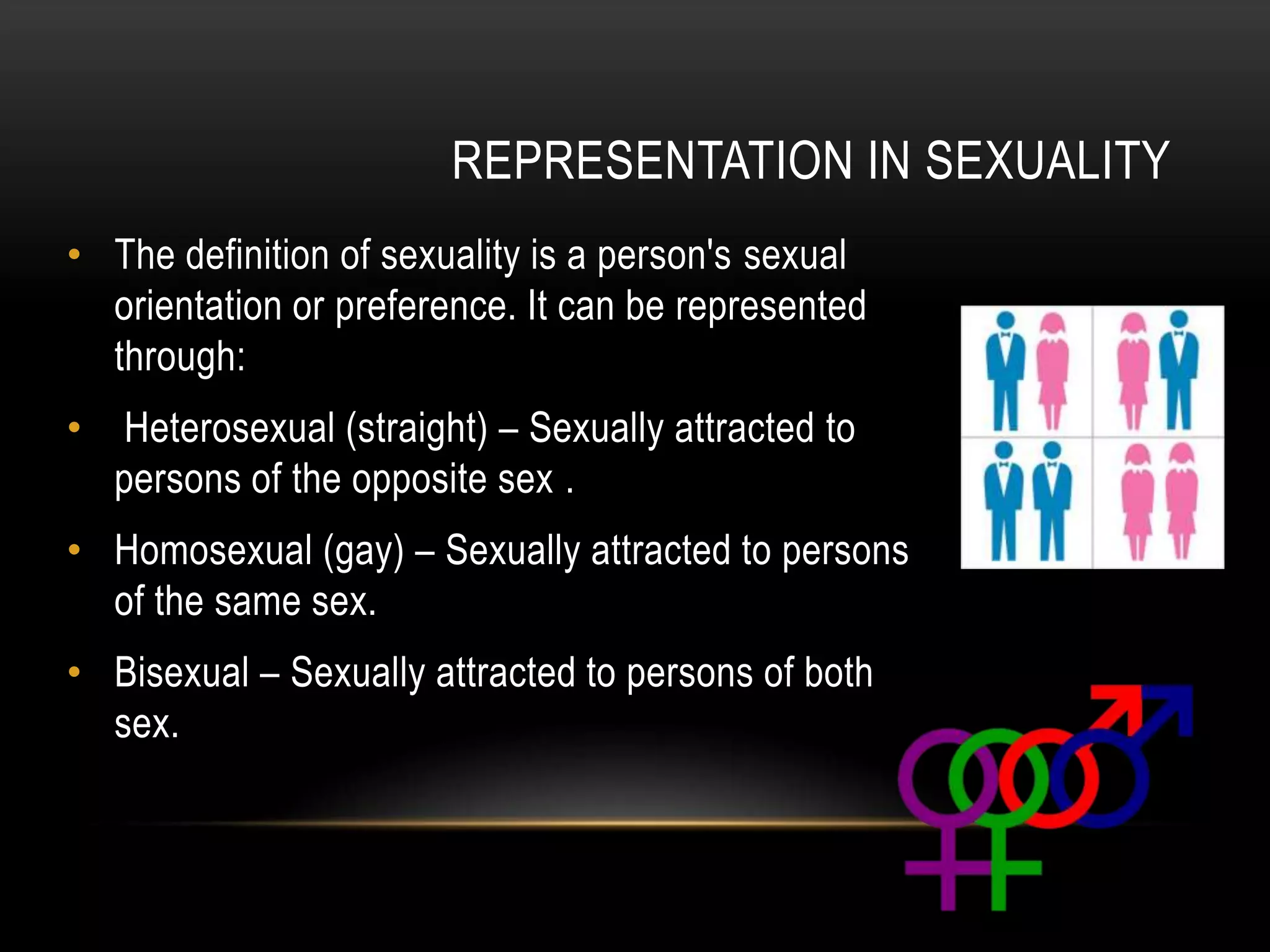
REPRESENTATION IN SEXUALITY
• The definition of sexuality is a person's sexual
orientation or preference. It can be represented
through:
• Heterosexual (straight) – Sexually attracted to
persons of the opposite sex .
• Homosexual (gay) – Sexually attracted to persons
of the same sex.
• Bisexual – Sexually attracted to persons of both
sex.
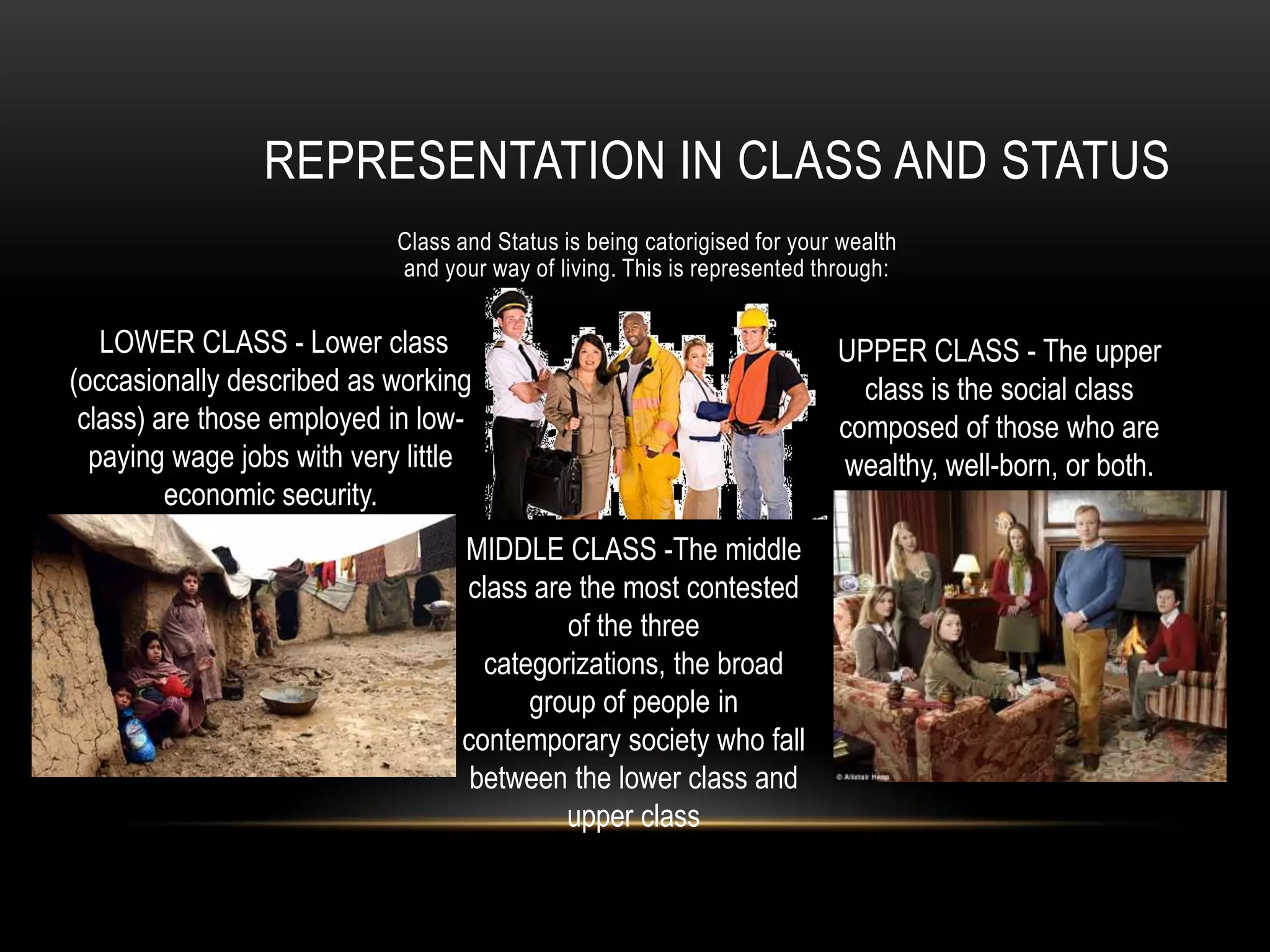
Class and Status is being catorigised for your wealth
and your way of living. This is represented through:
REPRESENTATION IN CLASS AND STATUS
MIDDLE CLASS -The middle
class are the most contested
of the three
categorizations, the broad
group of people in
contemporary society who fall
between the lower class and
upper class
UPPER CLASS - The upper
class is the social class
composed of those who are
wealthy, well-born, or both.
LOWER CLASS - Lower class
(occasionally described as working
class) are those employed in low-
paying wage jobs with very little
economic security.
REPRESENTATION IN PHYSICAL
ABILITY/DISABILITY
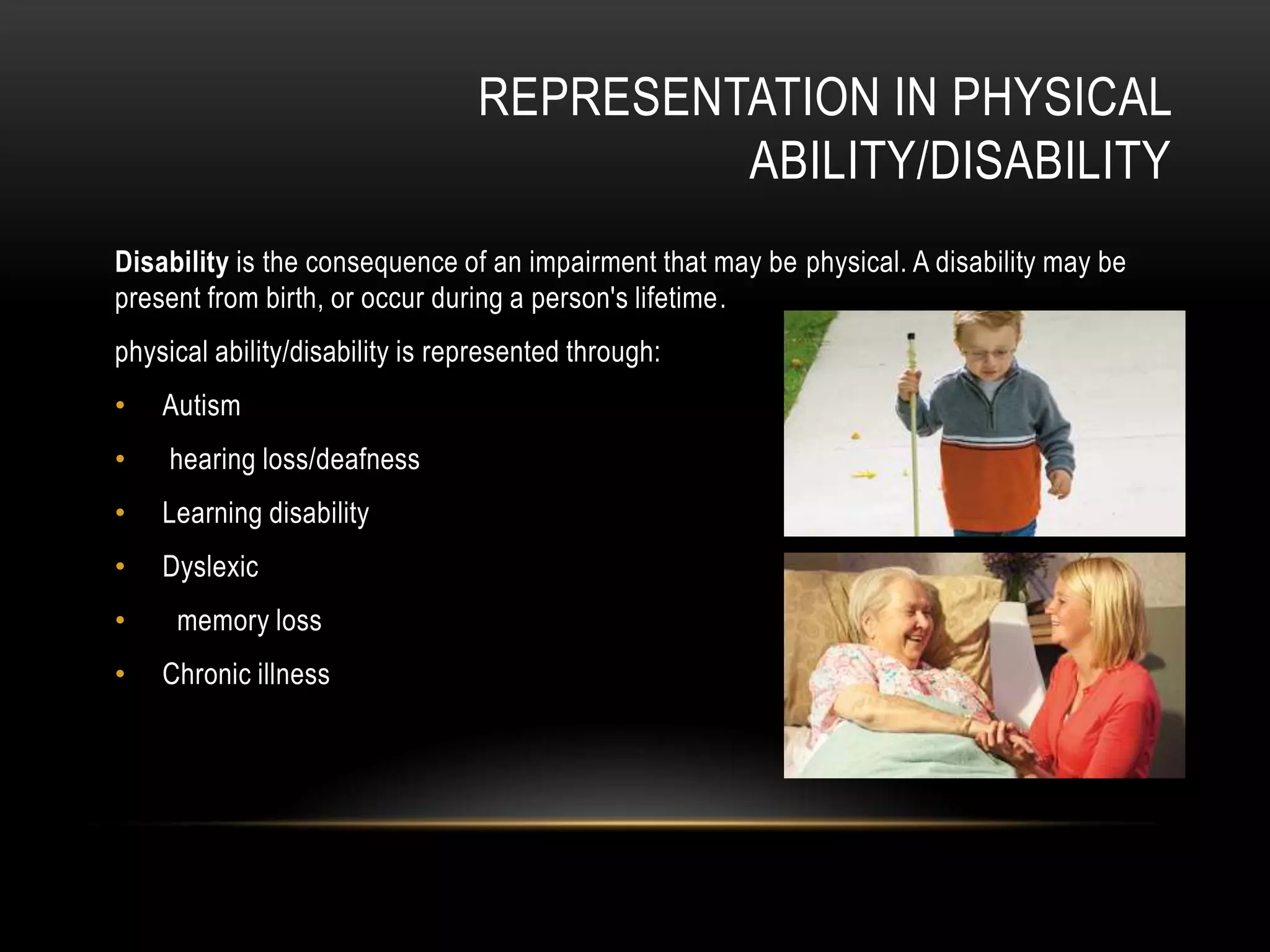
Disability is the consequence of an impairment that may be physical. A disability may be
present from birth, or occur during a person's lifetime.
physical ability/disability is represented through:
• Autism
• hearing loss/deafness
• Learning disability
• Dyslexic
• memory loss
• Chronic illness
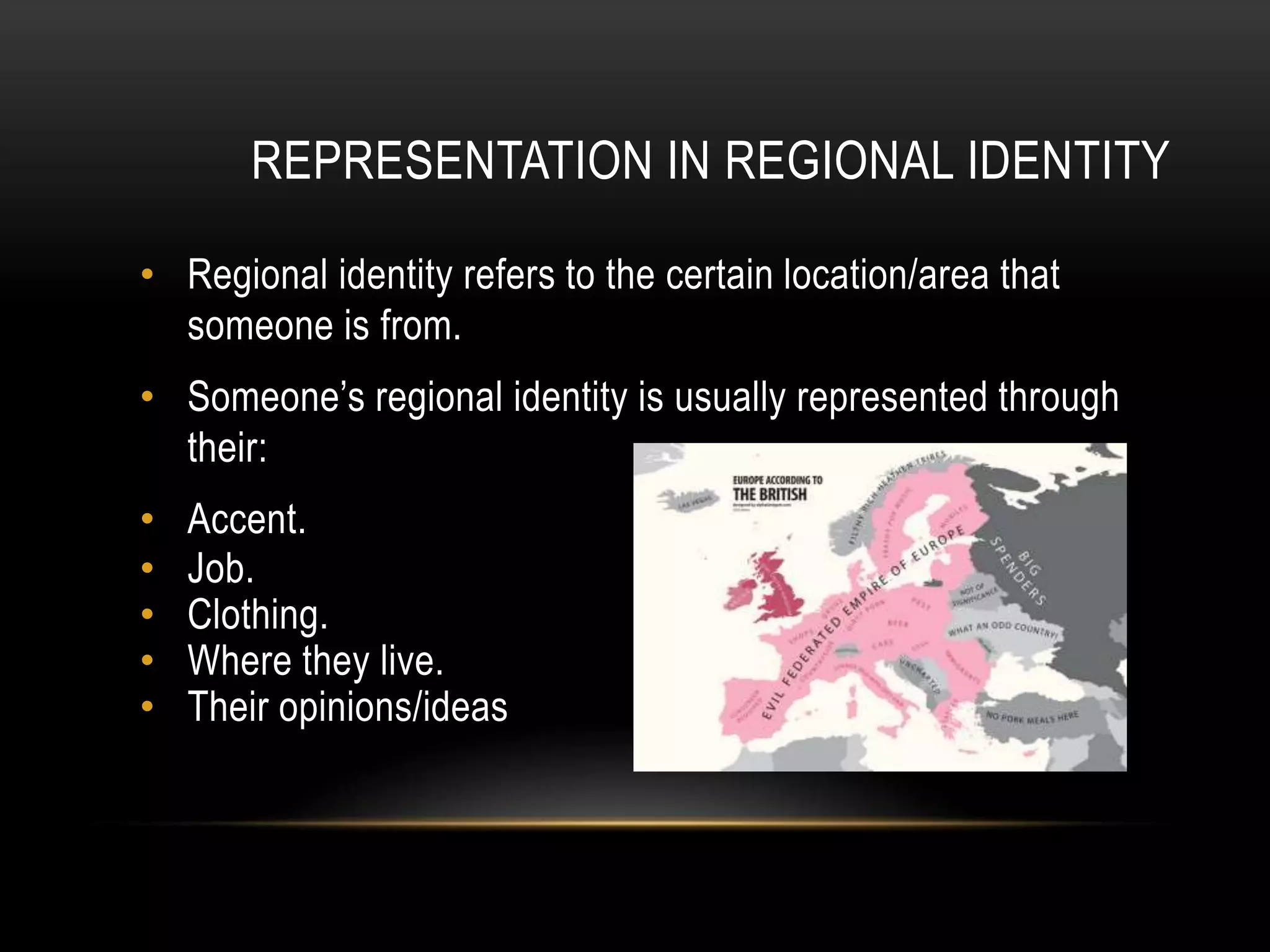
REPRESENTATION IN REGIONAL IDENTITY
• Regional identity refers to the certain location/area that
someone is from.
• Someone’s regional identity is usually represented through
their:
• Accent.
• Job.
• Clothing.
• Where they live.
• Their opinions/ideas
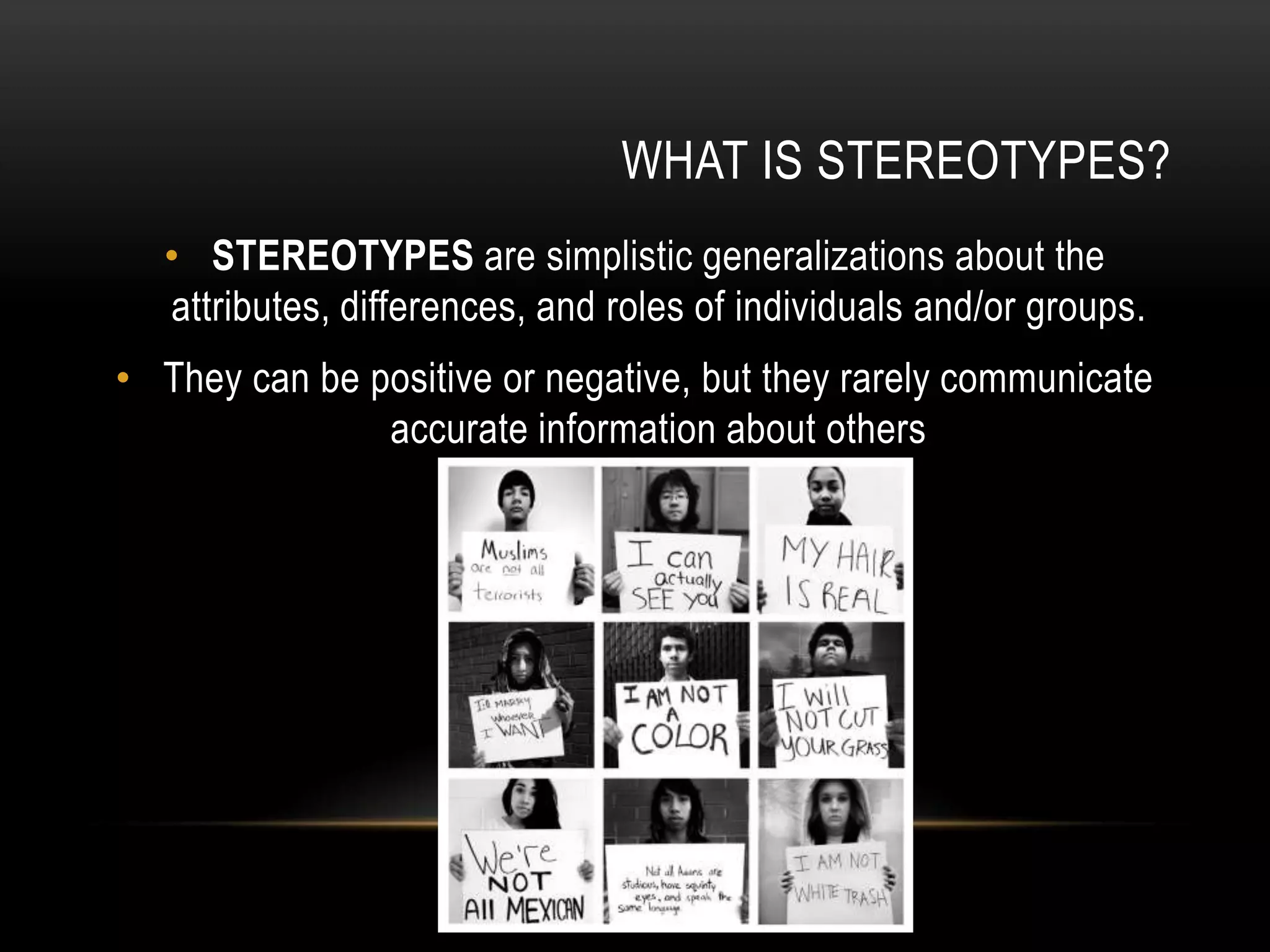
WHAT IS STEREOTYPES?
• STEREOTYPES are simplistic generalizations about the
attributes, differences, and roles of individuals and/or groups.
• They can be positive or negative, but they rarely communicate
accurate information about others
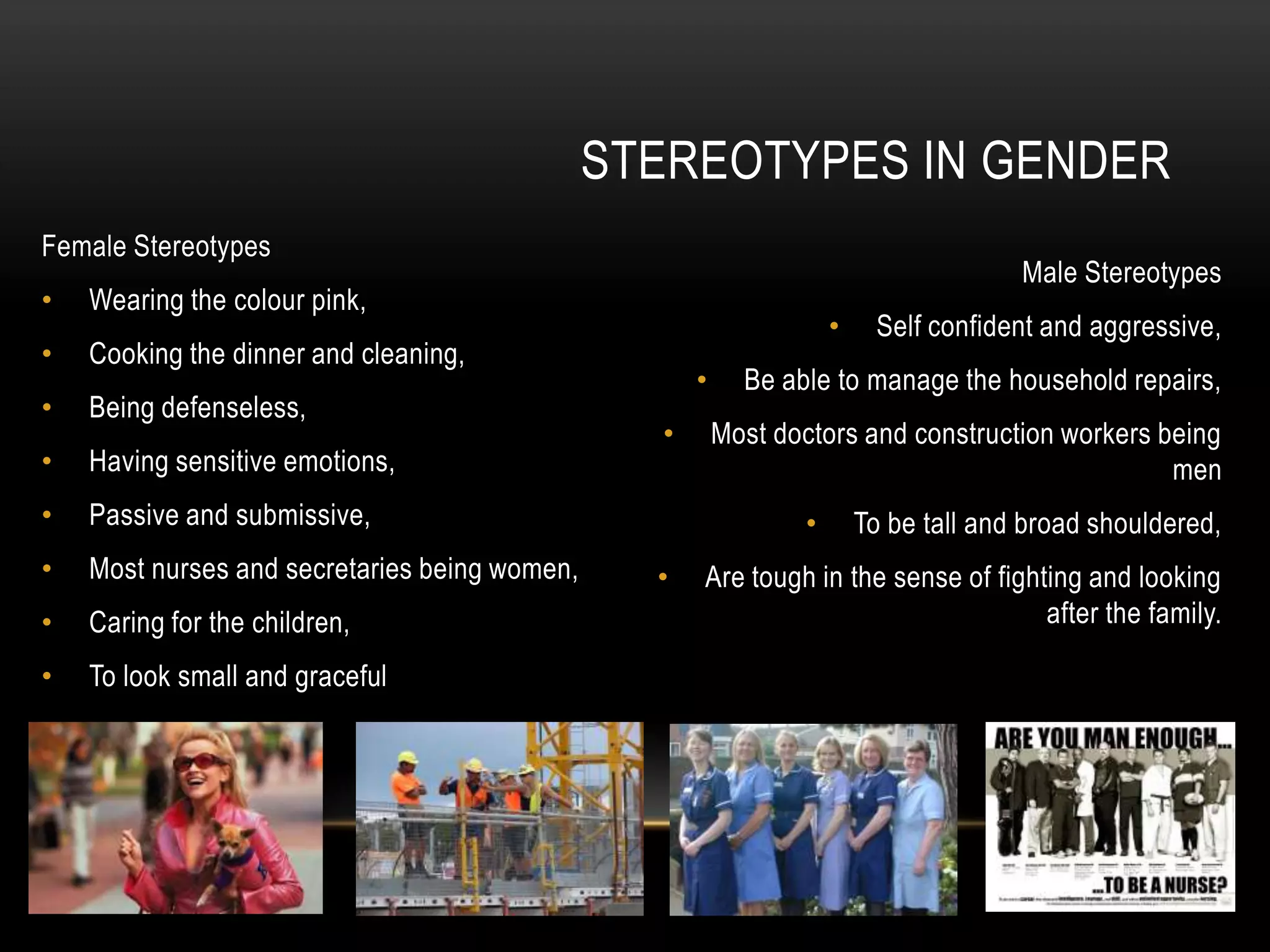
Female Stereotypes
• Wearing the colour pink,
• Cooking the dinner and cleaning,
• Being defenseless,
• Having sensitive emotions,
• Passive and submissive,
• Most nurses and secretaries being women,
• Caring for the children,
• To look small and graceful
STEREOTYPES IN GENDER
Male Stereotypes
• Self confident and aggressive,
• Be able to manage the household repairs,
• Most doctors and construction workers being
men
• To be tall and broad shouldered,
• Are tough in the sense of fighting and looking
after the family.
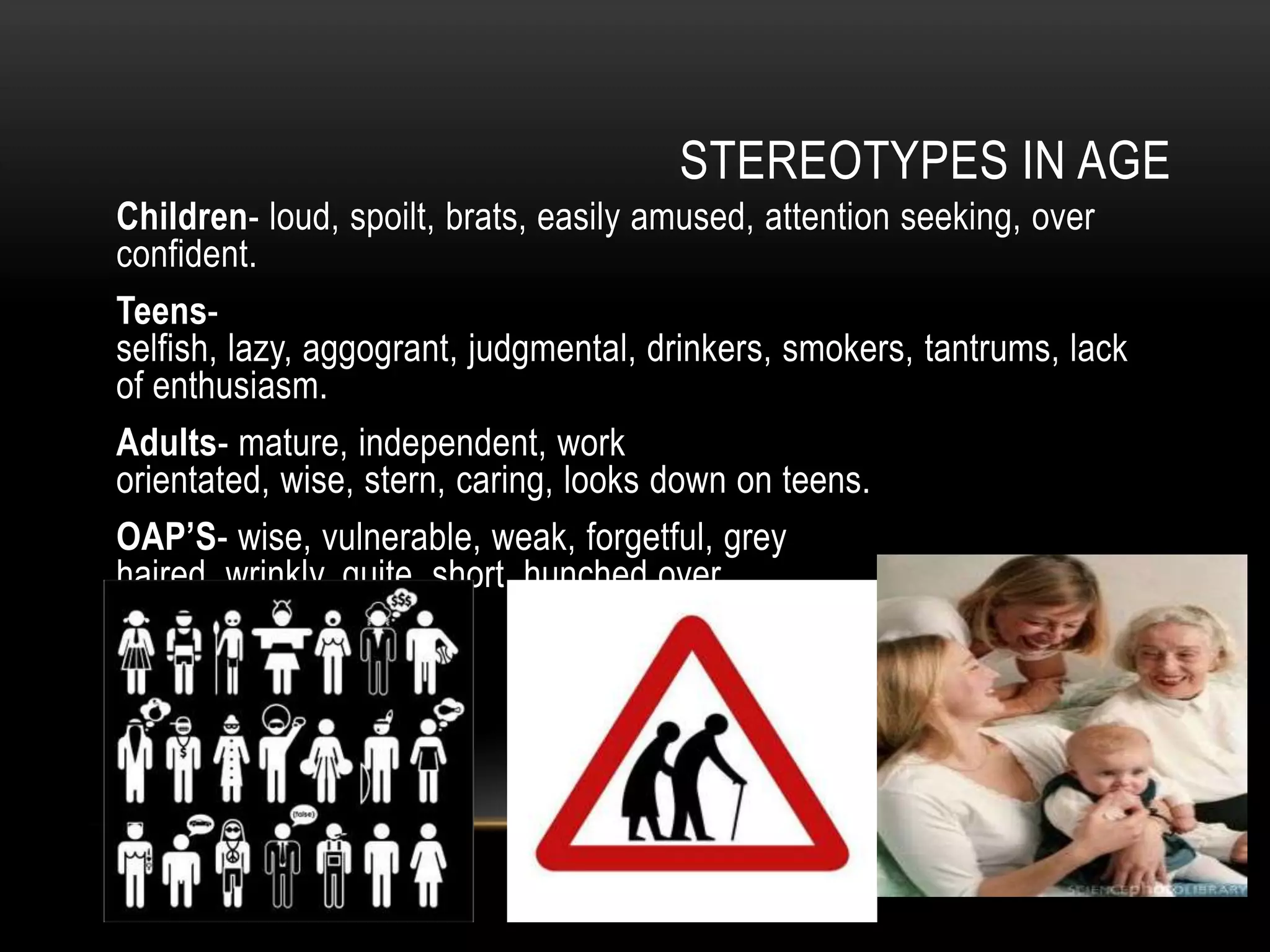
STEREOTYPES IN AGE
Children- loud, spoilt, brats, easily amused, attention seeking, over
confident.
Teens-
selfish, lazy, aggogrant, judgmental, drinkers, smokers, tantrums, lack
of enthusiasm.
Adults- mature, independent, work
orientated, wise, stern, caring, looks down on teens.
OAP’S- wise, vulnerable, weak, forgetful, grey
haired, wrinkly, quite, short, hunched over
STEREOTYPES IN ETHNICITY
• Stereotypes in ethnicity are simplified and are often misleading representation of an
ethnic group composed of what are thought to be typical characteristics. Examples of
stereotypes in ethnicity include:
• Scottish – All ginger, eat haggis, wear kilts, play bagpipes, eat
porridge.
• English – Drink tea, very punctual, bad teeth.
• Gypsies – Swindlers (trick people), rude, uneducated.
• Africans – uneducated, all in tribes, good at spear–throwing, hunt
lions.
• Indians – Uneducated, poor, rude.
• White and Black Caribbean – smoke
weed, aggressive, abusive, uncivilised.
• Pakistani - terrorists, dirty, deceiving.
STEREOTYPES IN SEXUALITY
Heterosexual (straight) – Sexually attracted to persons of the opposite sex.
Homosexual (gay/lesbian) – Sexually attracted to persons of the same sex.
Bisexual – Sexually attracted to persons of both sex.
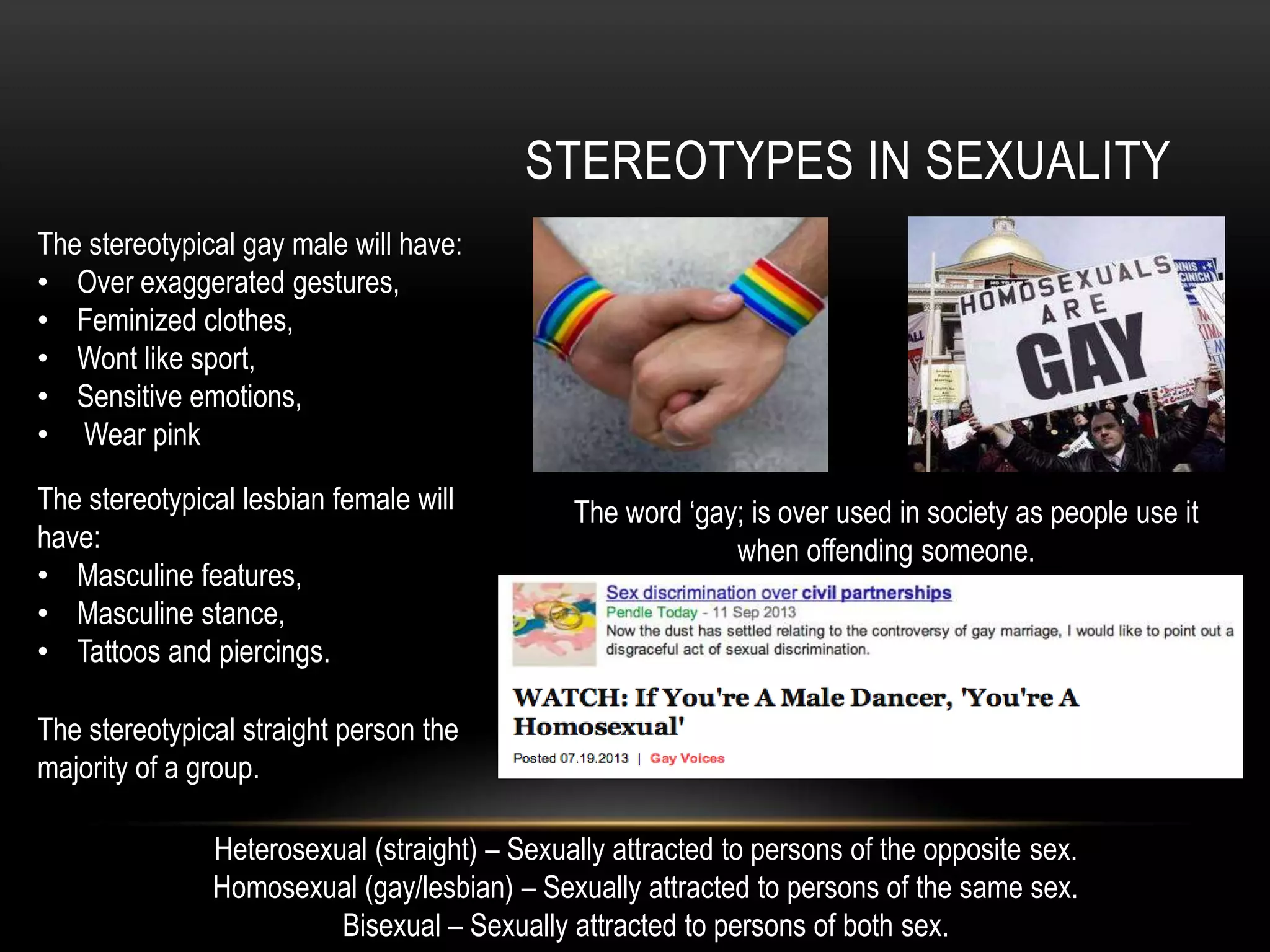
The stereotypical gay male will have:
• Over exaggerated gestures,
• Feminized clothes,
• Wont like sport,
• Sensitive emotions,
• Wear pink
The stereotypical lesbian female will
have:
• Masculine features,
• Masculine stance,
• Tattoos and piercings.
The stereotypical straight person the
majority of a group.
The word ‘gay; is over used in society as people use it
when offending someone.
STEREOTYPES IN CLASS AND STATUS
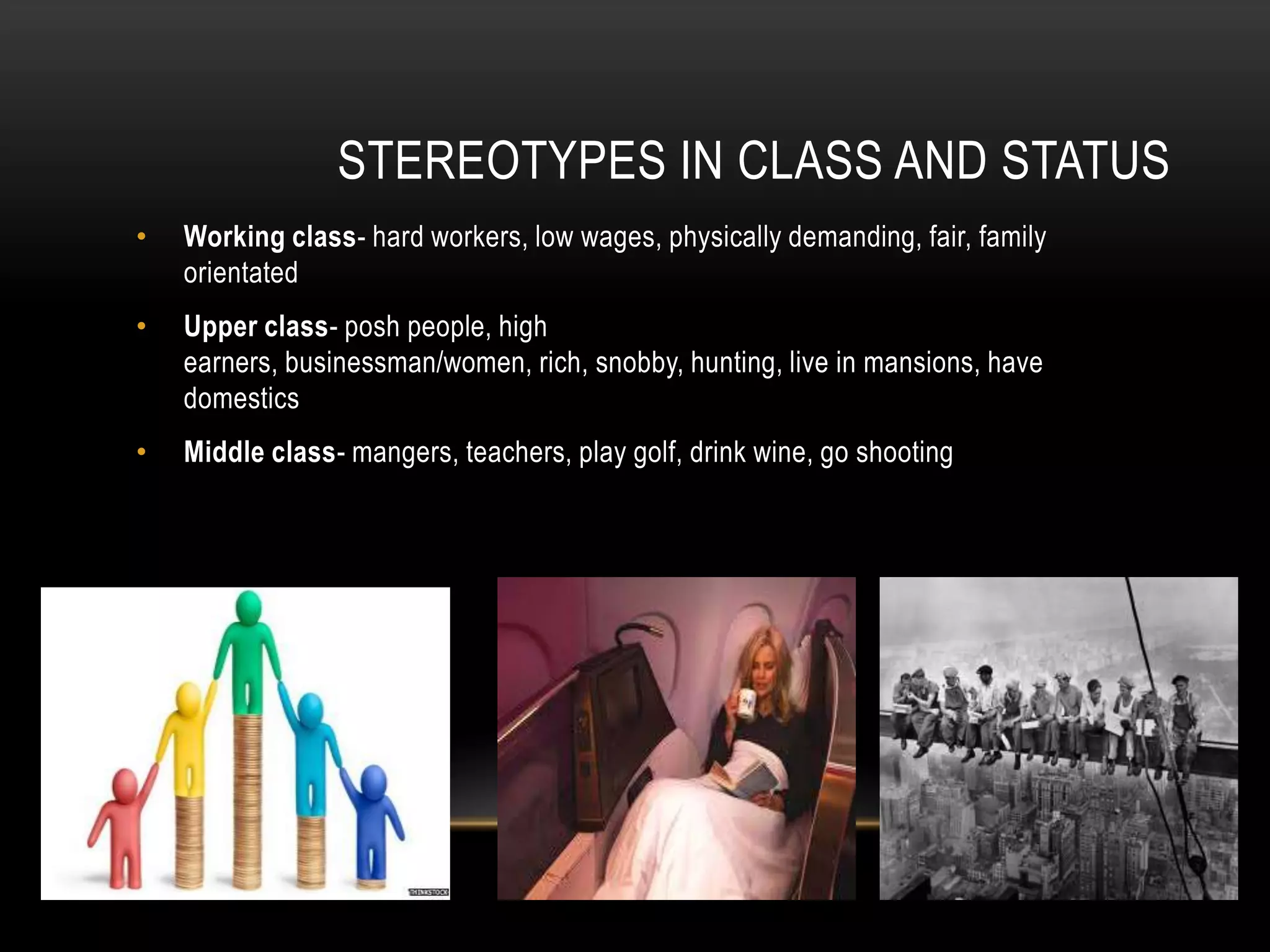
• Working class- hard workers, low wages, physically demanding, fair, family
orientated
• Upper class- posh people, high
earners, businessman/women, rich, snobby, hunting, live in mansions, have
domestics
• Middle class- mangers, teachers, play golf, drink wine, go shooting
STEREOTYPES IN PHYSICAL
ABILITIES/DISABLITLIES
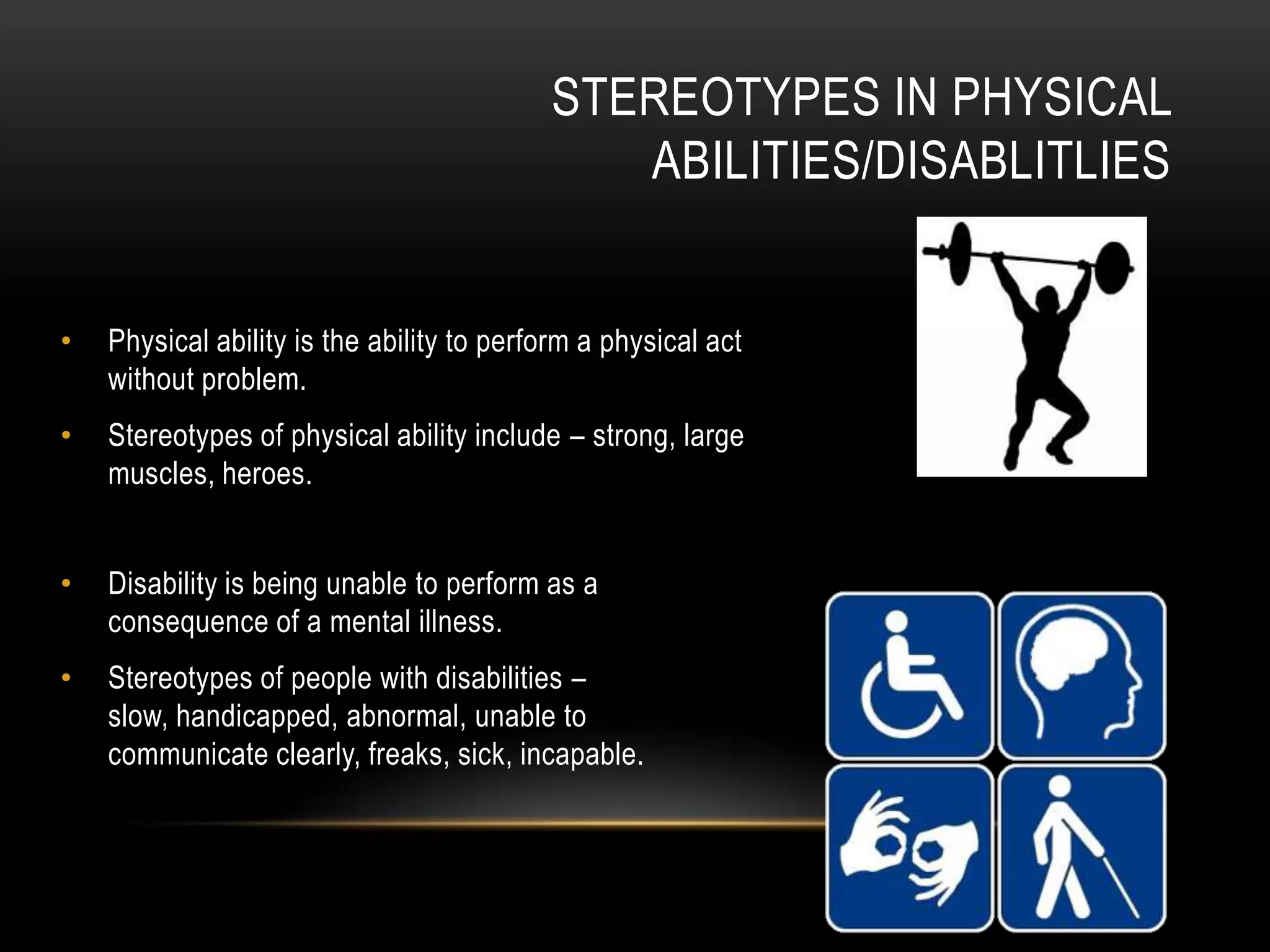
• Physical ability is the ability to perform a physical act
without problem.
• Stereotypes of physical ability include – strong, large
muscles, heroes.
• Disability is being unable to perform as a
consequence of a mental illness.
• Stereotypes of people with disabilities –
slow, handicapped, abnormal, unable to
communicate clearly, freaks, sick, incapable.
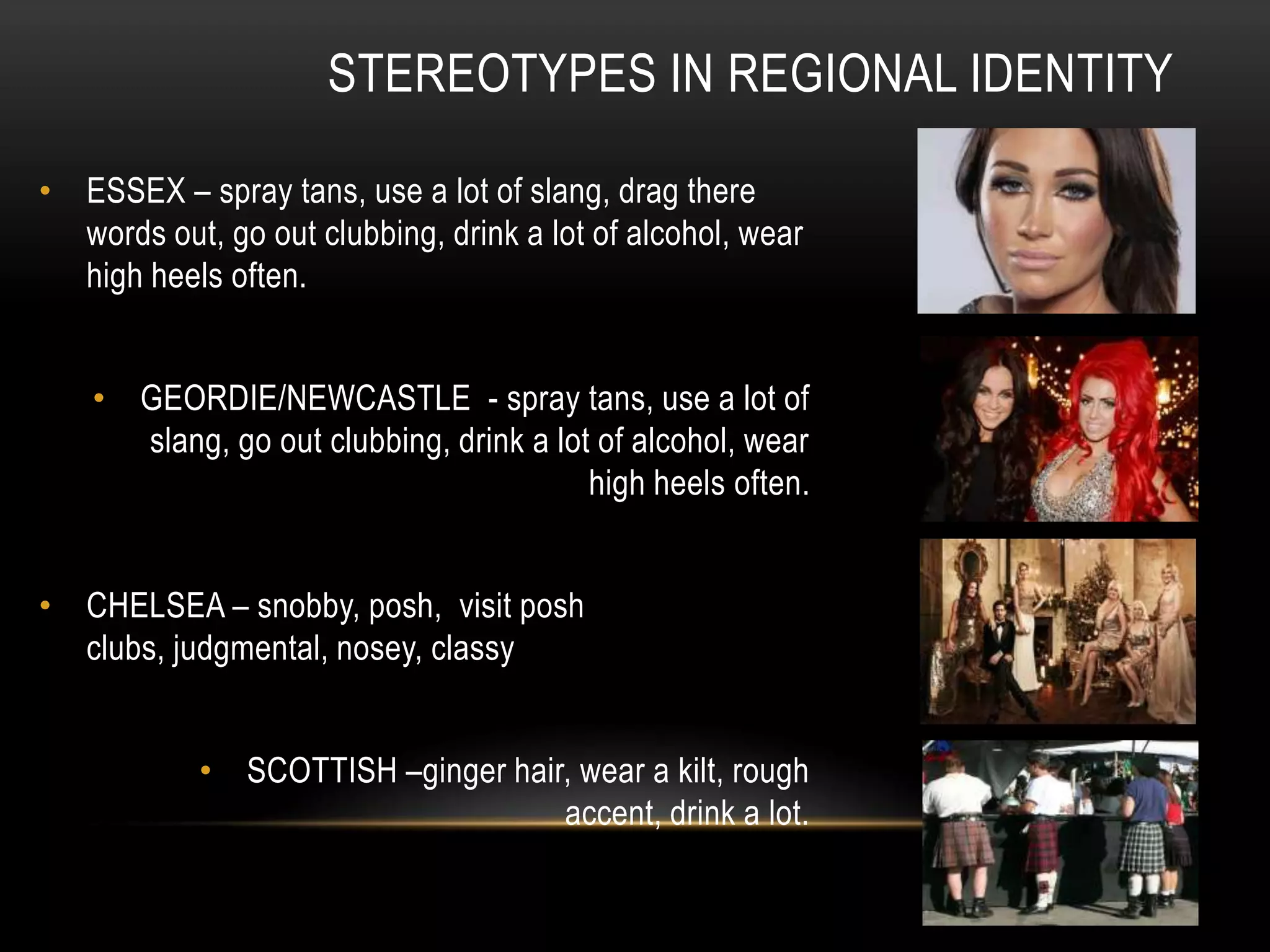
• ESSEX – spray tans, use a lot of slang, drag there
words out, go out clubbing, drink a lot of alcohol, wear
high heels often.
• GEORDIE/NEWCASTLE - spray tans, use a lot of
slang, go out clubbing, drink a lot of alcohol, wear
high heels often.
• CHELSEA – snobby, posh, visit posh
clubs, judgmental, nosey, classy
• SCOTTISH –ginger hair, wear a kilt, rough
accent, drink a lot.
STEREOTYPES IN REGIONAL IDENTITY

Representation and stereotyps

  • 1.
    Demi Wrenn, AmeliaBarrett and Stephanie Webb REPRESENTATION AND STEREOTYPES
  • 2.
    WHAT IS REPRESENTATION? •Representation is to describe or portrayal someone or something. • Representation is the way people, ideas or events are presented to us.
  • 3.
    REPRESENTATION IN GENDER Representationin gender is how a man or a women is presented in the media. The media present men and women in a masculine (strong, tough, aggressive) and feminine (sensitive, caring, gentle) outlook.
  • 4.
    Age is thelength of time that a person has lived or a thing has existed. Age is represented through: • Babies (0-2), • Toddlers (2-5), • Infants (5-8), • Children (8-13), • Teenagers (13-18), • Young adults (18-25), • Adults (25-60), • OAP’s (old age pensioners) (60+). REPRESENTATION IN AGE
  • 5.
    REPRESENTATION IN ETHNICITY Ethnicityis a fact or state of belonging to a social group that has a common notational or cultural tradition Ethnicity is represented through: • English/northern Irish/welsh/Scottish/British • Gyspsy/ traveller • White and Black Caribbean • White and Black African • White and Asian • Indian • Pakistani • Bangladeshi • African • Caribbean • Arab
  • 6.
    REPRESENTATION IN SEXUALITY •The definition of sexuality is a person's sexual orientation or preference. It can be represented through: • Heterosexual (straight) – Sexually attracted to persons of the opposite sex . • Homosexual (gay) – Sexually attracted to persons of the same sex. • Bisexual – Sexually attracted to persons of both sex.
  • 7.
    Class and Statusis being catorigised for your wealth and your way of living. This is represented through: REPRESENTATION IN CLASS AND STATUS MIDDLE CLASS -The middle class are the most contested of the three categorizations, the broad group of people in contemporary society who fall between the lower class and upper class UPPER CLASS - The upper class is the social class composed of those who are wealthy, well-born, or both. LOWER CLASS - Lower class (occasionally described as working class) are those employed in low- paying wage jobs with very little economic security.
  • 8.
    REPRESENTATION IN PHYSICAL ABILITY/DISABILITY Disabilityis the consequence of an impairment that may be physical. A disability may be present from birth, or occur during a person's lifetime. physical ability/disability is represented through: • Autism • hearing loss/deafness • Learning disability • Dyslexic • memory loss • Chronic illness
  • 9.
    REPRESENTATION IN REGIONALIDENTITY • Regional identity refers to the certain location/area that someone is from. • Someone’s regional identity is usually represented through their: • Accent. • Job. • Clothing. • Where they live. • Their opinions/ideas
  • 10.
    WHAT IS STEREOTYPES? •STEREOTYPES are simplistic generalizations about the attributes, differences, and roles of individuals and/or groups. • They can be positive or negative, but they rarely communicate accurate information about others
  • 11.
    Female Stereotypes • Wearingthe colour pink, • Cooking the dinner and cleaning, • Being defenseless, • Having sensitive emotions, • Passive and submissive, • Most nurses and secretaries being women, • Caring for the children, • To look small and graceful STEREOTYPES IN GENDER Male Stereotypes • Self confident and aggressive, • Be able to manage the household repairs, • Most doctors and construction workers being men • To be tall and broad shouldered, • Are tough in the sense of fighting and looking after the family.
  • 12.
    STEREOTYPES IN AGE Children-loud, spoilt, brats, easily amused, attention seeking, over confident. Teens- selfish, lazy, aggogrant, judgmental, drinkers, smokers, tantrums, lack of enthusiasm. Adults- mature, independent, work orientated, wise, stern, caring, looks down on teens. OAP’S- wise, vulnerable, weak, forgetful, grey haired, wrinkly, quite, short, hunched over
  • 13.
    STEREOTYPES IN ETHNICITY •Stereotypes in ethnicity are simplified and are often misleading representation of an ethnic group composed of what are thought to be typical characteristics. Examples of stereotypes in ethnicity include: • Scottish – All ginger, eat haggis, wear kilts, play bagpipes, eat porridge. • English – Drink tea, very punctual, bad teeth. • Gypsies – Swindlers (trick people), rude, uneducated. • Africans – uneducated, all in tribes, good at spear–throwing, hunt lions. • Indians – Uneducated, poor, rude. • White and Black Caribbean – smoke weed, aggressive, abusive, uncivilised. • Pakistani - terrorists, dirty, deceiving.
  • 14.
    STEREOTYPES IN SEXUALITY Heterosexual(straight) – Sexually attracted to persons of the opposite sex. Homosexual (gay/lesbian) – Sexually attracted to persons of the same sex. Bisexual – Sexually attracted to persons of both sex. The stereotypical gay male will have: • Over exaggerated gestures, • Feminized clothes, • Wont like sport, • Sensitive emotions, • Wear pink The stereotypical lesbian female will have: • Masculine features, • Masculine stance, • Tattoos and piercings. The stereotypical straight person the majority of a group. The word ‘gay; is over used in society as people use it when offending someone.
  • 15.
    STEREOTYPES IN CLASSAND STATUS • Working class- hard workers, low wages, physically demanding, fair, family orientated • Upper class- posh people, high earners, businessman/women, rich, snobby, hunting, live in mansions, have domestics • Middle class- mangers, teachers, play golf, drink wine, go shooting
  • 16.
    STEREOTYPES IN PHYSICAL ABILITIES/DISABLITLIES •Physical ability is the ability to perform a physical act without problem. • Stereotypes of physical ability include – strong, large muscles, heroes. • Disability is being unable to perform as a consequence of a mental illness. • Stereotypes of people with disabilities – slow, handicapped, abnormal, unable to communicate clearly, freaks, sick, incapable.
  • 17.
    • ESSEX –spray tans, use a lot of slang, drag there words out, go out clubbing, drink a lot of alcohol, wear high heels often. • GEORDIE/NEWCASTLE - spray tans, use a lot of slang, go out clubbing, drink a lot of alcohol, wear high heels often. • CHELSEA – snobby, posh, visit posh clubs, judgmental, nosey, classy • SCOTTISH –ginger hair, wear a kilt, rough accent, drink a lot. STEREOTYPES IN REGIONAL IDENTITY