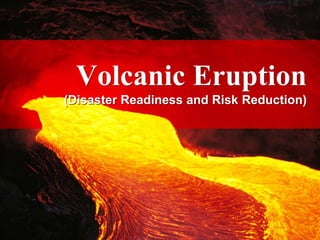
Volcanic Eruption
(Disaster Readiness and Risk Reduction)
Objectives
• To define volcanic eruption.
• Identify how volcanic eruptions affect our society.
• Evaluate the effects of volcanic eruptions in terms of their
harms.
• To identify the threats of volcanic eruption to people and
to the community
What is Volcanic Eruption?
• Volcanic Eruption are those that pose a risk to human lives,
livelihoods or infrastructure due to volcanic activity. There are
several hazards that may impact the area around the volcano,
including lava flows, pyroclastic flows, lahars, jökulhlaups,
landslides, and debris avalanches. Also, volcanoes can produce
hazards that affect areas far from their location, such as tephra and
ash falls, gas releases, and tsunamis.
• Volcanic Eruptions are often caused by magma that builds up in
the magma chamber and forces its way to the surface. In the ocean,
volcanoes erupt along cracks that are opened in the ocean floor by
the spreading of two plates called a mid-ocean ridge .
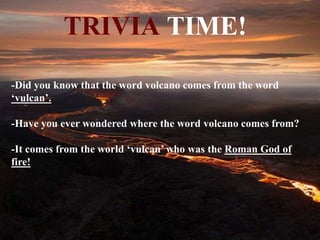
TRIVIA TIME!
-Did you know that the word volcano comes from the word
‘vulcan’.
-Have you ever wondered where the word volcano comes from?
-It comes from the world ‘vulcan’ who was the Roman God of
fire!
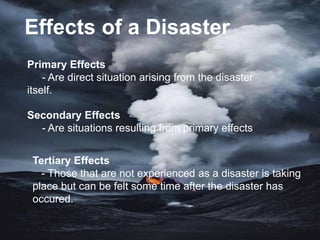
Effects of a Disaster
Primary Effects
- Are direct situation arising from the disaster
itself.
Secondary Effects
- Are situations resulting from primary effects
Tertiary Effects
- Those that are not experienced as a disaster is taking
place but can be felt some time after the disaster has
occured.
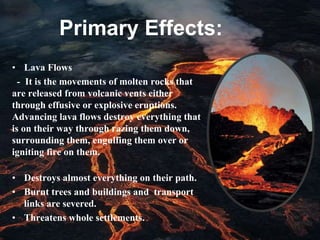
Primary Effects:
• Lava Flows
- It is the movements of molten rocks that
are released from volcanic vents either
through effusive or explosive eruptions.
Advancing lava flows destroy everything that
is on their way through razing them down,
surrounding them, engulfing them over or
igniting fire on them.
• Destroys almost everything on their path.
• Burnt trees and buildings and transport
links are severed.
• Threatens whole settlements.
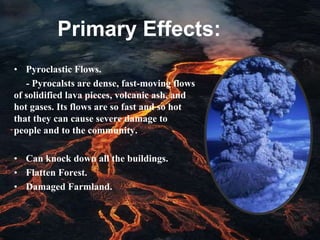
Primary Effects:
• Pyroclastic Flows.
- Pyrocalsts are dense, fast-moving flows
of solidified lava pieces, volcanic ash, and
hot gases. Its flows are so fast and so hot
that they can cause severe damage to
people and to the community.
• Can knock down all the buildings.
• Flatten Forest.
• Damaged Farmland.
Primary Effects:
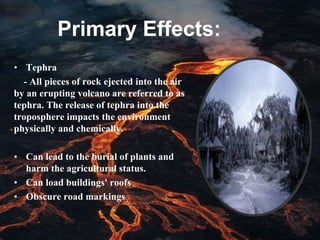
• Tephra
- All pieces of rock ejected into the air
by an erupting volcano are referred to as
tephra. The release of tephra into the
troposphere impacts the environment
physically and chemically.
• Can lead to the burial of plants and
harm the agricultural status.
• Can load buildings' roofs
• Obscure road markings
Primary Effects:
• Volcanic gases
-Significant amounts of carbon dioxide,
sulfur dioxide, hydrogen sulfide and
hydrogen halides can also be emitted from
volcanoes. Depending on their
concentrations, these gases are all
potentially hazardous to people, animals,
agriculture, and property. Variety of
dangerous gases emitted by Hydrogen
sulfide (most noticeable), CO2 (killed 1700
people in Cameroon, 1986) and CO
[Carbon Monoxide].
• Can lead to acid rain and air pollution
downwind from a volcano.
Secondary effects:
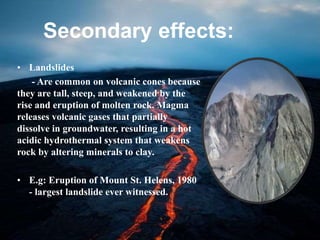
• Landslides
- Are common on volcanic cones because
they are tall, steep, and weakened by the
rise and eruption of molten rock. Magma
releases volcanic gases that partially
dissolve in groundwater, resulting in a hot
acidic hydrothermal system that weakens
rock by altering minerals to clay.
• E.g: Eruption of Mount St. Helens, 1980
- largest landslide ever witnessed.
Secondary effects:
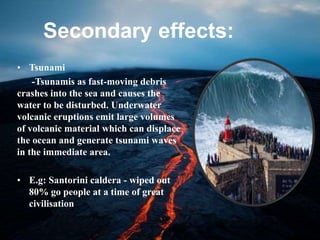
• Tsunami
-Tsunamis as fast-moving debris
crashes into the sea and causes the
water to be disturbed. Underwater
volcanic eruptions emit large volumes
of volcanic material which can displace
the ocean and generate tsunami waves
in the immediate area.
• E.g: Santorini caldera - wiped out
80% go people at a time of great
civilisation
Secondary effects:
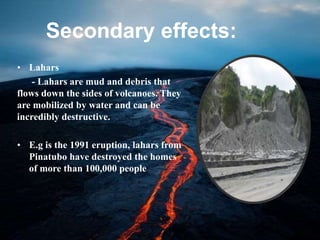
• Lahars
- Lahars are mud and debris that
flows down the sides of volcanoes. They
are mobilized by water and can be
incredibly destructive.
• E.g is the 1991 eruption, lahars from
Pinatubo have destroyed the homes
of more than 100,000 people
Secondary effects:
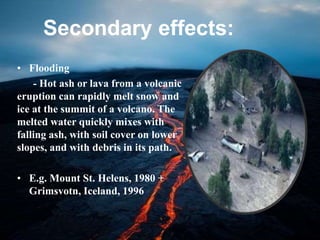
• Flooding
- Hot ash or lava from a volcanic
eruption can rapidly melt snow and
ice at the summit of a volcano. The
melted water quickly mixes with
falling ash, with soil cover on lower
slopes, and with debris in its path.
• E.g. Mount St. Helens, 1980 +
Grimsvotn, Iceland, 1996
Tertiary Effects:
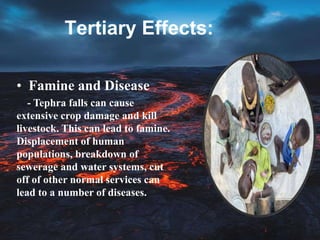
• Famine and Disease
- Tephra falls can cause
extensive crop damage and kill
livestock. This can lead to famine.
Displacement of human
populations, breakdown of
sewerage and water systems, cut
off of other normal services can
lead to a number of diseases.
Tertiary Effects:
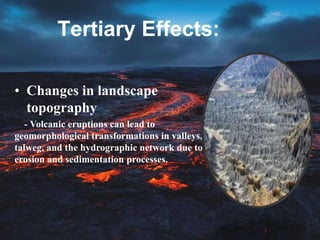
• Changes in landscape
topography
- Volcanic eruptions can lead to
geomorphological transformations in valleys,
talweg, and the hydrographic network due to
erosion and sedimentation processes.
Tertiary Effects:
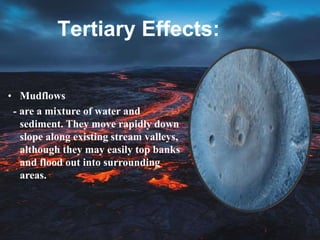
• Mudflows
- are a mixture of water and
sediment. They move rapidly down
slope along existing stream valleys,
although they may easily top banks
and flood out into surrounding
areas.
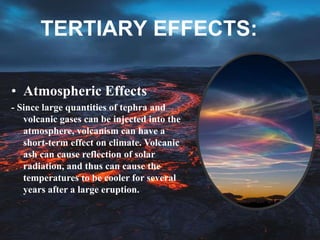
TERTIARY EFFECTS:
• Atmospheric Effects
- Since large quantities of tephra and
volcanic gases can be injected into the
atmosphere, volcanism can have a
short-term effect on climate. Volcanic
ash can cause reflection of solar
radiation, and thus can cause the
temperatures to be cooler for several
years after a large eruption.
THAN
K
YOU!
Members:
Calibara, Janella O.
Senora, Christine Mhay N.
Bondoc, Rhayne L.
Silva, Gabriel D.
REFERENCES:
• https://sierra.sitehost.iu.edu/papers/2013/hamdan.pdf
• https://www.nationalgeographic.org/encyclopedia/pyroclastic-flow/#:~:text=Encyclopedic%20Entry%20Vocabulary-
,A%20pyroclastic%20flow%20is%20a%20dense%2C%20fast%2Dmoving%20flow%20of,high%20as%20200%20m%2Fs.
• https://www.mytutor.co.uk/answers/25084/A-Level/Geography/List-two-primary-and-two-secondary-impacts-of-volcanic-activity-giving-
detail-of-each/#:~:text=Primary%20impacts%20are%20those%20that,volcanic%20bombs%20and%20ash%20particles.
• https://www.who.int/health-topics/volcanic-
eruptions#:~:text=Volcanic%20eruptions%20can%20also%20cause,rain%2C%20snow%20or%20melting%20ice.
• https://encyclopedia.pub/9593#:~:text=The%20variety%20of%20environmental%20destructions,%2C%20famine%2C%20disease
• https://www.google.com/search?q=lava+flows&rlz=1C1CHBF_enPH981PH981&sxsrf=AJOqlzXIelpTfmUqhD9Cmrf1GcPhWdcYFw:16760
35944750&source=lnms&tbm=isch&sa=X&ved=2ahUKEwiTl_i4iIv9AhVFG4gKHbv8CigQ_AUoAXoECAEQAw&biw=1536&bih=714&dpr=1
.25#imgrc=4cQhsaCeGWR4jM
• https://www.google.com/search?q=pyroclastic+flows&rlz=1C1CHBF_enPH981PH981&sxsrf=&oq=flooding+in+mountain+st+helens&gs_
lcp=CgNpbWcQAzoECCMQJzoHCAAQgAQQGFDoA1ifIGCrImgAcAB4AIAB8AGIAY4NkgEGMC4xMS4xmAEAoAEBqgELZ3dzLXdpei1pb
WfAAQE&sclient=img&ei=007mY5uiKoXK2roPsMqYUA&bih=714&biw=1536&rlz=1C1CHBF_enPH981PH981#imgrc=c9r7uUy73I4ZVM
• https://www.google.com/search?q=famine+and+disease&rlz=1C1CHBF_enPH981PH981&sxsrf=AJOqlzUmjWdqSkb_Drs6MWMbEbUno
wazVQ:1676038057156&source=lnms&tbm=isch&sa=X&ved=2ahUKEwiUmJuokIv9AhUWFogKHQlBC20Q_AUoAXoECAEQAw&biw=153
6&bih=714&dpr=1.25#imgrc=T8BEhP0j9aUCwM
• https://www.google.com/search?q=Changes+in+landscape+topography+&tbm=isch&ved=2ahUKEwiQsYKNkYv9AhXVGogKHSiEANAQ
2-
cCegQIABAA&oq=Changes+in+landscape+topography+&gs_lcp=CgNpbWcQAzIECCMQJ1CdC1jRDGC8DmgAcAB4AIABxwGIAZQEkgE
DMC4zmAEAoAEBqgELZ3dzLXdpei1pbWfAAQE&sclient=img&ei=fFDmY5CDItW1oASoiIKADQ&bih=714&biw=1536&rlz=1C1CHBF_enP
H981PH981#imgrc=jG-xc-Oa-JAnFM
• https://www.google.com/search?q=People+are+fascinated+by+volcanoes&rlz=1C1CHBF_enPH981PH981&sxsrf=AJOqlzVQWT3YdwNjVI
2P4H5fTx7gWewX-
w:1676038440700&source=lnms&tbm=isch&sa=X&ved=2ahUKEwjm5YzfkYv9AhXY0mEKHTtBBlIQ_AUoAXoECAEQAw&biw=1536&bih=
714&dpr=1.25#imgrc=UyQpBICAEIzrLM

report-group-1.pptx

  • 1.
  • 2.
    Objectives • To definevolcanic eruption. • Identify how volcanic eruptions affect our society. • Evaluate the effects of volcanic eruptions in terms of their harms. • To identify the threats of volcanic eruption to people and to the community
  • 4.
    What is VolcanicEruption? • Volcanic Eruption are those that pose a risk to human lives, livelihoods or infrastructure due to volcanic activity. There are several hazards that may impact the area around the volcano, including lava flows, pyroclastic flows, lahars, jökulhlaups, landslides, and debris avalanches. Also, volcanoes can produce hazards that affect areas far from their location, such as tephra and ash falls, gas releases, and tsunamis. • Volcanic Eruptions are often caused by magma that builds up in the magma chamber and forces its way to the surface. In the ocean, volcanoes erupt along cracks that are opened in the ocean floor by the spreading of two plates called a mid-ocean ridge .
  • 5.
    TRIVIA TIME! -Did youknow that the word volcano comes from the word ‘vulcan’. -Have you ever wondered where the word volcano comes from? -It comes from the world ‘vulcan’ who was the Roman God of fire!
  • 6.
    Effects of aDisaster Primary Effects - Are direct situation arising from the disaster itself. Secondary Effects - Are situations resulting from primary effects Tertiary Effects - Those that are not experienced as a disaster is taking place but can be felt some time after the disaster has occured.
  • 7.
    Primary Effects: • LavaFlows - It is the movements of molten rocks that are released from volcanic vents either through effusive or explosive eruptions. Advancing lava flows destroy everything that is on their way through razing them down, surrounding them, engulfing them over or igniting fire on them. • Destroys almost everything on their path. • Burnt trees and buildings and transport links are severed. • Threatens whole settlements.
  • 8.
    Primary Effects: • PyroclasticFlows. - Pyrocalsts are dense, fast-moving flows of solidified lava pieces, volcanic ash, and hot gases. Its flows are so fast and so hot that they can cause severe damage to people and to the community. • Can knock down all the buildings. • Flatten Forest. • Damaged Farmland.
  • 9.
    Primary Effects: • Tephra -All pieces of rock ejected into the air by an erupting volcano are referred to as tephra. The release of tephra into the troposphere impacts the environment physically and chemically. • Can lead to the burial of plants and harm the agricultural status. • Can load buildings' roofs • Obscure road markings
  • 10.
    Primary Effects: • Volcanicgases -Significant amounts of carbon dioxide, sulfur dioxide, hydrogen sulfide and hydrogen halides can also be emitted from volcanoes. Depending on their concentrations, these gases are all potentially hazardous to people, animals, agriculture, and property. Variety of dangerous gases emitted by Hydrogen sulfide (most noticeable), CO2 (killed 1700 people in Cameroon, 1986) and CO [Carbon Monoxide]. • Can lead to acid rain and air pollution downwind from a volcano.
  • 11.
    Secondary effects: • Landslides -Are common on volcanic cones because they are tall, steep, and weakened by the rise and eruption of molten rock. Magma releases volcanic gases that partially dissolve in groundwater, resulting in a hot acidic hydrothermal system that weakens rock by altering minerals to clay. • E.g: Eruption of Mount St. Helens, 1980 - largest landslide ever witnessed.
  • 12.
    Secondary effects: • Tsunami -Tsunamisas fast-moving debris crashes into the sea and causes the water to be disturbed. Underwater volcanic eruptions emit large volumes of volcanic material which can displace the ocean and generate tsunami waves in the immediate area. • E.g: Santorini caldera - wiped out 80% go people at a time of great civilisation
  • 13.
    Secondary effects: • Lahars -Lahars are mud and debris that flows down the sides of volcanoes. They are mobilized by water and can be incredibly destructive. • E.g is the 1991 eruption, lahars from Pinatubo have destroyed the homes of more than 100,000 people
  • 14.
    Secondary effects: • Flooding -Hot ash or lava from a volcanic eruption can rapidly melt snow and ice at the summit of a volcano. The melted water quickly mixes with falling ash, with soil cover on lower slopes, and with debris in its path. • E.g. Mount St. Helens, 1980 + Grimsvotn, Iceland, 1996
  • 15.
    Tertiary Effects: • Famineand Disease - Tephra falls can cause extensive crop damage and kill livestock. This can lead to famine. Displacement of human populations, breakdown of sewerage and water systems, cut off of other normal services can lead to a number of diseases.
  • 16.
    Tertiary Effects: • Changesin landscape topography - Volcanic eruptions can lead to geomorphological transformations in valleys, talweg, and the hydrographic network due to erosion and sedimentation processes.
  • 17.
    Tertiary Effects: • Mudflows -are a mixture of water and sediment. They move rapidly down slope along existing stream valleys, although they may easily top banks and flood out into surrounding areas.
  • 18.
    TERTIARY EFFECTS: • AtmosphericEffects - Since large quantities of tephra and volcanic gases can be injected into the atmosphere, volcanism can have a short-term effect on climate. Volcanic ash can cause reflection of solar radiation, and thus can cause the temperatures to be cooler for several years after a large eruption.
  • 19.
    THAN K YOU! Members: Calibara, Janella O. Senora,Christine Mhay N. Bondoc, Rhayne L. Silva, Gabriel D.
  • 20.
    REFERENCES: • https://sierra.sitehost.iu.edu/papers/2013/hamdan.pdf • https://www.nationalgeographic.org/encyclopedia/pyroclastic-flow/#:~:text=Encyclopedic%20Entry%20Vocabulary- ,A%20pyroclastic%20flow%20is%20a%20dense%2C%20fast%2Dmoving%20flow%20of,high%20as%20200%20m%2Fs. •https://www.mytutor.co.uk/answers/25084/A-Level/Geography/List-two-primary-and-two-secondary-impacts-of-volcanic-activity-giving- detail-of-each/#:~:text=Primary%20impacts%20are%20those%20that,volcanic%20bombs%20and%20ash%20particles. • https://www.who.int/health-topics/volcanic- eruptions#:~:text=Volcanic%20eruptions%20can%20also%20cause,rain%2C%20snow%20or%20melting%20ice. • https://encyclopedia.pub/9593#:~:text=The%20variety%20of%20environmental%20destructions,%2C%20famine%2C%20disease • https://www.google.com/search?q=lava+flows&rlz=1C1CHBF_enPH981PH981&sxsrf=AJOqlzXIelpTfmUqhD9Cmrf1GcPhWdcYFw:16760 35944750&source=lnms&tbm=isch&sa=X&ved=2ahUKEwiTl_i4iIv9AhVFG4gKHbv8CigQ_AUoAXoECAEQAw&biw=1536&bih=714&dpr=1 .25#imgrc=4cQhsaCeGWR4jM • https://www.google.com/search?q=pyroclastic+flows&rlz=1C1CHBF_enPH981PH981&sxsrf=&oq=flooding+in+mountain+st+helens&gs_ lcp=CgNpbWcQAzoECCMQJzoHCAAQgAQQGFDoA1ifIGCrImgAcAB4AIAB8AGIAY4NkgEGMC4xMS4xmAEAoAEBqgELZ3dzLXdpei1pb WfAAQE&sclient=img&ei=007mY5uiKoXK2roPsMqYUA&bih=714&biw=1536&rlz=1C1CHBF_enPH981PH981#imgrc=c9r7uUy73I4ZVM • https://www.google.com/search?q=famine+and+disease&rlz=1C1CHBF_enPH981PH981&sxsrf=AJOqlzUmjWdqSkb_Drs6MWMbEbUno wazVQ:1676038057156&source=lnms&tbm=isch&sa=X&ved=2ahUKEwiUmJuokIv9AhUWFogKHQlBC20Q_AUoAXoECAEQAw&biw=153 6&bih=714&dpr=1.25#imgrc=T8BEhP0j9aUCwM • https://www.google.com/search?q=Changes+in+landscape+topography+&tbm=isch&ved=2ahUKEwiQsYKNkYv9AhXVGogKHSiEANAQ 2- cCegQIABAA&oq=Changes+in+landscape+topography+&gs_lcp=CgNpbWcQAzIECCMQJ1CdC1jRDGC8DmgAcAB4AIABxwGIAZQEkgE DMC4zmAEAoAEBqgELZ3dzLXdpei1pbWfAAQE&sclient=img&ei=fFDmY5CDItW1oASoiIKADQ&bih=714&biw=1536&rlz=1C1CHBF_enP H981PH981#imgrc=jG-xc-Oa-JAnFM • https://www.google.com/search?q=People+are+fascinated+by+volcanoes&rlz=1C1CHBF_enPH981PH981&sxsrf=AJOqlzVQWT3YdwNjVI 2P4H5fTx7gWewX- w:1676038440700&source=lnms&tbm=isch&sa=X&ved=2ahUKEwjm5YzfkYv9AhXY0mEKHTtBBlIQ_AUoAXoECAEQAw&biw=1536&bih= 714&dpr=1.25#imgrc=UyQpBICAEIzrLM