1
Study Types Of Cooling Towers
StudentName: Ahmed Naseh Latif
Class: 4 Stage – Group:B
CourseTitle: Eng. Project 1
Department: Mechanic and MechatronicEngineering
College of Engineering
Salahaddin University-Erbil
Academic Year 2020-2021
2
Abstract
Temperature control is a significant requirement in the most industrial process.
In this regard, cooling towers are key parts of many power plant installations.
Operation of the cooling tower as heat rejection device is based on a principle
where waste thermal energy is extracted from hot water to the atmosphere using
relatively cooland dry air. In this study, a review study is carried out to
investigate different types of cooling towers, their application, performance,
usage and working principles, which can be useful in the field of nuclear plants
as well as other energy stations. A number of investigations have been
considered to reveal differences between the used cooling towers and finally a
Fluent simulation has been carried out to examine major contours and flow field
around the cooling tower.
Introduction
Cooling towers are heat rejection devices used to transfer waste heat to the atmosphere
through the cooling of a water stream. Cooling towers are mostly employed for cooling the
circulating water used in power plants. A number of numerical and experimental studies have
been done on the cooling towers. In this section, a summary of some valuable works is
presented. A study was done to enhance cooling efficiency of a natural draft dry cooling
tower. At various wind speeds structure was analyzed by computational fluid dynamics
approach. Obtained results confirm that, for wind velocity higher than 4 m/s, the cooling
efficiency of the natural draft dry cooling tower degrades with the increment of wind velocity
due to non-uniform ventilation and the vortex inside the tower. It was shown that, using an
enclosure can enhance the total cooling performance at all experimented wind speeds (Wang
et al. 2017). Inlet air spray cooling was suggested for performance improvements of natural
draft dry cooling towers. The study reviewed both the experimental and theoretical on natural
draft dry cooling towers and discussed the spray cooling system consisting of different types
of spray nozzles, which produce various spray patterns characterized by pressure, flow rate
and droplet size distribution. This study revealed that, in high ambient temperature, the inlet
air pre-cooling improves the performance of cooling tower and reduces power generation loss
(Sun et al. 2017). The balance equations were used to predict the temperature variations of
water and air, and changes in the humidity as a function of the tower height. The efficiency of
cooling tower elements, such as water spray nozzles and droplet separators was examined in
the pilot experiments. The 3D version of the computational fluid dynamics / Fluent was used
to predict the flow structure and 2 characteristics. The 2D version of the Fluent was also used
to predict the external airflow around the cooling tower at cold and hot weather conditions
(Milosavljevic et al. 2001). Windbreaker application in natural draft dry cooling towers was
analyzed. The efficiency of natural draft dry cooling towers is affected by the wind velocity
when its value is higher than a critical level that depends on their design and geometry.
Therefore, using different types of windbreakers can decrease this undesired effect. In the
study, internal flat and combination of internal flat–external rounded windbreakers were
investigated using ANSYS-Fluent (Ghasemi Zavaragh et al. 2016). In a solar thermal power
plant, the effects of crosswind on a natural draft dry cooling tower were surveyed. Tower
performance was investigated under different surrounding temperatures and crosswind speeds.
3
It was shown that, unlike tall cooling towers, the short cooling tower efficiency does not
monotonously decrease with the increase of the crosswind speed (Li et al. 2017). Induced
draft cooling tower was also studied to find out its characteristics and effectiveness (Sai et al.
2013). The influence of operating parameters including relative humidity, water inlet
temperature, air dry bulb temperature, heat load and tower efficiency were considered and an
analytical model was proposed to predict the amount of water taken up by the ambient air in a
cross-flow wet cooling tower. The model results were compared to experimental data and
good agreement was obtained. It was revealed that, the above mentioned parameters, except
air dry bulb temperature have a significant influence on the efficiency of the cooling tower
(Kiran Naik et al. 2017). Different physical parameters including water droplets and damp air
were considered for cooling tower design. Effects of atmospheric conditions on tower
performance and influence of atmospheric pressure were also investigated. Mechanical draft
cooling tower as a control system was proposed and numerically analyzed using mathematical
methods (Fisenko et al. 2004).
Power plant
A thermal power plant is a power station where thermal energy is converted to electric power.
In most of the places in the world the turbine is steam-driven. Generally, in the process water
is heated, evaporated and spins a steam turbine and finally mechanical energy converted to the
electric power by an electrical generator. This process can be well defined by on a Rankine
cycle as shown in the Fig. 1.
FIG. 1. A schematic view of nuclear power plant with cooling tower and main components
4
Heat Sources
The greatest variation in the design of thermal power stations is due to the different heat
sources, which includes fossil fuel, solar thermal electric, nuclear, geothermal, waste
incineration plants, and natural gas power stations (Fig. 2).
FIG. 2. Heat sources to convert in thermal plants
History Of Cooling Towers
Development of steam engine was a first step in developing cooling towers originated in the
19th century, when condensers were used in the power generation systems. Condensers were
used to condense the steam coming out of the turbines or cylinders. In some areas with
available large land, cooling ponds was used, but in big cities with limited land, the system
took the form of cooling towers. Early towers were placed either on the rooftops or as free-
standing structures. In 1901, an American engineer proposed a special design as a rectangular
or circular shell which was similar to a chimney stack shortened vertically, but laterally
enlarged very much. At the top is a set of distributing troughs, water from the condenser is
pumped to top and then trickles down over wooden slats or woven wire screens, which fill the
space within the tower. A hyperboloid forms of cooling tower was firstly patented by the
Dutch engineers Gerard Kuypers and Frederik van Iterson in 1918 and were built in the same
year near Heerlen (Gerard 1920).
CLASSIFICATION BY USE
Cooling towers are classified by use into either air-conditioning or industrial duty.
Air-conditioning (HVAC)
An HVAC cooling tower is a subcategory rejecting heat from a chiller. Water-cooled chillers
are normally more energy efficient than air-cooled chillers. Large office buildings, hospitals,
and schools typically use one or more cooling towers as part of their air conditioning systems.
Industrial cooling towers
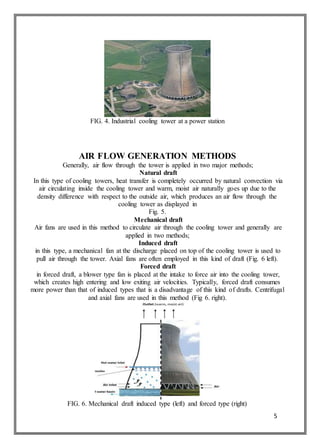
Generally, industrial cooling towers are much larger than HVAC towers. Industrial cooling
towers (shown in Fig. 4) are employed to remove heat from a thermodynamic process in the
industrial power plants using circulating cooling water. Cooling towers are also used in
petroleum refineries, petrochemical plants, food processing plants and semi-conductor plants.
5
FIG. 4. Industrial cooling tower at a power station
AIR FLOW GENERATION METHODS
Generally, air flow through the tower is applied in two major methods;
Natural draft
In this type of cooling towers, heat transfer is completely occurred by natural convection via
air circulating inside the cooling tower and warm, moist air naturally goes up due to the
density difference with respect to the outside air, which produces an air flow through the
cooling tower as displayed in
Fig. 5.
Mechanical draft
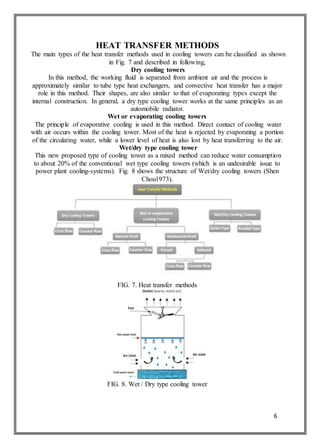
Air fans are used in this method to circulate air through the cooling tower and generally are
applied in two methods;
Induced draft
in this type, a mechanical fan at the discharge placed on top of the cooling tower is used to
pull air through the tower. Axial fans are often employed in this kind of draft (Fig. 6 left).
Forced draft
in forced draft, a blower type fan is placed at the intake to force air into the cooling tower,
which creates high entering and low exiting air velocities. Typically, forced draft consumes
more power than that of induced types that is a disadvantage of this kind of drafts. Centrifugal
and axial fans are used in this method (Fig 6. right).
FIG. 6. Mechanical draft induced type (left) and forced type (right)
6
HEAT TRANSFER METHODS
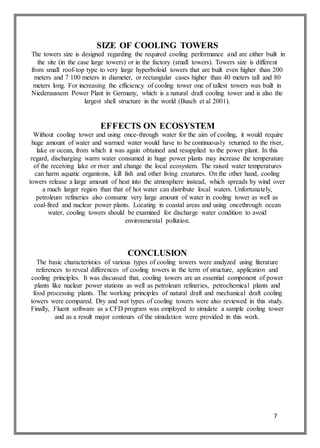
The main types of the heat transfer methods used in cooling towers can be classified as shown
in Fig. 7 and described in following,
Dry cooling towers
In this method, the working fluid is separated from ambient air and the process is
approximately similar to tube type heat exchangers, and convective heat transfer has a major
role in this method. Their shapes, are also similar to that of evaporating types except the
internal construction. In general, a dry type cooling tower works at the same principles as an
automobile radiator.
Wet or evaporating cooling towers
The principle of evaporative cooling is used in this method. Direct contact of cooling water
with air occurs within the cooling tower. Most of the heat is rejected by evaporating a portion
of the circulating water, while a lower level of heat is also lost by heat transferring to the air.
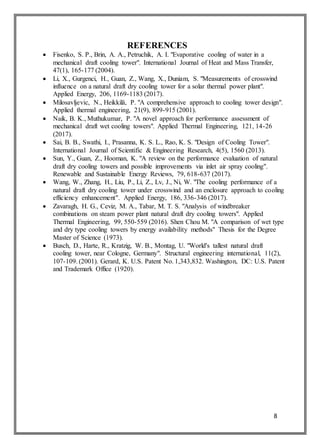
Wet/dry type cooling tower
This new proposed type of cooling tower as a mixed method can reduce water consumption
to about 20% of the conventional wet type cooling towers (which is an undesirable issue to
power plant cooling-systems). Fig. 8 shows the structure of Wet/dry cooling towers (Shen
Chou1973).
FIG. 7. Heat transfer methods
FIG. 8. Wet / Dry type cooling tower
7
SIZE OF COOLING TOWERS
The towers size is designed regarding the required cooling performance and are either built in
the site (in the case large towers) or in the factory (small towers). Towers size is different
from small roof-top type to very large hyperboloid towers that are built even higher than 200
meters and 7 100 meters in diameter, or rectangular cases higher than 40 meters tall and 80
meters long. For increasing the efficiency of cooling tower one of tallest towers was built in
Niederaussem Power Plant in Germany, which is a natural draft cooling tower and is also the
largest shell structure in the world (Busch et al 2001).
EFFECTS ON ECOSYSTEM
Without cooling tower and using once-through water for the aim of cooling, it would require
huge amount of water and warmed water would have to be continuously returned to the river,
lake or ocean, from which it was again obtained and resupplied to the power plant. In this
regard, discharging warm water consumed in huge power plants may increase the temperature
of the receiving lake or river and change the local ecosystem. The raised water temperatures
can harm aquatic organisms, kill fish and other living creatures. On the other hand, cooling
towers release a large amount of heat into the atmosphere instead, which spreads by wind over
a much larger region than that of hot water can distribute local waters. Unfortunately,
petroleum refineries also consume very large amount of water in cooling tower as well as
coal-fired and nuclear power plants. Locating in coastal areas and using oncethrough ocean
water, cooling towers should be examined for discharge water condition to avoid
environmental pollution.
CONCLUSION
The basic characteristics of various types of cooling towers were analyzed using literature
references to reveal differences of cooling towers in the term of structure, application and
cooling principles. It was discussed that, cooling towers are an essential component of power
plants like nuclear power stations as well as petroleum refineries, petrochemical plants and
food processing plants. The working principles of natural draft and mechanical draft cooling
towers were compared. Dry and wet types of cooling towers were also reviewed in this study.
Finally, Fluent software as a CFD program was employed to simulate a sample cooling tower
and as a result major contours of the simulation were provided in this work.
8
REFERENCES
 Fisenko, S. P., Brin, A. A., Petruchik, A. I. "Evaporative cooling of water in a
mechanical draft cooling tower". International Journal of Heat and Mass Transfer,
47(1), 165-177 (2004).
 Li, X., Gurgenci, H., Guan, Z., Wang, X., Duniam, S. "Measurements of crosswind
influence on a natural draft dry cooling tower for a solar thermal power plant".
Applied Energy, 206, 1169-1183 (2017).
 Milosavljevic, N., Heikkilä, P. "A comprehensive approach to cooling tower design".
Applied thermal engineering, 21(9), 899-915 (2001).
 Naik, B. K., Muthukumar, P. "A novel approach for performance assessment of
mechanical draft wet cooling towers". Applied Thermal Engineering, 121, 14-26
(2017).
 Sai, B. B., Swathi, I., Prasanna, K. S. L., Rao, K. S. "Design of Cooling Tower".
International Journal of Scientific & Engineering Research, 4(5), 1560 (2013).
 Sun, Y., Guan, Z., Hooman, K. "A review on the performance evaluation of natural
draft dry cooling towers and possible improvements via inlet air spray cooling".
Renewable and Sustainable Energy Reviews, 79, 618-637 (2017).
 Wang, W., Zhang, H., Liu, P., Li, Z., Lv, J., Ni, W. "The cooling performance of a
natural draft dry cooling tower under crosswind and an enclosure approach to cooling
efficiency enhancement". Applied Energy, 186, 336-346 (2017).
 Zavaragh, H. G., Ceviz, M. A., Tabar, M. T. S. "Analysis of windbreaker
combinations on steam power plant natural draft dry cooling towers". Applied
Thermal Engineering, 99, 550-559 (2016). Shen Chou M. "A comparison of wet type
and dry type cooling towers by energy availability methods" Thesis for the Degree
Master of Science (1973).
 Busch, D., Harte, R., Kratzig, W. B., Montag, U. "World's tallest natural draft
cooling tower, near Cologne, Germany". Structural engineering international, 11(2),
107-109. (2001). Gerard, K. U.S. Patent No. 1,343,832. Washington, DC: U.S. Patent
and Trademark Office (1920).

report project.docx

  • 1.
    1 Study Types OfCooling Towers StudentName: Ahmed Naseh Latif Class: 4 Stage – Group:B CourseTitle: Eng. Project 1 Department: Mechanic and MechatronicEngineering College of Engineering Salahaddin University-Erbil Academic Year 2020-2021
  • 2.
    2 Abstract Temperature control isa significant requirement in the most industrial process. In this regard, cooling towers are key parts of many power plant installations. Operation of the cooling tower as heat rejection device is based on a principle where waste thermal energy is extracted from hot water to the atmosphere using relatively cooland dry air. In this study, a review study is carried out to investigate different types of cooling towers, their application, performance, usage and working principles, which can be useful in the field of nuclear plants as well as other energy stations. A number of investigations have been considered to reveal differences between the used cooling towers and finally a Fluent simulation has been carried out to examine major contours and flow field around the cooling tower. Introduction Cooling towers are heat rejection devices used to transfer waste heat to the atmosphere through the cooling of a water stream. Cooling towers are mostly employed for cooling the circulating water used in power plants. A number of numerical and experimental studies have been done on the cooling towers. In this section, a summary of some valuable works is presented. A study was done to enhance cooling efficiency of a natural draft dry cooling tower. At various wind speeds structure was analyzed by computational fluid dynamics approach. Obtained results confirm that, for wind velocity higher than 4 m/s, the cooling efficiency of the natural draft dry cooling tower degrades with the increment of wind velocity due to non-uniform ventilation and the vortex inside the tower. It was shown that, using an enclosure can enhance the total cooling performance at all experimented wind speeds (Wang et al. 2017). Inlet air spray cooling was suggested for performance improvements of natural draft dry cooling towers. The study reviewed both the experimental and theoretical on natural draft dry cooling towers and discussed the spray cooling system consisting of different types of spray nozzles, which produce various spray patterns characterized by pressure, flow rate and droplet size distribution. This study revealed that, in high ambient temperature, the inlet air pre-cooling improves the performance of cooling tower and reduces power generation loss (Sun et al. 2017). The balance equations were used to predict the temperature variations of water and air, and changes in the humidity as a function of the tower height. The efficiency of cooling tower elements, such as water spray nozzles and droplet separators was examined in the pilot experiments. The 3D version of the computational fluid dynamics / Fluent was used to predict the flow structure and 2 characteristics. The 2D version of the Fluent was also used to predict the external airflow around the cooling tower at cold and hot weather conditions (Milosavljevic et al. 2001). Windbreaker application in natural draft dry cooling towers was analyzed. The efficiency of natural draft dry cooling towers is affected by the wind velocity when its value is higher than a critical level that depends on their design and geometry. Therefore, using different types of windbreakers can decrease this undesired effect. In the study, internal flat and combination of internal flat–external rounded windbreakers were investigated using ANSYS-Fluent (Ghasemi Zavaragh et al. 2016). In a solar thermal power plant, the effects of crosswind on a natural draft dry cooling tower were surveyed. Tower performance was investigated under different surrounding temperatures and crosswind speeds.
  • 3.
    3 It was shownthat, unlike tall cooling towers, the short cooling tower efficiency does not monotonously decrease with the increase of the crosswind speed (Li et al. 2017). Induced draft cooling tower was also studied to find out its characteristics and effectiveness (Sai et al. 2013). The influence of operating parameters including relative humidity, water inlet temperature, air dry bulb temperature, heat load and tower efficiency were considered and an analytical model was proposed to predict the amount of water taken up by the ambient air in a cross-flow wet cooling tower. The model results were compared to experimental data and good agreement was obtained. It was revealed that, the above mentioned parameters, except air dry bulb temperature have a significant influence on the efficiency of the cooling tower (Kiran Naik et al. 2017). Different physical parameters including water droplets and damp air were considered for cooling tower design. Effects of atmospheric conditions on tower performance and influence of atmospheric pressure were also investigated. Mechanical draft cooling tower as a control system was proposed and numerically analyzed using mathematical methods (Fisenko et al. 2004). Power plant A thermal power plant is a power station where thermal energy is converted to electric power. In most of the places in the world the turbine is steam-driven. Generally, in the process water is heated, evaporated and spins a steam turbine and finally mechanical energy converted to the electric power by an electrical generator. This process can be well defined by on a Rankine cycle as shown in the Fig. 1. FIG. 1. A schematic view of nuclear power plant with cooling tower and main components
  • 4.
    4 Heat Sources The greatestvariation in the design of thermal power stations is due to the different heat sources, which includes fossil fuel, solar thermal electric, nuclear, geothermal, waste incineration plants, and natural gas power stations (Fig. 2). FIG. 2. Heat sources to convert in thermal plants History Of Cooling Towers Development of steam engine was a first step in developing cooling towers originated in the 19th century, when condensers were used in the power generation systems. Condensers were used to condense the steam coming out of the turbines or cylinders. In some areas with available large land, cooling ponds was used, but in big cities with limited land, the system took the form of cooling towers. Early towers were placed either on the rooftops or as free- standing structures. In 1901, an American engineer proposed a special design as a rectangular or circular shell which was similar to a chimney stack shortened vertically, but laterally enlarged very much. At the top is a set of distributing troughs, water from the condenser is pumped to top and then trickles down over wooden slats or woven wire screens, which fill the space within the tower. A hyperboloid forms of cooling tower was firstly patented by the Dutch engineers Gerard Kuypers and Frederik van Iterson in 1918 and were built in the same year near Heerlen (Gerard 1920). CLASSIFICATION BY USE Cooling towers are classified by use into either air-conditioning or industrial duty. Air-conditioning (HVAC) An HVAC cooling tower is a subcategory rejecting heat from a chiller. Water-cooled chillers are normally more energy efficient than air-cooled chillers. Large office buildings, hospitals, and schools typically use one or more cooling towers as part of their air conditioning systems. Industrial cooling towers Generally, industrial cooling towers are much larger than HVAC towers. Industrial cooling towers (shown in Fig. 4) are employed to remove heat from a thermodynamic process in the industrial power plants using circulating cooling water. Cooling towers are also used in petroleum refineries, petrochemical plants, food processing plants and semi-conductor plants.
  • 5.
    5 FIG. 4. Industrialcooling tower at a power station AIR FLOW GENERATION METHODS Generally, air flow through the tower is applied in two major methods; Natural draft In this type of cooling towers, heat transfer is completely occurred by natural convection via air circulating inside the cooling tower and warm, moist air naturally goes up due to the density difference with respect to the outside air, which produces an air flow through the cooling tower as displayed in Fig. 5. Mechanical draft Air fans are used in this method to circulate air through the cooling tower and generally are applied in two methods; Induced draft in this type, a mechanical fan at the discharge placed on top of the cooling tower is used to pull air through the tower. Axial fans are often employed in this kind of draft (Fig. 6 left). Forced draft in forced draft, a blower type fan is placed at the intake to force air into the cooling tower, which creates high entering and low exiting air velocities. Typically, forced draft consumes more power than that of induced types that is a disadvantage of this kind of drafts. Centrifugal and axial fans are used in this method (Fig 6. right). FIG. 6. Mechanical draft induced type (left) and forced type (right)
  • 6.
    6 HEAT TRANSFER METHODS Themain types of the heat transfer methods used in cooling towers can be classified as shown in Fig. 7 and described in following, Dry cooling towers In this method, the working fluid is separated from ambient air and the process is approximately similar to tube type heat exchangers, and convective heat transfer has a major role in this method. Their shapes, are also similar to that of evaporating types except the internal construction. In general, a dry type cooling tower works at the same principles as an automobile radiator. Wet or evaporating cooling towers The principle of evaporative cooling is used in this method. Direct contact of cooling water with air occurs within the cooling tower. Most of the heat is rejected by evaporating a portion of the circulating water, while a lower level of heat is also lost by heat transferring to the air. Wet/dry type cooling tower This new proposed type of cooling tower as a mixed method can reduce water consumption to about 20% of the conventional wet type cooling towers (which is an undesirable issue to power plant cooling-systems). Fig. 8 shows the structure of Wet/dry cooling towers (Shen Chou1973). FIG. 7. Heat transfer methods FIG. 8. Wet / Dry type cooling tower
  • 7.
    7 SIZE OF COOLINGTOWERS The towers size is designed regarding the required cooling performance and are either built in the site (in the case large towers) or in the factory (small towers). Towers size is different from small roof-top type to very large hyperboloid towers that are built even higher than 200 meters and 7 100 meters in diameter, or rectangular cases higher than 40 meters tall and 80 meters long. For increasing the efficiency of cooling tower one of tallest towers was built in Niederaussem Power Plant in Germany, which is a natural draft cooling tower and is also the largest shell structure in the world (Busch et al 2001). EFFECTS ON ECOSYSTEM Without cooling tower and using once-through water for the aim of cooling, it would require huge amount of water and warmed water would have to be continuously returned to the river, lake or ocean, from which it was again obtained and resupplied to the power plant. In this regard, discharging warm water consumed in huge power plants may increase the temperature of the receiving lake or river and change the local ecosystem. The raised water temperatures can harm aquatic organisms, kill fish and other living creatures. On the other hand, cooling towers release a large amount of heat into the atmosphere instead, which spreads by wind over a much larger region than that of hot water can distribute local waters. Unfortunately, petroleum refineries also consume very large amount of water in cooling tower as well as coal-fired and nuclear power plants. Locating in coastal areas and using oncethrough ocean water, cooling towers should be examined for discharge water condition to avoid environmental pollution. CONCLUSION The basic characteristics of various types of cooling towers were analyzed using literature references to reveal differences of cooling towers in the term of structure, application and cooling principles. It was discussed that, cooling towers are an essential component of power plants like nuclear power stations as well as petroleum refineries, petrochemical plants and food processing plants. The working principles of natural draft and mechanical draft cooling towers were compared. Dry and wet types of cooling towers were also reviewed in this study. Finally, Fluent software as a CFD program was employed to simulate a sample cooling tower and as a result major contours of the simulation were provided in this work.
  • 8.
    8 REFERENCES  Fisenko, S.P., Brin, A. A., Petruchik, A. I. "Evaporative cooling of water in a mechanical draft cooling tower". International Journal of Heat and Mass Transfer, 47(1), 165-177 (2004).  Li, X., Gurgenci, H., Guan, Z., Wang, X., Duniam, S. "Measurements of crosswind influence on a natural draft dry cooling tower for a solar thermal power plant". Applied Energy, 206, 1169-1183 (2017).  Milosavljevic, N., Heikkilä, P. "A comprehensive approach to cooling tower design". Applied thermal engineering, 21(9), 899-915 (2001).  Naik, B. K., Muthukumar, P. "A novel approach for performance assessment of mechanical draft wet cooling towers". Applied Thermal Engineering, 121, 14-26 (2017).  Sai, B. B., Swathi, I., Prasanna, K. S. L., Rao, K. S. "Design of Cooling Tower". International Journal of Scientific & Engineering Research, 4(5), 1560 (2013).  Sun, Y., Guan, Z., Hooman, K. "A review on the performance evaluation of natural draft dry cooling towers and possible improvements via inlet air spray cooling". Renewable and Sustainable Energy Reviews, 79, 618-637 (2017).  Wang, W., Zhang, H., Liu, P., Li, Z., Lv, J., Ni, W. "The cooling performance of a natural draft dry cooling tower under crosswind and an enclosure approach to cooling efficiency enhancement". Applied Energy, 186, 336-346 (2017).  Zavaragh, H. G., Ceviz, M. A., Tabar, M. T. S. "Analysis of windbreaker combinations on steam power plant natural draft dry cooling towers". Applied Thermal Engineering, 99, 550-559 (2016). Shen Chou M. "A comparison of wet type and dry type cooling towers by energy availability methods" Thesis for the Degree Master of Science (1973).  Busch, D., Harte, R., Kratzig, W. B., Montag, U. "World's tallest natural draft cooling tower, near Cologne, Germany". Structural engineering international, 11(2), 107-109. (2001). Gerard, K. U.S. Patent No. 1,343,832. Washington, DC: U.S. Patent and Trademark Office (1920).