Philippine Forest
Group 13
Flores, Jennylyn
Mataac, Christell Ann
TERRESTRIAL ECOSYSTEM
IN THE PHILIPPINES
FOREST - is a partnership of trees,
shrubs, vines, herbs, and animal life.
It is an area of land where plant and
animal life live together in close
association, bound by specific and
recognizable patterns of
interdependence.
FOREST VALUE AND THEIR
USES
Intangible values of the forest are
those which cannot be quantified in
material terms but are essential for
maintaining life support systems and
for sustaining environmental
stability.
Examples:
* Ecological Values
* Cultural/Aesthetic Values
* Moral or Ethical Values
Tangible Values of the forest can
be realized either through extractive
use or non-extractive use. Harvesting
forest products can be profitable for
the local communities.
* Material Values
Help regulate Nature’s water
cycle - A forest can keep the natural
water cycle in balance by:
* Increasing the amount of rainfall in
its area.
* Storing the rainwater afterwards.
* Controlling the flow of this water to
surrounding lowlands.
* Water source.
WHAT TYPE OF ECOLOGICAL
DAMAGE IS THUS
PREVENTED BY FOREST?
Soil Erosion barrier
Floods and tidal wave barrier
Droughts
Promote and protect
agricultural production. A forest
can directly benefit agriculture in at
least two ways:
By improving soil fertility
By protecting crops against common
pests
Reduce destruction from
typhoon
Help maintain a wholesome
climate and act as soil stabilizer
Help cut down air and noise
pollution
Pollution regulator
Source of medicine and food
Natural source of plant and
animal strains resistant to pest
Economic Assets, because they:
Supply the raw materials for our
wood and forest-based industries.
Among the other useful products
derived from forest are:
Exudents, Tannins, Dye, Bark
Medicine from leaves and bark
Account for substantial foreign
exchange earned from abroad.
Provide income and employment
opportunities and contribute in other
ways to overall economic development.
FOREST TREES
Tree - is a woody perennial plant
with one stem or trunk which
develops many branches. Tress
commonly grow to more that 10 feet,
some reach hundreds of feet high.
Trees can live for many years.
Forest cover - includes all forested
areas without limitation in size or tree
species. Aside from natural forest,
forest cover also includes man-made
forest and small wooded areas.
Commercial Forest - is that in
which is commercially important.
This means that a sizeable amount of
forest resources are ready to be in the
wood based industries.
8 Types of
Philippine
Forest
1. Dipterocarp Forest/
Lowland rainforest
Carabao Musing
2. Molave Forest
(Mulawin)
Bilar Manmade Forest
3. Pine Forest
Cordilleras
Sagada
Sample Pine in Luzon
4. Mangrove Forest
(Bawakan)
Puerto Princesa Palawan
Others:
5. Beach Forest
Tagbanwa on Coron Island Forest
El Nido in Palawan
• Birds:
 Kingfisher
 wood swallows swifts
 Starlings
 Orioles
 Doves
 Flowerpeckers
 sunbirds
Major
Threats!
6. Mid-Mountain
Forest
Mount Apo
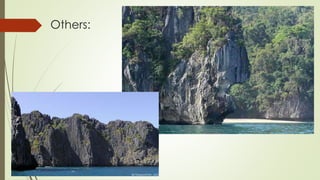
7. Limestone Forest
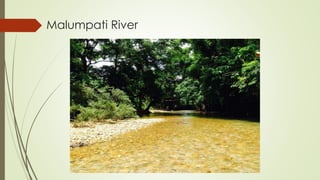
Lime stone in Palawan
Malumpati River
Others:
8. Freshwater/Swamp
Forest
Candamba Pampanga
Different Types of
Forest Resources:
Standing Trees
Minor Forest Products
Wildlife
Brush and Open Land
Who to blame?
Illegal Loggers,
Illegal forest product
gatherers, and
Timber smugglers
Kaingineros
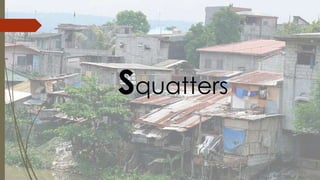
Squatters
Miners
Forest Incendiaries
Non-human agents
for forest destruction
Biological Agents
Atmospheric agents
3 Methods
Afforestation
Scientific harvesting
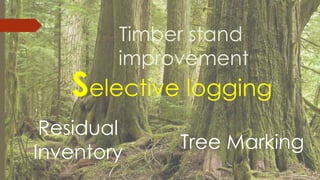
Selective logging
Tree Marking
Residual
Inventory
Timber stand
improvement
Report for ecology

Report for ecology

Editor's Notes

  • #14 Last part na ‘to ng report ko. Pakidagdag nalang yung sa part mo. Georgia ung font niyan. Tapos green yung theme kasi forest topic natin. Green means nature. Hahaha. :D
  • #19 In BOHOL. The two-kilometer forest was planted as part of a reforestation project started more than 50 years ago, to replace trees lost from widespread kaingin (slash-and-burn farming) in Bohol
  • #21 Baguio, officially the City of Baguio (Filipino: Lungsod ng Baguio ; Ibaloi: Ciudad ni Bagiw ; Pangasinan: Siyudad na Baguio)and often referred to as Baguio City, is a highly urbanized city located in the province of Benguet in northernLuzon island of the Philippines. The city has become the center of business and commerce as well as the center of education in the entire Northern Luzon thereby becoming the seat of government of the Cordillera Administrative Region (C.A.R.).[3] According to the 2010 census, Baguio City has a population of 318,676.[2]
  • #33 Mount Apo is a large solfataric, potentially active stratovolcano in the island of Mindanao, Philippines. With an elevation of 2,954 metres (9,692 ft) above sea level, it is the highest mountain in the Philippine Archipelago and is located between Davao City and Davao del Sur province in Region XI and Cotabato province in Region XII. The peak overlooks Davao City 45 kilometres (28 mi) to the northeast, Digos City 25 kilometres (16 mi) to the southeast, andKidapawan City 20 kilometres (12 mi) to the west.
  • #39 Candaba Swamp is located in the Candaba, Pampanga municipality, 60 km northeast of Manila in the Philippines. It encompasses about 32,000 ha, made of freshwater ponds, swamps and marshes surrounded by seasonally flooded grasslands. The entire area becomes submerged underwater during the wet season. It dries out during the months of November to April. Then the swamp is converted to farmland by the locals. Watermelon and rice are usually planted, comprising the vegetation of the flood plain, together with patches of Nipa palm and some mangrove species. The Candaba swamp also acts as a natural flood retention basin during the rainy season. It holds the overflow from five smaller rivers (Maasim, San Miguel, Garlang, Bulu and Peñaranda), then drains into the larger Pampanga River.