Replacement of a Legacy CIS (Customer
Information System) with SAP CR&B
SAP for Utilities Conference – 2013
Presented by: Thomas J. Pierpoint, Director, Business Applications
2
Topics
 About Pepco Holdings, Inc.
 A moment of recognition
 Background of customer information systems at PHI
 Decision options around the going-forward path
 Process used to make the decisions
 Overall timeline of key activities
 Moving forward on our SolutionOne project
 Q&A
3
About Pepco Holdings, Inc.
 Approximately 2 million customer
accounts in Delaware, the District of
Columbia, Maryland and New Jersey
 Total population served is 5.6 million
 Three T&D operating companies provide
regulated electricity service
• Atlantic City Electric,
• Delmarva Power (gas & electric)
• Pepco (including one of the top four
largest underground systems in the
country)
 Pepco Energy Service provides energy
efficiency and renewable energy services
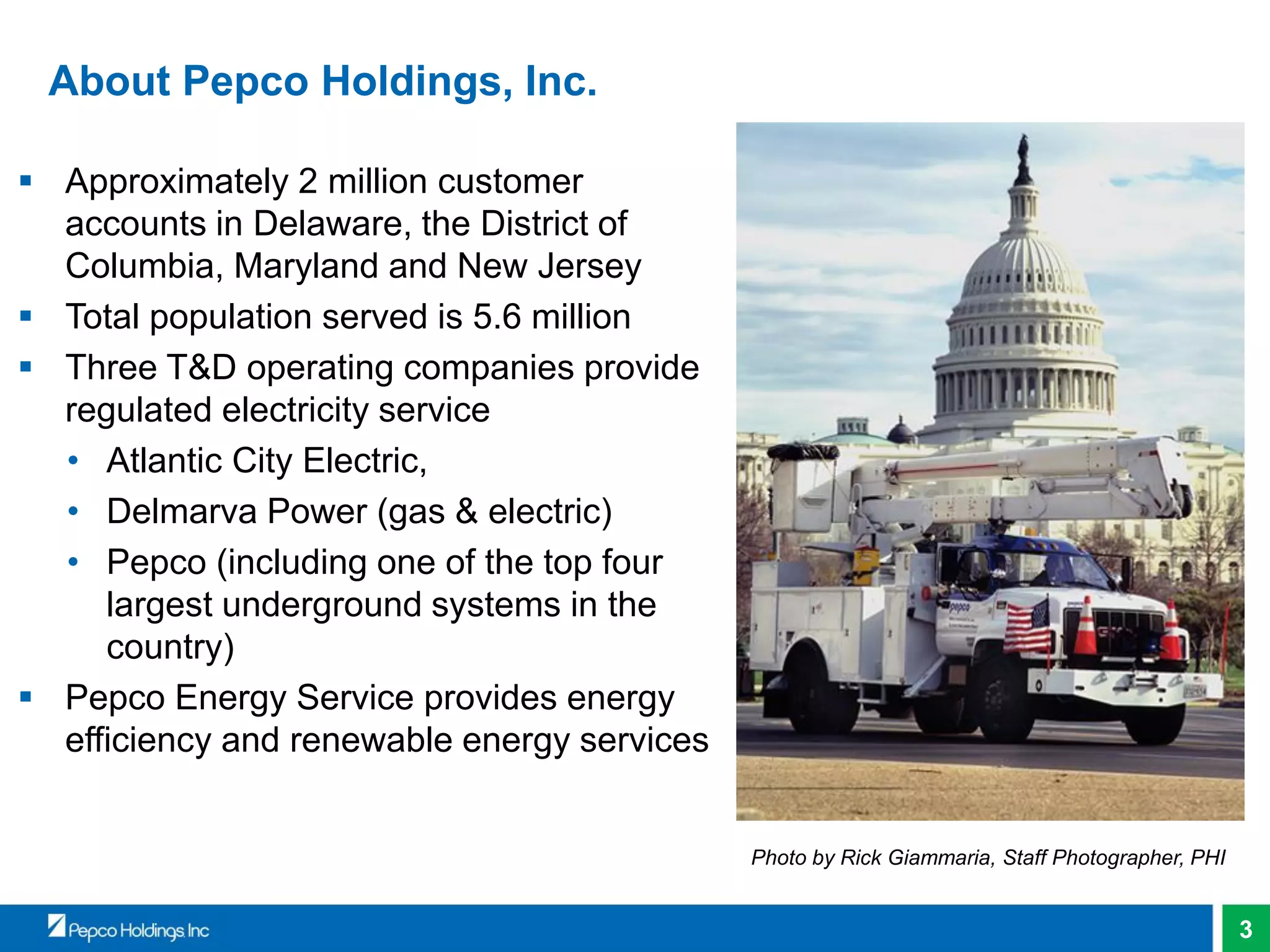
Photo by Rick Giammaria, Staff Photographer, PHI
4
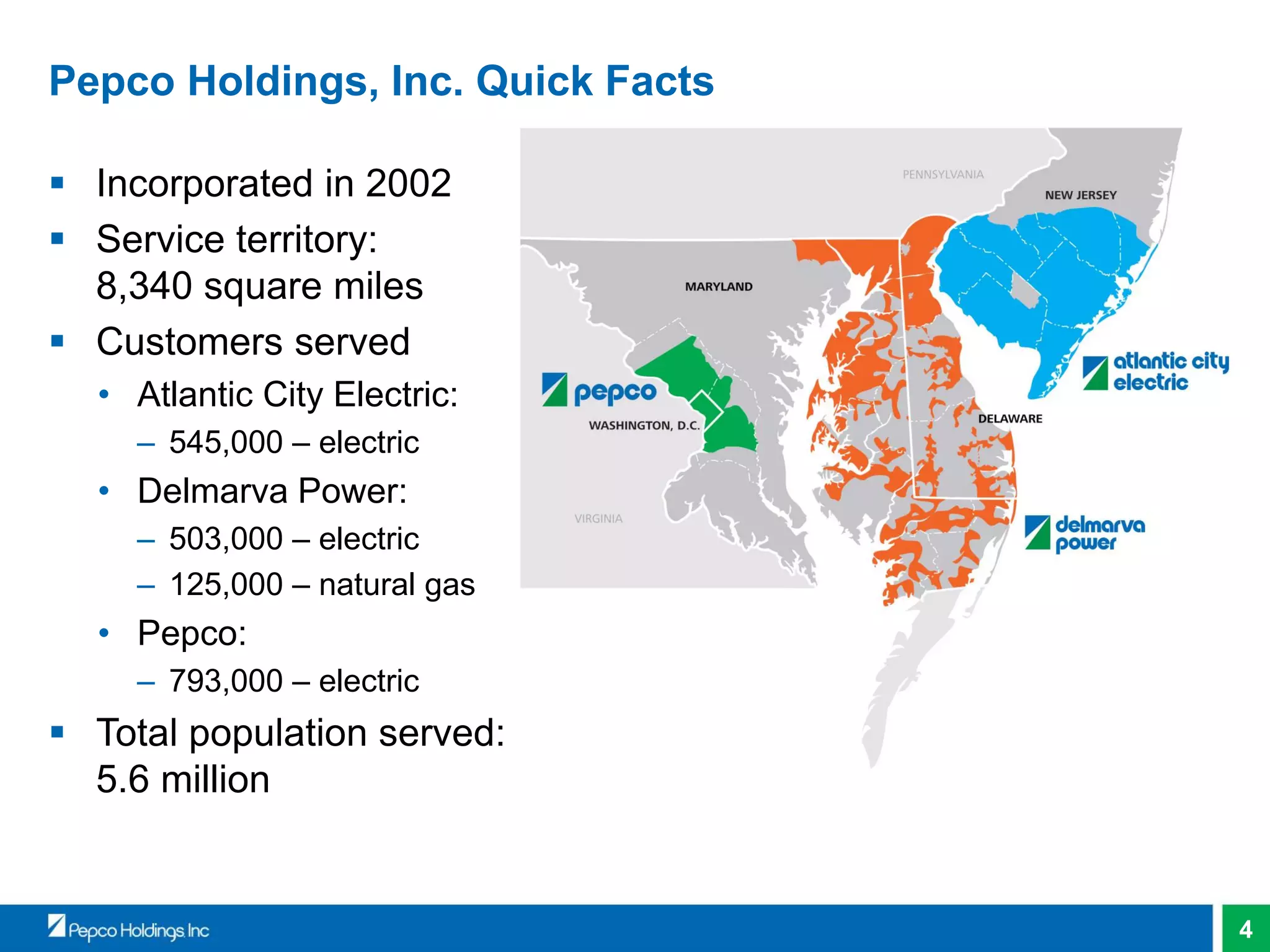
Pepco Holdings, Inc. Quick Facts
 Incorporated in 2002
 Service territory:
8,340 square miles
 Customers served
• Atlantic City Electric:
– 545,000 – electric
• Delmarva Power:
– 503,000 – electric
– 125,000 – natural gas
• Pepco:
– 793,000 – electric
 Total population served:
5.6 million
5
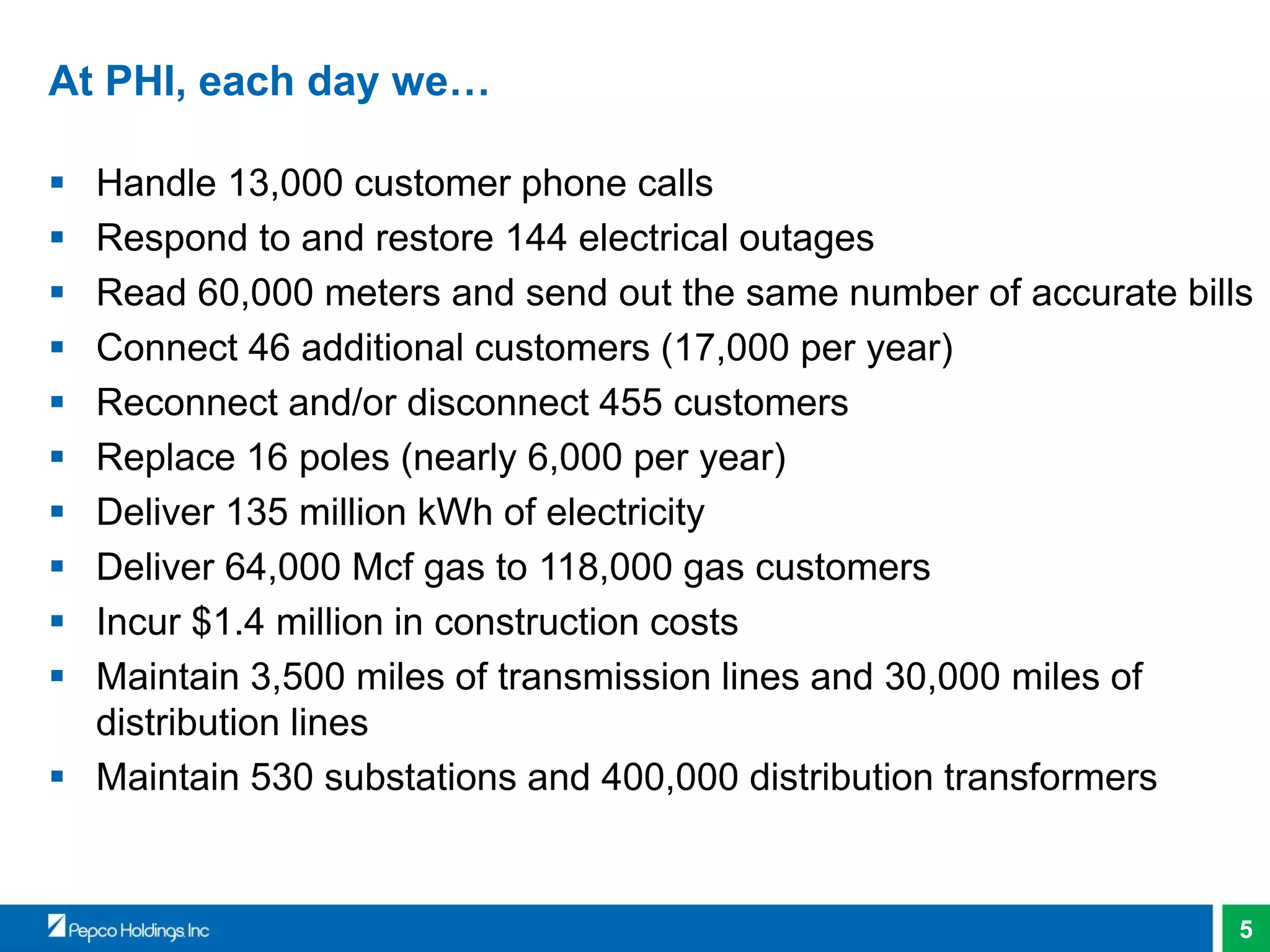
At PHI, each day we…
 Handle 13,000 customer phone calls
 Respond to and restore 144 electrical outages
 Read 60,000 meters and send out the same number of accurate bills
 Connect 46 additional customers (17,000 per year)
 Reconnect and/or disconnect 455 customers
 Replace 16 poles (nearly 6,000 per year)
 Deliver 135 million kWh of electricity
 Deliver 64,000 Mcf gas to 118,000 gas customers
 Incur $1.4 million in construction costs
 Maintain 3,500 miles of transmission lines and 30,000 miles of
distribution lines
 Maintain 530 substations and 400,000 distribution transformers
6Work Management Workshop July 28 2009
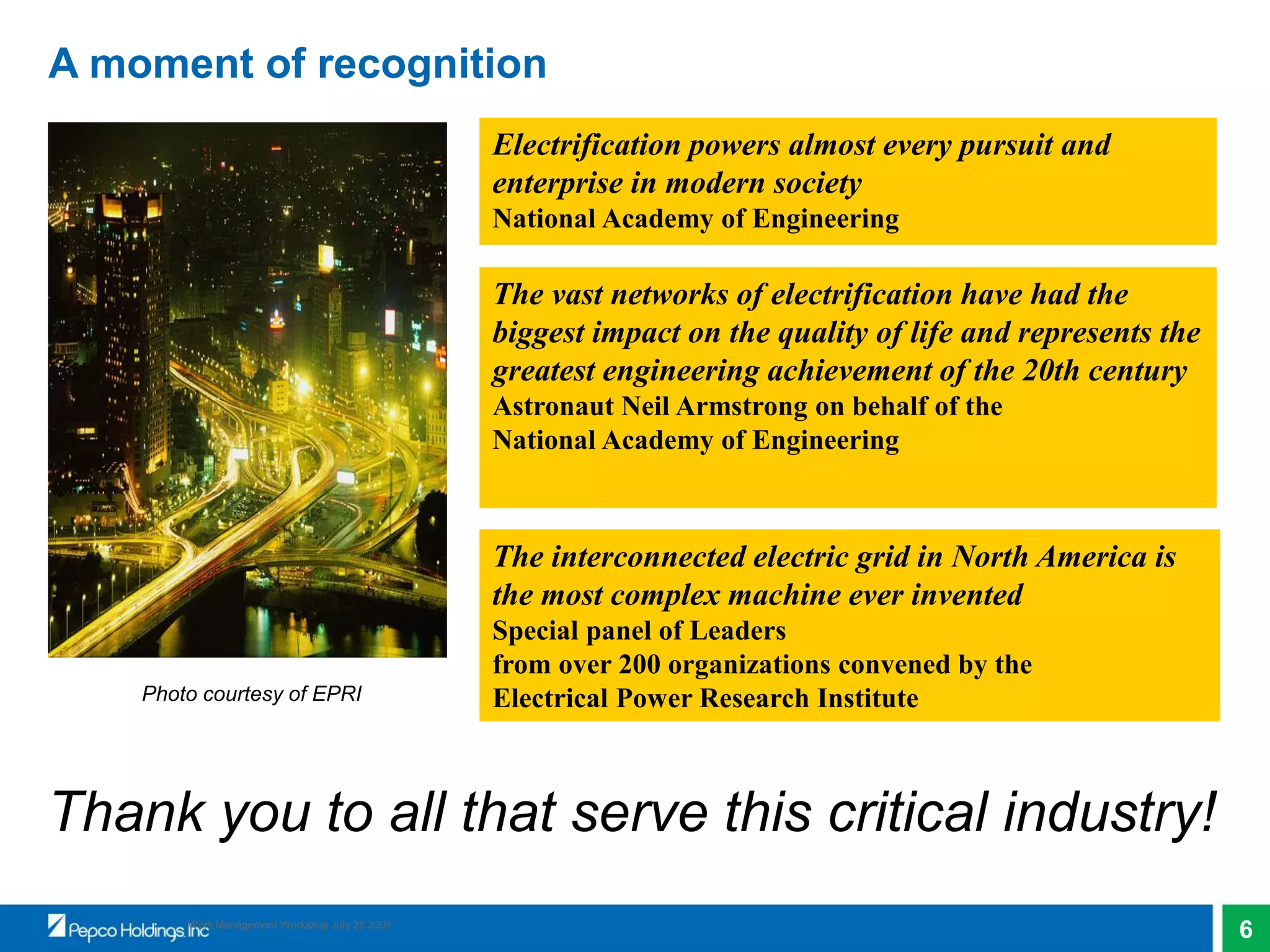
The vast networks of electrification have had the
biggest impact on the quality of life and represents the
greatest engineering achievement of the 20th century
Astronaut Neil Armstrong on behalf of the
National Academy of Engineering
The interconnected electric grid in North America is
the most complex machine ever invented
Special panel of Leaders
from over 200 organizations convened by the
Electrical Power Research Institute
Electrification powers almost every pursuit and
enterprise in modern society
National Academy of Engineering
A moment of recognition
Thank you to all that serve this critical industry!
Photo courtesy of EPRI
7
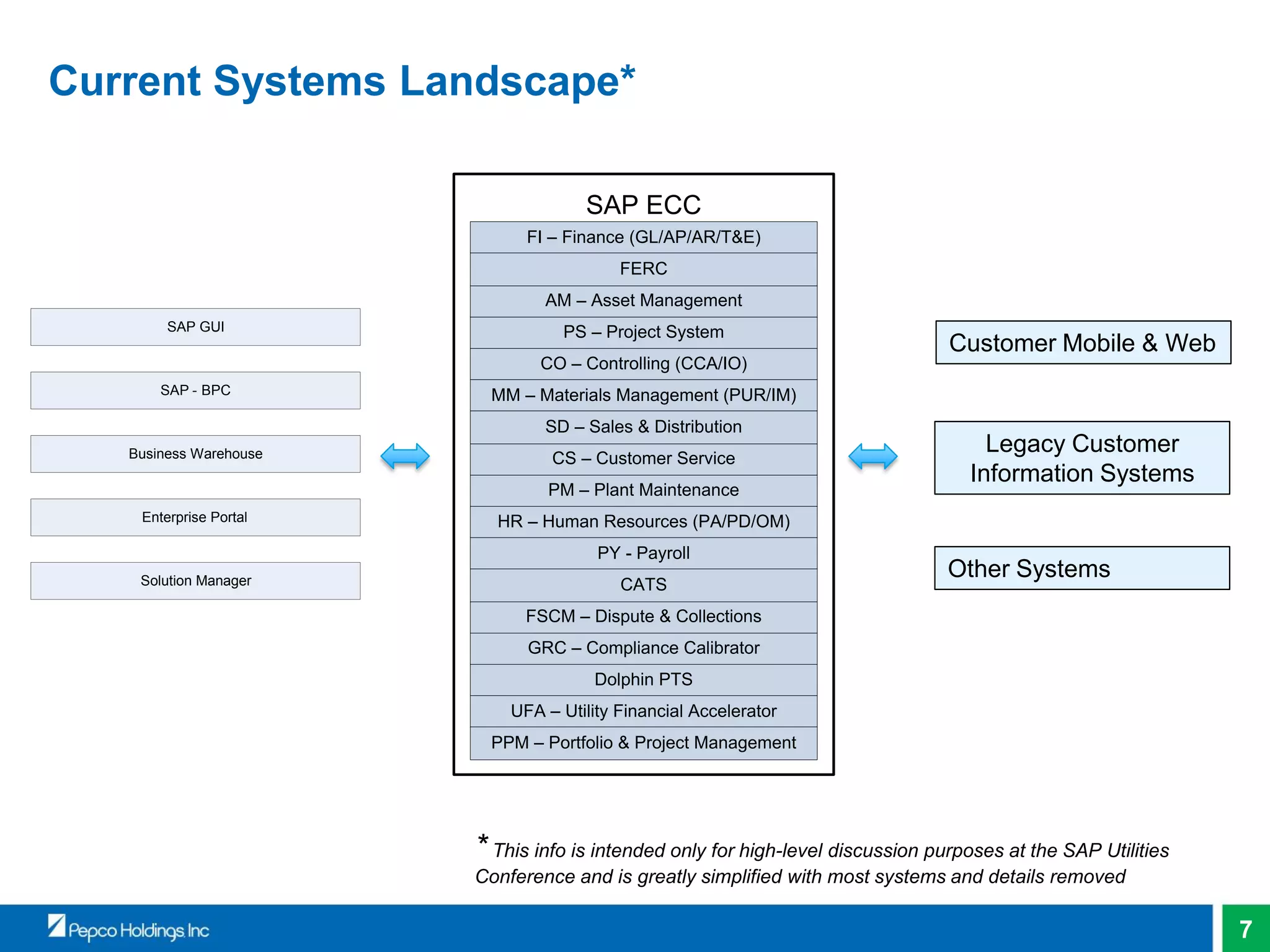
Current Systems Landscape*
SAP ECC
CO – Controlling (CCA/IO)
FI – Finance (GL/AP/AR/T&E)
AM – Asset Management
PS – Project System
MM – Materials Management (PUR/IM)
PM – Plant Maintenance
CS – Customer Service
SD – Sales & Distribution
HR – Human Resources (PA/PD/OM)
PY - Payroll
FERC
CATS
FSCM – Dispute & Collections
GRC – Compliance Calibrator
Dolphin PTS
UFA – Utility Financial Accelerator
PPM – Portfolio & Project Management
* This info is intended only for high-level discussion purposes at the SAP Utilities
Conference and is greatly simplified with most systems and details removed
Customer Mobile & Web
Legacy Customer
Information Systems
Other Systems
Business Warehouse
Enterprise Portal
SAP - BPC
SAP GUI
Solution Manager
8
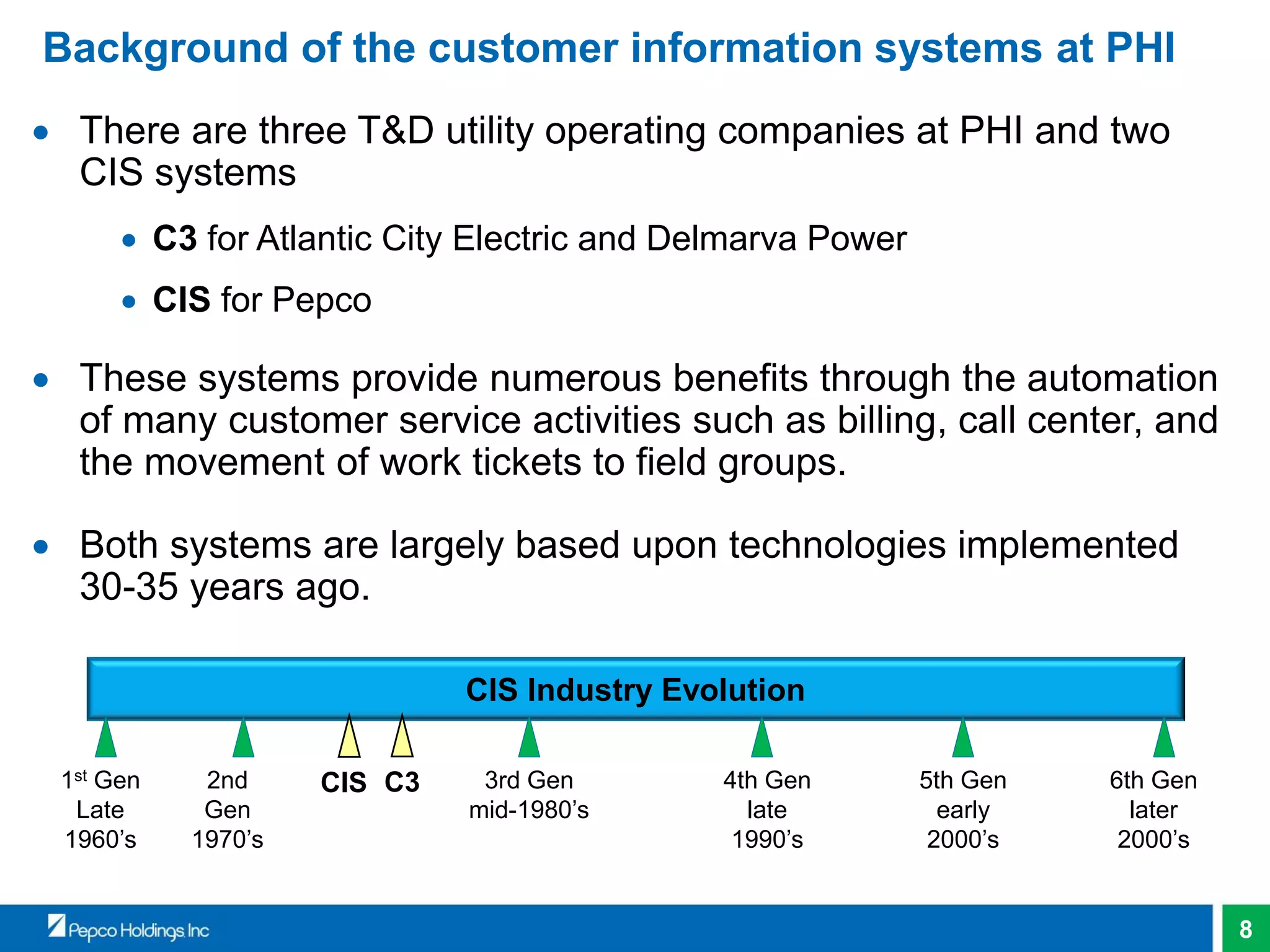
Background of the customer information systems at PHI
 There are three T&D utility operating companies at PHI and two
CIS systems
 C3 for Atlantic City Electric and Delmarva Power
 CIS for Pepco
 These systems provide numerous benefits through the automation
of many customer service activities such as billing, call center, and
the movement of work tickets to field groups.
 Both systems are largely based upon technologies implemented
30-35 years ago.
CIS Industry Evolution
1st Gen
Late
1960’s
2nd
Gen
1970’s
3rd Gen
mid-1980’s
4th Gen
late
1990’s
5th Gen
early
2000’s
6th Gen
later
2000’s
CIS C3
9
These systems have performed very well for many years in
supporting a relatively stable business environment . . .
However, PHI is proactively making many changes to stay
ahead of accelerating change in our industry
 Starting in 2005 major new capabilities were incrementally added to
improve levels of customer service and provide new offerings
including new rates, demand response, web, mobile, self-service with
AMI as a key enabler.
 The effort required to interface with the legacy systems can be
complex and time-consuming. This is increasingly proving to be
“critical path” in the deployment of further new functionality, especially
for customer-facing deliverables.
 The systems continue to perform core business processes very well,
but there are many newer processes they do not fully enable.
Workarounds are sometimes in place to address these limitations.
10
PHI has regularly evaluated the life-cycle of the existing
systems to determine the best path forward
 An Evaluation of Options has been performed every 24-30
months since 2003 at PHI
 Each option had pros and cons and the best course was to
“stay the course” and incrementally add new technologies
around the legacy systems
 A high-level evaluation in late 2010 revealed that some
underlying factors would likely change and that a further,
more detailed evaluation was appropriate during 2011
11
The replacement of a legacy CIS is a big commitment for
any utility. A few of the Critical Success Factors for the
detailed analysis to evaluate replacement options include. .
 Provide a structured, incremental approach including stage
gates
 Engage all principal stakeholders
 Expand the traditional cost-benefits analysis to include
possible emerging benefits from our changing industry
12
The structured, incremental analysis had key phases
with stage gates prior to the next phase
• Phase 0 was done in late 2010 and revealed that some underlying
factors would likely change. The recommendation was to perform the
next level of a detailed analysis.
• Phase I was done in the 1st quarter of 2011. This was a “Gap-Fit”
analysis that indicated substantial potential benefits of replacing the
existing CIS systems with a commercial technology. The
recommendation was to perform a more detailed analysis and make
preliminary plans for a possible project.
• Phase II was done in the 2nd and 3rd quarter of 2011 and drove to a
greater level of detail on scope of work, resource requirements, cost
estimates, and the viability of SAP CR&B for PHI. The recommendation
was to proceed with replacement of the legacy systems and set up a
formal and funded project.
13
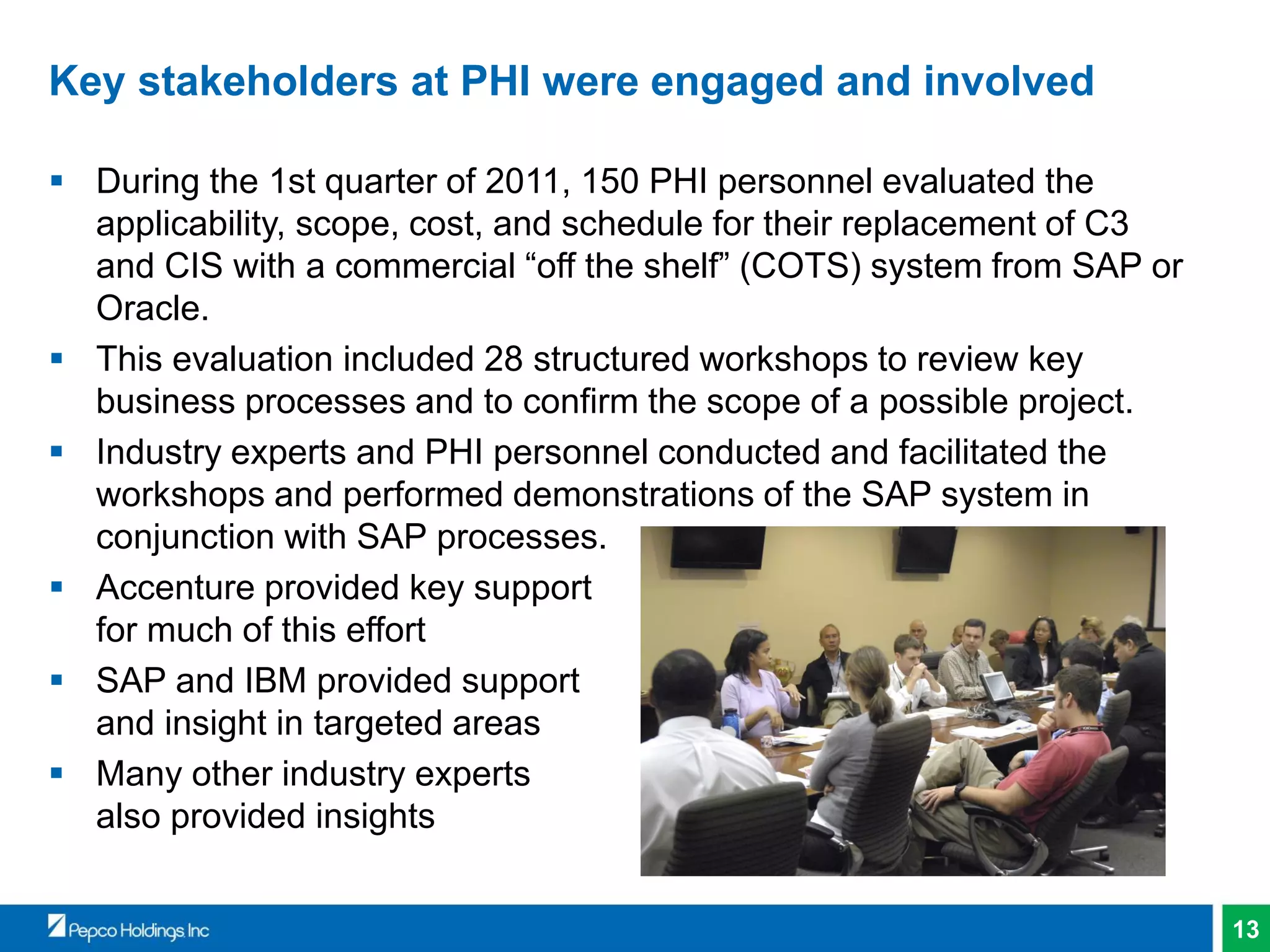
Key stakeholders at PHI were engaged and involved
 During the 1st quarter of 2011, 150 PHI personnel evaluated the
applicability, scope, cost, and schedule for their replacement of C3
and CIS with a commercial “off the shelf” (COTS) system from SAP or
Oracle.
 This evaluation included 28 structured workshops to review key
business processes and to confirm the scope of a possible project.
 Industry experts and PHI personnel conducted and facilitated the
workshops and performed demonstrations of the SAP system in
conjunction with SAP processes.
 Accenture provided key support
for much of this effort
 SAP and IBM provided support
and insight in targeted areas
 Many other industry experts
also provided insights
14
The traditional costs-benefit models typically address a
number of important areas
• Preservation of the existing benefits gained by a current CIS
– These benefits are substantial at many utilities
– These benefits should not be ignored (or jeopardized)
• Direct support of legacy systems
– Mainframe and licenses, usually increasing as user base at a utility
shrinks
– Staff of specialists
• Continuing modifications to legacy systems
• Business process inefficiencies
• New and needed capabilities that have been identified
– Complex rates
– CRM
15
A traditional cost-benefit analysis should also include
considerations for a changing business environment
 Newer variable, time-based rates
 Increasing needs to extract data
 Built-in business intelligence
 Multi-channel, multi-device
communication, supporting a single
system of record for all customer
communications
 Non-revenue products and services
such as demand response, energy
efficiency, or net metering
Will the pace, breadth and depth of future changes overwhelm the ability
of a utility to make timely and cost efficient changes to legacy systems?
 New, adaptable credit and
collections services
 Increasing levels of CRM
capabilities
 Consolidation and accuracy of
master data, especially related to
customers
16
Guiding principles were established early in this effort
Quality First - The quality of the implementation is paramount.
Design for Flexibility and Adaptability - Architecture must facilitate rapid
implementation of future enhancements.
Virtue in Simplicity, with the scope including three core components:
- fundamental CIS functionality
- functionality to meet public commitments
- some additional, value adding, out of the box capabilities
Change the Process, Not the System - A bias toward process change to
conform to out of the box functionality.
Not Everything is a Day One Deliverable - Deliverables will be pushed
to Phase 2 if they shift focus from a high quality implementation of the
three core deliverables.
17
Guiding principles were established early in this effort
Good Ideas Don't All Have to be Built – Some new functions can be
obtained by “innovation through adoption” of best functionality built by
other utilities.
What is the Impact on Customer Care and Operations? - Project
decisions need to be made with a clear understanding of the potential
impact on the operating areas.
Dedicated Team - Allow the assigned resources to focus exclusively on
this project and seek to capitalize on their fresh perspectives.
18
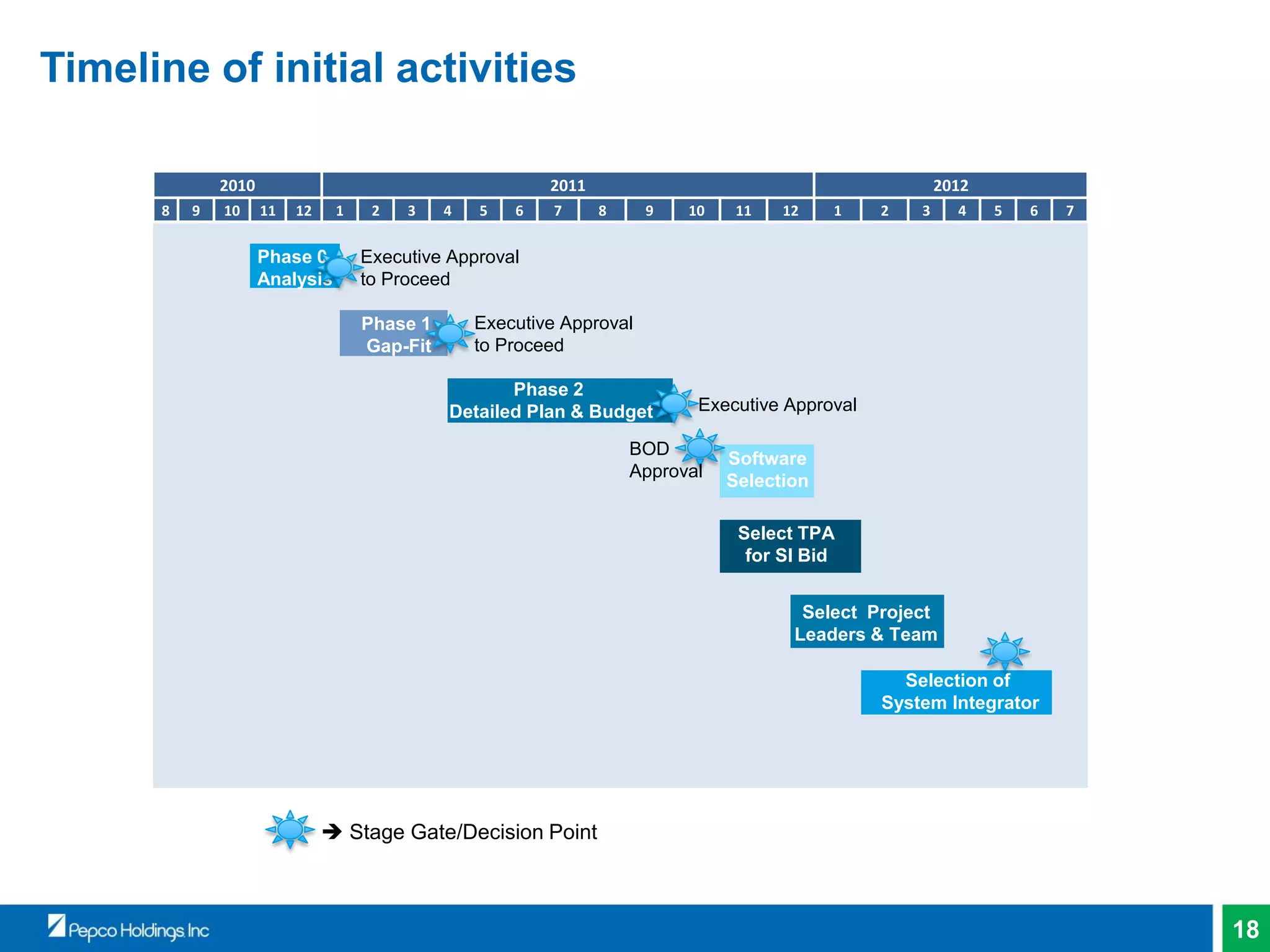
Timeline of initial activities
2010 2011 2012
8 9 10 11 12 1 2 3 4 5 6 7 8 9 10 11 12 1 2 3 4 5 6 7
Phase 0
Analysis
Phase 1
Gap-Fit
Phase 2
Detailed Plan & Budget
Software
Selection
Select TPA
for SI Bid
Select Project
Leaders & Team
Selection of
System Integrator
BOD
Approval
Executive Approval
to Proceed
Executive Approval
to Proceed
Executive Approval
 Stage Gate/Decision Point
19
Moving Forward with SolutionOne
19
20
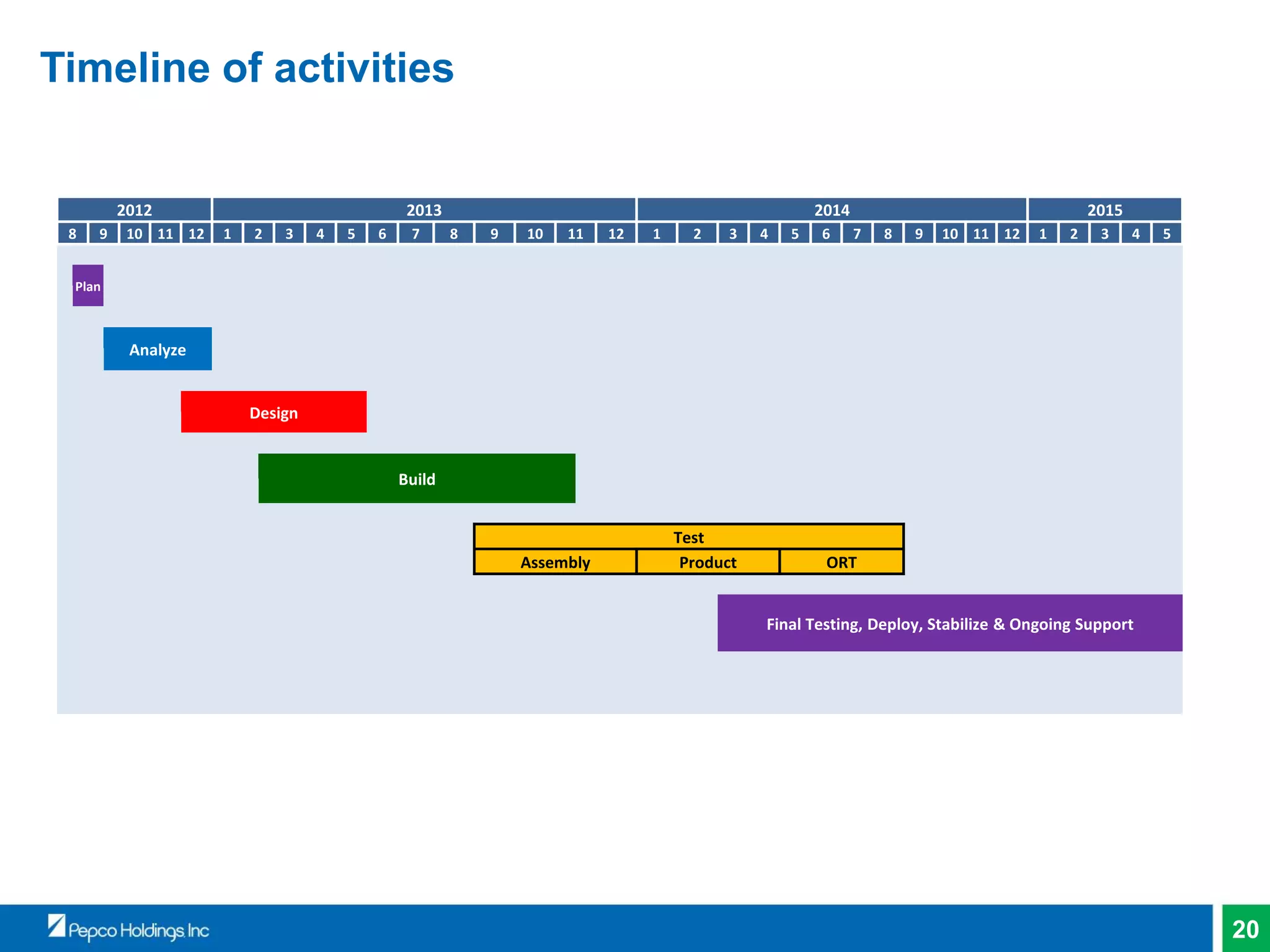
Timeline of activities
2012 2013 2014 2015
8 9 10 11 12 1 2 3 4 5 6 7 8 9 10 11 12 1 2 3 4 5 6 7 8 9 10 11 12 1 2 3 4 5
Plan
Analyze
Design
Build
Test
Assembly Product ORT
Final Testing, Deploy, Stabilize & Ongoing Support
21
Primary Objectives of Business Readiness
• Reduce the intensity and duration of the transition period
following the Go-Live to better serve our customers
• Prepare our employees
– Communication venues for our leaders
– Develop and execute a plan to utilize Customer Care
resources at key stages of project
– Collaborate with Change Management team on detailed
training, communications, and knowledge transfer plans
22
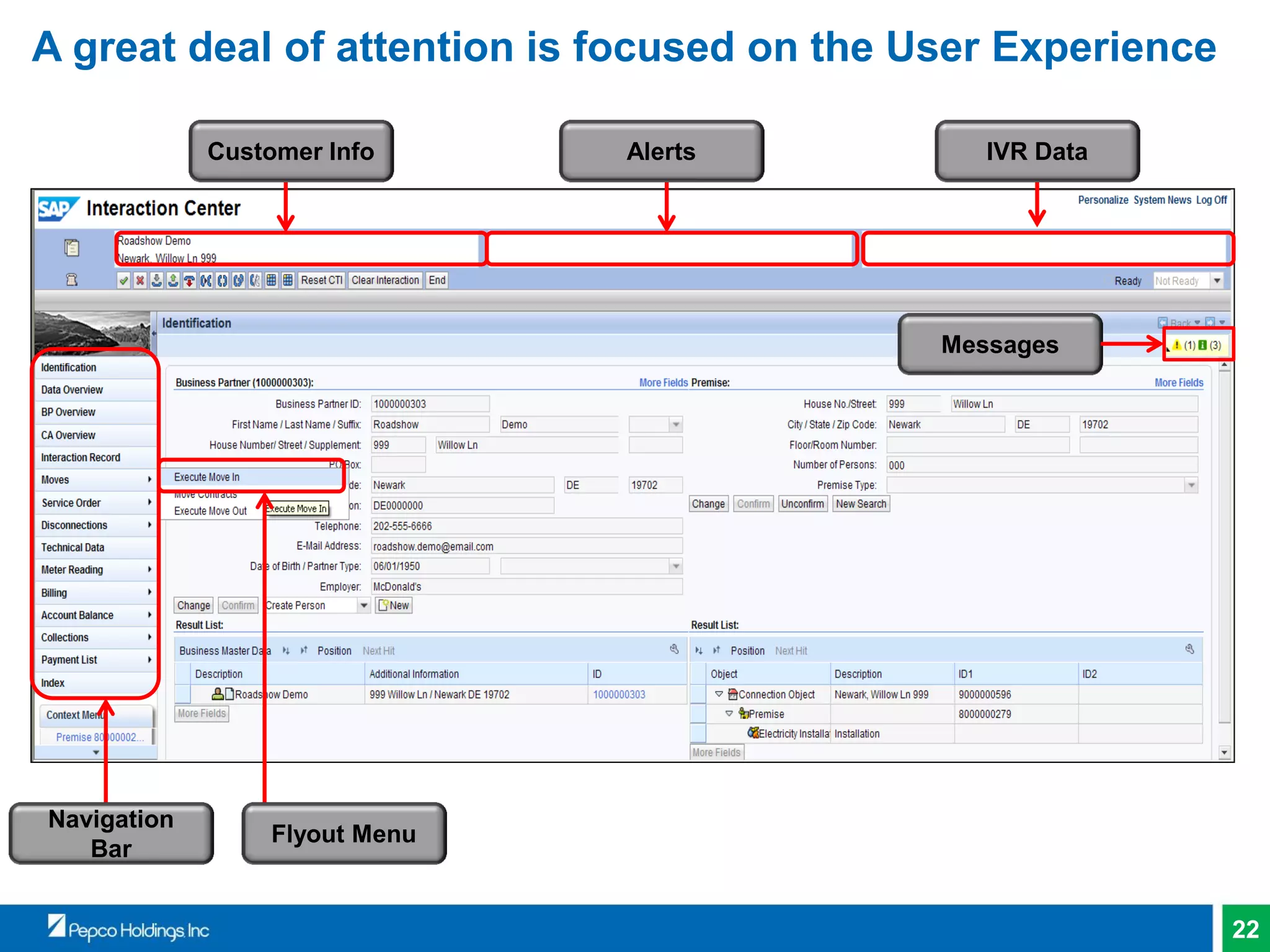
A great deal of attention is focused on the User Experience
Customer Info Alerts IVR Data
Navigation
Bar
Flyout Menu
Messages
23
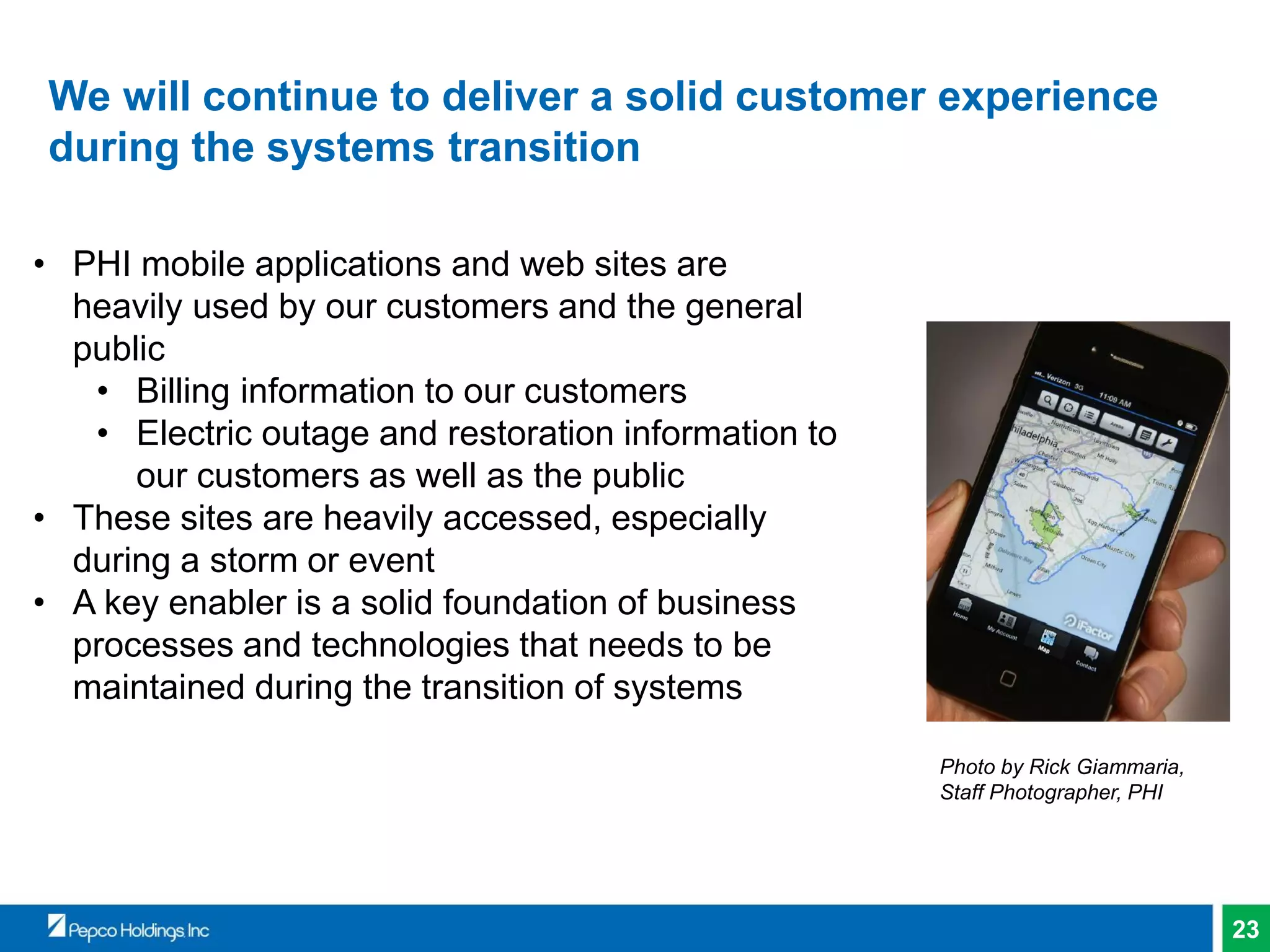
We will continue to deliver a solid customer experience
during the systems transition
• PHI mobile applications and web sites are
heavily used by our customers and the general
public
• Billing information to our customers
• Electric outage and restoration information to
our customers as well as the public
• These sites are heavily accessed, especially
during a storm or event
• A key enabler is a solid foundation of business
processes and technologies that needs to be
maintained during the transition of systems
Photo by Rick Giammaria,
Staff Photographer, PHI
24
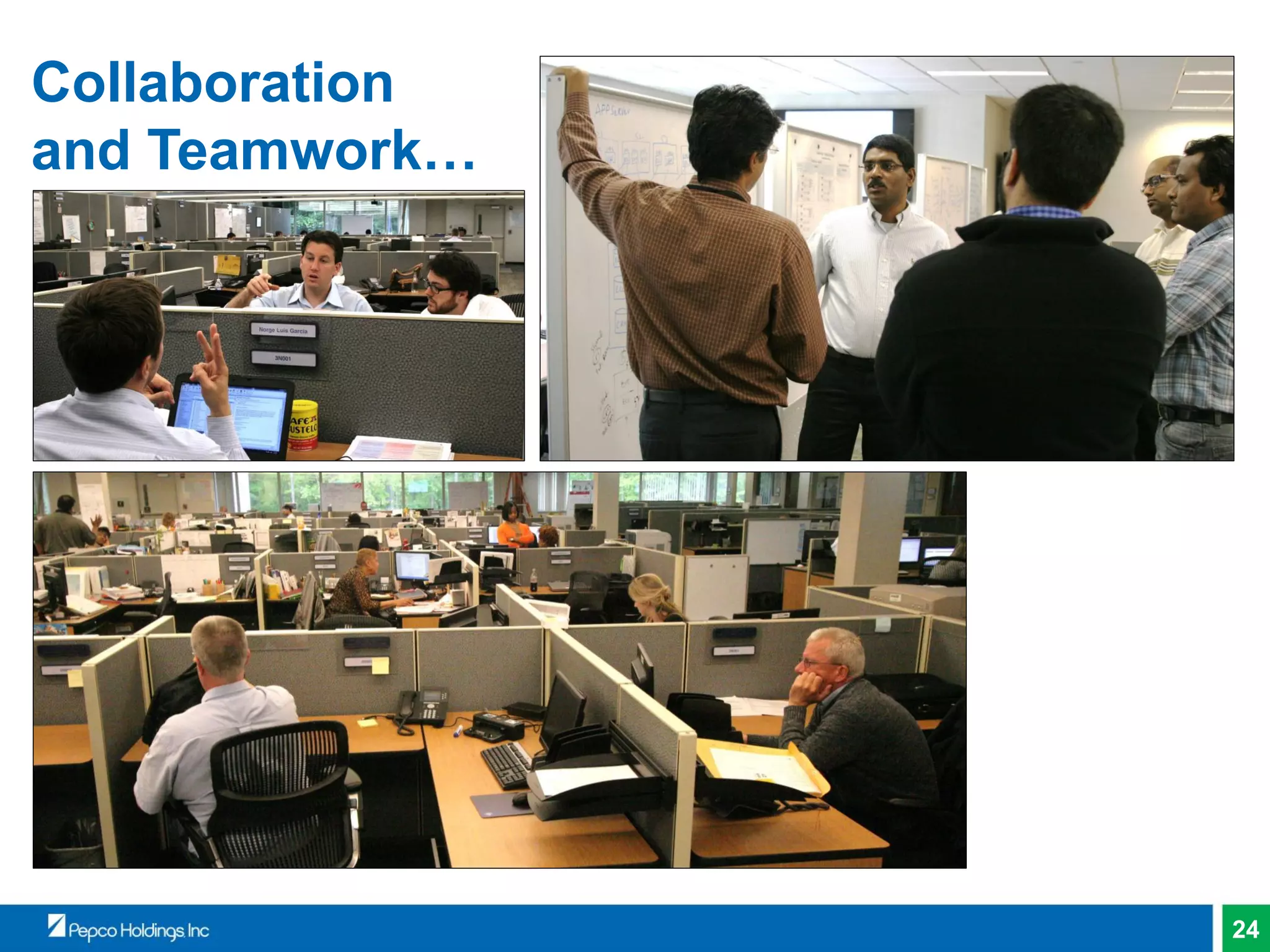
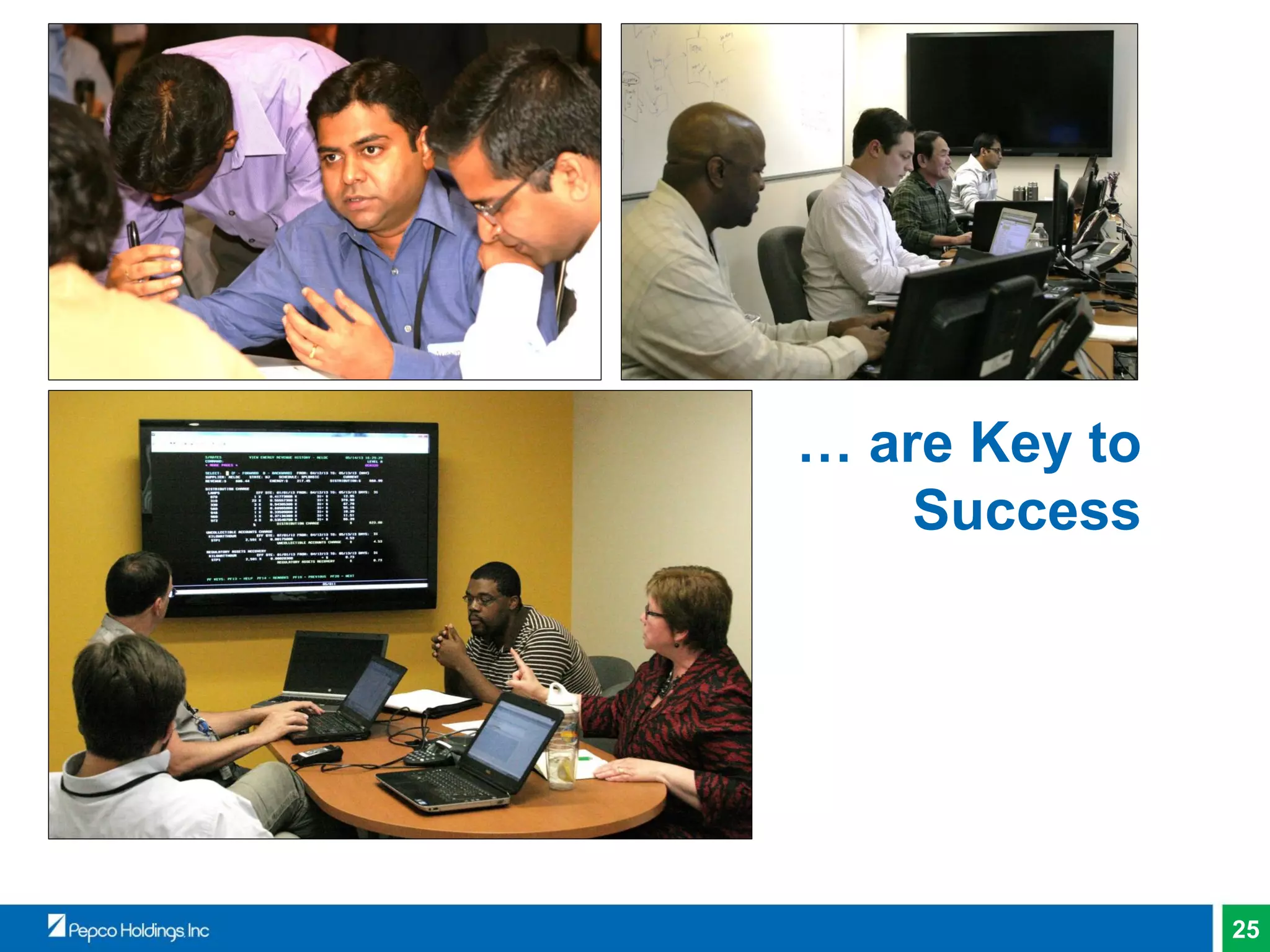
Collaboration
and Teamwork…
25
… are Key to
Success
26
Questions, thoughts, comments?
Again, thank you to all of you that support our
industry and have contributed to the many advances!
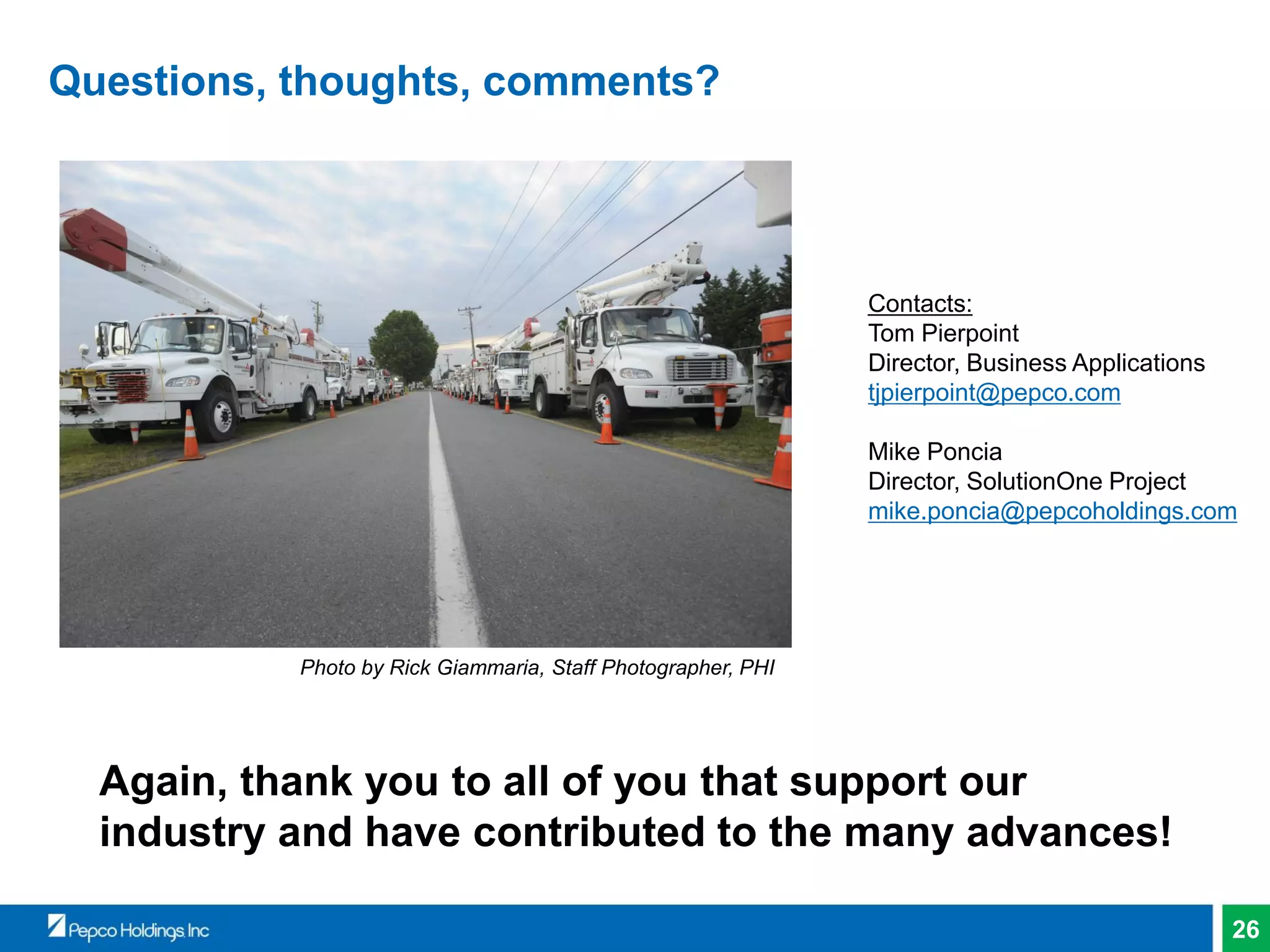
Photo by Rick Giammaria, Staff Photographer, PHI
Contacts:
Tom Pierpoint
Director, Business Applications
tjpierpoint@pepco.com
Mike Poncia
Director, SolutionOne Project
mike.poncia@pepcoholdings.com
27
A collaboration of:
Tom Pierpoint
Pepco Holdings Inc
tjpierpoint@pepco.com

Replacement of legacy cis with sap cr&b at phi

  • 1.
    Replacement of aLegacy CIS (Customer Information System) with SAP CR&B SAP for Utilities Conference – 2013 Presented by: Thomas J. Pierpoint, Director, Business Applications
  • 2.
    2 Topics  About PepcoHoldings, Inc.  A moment of recognition  Background of customer information systems at PHI  Decision options around the going-forward path  Process used to make the decisions  Overall timeline of key activities  Moving forward on our SolutionOne project  Q&A
  • 3.
    3 About Pepco Holdings,Inc.  Approximately 2 million customer accounts in Delaware, the District of Columbia, Maryland and New Jersey  Total population served is 5.6 million  Three T&D operating companies provide regulated electricity service • Atlantic City Electric, • Delmarva Power (gas & electric) • Pepco (including one of the top four largest underground systems in the country)  Pepco Energy Service provides energy efficiency and renewable energy services Photo by Rick Giammaria, Staff Photographer, PHI
  • 4.
    4 Pepco Holdings, Inc.Quick Facts  Incorporated in 2002  Service territory: 8,340 square miles  Customers served • Atlantic City Electric: – 545,000 – electric • Delmarva Power: – 503,000 – electric – 125,000 – natural gas • Pepco: – 793,000 – electric  Total population served: 5.6 million
  • 5.
    5 At PHI, eachday we…  Handle 13,000 customer phone calls  Respond to and restore 144 electrical outages  Read 60,000 meters and send out the same number of accurate bills  Connect 46 additional customers (17,000 per year)  Reconnect and/or disconnect 455 customers  Replace 16 poles (nearly 6,000 per year)  Deliver 135 million kWh of electricity  Deliver 64,000 Mcf gas to 118,000 gas customers  Incur $1.4 million in construction costs  Maintain 3,500 miles of transmission lines and 30,000 miles of distribution lines  Maintain 530 substations and 400,000 distribution transformers
  • 6.
    6Work Management WorkshopJuly 28 2009 The vast networks of electrification have had the biggest impact on the quality of life and represents the greatest engineering achievement of the 20th century Astronaut Neil Armstrong on behalf of the National Academy of Engineering The interconnected electric grid in North America is the most complex machine ever invented Special panel of Leaders from over 200 organizations convened by the Electrical Power Research Institute Electrification powers almost every pursuit and enterprise in modern society National Academy of Engineering A moment of recognition Thank you to all that serve this critical industry! Photo courtesy of EPRI
  • 7.
    7 Current Systems Landscape* SAPECC CO – Controlling (CCA/IO) FI – Finance (GL/AP/AR/T&E) AM – Asset Management PS – Project System MM – Materials Management (PUR/IM) PM – Plant Maintenance CS – Customer Service SD – Sales & Distribution HR – Human Resources (PA/PD/OM) PY - Payroll FERC CATS FSCM – Dispute & Collections GRC – Compliance Calibrator Dolphin PTS UFA – Utility Financial Accelerator PPM – Portfolio & Project Management * This info is intended only for high-level discussion purposes at the SAP Utilities Conference and is greatly simplified with most systems and details removed Customer Mobile & Web Legacy Customer Information Systems Other Systems Business Warehouse Enterprise Portal SAP - BPC SAP GUI Solution Manager
  • 8.
    8 Background of thecustomer information systems at PHI  There are three T&D utility operating companies at PHI and two CIS systems  C3 for Atlantic City Electric and Delmarva Power  CIS for Pepco  These systems provide numerous benefits through the automation of many customer service activities such as billing, call center, and the movement of work tickets to field groups.  Both systems are largely based upon technologies implemented 30-35 years ago. CIS Industry Evolution 1st Gen Late 1960’s 2nd Gen 1970’s 3rd Gen mid-1980’s 4th Gen late 1990’s 5th Gen early 2000’s 6th Gen later 2000’s CIS C3
  • 9.
    9 These systems haveperformed very well for many years in supporting a relatively stable business environment . . . However, PHI is proactively making many changes to stay ahead of accelerating change in our industry  Starting in 2005 major new capabilities were incrementally added to improve levels of customer service and provide new offerings including new rates, demand response, web, mobile, self-service with AMI as a key enabler.  The effort required to interface with the legacy systems can be complex and time-consuming. This is increasingly proving to be “critical path” in the deployment of further new functionality, especially for customer-facing deliverables.  The systems continue to perform core business processes very well, but there are many newer processes they do not fully enable. Workarounds are sometimes in place to address these limitations.
  • 10.
    10 PHI has regularlyevaluated the life-cycle of the existing systems to determine the best path forward  An Evaluation of Options has been performed every 24-30 months since 2003 at PHI  Each option had pros and cons and the best course was to “stay the course” and incrementally add new technologies around the legacy systems  A high-level evaluation in late 2010 revealed that some underlying factors would likely change and that a further, more detailed evaluation was appropriate during 2011
  • 11.
    11 The replacement ofa legacy CIS is a big commitment for any utility. A few of the Critical Success Factors for the detailed analysis to evaluate replacement options include. .  Provide a structured, incremental approach including stage gates  Engage all principal stakeholders  Expand the traditional cost-benefits analysis to include possible emerging benefits from our changing industry
  • 12.
    12 The structured, incrementalanalysis had key phases with stage gates prior to the next phase • Phase 0 was done in late 2010 and revealed that some underlying factors would likely change. The recommendation was to perform the next level of a detailed analysis. • Phase I was done in the 1st quarter of 2011. This was a “Gap-Fit” analysis that indicated substantial potential benefits of replacing the existing CIS systems with a commercial technology. The recommendation was to perform a more detailed analysis and make preliminary plans for a possible project. • Phase II was done in the 2nd and 3rd quarter of 2011 and drove to a greater level of detail on scope of work, resource requirements, cost estimates, and the viability of SAP CR&B for PHI. The recommendation was to proceed with replacement of the legacy systems and set up a formal and funded project.
  • 13.
    13 Key stakeholders atPHI were engaged and involved  During the 1st quarter of 2011, 150 PHI personnel evaluated the applicability, scope, cost, and schedule for their replacement of C3 and CIS with a commercial “off the shelf” (COTS) system from SAP or Oracle.  This evaluation included 28 structured workshops to review key business processes and to confirm the scope of a possible project.  Industry experts and PHI personnel conducted and facilitated the workshops and performed demonstrations of the SAP system in conjunction with SAP processes.  Accenture provided key support for much of this effort  SAP and IBM provided support and insight in targeted areas  Many other industry experts also provided insights
  • 14.
    14 The traditional costs-benefitmodels typically address a number of important areas • Preservation of the existing benefits gained by a current CIS – These benefits are substantial at many utilities – These benefits should not be ignored (or jeopardized) • Direct support of legacy systems – Mainframe and licenses, usually increasing as user base at a utility shrinks – Staff of specialists • Continuing modifications to legacy systems • Business process inefficiencies • New and needed capabilities that have been identified – Complex rates – CRM
  • 15.
    15 A traditional cost-benefitanalysis should also include considerations for a changing business environment  Newer variable, time-based rates  Increasing needs to extract data  Built-in business intelligence  Multi-channel, multi-device communication, supporting a single system of record for all customer communications  Non-revenue products and services such as demand response, energy efficiency, or net metering Will the pace, breadth and depth of future changes overwhelm the ability of a utility to make timely and cost efficient changes to legacy systems?  New, adaptable credit and collections services  Increasing levels of CRM capabilities  Consolidation and accuracy of master data, especially related to customers
  • 16.
    16 Guiding principles wereestablished early in this effort Quality First - The quality of the implementation is paramount. Design for Flexibility and Adaptability - Architecture must facilitate rapid implementation of future enhancements. Virtue in Simplicity, with the scope including three core components: - fundamental CIS functionality - functionality to meet public commitments - some additional, value adding, out of the box capabilities Change the Process, Not the System - A bias toward process change to conform to out of the box functionality. Not Everything is a Day One Deliverable - Deliverables will be pushed to Phase 2 if they shift focus from a high quality implementation of the three core deliverables.
  • 17.
    17 Guiding principles wereestablished early in this effort Good Ideas Don't All Have to be Built – Some new functions can be obtained by “innovation through adoption” of best functionality built by other utilities. What is the Impact on Customer Care and Operations? - Project decisions need to be made with a clear understanding of the potential impact on the operating areas. Dedicated Team - Allow the assigned resources to focus exclusively on this project and seek to capitalize on their fresh perspectives.
  • 18.
    18 Timeline of initialactivities 2010 2011 2012 8 9 10 11 12 1 2 3 4 5 6 7 8 9 10 11 12 1 2 3 4 5 6 7 Phase 0 Analysis Phase 1 Gap-Fit Phase 2 Detailed Plan & Budget Software Selection Select TPA for SI Bid Select Project Leaders & Team Selection of System Integrator BOD Approval Executive Approval to Proceed Executive Approval to Proceed Executive Approval  Stage Gate/Decision Point
  • 19.
    19 Moving Forward withSolutionOne 19
  • 20.
    20 Timeline of activities 20122013 2014 2015 8 9 10 11 12 1 2 3 4 5 6 7 8 9 10 11 12 1 2 3 4 5 6 7 8 9 10 11 12 1 2 3 4 5 Plan Analyze Design Build Test Assembly Product ORT Final Testing, Deploy, Stabilize & Ongoing Support
  • 21.
    21 Primary Objectives ofBusiness Readiness • Reduce the intensity and duration of the transition period following the Go-Live to better serve our customers • Prepare our employees – Communication venues for our leaders – Develop and execute a plan to utilize Customer Care resources at key stages of project – Collaborate with Change Management team on detailed training, communications, and knowledge transfer plans
  • 22.
    22 A great dealof attention is focused on the User Experience Customer Info Alerts IVR Data Navigation Bar Flyout Menu Messages
  • 23.
    23 We will continueto deliver a solid customer experience during the systems transition • PHI mobile applications and web sites are heavily used by our customers and the general public • Billing information to our customers • Electric outage and restoration information to our customers as well as the public • These sites are heavily accessed, especially during a storm or event • A key enabler is a solid foundation of business processes and technologies that needs to be maintained during the transition of systems Photo by Rick Giammaria, Staff Photographer, PHI
  • 24.
  • 25.
    25 … are Keyto Success
  • 26.
    26 Questions, thoughts, comments? Again,thank you to all of you that support our industry and have contributed to the many advances! Photo by Rick Giammaria, Staff Photographer, PHI Contacts: Tom Pierpoint Director, Business Applications tjpierpoint@pepco.com Mike Poncia Director, SolutionOne Project mike.poncia@pepcoholdings.com
  • 27.
    27 A collaboration of: TomPierpoint Pepco Holdings Inc tjpierpoint@pepco.com