Results of research on radiofrequency
fields from telecommunications
Dr Mike Repacholi
Visiting Professor, University of Rome “La Sapienza”
Former Coordinator, WHO Program on
Radiation and Environmental Health
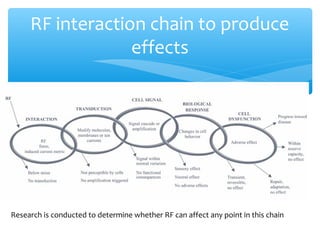
RF interaction chain to produce
effects
Research is conducted to determine whether RF can affect any point in this chain
∗ In vitro studies are conducted on cells and tissues to
investigate mechanisms and effects on cells to be tested to see
if they occur in vivo
∗ In vivo studies are conducted on experimental animals to
investigate short and long-term effects such as cancer
∗ Human laboratory studies determine whether short term
ethical and non-damaging effects occur
∗ Epidemiology studies compare the incidence of health effects
in RF exposed and non-exposed populations
Types of research
For research to be useful it must:
∗Conform to good research standards as shown in the
following worksheets from Repacholi et al 2012.
∗Be replicated by independent laboratories
∗Should be explained by a mechanism that is in
agreement with generally accepted scientific
knowledge unless there is substantial evidence for a
new mechanism that still conforms with the laws of
physics
Good Research
Epidemiology Study Quality Assessment Worksheet
First author, year, and brief title:
Study
Criteria
Summary of criterion (see protocol page and item number provided in brackets
for full criterion)
Additional Weight
Full
††
Partial
†
None
#
Funders Discloses funding source
Reporting Satisfies STROBE most important checklist items for particular study design in
reviewer’s judgment (see attached checklist)
Data analysis Results derived using all of the appropriate standard statistical methods, unless
other methods convincingly justified
Selection -
participation bias
Case-control or cohort studies: selection and participation of study participants
independent of exposure and disease status.
Ecological studies: study population selected from whole population or a
defined region or population strata
Confounding Corrected for confounding if needed and reported both unadjusted and adjusted
risk estimates.
Recall and
information bias
Case-control studies with retrospective exposure assessment: assessment used
objectively recorded exposure data.
Cohort studies: objectively recorded exposure data used or self-reported
exposure data obtained before occurrence of the disease.
Random exposure
error
Validated that the method used for estimating exposure was highly correlated
with validated exposure and demonstrated that random exposure
misclassification did not change the result.
Registration bias Ecological studies: data obtained from registries with high % of disease
registration that does not change significantly over time.
††Criterion fully satisfied [including when the criterion is satisfied as a result of the study design]
†Criterion partially satisfied [Refer to protocol for additional detail]
#Criterion not satisfied [including when not addressed in the study].
Insert comments on study and complete data extraction table below.
Phone use **Outcome
number
Lower
CI
Upper
CI
*Latency
(yrs)
Point
estimate
First author, year
Short-term
Long-term
Short-term
Long-term
Short-term
Long-term
Short-term
Long-term
* Latency is defined as the time between the last date when exposure was considered in the study (i.e., the reference date) and the
date of diagnosis. [This not the same as the latency of the disease]
** Outcomes: 1 = glioma, 2 = meningioma, 3 = neuroma, 4 = parotid.
In Vivo Study Quality Assessment Worksheet
First author, year and brief title:
Study
Criteria
Summary of criterion (refer protocol item number provided in brackets for full
criterion).
Additional Weight
Full
††
Partial
†
None
#
Funders Discloses funding source
Reporting Clear statement of hypothesis
Reporting Description of study methods sufficient for replication of study
Reporting Data reported sufficient to independently confirm results of analyses
Data analysis Results derived using all of the appropriate standard statistical methods, unless
other methods convincingly justified
Blinding Researchers blinded to which exposed and control groups
Blinding Researchers blinded during data management and analyses
Bias Random assignment of animals to experimental groups
Duration Sufficient duration after exposure for effect to be observed
Treatment &
management
Exposed and control groups treated and managed same way, except for exposure
Controls Positive and sham controls used as appropriate to study
Sentinels Used sentinels to detect pathogens that could affect outcome
Environment Properly controlled and documented environmental conditions
Sterile technique Used in all appropriate procedures
Exposure system Properly calibrated and delivers dose known to reasonable accuracy
GLP Applicable good lab practices used
Animal restraint Animals habituated before exposure, same restraint for exposed and controls, and
detailed analysis of range of dose received, especially if animal growth taken into
account, as applicable
Dose range if
animals move
Detailed analysis of range of dose received if animals free to move, especially in
long term studies if animal growth taken into account, as applicable
Histopathology Diagnoses reviewed by independent panel of pathologists
Consistency Extent of internal consistency across data sets
††Criterion fully satisfied [including when the criterion is satisfied as a result of the study design]
† Criterion partially satisfied [Refer to protocol for additional detail]
#Criterion not satisfied [including when not addressed in the study].
Insert comments on study and complete data extraction table below.
Mouse/Rat numbers* (Cross out which animal type not applicable to study reviewed)
Exposed with
tumors
Exposed
without
tumors
Sham exposed
with tumors
Sham exposed
without
tumors
Exposure
level
(W/kg)
First author, year
* Only tumor outcomes are to be inserted here, not genotoxic outcomes such as gene expression, DNA fragmentation/mutation
Based mainly on 2 epidemiology results: Interphone and Hardell.
Wiedemann et al (2014) notes:
∗Interphone did not consider it had a positive result.
∗Hardell’s results consistently found to be outliers and
inconsistent with the studies showing time trends in cancer
incidence
∗The meaning of the 2B categorization is misunderstood by most
intelligent people: A communications problem for IARC
Recent epidemiology studies have not supported the 2B
classification
IARC’s categorization of RF as 2B
Lagorio and Rooslie (2013) conducted a consistency analysis of
47 epidemiology studies and did not find evidence that mobile
phones affect intracranial tumours up to 15 years use.
Heterogeneity among results was explained by methodological
differences. They concluded more research was needed on
children and in adults after 15 years mobile phone use.
However, Elwood (2014) asks whether epidemiology can detect
a small increased risk in a rare disease with a long latency period
after a difficult to measure exposure; can these studies ever
definitively measure the hazard, or with even more difficulty
show it is too small or too unlikely to matter?
Remember the Chernobyl and Fukashima accidents….
Limits of epidemiology
Compounding the problem of determining whether mobile
phones cause head cancers is the increasing numbers of bad or
fraudulent science published in journals that do not have good
peer review, or can be published for a fee to authors and put
online free of charge. Many of these are “predatory” journals
While some of these studies have been detected (e.g. by Prof A
Lerchl), most go undetected and remain in the literature to
create further studies that will lead nowhere, or are not
replicated and stay in the literature as possible questions about
health risks.
Bad and fraudulent studies
∗ The open access movement in publishing has seen an
extraordinary increase in “scientific” journals available.
∗ All scientific fields are covered and authors can have their
papers published for a fee of about $1000.
∗ Peer review is poor or absent, so low quality studies are
published
∗ Predatory journals are for profit only and “spam” emails are
regularly sent out to authors of previous publications
requesting papers
∗ These publications are now distorting the science base and
threaten to erase the line between good and bad science
Predatory journals
∗ Elliot-Friend et al (2014) conducted a meta-analysis on
10 studies (in vitro and in vivo) and suggested sperm
quality was affected by RF exposures from mobile
phones.
∗ This study received significant press
∗ Lerchl (2014) points out their meta-analysis was
conducted on a very heterogeneous group of studies
and so completely uninformative.. Poor science
Poor or uninformative studies
∗ Lerchl found fraudulent results in many studies: eg
Diem et al (2008), Schwaz et al (2008), Pilger et al
(2004) etc
∗ His analyses were made of the methodology,
inconsistences in the data, statistical analyses and
quality of the data
∗ Some of the papers were retracted but many remain
in the literature to confuse the scientific database
from which health risk assessments are made.
Fraudulent studies
∗ Soviet scientists reported laboratory studies suggesting
organisms can adapt to low-level exposures to RF and
extrapolated this to humans for their RF standards.
∗ There is other laboratory evidence that animals adapt to various
low-level chemical and radiation exposures
∗ Vijayalaxmi and Prihoda (2014) suggests an adaptive
mechanism may explain the low Odds Ratios or apparent
“beneficial” effect of RF exposures reported in the Interphone
study… credible?
Adaptation to RF?
∗ WHO’s Fact Sheet noted IARC’s review of “the carcinogenic
potential” of RF fields while finding “[t]o date, no adverse
health effects have been established as being caused by mobile
phone use”.
∗ WHO’s finding was based on animal studies consistently
showing no increased cancer risk for long-term exposure to RF
fields and the lack of an established mechanism by which RF
fields from cell phones could cause any adverse health effects.
∗ This fact sheet is still valid
WHO
The ICNIRP Standing Committee on Epidemiology’s finding that
within about 10-15 years after first use of cell phones there is
“unlikely to be a material increase in the risk of brain tumours in
adults,” and their conclusion that “the trend in the accumulating
evidence is increasingly against the hypothesis that mobile phone
use can cause head tumours in adults” took into account the
results of Interphone and other epidemiological studies including
studies of trends in brain tumor incidence, in vitro and in vivo
laboratory studies, and the lack of an established biological
mechanism.
ICNIRP
∗ Neither the in vitro or animals studies provide any convincing
evidence of harm from exposures mobile phone RF signals below
the ICNIRP guidelines
∗ Results from epidemiology studies are providing the real driver for
more research, and these studies may not be able to provide
definitive answers. Long term cohort studies are probably the only
ones to give convincing results.
∗ My opinion is that from a review of the >6000 scientific
publications in this area there is no harm to health from mobile
phone use or from base station signals. If there was an effect it
would have been seen by now…..
Overall conclusions
Thank you
Muchas gracias
Dr Mike Repacholi
University of Rome “La Sapienza”
Email: mrepacholi@yahoo.com
Dr Mike Repacholi
University of Rome “La Sapienza”
Email: mrepacholi@yahoo.com

Cómo distinguir una investigación seria de una fraudulenta

  • 1.
    Results of researchon radiofrequency fields from telecommunications Dr Mike Repacholi Visiting Professor, University of Rome “La Sapienza” Former Coordinator, WHO Program on Radiation and Environmental Health
  • 2.
    RF interaction chainto produce effects Research is conducted to determine whether RF can affect any point in this chain
  • 3.
    ∗ In vitrostudies are conducted on cells and tissues to investigate mechanisms and effects on cells to be tested to see if they occur in vivo ∗ In vivo studies are conducted on experimental animals to investigate short and long-term effects such as cancer ∗ Human laboratory studies determine whether short term ethical and non-damaging effects occur ∗ Epidemiology studies compare the incidence of health effects in RF exposed and non-exposed populations Types of research
  • 4.
    For research tobe useful it must: ∗Conform to good research standards as shown in the following worksheets from Repacholi et al 2012. ∗Be replicated by independent laboratories ∗Should be explained by a mechanism that is in agreement with generally accepted scientific knowledge unless there is substantial evidence for a new mechanism that still conforms with the laws of physics Good Research
  • 5.
    Epidemiology Study QualityAssessment Worksheet First author, year, and brief title: Study Criteria Summary of criterion (see protocol page and item number provided in brackets for full criterion) Additional Weight Full †† Partial † None # Funders Discloses funding source Reporting Satisfies STROBE most important checklist items for particular study design in reviewer’s judgment (see attached checklist) Data analysis Results derived using all of the appropriate standard statistical methods, unless other methods convincingly justified Selection - participation bias Case-control or cohort studies: selection and participation of study participants independent of exposure and disease status. Ecological studies: study population selected from whole population or a defined region or population strata Confounding Corrected for confounding if needed and reported both unadjusted and adjusted risk estimates. Recall and information bias Case-control studies with retrospective exposure assessment: assessment used objectively recorded exposure data. Cohort studies: objectively recorded exposure data used or self-reported exposure data obtained before occurrence of the disease. Random exposure error Validated that the method used for estimating exposure was highly correlated with validated exposure and demonstrated that random exposure misclassification did not change the result. Registration bias Ecological studies: data obtained from registries with high % of disease registration that does not change significantly over time. ††Criterion fully satisfied [including when the criterion is satisfied as a result of the study design] †Criterion partially satisfied [Refer to protocol for additional detail] #Criterion not satisfied [including when not addressed in the study]. Insert comments on study and complete data extraction table below. Phone use **Outcome number Lower CI Upper CI *Latency (yrs) Point estimate First author, year Short-term Long-term Short-term Long-term Short-term Long-term Short-term Long-term * Latency is defined as the time between the last date when exposure was considered in the study (i.e., the reference date) and the date of diagnosis. [This not the same as the latency of the disease] ** Outcomes: 1 = glioma, 2 = meningioma, 3 = neuroma, 4 = parotid.
  • 6.
    In Vivo StudyQuality Assessment Worksheet First author, year and brief title: Study Criteria Summary of criterion (refer protocol item number provided in brackets for full criterion). Additional Weight Full †† Partial † None # Funders Discloses funding source Reporting Clear statement of hypothesis Reporting Description of study methods sufficient for replication of study Reporting Data reported sufficient to independently confirm results of analyses Data analysis Results derived using all of the appropriate standard statistical methods, unless other methods convincingly justified Blinding Researchers blinded to which exposed and control groups Blinding Researchers blinded during data management and analyses Bias Random assignment of animals to experimental groups Duration Sufficient duration after exposure for effect to be observed Treatment & management Exposed and control groups treated and managed same way, except for exposure Controls Positive and sham controls used as appropriate to study Sentinels Used sentinels to detect pathogens that could affect outcome Environment Properly controlled and documented environmental conditions Sterile technique Used in all appropriate procedures Exposure system Properly calibrated and delivers dose known to reasonable accuracy GLP Applicable good lab practices used Animal restraint Animals habituated before exposure, same restraint for exposed and controls, and detailed analysis of range of dose received, especially if animal growth taken into account, as applicable Dose range if animals move Detailed analysis of range of dose received if animals free to move, especially in long term studies if animal growth taken into account, as applicable Histopathology Diagnoses reviewed by independent panel of pathologists Consistency Extent of internal consistency across data sets ††Criterion fully satisfied [including when the criterion is satisfied as a result of the study design] † Criterion partially satisfied [Refer to protocol for additional detail] #Criterion not satisfied [including when not addressed in the study]. Insert comments on study and complete data extraction table below. Mouse/Rat numbers* (Cross out which animal type not applicable to study reviewed) Exposed with tumors Exposed without tumors Sham exposed with tumors Sham exposed without tumors Exposure level (W/kg) First author, year * Only tumor outcomes are to be inserted here, not genotoxic outcomes such as gene expression, DNA fragmentation/mutation
  • 7.
    Based mainly on2 epidemiology results: Interphone and Hardell. Wiedemann et al (2014) notes: ∗Interphone did not consider it had a positive result. ∗Hardell’s results consistently found to be outliers and inconsistent with the studies showing time trends in cancer incidence ∗The meaning of the 2B categorization is misunderstood by most intelligent people: A communications problem for IARC Recent epidemiology studies have not supported the 2B classification IARC’s categorization of RF as 2B
  • 8.
    Lagorio and Rooslie(2013) conducted a consistency analysis of 47 epidemiology studies and did not find evidence that mobile phones affect intracranial tumours up to 15 years use. Heterogeneity among results was explained by methodological differences. They concluded more research was needed on children and in adults after 15 years mobile phone use. However, Elwood (2014) asks whether epidemiology can detect a small increased risk in a rare disease with a long latency period after a difficult to measure exposure; can these studies ever definitively measure the hazard, or with even more difficulty show it is too small or too unlikely to matter? Remember the Chernobyl and Fukashima accidents…. Limits of epidemiology
  • 9.
    Compounding the problemof determining whether mobile phones cause head cancers is the increasing numbers of bad or fraudulent science published in journals that do not have good peer review, or can be published for a fee to authors and put online free of charge. Many of these are “predatory” journals While some of these studies have been detected (e.g. by Prof A Lerchl), most go undetected and remain in the literature to create further studies that will lead nowhere, or are not replicated and stay in the literature as possible questions about health risks. Bad and fraudulent studies
  • 10.
    ∗ The openaccess movement in publishing has seen an extraordinary increase in “scientific” journals available. ∗ All scientific fields are covered and authors can have their papers published for a fee of about $1000. ∗ Peer review is poor or absent, so low quality studies are published ∗ Predatory journals are for profit only and “spam” emails are regularly sent out to authors of previous publications requesting papers ∗ These publications are now distorting the science base and threaten to erase the line between good and bad science Predatory journals
  • 11.
    ∗ Elliot-Friend etal (2014) conducted a meta-analysis on 10 studies (in vitro and in vivo) and suggested sperm quality was affected by RF exposures from mobile phones. ∗ This study received significant press ∗ Lerchl (2014) points out their meta-analysis was conducted on a very heterogeneous group of studies and so completely uninformative.. Poor science Poor or uninformative studies
  • 12.
    ∗ Lerchl foundfraudulent results in many studies: eg Diem et al (2008), Schwaz et al (2008), Pilger et al (2004) etc ∗ His analyses were made of the methodology, inconsistences in the data, statistical analyses and quality of the data ∗ Some of the papers were retracted but many remain in the literature to confuse the scientific database from which health risk assessments are made. Fraudulent studies
  • 13.
    ∗ Soviet scientistsreported laboratory studies suggesting organisms can adapt to low-level exposures to RF and extrapolated this to humans for their RF standards. ∗ There is other laboratory evidence that animals adapt to various low-level chemical and radiation exposures ∗ Vijayalaxmi and Prihoda (2014) suggests an adaptive mechanism may explain the low Odds Ratios or apparent “beneficial” effect of RF exposures reported in the Interphone study… credible? Adaptation to RF?
  • 14.
    ∗ WHO’s FactSheet noted IARC’s review of “the carcinogenic potential” of RF fields while finding “[t]o date, no adverse health effects have been established as being caused by mobile phone use”. ∗ WHO’s finding was based on animal studies consistently showing no increased cancer risk for long-term exposure to RF fields and the lack of an established mechanism by which RF fields from cell phones could cause any adverse health effects. ∗ This fact sheet is still valid WHO
  • 15.
    The ICNIRP StandingCommittee on Epidemiology’s finding that within about 10-15 years after first use of cell phones there is “unlikely to be a material increase in the risk of brain tumours in adults,” and their conclusion that “the trend in the accumulating evidence is increasingly against the hypothesis that mobile phone use can cause head tumours in adults” took into account the results of Interphone and other epidemiological studies including studies of trends in brain tumor incidence, in vitro and in vivo laboratory studies, and the lack of an established biological mechanism. ICNIRP
  • 16.
    ∗ Neither thein vitro or animals studies provide any convincing evidence of harm from exposures mobile phone RF signals below the ICNIRP guidelines ∗ Results from epidemiology studies are providing the real driver for more research, and these studies may not be able to provide definitive answers. Long term cohort studies are probably the only ones to give convincing results. ∗ My opinion is that from a review of the >6000 scientific publications in this area there is no harm to health from mobile phone use or from base station signals. If there was an effect it would have been seen by now….. Overall conclusions
  • 17.
    Thank you Muchas gracias DrMike Repacholi University of Rome “La Sapienza” Email: mrepacholi@yahoo.com Dr Mike Repacholi University of Rome “La Sapienza” Email: mrepacholi@yahoo.com