Systems Biology and Genetics in Drug Discovery for Diabetes   Preston Hensley Senior Director Pfizer Biotherapeutics and Bioinnovation Center
SCIENCE VOL 322 3 OCTOBER 2008 Despite the tools and technologies of modern medical science, we are still in the Dark Ages of understanding our own biology and discovering agents that can provide cures
Human Genetics and Drug Discovery Molecular Targets Clinical Outcome Human Genetics Traditional Discovery David Cox Historically Difficult Now more Feasible
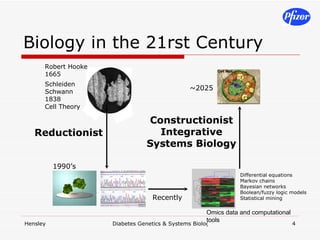
Biology in the 21rst Century
Link Genetics and Systems Biology
Utilize New Academic-Industrial Partnerships Drug development Knowledge and tool implementation IP Knowledge and tool development Public domain Academia Industry
Fundamental Industry Problem:  High Cost, Low Productivity 56 NME/16 B$ 19 NME/54 B$
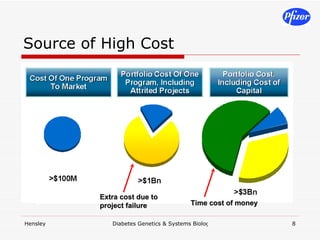
Source of High Cost
Despite Industry Issues - Unmet Need For New Medicine Is Great
Estimated Market for New Medicines Is Significant - 2012 Source: Pfizer Annual Review 2007 ~600 B$
Source of Low Productivity
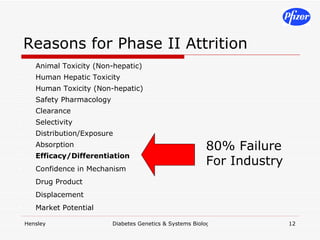
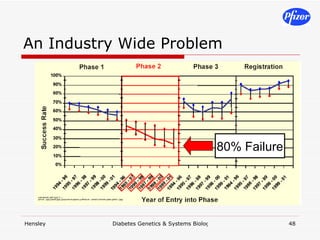
Reasons for Phase II Attrition Animal Toxicity (Non-hepatic) Human Hepatic Toxicity Human Toxicity (Non-hepatic) Safety Pharmacology Clearance Selectivity Distribution/Exposure Absorption Efficacy/Differentiation Confidence in Mechanism Drug Product Displacement Market Potential 80% Failure For Industry
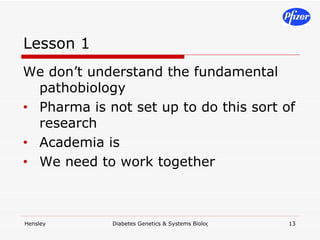
Lesson 1 We don’t understand the fundamental pathobiology Pharma is not set up to do this sort of research Academia is We need to work together
Current Safety Optimization And ADME Approaches Bruce Car, BMS
Yet Toxicity Remains a Problem Bruce Car, BMS
Lesson 2 We don’t understand the fundamental toxicobiology Pharma is not set up to do this sort of research Academia is We need to work together
Diabetes – Historic Drug Discovery Failure 50 years of research have produced three new classes of diabetes medicines - > 60% of patients  have unmet need Pierre de Meyts
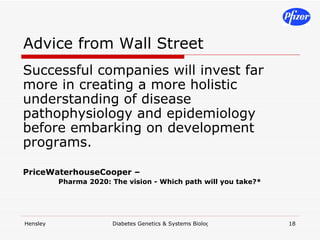
Advice from Wall Street Successful companies will invest far more in creating a more holistic understanding of disease pathophysiology and epidemiology before embarking on development programs.   PriceWaterhouseCooper –  Pharma 2020: The vision - Which path will you take?*
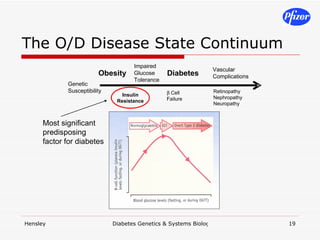
The O/D Disease State Continuum
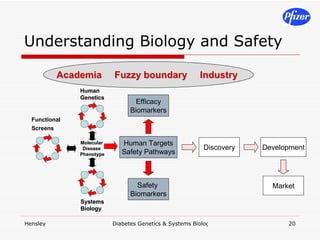
Understanding Biology and Safety
IRP Discovery Cycle Topology Prediction Validation  Chemical Genetics (Shokat) siRNA,   Bioinformatics Biological Data Collection Target Predict- ion Validation siRNA, drugs Build ODE Model, Sensitivity Analysis
Systems Biology Using Global Unbiased Quantitative Discovery Technologies   Other Omics Metabolomics Lipidomics Etc. Other Proteomics Acetyl- Ubiquitinyl- SUMOyl- NOyl-
Global Unbiased Phosphoproteomics Forest White, MIT
Insulin Signaling Recapitulated Forest White,  et al.,  DIABETES 2006,  55 , 2171-2179 20% of pY phosphoproteomic data recapitulates current pY signaling knowledge What is the remaining 80% reporting?
Ernest Fraenkel, MIT ChIP-Seq Genome-Wide Chromatin  Immunoprecipitation E2F4 ~1500 Transcription sites
Changes in Transcription Profiles Time Courses Bob Garofalo, Pfizer Transcriptional changes
Primary Data - Unlinked Many 100’s Many 1000’s
Pre-existing  Knowledge Time course data phosphorylation tf binding expression profiling Pathway knowledge Other knowledge interactome, etc. metabolome 0.0 0.2 0.4 0.6 0.8 1.0 1.2 0 10 20 30 40 50 Time [min] Amount normalized with 5 min . 0.0 0.2 0.4 0.6 0.8 1.0 1.2 0 10 20 30 40 50 Time [min] Amount normalized with 5 min .
Spectrum of Computational Tools  To Link Observations
Topology Predictions Lauffenburger, MIT Validate with cell-based assays using: RNAi Drugs Chemical genetics Bioinformatics
Confirm and Extend Topologies with Chemical Genetics Chemical genetics: Substrate ID Kevan Shokat, UCSF Norman Kennedy, UMass … Kinase 1 Kinase 2 Many substrates
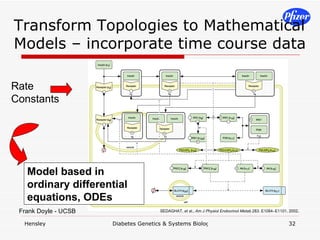
Transform Topologies to Mathematical Models – incorporate time course data SEDAGHAT,  et al .,  Am J Physiol Endocrinol Metab  283: E1084–E1101, 2002 . Rate Constants Model based in ordinary differential equations, ODEs Frank Doyle - UCSB
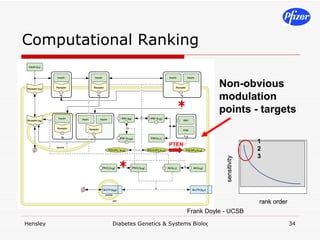
One Approach: Sensitivity Analyses Identify Targets
PTEN Non-obvious modulation points - targets Frank Doyle - UCSB Computational Ranking * *
Alternative Approach: Screen Against Phenotype (aspirational) Phenotype Input
Use Multiplex Assay Tools to Fingerprint Network Dynamics   Cell Communication Network Assays could be Phosphoproteomics, etc. Expression profiling Metabolomic markers Etc. Epitome Biosystems
Phenotypic Screens Facilitate Network Pharmacology Screen for desired biology Deconvolute hits using pathway tools Develop hit to lead understanding mode of action Avoid target based toxicity
Use Assays to Deconvolute Phenotype Network  Screening Tools
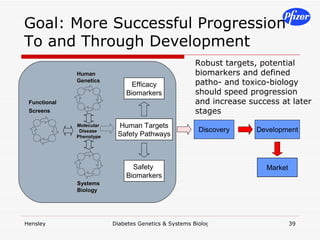
Goal: More Successful Progression To and Through Development Robust targets, potential biomarkers and defined patho- and toxico-biology should speed progression and increase success at later stages
Messages As currently configured, small molecule drug discovery has a high failure rate >99% for the industry Failure is due to safety in preclinical and Phase I, as well as efficacy in Phase II Failure in both cases is largely due to a lack of knowledge of fundamental biological processes
Messages, cont Elucidating these processes will require new multidisciplinary experimental and computational approaches  Success will require new research partnerships  These approaches should work resolve both safety and efficacy issues and increase the success in bringing new medicines to the market
Thanks to many WEST:  P Hensley S Kennedy E Kuja S Hansen S Faraci CVMED: B Garofalo W Soeller J Hadcock D Flynn RTC & Comp Bio: C Cho D Nathan J Miret R Herrera A Seymour W Loging MIT: D Lauffenburger F White E Frankel Entelos: J Trimmer UMASS: R Davis N Kennedy Drug Safety: A Ryan  R Chapin Clinical Research: R Calle A Taylor UCSB: F Doyle L Petzold Cal Tech: John Doyle PFE, Other:  O Basavapathruni J McNeish J Treadway
Backup Slides
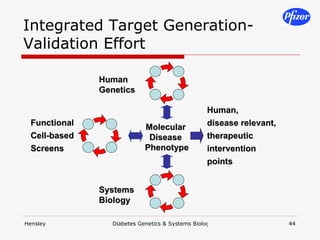
Integrated Target Generation-Validation Effort
Chemical genetics:  Upstream Kinase ID Norman Kennedy, UMass … Kinase 1 Kinase 2 Upstream Kinases Kevan Shokat, UCSF
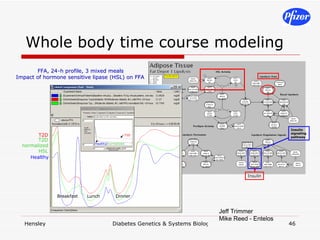
Whole body time course modeling
Current diabetes medicines Sales Scripts TM Nature Reviews |  drug discovery,  2007,   6, 777-778 TM TM TM TM TM TM TM TM TM TM
An Industry Wide Problem 1 in 5 80% Failure
Diabetes - Medical Need Major epidemic in obesity and diabetes 21 MM people in the US (7% population) 180 MM people WW.  Number will double by 2030 Epidemic cost 174 B$ in the US in 2007 95% with diabetes have Type II Diabetes 60% of patients are unresponsive to current therapies
Project deliverables Relation- ships Partners Know- ledge Sharing Clinical Correlates Efficacy Bio- markers Safety Tools Comp- utational Tools Data Sharing Exper- imental Tools This Method Robust Targets Disc- overy Cycle
Messages Biological processes are complex and robust Insight into the origins of pathology (dysfunctional processes) comes from human genetics To learn how to modulate processes, one must interrogate them as a whole Modulation points may produce drug targets (our hypothesis) Interrogating these processes will require new multidisciplinary experimental and computational approaches
Future If validated, this experimental approach should have broad application to discovery efforts involving phosphorylation-mediated signal transduction
Next Steps Connect basic biology to target identification in humans Correlate predicted targets with genome-wide association studies Understand disease progression and subtypes Develop diagnostic tools Test predicted targets in patients Use new methods to predict/understand safety issues
Reverse Pathway Engineering
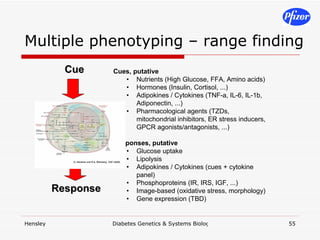
Multiple phenotyping – range finding
Understand pathobiology The IRP Project strategy is to define targets from a sensitivity analysis of insulin binding-promoted signal transduction pathways defined in a global and unbiased way. How will we do this?
IRP Consortium Systems Biology Proposal We will use state of the art methods Global time-resolved phosphoproteomics Expression profiling and ChIP-Seq analysis Network development using a spectrum of c omputational modeling methods Validation using chemical genetics, RNAi, drugs Global sensitivity analysis Whole body disease modeling
Data Collection in Three Stages
Targeted CSR stimuli*time points*measurements*inhibitors*[I]*cell types (n=replicates)
Chemical genetics: Substrate tagging Kevan Shokat,  et al.,   NATURE METHODS ,  4  2007, 511-16
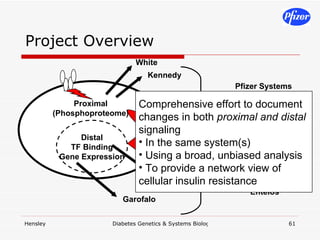
Project Overview White Fraenkel Garofalo Kennedy Responses Comprehensive effort to document changes in both  proximal and distal  signaling In the same system(s) Using a broad, unbiased analysis To provide a network view of cellular insulin resistance Lauffenburger F Doyle, J Doyle Petzold Entelos Pfizer Systems Biology (Cho) Distal TF Binding Gene Expression Proximal (Phosphoproteome)
Developing Diabetes Medicines
Reasons for Efficacy Failure Confidence in mechanism Differentiation from internal pipeline Differentiation from external pipeline Distribution and exposure
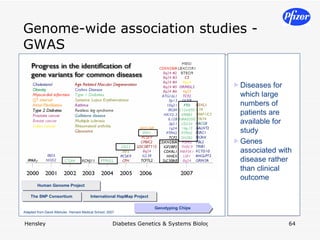
Genome-wide association studies - GWAS
Sequence rare variants Rare variant very obese – no diabetes is there a loss of function, LOF, in a gene that results in prevention of diabetes? such genes function as human knockouts how are such genes chosen to sequence? Rare variant very thin – but diabetic is there a loss of function in a gene that results in increased risk of diabetes? how are such genes chosen to sequence?
Framework to Build CIS
Diabetes is a Multi-organ Disease Initial focus on adipocytes Kahn NATURE | VOL 414 | 13 DECEMBER 2001 |
Visceral Adipose Tissue as an Endocrine Organ SHOELSON, et al., GASTROENTEROLOGY 2007;132:2169–2180 From Kershaw and Flier, J Clin Endocrinol Metab, June 2004, 89(6):2548–2556
Improved National Productivity - 2023
Attrition Contributes to the High Cost of Pharmaceutical Discovery
Phenotypic Assays Modified from Sheng Ding and Peter G Schultz,  Nature Biotechnology   22, 833 - 840 (2004)   Phosphoproteomics

Diabetes Systems Biology And Genetics V6

  • 1.
    Systems Biology andGenetics in Drug Discovery for Diabetes Preston Hensley Senior Director Pfizer Biotherapeutics and Bioinnovation Center
  • 2.
    SCIENCE VOL 3223 OCTOBER 2008 Despite the tools and technologies of modern medical science, we are still in the Dark Ages of understanding our own biology and discovering agents that can provide cures
  • 3.
    Human Genetics andDrug Discovery Molecular Targets Clinical Outcome Human Genetics Traditional Discovery David Cox Historically Difficult Now more Feasible
  • 4.
    Biology in the21rst Century
  • 5.
    Link Genetics andSystems Biology
  • 6.
    Utilize New Academic-IndustrialPartnerships Drug development Knowledge and tool implementation IP Knowledge and tool development Public domain Academia Industry
  • 7.
    Fundamental Industry Problem: High Cost, Low Productivity 56 NME/16 B$ 19 NME/54 B$
  • 8.
  • 9.
    Despite Industry Issues- Unmet Need For New Medicine Is Great
  • 10.
    Estimated Market forNew Medicines Is Significant - 2012 Source: Pfizer Annual Review 2007 ~600 B$
  • 11.
    Source of LowProductivity
  • 12.
    Reasons for PhaseII Attrition Animal Toxicity (Non-hepatic) Human Hepatic Toxicity Human Toxicity (Non-hepatic) Safety Pharmacology Clearance Selectivity Distribution/Exposure Absorption Efficacy/Differentiation Confidence in Mechanism Drug Product Displacement Market Potential 80% Failure For Industry
  • 13.
    Lesson 1 Wedon’t understand the fundamental pathobiology Pharma is not set up to do this sort of research Academia is We need to work together
  • 14.
    Current Safety OptimizationAnd ADME Approaches Bruce Car, BMS
  • 15.
    Yet Toxicity Remainsa Problem Bruce Car, BMS
  • 16.
    Lesson 2 Wedon’t understand the fundamental toxicobiology Pharma is not set up to do this sort of research Academia is We need to work together
  • 17.
    Diabetes – HistoricDrug Discovery Failure 50 years of research have produced three new classes of diabetes medicines - > 60% of patients have unmet need Pierre de Meyts
  • 18.
    Advice from WallStreet Successful companies will invest far more in creating a more holistic understanding of disease pathophysiology and epidemiology before embarking on development programs. PriceWaterhouseCooper – Pharma 2020: The vision - Which path will you take?*
  • 19.
    The O/D DiseaseState Continuum
  • 20.
  • 21.
    IRP Discovery CycleTopology Prediction Validation Chemical Genetics (Shokat) siRNA, Bioinformatics Biological Data Collection Target Predict- ion Validation siRNA, drugs Build ODE Model, Sensitivity Analysis
  • 22.
    Systems Biology UsingGlobal Unbiased Quantitative Discovery Technologies Other Omics Metabolomics Lipidomics Etc. Other Proteomics Acetyl- Ubiquitinyl- SUMOyl- NOyl-
  • 23.
  • 24.
    Insulin Signaling RecapitulatedForest White, et al., DIABETES 2006, 55 , 2171-2179 20% of pY phosphoproteomic data recapitulates current pY signaling knowledge What is the remaining 80% reporting?
  • 25.
    Ernest Fraenkel, MITChIP-Seq Genome-Wide Chromatin Immunoprecipitation E2F4 ~1500 Transcription sites
  • 26.
    Changes in TranscriptionProfiles Time Courses Bob Garofalo, Pfizer Transcriptional changes
  • 27.
    Primary Data -Unlinked Many 100’s Many 1000’s
  • 28.
    Pre-existing KnowledgeTime course data phosphorylation tf binding expression profiling Pathway knowledge Other knowledge interactome, etc. metabolome 0.0 0.2 0.4 0.6 0.8 1.0 1.2 0 10 20 30 40 50 Time [min] Amount normalized with 5 min . 0.0 0.2 0.4 0.6 0.8 1.0 1.2 0 10 20 30 40 50 Time [min] Amount normalized with 5 min .
  • 29.
    Spectrum of ComputationalTools To Link Observations
  • 30.
    Topology Predictions Lauffenburger,MIT Validate with cell-based assays using: RNAi Drugs Chemical genetics Bioinformatics
  • 31.
    Confirm and ExtendTopologies with Chemical Genetics Chemical genetics: Substrate ID Kevan Shokat, UCSF Norman Kennedy, UMass … Kinase 1 Kinase 2 Many substrates
  • 32.
    Transform Topologies toMathematical Models – incorporate time course data SEDAGHAT, et al ., Am J Physiol Endocrinol Metab 283: E1084–E1101, 2002 . Rate Constants Model based in ordinary differential equations, ODEs Frank Doyle - UCSB
  • 33.
    One Approach: SensitivityAnalyses Identify Targets
  • 34.
    PTEN Non-obvious modulationpoints - targets Frank Doyle - UCSB Computational Ranking * *
  • 35.
    Alternative Approach: ScreenAgainst Phenotype (aspirational) Phenotype Input
  • 36.
    Use Multiplex AssayTools to Fingerprint Network Dynamics Cell Communication Network Assays could be Phosphoproteomics, etc. Expression profiling Metabolomic markers Etc. Epitome Biosystems
  • 37.
    Phenotypic Screens FacilitateNetwork Pharmacology Screen for desired biology Deconvolute hits using pathway tools Develop hit to lead understanding mode of action Avoid target based toxicity
  • 38.
    Use Assays toDeconvolute Phenotype Network Screening Tools
  • 39.
    Goal: More SuccessfulProgression To and Through Development Robust targets, potential biomarkers and defined patho- and toxico-biology should speed progression and increase success at later stages
  • 40.
    Messages As currentlyconfigured, small molecule drug discovery has a high failure rate >99% for the industry Failure is due to safety in preclinical and Phase I, as well as efficacy in Phase II Failure in both cases is largely due to a lack of knowledge of fundamental biological processes
  • 41.
    Messages, cont Elucidatingthese processes will require new multidisciplinary experimental and computational approaches Success will require new research partnerships These approaches should work resolve both safety and efficacy issues and increase the success in bringing new medicines to the market
  • 42.
    Thanks to manyWEST: P Hensley S Kennedy E Kuja S Hansen S Faraci CVMED: B Garofalo W Soeller J Hadcock D Flynn RTC & Comp Bio: C Cho D Nathan J Miret R Herrera A Seymour W Loging MIT: D Lauffenburger F White E Frankel Entelos: J Trimmer UMASS: R Davis N Kennedy Drug Safety: A Ryan R Chapin Clinical Research: R Calle A Taylor UCSB: F Doyle L Petzold Cal Tech: John Doyle PFE, Other: O Basavapathruni J McNeish J Treadway
  • 43.
  • 44.
  • 45.
    Chemical genetics: Upstream Kinase ID Norman Kennedy, UMass … Kinase 1 Kinase 2 Upstream Kinases Kevan Shokat, UCSF
  • 46.
    Whole body timecourse modeling
  • 47.
    Current diabetes medicinesSales Scripts TM Nature Reviews | drug discovery, 2007, 6, 777-778 TM TM TM TM TM TM TM TM TM TM
  • 48.
    An Industry WideProblem 1 in 5 80% Failure
  • 49.
    Diabetes - MedicalNeed Major epidemic in obesity and diabetes 21 MM people in the US (7% population) 180 MM people WW. Number will double by 2030 Epidemic cost 174 B$ in the US in 2007 95% with diabetes have Type II Diabetes 60% of patients are unresponsive to current therapies
  • 50.
    Project deliverables Relation-ships Partners Know- ledge Sharing Clinical Correlates Efficacy Bio- markers Safety Tools Comp- utational Tools Data Sharing Exper- imental Tools This Method Robust Targets Disc- overy Cycle
  • 51.
    Messages Biological processesare complex and robust Insight into the origins of pathology (dysfunctional processes) comes from human genetics To learn how to modulate processes, one must interrogate them as a whole Modulation points may produce drug targets (our hypothesis) Interrogating these processes will require new multidisciplinary experimental and computational approaches
  • 52.
    Future If validated,this experimental approach should have broad application to discovery efforts involving phosphorylation-mediated signal transduction
  • 53.
    Next Steps Connectbasic biology to target identification in humans Correlate predicted targets with genome-wide association studies Understand disease progression and subtypes Develop diagnostic tools Test predicted targets in patients Use new methods to predict/understand safety issues
  • 54.
  • 55.
  • 56.
    Understand pathobiology TheIRP Project strategy is to define targets from a sensitivity analysis of insulin binding-promoted signal transduction pathways defined in a global and unbiased way. How will we do this?
  • 57.
    IRP Consortium SystemsBiology Proposal We will use state of the art methods Global time-resolved phosphoproteomics Expression profiling and ChIP-Seq analysis Network development using a spectrum of c omputational modeling methods Validation using chemical genetics, RNAi, drugs Global sensitivity analysis Whole body disease modeling
  • 58.
    Data Collection inThree Stages
  • 59.
    Targeted CSR stimuli*timepoints*measurements*inhibitors*[I]*cell types (n=replicates)
  • 60.
    Chemical genetics: Substratetagging Kevan Shokat, et al., NATURE METHODS , 4 2007, 511-16
  • 61.
    Project Overview WhiteFraenkel Garofalo Kennedy Responses Comprehensive effort to document changes in both proximal and distal signaling In the same system(s) Using a broad, unbiased analysis To provide a network view of cellular insulin resistance Lauffenburger F Doyle, J Doyle Petzold Entelos Pfizer Systems Biology (Cho) Distal TF Binding Gene Expression Proximal (Phosphoproteome)
  • 62.
  • 63.
    Reasons for EfficacyFailure Confidence in mechanism Differentiation from internal pipeline Differentiation from external pipeline Distribution and exposure
  • 64.
  • 65.
    Sequence rare variantsRare variant very obese – no diabetes is there a loss of function, LOF, in a gene that results in prevention of diabetes? such genes function as human knockouts how are such genes chosen to sequence? Rare variant very thin – but diabetic is there a loss of function in a gene that results in increased risk of diabetes? how are such genes chosen to sequence?
  • 66.
  • 67.
    Diabetes is aMulti-organ Disease Initial focus on adipocytes Kahn NATURE | VOL 414 | 13 DECEMBER 2001 |
  • 68.
    Visceral Adipose Tissueas an Endocrine Organ SHOELSON, et al., GASTROENTEROLOGY 2007;132:2169–2180 From Kershaw and Flier, J Clin Endocrinol Metab, June 2004, 89(6):2548–2556
  • 69.
  • 70.
    Attrition Contributes tothe High Cost of Pharmaceutical Discovery
  • 71.
    Phenotypic Assays Modifiedfrom Sheng Ding and Peter G Schultz, Nature Biotechnology  22, 833 - 840 (2004) Phosphoproteomics