Renewable Resources
Basic Concept
Renewable Resources: The New Webster’s Dictionary defines
“renewable” as “replaceable naturally or by human activity”. Renewable
resources are resources that are replenished by the environment over
relatively short periods of time. Examples of renewable resources
include trees and other plants, animal populations, groundwater, solar
energy, wind energy, etc.
Non-renewable Resources: In contrast, non-renewable resources are those
that are not replaceable, or replaced so slowly by natural or artificial
processes that for all practical purposes, once used they would not be
available again within any reasonable time frame. Obvious examples are
oil and mineral deposits.
Basic Concept
Distinction between renewable and non-renewable resources –
 These resources, after use if not recycled properly become a waste material.
 On the other hand, resources are renewable when they can be replenished after
use and can be sustained if natural flow of the resources is maintained.
 Discussion of resources and their use is important because in the pursuit of
development available resources are nearly over exploited.
 Therefore their efficient use and allocation is highly significant for attaining
sustainable development.
Importance: Understanding the conditions of efficient allocation of both the types
of resources requires understanding of resource growth model, its rate of
exploitation, cost and revenues, extinction & problems, access and many other
aspects. Our group members will discuss these.
Growth Curve
The relationship between renewable resources and growth is an
important issue. It is found that renewable resources have an
adverse effect on the equilibrium growth rate.
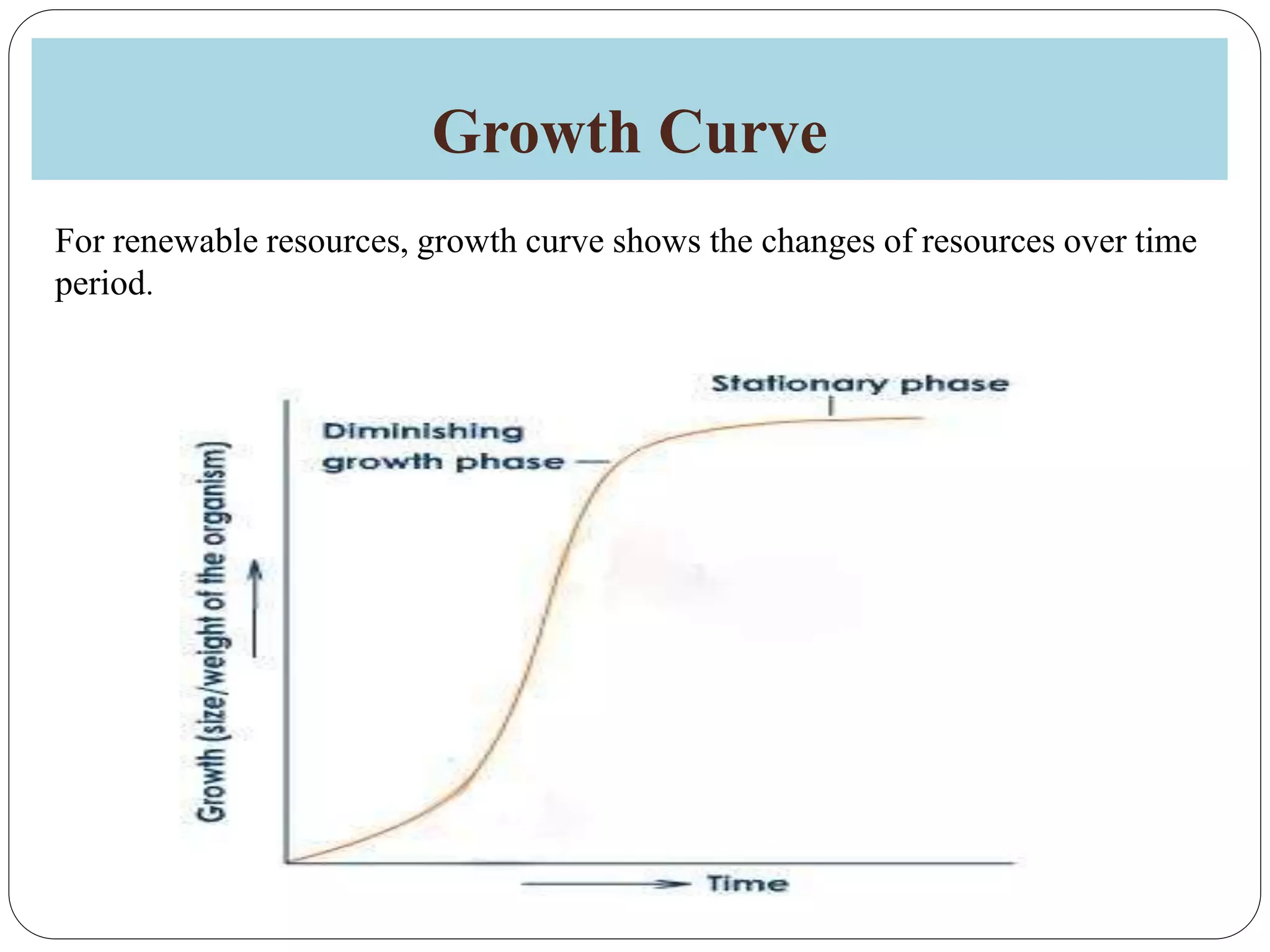
A growth curve is an empirical model of the evolution of a
quantity over time.
Growth Curve
For renewable resources, growth curve shows the changes of resources over time
period.
Growth Curve
Here we analyze the equilibrium growth rate for an economy having a
renewable resource. In doing so we focus on two main issues. The first is
the fact that the harvesting of the resource requires the use of productive
factors, such as labor and/or capital, that otherwise could be employed in
a final output sector that produces capital goods, thereby enhancing the
economy’s potential for growth. This provides an alternative explanation
for the inverse relationship between resource endowment and growth.
The second is that by its nature the resource sector is limited in size,
which raises questions about the nature of its coexistence with a growing
sector in a balanced growth equilibrium.
Rate of Exploitation
The exploitation of natural resources is the use of natural resources for economic
growth, sometimes with a negative connotation of accompanying environmental
degradation. It started to emerge on an industrial scale in the 19th century as the extraction
and processing of raw materials (such as in mining, steam power, and machinery) developed
much further than it had in preindustrial eras. During the 20th century, energy consumption
rapidly increased. Today, about 80% of the world’s energy consumption is sustained by the
extraction of fossil fuels, which consists of oil, coal and gas. Another non-renewable
resource that is exploited by humans are Subsoil minerals such as precious metals that are
mainly used in the production of industrial commodities. Intensive agriculture is an example
of a mode of production that hinders many aspects of the natural environment, for example
the degradation of forests in a terrestrial ecosystem and water pollution in an aquatic
ecosystem. As the world population rises and economic growth occurs, the depletion of
natural resources influenced by the unsustainable extraction of raw materials becomes an
increasing concern
Example: Ground Water
Revenues & Costs
Revenues- revenue is the income that a company receives from its normal
business activities, usually from the sale of goods and services to customers.
Revenue is also referred to as sales or turnover.
Cost - cost is the value of money that has been used up to produce something,
and hence is not available for use anymore.
Analysis of the cost benefit of distribution generation for renewable energy
leads to the conclusion that short-term return on investment is low and long-
term investment shows profitable returns if development capital is produced.
Revenues & Costs
Renewable energy efficiency is only going to show a cost benefit once stable
operating environments are established; producing renewable energy standards
will offset the cost risk of not having controls; centralization or renewable energy
is not yet cost effective while economies of scale still exist in distribution;
renewable energy tax revenues are higher due to support and storage issues in
importing and exporting energy; military and government investment in
renewable energy development will have positive private sector financial impact
in patents and applications; and renewable energy infrastructure must be
developed to properly assess monitoring and management costs and benefits.
Revenues & Costs
Overall, these conclusions point to the need for capital investments in technologies
and systems to mature and grow the potential of sustainable electricity generated
from renewable energy sources. Long term environmental and economic benefits,
such as job creation and increased revenues, are on the horizon once renewable
energy distribution is standardized and the systems are sustainable. Return on
investment (ROI) from renewable energy sources is difficult to measure in short-
term profits. When determining the cost benefits of wind; hydro/tidal power;
solar; geothermal and biomass and biogas energies, a comprehensive portfolio is
still out of reach although segments of the renewable energy industry can be
effectively evaluated to provide a measurable guide of progress toward profits.
A model with time dimension
The Hotelling Model
Assume that-
price per unit =P,
interest rate on investments in the economy is r % per year.
That is; Any amount of the resource extracted today will not be
available in the future, and any resource left untouched today
may fetch a higher price in the market in the future.
Example of a competitive market.
A model with time dimension
If the rate is rising slower, resource owners would begin to sell off
current stocks and the current market price would fall.
If it is increasing at a faster rate than r per cent per year all owners
of the resource would hold on to their stock, decreasing the current
supply in the market, thereby inducing the current market price to
rise.
Fundamental rule of renewable resource
exploitation
 The principal economic question in the management of
renewable natural resources has been: How much of a
resource should be harvested during the present vs. future
time periods?
 The fundamental equation of renewable resources highlights
the essence of an efficient, market-based approach to
management
 Xt+1 – Xt = F(Xt) – Yt (1)
Fundamental rule of renewable resource
exploitation
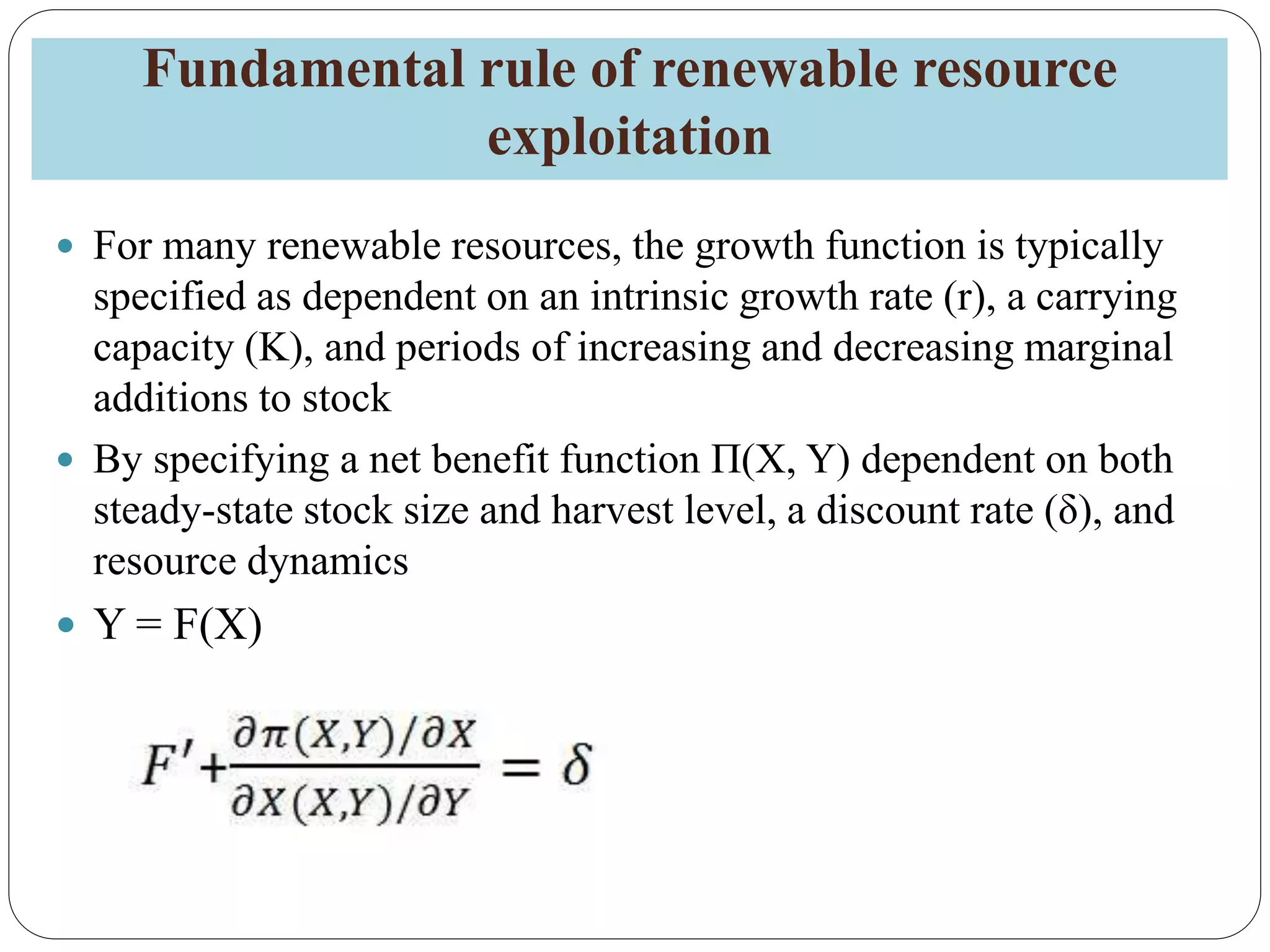
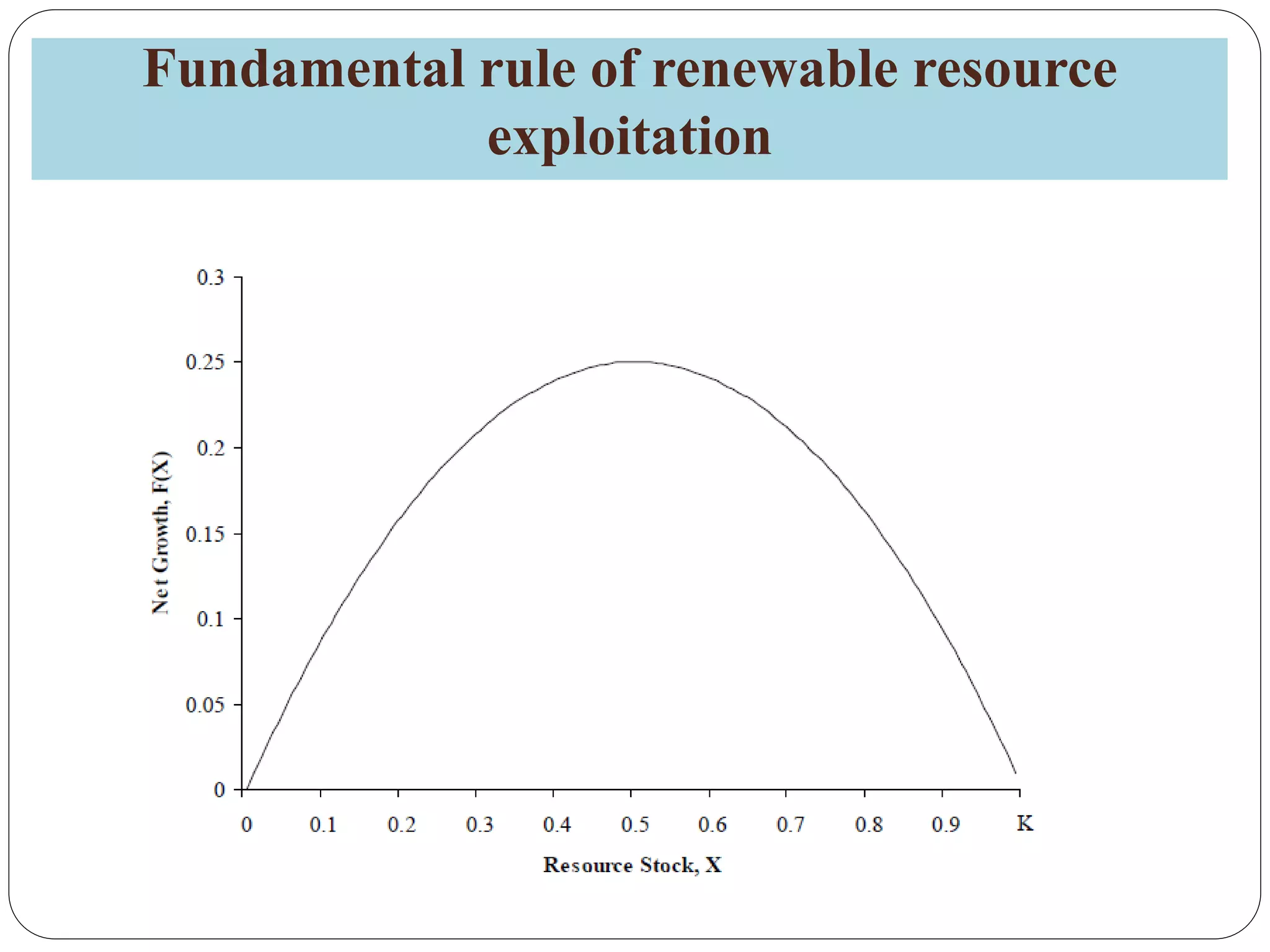
 For many renewable resources, the growth function is typically
specified as dependent on an intrinsic growth rate (r), a carrying
capacity (K), and periods of increasing and decreasing marginal
additions to stock
 By specifying a net benefit function Π(X, Y) dependent on both
steady-state stock size and harvest level, a discount rate (δ), and
resource dynamics
 Y = F(X)
Fundamental rule of renewable resource
exploitation
Problem of extinction
The exploitation of renewable resources is the use of
resources for economic growth, sometimes with a negative
connotation of accompanying environmental degradation. This
problem examines conditions for extinction when the net benefits
from a renewable resource are a nonlinear function of the harvest
rate. As in the linear case, extinction depends on the size of the
interest rate relative to the growth potential of the species.
Problem of extinction
However, the size of the initial resource stock is also crucial. It is seen that
extinction is optimal if the interest rate is greater than the growth potential of the
species, but only for small initial stocks. Indeed, if the initial stock is sufficiently
high, extinction need not be optimal even if the interest rate is infinite.
Extinction, or loss of viability of a species, can be deliberate or an inadvertent
event. “Commercially important species are often overharvested to economic
depletion to near extinction. Overexploitation, usually combined with habitat
destruction and introduced species threatens about one-third of the endangered
species.
Restricted & open access for resource harvest
Restricted access (RA)- Exclusion is performed by the owner(s) of the
resource site, perfectly and costless.
Open access (OA)- The resource site can be accessed by anyone without any
restriction whatsoever. Open access when costs are proportional to effort.
An open access resource is a limited resource which appears to each
individual to be limitless. Individuals use the resource without
taking into account the effect that their use has on others.
Profit maximization & extinction
Profit maximization of renewable resources-
Profit maximizing rule states that in a competitive market, the price
of the resource must equal marginal revenue product. In other
words, a firm will achieve its profit-maximizing combination of
resources when each resource is employed to the point at which its
marginal revenue product equals its resource price. So the profit
maximization of renewable resource means utilizing the resources
to the point that the resource price equals to its marginal revenue
product limit.
Profit maximization & extinction
Extinction- The extinction of renewable resources could be
consistent with a policy of maximizing the discounted present
value of economic rent. Maximizing a nonlinear benefit function of
renewable resource stock would be more profitable to harvest the
stock to extinction than follow a continuous harvesting strategy.
When the minimum viable resource stock is positive, extinction is
optimal as long as the initial resource stock is sufficiently small,
regardless of the discount rate. When the minimum viable resource
stock is zero and the discount rate exceeds the growth potential of
the species, extinction is optimal for sufficiently small initial
stocks.
Conclusion
Renewable resources are those resources that are easily
replenished. However, when consumption of these
resources exceeds the rate at which they are replenished,
the resource may be exhausted. To prevent this, renewable
resources must be managed in a way that allows them to
recover before irreparable harm is done. Unfortunately, the
breaking point at which a renewable resource becomes
overused is difficult to predict before the threshold is
reached. For this renewable resources should be utilize in a
proper way.

Renewable resources

  • 1.
  • 2.
    Basic Concept Renewable Resources:The New Webster’s Dictionary defines “renewable” as “replaceable naturally or by human activity”. Renewable resources are resources that are replenished by the environment over relatively short periods of time. Examples of renewable resources include trees and other plants, animal populations, groundwater, solar energy, wind energy, etc. Non-renewable Resources: In contrast, non-renewable resources are those that are not replaceable, or replaced so slowly by natural or artificial processes that for all practical purposes, once used they would not be available again within any reasonable time frame. Obvious examples are oil and mineral deposits.
  • 3.
    Basic Concept Distinction betweenrenewable and non-renewable resources –  These resources, after use if not recycled properly become a waste material.  On the other hand, resources are renewable when they can be replenished after use and can be sustained if natural flow of the resources is maintained.  Discussion of resources and their use is important because in the pursuit of development available resources are nearly over exploited.  Therefore their efficient use and allocation is highly significant for attaining sustainable development. Importance: Understanding the conditions of efficient allocation of both the types of resources requires understanding of resource growth model, its rate of exploitation, cost and revenues, extinction & problems, access and many other aspects. Our group members will discuss these.
  • 4.
    Growth Curve The relationshipbetween renewable resources and growth is an important issue. It is found that renewable resources have an adverse effect on the equilibrium growth rate. A growth curve is an empirical model of the evolution of a quantity over time.
  • 5.
    Growth Curve For renewableresources, growth curve shows the changes of resources over time period.
  • 6.
    Growth Curve Here weanalyze the equilibrium growth rate for an economy having a renewable resource. In doing so we focus on two main issues. The first is the fact that the harvesting of the resource requires the use of productive factors, such as labor and/or capital, that otherwise could be employed in a final output sector that produces capital goods, thereby enhancing the economy’s potential for growth. This provides an alternative explanation for the inverse relationship between resource endowment and growth. The second is that by its nature the resource sector is limited in size, which raises questions about the nature of its coexistence with a growing sector in a balanced growth equilibrium.
  • 7.
    Rate of Exploitation Theexploitation of natural resources is the use of natural resources for economic growth, sometimes with a negative connotation of accompanying environmental degradation. It started to emerge on an industrial scale in the 19th century as the extraction and processing of raw materials (such as in mining, steam power, and machinery) developed much further than it had in preindustrial eras. During the 20th century, energy consumption rapidly increased. Today, about 80% of the world’s energy consumption is sustained by the extraction of fossil fuels, which consists of oil, coal and gas. Another non-renewable resource that is exploited by humans are Subsoil minerals such as precious metals that are mainly used in the production of industrial commodities. Intensive agriculture is an example of a mode of production that hinders many aspects of the natural environment, for example the degradation of forests in a terrestrial ecosystem and water pollution in an aquatic ecosystem. As the world population rises and economic growth occurs, the depletion of natural resources influenced by the unsustainable extraction of raw materials becomes an increasing concern Example: Ground Water
  • 8.
    Revenues & Costs Revenues-revenue is the income that a company receives from its normal business activities, usually from the sale of goods and services to customers. Revenue is also referred to as sales or turnover. Cost - cost is the value of money that has been used up to produce something, and hence is not available for use anymore. Analysis of the cost benefit of distribution generation for renewable energy leads to the conclusion that short-term return on investment is low and long- term investment shows profitable returns if development capital is produced.
  • 9.
    Revenues & Costs Renewableenergy efficiency is only going to show a cost benefit once stable operating environments are established; producing renewable energy standards will offset the cost risk of not having controls; centralization or renewable energy is not yet cost effective while economies of scale still exist in distribution; renewable energy tax revenues are higher due to support and storage issues in importing and exporting energy; military and government investment in renewable energy development will have positive private sector financial impact in patents and applications; and renewable energy infrastructure must be developed to properly assess monitoring and management costs and benefits.
  • 10.
    Revenues & Costs Overall,these conclusions point to the need for capital investments in technologies and systems to mature and grow the potential of sustainable electricity generated from renewable energy sources. Long term environmental and economic benefits, such as job creation and increased revenues, are on the horizon once renewable energy distribution is standardized and the systems are sustainable. Return on investment (ROI) from renewable energy sources is difficult to measure in short- term profits. When determining the cost benefits of wind; hydro/tidal power; solar; geothermal and biomass and biogas energies, a comprehensive portfolio is still out of reach although segments of the renewable energy industry can be effectively evaluated to provide a measurable guide of progress toward profits.
  • 11.
    A model withtime dimension The Hotelling Model Assume that- price per unit =P, interest rate on investments in the economy is r % per year. That is; Any amount of the resource extracted today will not be available in the future, and any resource left untouched today may fetch a higher price in the market in the future. Example of a competitive market.
  • 12.
    A model withtime dimension If the rate is rising slower, resource owners would begin to sell off current stocks and the current market price would fall. If it is increasing at a faster rate than r per cent per year all owners of the resource would hold on to their stock, decreasing the current supply in the market, thereby inducing the current market price to rise.
  • 13.
    Fundamental rule ofrenewable resource exploitation  The principal economic question in the management of renewable natural resources has been: How much of a resource should be harvested during the present vs. future time periods?  The fundamental equation of renewable resources highlights the essence of an efficient, market-based approach to management  Xt+1 – Xt = F(Xt) – Yt (1)
  • 14.
    Fundamental rule ofrenewable resource exploitation  For many renewable resources, the growth function is typically specified as dependent on an intrinsic growth rate (r), a carrying capacity (K), and periods of increasing and decreasing marginal additions to stock  By specifying a net benefit function Π(X, Y) dependent on both steady-state stock size and harvest level, a discount rate (δ), and resource dynamics  Y = F(X)
  • 15.
    Fundamental rule ofrenewable resource exploitation
  • 16.
    Problem of extinction Theexploitation of renewable resources is the use of resources for economic growth, sometimes with a negative connotation of accompanying environmental degradation. This problem examines conditions for extinction when the net benefits from a renewable resource are a nonlinear function of the harvest rate. As in the linear case, extinction depends on the size of the interest rate relative to the growth potential of the species.
  • 17.
    Problem of extinction However,the size of the initial resource stock is also crucial. It is seen that extinction is optimal if the interest rate is greater than the growth potential of the species, but only for small initial stocks. Indeed, if the initial stock is sufficiently high, extinction need not be optimal even if the interest rate is infinite. Extinction, or loss of viability of a species, can be deliberate or an inadvertent event. “Commercially important species are often overharvested to economic depletion to near extinction. Overexploitation, usually combined with habitat destruction and introduced species threatens about one-third of the endangered species.
  • 18.
    Restricted & openaccess for resource harvest Restricted access (RA)- Exclusion is performed by the owner(s) of the resource site, perfectly and costless. Open access (OA)- The resource site can be accessed by anyone without any restriction whatsoever. Open access when costs are proportional to effort. An open access resource is a limited resource which appears to each individual to be limitless. Individuals use the resource without taking into account the effect that their use has on others.
  • 19.
    Profit maximization &extinction Profit maximization of renewable resources- Profit maximizing rule states that in a competitive market, the price of the resource must equal marginal revenue product. In other words, a firm will achieve its profit-maximizing combination of resources when each resource is employed to the point at which its marginal revenue product equals its resource price. So the profit maximization of renewable resource means utilizing the resources to the point that the resource price equals to its marginal revenue product limit.
  • 20.
    Profit maximization &extinction Extinction- The extinction of renewable resources could be consistent with a policy of maximizing the discounted present value of economic rent. Maximizing a nonlinear benefit function of renewable resource stock would be more profitable to harvest the stock to extinction than follow a continuous harvesting strategy. When the minimum viable resource stock is positive, extinction is optimal as long as the initial resource stock is sufficiently small, regardless of the discount rate. When the minimum viable resource stock is zero and the discount rate exceeds the growth potential of the species, extinction is optimal for sufficiently small initial stocks.
  • 21.
    Conclusion Renewable resources arethose resources that are easily replenished. However, when consumption of these resources exceeds the rate at which they are replenished, the resource may be exhausted. To prevent this, renewable resources must be managed in a way that allows them to recover before irreparable harm is done. Unfortunately, the breaking point at which a renewable resource becomes overused is difficult to predict before the threshold is reached. For this renewable resources should be utilize in a proper way.