
Economic Consulting


                                                        GT
Total Cost (Energy + Capacity)

                                 CT


                                                   CC               L
                                                             CO A

                                  NUCLEAR                               Economics of Nuclear Power
                                                                        Nuclear Power International
                                                                        Las Vegas – 8 Dec 2009
                                      Capacity Factor


                                                                        Edward Kee
                                                                        Vice President


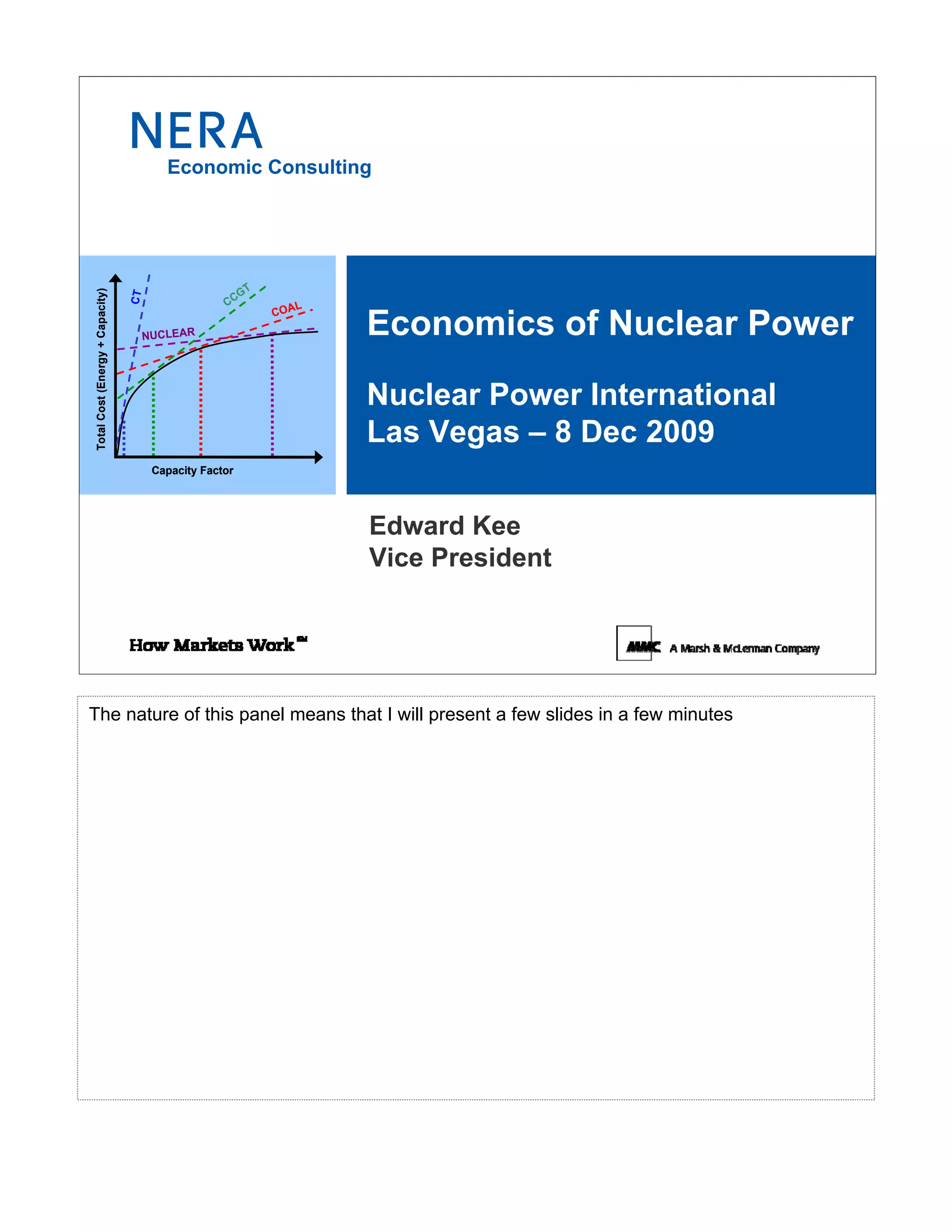
The nature of this panel means that I will present a few slides in a few minutes
Disclaimer


 The slides that follow do not provide a complete
 record of this presentation and discussion.
 The views expressed in this presentation are mine;
 these views may not be the same as those held by
 our clients or by my colleagues.


NERA Economic Consulting – Edward Kee – Nuclear Power International – 8 Dec 2009   8 Dec 2009   111
Nuclear energy is valuable

        Zero carbon energy
        Low cost energy
        High availability and reliability
        Profitable for unregulated owners
        Low rates for regulated utility and public
        power ratepayers


     NERA Economic Consulting – Edward Kee – Nuclear Power International – 8 Dec 2009     8 Dec 2009   222


Existing nuclear power plants are valuable resources
Nuclear energy from these existing units is zero-carbon and low-cost
Existing US nuclear power plants are operating well, with very high availability
Existing nuclear power plants produce:
      significant profits for unregulated utility or merchant generation company owners
      low rates for customers of regulated and public power utility owners
Nuclear has low production costs
                    9
                    8
                    7
     cents / kW h


                    6
                    5
                    4
                    3
                    2
                    1
                    0
                        1995

                               1996

                                      1997

                                             1998

                                                    1999

                                                           2000

                                                                  2001

                                                                          2002

                                                                                  2003

                                                                                         2004

                                                                                                2005

                                                                                                       2006

                                                                                                              2007

                                                                                                                      2008
                                                       Coal         Gas          Nuclear
    Source: NEI

     NERA Economic Consulting – Edward Kee – Nuclear Power International – 8 Dec 2009                         8 Dec 2009     333


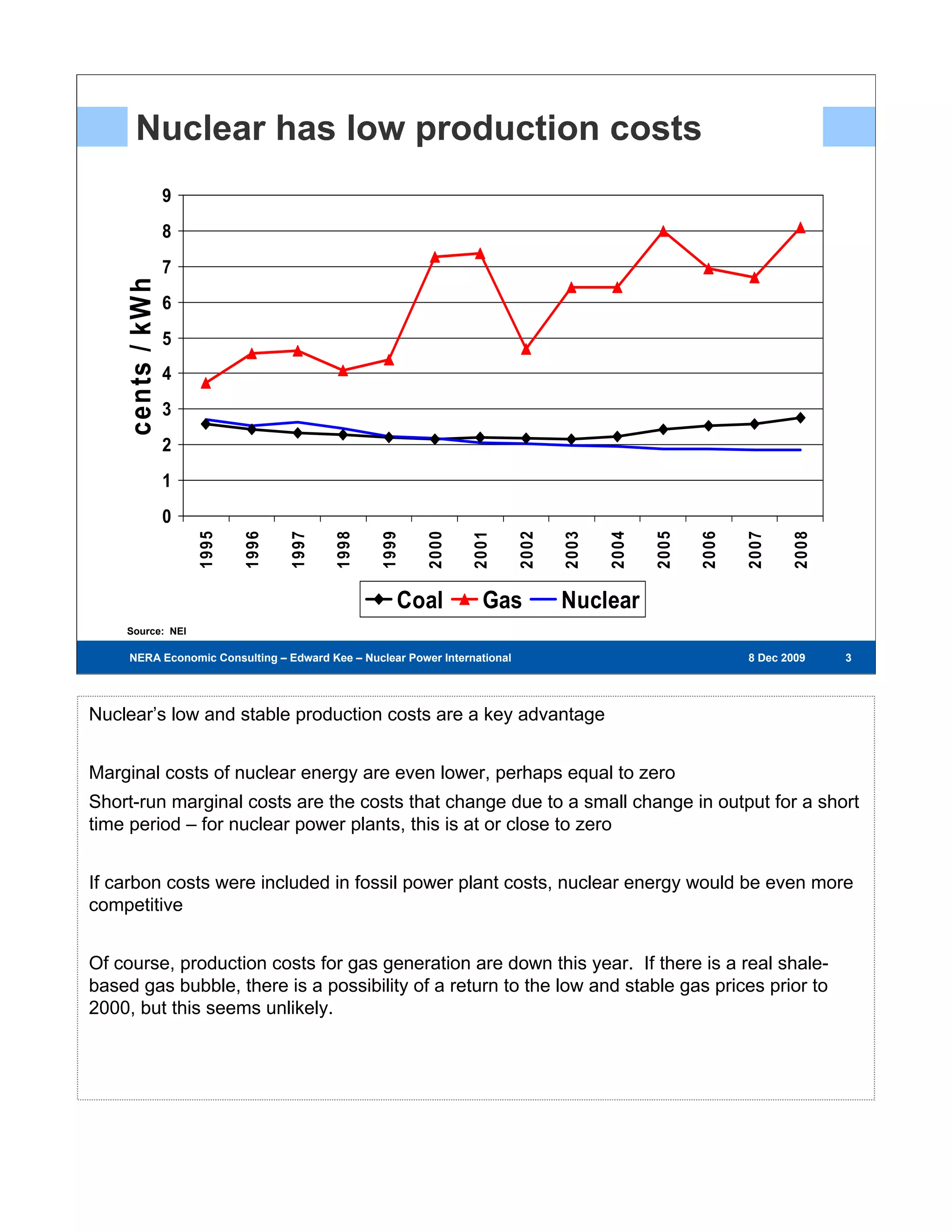
Nuclear’s low and stable production costs are a key advantage


Marginal costs of nuclear energy are even lower, perhaps equal to zero
Short-run marginal costs are the costs that change due to a small change in output for a short
time period – for nuclear power plants, this is at or close to zero


If carbon costs were included in fossil power plant costs, nuclear energy would be even more
competitive


Of course, production costs for gas generation are down this year. If there is a real shale-
based gas bubble, there is a possibility of a return to the low and stable gas prices prior to
2000, but this seems unlikely.
Nuclear plants have long operating life


        Wind


             CT


      CCGT


    Nuclear


                    0                         20                        40              60                80

                                                   Typical operating life

     NERA Economic Consulting – Edward Kee – Nuclear Power International – 8 Dec 2009        8 Dec 2009        444


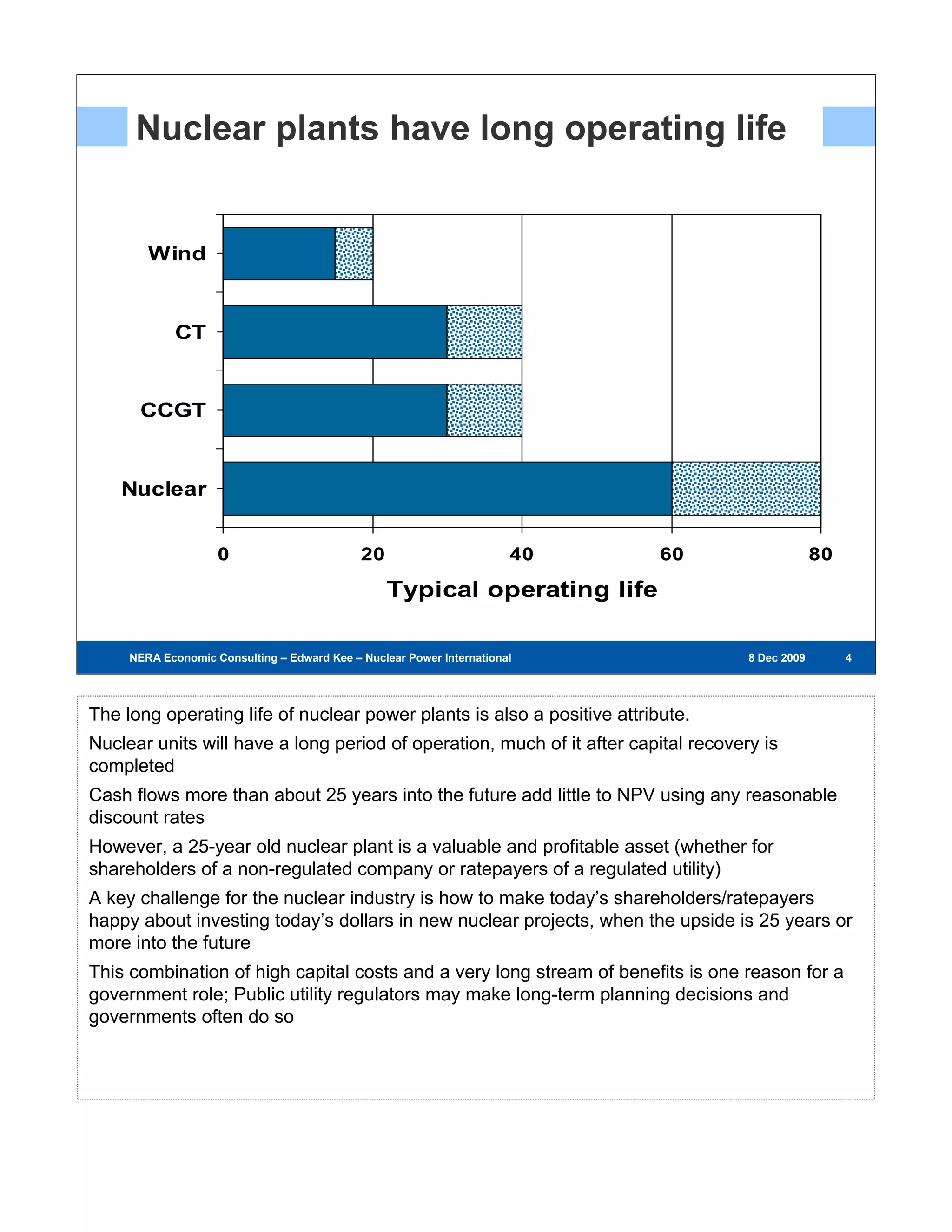
The long operating life of nuclear power plants is also a positive attribute.
Nuclear units will have a long period of operation, much of it after capital recovery is
completed
Cash flows more than about 25 years into the future add little to NPV using any reasonable
discount rates
However, a 25-year old nuclear plant is a valuable and profitable asset (whether for
shareholders of a non-regulated company or ratepayers of a regulated utility)
A key challenge for the nuclear industry is how to make today’s shareholders/ratepayers
happy about investing today’s dollars in new nuclear projects, when the upside is 25 years or
more into the future
This combination of high capital costs and a very long stream of benefits is one reason for a
government role; Public utility regulators may make long-term planning decisions and
governments often do so
How do we get more nuclear energy?

        Increase output of existing plants
        –Improve performance
        –License renewal / life extension
        –Uprate

        Build new nuclear power plants


     NERA Economic Consulting – Edward Kee – Nuclear Power International – 8 Dec 2009   8 Dec 2009   555


The first way to get more nuclear energy is to work existing nuclear plants harder and longer


Companies that developed a superior organizational approach to running nuclear power
plants (e.g., Constellation, Dominion, Entergy, Exelon) were able to make money by
transferring this institutional knowledge to other plants they acquired
This nuclear “fixer-upper” strategy has gone well, but there are few fixer-uppers left in the US.
Is it time for industry leaders to consider an international fixer-upper strategy?
Most US nuclear units have already gotten NRC approval for a 20-year license renewal, most
other units have applications in the review process. 80 year (or longer) life is not out of the
question for existing nuclear plants
Many US units have already received approval for uprates and have implemented them, with
some units including extensive secondary plant re-works to accommodate higher electrical
output. Other units have or will apply for uprates


The second way to get more nuclear energy is to build new units - not so easy!
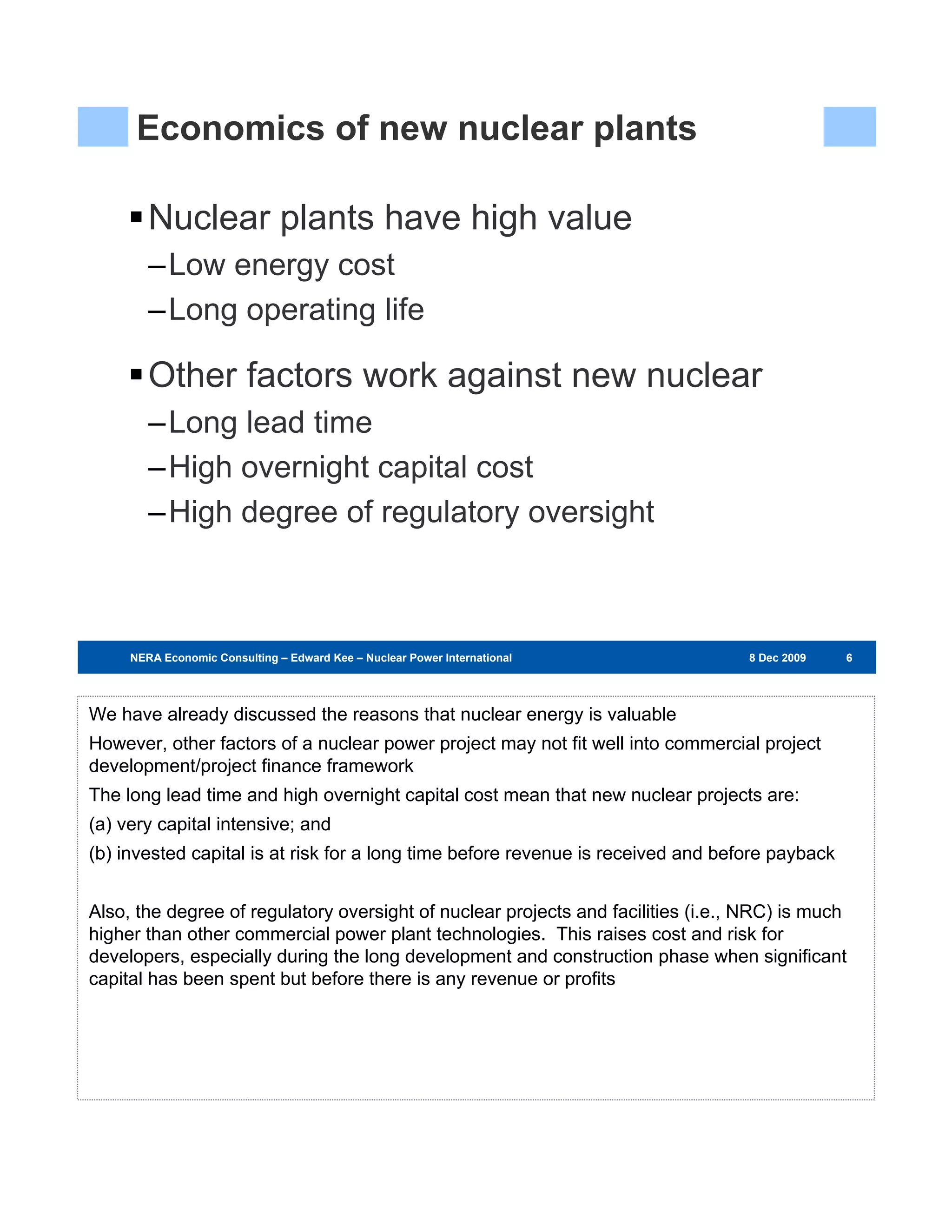
Economics of new nuclear plants

        Nuclear plants have high value
        –Low energy cost
        –Long operating life

        Other factors work against new nuclear
        –Long lead time
        –High overnight capital cost
        –High degree of regulatory oversight


     NERA Economic Consulting – Edward Kee – Nuclear Power International – 8 Dec 2009   8 Dec 2009   666


We have already discussed the reasons that nuclear energy is valuable
However, other factors of a nuclear power project may not fit well into commercial project
development/project finance framework
The long lead time and high overnight capital cost mean that new nuclear projects are:
(a) very capital intensive; and
(b) invested capital is at risk for a long time before revenue is received and before payback


Also, the degree of regulatory oversight of nuclear projects and facilities (i.e., NRC) is much
higher than other commercial power plant technologies. This raises cost and risk for
developers, especially during the long development and construction phase when significant
capital has been spent but before there is any revenue or profits
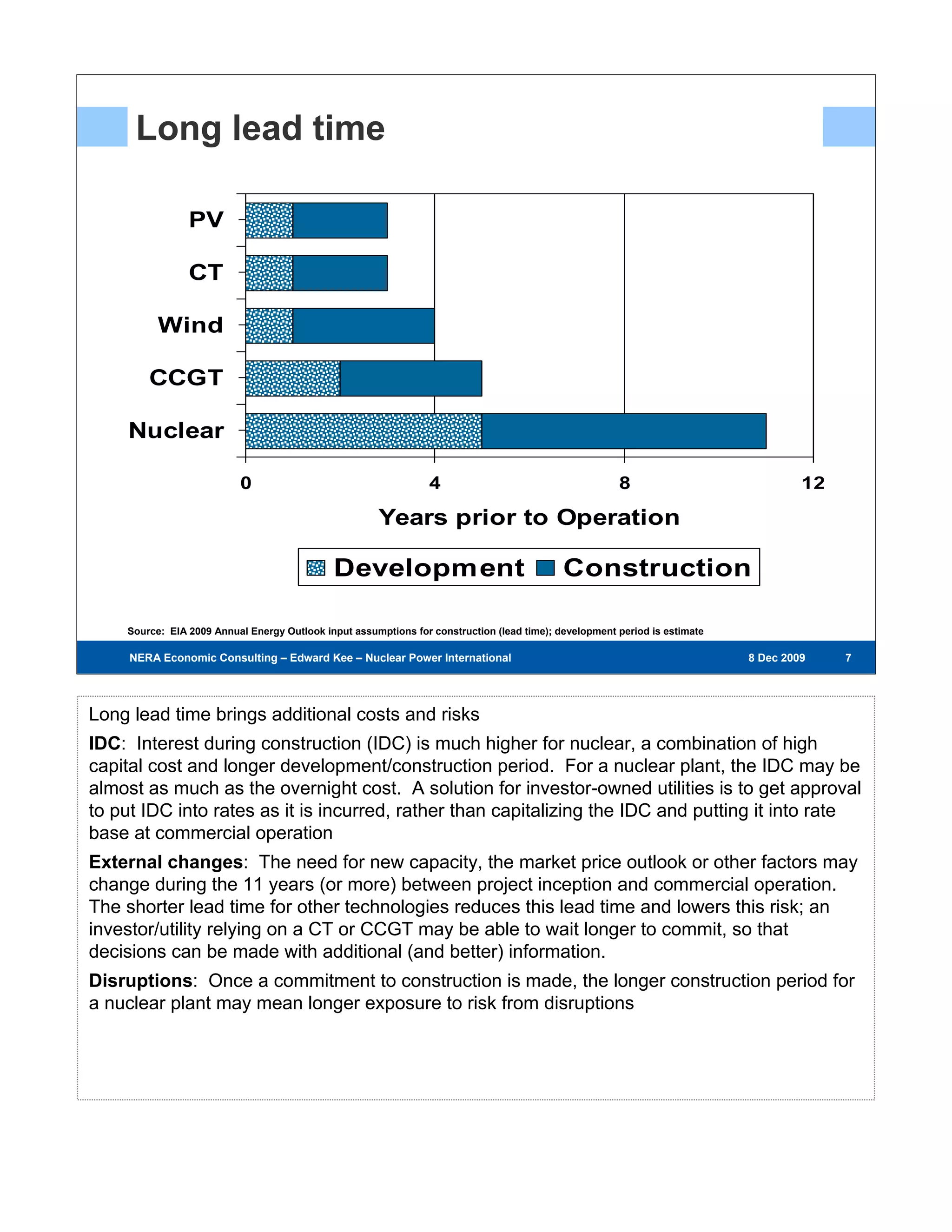
Long lead time

                PV

                CT

          Wind

        CCGT

    Nuclear

                          0                                      4                                     8                             12

                                                      Years prior to Operation

                                             Development                                    Construction

    Source: EIA 2009 Annual Energy Outlook input assumptions for construction (lead time); development period is estimate

     NERA Economic Consulting – Edward Kee – Nuclear Power International – 8 Dec 2009                                       8 Dec 2009    777


Long lead time brings additional costs and risks
IDC: Interest during construction (IDC) is much higher for nuclear, a combination of high
capital cost and longer development/construction period. For a nuclear plant, the IDC may be
almost as much as the overnight cost. A solution for investor-owned utilities is to get approval
to put IDC into rates as it is incurred, rather than capitalizing the IDC and putting it into rate
base at commercial operation
External changes: The need for new capacity, the market price outlook or other factors may
change during the 11 years (or more) between project inception and commercial operation.
The shorter lead time for other technologies reduces this lead time and lowers this risk; an
investor/utility relying on a CT or CCGT may be able to wait longer to commit, so that
decisions can be made with additional (and better) information.
Disruptions: Once a commitment to construction is made, the longer construction period for
a nuclear plant may mean longer exposure to risk from disruptions
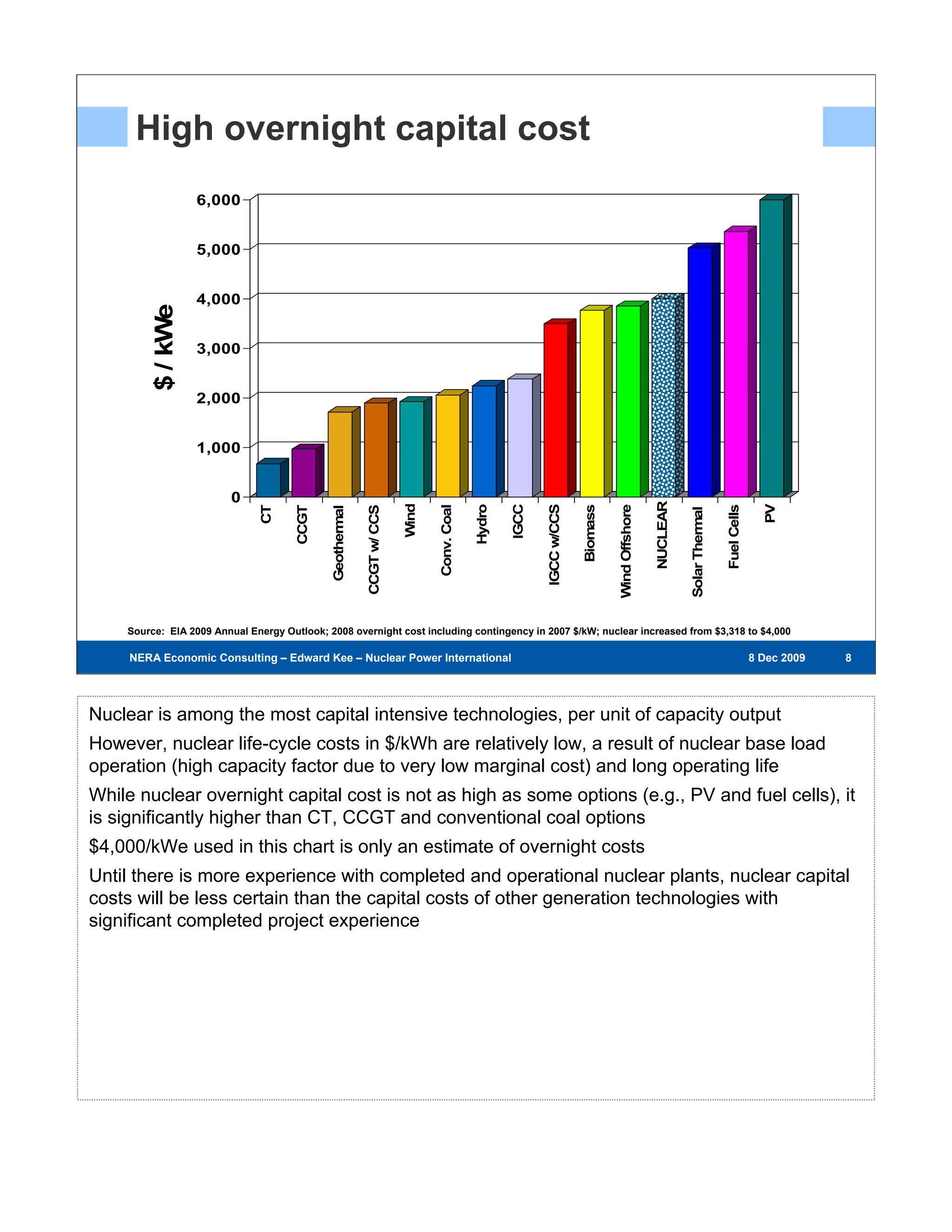
High overnight capital cost
                   6,000


                   5,000


                   4,000
         $ / kWe


                   3,000


                   2,000


                   1,000


                         0


                                                                                                                                                  NUCLEAR
                                                                        Wind


                                                                                                    IGCC

                                                                                                           IGCC w/CCS


                                                                                                                                                                                           PV
                                                                                            Hydro


                                                                                                                                  Wind Offshore
                                                                                                                        Biomass


                                                                                                                                                                            Fuel Cells
                                                                               Conv. Coal
                                                          CCGT w/ CCS
                               CT

                                      CCGT

                                             Geothermal


                                                                                                                                                            Solar Thermal
    Source: EIA 2009 Annual Energy Outlook; 2008 overnight cost including contingency in 2007 $/kW; nuclear increased from $3,318 to $4,000

     NERA Economic Consulting – Edward Kee – Nuclear Power International – 8 Dec 2009                                                                                                    8 Dec 2009   888


Nuclear is among the most capital intensive technologies, per unit of capacity output
However, nuclear life-cycle costs in $/kWh are relatively low, a result of nuclear base load
operation (high capacity factor due to very low marginal cost) and long operating life
While nuclear overnight capital cost is not as high as some options (e.g., PV and fuel cells), it
is significantly higher than CT, CCGT and conventional coal options
$4,000/kWe used in this chart is only an estimate of overnight costs
Until there is more experience with completed and operational nuclear plants, nuclear capital
costs will be less certain than the capital costs of other generation technologies with
significant completed project experience
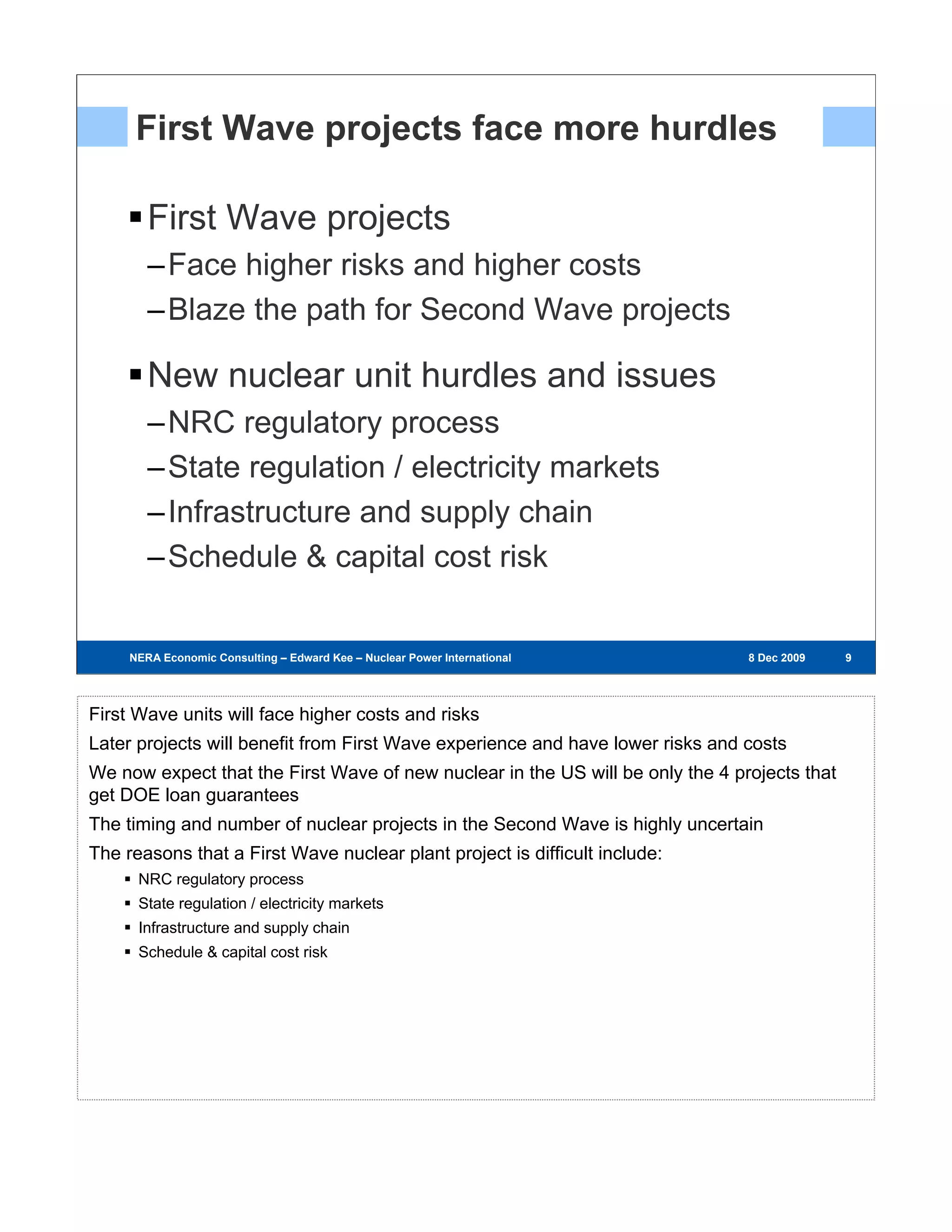
First Wave projects face more hurdles

        First Wave projects
        –Face higher risks and higher costs
        –Blaze the path for Second Wave projects

        New nuclear unit hurdles and issues
        –NRC regulatory process
        –State regulation / electricity markets
        –Infrastructure and supply chain
        –Schedule & capital cost risk


     NERA Economic Consulting – Edward Kee – Nuclear Power International – 8 Dec 2009   8 Dec 2009   999


First Wave units will face higher costs and risks
Later projects will benefit from First Wave experience and have lower risks and costs
We now expect that the First Wave of new nuclear in the US will be only the 4 projects that
get DOE loan guarantees
The timing and number of nuclear projects in the Second Wave is highly uncertain
The reasons that a First Wave nuclear plant project is difficult include:
      NRC regulatory process
      State regulation / electricity markets
      Infrastructure and supply chain
      Schedule & capital cost risk
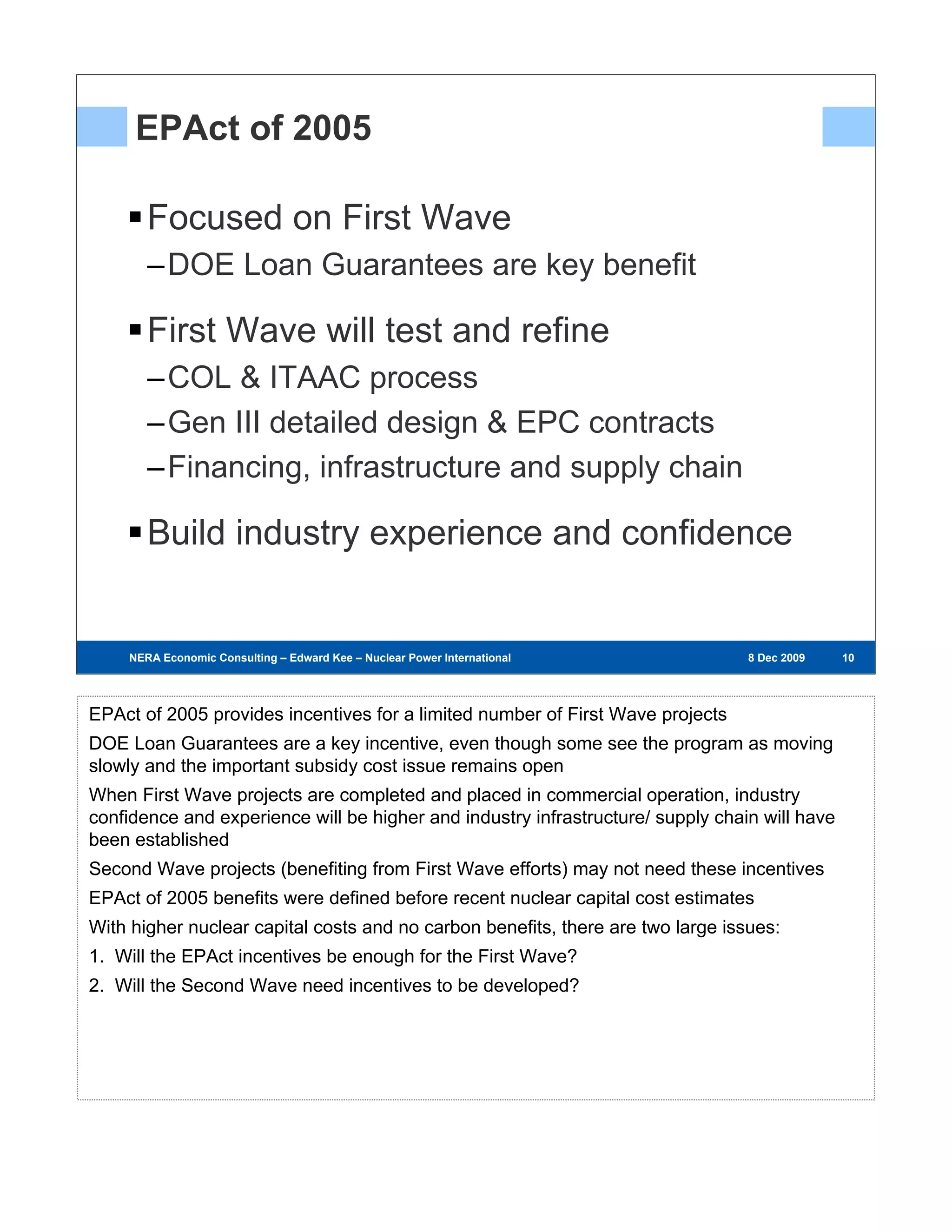
EPAct of 2005

       Focused on First Wave
       –DOE Loan Guarantees are key benefit

       First Wave will test and refine
       –COL & ITAAC process
       –Gen III detailed design & EPC contracts
       –Financing, infrastructure and supply chain

       Build industry experience and confidence


    NERA Economic Consulting – Edward Kee – Nuclear Power International – 8 Dec 2009   8 Dec 2009   10
                                                                                                     10
                                                                                                    10


EPAct of 2005 provides incentives for a limited number of First Wave projects
DOE Loan Guarantees are a key incentive, even though some see the program as moving
slowly and the important subsidy cost issue remains open
When First Wave projects are completed and placed in commercial operation, industry
confidence and experience will be higher and industry infrastructure/ supply chain will have
been established
Second Wave projects (benefiting from First Wave efforts) may not need these incentives
EPAct of 2005 benefits were defined before recent nuclear capital cost estimates
With higher nuclear capital costs and no carbon benefits, there are two large issues:
1. Will the EPAct incentives be enough for the First Wave?
2. Will the Second Wave need incentives to be developed?
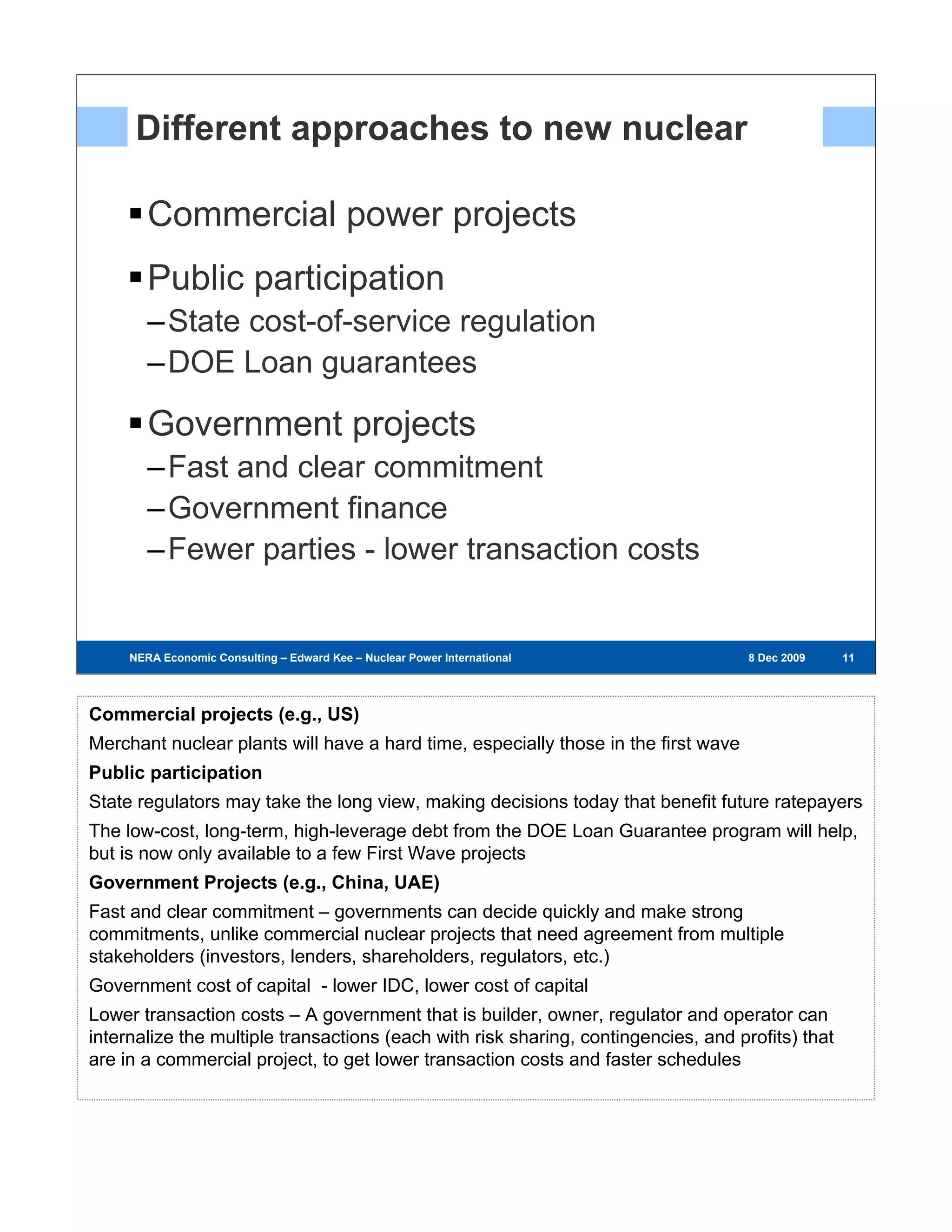
Different approaches to new nuclear

        Commercial power projects
        Public participation
        –State cost-of-service regulation
        –DOE Loan guarantees

        Government projects
        –Fast and clear commitment
        –Government finance
        –Fewer parties - lower transaction costs


     NERA Economic Consulting – Edward Kee – Nuclear Power International – 8 Dec 2009   8 Dec 2009   11
                                                                                                      11
                                                                                                     11


Commercial projects (e.g., US)
Merchant nuclear plants will have a hard time, especially those in the first wave
Public participation
State regulators may take the long view, making decisions today that benefit future ratepayers
The low-cost, long-term, high-leverage debt from the DOE Loan Guarantee program will help,
but is now only available to a few First Wave projects
Government Projects (e.g., China, UAE)
Fast and clear commitment – governments can decide quickly and make strong
commitments, unlike commercial nuclear projects that need agreement from multiple
stakeholders (investors, lenders, shareholders, regulators, etc.)
Government cost of capital - lower IDC, lower cost of capital
Lower transaction costs – A government that is builder, owner, regulator and operator can
internalize the multiple transactions (each with risk sharing, contingencies, and profits) that
are in a commercial project, to get lower transaction costs and faster schedules
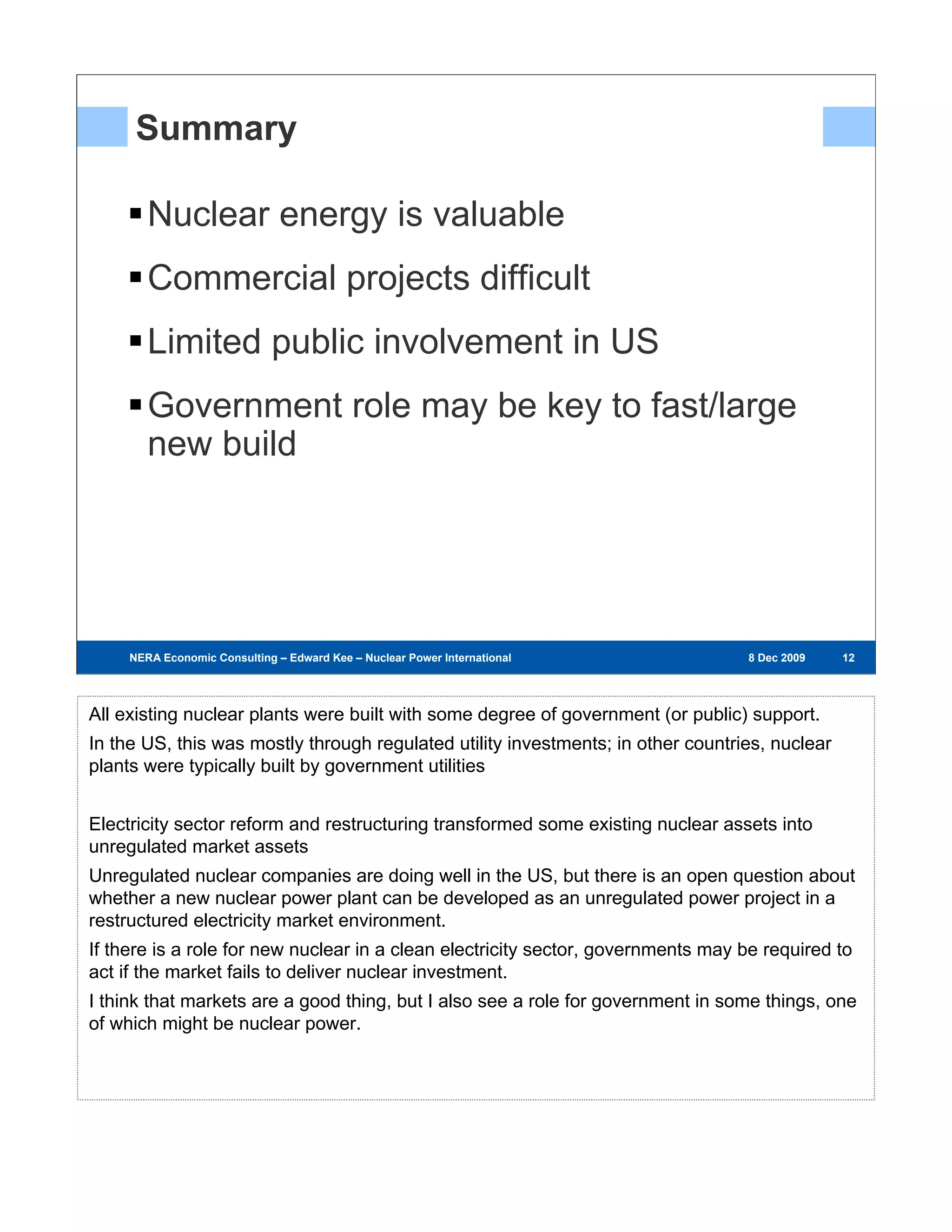
Summary

        Nuclear energy is valuable
        Commercial projects difficult
        Limited public involvement in US
        Government role may be key to fast/large
        new build


     NERA Economic Consulting – Edward Kee – Nuclear Power International – 8 Dec 2009   8 Dec 2009   12
                                                                                                      12
                                                                                                     12


All existing nuclear plants were built with some degree of government (or public) support.
In the US, this was mostly through regulated utility investments; in other countries, nuclear
plants were typically built by government utilities


Electricity sector reform and restructuring transformed some existing nuclear assets into
unregulated market assets
Unregulated nuclear companies are doing well in the US, but there is an open question about
whether a new nuclear power plant can be developed as an unregulated power project in a
restructured electricity market environment.
If there is a role for new nuclear in a clean electricity sector, governments may be required to
act if the market fails to deliver nuclear investment.
I think that markets are a good thing, but I also see a role for government in some things, one
of which might be nuclear power.
Contact us
     Auckland                     New York City
     Beijing                      Paris
                                                                              Edward Kee
                                                                              Vice President
     Boston                       Philadelphia
                                                                              NERA Economic Consulting
     Brussels                     Rome
                                                                              Washington, DC
     Chicago                      San Francisco
                                                                              +1 (202) 370-7713
     Denver                       Sao Paulo                                   edward.kee@nera.com
     Frankfurt                    Shanghai                                    www.nera.com
     Geneva                       Sydney
     Ithaca                       Tokyo
     London                       Toronto
     Los Angeles                  Washington, D.C.                                       Nuclear Power
                                                                                           – the next generation
     Madrid                       Wellington
     Melbourne                    White Plains


     © Copyright 2009 National Economic Research Associates, Inc. All rights reserved.

     NERA Economic Consulting – Edward Kee – Nuclear Power International – 8 Dec 2009                        8 Dec 2009   13
                                                                                                                           13
                                                                                                                          13


My work combines economics with expertise in nuclear power, electricity markets,
restructuring, regulation, private power, and related issues.

I provide strategic advice to companies and governments on issues related to the nuclear and
electricity industries. I also provide testimony as an expert witness on nuclear and electricity
industry issues.

I invite all of you to join the Linked-In group that I started:

“Nuclear Power – the next generation”

If you are already a member of Linked-In, go to the groups directory and search for “nuclear”

2009 12 08 Nuclear Power International Ed Kee Slides & Notes

  • 1.
    Economic Consulting GT Total Cost (Energy + Capacity) CT CC L CO A NUCLEAR Economics of Nuclear Power Nuclear Power International Las Vegas – 8 Dec 2009 Capacity Factor Edward Kee Vice President The nature of this panel means that I will present a few slides in a few minutes
  • 2.
    Disclaimer The slidesthat follow do not provide a complete record of this presentation and discussion. The views expressed in this presentation are mine; these views may not be the same as those held by our clients or by my colleagues. NERA Economic Consulting – Edward Kee – Nuclear Power International – 8 Dec 2009 8 Dec 2009 111
  • 3.
    Nuclear energy isvaluable Zero carbon energy Low cost energy High availability and reliability Profitable for unregulated owners Low rates for regulated utility and public power ratepayers NERA Economic Consulting – Edward Kee – Nuclear Power International – 8 Dec 2009 8 Dec 2009 222 Existing nuclear power plants are valuable resources Nuclear energy from these existing units is zero-carbon and low-cost Existing US nuclear power plants are operating well, with very high availability Existing nuclear power plants produce: significant profits for unregulated utility or merchant generation company owners low rates for customers of regulated and public power utility owners
  • 4.
    Nuclear has lowproduction costs 9 8 7 cents / kW h 6 5 4 3 2 1 0 1995 1996 1997 1998 1999 2000 2001 2002 2003 2004 2005 2006 2007 2008 Coal Gas Nuclear Source: NEI NERA Economic Consulting – Edward Kee – Nuclear Power International – 8 Dec 2009 8 Dec 2009 333 Nuclear’s low and stable production costs are a key advantage Marginal costs of nuclear energy are even lower, perhaps equal to zero Short-run marginal costs are the costs that change due to a small change in output for a short time period – for nuclear power plants, this is at or close to zero If carbon costs were included in fossil power plant costs, nuclear energy would be even more competitive Of course, production costs for gas generation are down this year. If there is a real shale- based gas bubble, there is a possibility of a return to the low and stable gas prices prior to 2000, but this seems unlikely.
  • 5.
    Nuclear plants havelong operating life Wind CT CCGT Nuclear 0 20 40 60 80 Typical operating life NERA Economic Consulting – Edward Kee – Nuclear Power International – 8 Dec 2009 8 Dec 2009 444 The long operating life of nuclear power plants is also a positive attribute. Nuclear units will have a long period of operation, much of it after capital recovery is completed Cash flows more than about 25 years into the future add little to NPV using any reasonable discount rates However, a 25-year old nuclear plant is a valuable and profitable asset (whether for shareholders of a non-regulated company or ratepayers of a regulated utility) A key challenge for the nuclear industry is how to make today’s shareholders/ratepayers happy about investing today’s dollars in new nuclear projects, when the upside is 25 years or more into the future This combination of high capital costs and a very long stream of benefits is one reason for a government role; Public utility regulators may make long-term planning decisions and governments often do so
  • 6.
    How do weget more nuclear energy? Increase output of existing plants –Improve performance –License renewal / life extension –Uprate Build new nuclear power plants NERA Economic Consulting – Edward Kee – Nuclear Power International – 8 Dec 2009 8 Dec 2009 555 The first way to get more nuclear energy is to work existing nuclear plants harder and longer Companies that developed a superior organizational approach to running nuclear power plants (e.g., Constellation, Dominion, Entergy, Exelon) were able to make money by transferring this institutional knowledge to other plants they acquired This nuclear “fixer-upper” strategy has gone well, but there are few fixer-uppers left in the US. Is it time for industry leaders to consider an international fixer-upper strategy? Most US nuclear units have already gotten NRC approval for a 20-year license renewal, most other units have applications in the review process. 80 year (or longer) life is not out of the question for existing nuclear plants Many US units have already received approval for uprates and have implemented them, with some units including extensive secondary plant re-works to accommodate higher electrical output. Other units have or will apply for uprates The second way to get more nuclear energy is to build new units - not so easy!
  • 7.
    Economics of newnuclear plants Nuclear plants have high value –Low energy cost –Long operating life Other factors work against new nuclear –Long lead time –High overnight capital cost –High degree of regulatory oversight NERA Economic Consulting – Edward Kee – Nuclear Power International – 8 Dec 2009 8 Dec 2009 666 We have already discussed the reasons that nuclear energy is valuable However, other factors of a nuclear power project may not fit well into commercial project development/project finance framework The long lead time and high overnight capital cost mean that new nuclear projects are: (a) very capital intensive; and (b) invested capital is at risk for a long time before revenue is received and before payback Also, the degree of regulatory oversight of nuclear projects and facilities (i.e., NRC) is much higher than other commercial power plant technologies. This raises cost and risk for developers, especially during the long development and construction phase when significant capital has been spent but before there is any revenue or profits
  • 8.
    Long lead time PV CT Wind CCGT Nuclear 0 4 8 12 Years prior to Operation Development Construction Source: EIA 2009 Annual Energy Outlook input assumptions for construction (lead time); development period is estimate NERA Economic Consulting – Edward Kee – Nuclear Power International – 8 Dec 2009 8 Dec 2009 777 Long lead time brings additional costs and risks IDC: Interest during construction (IDC) is much higher for nuclear, a combination of high capital cost and longer development/construction period. For a nuclear plant, the IDC may be almost as much as the overnight cost. A solution for investor-owned utilities is to get approval to put IDC into rates as it is incurred, rather than capitalizing the IDC and putting it into rate base at commercial operation External changes: The need for new capacity, the market price outlook or other factors may change during the 11 years (or more) between project inception and commercial operation. The shorter lead time for other technologies reduces this lead time and lowers this risk; an investor/utility relying on a CT or CCGT may be able to wait longer to commit, so that decisions can be made with additional (and better) information. Disruptions: Once a commitment to construction is made, the longer construction period for a nuclear plant may mean longer exposure to risk from disruptions
  • 9.
    High overnight capitalcost 6,000 5,000 4,000 $ / kWe 3,000 2,000 1,000 0 NUCLEAR Wind IGCC IGCC w/CCS PV Hydro Wind Offshore Biomass Fuel Cells Conv. Coal CCGT w/ CCS CT CCGT Geothermal Solar Thermal Source: EIA 2009 Annual Energy Outlook; 2008 overnight cost including contingency in 2007 $/kW; nuclear increased from $3,318 to $4,000 NERA Economic Consulting – Edward Kee – Nuclear Power International – 8 Dec 2009 8 Dec 2009 888 Nuclear is among the most capital intensive technologies, per unit of capacity output However, nuclear life-cycle costs in $/kWh are relatively low, a result of nuclear base load operation (high capacity factor due to very low marginal cost) and long operating life While nuclear overnight capital cost is not as high as some options (e.g., PV and fuel cells), it is significantly higher than CT, CCGT and conventional coal options $4,000/kWe used in this chart is only an estimate of overnight costs Until there is more experience with completed and operational nuclear plants, nuclear capital costs will be less certain than the capital costs of other generation technologies with significant completed project experience
  • 10.
    First Wave projectsface more hurdles First Wave projects –Face higher risks and higher costs –Blaze the path for Second Wave projects New nuclear unit hurdles and issues –NRC regulatory process –State regulation / electricity markets –Infrastructure and supply chain –Schedule & capital cost risk NERA Economic Consulting – Edward Kee – Nuclear Power International – 8 Dec 2009 8 Dec 2009 999 First Wave units will face higher costs and risks Later projects will benefit from First Wave experience and have lower risks and costs We now expect that the First Wave of new nuclear in the US will be only the 4 projects that get DOE loan guarantees The timing and number of nuclear projects in the Second Wave is highly uncertain The reasons that a First Wave nuclear plant project is difficult include: NRC regulatory process State regulation / electricity markets Infrastructure and supply chain Schedule & capital cost risk
  • 11.
    EPAct of 2005 Focused on First Wave –DOE Loan Guarantees are key benefit First Wave will test and refine –COL & ITAAC process –Gen III detailed design & EPC contracts –Financing, infrastructure and supply chain Build industry experience and confidence NERA Economic Consulting – Edward Kee – Nuclear Power International – 8 Dec 2009 8 Dec 2009 10 10 10 EPAct of 2005 provides incentives for a limited number of First Wave projects DOE Loan Guarantees are a key incentive, even though some see the program as moving slowly and the important subsidy cost issue remains open When First Wave projects are completed and placed in commercial operation, industry confidence and experience will be higher and industry infrastructure/ supply chain will have been established Second Wave projects (benefiting from First Wave efforts) may not need these incentives EPAct of 2005 benefits were defined before recent nuclear capital cost estimates With higher nuclear capital costs and no carbon benefits, there are two large issues: 1. Will the EPAct incentives be enough for the First Wave? 2. Will the Second Wave need incentives to be developed?
  • 12.
    Different approaches tonew nuclear Commercial power projects Public participation –State cost-of-service regulation –DOE Loan guarantees Government projects –Fast and clear commitment –Government finance –Fewer parties - lower transaction costs NERA Economic Consulting – Edward Kee – Nuclear Power International – 8 Dec 2009 8 Dec 2009 11 11 11 Commercial projects (e.g., US) Merchant nuclear plants will have a hard time, especially those in the first wave Public participation State regulators may take the long view, making decisions today that benefit future ratepayers The low-cost, long-term, high-leverage debt from the DOE Loan Guarantee program will help, but is now only available to a few First Wave projects Government Projects (e.g., China, UAE) Fast and clear commitment – governments can decide quickly and make strong commitments, unlike commercial nuclear projects that need agreement from multiple stakeholders (investors, lenders, shareholders, regulators, etc.) Government cost of capital - lower IDC, lower cost of capital Lower transaction costs – A government that is builder, owner, regulator and operator can internalize the multiple transactions (each with risk sharing, contingencies, and profits) that are in a commercial project, to get lower transaction costs and faster schedules
  • 13.
    Summary Nuclear energy is valuable Commercial projects difficult Limited public involvement in US Government role may be key to fast/large new build NERA Economic Consulting – Edward Kee – Nuclear Power International – 8 Dec 2009 8 Dec 2009 12 12 12 All existing nuclear plants were built with some degree of government (or public) support. In the US, this was mostly through regulated utility investments; in other countries, nuclear plants were typically built by government utilities Electricity sector reform and restructuring transformed some existing nuclear assets into unregulated market assets Unregulated nuclear companies are doing well in the US, but there is an open question about whether a new nuclear power plant can be developed as an unregulated power project in a restructured electricity market environment. If there is a role for new nuclear in a clean electricity sector, governments may be required to act if the market fails to deliver nuclear investment. I think that markets are a good thing, but I also see a role for government in some things, one of which might be nuclear power.
  • 14.
    Contact us Auckland New York City Beijing Paris Edward Kee Vice President Boston Philadelphia NERA Economic Consulting Brussels Rome Washington, DC Chicago San Francisco +1 (202) 370-7713 Denver Sao Paulo edward.kee@nera.com Frankfurt Shanghai www.nera.com Geneva Sydney Ithaca Tokyo London Toronto Los Angeles Washington, D.C. Nuclear Power – the next generation Madrid Wellington Melbourne White Plains © Copyright 2009 National Economic Research Associates, Inc. All rights reserved. NERA Economic Consulting – Edward Kee – Nuclear Power International – 8 Dec 2009 8 Dec 2009 13 13 13 My work combines economics with expertise in nuclear power, electricity markets, restructuring, regulation, private power, and related issues. I provide strategic advice to companies and governments on issues related to the nuclear and electricity industries. I also provide testimony as an expert witness on nuclear and electricity industry issues. I invite all of you to join the Linked-In group that I started: “Nuclear Power – the next generation” If you are already a member of Linked-In, go to the groups directory and search for “nuclear”