RENAISSANCE
CONTRIBUTIONS IN LITERATURE
RENAISSANCE LITERATURE
 Renaissance a new era in literature.
 Features-@ revival of classics,@ Humanism-human
problems, values, and human nature as themes.
 New life to literary forms like Drama, History, Poetry,
Philosophy, and Classical Secular literature.
• use of vernacular languages or the languages spoken by the people of a
region or country
• Latin was replaced with vernacular languages such as Italian, Spanish,
French, German, English, etc.
• The total number of books available in Europe till the late fifteenth
century was minimal. The first printed book, the Gutenberg's Bible, was
brought out in 1456.
• handwritten (manuscripts). They were copied in hand by scribes and
were primarily available in the libraries of the monasteries.
• In the first half of the fifteenth century, there were only about 100,000
manuscripts in Europe. Fifty years, time, after the introduction of the
printing press, there were nine million book
RENAISSANCE LITERATURE
• ITALY
• Early Renaissance period- The growth of the Italian
language and literature was very fast.
• The Italian language superseded Latin in Italy.
• Produced great humanist writers such as Petrarch,
Dante, Boccaccio, Ariosto, Machiavelli, etc.
RENAISSANCE LITERATURE
• Petrarch
• Poet from Florence- “Father of Humanism”- used
Italian language- themes from Roman classics-
followed classical writing styles
• Patronised by popes and rulers
• Important works- 'Sonnets to Laura' or ‘Laura’ and
'Letters to Ancient Authors'
RENAISSANCE LITERATURE
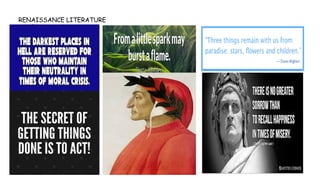
DANTE-Divine Comedy
RENAISSANCE LITERATURE
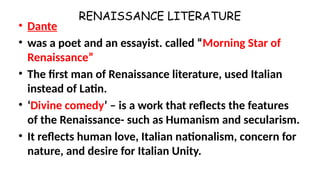
• Dante
• was a poet and an essayist. called “Morning Star of
Renaissance”
• The first man of Renaissance literature, used Italian
instead of Latin.
• ‘Divine comedy’ – is a work that reflects the features
of the Renaissance- such as Humanism and secularism.
• It reflects human love, Italian nationalism, concern for
nature, and desire for Italian Unity.
RENAISSANCE LITERATURE
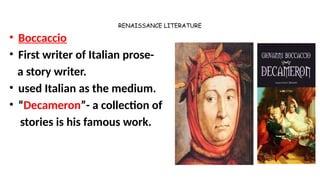
• Boccaccio
• First writer of Italian prose-
a story writer.
• used Italian as the medium.
• “Decameron”- a collection of
stories is his famous work.
RENAISSANCE LITERATURE
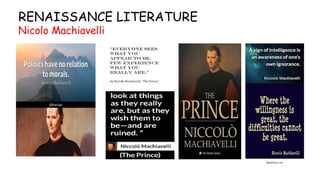
Nicolo Machiavelli
RENAISSANCE LITERATURE
• Nicolo Machiavelli
• Italian patriot and diplomat.
• Famous for his political treatise ‘The Prince’
• It became a Bible of kings and politicians who
advocate absolute power, written with the essence of
intense nationalism.
• It advocates Italian unity at any cost-translated to all
European languages.
RENAISSANCE LITERATURE
• It contains remarks like- “It is not necessary for a King to
be merciful, faithful, religious for that would make him
dangerously weak. But it is most necessary for him to seen
to be having these things”.
• “A good prince should know how to do wrong when
circumstances demand”.
• Influenced great leaders like Victor Emmanuel, Napoleon,
and Mussolini to build power.
RENAISSANCE LITERATURE
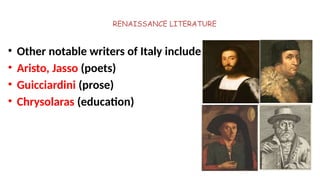
• Other notable writers of Italy include
• Aristo, Jasso (poets)
• Guicciardini (prose)
• Chrysolaras (education)
RENAISSANCE LITERATURE
England
• English Renaissance in literature started during the 16th
century
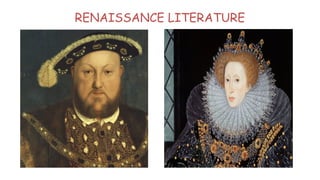
• Renaissance literature was in full bloom in England under
Henry VIII and Queen Elizabeth
• Both poets and prose writers were there.
• Due to the presence of a large number of poets, England was
rightly called “the land of Singing birds”
RENAISSANCE LITERATURE
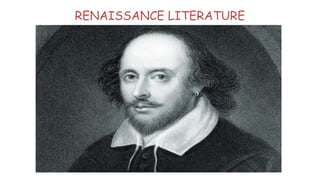
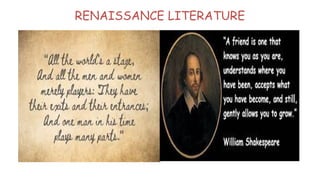
• William Shakespeare (1564-1616)
• Greatest English dramatist and greatest dramatist of all
times
• was a humanist –with an interest in the world and man.
• His works reflect the expression of eternal human
emotions, hopes, and aspirations like frustration in
love, crime, retribution, jealousy, corruption, etc.
RENAISSANCE LITERATURE
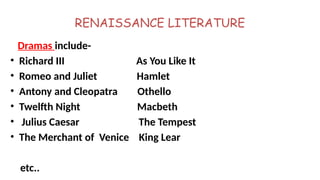
Dramas include-
• Richard III As You Like It
• Romeo and Juliet Hamlet
• Antony and Cleopatra Othello
• Twelfth Night Macbeth
• Julius Caesar The Tempest
• The Merchant of Venice King Lear
etc..
RENAISSANCE LITERATURE
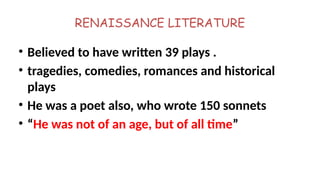
• Believed to have written 39 plays .
• tragedies, comedies, romances and historical
plays
• He was a poet also, who wrote 150 sonnets
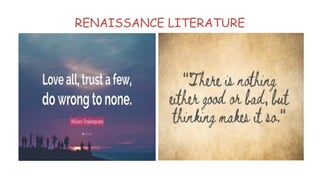
• “He was not of an age, but of all time”
RENAISSANCE LITERATURE
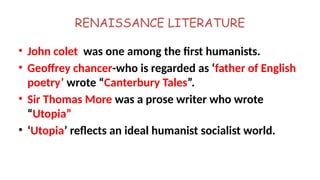
• John colet was one among the first humanists.
• Geoffrey chancer-who is regarded as ‘father of English
poetry’ wrote “Canterbury Tales”.
• Sir Thomas More was a prose writer who wrote
“Utopia”
• ‘Utopia’ reflects an ideal humanist socialist world.
RENAISSANCE LITERATURE
• Francis Bacon –was a prose writer
• He wrote The “New Atlantis”
• It dreams of an ideal world
• Bacon was a versatile genius- a man of letters,
statesman, lawyer, philosopher
• ‘Novum Organum’,his work is one of the earliest books
on science.
RENAISSANCE LITERATURE
• John Milton-wrote an epic poetry
“Paradise Lost”and later “Paradise Regained”
• Edmund Spencer was another Poet.
‘The Faerie Queen’ was a poem in praise of Elizabeth
• Ben Johson was a Dramatist
• A Tale of a Tub, The Isle of Dogs, The Case is Altered, Every Man
in His Humour, Every Man out of His Humour ,Cynthia's
Revels,Sejanus His Fall.
• Volpone, Epicoene, or the Silent Woman.
• The Alchemist.
RENAISSANCE LITERATURE
• Christopher Marlow -author of three great tragedies
• “Tamburcaine the Great”,“Doctor Faustus”and “The Rich Jew
of Malta”
• Other writers include
• John Donne, Herrick, Lovelace and Marvell (poets)
• Richard Hakluyt who wrote a famous travellogue “Principal
Navigations”
• Sidney Green, Beaumont, Fletcher.
RENAISSANCE LITERATURE
France
• Renaissance literature in full bloom in the 16th century
• Earliest scholars.
• Francious Rebelais – Humanist poet- wrote “Gargantua and
Pantagruel”
• He used humor as a weapon against clergy, Kings and Magistrates
• Ridiculed education system and the activities of church.
• Presented man as a being capable of solving his own problems
using rational thinking.
RENAISSANCE LITERATURE
• Micheal Montaigne
• First writer of modern essays, framed the structure of modern
essay.
• His Essays – (94 in number) touches every subject.
• Written in a direct, lucid style.
• Objectivity, detachment and tolerance were other qualities of
his essays.
• Still counted as model essays.
RENAISSANCE LITERATURE
Holland
• Dutch literature
• Desderius Erasmus
• Prince of Humanism-greatest of Humanist scholars
• A master of Greek and Latin
• Patronage of Pope Leo
• “In Praise of Folly”- wrote on the follies and superstitions of church
• Old Testament translated to Greek -tried to reform the church
from within -
RENAISSANCE LITERATURE
John Calvin :
• A man of reformation wrote- “Institutes of the
Christian Religion” in French
Jean Bodin-
• one of the founders of modern social science
• contribution in political science
• Introduced the idea of “sovereignty”-wrote “Republic”.
RENAISSANCE LITERATURE
Spain
• Miguael de Cervantes.
• Prose writer and satirist.
• wrote ‘Don Quixote’ – 2 Vols.
• Criticism of medieval customs and chivalry.
• Through the story of a lord Don Quixote and Sancho
Panza-many comic situations .
RENAISSANCE LITERATURE
Lope De Vega
• Founder of Spanish theatre
• Wrote more than 1000 dramas
• Enriched Spanish literature-witty, emotional and realistic plays.
Calderon
• was a writer of allegorical poems
Bartolomeo Casas
• First writer of Spanish history-History of the indies
Ignatius Loyola-man of counter reformation
• Wrote – “Spiritual Exercises”
RENAISSANCE LITERATURE
Germany
Martin Luther
• Bible translation to Germany
• wrote secular and religious prose also
Konrad Von Gesner
• Completed Grammar dictionaries in German ,helped growth of
language.
Portugal
• Camoens -wrote ‘Lusiades’
• A dramatic description of Vasco Da Gama’s voyages.
Thank You…

Renaissance contribution in Literature .

  • 1.
  • 2.
    RENAISSANCE LITERATURE  Renaissancea new era in literature.  Features-@ revival of classics,@ Humanism-human problems, values, and human nature as themes.  New life to literary forms like Drama, History, Poetry, Philosophy, and Classical Secular literature.
  • 3.
    • use ofvernacular languages or the languages spoken by the people of a region or country • Latin was replaced with vernacular languages such as Italian, Spanish, French, German, English, etc. • The total number of books available in Europe till the late fifteenth century was minimal. The first printed book, the Gutenberg's Bible, was brought out in 1456. • handwritten (manuscripts). They were copied in hand by scribes and were primarily available in the libraries of the monasteries. • In the first half of the fifteenth century, there were only about 100,000 manuscripts in Europe. Fifty years, time, after the introduction of the printing press, there were nine million book
  • 4.
    RENAISSANCE LITERATURE • ITALY •Early Renaissance period- The growth of the Italian language and literature was very fast. • The Italian language superseded Latin in Italy. • Produced great humanist writers such as Petrarch, Dante, Boccaccio, Ariosto, Machiavelli, etc.
  • 5.
  • 6.
    RENAISSANCE LITERATURE • Petrarch •Poet from Florence- “Father of Humanism”- used Italian language- themes from Roman classics- followed classical writing styles • Patronised by popes and rulers • Important works- 'Sonnets to Laura' or ‘Laura’ and 'Letters to Ancient Authors'
  • 7.
  • 8.
    RENAISSANCE LITERATURE • Dante •was a poet and an essayist. called “Morning Star of Renaissance” • The first man of Renaissance literature, used Italian instead of Latin. • ‘Divine comedy’ – is a work that reflects the features of the Renaissance- such as Humanism and secularism. • It reflects human love, Italian nationalism, concern for nature, and desire for Italian Unity.
  • 9.
    RENAISSANCE LITERATURE • Boccaccio •First writer of Italian prose- a story writer. • used Italian as the medium. • “Decameron”- a collection of stories is his famous work.
  • 10.
  • 11.
    RENAISSANCE LITERATURE • NicoloMachiavelli • Italian patriot and diplomat. • Famous for his political treatise ‘The Prince’ • It became a Bible of kings and politicians who advocate absolute power, written with the essence of intense nationalism. • It advocates Italian unity at any cost-translated to all European languages.
  • 12.
    RENAISSANCE LITERATURE • Itcontains remarks like- “It is not necessary for a King to be merciful, faithful, religious for that would make him dangerously weak. But it is most necessary for him to seen to be having these things”. • “A good prince should know how to do wrong when circumstances demand”. • Influenced great leaders like Victor Emmanuel, Napoleon, and Mussolini to build power.
  • 13.
    RENAISSANCE LITERATURE • Othernotable writers of Italy include • Aristo, Jasso (poets) • Guicciardini (prose) • Chrysolaras (education)
  • 14.
    RENAISSANCE LITERATURE England • EnglishRenaissance in literature started during the 16th century • Renaissance literature was in full bloom in England under Henry VIII and Queen Elizabeth • Both poets and prose writers were there. • Due to the presence of a large number of poets, England was rightly called “the land of Singing birds”
  • 15.
  • 16.
    RENAISSANCE LITERATURE • WilliamShakespeare (1564-1616) • Greatest English dramatist and greatest dramatist of all times • was a humanist –with an interest in the world and man. • His works reflect the expression of eternal human emotions, hopes, and aspirations like frustration in love, crime, retribution, jealousy, corruption, etc.
  • 17.
  • 18.
  • 19.
  • 20.
    RENAISSANCE LITERATURE Dramas include- •Richard III As You Like It • Romeo and Juliet Hamlet • Antony and Cleopatra Othello • Twelfth Night Macbeth • Julius Caesar The Tempest • The Merchant of Venice King Lear etc..
  • 21.
    RENAISSANCE LITERATURE • Believedto have written 39 plays . • tragedies, comedies, romances and historical plays • He was a poet also, who wrote 150 sonnets • “He was not of an age, but of all time”
  • 22.
    RENAISSANCE LITERATURE • Johncolet was one among the first humanists. • Geoffrey chancer-who is regarded as ‘father of English poetry’ wrote “Canterbury Tales”. • Sir Thomas More was a prose writer who wrote “Utopia” • ‘Utopia’ reflects an ideal humanist socialist world.
  • 23.
    RENAISSANCE LITERATURE • FrancisBacon –was a prose writer • He wrote The “New Atlantis” • It dreams of an ideal world • Bacon was a versatile genius- a man of letters, statesman, lawyer, philosopher • ‘Novum Organum’,his work is one of the earliest books on science.
  • 24.
    RENAISSANCE LITERATURE • JohnMilton-wrote an epic poetry “Paradise Lost”and later “Paradise Regained” • Edmund Spencer was another Poet. ‘The Faerie Queen’ was a poem in praise of Elizabeth • Ben Johson was a Dramatist • A Tale of a Tub, The Isle of Dogs, The Case is Altered, Every Man in His Humour, Every Man out of His Humour ,Cynthia's Revels,Sejanus His Fall. • Volpone, Epicoene, or the Silent Woman. • The Alchemist.
  • 25.
    RENAISSANCE LITERATURE • ChristopherMarlow -author of three great tragedies • “Tamburcaine the Great”,“Doctor Faustus”and “The Rich Jew of Malta” • Other writers include • John Donne, Herrick, Lovelace and Marvell (poets) • Richard Hakluyt who wrote a famous travellogue “Principal Navigations” • Sidney Green, Beaumont, Fletcher.
  • 26.
    RENAISSANCE LITERATURE France • Renaissanceliterature in full bloom in the 16th century • Earliest scholars. • Francious Rebelais – Humanist poet- wrote “Gargantua and Pantagruel” • He used humor as a weapon against clergy, Kings and Magistrates • Ridiculed education system and the activities of church. • Presented man as a being capable of solving his own problems using rational thinking.
  • 27.
    RENAISSANCE LITERATURE • MichealMontaigne • First writer of modern essays, framed the structure of modern essay. • His Essays – (94 in number) touches every subject. • Written in a direct, lucid style. • Objectivity, detachment and tolerance were other qualities of his essays. • Still counted as model essays.
  • 28.
    RENAISSANCE LITERATURE Holland • Dutchliterature • Desderius Erasmus • Prince of Humanism-greatest of Humanist scholars • A master of Greek and Latin • Patronage of Pope Leo • “In Praise of Folly”- wrote on the follies and superstitions of church • Old Testament translated to Greek -tried to reform the church from within -
  • 29.
    RENAISSANCE LITERATURE John Calvin: • A man of reformation wrote- “Institutes of the Christian Religion” in French Jean Bodin- • one of the founders of modern social science • contribution in political science • Introduced the idea of “sovereignty”-wrote “Republic”.
  • 30.
    RENAISSANCE LITERATURE Spain • Miguaelde Cervantes. • Prose writer and satirist. • wrote ‘Don Quixote’ – 2 Vols. • Criticism of medieval customs and chivalry. • Through the story of a lord Don Quixote and Sancho Panza-many comic situations .
  • 31.
    RENAISSANCE LITERATURE Lope DeVega • Founder of Spanish theatre • Wrote more than 1000 dramas • Enriched Spanish literature-witty, emotional and realistic plays. Calderon • was a writer of allegorical poems Bartolomeo Casas • First writer of Spanish history-History of the indies Ignatius Loyola-man of counter reformation • Wrote – “Spiritual Exercises”
  • 32.
    RENAISSANCE LITERATURE Germany Martin Luther •Bible translation to Germany • wrote secular and religious prose also Konrad Von Gesner • Completed Grammar dictionaries in German ,helped growth of language. Portugal • Camoens -wrote ‘Lusiades’ • A dramatic description of Vasco Da Gama’s voyages.
  • 33.