ENLIGHTENMENT PHILOSOPHERS
JOHN LOCKE
John Locke
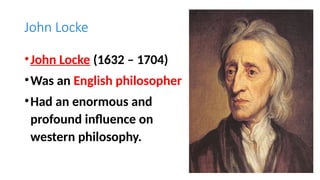
•John Locke (1632 – 1704)
•Was an English philosopher
•Had an enormous and
profound influence on
western philosophy.
John Locke
•Regarded as the founder of modern
philosophical empiricism, a concept that the
human mind is a blank slate at birth and that
knowledge is based on experience.
John Locke
•Locke is also considered as the father of the
political philosophy called Liberalism, which is
based on the principle of liberty and equality.
John Locke
•His major contribution to philosophy include
the development of social contract theory.
•Locke also made significant contributions to
the fields of theology, religious tolerance
and educational theory.
John Locke
•His book, 'An Essay Concerning Human
Understanding, is one of the most influential works
in philosophy
•In the book, Locke examines the human mind with
respect to its contents and operations to uncover the
basis of human knowledge and understanding.
•One of the most influential works with its ideas
deeply affecting subsequent philosophical thought.
John Locke
•He is regarded as the founder of modern philosophical
empiricism
•Empiricism is a theory that all knowledge is based on
experience derived from the senses.
• Locke postulated that, at birth, the mind was a 'tabula
rasa', a Latin phrase meaning “blank slate”.
•He maintained that humans are born without innate
ideas; and data is added and rules for processing are
formed solely by one’s sensory experiences.
John Locke
•He wrote the influential political work 'Two
Treatises of Government'
•This work discusses Patriarchalism,the nature
of government, conquest and slavery, property
and right of revolution.
John Locke
•He developed the 'labour theory of property'
•This theory was a forerunner to the famous
labour theory of value of Karl Marx.
• His political views influenced the American
Declaration of Independence
John Locke
• According to him, rulers have an obligation to be
responsive to the needs and desires of the citizens;
no ruler can claim absolute power; and, most
importantly, citizens are obliged to revolt and
overthrow any government that fails to secure their
natural rights.
•Regarded as the philosophical basis of the American
Declaration of Independence.
John Locke
•John Locke is considered the Father of Liberalism
•Liberalism is a political philosophy or worldview
founded on ideas of liberty and equality.
•Liberalism rejected the prevailing social and political
norms of hereditary privilege, state religion,
absolute monarchy, and the divine right of kings.
John Locke
•views strongly influenced European education in the 18th
century
•Locke was regarded as an expert on educational matters.
• His most important work in the field is 'Some Thoughts
Concerning Education'
John Locke
• His religious writings had a substantial influence on
Protestant Christian thought
• In his book,' The Reasonableness of Christianity’, he says :
• “To be a true Christian and worthy of salvation, an individual
only needs to believe one simple truth: that Jesus is the
Messiah.”
• and that “every individual has within him the abilities
necessary to comprehend his duty and to achieve salvation”
John Locke
•He argued for religious tolerance.
•John Locke formulated a classic reasoning for religious
tolerance which can be seen in his “Letters Concerning
Toleration” .
•“Enforcing a single religion would have an adverse effect
as faith cannot be compelled by violence; and coercing
religious uniformity would lead to more social disorder
than allowing diversity.”
John Locke
•John Locke is considered the first philosopher of the Age
of Enlightenment. He hugely effected subsequent
western thought and his influence remains even three
centuries after his death.
John Locke
Thank You.....

JOHN LOCKE, IDEAS, CONCEPTS, THEORY and WORK

  • 1.
  • 2.
    John Locke •John Locke(1632 – 1704) •Was an English philosopher •Had an enormous and profound influence on western philosophy.
  • 3.
    John Locke •Regarded asthe founder of modern philosophical empiricism, a concept that the human mind is a blank slate at birth and that knowledge is based on experience.
  • 4.
    John Locke •Locke isalso considered as the father of the political philosophy called Liberalism, which is based on the principle of liberty and equality.
  • 5.
    John Locke •His majorcontribution to philosophy include the development of social contract theory. •Locke also made significant contributions to the fields of theology, religious tolerance and educational theory.
  • 6.
    John Locke •His book,'An Essay Concerning Human Understanding, is one of the most influential works in philosophy •In the book, Locke examines the human mind with respect to its contents and operations to uncover the basis of human knowledge and understanding. •One of the most influential works with its ideas deeply affecting subsequent philosophical thought.
  • 7.
    John Locke •He isregarded as the founder of modern philosophical empiricism •Empiricism is a theory that all knowledge is based on experience derived from the senses. • Locke postulated that, at birth, the mind was a 'tabula rasa', a Latin phrase meaning “blank slate”. •He maintained that humans are born without innate ideas; and data is added and rules for processing are formed solely by one’s sensory experiences.
  • 8.
    John Locke •He wrotethe influential political work 'Two Treatises of Government' •This work discusses Patriarchalism,the nature of government, conquest and slavery, property and right of revolution.
  • 9.
    John Locke •He developedthe 'labour theory of property' •This theory was a forerunner to the famous labour theory of value of Karl Marx. • His political views influenced the American Declaration of Independence
  • 10.
    John Locke • Accordingto him, rulers have an obligation to be responsive to the needs and desires of the citizens; no ruler can claim absolute power; and, most importantly, citizens are obliged to revolt and overthrow any government that fails to secure their natural rights. •Regarded as the philosophical basis of the American Declaration of Independence.
  • 11.
    John Locke •John Lockeis considered the Father of Liberalism •Liberalism is a political philosophy or worldview founded on ideas of liberty and equality. •Liberalism rejected the prevailing social and political norms of hereditary privilege, state religion, absolute monarchy, and the divine right of kings.
  • 12.
    John Locke •views stronglyinfluenced European education in the 18th century •Locke was regarded as an expert on educational matters. • His most important work in the field is 'Some Thoughts Concerning Education'
  • 13.
    John Locke • Hisreligious writings had a substantial influence on Protestant Christian thought • In his book,' The Reasonableness of Christianity’, he says : • “To be a true Christian and worthy of salvation, an individual only needs to believe one simple truth: that Jesus is the Messiah.” • and that “every individual has within him the abilities necessary to comprehend his duty and to achieve salvation”
  • 14.
    John Locke •He arguedfor religious tolerance. •John Locke formulated a classic reasoning for religious tolerance which can be seen in his “Letters Concerning Toleration” . •“Enforcing a single religion would have an adverse effect as faith cannot be compelled by violence; and coercing religious uniformity would lead to more social disorder than allowing diversity.”
  • 15.
    John Locke •John Lockeis considered the first philosopher of the Age of Enlightenment. He hugely effected subsequent western thought and his influence remains even three centuries after his death.
  • 16.