Can You Remove
Negative Memories?
Matt Kendall
Tonight is personal development
Not group therapy/neuroscience
Before we begin
• Those with mental health issues or medical
conditions should refrain from participation of
the exercises
• Please ask questions
• IEMT is a alternative/complementary therapy
No Phones Please
• I need your full attention
• All the slides will be sent out to you
• Just sit back and relax
What we are covering
• The different types of memory
• Belief systems
• Memory and time
• Memory Structure
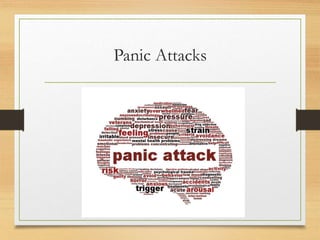
• Understanding panic attacks
• IEMT and it’s applications
My Background
Client Work
• PTSD and Trauma recovery
• Helping people to become productive
• IEMT Training
So why I Do I These Talks?
• Because people are in pain, and they don’t
have to be.
• The NHS provides amazing services,
however waiting lists can be long.
• By learning and applying these techniques, it
can radically improve your quality of life
• Put you into a position of control
We are living in
traumatic times
My own personal mission
• Hopefully some of what I share can be of help.
• I want to teach these skills to as many people as
possible
• So people can lead a life with less pain and more
enjoyment
Past success stories
• A guy went for an “embarrassing” GP appointment
and had an early prostate cancer diagnosis.
• A women finally let go her past marriage, met a new
partner and they are expecting their first child
• A guy spoke with his brother for the first time in 8
years
• A women passed her driving test after 15 previous
attempts
The 4 exercises we are doing
• Reduce the impact of a troublesome memory
• Help to resolve a ruminating memory/issue
• Reprocess a upsetting memory
• Reduce an unwanted emotion
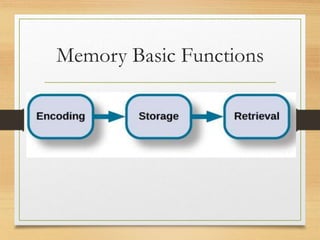
Memory Basic Functions
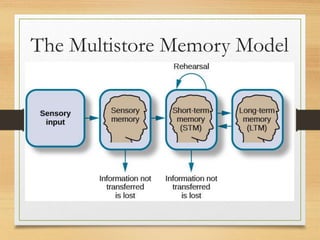
The Multistore Memory Model
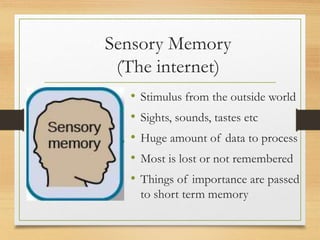
Sensory Memory
(The internet)
• Stimulus from the outside world
• Sights, sounds, tastes etc
• Huge amount of data to process
• Most is lost or not remembered
• Things of importance are passed
to short term memory
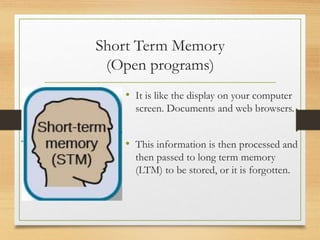
Short Term Memory
(Open programs)
• It is like the display on your computer
screen. Documents and web browsers.
• This information is then processed and
then passed to long term memory
(LTM) to be stored, or it is forgotten.
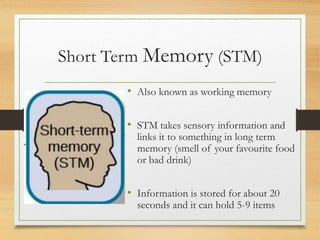
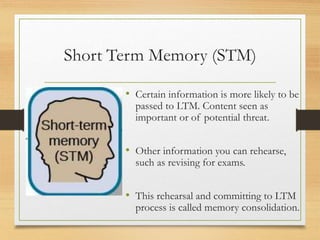
Short Term Memory (STM)
• Also known as working memory
• STM takes sensory information and
links it to something in long term
memory (smell of your favourite food
or bad drink)
• Information is stored for about 20
seconds and it can hold 5-9 items
Short Term Memory (STM)
• Certain information is more likely to be
passed to LTM. Content seen as
important or of potential threat.
• Other information you can rehearse,
such as revising for exams.
• This rehearsal and committing to LTM
process is called memory consolidation.
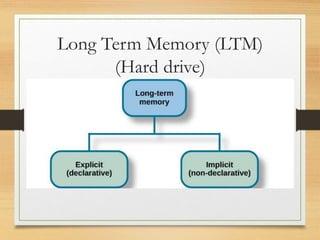
Long Term Memory (LTM)
(Hard drive)
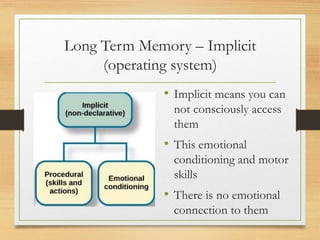
Long Term Memory – Implicit
(operating system)
• Implicit means you can
not consciously access
them
• This emotional
conditioning and motor
skills
• There is no emotional
connection to them
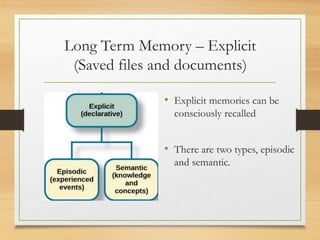
Long Term Memory – Explicit
(Saved files and documents)
• Explicit memories can be
consciously recalled
• There are two types, episodic
and semantic.
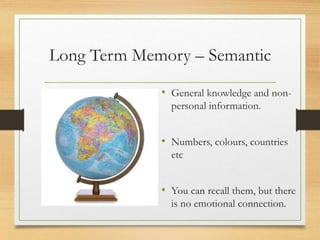
Long Term Memory – Semantic
• General knowledge and non-
personal information.
• Numbers, colours, countries
etc
• You can recall them, but there
is no emotional connection.
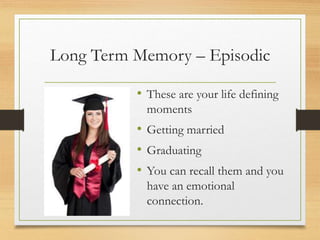
Long Term Memory – Episodic
• These are your life defining
moments
• Getting married
• Graduating
• You can recall them and you
have an emotional
connection.
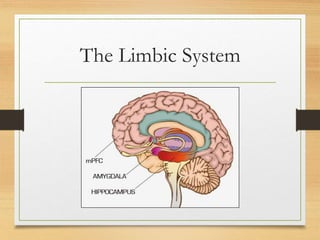
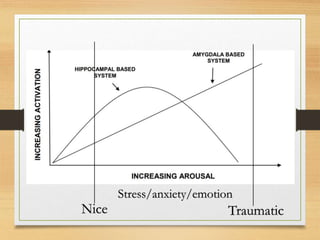
The Limbic System
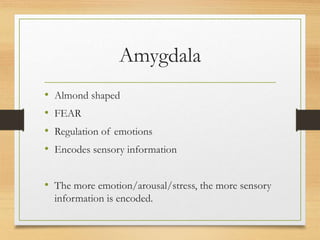
Amygdala
• Almond shaped
• FEAR
• Regulation of emotions
• Encodes sensory information
• The more emotion/arousal/stress, the more sensory
information is encoded.
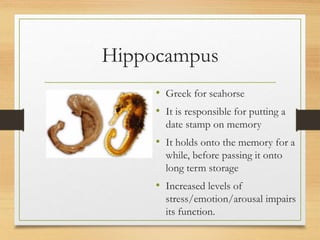
Hippocampus
• Greek for seahorse
• It is responsible for putting a
date stamp on memory
• It holds onto the memory for a
while, before passing it onto
long term storage
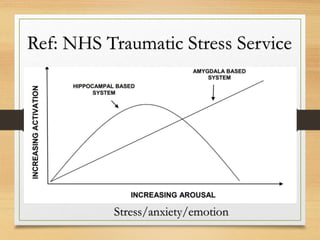
• Increased levels of
stress/emotion/arousal impairs
its function.
Stress/anxiety/emotion
Ref: NHS Traumatic Stress Service
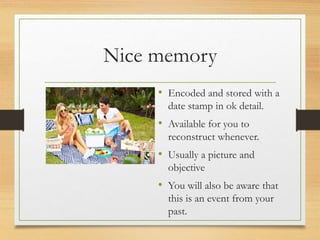
Nice memory
• Encoded and stored with a
date stamp in ok detail.
• Available for you to
reconstruct whenever.
• Usually a picture and
objective
• You will also be aware that
this is an event from your
past.
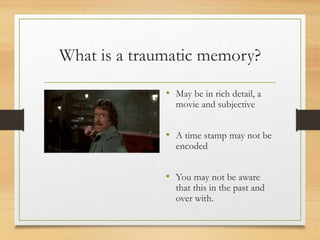
What is a traumatic memory?
• May be in rich detail, a
movie and subjective
• A time stamp may not be
encoded
• You may not be aware
that this in the past and
over with.
How untreated trauma effects us
• As a result your brain will be working as though the event is
about to happen again now.
• You will be aware that you are on “red alert” and that you
will react suddenly to “cues” or “triggers” that are possible
reminders of the traumatic event.
• People can seem always “on edge”, nervous, shy and always
under threat.
Stress/anxiety/emotion
Nice Traumatic
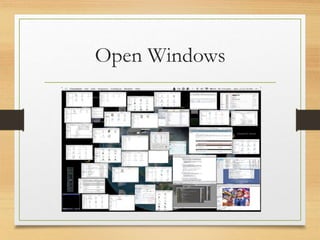
Open Windows
Minimised Windows
• A traumatic memory can be considered as
a minimised window on your computer
• It is there, not filed away properly
• Can be easily open by triggers
• Can cause flashbacks and intrusive
thoughts, like pop ups.
Personal
Development
Ahead
So Why Do We Have Memory?
• To keep us alive and away from danger
• We remember what we have learned,
especially if it is a threat to our safety
• So we know how to act, feel and
respond to stimuli and our surrounding.
Early Development
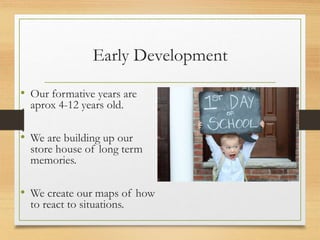
• Our formative years are
aprox 4-12 years old.
• We are building up our
store house of long term
memories.
• We create our maps of how
to react to situations.
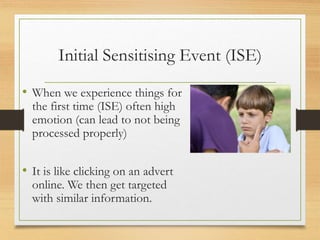
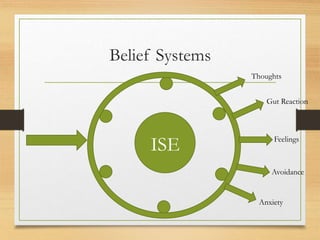
Initial Sensitising Event (ISE)
• When we experience things for
the first time (ISE) often high
emotion (can lead to not being
processed properly)
• It is like clicking on an advert
online. We then get targeted
with similar information.
Belief Systems
ISE
Thoughts
Gut Reaction
Feelings
Avoidance
Anxiety
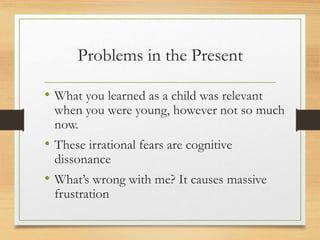
Problems in the Present
• What you learned as a child was relevant
when you were young, however not so much
now.
• These irrational fears are cognitive
dissonance
• What’s wrong with me? It causes massive
frustration
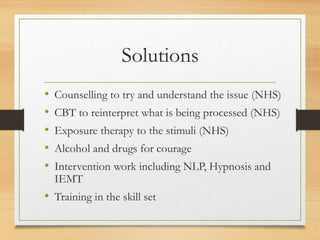
Solutions
• Counselling to try and understand the issue (NHS)
• CBT to reinterpret what is being processed (NHS)
• Exposure therapy to the stimuli (NHS)
• Alcohol and drugs for courage
• Intervention work including NLP, Hypnosis and
IEMT
• Training in the skill set
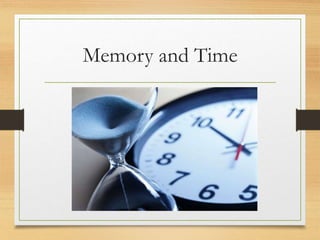
Memory and Time
Is Time Moving More Quickly?
• Three theories are;
• David Icke says “We are living in a vortex
that is controlled by our reptilian overlords
and they are speeding up time to control us”
• That we review time at certain points and see
a year as a percentage
• We are simply creating less long term
memories as we age
A year as a %
• When you are 10, 1 year is 10% of your
life
• When you are 50, 1 year is 2% of your
life
• We think of a year at two points in
time: NYE and birthdays
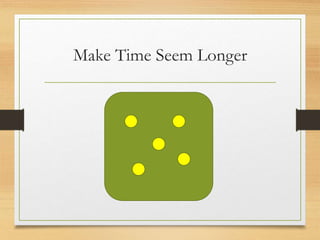
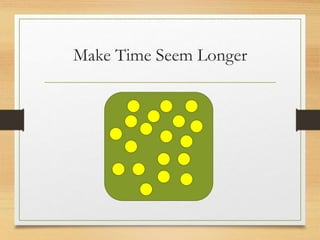
Less Long Term Memories
• Another theory is that we are producing less long
term memories
• We tend to live routine lives and therefore don’t
create as many long term memories as when we
were young
• Be creating more, it would make time seem
longer in retrospect
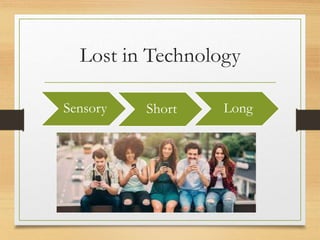
Lost in Technology
Sensory Short Long
Make Time Seem Longer
Make Nice Long Term Memories
• Do things that are different
• Has elevated emotion (excitement, pushing
boundaries)
• Also work to reduce your anxiety so you can be
more present
• Put the phone away and engage with the
sensory information
Create great change
• By learning and applying these tools to old
memories you can start to break down
patterns and beliefs.
• See it as an opportunity to change your
actions!
• Reduced emotions + action = massive change
Are you 180 Degrees Out?
• From my experience I have found that a lot of
people are 180 degrees out when trying to
solve problems
• People who live in the past
• People who live in the future
• People who are trying hard to be “present”
• All are escapism
Positive Personal Development
• To actively work on past negative memories and
emotions
• Whilst constantly adding new long term
memories.
• Choose a direction in life, use IEMT on
blockages
• Carefully monitor yourself so you can measure
the changes
The 3 ways to change memory
• You can manually reduce the sensory
information
• You can manually introduce a time stamp and
extra content
• You can reprocess it using IEMT/EMDR
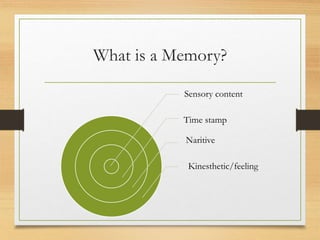
What is a Memory?
Sensory content
Time stamp
Kinesthetic/feeling
Naritive
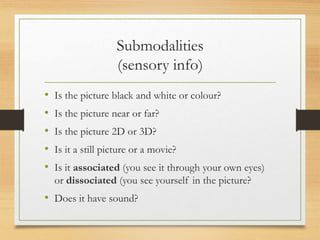
Submodalities
(sensory info)
• Is the picture black and white or colour?
• Is the picture near or far?
• Is the picture 2D or 3D?
• Is it a still picture or a movie?
• Is it associated (you see it through your own eyes)
or dissociated (you see yourself in the picture?
• Does it have sound?
Exercise Part 1
• Ask a partner about a troublesome memory.
• Is it a picture or a movie?
• Does it have sound?
• It is subjective or objective?
• Is it near or far away?
• Out of 10, how strong is the emotion?
Exercise Part 2
• Now begin to change the submodalities.
• Picture or a movie? Change it
• Does it have sound? Make it quieter or louder
• It is subjective or objective? Change it
• Distance? Move it closer and further away
• Out of 10, how strong is the emotion? Observe
Submodality Work
• If your memory is a movie, associated, bright, close
and with sound
• It will have a much higher emotional impact (0/10)
• At home you can experiment with your own
submodalities to lessen the emotional impact
• Make sure to record things and what progress you
make
Ruminating Memory
(time stamp)
Ruminating Memory/Decision
• Leaving a job/not taking a job
• Leaving a partner/staying in a relationship
• Not going to university
• Saying the wrong thing to someone
• I wish I had done something different
• We imagine what we missed out on
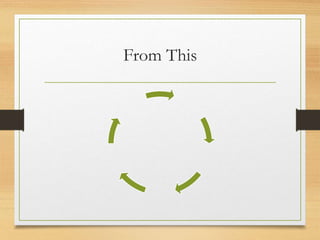
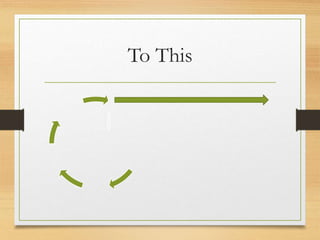
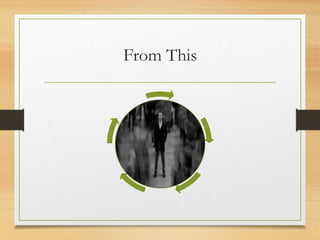
Ruminating Memory/issue
• Memories that we ruminate tend to start in the same
place, build up to a climax and then stop.
• Then then loop and start at the same point again.
• Thinking about something does not help! People
often go “internal” and problems worsen.
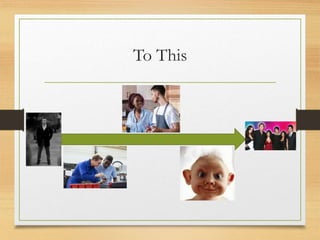
• Instead, we need to create an exit and put it in it’s
place in time.
From This
To This
Adding Time & Content
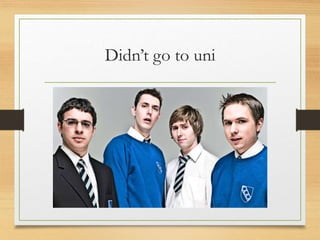
Didn’t go to uni
Got an apprenticeship
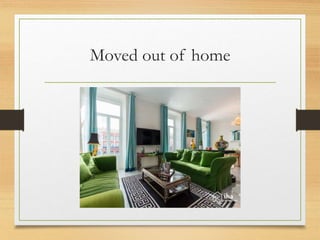
Moved out of home
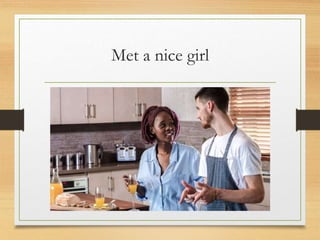
Met a nice girl
Went travelling
To the best cities in the world!
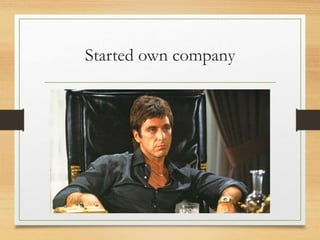
Started own company
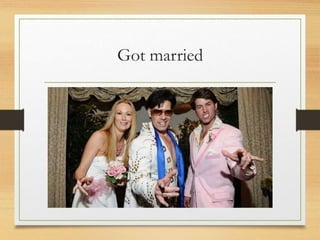
Got married
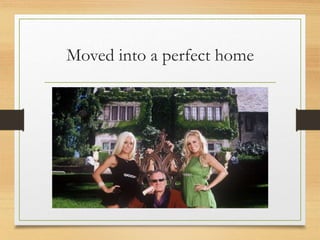
Moved into a perfect home
Started a family
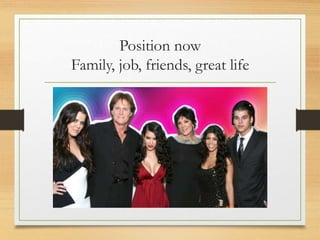
Position now
Family, job, friends, great life
So, when you think of not going
to uni now, what is it like?
From This
To This
Your Turn
• With a partner, ask them if they ruminate on a memory
or decision.
• Asked them what positive things they did afterwards in
time blocks (not consequences of the issue)
• Keep adding time and content until you reach the
present day
• Then ask when they think of the memory now, what is
it like?
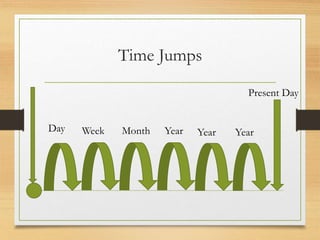
Time Jumps
Present Day
Day Week Month Year Year Year
Panic Attacks
Panic Attacks
• Panic is a future based issue. We are worrying
about what is going to happen.
• We project our future through past experiences.
• What if what if what if? We catastrophise and
cause overwhelm
• People then start to worry about having panic
attacks, which is a problem in itself
Panic Attacks
• Prevention is better than cure . Close the
open tabs!
• By working on your old negative
memories and issues with the tools you
learn tonight, it should alleviate a lot of
anxiety
• That will then prevent it from developing
into an attack
Reduce Panic – Mindfulness
• One thing you can do, is to practice
mindfulness.
• Simply start saying what is around you.
• Bring your attention outwards, instead
of inwards
Reduce Panic – Physical
• Also create physical sensation. Simple
technique is to rub your toes inside your
shoes
• Daily exercise, reduce caffeine, less screen
time
• Another technique is to tap out the rhythm
of the anxiety, then consciously lower it
IEMT
(Intergral Eye Movement Therapy)
• Emotional imprinting occurs when a person
lays down a new kinesthetic response to an
experience. This teaches the person how to feel
about certain things.
• IEMT addresses and resolves the question,
"how did this person learn to feel this way
about this thing?"
Changing Perception & IEMT
• IEMT allows the client to observe life
defining moments from the perspective
of who they are today
• The emotional connection, significance
and visual recall all tend to diminish and
have predictable outcomes.
Exercise – Memory 1
• With a partner, ask them if they have a negative or
upsetting memory (nothing to traumatic)
• Ask them for a label e.g. The school yard
• Ask if it is a picture or a movie
• Ask if it is a subjective or objective
• How clear and in focus is it
• Out of 10, how strong is the emotion
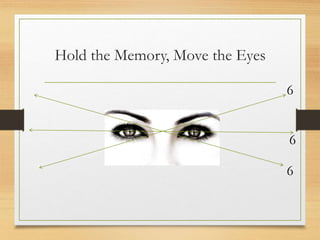
Hold the Memory, Move the Eyes
6
6
6
Predictable Outcomes
• The memory is harder to retrieve
• Movies turn into a picture, or at least broken up
• Pictures are harder to get, seem faded out
• The memory seems further away
• The emotion level drops
• The memory loses significance
Best Outcome
Exercise – Memory 2
• Repeat the exercise on a DIFFERENT
memory
• Move the eyes x 6
• Recalibrate
• Hold what is left - Move the eyes again x 6
Finding the Imprint
• IEMT does NOT work on emotion
• It does however use emotion to locate the
imprint, which you then use the IEMT
process on
Unwanted emotions
• Anxiety and stress are not real emotions, they are an
overstimulation of the nervous system.
• Instead, good emotions to use are; guilt, regret, anger,
frustration.
• We often have guilt and anger cycles. Always anxious!
Exercise
• With a partner, ask;
• Do you have an unwanted feeling you want to reduce?
• How strong is the emotion when you think of it? ( /10)
• How familiar is this feeling?
• When was the first time you can remember feeling this
way?
• Allow them to locate the memory, then move the eyes.
Allow their mind to wander.
Result
• When you now think of the feeling
• It should seem less intense
• More manageable
• And it should be less overwhelming
Can I Do This on Myself?
• To get the best results I
recommend you work with a
certified IEMT Practitioner.
• Failing that, teach someone what to
do to you.
• Ask to “borrow their finger”
Why I Love IEMT
• Having used different therapy models,
I just love the way IEMT works
• It is content free, which means you
DO NOT talk about the content, just
the structure
• It works with most of the people,
most of the time
IEMT Training
• I run 6-8 trainings per year in London
• I get 2 types of people attending;
• Those who are therapists and want to add
to their skills, or want to get into therapy
• Those who just want to work on
themselves
Private Sessions
• I offer in person sessions from my clinic in
London Bridge
• Also sessions online
• I see people for 2 – 3 sessions max
• Anxiety, trauma, PTSD, emotional
problems
• I basically “Marie Kondo” your head
Thank you
• Thank you for your time
• I hope you enjoyed the talk and got some
useful information
• I hope to see you again for future talks and
presentations
• Please do rate and give feedback for this event
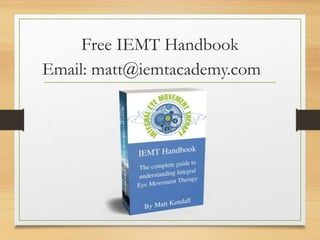
Free IEMT Handbook
Email: matt@iemtacademy.com
Keep in Contact
Facebook: Themattkendall
LinkedIn: Matt Kendall
YouTube: The Matt Kendall
Email: matt@iemtacademy.com
Remove negative memories Manchester October

Remove negative memories Manchester October

  • 1.
    Can You Remove NegativeMemories? Matt Kendall
  • 2.
    Tonight is personaldevelopment Not group therapy/neuroscience
  • 3.
    Before we begin •Those with mental health issues or medical conditions should refrain from participation of the exercises • Please ask questions • IEMT is a alternative/complementary therapy
  • 4.
    No Phones Please •I need your full attention • All the slides will be sent out to you • Just sit back and relax
  • 5.
    What we arecovering • The different types of memory • Belief systems • Memory and time • Memory Structure • Understanding panic attacks • IEMT and it’s applications
  • 6.
  • 7.
    Client Work • PTSDand Trauma recovery • Helping people to become productive • IEMT Training
  • 8.
    So why IDo I These Talks? • Because people are in pain, and they don’t have to be. • The NHS provides amazing services, however waiting lists can be long. • By learning and applying these techniques, it can radically improve your quality of life • Put you into a position of control
  • 9.
    We are livingin traumatic times
  • 10.
    My own personalmission • Hopefully some of what I share can be of help. • I want to teach these skills to as many people as possible • So people can lead a life with less pain and more enjoyment
  • 11.
    Past success stories •A guy went for an “embarrassing” GP appointment and had an early prostate cancer diagnosis. • A women finally let go her past marriage, met a new partner and they are expecting their first child • A guy spoke with his brother for the first time in 8 years • A women passed her driving test after 15 previous attempts
  • 12.
    The 4 exerciseswe are doing • Reduce the impact of a troublesome memory • Help to resolve a ruminating memory/issue • Reprocess a upsetting memory • Reduce an unwanted emotion
  • 14.
  • 15.
  • 16.
    Sensory Memory (The internet) •Stimulus from the outside world • Sights, sounds, tastes etc • Huge amount of data to process • Most is lost or not remembered • Things of importance are passed to short term memory
  • 17.
    Short Term Memory (Openprograms) • It is like the display on your computer screen. Documents and web browsers. • This information is then processed and then passed to long term memory (LTM) to be stored, or it is forgotten.
  • 18.
    Short Term Memory(STM) • Also known as working memory • STM takes sensory information and links it to something in long term memory (smell of your favourite food or bad drink) • Information is stored for about 20 seconds and it can hold 5-9 items
  • 19.
    Short Term Memory(STM) • Certain information is more likely to be passed to LTM. Content seen as important or of potential threat. • Other information you can rehearse, such as revising for exams. • This rehearsal and committing to LTM process is called memory consolidation.
  • 20.
    Long Term Memory(LTM) (Hard drive)
  • 21.
    Long Term Memory– Implicit (operating system) • Implicit means you can not consciously access them • This emotional conditioning and motor skills • There is no emotional connection to them
  • 22.
    Long Term Memory– Explicit (Saved files and documents) • Explicit memories can be consciously recalled • There are two types, episodic and semantic.
  • 23.
    Long Term Memory– Semantic • General knowledge and non- personal information. • Numbers, colours, countries etc • You can recall them, but there is no emotional connection.
  • 24.
    Long Term Memory– Episodic • These are your life defining moments • Getting married • Graduating • You can recall them and you have an emotional connection.
  • 25.
  • 26.
    Amygdala • Almond shaped •FEAR • Regulation of emotions • Encodes sensory information • The more emotion/arousal/stress, the more sensory information is encoded.
  • 27.
    Hippocampus • Greek forseahorse • It is responsible for putting a date stamp on memory • It holds onto the memory for a while, before passing it onto long term storage • Increased levels of stress/emotion/arousal impairs its function.
  • 28.
  • 29.
    Nice memory • Encodedand stored with a date stamp in ok detail. • Available for you to reconstruct whenever. • Usually a picture and objective • You will also be aware that this is an event from your past.
  • 30.
    What is atraumatic memory? • May be in rich detail, a movie and subjective • A time stamp may not be encoded • You may not be aware that this in the past and over with.
  • 31.
    How untreated traumaeffects us • As a result your brain will be working as though the event is about to happen again now. • You will be aware that you are on “red alert” and that you will react suddenly to “cues” or “triggers” that are possible reminders of the traumatic event. • People can seem always “on edge”, nervous, shy and always under threat.
  • 32.
  • 33.
  • 34.
    Minimised Windows • Atraumatic memory can be considered as a minimised window on your computer • It is there, not filed away properly • Can be easily open by triggers • Can cause flashbacks and intrusive thoughts, like pop ups.
  • 35.
  • 36.
    So Why DoWe Have Memory? • To keep us alive and away from danger • We remember what we have learned, especially if it is a threat to our safety • So we know how to act, feel and respond to stimuli and our surrounding.
  • 37.
    Early Development • Ourformative years are aprox 4-12 years old. • We are building up our store house of long term memories. • We create our maps of how to react to situations.
  • 38.
    Initial Sensitising Event(ISE) • When we experience things for the first time (ISE) often high emotion (can lead to not being processed properly) • It is like clicking on an advert online. We then get targeted with similar information.
  • 39.
  • 41.
    Problems in thePresent • What you learned as a child was relevant when you were young, however not so much now. • These irrational fears are cognitive dissonance • What’s wrong with me? It causes massive frustration
  • 42.
    Solutions • Counselling totry and understand the issue (NHS) • CBT to reinterpret what is being processed (NHS) • Exposure therapy to the stimuli (NHS) • Alcohol and drugs for courage • Intervention work including NLP, Hypnosis and IEMT • Training in the skill set
  • 43.
  • 44.
    Is Time MovingMore Quickly? • Three theories are; • David Icke says “We are living in a vortex that is controlled by our reptilian overlords and they are speeding up time to control us” • That we review time at certain points and see a year as a percentage • We are simply creating less long term memories as we age
  • 45.
    A year asa % • When you are 10, 1 year is 10% of your life • When you are 50, 1 year is 2% of your life • We think of a year at two points in time: NYE and birthdays
  • 46.
    Less Long TermMemories • Another theory is that we are producing less long term memories • We tend to live routine lives and therefore don’t create as many long term memories as when we were young • Be creating more, it would make time seem longer in retrospect
  • 47.
  • 48.
  • 49.
  • 50.
    Make Nice LongTerm Memories • Do things that are different • Has elevated emotion (excitement, pushing boundaries) • Also work to reduce your anxiety so you can be more present • Put the phone away and engage with the sensory information
  • 51.
    Create great change •By learning and applying these tools to old memories you can start to break down patterns and beliefs. • See it as an opportunity to change your actions! • Reduced emotions + action = massive change
  • 52.
    Are you 180Degrees Out? • From my experience I have found that a lot of people are 180 degrees out when trying to solve problems • People who live in the past • People who live in the future • People who are trying hard to be “present” • All are escapism
  • 53.
    Positive Personal Development •To actively work on past negative memories and emotions • Whilst constantly adding new long term memories. • Choose a direction in life, use IEMT on blockages • Carefully monitor yourself so you can measure the changes
  • 54.
    The 3 waysto change memory • You can manually reduce the sensory information • You can manually introduce a time stamp and extra content • You can reprocess it using IEMT/EMDR
  • 55.
    What is aMemory? Sensory content Time stamp Kinesthetic/feeling Naritive
  • 56.
    Submodalities (sensory info) • Isthe picture black and white or colour? • Is the picture near or far? • Is the picture 2D or 3D? • Is it a still picture or a movie? • Is it associated (you see it through your own eyes) or dissociated (you see yourself in the picture? • Does it have sound?
  • 57.
    Exercise Part 1 •Ask a partner about a troublesome memory. • Is it a picture or a movie? • Does it have sound? • It is subjective or objective? • Is it near or far away? • Out of 10, how strong is the emotion?
  • 58.
    Exercise Part 2 •Now begin to change the submodalities. • Picture or a movie? Change it • Does it have sound? Make it quieter or louder • It is subjective or objective? Change it • Distance? Move it closer and further away • Out of 10, how strong is the emotion? Observe
  • 59.
    Submodality Work • Ifyour memory is a movie, associated, bright, close and with sound • It will have a much higher emotional impact (0/10) • At home you can experiment with your own submodalities to lessen the emotional impact • Make sure to record things and what progress you make
  • 60.
  • 61.
    Ruminating Memory/Decision • Leavinga job/not taking a job • Leaving a partner/staying in a relationship • Not going to university • Saying the wrong thing to someone • I wish I had done something different • We imagine what we missed out on
  • 62.
    Ruminating Memory/issue • Memoriesthat we ruminate tend to start in the same place, build up to a climax and then stop. • Then then loop and start at the same point again. • Thinking about something does not help! People often go “internal” and problems worsen. • Instead, we need to create an exit and put it in it’s place in time.
  • 63.
  • 64.
  • 65.
  • 66.
  • 67.
  • 68.
  • 69.
  • 70.
    Went travelling To thebest cities in the world!
  • 71.
  • 72.
  • 73.
    Moved into aperfect home
  • 74.
  • 75.
    Position now Family, job,friends, great life
  • 76.
    So, when youthink of not going to uni now, what is it like?
  • 77.
  • 78.
  • 79.
    Your Turn • Witha partner, ask them if they ruminate on a memory or decision. • Asked them what positive things they did afterwards in time blocks (not consequences of the issue) • Keep adding time and content until you reach the present day • Then ask when they think of the memory now, what is it like?
  • 80.
    Time Jumps Present Day DayWeek Month Year Year Year
  • 81.
  • 82.
    Panic Attacks • Panicis a future based issue. We are worrying about what is going to happen. • We project our future through past experiences. • What if what if what if? We catastrophise and cause overwhelm • People then start to worry about having panic attacks, which is a problem in itself
  • 83.
    Panic Attacks • Preventionis better than cure . Close the open tabs! • By working on your old negative memories and issues with the tools you learn tonight, it should alleviate a lot of anxiety • That will then prevent it from developing into an attack
  • 84.
    Reduce Panic –Mindfulness • One thing you can do, is to practice mindfulness. • Simply start saying what is around you. • Bring your attention outwards, instead of inwards
  • 85.
    Reduce Panic –Physical • Also create physical sensation. Simple technique is to rub your toes inside your shoes • Daily exercise, reduce caffeine, less screen time • Another technique is to tap out the rhythm of the anxiety, then consciously lower it
  • 86.
    IEMT (Intergral Eye MovementTherapy) • Emotional imprinting occurs when a person lays down a new kinesthetic response to an experience. This teaches the person how to feel about certain things. • IEMT addresses and resolves the question, "how did this person learn to feel this way about this thing?"
  • 87.
    Changing Perception &IEMT • IEMT allows the client to observe life defining moments from the perspective of who they are today • The emotional connection, significance and visual recall all tend to diminish and have predictable outcomes.
  • 88.
    Exercise – Memory1 • With a partner, ask them if they have a negative or upsetting memory (nothing to traumatic) • Ask them for a label e.g. The school yard • Ask if it is a picture or a movie • Ask if it is a subjective or objective • How clear and in focus is it • Out of 10, how strong is the emotion
  • 89.
    Hold the Memory,Move the Eyes 6 6 6
  • 90.
    Predictable Outcomes • Thememory is harder to retrieve • Movies turn into a picture, or at least broken up • Pictures are harder to get, seem faded out • The memory seems further away • The emotion level drops • The memory loses significance
  • 91.
  • 92.
    Exercise – Memory2 • Repeat the exercise on a DIFFERENT memory • Move the eyes x 6 • Recalibrate • Hold what is left - Move the eyes again x 6
  • 93.
    Finding the Imprint •IEMT does NOT work on emotion • It does however use emotion to locate the imprint, which you then use the IEMT process on
  • 94.
    Unwanted emotions • Anxietyand stress are not real emotions, they are an overstimulation of the nervous system. • Instead, good emotions to use are; guilt, regret, anger, frustration. • We often have guilt and anger cycles. Always anxious!
  • 95.
    Exercise • With apartner, ask; • Do you have an unwanted feeling you want to reduce? • How strong is the emotion when you think of it? ( /10) • How familiar is this feeling? • When was the first time you can remember feeling this way? • Allow them to locate the memory, then move the eyes. Allow their mind to wander.
  • 96.
    Result • When younow think of the feeling • It should seem less intense • More manageable • And it should be less overwhelming
  • 97.
    Can I DoThis on Myself? • To get the best results I recommend you work with a certified IEMT Practitioner. • Failing that, teach someone what to do to you. • Ask to “borrow their finger”
  • 98.
    Why I LoveIEMT • Having used different therapy models, I just love the way IEMT works • It is content free, which means you DO NOT talk about the content, just the structure • It works with most of the people, most of the time
  • 99.
    IEMT Training • Irun 6-8 trainings per year in London • I get 2 types of people attending; • Those who are therapists and want to add to their skills, or want to get into therapy • Those who just want to work on themselves
  • 100.
    Private Sessions • Ioffer in person sessions from my clinic in London Bridge • Also sessions online • I see people for 2 – 3 sessions max • Anxiety, trauma, PTSD, emotional problems • I basically “Marie Kondo” your head
  • 101.
    Thank you • Thankyou for your time • I hope you enjoyed the talk and got some useful information • I hope to see you again for future talks and presentations • Please do rate and give feedback for this event
  • 102.
    Free IEMT Handbook Email:matt@iemtacademy.com
  • 103.
    Keep in Contact Facebook:Themattkendall LinkedIn: Matt Kendall YouTube: The Matt Kendall Email: matt@iemtacademy.com