Final Assignment
Zain Ul Abideen Mustafa
LEARNING HOW TO LEARN.
FINAL ASSIGNMENT
LEARNING HOW TO LEARN.
FINAL ASSIGNMENT
Learning has Never been an easy task
It takes weeks to decide weather to go
for a new thing and months for some
Practical work and years to become
professional.
This Presentation won’t change something
but the methods discussed CAN
So,
Fasten your Seat Belts.
LEARNING HOW TO LEARN.
FINAL ASSIGNMENT
1. Memory
2. Chunking
3. Procrastination
TOPICS
LEARNING HOW TO LEARN.
FINAL ASSIGNMENT
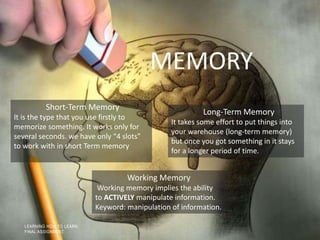
Short-Term Memory
It is the type that you use firstly to
memorize something. It works only for
several seconds. we have only “4 slots”
to work with in short Term memory
Long-Term Memory
It takes some effort to put things into
your warehouse (long-term memory)
but once you got something in it stays
for a longer period of time.
MEMORY
Working Memory
Working memory implies the ability
to ACTIVELY manipulate information.
Keyword: manipulation of information.
LEARNING HOW TO LEARN.
FINAL ASSIGNMENT
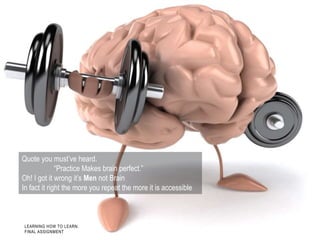
Quote you must’ve heard.
“Practice Makes brain perfect.”
Oh! I got it wrong it’s Men not Brain
In fact it right the more you repeat the more it is accessible
LEARNING HOW TO LEARN.
FINAL ASSIGNMENT
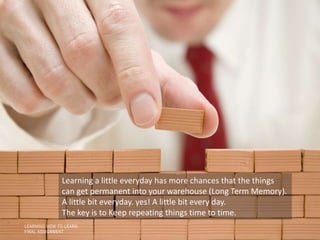
Learning a little everyday has more chances that the things
can get permanent into your warehouse (Long Term Memory).
A little bit everyday. yes! A little bit every day.
The key is to Keep repeating things time to time.
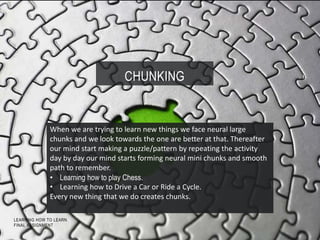
CHUNKING
LEARNING HOW TO LEARN.
FINAL ASSIGNMENT
When we are trying to learn new things we face neural large
chunks and we look towards the one are better at that. Thereafter
our mind start making a puzzle/pattern by repeating the activity
day by day our mind starts forming neural mini chunks and smooth
path to remember.
• Learning how to play Chess.
• Learning how to Drive a Car or Ride a Cycle.
Every new thing that we do creates chunks.
LEARNING HOW TO LEARN.
FINAL ASSIGNMENT
• Remember why we are creating chunks.
• This is not a "just do it" mindless approach also have to
try to connect this with the larger Chunks.
• Simply Focus without distraction
• Understand the basic idea.
• gain contexts, so we could see not only how but also
when to use the chunks
KEY POINTS
PATH TO SUCCESS WITH CHUNKS
LEARNING HOW TO LEARN.
FINAL ASSIGNMENT
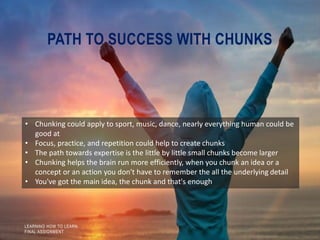
• Chunking could apply to sport, music, dance, nearly everything human could be
good at
• Focus, practice, and repetition could help to create chunks
• The path towards expertise is the little by little small chunks become larger
• Chunking helps the brain run more efficiently, when you chunk an idea or a
concept or an action you don't have to remember the all the underlying detail
• You've got the main idea, the chunk and that's enough
NEXT BIG THING
LEARNING HOW TO LEARN.
FINAL ASSIGNMENT
So far we have discussed what is memory and what are the different
memory types now the next million dollar question is
“how we can learn”
It doesn’t how weak a person is in learning new things/Subjects Following
techniques will help.
LEARNING HOW TO LEARN.
FINAL ASSIGNMENT
o When we have something we really rather not to do, it activates certain
area in the brain called insular cortex, which associate the activity with
pain.
o Our brain looks way to stop that pain from happening, so it switches to
something else with more pleasure
LEARNING HOW TO LEARN.
FINAL ASSIGNMENT
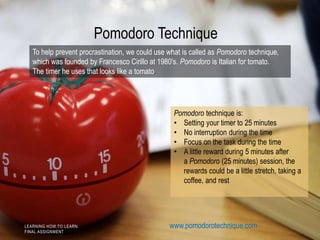
To help prevent procrastination, we could use what is called as Pomodoro technique,
which was founded by Francesco Cirillo at 1980's. Pomodoro is Italian for tomato.
The timer he uses that looks like a tomato.
Pomodoro Technique
Pomodoro technique is:
• Setting your timer to 25 minutes
• No interruption during the time
• Focus on the task during the time
• A little reward during 5 minutes after
a Pomodoro (25 minutes) session, the
rewards could be a little stretch, taking a
coffee, and rest
www.pomodorotechnique.com
LEARNING HOW TO LEARN.
FINAL ASSIGNMENT
LEARNING HOW TO LEARN.
FINAL ASSIGNMENT
THANKS FOR LEARNING ABOUT LEARNING 
LEARNING HOW TO LEARN.
FINAL ASSIGNMENT
CREDITS:
LEARNING HOW TO LEARN.
FINAL ASSIGNMENT
Content:
https://www.coursera.com
https://class.coursera.org/learning-003
Photos:
https://christcenteredchristianity.files.wordpress.com/2012/06/interlocking-puzzle-pieces.jpg
http://createart4good.org/wp-content/uploads/2013/11/missing-puzzle-piece.jpg
https://scontent-b-cdg.xx.fbcdn.net/hphotos-xpa1/v/t1.0-
9/1915592_190630612364_1597183_n.jpg?oh=e4d643286b069f517ab8b8a54f47aa18&oe=555E0995
http://itechthereforeiam.com/wp-content/uploads/2013/11/brick-by-brick.jpg
http://familyfriendlysearch.com/wp-content/uploads/memoryloss-620x400.jpg
http://www.semel.ucla.edu/sites/all/files/users/user-412/dreamstime_xxl_17754591%20(2).jpg
http://etfovoice.ca/wp-content/uploads/2014/01/Nutrition-for-school-learning-pic1.jpg
http://www.edpsoftware.com/images//2013/12/pomodoro1.jpg
http://thesuperslice.com/wp-content/uploads/2012/03/procrastination1.png
http://cdn.geekwire.com/wp-content/uploads/procrastinate-bigstock_Procrastination_29308502.jpg
http://www.jmlalonde.com/wp-content/uploads/2013/08/Procrastination-Doodle.jpg
https://d3f1iyfxxz8i1e.cloudfront.net/courses/course_image/2099a0f4bc08.png
http://www.ucira.ucsb.edu/wp-content/files_flutter/1357593636_3_1_1_1_news-image.jpg
http://cdn10.techchange.org/wp-content/uploads/2013/02/Coursera-Logo-cropped1.jpg
https://blog.compete.com/wp-content/uploads/2014/04/success.jpg
Special Thanks To:
• Coursera
• University of California, San Diego
• Dr. Barbara Oakley
• Dr. Terrence Sejnowski

Final Assignment, Learning How to Learn, Coursera

  • 1.
    Final Assignment Zain UlAbideen Mustafa LEARNING HOW TO LEARN. FINAL ASSIGNMENT
  • 2.
    LEARNING HOW TOLEARN. FINAL ASSIGNMENT Learning has Never been an easy task It takes weeks to decide weather to go for a new thing and months for some Practical work and years to become professional. This Presentation won’t change something but the methods discussed CAN So, Fasten your Seat Belts.
  • 3.
    LEARNING HOW TOLEARN. FINAL ASSIGNMENT 1. Memory 2. Chunking 3. Procrastination TOPICS
  • 4.
    LEARNING HOW TOLEARN. FINAL ASSIGNMENT Short-Term Memory It is the type that you use firstly to memorize something. It works only for several seconds. we have only “4 slots” to work with in short Term memory Long-Term Memory It takes some effort to put things into your warehouse (long-term memory) but once you got something in it stays for a longer period of time. MEMORY Working Memory Working memory implies the ability to ACTIVELY manipulate information. Keyword: manipulation of information.
  • 5.
    LEARNING HOW TOLEARN. FINAL ASSIGNMENT Quote you must’ve heard. “Practice Makes brain perfect.” Oh! I got it wrong it’s Men not Brain In fact it right the more you repeat the more it is accessible
  • 6.
    LEARNING HOW TOLEARN. FINAL ASSIGNMENT Learning a little everyday has more chances that the things can get permanent into your warehouse (Long Term Memory). A little bit everyday. yes! A little bit every day. The key is to Keep repeating things time to time.
  • 7.
    CHUNKING LEARNING HOW TOLEARN. FINAL ASSIGNMENT When we are trying to learn new things we face neural large chunks and we look towards the one are better at that. Thereafter our mind start making a puzzle/pattern by repeating the activity day by day our mind starts forming neural mini chunks and smooth path to remember. • Learning how to play Chess. • Learning how to Drive a Car or Ride a Cycle. Every new thing that we do creates chunks.
  • 8.
    LEARNING HOW TOLEARN. FINAL ASSIGNMENT • Remember why we are creating chunks. • This is not a "just do it" mindless approach also have to try to connect this with the larger Chunks. • Simply Focus without distraction • Understand the basic idea. • gain contexts, so we could see not only how but also when to use the chunks KEY POINTS
  • 9.
    PATH TO SUCCESSWITH CHUNKS LEARNING HOW TO LEARN. FINAL ASSIGNMENT • Chunking could apply to sport, music, dance, nearly everything human could be good at • Focus, practice, and repetition could help to create chunks • The path towards expertise is the little by little small chunks become larger • Chunking helps the brain run more efficiently, when you chunk an idea or a concept or an action you don't have to remember the all the underlying detail • You've got the main idea, the chunk and that's enough
  • 10.
    NEXT BIG THING LEARNINGHOW TO LEARN. FINAL ASSIGNMENT So far we have discussed what is memory and what are the different memory types now the next million dollar question is “how we can learn” It doesn’t how weak a person is in learning new things/Subjects Following techniques will help.
  • 11.
    LEARNING HOW TOLEARN. FINAL ASSIGNMENT o When we have something we really rather not to do, it activates certain area in the brain called insular cortex, which associate the activity with pain. o Our brain looks way to stop that pain from happening, so it switches to something else with more pleasure
  • 12.
    LEARNING HOW TOLEARN. FINAL ASSIGNMENT To help prevent procrastination, we could use what is called as Pomodoro technique, which was founded by Francesco Cirillo at 1980's. Pomodoro is Italian for tomato. The timer he uses that looks like a tomato. Pomodoro Technique Pomodoro technique is: • Setting your timer to 25 minutes • No interruption during the time • Focus on the task during the time • A little reward during 5 minutes after a Pomodoro (25 minutes) session, the rewards could be a little stretch, taking a coffee, and rest www.pomodorotechnique.com
  • 13.
    LEARNING HOW TOLEARN. FINAL ASSIGNMENT
  • 14.
    LEARNING HOW TOLEARN. FINAL ASSIGNMENT
  • 15.
    THANKS FOR LEARNINGABOUT LEARNING  LEARNING HOW TO LEARN. FINAL ASSIGNMENT
  • 16.
    CREDITS: LEARNING HOW TOLEARN. FINAL ASSIGNMENT Content: https://www.coursera.com https://class.coursera.org/learning-003 Photos: https://christcenteredchristianity.files.wordpress.com/2012/06/interlocking-puzzle-pieces.jpg http://createart4good.org/wp-content/uploads/2013/11/missing-puzzle-piece.jpg https://scontent-b-cdg.xx.fbcdn.net/hphotos-xpa1/v/t1.0- 9/1915592_190630612364_1597183_n.jpg?oh=e4d643286b069f517ab8b8a54f47aa18&oe=555E0995 http://itechthereforeiam.com/wp-content/uploads/2013/11/brick-by-brick.jpg http://familyfriendlysearch.com/wp-content/uploads/memoryloss-620x400.jpg http://www.semel.ucla.edu/sites/all/files/users/user-412/dreamstime_xxl_17754591%20(2).jpg http://etfovoice.ca/wp-content/uploads/2014/01/Nutrition-for-school-learning-pic1.jpg http://www.edpsoftware.com/images//2013/12/pomodoro1.jpg http://thesuperslice.com/wp-content/uploads/2012/03/procrastination1.png http://cdn.geekwire.com/wp-content/uploads/procrastinate-bigstock_Procrastination_29308502.jpg http://www.jmlalonde.com/wp-content/uploads/2013/08/Procrastination-Doodle.jpg https://d3f1iyfxxz8i1e.cloudfront.net/courses/course_image/2099a0f4bc08.png http://www.ucira.ucsb.edu/wp-content/files_flutter/1357593636_3_1_1_1_news-image.jpg http://cdn10.techchange.org/wp-content/uploads/2013/02/Coursera-Logo-cropped1.jpg https://blog.compete.com/wp-content/uploads/2014/04/success.jpg Special Thanks To: • Coursera • University of California, San Diego • Dr. Barbara Oakley • Dr. Terrence Sejnowski

Editor's Notes