Removable Prosthesis Retainer Systems
William M. Baum, MDT, CDT
Bill@BaumDental.com
“All partial dentures have two things in common. First, they must be
supported by oral tissues. Second, they must be retained against
reasonable dislodging forces.”
-William L. McCracken, DDS
Bill Baum MDT, CDT
Retainer Systems Designs can be-
• Intra or Extra-Coronal
• Precision or Semi-Precision
• Locking or Non-Locking
Dentists must take into account jaw relationships, residual ridge form, occlusal
schemes, major and minor connector designs and placement, as well as the
patient’s desires and dexterity when selecting a retainer system.
Proper design selection and fabrication is paramount to achieve success!
Clasps, precision attachments, semi-precision attachments, and bars are
removable partial denture retainer systems. Retainer systems are used in
prosthetic dentistry to facilitate the selective placement and removal of
prosthetic components. They affect the manner in which occlusal forces are
transmitted to supportative structures
Bill Baum MDT, CDT
Removable Partial Dentures
Long Span Fixed Bridge
Long Canter-leaver Bridge??
What’s The Difference??
The wonder of Removable Partial Dentures is that when properly
designed and fabricated, they possess the ability to distribute load
among supporting abutment teeth, implants, residual ridges and
palette.
Conversely, when improperly designed and/or fabricated their leaver
arms can magnify these forces and hasten the loss of teeth and other
supporting structures.
Bill Baum MDT, CDT
Lever Systems
Class 1
Class 2
Class 3
See saw
Wheel barrel
Tweezers
Retentive
arm
Restseat
Bill Baum MDT, CDT
Rotation
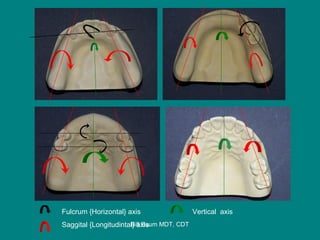
All Removable Partial Dentures Rotate
•Tooth borne Removable Partial Dentures are better able to resist
rotational forces
•Extension Base Partial Dentures also rotate around a fulcrum line
“T o a great extent, the forces occurring through a removable
prosthesis can be widely distributed, directed, and minimized by
the selection, the design, and the location of components of the
removable partial denture and by development of a harmonious
occlusion.”
-William L. McCracken, DDS
Bill Baum MDT, CDT
Fulcrum {Horizontal} axis
Saggital {Longitudintal} axis
Vertical axis
Bill Baum MDT, CDT
Management of Rotation
• Fulcrum Line -
Horizontal Axis
– Impression procedures
– Residual ridge contour
– Adaptation of denture
base to ridge
– Placement of direct and
indirect retainers
– Material used in retainer
system
– Major connector design
{maxillary}
– Occlusal outline form
{attachments}
Bill Baum MDT, CDT
Management of Rotation
• Saggital –
Longitudintal
Axis
– Rigidity of major
connector
– Proximal outline
form
{attachments}
Bill Baum MDT, CDT
Management of Rotation
• Vertical
{midline}
– Bracing
Components –
guide plates,
reciprocal arms,
major
connectors, etc
– Occlusion
Bill Baum MDT, CDT
Major Connectors
Bill Baum MDT, CDT
All retainer systems must provide three
basic functions
• Support
• Bracing
• Retention
Bill Baum MDT, CDT
All retainer systems must provide three basic functions
The first is:
B acing-
The ability of the retainer system to stabilize lateral forces.
A large percentage of a retainer system’s design is devoted to this
purpose. Providing bracing is critical because if any component of a
prosthetic device can move laterally it may promote loss of
supporting structures such as teeth and bone.
Bill Baum MDT, CDT
All retainer systems must provide three basic functions
The second
Support-
The ability the design to transmit occlusal force to the abutment teeth.
Support is the ability of the design to transmit occlusal force applied to
the device vertically onto the abutment teeth. Without this component
occlusal forces may be transmitted to the soft tissue and residual
ridges.
Support is an essential element which is often neglected with
transitional removable partial dentures
Bill Baum MDT, CDT
Retention
The ability of the prosthesis to keep itself in a predetermined place until it is intended to be
removed
Retention is important because if a prosthetic component does not remain in its
predetermined position there will be torquing forces on the abutments that are
detrimental to a favorable prognosis. A small percentage of the retainer’s design
is devoted to retention; this is all that is required when a dual or curvilinear path
of insertion is employed.
Indirect retention
The effect achieved by one or more indirect retainers of a removable partial denture that
reduces the tendency for a denture base to move in an occlusal direction or rotate about the
fulcrum line
Indirect direct Retention is critical in preventing displacement of the extension
base partial denture when the denture base moves away from the tissues in pure
rotation around the fulcrum line
All retainer systems must provide three basic functions
The third:
Bill Baum MDT, CDT
Suprabulge
or non-
undercut
area
Infrabulge
or undercut
area
Surveying
Path of removal is
not perpendicular
with plane of
occlusion. Partial is
more stable.Bill Baum MDT, CDT
Place cast positioner into cast to enable communication of
selected path of insertion
Bill Baum MDT, CDT
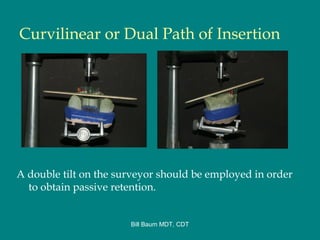
A double tilt on the surveyor should be employed in order
to obtain passive retention.
Curvilinear or Dual Path of Insertion
Bill Baum MDT, CDT
Clasp Type Retainer Systems
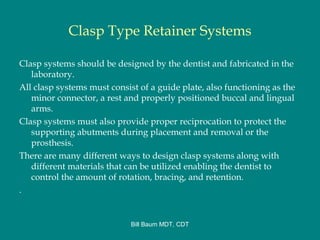
Clasp systems should be designed by the dentist and fabricated in the
laboratory.
All clasp systems must consist of a guide plate, also functioning as the
minor connector, a rest and properly positioned buccal and lingual
arms.
Clasp systems must also provide proper reciprocation to protect the
supporting abutments during placement and removal or the
prosthesis.
There are many different ways to design clasp systems along with
different materials that can be utilized enabling the dentist to
control the amount of rotation, bracing, and retention.
.
Bill Baum MDT, CDT
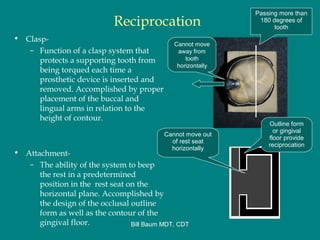
Reciprocation
• Clasp-
– Function of a clasp system that
protects a supporting tooth from
being torqued each time a
prosthetic device is inserted and
removed. Accomplished by proper
placement of the buccal and
lingual arms in relation to the
height of contour.
• Attachment-
– The ability of the system to beep
the rest in a predetermined
position in the rest seat on the
horizontal plane. Accomplished by
the design of the occlusal outline
form as well as the contour of the
gingival floor.
Passing more than
180 degrees of
tooth
Cannot move
away from
tooth
horizontally
Cannot move out
of rest seat
horizontally
Outline form
or gingival
floor provide
reciprocation
Bill Baum MDT, CDT
Clasp Type Retainer Systems
• Retention is influenced by the placement of the retentive arm in
relation to the height of contour, the material the arm is fabricated
with and the legenth of the arm.
• Bracing provided by buccal and lingual arms as well as the guide
planes.
• Reciprocation provided by the proper placement of buccal and
lingual arms in relation to the height of contour.
• Retention provided by the retentive 1/3 of the retentive arm
terminating in an infrabulge area below the survey line of the tooth.
Bill Baum MDT, CDT
Anatomy of a Clasp
Bracing
arm can
be buccal
or lingual
Guide plate
which rests
against
guiding plane
prepared on
tooth or
crown
Retentiv
e clasp
tip
Bill Baum MDT, CDT
Advantages and disadvantages of clasps
• Advantages
– Lower cost to patient
– Minimal tooth preparation
• Disadvantages
– Generally unesthetic
– Increased likelihood of caries developing beneath clasp
components
– Proper design and construction is impretive to prevent strain on
abutment teeth
Bill Baum MDT, CDT
Intracoronal Locking SemiPrecision
Attachments
• Vary in design and in degree of precision depending on the skill of
the technician.
• The occlusal outline form can be varied in order to alter the degree
of rotation permitted around the horizontal axis of rotation
• Different alloys can be used to control the wear between the rest
and rest seat
• Retention is provided by an external means such as an clasp arm
which follows a contoured lingual surface terminating in an
infrabulge area
• Deep rests provide bracing {axial walls} and support {gingival
floor}. Additional bracing is added through the use of a lingual
clasp arm on a surveyed and contoured lingual surface
Bill Baum MDT, CDT
Varied
proximal
outline
forms
Type IV gold rest
soldered to chrome
cobalt frame to limit wear
on restseat
Bill Baum MDT, CDT
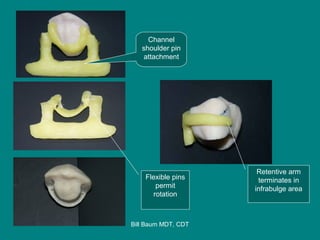
Retentive arm
terminates in
infrabulge area
Flexible pins
permit
rotation
Channel
shoulder pin
attachment
Bill Baum MDT, CDT
Advantages and Disadvantages of
Locking Semiprecision Attachments
• Advantages
– Easier to fabricate clinical and laboratory
– Control of rotation by altering outline form and alloys employed
– Lower cost than precision attachments
• Disadvantages
– Dentist must alter tooth preparation
– More difficult to repair than precision attachment
Bill Baum MDT, CDT
Intracoronal Non-Locking SemiPrecision
Attachments
• Provides for stress relief when used with extension base partials in
the maxilla and mandible
• Rectangular occlusal outline form with a 1.5 - 2.0 mm deep well on
the gingival floor
• Proximal outline form with a 2 degree taper
• Retentive lingual located on the lingual surface opposite the mid-
well area which is the center of rotation
• Deep rests are parallel to each other horizontally, vertically and
saggitally regardless of ridges
• Lingual surface parallel vertically and horizontally to the deep rests
• Reciprocation provided for by the channeled gingival floor
Bill Baum MDT, CDT
Parallel vertically,
horizontally and saggitally
regardless of the crest of
the ridge
Center of
rotation
opposite
midwell
DM
Channeled
gingival floor
provides
reciprocationBill Baum MDT, CDT
Casting for Thompson Dowell Attachment
Note lingual
contours
Parallel vertically,
horizontally and
saggitally regardless of
the crest of the ridge.
Bill Baum MDT, CDT
Movie
Thompson Dowel attachment rotating on the horizontal axis
Bill Baum MDT, CDT
Movie
Thompson Dowel attachment rotating on the horizontal axis
Retentive
dimple at
center of
rotation
Bill Baum MDT, CDT
Precision Attachments
• Manufactured and utilized usually in a tooth-borne removable
partial denture or as an interlock between two sections of a fixed
partial denture
• Manufactured to fit together with precise tolerances of one to one-
thousandth of an inch
• Self-contained that is all the necessary functions of a partial denture
i.e.: bracing support, and retention are provided for within the
device
• The alloys used in construction of precision attachments provide
for controlled wear between rest and rest seat.
• An assembled precision attachment allows for movement in only a
superior-inferior direction and does not provide for rotation
• Thus intracoronal semi-precision rest systems are designed with
various occlusal outline forms, varying proximal taper, as well as
different gingival floor contours.
Bill Baum MDT, CDT
Advantages and Disadvantages of Precision
Attachments
Advantages
• Controller tolerances of fit
• Ease of repair
• Matched metal alloys help control wear between rest and rest seat
Disadvantages
• Lack of rotational not advised for extension base partial dentures
• Complex clinical and laboratory procedures
• Increased cost
• Increased tooth preparation necessary
Bill Baum MDT, CDT
No retentive
component on
lingual arm
Retentive
component
Bill Baum MDT, CDT
Extra-Coronal Attachments
• When extra coronal attachments are selected one must be sure all of
the necessary functional qualifications are met
• These attachments are seen as some form of stud, ball and socket, or
spring loaded plunger (pawl).
• Usually connected to the near proximal zone of a supporting crown.
Bill Baum MDT, CDT
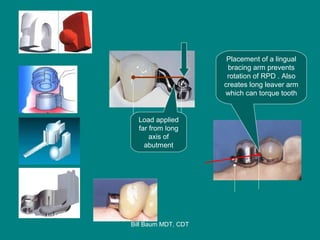
Load applied
far from long
axis of
abutment
Placement of a lingual
bracing arm prevents
rotation of RPD . Also
creates long leaver arm
which can torque tooth
Bill Baum MDT, CDT
Parallel
vertically,
horizontally and
saggitally
Bracing
provided by
axial
surfaces
Axis of rotation
continues bilaterally
and is in harmony
with entire bar
Bill Baum MDT, CDT
Advantages and Disadvantages of Extra-
Coronal Attachments
• Advantages
– No need to alter tooth preparation
– More esthetic than clasps
– Simpler laboratory procedures
• Disadvantages
– Lack of occlusal stability
– Improper control of force distrbution fulcrum far from long axis
of tooth
– Rebasing problems
– Increased maintenance
– Hygiene under attachment is more difficult
– Inadequate bracing must be added
Bill Baum MDT, CDT
Bar Retainer Systems
Span edentulous areas and connect abutment teeth, roots or implants. The
removable prosthesis is connected by one or more retentive components.
•Retention provided by friction between bar substructure and cast
superstructure or bar and clip [rider].
•Bracing is provided by the axial surfaces and affected by shape
and angulation.
•Support provided by occlusal surface of bar.
Advantages
•Enables cross arch splinting so as to share load
•Rotation can be controlled by shape of bar as well as placement of
retentive component
Disadvantages
•Soft tissue complications if improperly placed
Bill Baum MDT, CDT
Bar Type Retainer Systems
Bill Baum MDT, CDT
Plunger Type Attachments
• Provide only for retention
• System must be augmented in order to provide all three functions
as well as reciprocation.
Bill Baum MDT, CDT
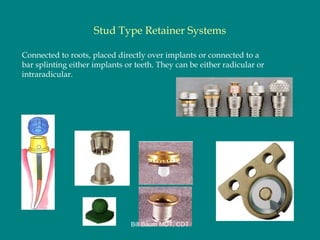
Stud Type Retainer Systems
Connected to roots, placed directly over implants or connected to a
bar splinting either implants or teeth. They can be either radicular or
intraradicular.
Bill Baum MDT, CDT
Summary
Retainer system selection is often left to the
technician. Although some technicians are very
knowledgeable with the intricacies of these cases, the
dentist must select the system employed since they have
examined and treated the remaining soft and hard tissues
in the patient’s mouth and should be familiar with the
patient’s specific problems.. Therefore it is paramount that
both dentist and technician to work and learn together as a
team in order to fully understand the complex world of
retainer systems.
Bill Baum MDT, CDT
• Bill Baum, MDT, CDT
• Baum Dental Studio, Inc
• Bill@BaumDental.com
Bill Baum MDT, CDT
References
• McCrackens- Removable Partial Prosthodontics tenth edition
• Lloyd Landa- Diagnosis and management of Partially Edentulus Cases with a
Minimal Number of Remaining Teeth-Dental Clinics of North America, Jan. 1985
• George Argerakis- Functional Forces With Removable Partial Dentures- Dental
Clinics of North America, Jan. 1985
• John C. Miglino-Impression Procedures for Removable Partial Dentures Dental
Clinics of North America, Jan. 1985
• I. D. Zinner- Locking Types of Semiprecision Attachments- Dental Clinics of North
America, Jan. 1985
• I. D. Zinner-Nonlocking Types of Semiprecision Attachments- Dental Clinics of North
America, Jan. 1985
• Robert E. Wolfe- Extracoronal Attachments- Dental Clinics of North America, Jan.
1985
• Gerald Weintraub- Review of Removeable Partial Denture Components and There
Designas Related To Maintenance Of Tissue Health- Dentures- Dental Clinics of
North America, Jan. 1985
• I.D. Zinner- Precision Attachments- Dental Clinics of North America, Jan. 1987
Bill Baum MDT, CDT

Removable Partial denture Retainer Systems

  • 1.
    Removable Prosthesis RetainerSystems William M. Baum, MDT, CDT Bill@BaumDental.com “All partial dentures have two things in common. First, they must be supported by oral tissues. Second, they must be retained against reasonable dislodging forces.” -William L. McCracken, DDS Bill Baum MDT, CDT
  • 2.
    Retainer Systems Designscan be- • Intra or Extra-Coronal • Precision or Semi-Precision • Locking or Non-Locking Dentists must take into account jaw relationships, residual ridge form, occlusal schemes, major and minor connector designs and placement, as well as the patient’s desires and dexterity when selecting a retainer system. Proper design selection and fabrication is paramount to achieve success! Clasps, precision attachments, semi-precision attachments, and bars are removable partial denture retainer systems. Retainer systems are used in prosthetic dentistry to facilitate the selective placement and removal of prosthetic components. They affect the manner in which occlusal forces are transmitted to supportative structures Bill Baum MDT, CDT
  • 3.
    Removable Partial Dentures LongSpan Fixed Bridge Long Canter-leaver Bridge?? What’s The Difference?? The wonder of Removable Partial Dentures is that when properly designed and fabricated, they possess the ability to distribute load among supporting abutment teeth, implants, residual ridges and palette. Conversely, when improperly designed and/or fabricated their leaver arms can magnify these forces and hasten the loss of teeth and other supporting structures. Bill Baum MDT, CDT
  • 4.
    Lever Systems Class 1 Class2 Class 3 See saw Wheel barrel Tweezers Retentive arm Restseat Bill Baum MDT, CDT
  • 5.
    Rotation All Removable PartialDentures Rotate •Tooth borne Removable Partial Dentures are better able to resist rotational forces •Extension Base Partial Dentures also rotate around a fulcrum line “T o a great extent, the forces occurring through a removable prosthesis can be widely distributed, directed, and minimized by the selection, the design, and the location of components of the removable partial denture and by development of a harmonious occlusion.” -William L. McCracken, DDS Bill Baum MDT, CDT
  • 6.
    Fulcrum {Horizontal} axis Saggital{Longitudintal} axis Vertical axis Bill Baum MDT, CDT
  • 7.
    Management of Rotation •Fulcrum Line - Horizontal Axis – Impression procedures – Residual ridge contour – Adaptation of denture base to ridge – Placement of direct and indirect retainers – Material used in retainer system – Major connector design {maxillary} – Occlusal outline form {attachments} Bill Baum MDT, CDT
  • 8.
    Management of Rotation •Saggital – Longitudintal Axis – Rigidity of major connector – Proximal outline form {attachments} Bill Baum MDT, CDT
  • 9.
    Management of Rotation •Vertical {midline} – Bracing Components – guide plates, reciprocal arms, major connectors, etc – Occlusion Bill Baum MDT, CDT
  • 10.
  • 11.
    All retainer systemsmust provide three basic functions • Support • Bracing • Retention Bill Baum MDT, CDT
  • 12.
    All retainer systemsmust provide three basic functions The first is: B acing- The ability of the retainer system to stabilize lateral forces. A large percentage of a retainer system’s design is devoted to this purpose. Providing bracing is critical because if any component of a prosthetic device can move laterally it may promote loss of supporting structures such as teeth and bone. Bill Baum MDT, CDT
  • 13.
    All retainer systemsmust provide three basic functions The second Support- The ability the design to transmit occlusal force to the abutment teeth. Support is the ability of the design to transmit occlusal force applied to the device vertically onto the abutment teeth. Without this component occlusal forces may be transmitted to the soft tissue and residual ridges. Support is an essential element which is often neglected with transitional removable partial dentures Bill Baum MDT, CDT
  • 14.
    Retention The ability ofthe prosthesis to keep itself in a predetermined place until it is intended to be removed Retention is important because if a prosthetic component does not remain in its predetermined position there will be torquing forces on the abutments that are detrimental to a favorable prognosis. A small percentage of the retainer’s design is devoted to retention; this is all that is required when a dual or curvilinear path of insertion is employed. Indirect retention The effect achieved by one or more indirect retainers of a removable partial denture that reduces the tendency for a denture base to move in an occlusal direction or rotate about the fulcrum line Indirect direct Retention is critical in preventing displacement of the extension base partial denture when the denture base moves away from the tissues in pure rotation around the fulcrum line All retainer systems must provide three basic functions The third: Bill Baum MDT, CDT
  • 15.
    Suprabulge or non- undercut area Infrabulge or undercut area Surveying Pathof removal is not perpendicular with plane of occlusion. Partial is more stable.Bill Baum MDT, CDT
  • 16.
    Place cast positionerinto cast to enable communication of selected path of insertion Bill Baum MDT, CDT
  • 17.
    A double tilton the surveyor should be employed in order to obtain passive retention. Curvilinear or Dual Path of Insertion Bill Baum MDT, CDT
  • 18.
    Clasp Type RetainerSystems Clasp systems should be designed by the dentist and fabricated in the laboratory. All clasp systems must consist of a guide plate, also functioning as the minor connector, a rest and properly positioned buccal and lingual arms. Clasp systems must also provide proper reciprocation to protect the supporting abutments during placement and removal or the prosthesis. There are many different ways to design clasp systems along with different materials that can be utilized enabling the dentist to control the amount of rotation, bracing, and retention. . Bill Baum MDT, CDT
  • 19.
    Reciprocation • Clasp- – Functionof a clasp system that protects a supporting tooth from being torqued each time a prosthetic device is inserted and removed. Accomplished by proper placement of the buccal and lingual arms in relation to the height of contour. • Attachment- – The ability of the system to beep the rest in a predetermined position in the rest seat on the horizontal plane. Accomplished by the design of the occlusal outline form as well as the contour of the gingival floor. Passing more than 180 degrees of tooth Cannot move away from tooth horizontally Cannot move out of rest seat horizontally Outline form or gingival floor provide reciprocation Bill Baum MDT, CDT
  • 20.
    Clasp Type RetainerSystems • Retention is influenced by the placement of the retentive arm in relation to the height of contour, the material the arm is fabricated with and the legenth of the arm. • Bracing provided by buccal and lingual arms as well as the guide planes. • Reciprocation provided by the proper placement of buccal and lingual arms in relation to the height of contour. • Retention provided by the retentive 1/3 of the retentive arm terminating in an infrabulge area below the survey line of the tooth. Bill Baum MDT, CDT
  • 21.
    Anatomy of aClasp Bracing arm can be buccal or lingual Guide plate which rests against guiding plane prepared on tooth or crown Retentiv e clasp tip Bill Baum MDT, CDT
  • 22.
    Advantages and disadvantagesof clasps • Advantages – Lower cost to patient – Minimal tooth preparation • Disadvantages – Generally unesthetic – Increased likelihood of caries developing beneath clasp components – Proper design and construction is impretive to prevent strain on abutment teeth Bill Baum MDT, CDT
  • 23.
    Intracoronal Locking SemiPrecision Attachments •Vary in design and in degree of precision depending on the skill of the technician. • The occlusal outline form can be varied in order to alter the degree of rotation permitted around the horizontal axis of rotation • Different alloys can be used to control the wear between the rest and rest seat • Retention is provided by an external means such as an clasp arm which follows a contoured lingual surface terminating in an infrabulge area • Deep rests provide bracing {axial walls} and support {gingival floor}. Additional bracing is added through the use of a lingual clasp arm on a surveyed and contoured lingual surface Bill Baum MDT, CDT
  • 24.
    Varied proximal outline forms Type IV goldrest soldered to chrome cobalt frame to limit wear on restseat Bill Baum MDT, CDT
  • 25.
    Retentive arm terminates in infrabulgearea Flexible pins permit rotation Channel shoulder pin attachment Bill Baum MDT, CDT
  • 26.
    Advantages and Disadvantagesof Locking Semiprecision Attachments • Advantages – Easier to fabricate clinical and laboratory – Control of rotation by altering outline form and alloys employed – Lower cost than precision attachments • Disadvantages – Dentist must alter tooth preparation – More difficult to repair than precision attachment Bill Baum MDT, CDT
  • 27.
    Intracoronal Non-Locking SemiPrecision Attachments •Provides for stress relief when used with extension base partials in the maxilla and mandible • Rectangular occlusal outline form with a 1.5 - 2.0 mm deep well on the gingival floor • Proximal outline form with a 2 degree taper • Retentive lingual located on the lingual surface opposite the mid- well area which is the center of rotation • Deep rests are parallel to each other horizontally, vertically and saggitally regardless of ridges • Lingual surface parallel vertically and horizontally to the deep rests • Reciprocation provided for by the channeled gingival floor Bill Baum MDT, CDT
  • 28.
    Parallel vertically, horizontally andsaggitally regardless of the crest of the ridge Center of rotation opposite midwell DM Channeled gingival floor provides reciprocationBill Baum MDT, CDT
  • 29.
    Casting for ThompsonDowell Attachment Note lingual contours Parallel vertically, horizontally and saggitally regardless of the crest of the ridge. Bill Baum MDT, CDT
  • 30.
    Movie Thompson Dowel attachmentrotating on the horizontal axis Bill Baum MDT, CDT
  • 31.
    Movie Thompson Dowel attachmentrotating on the horizontal axis Retentive dimple at center of rotation Bill Baum MDT, CDT
  • 32.
    Precision Attachments • Manufacturedand utilized usually in a tooth-borne removable partial denture or as an interlock between two sections of a fixed partial denture • Manufactured to fit together with precise tolerances of one to one- thousandth of an inch • Self-contained that is all the necessary functions of a partial denture i.e.: bracing support, and retention are provided for within the device • The alloys used in construction of precision attachments provide for controlled wear between rest and rest seat. • An assembled precision attachment allows for movement in only a superior-inferior direction and does not provide for rotation • Thus intracoronal semi-precision rest systems are designed with various occlusal outline forms, varying proximal taper, as well as different gingival floor contours. Bill Baum MDT, CDT
  • 33.
    Advantages and Disadvantagesof Precision Attachments Advantages • Controller tolerances of fit • Ease of repair • Matched metal alloys help control wear between rest and rest seat Disadvantages • Lack of rotational not advised for extension base partial dentures • Complex clinical and laboratory procedures • Increased cost • Increased tooth preparation necessary Bill Baum MDT, CDT
  • 34.
    No retentive component on lingualarm Retentive component Bill Baum MDT, CDT
  • 35.
    Extra-Coronal Attachments • Whenextra coronal attachments are selected one must be sure all of the necessary functional qualifications are met • These attachments are seen as some form of stud, ball and socket, or spring loaded plunger (pawl). • Usually connected to the near proximal zone of a supporting crown. Bill Baum MDT, CDT
  • 36.
    Load applied far fromlong axis of abutment Placement of a lingual bracing arm prevents rotation of RPD . Also creates long leaver arm which can torque tooth Bill Baum MDT, CDT
  • 37.
    Parallel vertically, horizontally and saggitally Bracing provided by axial surfaces Axisof rotation continues bilaterally and is in harmony with entire bar Bill Baum MDT, CDT
  • 38.
    Advantages and Disadvantagesof Extra- Coronal Attachments • Advantages – No need to alter tooth preparation – More esthetic than clasps – Simpler laboratory procedures • Disadvantages – Lack of occlusal stability – Improper control of force distrbution fulcrum far from long axis of tooth – Rebasing problems – Increased maintenance – Hygiene under attachment is more difficult – Inadequate bracing must be added Bill Baum MDT, CDT
  • 39.
    Bar Retainer Systems Spanedentulous areas and connect abutment teeth, roots or implants. The removable prosthesis is connected by one or more retentive components. •Retention provided by friction between bar substructure and cast superstructure or bar and clip [rider]. •Bracing is provided by the axial surfaces and affected by shape and angulation. •Support provided by occlusal surface of bar. Advantages •Enables cross arch splinting so as to share load •Rotation can be controlled by shape of bar as well as placement of retentive component Disadvantages •Soft tissue complications if improperly placed Bill Baum MDT, CDT
  • 40.
    Bar Type RetainerSystems Bill Baum MDT, CDT
  • 41.
    Plunger Type Attachments •Provide only for retention • System must be augmented in order to provide all three functions as well as reciprocation. Bill Baum MDT, CDT
  • 42.
    Stud Type RetainerSystems Connected to roots, placed directly over implants or connected to a bar splinting either implants or teeth. They can be either radicular or intraradicular. Bill Baum MDT, CDT
  • 43.
    Summary Retainer system selectionis often left to the technician. Although some technicians are very knowledgeable with the intricacies of these cases, the dentist must select the system employed since they have examined and treated the remaining soft and hard tissues in the patient’s mouth and should be familiar with the patient’s specific problems.. Therefore it is paramount that both dentist and technician to work and learn together as a team in order to fully understand the complex world of retainer systems. Bill Baum MDT, CDT
  • 44.
    • Bill Baum,MDT, CDT • Baum Dental Studio, Inc • Bill@BaumDental.com Bill Baum MDT, CDT
  • 45.
    References • McCrackens- RemovablePartial Prosthodontics tenth edition • Lloyd Landa- Diagnosis and management of Partially Edentulus Cases with a Minimal Number of Remaining Teeth-Dental Clinics of North America, Jan. 1985 • George Argerakis- Functional Forces With Removable Partial Dentures- Dental Clinics of North America, Jan. 1985 • John C. Miglino-Impression Procedures for Removable Partial Dentures Dental Clinics of North America, Jan. 1985 • I. D. Zinner- Locking Types of Semiprecision Attachments- Dental Clinics of North America, Jan. 1985 • I. D. Zinner-Nonlocking Types of Semiprecision Attachments- Dental Clinics of North America, Jan. 1985 • Robert E. Wolfe- Extracoronal Attachments- Dental Clinics of North America, Jan. 1985 • Gerald Weintraub- Review of Removeable Partial Denture Components and There Designas Related To Maintenance Of Tissue Health- Dentures- Dental Clinics of North America, Jan. 1985 • I.D. Zinner- Precision Attachments- Dental Clinics of North America, Jan. 1987 Bill Baum MDT, CDT