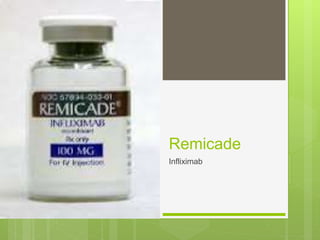
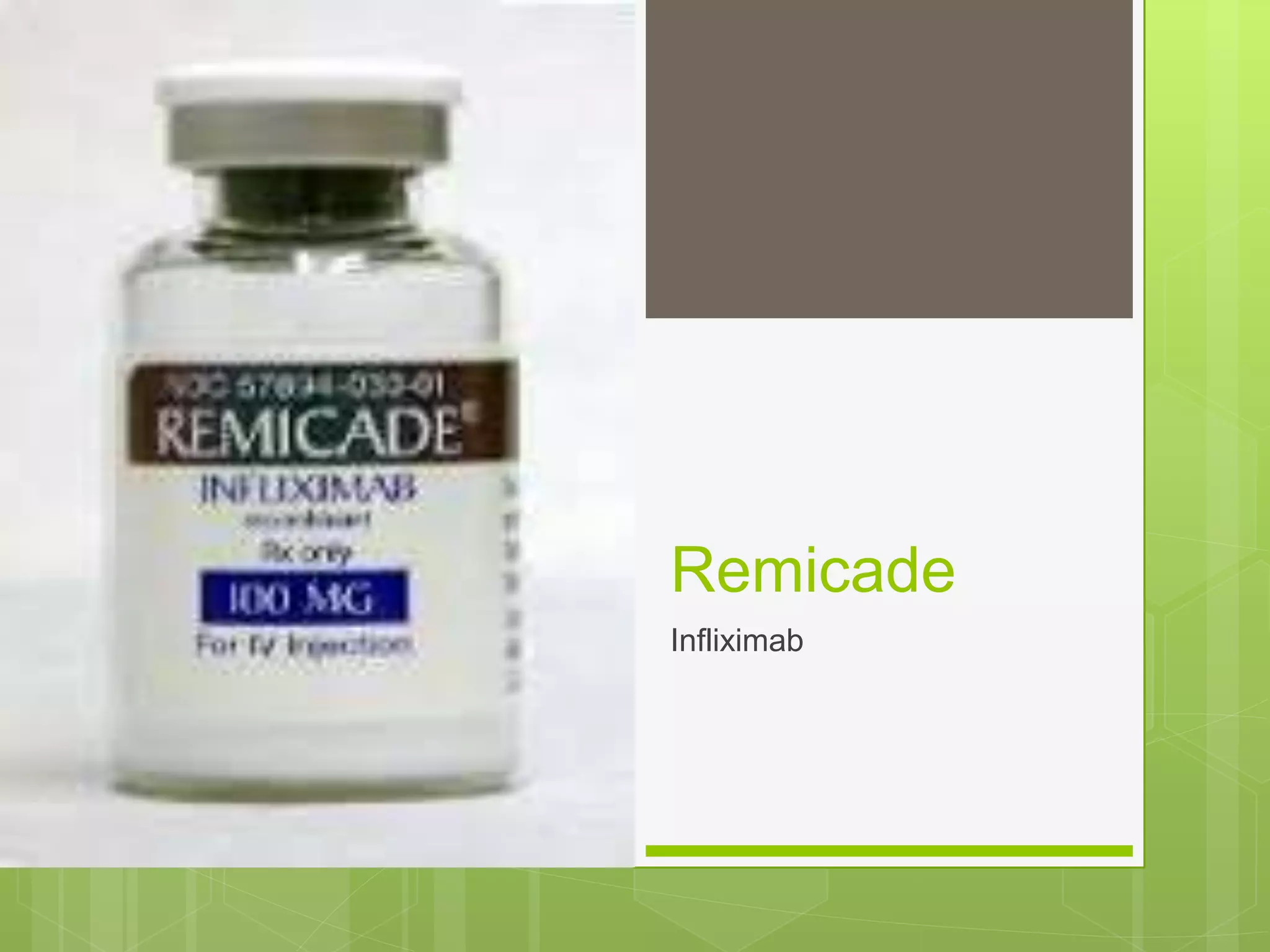
Remicade
Infliximab
What is Remicade
• Remicade is the brand name for Infliximab
• An injectable prescription drug which is usually
prescribed when other medicines or treatments have
failed
• Manufactured and sold by Johnson & Johnson
subsidiary Janssen Biotech
• The FDA first approved Remicade for adult Crohn's
disease in 1998, and extended approvals to other
immune system diseases, including rheumatoid
arthritis in 2004, ulcerative colitis in 2005, pediatric
Crohn's in 2006, and pediatric ulcerative colitis in
2011.
Production mechanism
 Infliximab is a human medicine but it was
developed originally in mice as a mouse
antibody.
 The mouse common amino acid sequences were
replaced with similar human antibody domain
as human has immune reactions to mouse
proteins.
 For the combination of mouse and human
antibody amino acid sequences, it is called a
monoclonal antibody.
Formulation
• Formulation : 100mg/vial powder for
solution to be administrated as an IV
infusion
• The active ingredient is Infliximab.
• The inactive ingredients in
REMICADE include: sucrose,
polysorbate 80, monobasic sodium
phosphate monohydrate, and dibasic
sodium phosphate dyhydrate.
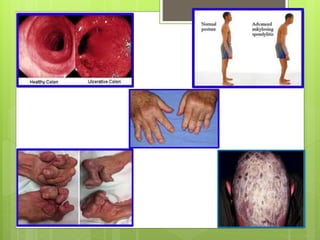
Usage
• Rheumatoid Arthritis
• Crohn's disease
• Ulcerative Colitis
• Psoriatic Arthritis
• Plaque Psoriasis
• Ankylosing spondylitis
Mechanisms
 Delivers TNF-α which is a TNFα is a pro-
inflammatory and immune regulatory cytokine
 Produces too much TNF-α which results in
inflammation & other symptoms.
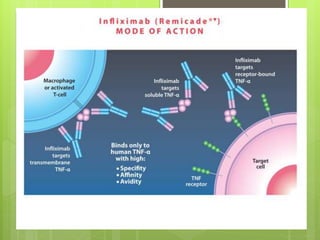
 But Remicade has the ability to bind with this TNF-α
and block the action of it.
 By doing so it block the damage also having too
much TNF in the body.No medicine can do this but
remicade a target specific medicine can do this to
recover from inflammatory related disease
 Remicade binds to Tumore Necrosis Factor Alpha
and blocks its inflammatory effect.
Admisintration
• Remicade (infliximab) is administered directly into
a vein (intravenous infusion).
• This is done in a hospital or clinic.
• It cannot be taken orally because the drug's active
ingredient would be destroyed.
Dosage
 Remicade is dosed in milligrams (mg) per kilogram (kg) of the
patient’s body weight.
 Recommended dosage is generally 5 mg/kg at 0, two, and six
weeks, followed by a maintenance regimen of 5 mg/kg every
eight weeks after that.
 Rheumatoid arthritis: The recommended dosage is 3 mg/kg,
used in combination with methotrexate.
 Crohn's disease: Some adult patients may benefit from
increasing the regimen dosage to 10 mg/kg.
 Ankylosing spondylitis: The maintenance regimen is treatment
every six weeks, not every eight weeks.
Side Effects
 Common Side Effects of Remicade (Infliximab):
-Stomach and chest pain
-Cough, runny nose, sneezing
-Respiratory infections, such as sinus infections and sore throat
-Fatigue or weakness
-Difficulty breathing
 Serious Side Effects of Remicade (Infliximab):
-Tuberculosis (TB)
-Viral, fungal, and bacterial infections that can prove fatal
-Liver injury
-Blood problems
-Nervous system problems
-Allergic reactions
-Heart failure
-Increased risk for certain types of cancer: lymphoma, hepatosplenic T-cell
lymphoma ( a rare and usually fatal cancer of the white blood cells), certain
types of skin cancer
Contradictions
• Hypersensitivity to infliximab, any
component of the formulation
• Doses >5 mg/kg in patients with moderate or
severe heart failure
• Severe infections
-Sepsis
-Tuberculosis
-opportunistic infections
Controversial News
6/7 people died in USA
Some serious side effects
In some case it did not show any type of effect
in body
But Remicade is not responsible for this
It has no toxicity
It can happen for dosage problem
Remicade presentation

Remicade presentation

  • 1.
  • 2.
    What is Remicade •Remicade is the brand name for Infliximab • An injectable prescription drug which is usually prescribed when other medicines or treatments have failed • Manufactured and sold by Johnson & Johnson subsidiary Janssen Biotech • The FDA first approved Remicade for adult Crohn's disease in 1998, and extended approvals to other immune system diseases, including rheumatoid arthritis in 2004, ulcerative colitis in 2005, pediatric Crohn's in 2006, and pediatric ulcerative colitis in 2011.
  • 4.
    Production mechanism  Infliximabis a human medicine but it was developed originally in mice as a mouse antibody.  The mouse common amino acid sequences were replaced with similar human antibody domain as human has immune reactions to mouse proteins.  For the combination of mouse and human antibody amino acid sequences, it is called a monoclonal antibody.
  • 5.
    Formulation • Formulation :100mg/vial powder for solution to be administrated as an IV infusion • The active ingredient is Infliximab. • The inactive ingredients in REMICADE include: sucrose, polysorbate 80, monobasic sodium phosphate monohydrate, and dibasic sodium phosphate dyhydrate.
  • 6.
    Usage • Rheumatoid Arthritis •Crohn's disease • Ulcerative Colitis • Psoriatic Arthritis • Plaque Psoriasis • Ankylosing spondylitis
  • 8.
    Mechanisms  Delivers TNF-αwhich is a TNFα is a pro- inflammatory and immune regulatory cytokine  Produces too much TNF-α which results in inflammation & other symptoms.  But Remicade has the ability to bind with this TNF-α and block the action of it.  By doing so it block the damage also having too much TNF in the body.No medicine can do this but remicade a target specific medicine can do this to recover from inflammatory related disease  Remicade binds to Tumore Necrosis Factor Alpha and blocks its inflammatory effect.
  • 10.
    Admisintration • Remicade (infliximab)is administered directly into a vein (intravenous infusion). • This is done in a hospital or clinic. • It cannot be taken orally because the drug's active ingredient would be destroyed.
  • 11.
    Dosage  Remicade isdosed in milligrams (mg) per kilogram (kg) of the patient’s body weight.  Recommended dosage is generally 5 mg/kg at 0, two, and six weeks, followed by a maintenance regimen of 5 mg/kg every eight weeks after that.  Rheumatoid arthritis: The recommended dosage is 3 mg/kg, used in combination with methotrexate.  Crohn's disease: Some adult patients may benefit from increasing the regimen dosage to 10 mg/kg.  Ankylosing spondylitis: The maintenance regimen is treatment every six weeks, not every eight weeks.
  • 12.
    Side Effects  CommonSide Effects of Remicade (Infliximab): -Stomach and chest pain -Cough, runny nose, sneezing -Respiratory infections, such as sinus infections and sore throat -Fatigue or weakness -Difficulty breathing  Serious Side Effects of Remicade (Infliximab): -Tuberculosis (TB) -Viral, fungal, and bacterial infections that can prove fatal -Liver injury -Blood problems -Nervous system problems -Allergic reactions -Heart failure -Increased risk for certain types of cancer: lymphoma, hepatosplenic T-cell lymphoma ( a rare and usually fatal cancer of the white blood cells), certain types of skin cancer
  • 13.
    Contradictions • Hypersensitivity toinfliximab, any component of the formulation • Doses >5 mg/kg in patients with moderate or severe heart failure • Severe infections -Sepsis -Tuberculosis -opportunistic infections
  • 14.
    Controversial News 6/7 peopledied in USA Some serious side effects In some case it did not show any type of effect in body But Remicade is not responsible for this It has no toxicity It can happen for dosage problem