Marwa Abo Elmaaty Besar
Lecturer of Internal Medicine
(Rheumatology Immunology Unit)
(Pediatric Rheumatology)
Biological therapy
when and how to prescribe?
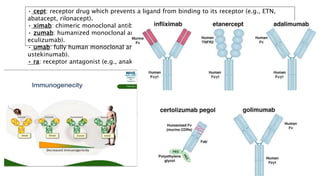
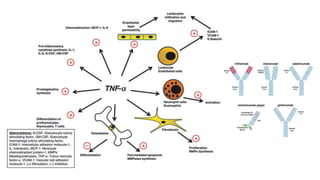
• cept: receptor drug which prevents a ligand from binding to its receptor (e.g., ETN,
abatacept, rilonacept).
• ximab: chimeric monoclonal antibody (e.g., INF, RTX).
• zumab: humanized monoclonal antibody (e.g., certolizumab, tocilizumab, ixekizumab,
eculizumab).
• umab: fully human monoclonal antibody (e.g., ADA, golimumab, belimumab,
ustekinumab).
• ra: receptor antagonist (e.g., anakinra).
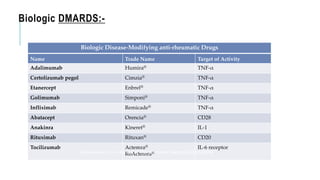
Biologic DMARDS:-
Donahue KE, Jonas D, Hansen RA, et al. Comparative Effectiveness Review No. 55. Available at www.effectivehealthcare.gov/dmardsra.cfm.
Biologic Disease-Modifying anti-rheumatic Drugs
Name Trade Name Target of Activity
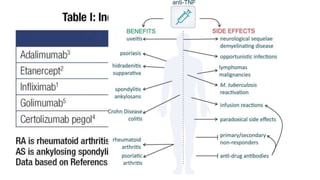
Adalimumab Humira® TNF-α
Certolizumab pegol Cimzia® TNF-α
Etanercept Enbrel® TNF-α
Golimumab Simponi® TNF-α
Infliximab Remicade® TNF-α
Abatacept Orencia® CD28
Anakinra Kineret® IL-1
Rituximab Rituxan® CD20
Tocilizumab Actemra®
RoActemra®
IL-6 receptor
Abbreviations: IL = interleukin; TNF-α = tumor necrosis factor-alpha
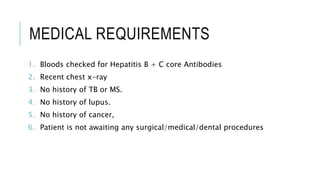
MEDICAL REQUIREMENTS
1. Bloods checked for Hepatitis B + C core Antibodies
2. Recent chest x-ray
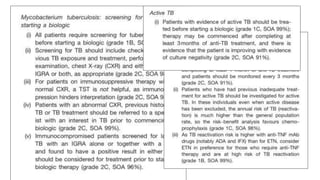
3. No history of TB or MS.
4. No history of lupus.
5. No history of cancer,
6. Patient is not awaiting any surgical/medical/dental procedures
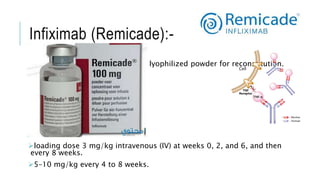
Infiximab (Remicade):-
Single-use vials with 100 mg of lyophilized powder for reconstitution.
loading dose 3 mg/kg intravenous (IV) at weeks 0, 2, and 6, and then
every 8 weeks.
5–10 mg/kg every 4 to 8 weeks.
Initial infusion takes 2 hours. If tolerated, subsequent infusions can
be shortened.
Anti-chimeric antibodies (HACAs).
Concomitant use DMARD (MTX).
 if a patient is not responding initially, increasing the frequency of
infliximab infusions is more efficacious than increasing the dose.
Try not to increase dose higher than 5 mg/kg every 4 weeks because
of infection and malignancy concerns.
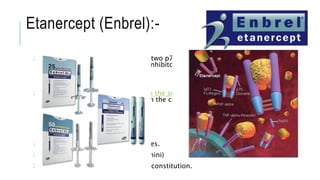
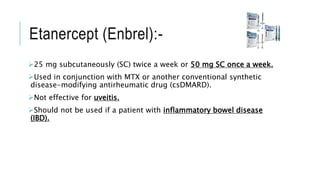
Etanercept (Enbrel):-
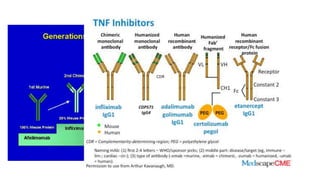
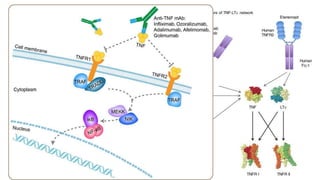
Etanercept is a fusion protein with two p75 TNF receptors bound to the Fc
portion of IgG. The other four TNF inhibitors are monoclonal
antibodies directed against TNF-α.
Etanercept can only block TNF-α in the serum while the other TNF inhibitors
can also inhibit TNF-α expressed on the cell surface.
25-mg and 50-mg prefilled syringes.
50-mg prefilled cartridge (enbrel mini)
25 mg of lyophilized powder for reconstitution.
Etanercept (Enbrel):-
25 mg subcutaneously (SC) twice a week or 50 mg SC once a week.
Used in conjunction with MTX or another conventional synthetic
disease-modifying antirheumatic drug (csDMARD).
Not effective for uveitis.
Should not be used if a patient with inflammatory bowel disease
(IBD).
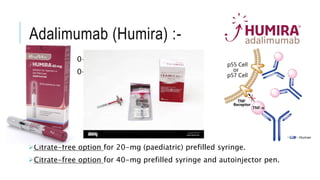
Adalimumab (Humira) :-
Single use 40-mg prefilled syringe.
Single use 40-mg autoinjector pen.
Citrate-free option for 20-mg (paediatric) prefilled syringe.
Citrate-free option for 40-mg prefilled syringe and autoinjector pen.
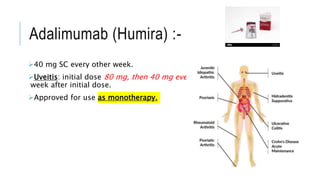
Adalimumab (Humira) :-
40 mg SC every other week.
Uveitis: initial dose 80 mg, then 40 mg every other week starting 1
week after initial dose.
Approved for use as monotherapy.
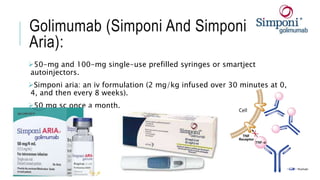
Golimumab (Simponi And Simponi
Aria):
50-mg and 100-mg single-use prefilled syringes or smartject
autoinjectors.
Simponi aria: an iv formulation (2 mg/kg infused over 30 minutes at 0,
4, and then every 8 weeks).
50 mg sc once a month.
Certolizumab Pegol (Cimzia):
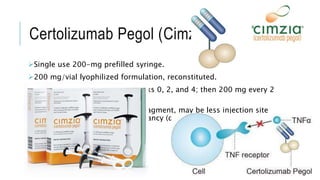
Single use 200-mg prefilled syringe.
200 mg/vial lyophilized formulation, reconstituted.
Loading dose 400 mg sc at weeks 0, 2, and 4; then 200 mg every 2
weeks.
Owing to lack of functional fc fragment, may be less injection site
reactions and safer during pregnancy (does not cross placenta).
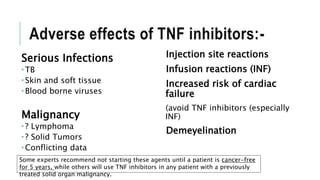
Adverse effects of TNF inhibitors:-
Serious Infections
 TB
 Skin and soft tissue
 Blood borne viruses
Malignancy
 ? Lymphoma
 ? Solid Tumors
 Conflicting data
Injection site reactions
Infusion reactions (INF)
Increased risk of cardiac
failure
(avoid TNF inhibitors (especially
INF)
Demeyelination
Some experts recommend not starting these agents until a patient is cancer-free
for 5 years, while others will use TNF inhibitors in any patient with a previously
treated solid organ malignancy.
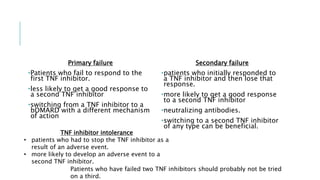
Primary failure
•Patients who fail to respond to the
first TNF inhibitor.
•less likely to get a good response to
a second TNF inhibitor
•switching from a TNF inhibitor to a
bDMARD with a different mechanism
of action
Secondary failure
•patients who initially responded to
a TNF inhibitor and then lose that
response.
•more likely to get a good response
to a second TNF inhibitor
•neutralizing antibodies.
•switching to a second TNF inhibitor
of any type can be beneficial.
TNF inhibitor intolerance
• patients who had to stop the TNF inhibitor as a
result of an adverse event.
• more likely to develop an adverse event to a
second TNF inhibitor.
Patients who have failed two TNF inhibitors should probably not be tried
on a third.
Contraindication:-
1. Female in childbearing period.
2. Active infection(indewelling urinary cath, chest infction,…..).
3. Spetic arthritis within the past 12 months.
4. Prosthetic valve within the past 12 months
5. History of malignancy.
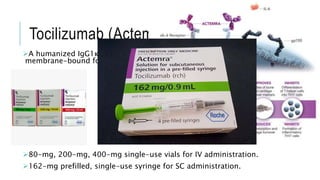
Tocilizumab (Actemra):-
A humanized IgG1κ monoclonal antibody that binds to the soluble and
membrane-bound forms of the IL-6 receptor (IL-6R).
80-mg, 200-mg, 400-mg single-use vials for IV administration.
162-mg prefilled, single-use syringe for SC administration.
patient weight <30 kg: use 12 mg/kg IV every 2 weeks; ≥30 kg: use
8 mg/kg IV every 2 weeks.
Tocilizumab can be used with or without MTX or another csDMARD.
Precautions:
 Do not use in patients with active infection.
 Hepatic enzymes >1.5× upper limit.
 Platelet count <100,000/mm3.
 History of diverticulitis or other IBD.
Monitoring
 CBC (with differential) and hepatic enzymes monthly until stable dose, then every 1
to 2 months.
 Lipid panel every 1 to 2 months until stable dose, then every 3 to 6 months.
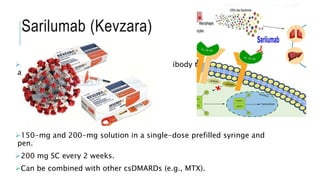
Sarilumab (Kevzara)
A fully human anti-IL-6Rα monoclonal antibody that binds the soluble
and membrane-bound human IL-6Rα.
150-mg and 200-mg solution in a single-dose prefilled syringe and
pen.
200 mg SC every 2 weeks.
Can be combined with other csDMARDs (e.g., MTX).
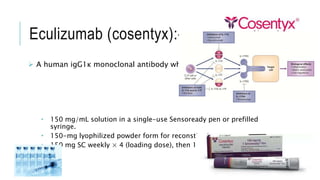
Eculizumab (cosentyx):-
 A human igG1κ monoclonal antibody which blocks IL-17A.
 150 mg/mL solution in a single-use Sensoready pen or prefilled
syringe.
 150-mg lyophilized powder form for reconstitution.
 150 mg SC weekly × 4 (loading dose), then 150 mg SC every 4 weeks.
Can be combined with a csDMARD (e.g., MTX).
Adverse reactions:
• Injection site reactions
• Nasopharyngitis are most common.
• Opportunistic infections (candida)
• Exacerbation of crohn’s disease have been reported.
Effective in AS, PSA, Not in RA.
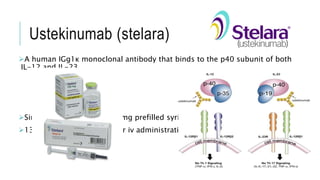
Ustekinumab (stelara)
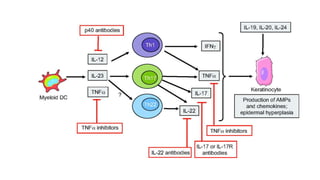
A human IGg1κ monoclonal antibody that binds to the p40 subunit of both
IL-12 and IL-23.
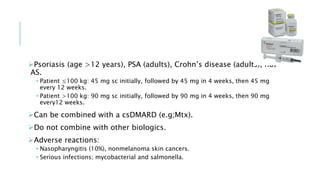
Single-use 45-mg and 90-mg prefilled syringes.
130-mg single-dose vial for iv administration.
Psoriasis (age >12 years), PSA (adults), Crohn’s disease (adults), not
AS.
• Patient ≤100 kg: 45 mg sc initially, followed by 45 mg in 4 weeks, then 45 mg
every 12 weeks.
• Patient >100 kg: 90 mg sc initially, followed by 90 mg in 4 weeks, then 90 mg
every12 weeks.
Can be combined with a csDMARD (e.g;Mtx).
Do not combine with other biologics.
Adverse reactions:
• Nasopharyngitis (10%), nonmelanoma skin cancers.
• Serious infections; mycobacterial and salmonella.
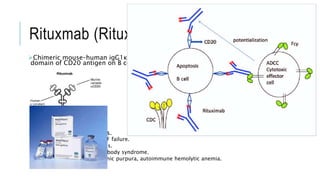
Rituxmab (Rituxan):-
Chimeric mouse–human igG1κ monoclonal antibody directed against extracellular
domain of CD20 antigen on B cells.
Half-life is 18 to 21 days.
 RA after MTX and anti-TNF failure.
 ANCA-associated vasculitis.
 SLE, antiphospholipid antibody syndrome.
 idiopathic thrombocytopenic purpura, autoimmune hemolytic anemia.
• Loading:(1g on days 1 and 15). Maintenance dose: 500 mg IV every 6
months.
• First infusion lasts 3 to 5 hours, subsequent infusions 1.5 to 3 hours.
Follow-up:
• CBC every 2 to 4 months
• Get IgG level prior to RTX infusions
Among ANCA-associated vasculitis patients, RTX is noninferior to
cyclophosphamide.
Adverse reactions:
• Infusion reaction
• Infection: serious, opportunistic (JC viruse).
• Viral infections; hbv, hcv.
• Hypogammaglobulinemia.
• Late-onset neutropenia, 3 to 4 months, last several weeks.
• Immunizations:, 2 to 4 weeks before or 6 months post-rtx infusion.
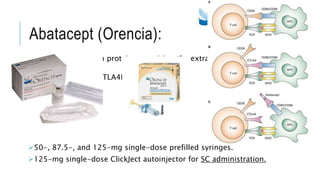
Abatacept (Orencia):
A fully human fusion protein comprising the extracellular portion of
CTLA4 and the fc
Fragment of IgG1 (CTLA4IG).
50-, 87.5-, and 125-mg single-dose prefilled syringes.
125-mg single-dose ClickJect autoinjector for SC administration.
IV dose; (500 mg if <60 kg; 750 mg if 60–100 kg; 1000 mg if >100 kg)
Loading dose at 0, 2, and 4 weeks, then every 4 weeks
 RA, adult PsA.
 polyarticular JIA (age >2 years) who are inadequate responders to DMARDs
(MTX).
 SLE, inflammatory myopathies, GCA, and Takayasu’s arteritis.
Can use with csDMARDs (MTX).
Abatacept may be the safest biologic to use in patients at risk for contacting TB.
Adverse reactions:
• Infusion reaction
• Infections; serious infections. Pneumonias
• Malignancy: lung cancer, lymphoma.
• Immunizations; response decreased to both killed and live vaccine.
When to with-hold biologics?
Should be discontinued in the presence of serious infections, but can
be recommenced once the infection has resolved clinically.
Stop biologic 3 to 5 half lives before major surgery. Should not be
restarted after surgery until there is good wound healing and no
evidence of infection.
Reference:
•Aaltonen KJ, Virkki LM, Malmivarra A, et al. Systematic review and meta-
analysis of the efficacy and safety of existing TNF blocking agents in
treatment of rheumatoid arthritis. PLOS ONE. 2012;7:e30275.
•Baeten D, Sieper J, Braun J, et al. Secukinumab, an interleukin-17A
inhibitor, in ankylosing spondylitis. N Engl J Med. 2015;373:2534– 2548.
•Bredemeir M, de Oliveira FK, Rocha CM. Low- versus high-dose
rituximab for rheumatoid arthritis: a systemic review and meta-analysis.
Arthritis Care Res. 2014;66:228–235.
•Campbell L, Chen C, Bhagat SS, et al. Risk of adverse events including
serious infections in rheumatoid arthritis patients treated with
tocilizumab: a systematic literature review and meta-analysis of
randomized controlled trials. Rheumatology. 2011;50:552–562.
•Chen L, Flies DB. Molecular mechanisms of T cell co-stimulation and co-
inhibition. Nat Rev Immunol. 2013;13:227–242.
•Cohen SB, Emery P, Greenwald MW, et al. Rituximab for rheumatoid
arthritis refractory to anti-tumor necrosis factor therapy: results of a
multicenter, randomized, double-blind, placebo-controlled phase III trial
evaluating primary efficacy and safety at twenty-four weeks. Arthritis
Rheum. 2006;54:2793–2806.
Biological therapy

Biological therapy

  • 1.
    Marwa Abo ElmaatyBesar Lecturer of Internal Medicine (Rheumatology Immunology Unit) (Pediatric Rheumatology) Biological therapy when and how to prescribe?
  • 5.
    • cept: receptordrug which prevents a ligand from binding to its receptor (e.g., ETN, abatacept, rilonacept). • ximab: chimeric monoclonal antibody (e.g., INF, RTX). • zumab: humanized monoclonal antibody (e.g., certolizumab, tocilizumab, ixekizumab, eculizumab). • umab: fully human monoclonal antibody (e.g., ADA, golimumab, belimumab, ustekinumab). • ra: receptor antagonist (e.g., anakinra).
  • 6.
    Biologic DMARDS:- Donahue KE,Jonas D, Hansen RA, et al. Comparative Effectiveness Review No. 55. Available at www.effectivehealthcare.gov/dmardsra.cfm. Biologic Disease-Modifying anti-rheumatic Drugs Name Trade Name Target of Activity Adalimumab Humira® TNF-α Certolizumab pegol Cimzia® TNF-α Etanercept Enbrel® TNF-α Golimumab Simponi® TNF-α Infliximab Remicade® TNF-α Abatacept Orencia® CD28 Anakinra Kineret® IL-1 Rituximab Rituxan® CD20 Tocilizumab Actemra® RoActemra® IL-6 receptor Abbreviations: IL = interleukin; TNF-α = tumor necrosis factor-alpha
  • 7.
    MEDICAL REQUIREMENTS 1. Bloodschecked for Hepatitis B + C core Antibodies 2. Recent chest x-ray 3. No history of TB or MS. 4. No history of lupus. 5. No history of cancer, 6. Patient is not awaiting any surgical/medical/dental procedures
  • 11.
    Infiximab (Remicade):- Single-use vialswith 100 mg of lyophilized powder for reconstitution. loading dose 3 mg/kg intravenous (IV) at weeks 0, 2, and 6, and then every 8 weeks. 5–10 mg/kg every 4 to 8 weeks.
  • 12.
    Initial infusion takes2 hours. If tolerated, subsequent infusions can be shortened. Anti-chimeric antibodies (HACAs). Concomitant use DMARD (MTX).  if a patient is not responding initially, increasing the frequency of infliximab infusions is more efficacious than increasing the dose. Try not to increase dose higher than 5 mg/kg every 4 weeks because of infection and malignancy concerns.
  • 13.
    Etanercept (Enbrel):- Etanercept isa fusion protein with two p75 TNF receptors bound to the Fc portion of IgG. The other four TNF inhibitors are monoclonal antibodies directed against TNF-α. Etanercept can only block TNF-α in the serum while the other TNF inhibitors can also inhibit TNF-α expressed on the cell surface. 25-mg and 50-mg prefilled syringes. 50-mg prefilled cartridge (enbrel mini) 25 mg of lyophilized powder for reconstitution.
  • 14.
    Etanercept (Enbrel):- 25 mgsubcutaneously (SC) twice a week or 50 mg SC once a week. Used in conjunction with MTX or another conventional synthetic disease-modifying antirheumatic drug (csDMARD). Not effective for uveitis. Should not be used if a patient with inflammatory bowel disease (IBD).
  • 15.
    Adalimumab (Humira) :- Singleuse 40-mg prefilled syringe. Single use 40-mg autoinjector pen. Citrate-free option for 20-mg (paediatric) prefilled syringe. Citrate-free option for 40-mg prefilled syringe and autoinjector pen.
  • 16.
    Adalimumab (Humira) :- 40mg SC every other week. Uveitis: initial dose 80 mg, then 40 mg every other week starting 1 week after initial dose. Approved for use as monotherapy.
  • 17.
    Golimumab (Simponi AndSimponi Aria): 50-mg and 100-mg single-use prefilled syringes or smartject autoinjectors. Simponi aria: an iv formulation (2 mg/kg infused over 30 minutes at 0, 4, and then every 8 weeks). 50 mg sc once a month.
  • 18.
    Certolizumab Pegol (Cimzia): Singleuse 200-mg prefilled syringe. 200 mg/vial lyophilized formulation, reconstituted. Loading dose 400 mg sc at weeks 0, 2, and 4; then 200 mg every 2 weeks. Owing to lack of functional fc fragment, may be less injection site reactions and safer during pregnancy (does not cross placenta).
  • 20.
    Adverse effects ofTNF inhibitors:- Serious Infections  TB  Skin and soft tissue  Blood borne viruses Malignancy  ? Lymphoma  ? Solid Tumors  Conflicting data Injection site reactions Infusion reactions (INF) Increased risk of cardiac failure (avoid TNF inhibitors (especially INF) Demeyelination Some experts recommend not starting these agents until a patient is cancer-free for 5 years, while others will use TNF inhibitors in any patient with a previously treated solid organ malignancy.
  • 21.
    Primary failure •Patients whofail to respond to the first TNF inhibitor. •less likely to get a good response to a second TNF inhibitor •switching from a TNF inhibitor to a bDMARD with a different mechanism of action Secondary failure •patients who initially responded to a TNF inhibitor and then lose that response. •more likely to get a good response to a second TNF inhibitor •neutralizing antibodies. •switching to a second TNF inhibitor of any type can be beneficial. TNF inhibitor intolerance • patients who had to stop the TNF inhibitor as a result of an adverse event. • more likely to develop an adverse event to a second TNF inhibitor. Patients who have failed two TNF inhibitors should probably not be tried on a third.
  • 22.
    Contraindication:- 1. Female inchildbearing period. 2. Active infection(indewelling urinary cath, chest infction,…..). 3. Spetic arthritis within the past 12 months. 4. Prosthetic valve within the past 12 months 5. History of malignancy.
  • 23.
    Tocilizumab (Actemra):- A humanizedIgG1κ monoclonal antibody that binds to the soluble and membrane-bound forms of the IL-6 receptor (IL-6R). 80-mg, 200-mg, 400-mg single-use vials for IV administration. 162-mg prefilled, single-use syringe for SC administration.
  • 24.
    patient weight <30kg: use 12 mg/kg IV every 2 weeks; ≥30 kg: use 8 mg/kg IV every 2 weeks. Tocilizumab can be used with or without MTX or another csDMARD. Precautions:  Do not use in patients with active infection.  Hepatic enzymes >1.5× upper limit.  Platelet count <100,000/mm3.  History of diverticulitis or other IBD. Monitoring  CBC (with differential) and hepatic enzymes monthly until stable dose, then every 1 to 2 months.  Lipid panel every 1 to 2 months until stable dose, then every 3 to 6 months.
  • 25.
    Sarilumab (Kevzara) A fullyhuman anti-IL-6Rα monoclonal antibody that binds the soluble and membrane-bound human IL-6Rα. 150-mg and 200-mg solution in a single-dose prefilled syringe and pen. 200 mg SC every 2 weeks. Can be combined with other csDMARDs (e.g., MTX).
  • 27.
    Eculizumab (cosentyx):-  Ahuman igG1κ monoclonal antibody which blocks IL-17A.  150 mg/mL solution in a single-use Sensoready pen or prefilled syringe.  150-mg lyophilized powder form for reconstitution.  150 mg SC weekly × 4 (loading dose), then 150 mg SC every 4 weeks.
  • 28.
    Can be combinedwith a csDMARD (e.g., MTX). Adverse reactions: • Injection site reactions • Nasopharyngitis are most common. • Opportunistic infections (candida) • Exacerbation of crohn’s disease have been reported. Effective in AS, PSA, Not in RA.
  • 29.
    Ustekinumab (stelara) A humanIGg1κ monoclonal antibody that binds to the p40 subunit of both IL-12 and IL-23. Single-use 45-mg and 90-mg prefilled syringes. 130-mg single-dose vial for iv administration.
  • 30.
    Psoriasis (age >12years), PSA (adults), Crohn’s disease (adults), not AS. • Patient ≤100 kg: 45 mg sc initially, followed by 45 mg in 4 weeks, then 45 mg every 12 weeks. • Patient >100 kg: 90 mg sc initially, followed by 90 mg in 4 weeks, then 90 mg every12 weeks. Can be combined with a csDMARD (e.g;Mtx). Do not combine with other biologics. Adverse reactions: • Nasopharyngitis (10%), nonmelanoma skin cancers. • Serious infections; mycobacterial and salmonella.
  • 31.
    Rituxmab (Rituxan):- Chimeric mouse–humanigG1κ monoclonal antibody directed against extracellular domain of CD20 antigen on B cells. Half-life is 18 to 21 days.  RA after MTX and anti-TNF failure.  ANCA-associated vasculitis.  SLE, antiphospholipid antibody syndrome.  idiopathic thrombocytopenic purpura, autoimmune hemolytic anemia.
  • 32.
    • Loading:(1g ondays 1 and 15). Maintenance dose: 500 mg IV every 6 months. • First infusion lasts 3 to 5 hours, subsequent infusions 1.5 to 3 hours. Follow-up: • CBC every 2 to 4 months • Get IgG level prior to RTX infusions Among ANCA-associated vasculitis patients, RTX is noninferior to cyclophosphamide. Adverse reactions: • Infusion reaction • Infection: serious, opportunistic (JC viruse). • Viral infections; hbv, hcv. • Hypogammaglobulinemia. • Late-onset neutropenia, 3 to 4 months, last several weeks. • Immunizations:, 2 to 4 weeks before or 6 months post-rtx infusion.
  • 33.
    Abatacept (Orencia): A fullyhuman fusion protein comprising the extracellular portion of CTLA4 and the fc Fragment of IgG1 (CTLA4IG). 50-, 87.5-, and 125-mg single-dose prefilled syringes. 125-mg single-dose ClickJect autoinjector for SC administration.
  • 34.
    IV dose; (500mg if <60 kg; 750 mg if 60–100 kg; 1000 mg if >100 kg) Loading dose at 0, 2, and 4 weeks, then every 4 weeks  RA, adult PsA.  polyarticular JIA (age >2 years) who are inadequate responders to DMARDs (MTX).  SLE, inflammatory myopathies, GCA, and Takayasu’s arteritis. Can use with csDMARDs (MTX). Abatacept may be the safest biologic to use in patients at risk for contacting TB. Adverse reactions: • Infusion reaction • Infections; serious infections. Pneumonias • Malignancy: lung cancer, lymphoma. • Immunizations; response decreased to both killed and live vaccine.
  • 35.
    When to with-holdbiologics? Should be discontinued in the presence of serious infections, but can be recommenced once the infection has resolved clinically. Stop biologic 3 to 5 half lives before major surgery. Should not be restarted after surgery until there is good wound healing and no evidence of infection.
  • 36.
    Reference: •Aaltonen KJ, VirkkiLM, Malmivarra A, et al. Systematic review and meta- analysis of the efficacy and safety of existing TNF blocking agents in treatment of rheumatoid arthritis. PLOS ONE. 2012;7:e30275. •Baeten D, Sieper J, Braun J, et al. Secukinumab, an interleukin-17A inhibitor, in ankylosing spondylitis. N Engl J Med. 2015;373:2534– 2548. •Bredemeir M, de Oliveira FK, Rocha CM. Low- versus high-dose rituximab for rheumatoid arthritis: a systemic review and meta-analysis. Arthritis Care Res. 2014;66:228–235. •Campbell L, Chen C, Bhagat SS, et al. Risk of adverse events including serious infections in rheumatoid arthritis patients treated with tocilizumab: a systematic literature review and meta-analysis of randomized controlled trials. Rheumatology. 2011;50:552–562. •Chen L, Flies DB. Molecular mechanisms of T cell co-stimulation and co- inhibition. Nat Rev Immunol. 2013;13:227–242. •Cohen SB, Emery P, Greenwald MW, et al. Rituximab for rheumatoid arthritis refractory to anti-tumor necrosis factor therapy: results of a multicenter, randomized, double-blind, placebo-controlled phase III trial evaluating primary efficacy and safety at twenty-four weeks. Arthritis Rheum. 2006;54:2793–2806.

Editor's Notes