Immunomodulators
BY:RASHI
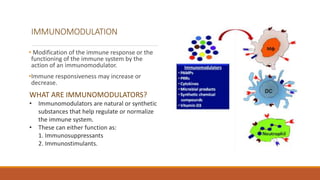
IMMUNOMODULATION
• Modification of the immune response or the
functioning of the immune system by the
action of an immunomodulator.
•Immune responsiveness may increase or
decrease.
WHAT ARE IMMUNOMODULATORS?
• Immunomodulators are natural or synthetic
substances that help regulate or normalize
the immune system.
• These can either function as:
1. Immunosuppressants
2. Immunostimulants.
HISTORY
OBJECTIVES OF IMMUNOMODULATION
•To improve disease resistance.
•To prevent or control immune disorders
•To speed up maturation of nonspecific and specific immunity
•To enhance local protective immune reactions at vulnerable sites such as mammary gland
•To surmount the immunosuppressive effects of stress and environmental pollution
•To enhance level and duration of immune response following vaccination
CHARACTERISTICS OF AN IDEAL IMMUNOMODULATOR
•Short withdrawal period and low tissue residues
•Stimulate both specific and non specific immune response
•Defined chemical composition and biological activity
•Inexpensive
•It should be active by oral route and stable in both its native state and upon incorporation into
food and water
•Nontoxic at high dose rates for animals and humans
•Neither antigenic nor pyrogenic
•It should not be excreted in milk or eggs
Dhama et. al., 2015
CLASSIFICATION
PHYSIOLOGICAL PRODUCTS-harmones, cytokines, peptides
MICROBIAL PRODUCTS
SYNTHETIC CHEMICAL COMPOUNDS
HERBAL PRODUCTS
ADJUVANTS
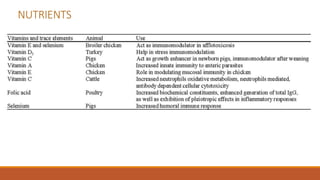
NUTRIENTS
PHYSIOLOGICAL PRODUCTS
(Prednisolone)
THYMIC HARMONES
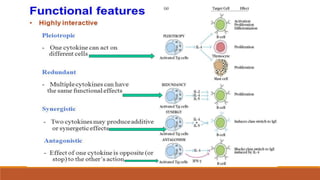
CYTOKINES
 Small proteins (~5–20 kDa).
 Cells of the immune system communicate with one another by releasing and responding to
chemical messengers called cytokines.
 Cytokine plays a key role in modulation of immune responses.
Cytokines are produced by a broad range of cells, including immune cells like macrophages, B
lymphocytes, T lymphocytes and mast cells, as well as endothelial cells, fibroblasts, and
various stromal cells; a given cytokine may be produced by more than one type of cell.
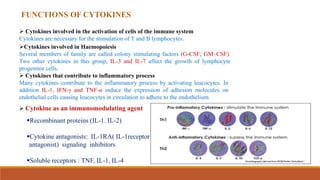
FUNCTIONS OF CYTOKINES
 Cytokines involved in the activation of cells of the immune system
Cytokines are necessary for the stimulation of T and B lymphocytes.
Cytokines involved in Haemopoiesis
Several members of family are called colony stimulating factors (G-CSF; GM–CSF).
Two other cytokines in this group, IL-3 and IL-7 affect the growth of lymphocyte
progenitor cells.
 Cytokines that contribute to inflammatory process
Many cytokines contribute to the inflammatory process by activating leucocytes. In
addition IL-1, IFN-γ and TNF-α induce the expression of adhesion molecules on
endothelial cells causing leucocytes in circulation to adhere to the endothelium.
 Cytokine as an immunomodulating agent
Recombinant proteins (IL-1. IL-2)
Cytokine antagonists: IL-1RA( IL-1receptor
antagonist) signaling inhibitors
Soluble receptors : TNF, IL-1, IL-4
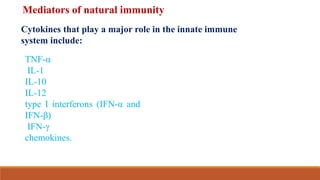
Mediators of natural immunity
Cytokines that play a major role in the innate immune
system include:
TNF-α
IL-1
IL-10
IL-12
type I interferons (IFN-α and
IFN-β)
IFN-γ
chemokines.
TNF-α
Tumor necrosis factor alpha is produced by activated macrophages is response to microbes, especially
the lipopolysaccharide (LPS) of Gram negative bacteria.
IL-1
Interleukin 1 is another inflammatory cytokine produced by
activated macrophages. Its effects are similar to that of TNF-α
and it also helps to activate T cells.
IL-10
Interleukin 10 is produced by activated macrophages and Th2
cells. It is predominantly an inhibitory cytokine. It inhibits
production of IFN-γ by Th1 cells, which shifts immune responses
toward a Th2 type.
IL-12
Interleukin 12 is produced
by activated macrophages
and dendritic cells.
• It stimulates the
production of IFN-γ
and induces the
differentiation of Th
cells to become Th1
cells.
• In addition, it
enhances the cytolytic
functions of T and NK
cells.
INF-γ
Interferon gamma is an important cytokine produced by primarily by Th1 cells, although it can
also be produced by Tc cells and NK cells to a lesser extent.
CHEMOKINES
Chemokines are chemotactic cytokines produced
by many kinds of leukocytes and other cell type.
The major role of chemokines is to act as a
chemoattractant to guide the migration of cells.
Cells that are attracted by chemokines follow a
signal of increasing chemokine concentration
towards the source of the chemokine. Eg IL-8
MEDIATORS OFADAPTIVE IMMUNITY
Cytokines that play a major role in the adaptive immune system
include:
IL-2
IL-4
IL-5
TGF-β
IFN-γ
IL-2
Interleukin 2 is produced by Th cells, although it can also be produced by Tc cells to a lesser extent.
IL-2 acts on T cells in an autocrine fashion.
In the thymus, where T cells mature, it prevents autoimmune diseases by promoting the differentiation of certain
immature T cells into regulatory T cells, which suppress other T cells that are otherwise primed to attack normal
healthy cells in the body
IL-4
Interleukin 4 is produced by macrophages and Th2 cells.
It stimulates the development of Th2 cells from naïve Th cells
and it promotes the growth of differentiated Th2 cells resulting
in the production of an antibody response.
It also stimulates Ig class switching to the IgE isotype.
IL-5
Interleukin 5 is produced by Th2 cells and it functions to promote the
growth and differentiation of B cells and eosinophiles.
It also activates mature eosinophiles.
TGF-β
Transforming growth factor beta is produced by T cells and many
other cell types.
It is primarily an inhibitory cytokine. It inhibits the proliferation of T
cells and the activation of macrophages.
CYTOKINES AS NOVEL IMMUNOMODULATORS FOR VACCINES
•The vaccine adjuvants cytokines can be administered by following:
 Genes encoded by DNA vaccines
 As soluble proteins
•In cattle, sheep, pigs and poultry soluble cytokines have been successfully used
Short half-life
Large doses
needed invivo
Adverse
effects
PROBLEM
SOLUTION
SLOW AND SUSTAINED
RELEASE
• IFN-α of Feline origin used for treatment of canine parvovirus in Europe
• IFN-γ of poultry origin appers to have significant role in treatment of circovirus
infection in grey parrots
• Recombinant bovine IL-1β and IL-2 found to be effective in Staphylococcus
aureus mastitis- these may provide sustainable alternatives to antibiotics or may
be used along with them as effective therapeutic agents for mastitis
• IL-11 useful in treating P. aeruginosa induced sepsis in immunocompromised
animals
• Immunostimulant cytokines have therapeutic potential against canine pyaderma
– a majaor veterinary problem
MICROBIAL PRODUCTS
• BCG derived from Mycobacterium bovis is most potent cytokine synthesis enhancer
• Muramyl dipeptide is a simple glycopeptide which activates MΦ and enhances humoral immunity
SYNTHETIC CHEMICAL COMPOUNDS
HERBAL PRODUCTS
ROLE OF ADJUVANT IN IMMUNOMODULATION AND VETERINARY VACCINE
DEVELOPMENT
•Enhance the immunogenicity of weak antigens
•Increase the duration and speed of immune response
•Modulate avidity, specificity and isotype distribution of
antibodies
•Enhance strong cell mediated immunity
•Reduce the antigen dose or the number of immunizations
needed for protective immunity to reduce the vaccine costs
•Increase the overall antibody titer
ADJUVANTS
Adjuvants are substances that, when mixed with vaccine immunogens, potentiate the immune response
resulting in the need for either a lesser quantity of antigen or fewer doses, or both.
NUTRIENTS
REFERENCES
Problem
Life long use
Infection, cancer
Nephrotoxicity
Diabetogenic

Immunomodulators

  • 1.
  • 2.
    IMMUNOMODULATION • Modification ofthe immune response or the functioning of the immune system by the action of an immunomodulator. •Immune responsiveness may increase or decrease. WHAT ARE IMMUNOMODULATORS? • Immunomodulators are natural or synthetic substances that help regulate or normalize the immune system. • These can either function as: 1. Immunosuppressants 2. Immunostimulants.
  • 3.
  • 4.
    OBJECTIVES OF IMMUNOMODULATION •Toimprove disease resistance. •To prevent or control immune disorders •To speed up maturation of nonspecific and specific immunity •To enhance local protective immune reactions at vulnerable sites such as mammary gland •To surmount the immunosuppressive effects of stress and environmental pollution •To enhance level and duration of immune response following vaccination
  • 5.
    CHARACTERISTICS OF ANIDEAL IMMUNOMODULATOR •Short withdrawal period and low tissue residues •Stimulate both specific and non specific immune response •Defined chemical composition and biological activity •Inexpensive •It should be active by oral route and stable in both its native state and upon incorporation into food and water •Nontoxic at high dose rates for animals and humans •Neither antigenic nor pyrogenic •It should not be excreted in milk or eggs Dhama et. al., 2015
  • 6.
    CLASSIFICATION PHYSIOLOGICAL PRODUCTS-harmones, cytokines,peptides MICROBIAL PRODUCTS SYNTHETIC CHEMICAL COMPOUNDS HERBAL PRODUCTS ADJUVANTS NUTRIENTS
  • 7.
  • 8.
  • 9.
    CYTOKINES  Small proteins(~5–20 kDa).  Cells of the immune system communicate with one another by releasing and responding to chemical messengers called cytokines.  Cytokine plays a key role in modulation of immune responses. Cytokines are produced by a broad range of cells, including immune cells like macrophages, B lymphocytes, T lymphocytes and mast cells, as well as endothelial cells, fibroblasts, and various stromal cells; a given cytokine may be produced by more than one type of cell.
  • 11.
    FUNCTIONS OF CYTOKINES Cytokines involved in the activation of cells of the immune system Cytokines are necessary for the stimulation of T and B lymphocytes. Cytokines involved in Haemopoiesis Several members of family are called colony stimulating factors (G-CSF; GM–CSF). Two other cytokines in this group, IL-3 and IL-7 affect the growth of lymphocyte progenitor cells.  Cytokines that contribute to inflammatory process Many cytokines contribute to the inflammatory process by activating leucocytes. In addition IL-1, IFN-γ and TNF-α induce the expression of adhesion molecules on endothelial cells causing leucocytes in circulation to adhere to the endothelium.  Cytokine as an immunomodulating agent Recombinant proteins (IL-1. IL-2) Cytokine antagonists: IL-1RA( IL-1receptor antagonist) signaling inhibitors Soluble receptors : TNF, IL-1, IL-4
  • 12.
    Mediators of naturalimmunity Cytokines that play a major role in the innate immune system include: TNF-α IL-1 IL-10 IL-12 type I interferons (IFN-α and IFN-β) IFN-γ chemokines.
  • 13.
    TNF-α Tumor necrosis factoralpha is produced by activated macrophages is response to microbes, especially the lipopolysaccharide (LPS) of Gram negative bacteria. IL-1 Interleukin 1 is another inflammatory cytokine produced by activated macrophages. Its effects are similar to that of TNF-α and it also helps to activate T cells.
  • 14.
    IL-10 Interleukin 10 isproduced by activated macrophages and Th2 cells. It is predominantly an inhibitory cytokine. It inhibits production of IFN-γ by Th1 cells, which shifts immune responses toward a Th2 type. IL-12 Interleukin 12 is produced by activated macrophages and dendritic cells. • It stimulates the production of IFN-γ and induces the differentiation of Th cells to become Th1 cells. • In addition, it enhances the cytolytic functions of T and NK cells.
  • 15.
    INF-γ Interferon gamma isan important cytokine produced by primarily by Th1 cells, although it can also be produced by Tc cells and NK cells to a lesser extent. CHEMOKINES Chemokines are chemotactic cytokines produced by many kinds of leukocytes and other cell type. The major role of chemokines is to act as a chemoattractant to guide the migration of cells. Cells that are attracted by chemokines follow a signal of increasing chemokine concentration towards the source of the chemokine. Eg IL-8
  • 16.
    MEDIATORS OFADAPTIVE IMMUNITY Cytokinesthat play a major role in the adaptive immune system include: IL-2 IL-4 IL-5 TGF-β IFN-γ
  • 17.
    IL-2 Interleukin 2 isproduced by Th cells, although it can also be produced by Tc cells to a lesser extent. IL-2 acts on T cells in an autocrine fashion. In the thymus, where T cells mature, it prevents autoimmune diseases by promoting the differentiation of certain immature T cells into regulatory T cells, which suppress other T cells that are otherwise primed to attack normal healthy cells in the body IL-4 Interleukin 4 is produced by macrophages and Th2 cells. It stimulates the development of Th2 cells from naïve Th cells and it promotes the growth of differentiated Th2 cells resulting in the production of an antibody response. It also stimulates Ig class switching to the IgE isotype.
  • 18.
    IL-5 Interleukin 5 isproduced by Th2 cells and it functions to promote the growth and differentiation of B cells and eosinophiles. It also activates mature eosinophiles. TGF-β Transforming growth factor beta is produced by T cells and many other cell types. It is primarily an inhibitory cytokine. It inhibits the proliferation of T cells and the activation of macrophages.
  • 19.
    CYTOKINES AS NOVELIMMUNOMODULATORS FOR VACCINES •The vaccine adjuvants cytokines can be administered by following:  Genes encoded by DNA vaccines  As soluble proteins •In cattle, sheep, pigs and poultry soluble cytokines have been successfully used Short half-life Large doses needed invivo Adverse effects PROBLEM SOLUTION SLOW AND SUSTAINED RELEASE
  • 20.
    • IFN-α ofFeline origin used for treatment of canine parvovirus in Europe • IFN-γ of poultry origin appers to have significant role in treatment of circovirus infection in grey parrots • Recombinant bovine IL-1β and IL-2 found to be effective in Staphylococcus aureus mastitis- these may provide sustainable alternatives to antibiotics or may be used along with them as effective therapeutic agents for mastitis • IL-11 useful in treating P. aeruginosa induced sepsis in immunocompromised animals • Immunostimulant cytokines have therapeutic potential against canine pyaderma – a majaor veterinary problem
  • 23.
    MICROBIAL PRODUCTS • BCGderived from Mycobacterium bovis is most potent cytokine synthesis enhancer • Muramyl dipeptide is a simple glycopeptide which activates MΦ and enhances humoral immunity
  • 24.
  • 25.
  • 26.
    ROLE OF ADJUVANTIN IMMUNOMODULATION AND VETERINARY VACCINE DEVELOPMENT •Enhance the immunogenicity of weak antigens •Increase the duration and speed of immune response •Modulate avidity, specificity and isotype distribution of antibodies •Enhance strong cell mediated immunity •Reduce the antigen dose or the number of immunizations needed for protective immunity to reduce the vaccine costs •Increase the overall antibody titer ADJUVANTS Adjuvants are substances that, when mixed with vaccine immunogens, potentiate the immune response resulting in the need for either a lesser quantity of antigen or fewer doses, or both.
  • 29.
  • 30.
  • 31.
    Problem Life long use Infection,cancer Nephrotoxicity Diabetogenic