Remedial Math Redesign: 
Improving Success in College Algebra 
Presented by: 
Dr. David G. Underwood
Arkansas Legislative Mandate 
Students scoring less than 19 on the 
mathematics section of the ACT Examination 
must be remediated in mathematics.
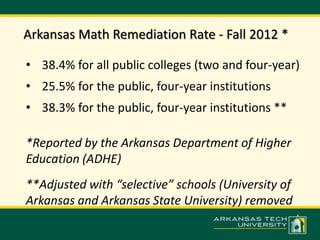
Arkansas Math Remediation Rate - Fall 2012 * 
• 38.4% for all public colleges (two and four-year) 
• 25.5% for the public, four-year institutions 
• 38.3% for the public, four-year institutions ** 
*Reported by the Arkansas Department of Higher 
Education (ADHE) 
**Adjusted with “selective” schools (University of 
Arkansas and Arkansas State University) removed
Context – Arkansas Tech University 
First Generation College Students – More than 50% 
Some Type Financial Aid – 95.4% 
Pell Grant Eligible – 61% 
Graduation Rate – 40.2% 
Math Remediation Rate Fall 2012 - 40%
ATU’s Approach to Math Remediation 
Two-step process 
• MATH 0802 (Beginning Algebra) for students 
scoring 16 or below on Math ACT 
• MATH 0903 (Intermediate Algebra) for students 
earning 17 or 18 on Math ACT 
Very Traditional Approach 
• Students attend a mathematics class 
• Teachers provide lecture and homework 
• Students take traditional exams throughout 
semester
ATU Performance 
• First-time, Full-time, Degree-Seeking - 
Fall 07 Cohort through 2010 
• Success = Earned C or Better 
Course % 
Successful 
% 
Unsuccessful Total 
MATH0803 67.6 32.4 1272 
MATH0903 58.6 41.4 997 
MATH1113 68.8 31.2 2265
ATU Performance (Continued) 
• Over two-thirds, 67.6%, of the poorest 
students are successful in their mathematics 
course (MATH 0803). 
• Likewise, more than half of the next best 
students are successful (58.6%) 
• Students who scored high enough to enter 
directly into MATH 1113, College Algebra, 
have a 68.8% success rate.
Big Picture 
• It is easy to focus on the courses as discrete 
entities and overlook the larger picture of 
what the student must accomplish to 
ultimately be successful. In order to graduate 
from college, the students who begin in MATH 
0803 or MATH 0903 must ultimately complete 
MATH 1113 with a grade of “C” or better.
Big Picture – Successful Completion 
Keeping the goal in mind – completing MATH 1113 
• Students who successfully completed MATH 0803 - 
only 43.9% were successful in MATH 0903. 
• Students who were successful in MATH 0903 after 
competing MATH 0803 - only 23.2% were 
successful in completing MATH 1113. 
• Students who started in, and successfully 
completed MATH 0903, a total of 74% were 
successful.
Big Picture - Casualties 
• Of 2,269 in the 2007-2010 Remedial Cohort - 
only 668 (29.4%) successfully completed the 
college algebra course required for an 
opportunity to complete most college degree 
programs.
Math Remediation Redesign Project 
• During 2011, the Arkansas Department of 
Higher Education (ADHE) received a grant 
from the Bill and Melinda Gates Foundation, 
under the auspices of Complete College 
America (CCA). 
• Goal: to assist institutions to redesign how 
remedial courses are taught to improve 
success rates and reduce time to degree.
Math Remediation Redesign Begins 
• The associate vice president for academic affairs 
was designated to lead the effort on campus. 
• His first task after acceptance as one of the 
volunteer institutions was to meet with faculty 
members in the mathematics department who 
have a history of teaching both remedial 
mathematics and college algebra to discuss the 
opportunity and seek volunteers to work on the 
redesign.
Volunteers 
Five full-time faculty members volunteered 
• Kristi Spittler-Brown, 
• Terre Taylor, 
• Susan Jordan, 
• Jessie Hogan, and 
• Jamie King
Early Decisions 
1. Because the goals were to improve success 
as well as reduce time to degree completion, 
the institution would no longer use a two-step 
remediation process. To that end, MATH 
0803 would be deleted from the course 
listings and all students requiring 
remediation would be enrolled in MATH 
0903.
Early Decision (Continued) 
2. The redesigned course would be developed 
using the Emporium model (based on work 
originally completed several years ago by 
Virginia Tech) rather than the traditional 
approach of lecture and testing. (See also, 
The National Center for Academic 
Transformation NCAT)
Emporium Model 
• The decision to use the Emporium model was a 
result of meeting with experts in that model 
identified by our Complete College America 
liaison and reviews of the literature regarding the 
benefits of a course redesign 
• The expert most frequently used was Dr. Loretta 
Griffy from Austin Peay University and many of 
the ideas implemented were a direct result of Dr. 
Griffy’s experience in completing her own 
redesign at Austin Peay.
Redesign Continues 
• Two classrooms were converted from lecture 
to computer based. Once identified, each 
classroom was set up with 44 personal 
computers. 
• At the same time, the working group of faculty 
was deciding the most appropriate 
instructional platform to use and identifying 
the key components of a modular approach to 
teaching developmental math.
Software Selected 
• Pearson’s MyMathLabPlus was selected as the 
software platform 
– could be adapted to the modular approach, 
– provided testing capacity, 
– allowed immediate feedback, and 
– offered targeted homework problems (based on 
the types of procedures with which the student 
was experiencing difficulty)
Textbook Selection 
• Faculty selected Pearson’s custom textbook 
option to develop “Beginning & Intermediate 
Algebra Guided Notebook”. 
• The faculty chose this option to allow the 
book to seamlessly follow the modules they 
were developing.
Eight Modules Developed 
1. Real Numbers and Algebraic Expressions 
2. Linear Equations and Inequalities in One 
Variable 
3. Graphs and Systems of Linear Equations 
4. Exponents and Polynomials 
5. Factoring Polynomials 
6. Radicals and Rational Exponents 
7. Solving Non-Linear Equations 
8. Functions
Requirements to Take Credit Courses 
• Successfully completing the first 6 modules 
would allow the student to enter MATH 1003 
(College Mathematics), a credit course for 
non-STEM majors. 
• Successfully completing all 8 modules allows 
the student to enter into MATH 1113 (College 
Algebra).
Completion of Modules 
• Completion of a module is a two-step process. 
– Pass MyMathLabPlus Modular Test with 70% or 
Better and 
– Pass Faculty-Developed Module Tests also with 
70% or Better 
• In any class meeting, students attending will 
be at working on various levels of the 
modules.
“Working at Own Pace” 
• Not same as “working at your own pace”. 
Goals must be set to ensure the student 
continues to make progress. 
• Not all students will complete all modules in 
one semester. This becomes a very interesting 
grading issue and also directly relates to 
financial aid.
Grading & Financial Aid Implications 
• To avoid grading/financial aid issues include 
Financial Aid and Registrar’s Personnel on 
Team 
• Needed New Grading System 
– Successful Completion = Regular Grade 
– Grade for Successful Progress (completion of at 
least 3 modules during the semester) 
• Financial Aid allows 2 semesters to complete 
all modules
Implementation Date 
• CCA Grant Called for Implementation Fall 2012 
• AVPAA Strongly Recommended Summer 2011 
1) the summer has fewer students enrolled in 
remedial mathematics, and 
2) when a new program is implemented it is rare for 
it not to have unforeseen consequences, 
problems, etc. It is better to identify problems 
with smaller numbers of students involved.
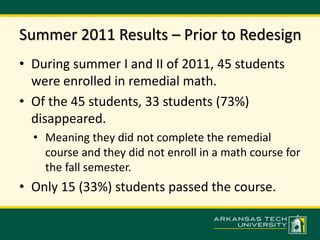
Summer 2011 Results – Prior to Redesign 
• During summer I and II of 2011, 45 students 
were enrolled in remedial math. 
• Of the 45 students, 33 students (73%) 
disappeared. 
• Meaning they did not complete the remedial 
course and they did not enroll in a math course for 
the fall semester. 
• Only 15 (33%) students passed the course.
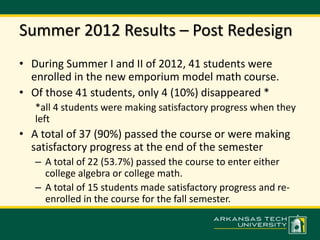
Summer 2012 Results – Post Redesign 
• During Summer I and II of 2012, 41 students were 
enrolled in the new emporium model math course. 
• Of those 41 students, only 4 (10%) disappeared * 
*all 4 students were making satisfactory progress when they 
left 
• A total of 37 (90%) passed the course or were making 
satisfactory progress at the end of the semester 
– A total of 22 (53.7%) passed the course to enter either 
college algebra or college math. 
– A total of 15 students made satisfactory progress and re-enrolled 
in the course for the fall semester.
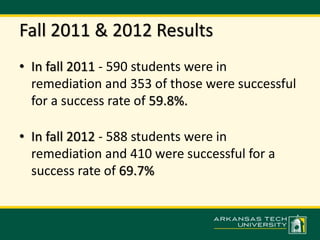
Fall 2011 & 2012 Results 
• In fall 2011 - 590 students were in 
remediation and 353 of those were successful 
for a success rate of 59.8%. 
• In fall 2012 - 588 students were in 
remediation and 410 were successful for a 
success rate of 69.7%
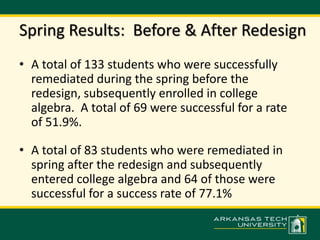
Spring Results: Before & After Redesign 
• A total of 133 students who were successfully 
remediated during the spring before the 
redesign, subsequently enrolled in college 
algebra. A total of 69 were successful for a rate 
of 51.9%. 
• A total of 83 students who were remediated in 
spring after the redesign and subsequently 
entered college algebra and 64 of those were 
successful for a success rate of 77.1%
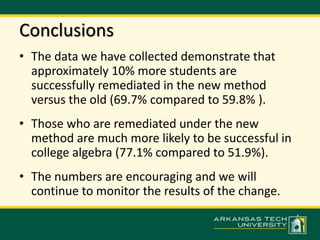
Conclusions 
• The data we have collected demonstrate that 
approximately 10% more students are 
successfully remediated in the new method 
versus the old (69.7% compared to 59.8% ). 
• Those who are remediated under the new 
method are much more likely to be successful in 
college algebra (77.1% compared to 51.9%). 
• The numbers are encouraging and we will 
continue to monitor the results of the change.
Remedial math redesign final

Remedial math redesign final

  • 1.
    Remedial Math Redesign: Improving Success in College Algebra Presented by: Dr. David G. Underwood
  • 2.
    Arkansas Legislative Mandate Students scoring less than 19 on the mathematics section of the ACT Examination must be remediated in mathematics.
  • 3.
    Arkansas Math RemediationRate - Fall 2012 * • 38.4% for all public colleges (two and four-year) • 25.5% for the public, four-year institutions • 38.3% for the public, four-year institutions ** *Reported by the Arkansas Department of Higher Education (ADHE) **Adjusted with “selective” schools (University of Arkansas and Arkansas State University) removed
  • 4.
    Context – ArkansasTech University First Generation College Students – More than 50% Some Type Financial Aid – 95.4% Pell Grant Eligible – 61% Graduation Rate – 40.2% Math Remediation Rate Fall 2012 - 40%
  • 5.
    ATU’s Approach toMath Remediation Two-step process • MATH 0802 (Beginning Algebra) for students scoring 16 or below on Math ACT • MATH 0903 (Intermediate Algebra) for students earning 17 or 18 on Math ACT Very Traditional Approach • Students attend a mathematics class • Teachers provide lecture and homework • Students take traditional exams throughout semester
  • 6.
    ATU Performance •First-time, Full-time, Degree-Seeking - Fall 07 Cohort through 2010 • Success = Earned C or Better Course % Successful % Unsuccessful Total MATH0803 67.6 32.4 1272 MATH0903 58.6 41.4 997 MATH1113 68.8 31.2 2265
  • 7.
    ATU Performance (Continued) • Over two-thirds, 67.6%, of the poorest students are successful in their mathematics course (MATH 0803). • Likewise, more than half of the next best students are successful (58.6%) • Students who scored high enough to enter directly into MATH 1113, College Algebra, have a 68.8% success rate.
  • 8.
    Big Picture •It is easy to focus on the courses as discrete entities and overlook the larger picture of what the student must accomplish to ultimately be successful. In order to graduate from college, the students who begin in MATH 0803 or MATH 0903 must ultimately complete MATH 1113 with a grade of “C” or better.
  • 9.
    Big Picture –Successful Completion Keeping the goal in mind – completing MATH 1113 • Students who successfully completed MATH 0803 - only 43.9% were successful in MATH 0903. • Students who were successful in MATH 0903 after competing MATH 0803 - only 23.2% were successful in completing MATH 1113. • Students who started in, and successfully completed MATH 0903, a total of 74% were successful.
  • 10.
    Big Picture -Casualties • Of 2,269 in the 2007-2010 Remedial Cohort - only 668 (29.4%) successfully completed the college algebra course required for an opportunity to complete most college degree programs.
  • 11.
    Math Remediation RedesignProject • During 2011, the Arkansas Department of Higher Education (ADHE) received a grant from the Bill and Melinda Gates Foundation, under the auspices of Complete College America (CCA). • Goal: to assist institutions to redesign how remedial courses are taught to improve success rates and reduce time to degree.
  • 12.
    Math Remediation RedesignBegins • The associate vice president for academic affairs was designated to lead the effort on campus. • His first task after acceptance as one of the volunteer institutions was to meet with faculty members in the mathematics department who have a history of teaching both remedial mathematics and college algebra to discuss the opportunity and seek volunteers to work on the redesign.
  • 13.
    Volunteers Five full-timefaculty members volunteered • Kristi Spittler-Brown, • Terre Taylor, • Susan Jordan, • Jessie Hogan, and • Jamie King
  • 14.
    Early Decisions 1.Because the goals were to improve success as well as reduce time to degree completion, the institution would no longer use a two-step remediation process. To that end, MATH 0803 would be deleted from the course listings and all students requiring remediation would be enrolled in MATH 0903.
  • 15.
    Early Decision (Continued) 2. The redesigned course would be developed using the Emporium model (based on work originally completed several years ago by Virginia Tech) rather than the traditional approach of lecture and testing. (See also, The National Center for Academic Transformation NCAT)
  • 16.
    Emporium Model •The decision to use the Emporium model was a result of meeting with experts in that model identified by our Complete College America liaison and reviews of the literature regarding the benefits of a course redesign • The expert most frequently used was Dr. Loretta Griffy from Austin Peay University and many of the ideas implemented were a direct result of Dr. Griffy’s experience in completing her own redesign at Austin Peay.
  • 17.
    Redesign Continues •Two classrooms were converted from lecture to computer based. Once identified, each classroom was set up with 44 personal computers. • At the same time, the working group of faculty was deciding the most appropriate instructional platform to use and identifying the key components of a modular approach to teaching developmental math.
  • 18.
    Software Selected •Pearson’s MyMathLabPlus was selected as the software platform – could be adapted to the modular approach, – provided testing capacity, – allowed immediate feedback, and – offered targeted homework problems (based on the types of procedures with which the student was experiencing difficulty)
  • 19.
    Textbook Selection •Faculty selected Pearson’s custom textbook option to develop “Beginning & Intermediate Algebra Guided Notebook”. • The faculty chose this option to allow the book to seamlessly follow the modules they were developing.
  • 20.
    Eight Modules Developed 1. Real Numbers and Algebraic Expressions 2. Linear Equations and Inequalities in One Variable 3. Graphs and Systems of Linear Equations 4. Exponents and Polynomials 5. Factoring Polynomials 6. Radicals and Rational Exponents 7. Solving Non-Linear Equations 8. Functions
  • 21.
    Requirements to TakeCredit Courses • Successfully completing the first 6 modules would allow the student to enter MATH 1003 (College Mathematics), a credit course for non-STEM majors. • Successfully completing all 8 modules allows the student to enter into MATH 1113 (College Algebra).
  • 22.
    Completion of Modules • Completion of a module is a two-step process. – Pass MyMathLabPlus Modular Test with 70% or Better and – Pass Faculty-Developed Module Tests also with 70% or Better • In any class meeting, students attending will be at working on various levels of the modules.
  • 23.
    “Working at OwnPace” • Not same as “working at your own pace”. Goals must be set to ensure the student continues to make progress. • Not all students will complete all modules in one semester. This becomes a very interesting grading issue and also directly relates to financial aid.
  • 24.
    Grading & FinancialAid Implications • To avoid grading/financial aid issues include Financial Aid and Registrar’s Personnel on Team • Needed New Grading System – Successful Completion = Regular Grade – Grade for Successful Progress (completion of at least 3 modules during the semester) • Financial Aid allows 2 semesters to complete all modules
  • 25.
    Implementation Date •CCA Grant Called for Implementation Fall 2012 • AVPAA Strongly Recommended Summer 2011 1) the summer has fewer students enrolled in remedial mathematics, and 2) when a new program is implemented it is rare for it not to have unforeseen consequences, problems, etc. It is better to identify problems with smaller numbers of students involved.
  • 26.
    Summer 2011 Results– Prior to Redesign • During summer I and II of 2011, 45 students were enrolled in remedial math. • Of the 45 students, 33 students (73%) disappeared. • Meaning they did not complete the remedial course and they did not enroll in a math course for the fall semester. • Only 15 (33%) students passed the course.
  • 27.
    Summer 2012 Results– Post Redesign • During Summer I and II of 2012, 41 students were enrolled in the new emporium model math course. • Of those 41 students, only 4 (10%) disappeared * *all 4 students were making satisfactory progress when they left • A total of 37 (90%) passed the course or were making satisfactory progress at the end of the semester – A total of 22 (53.7%) passed the course to enter either college algebra or college math. – A total of 15 students made satisfactory progress and re-enrolled in the course for the fall semester.
  • 28.
    Fall 2011 &2012 Results • In fall 2011 - 590 students were in remediation and 353 of those were successful for a success rate of 59.8%. • In fall 2012 - 588 students were in remediation and 410 were successful for a success rate of 69.7%
  • 29.
    Spring Results: Before& After Redesign • A total of 133 students who were successfully remediated during the spring before the redesign, subsequently enrolled in college algebra. A total of 69 were successful for a rate of 51.9%. • A total of 83 students who were remediated in spring after the redesign and subsequently entered college algebra and 64 of those were successful for a success rate of 77.1%
  • 30.
    Conclusions • Thedata we have collected demonstrate that approximately 10% more students are successfully remediated in the new method versus the old (69.7% compared to 59.8% ). • Those who are remediated under the new method are much more likely to be successful in college algebra (77.1% compared to 51.9%). • The numbers are encouraging and we will continue to monitor the results of the change.

Editor's Notes

  • #6 The expectation was that the student would first pass MATH 0803 and then enter MATH 0903 where they would gain more advanced skills in preparation for MATH 1113, the first college credit course required for most majors.
  • #11 However, this still does not convey the full picture in terms of human casualties.
  • #30 These numbers appear low because many of the remediated students either entered college math instead of college algebra, or postponed college algebra to a future semester, or dropped out for reasons other than math.