Baroque Period 1600-1750
Vocal- Opera Developed from stories of ancient Greek tragedies Parts of an opera Always opened with an overture Orchestra and chorus Performers and costumes Stage design (lighting and scenery) Some solo part (solo aria, duet, or trio) Aria Recitative
Opera-Italian Florentine- end of 1500’s group of noblemen wanted to bring back ancient Greek tragedy Roman- focused more on religious subjects rather than Greek tragedy Venetian- less choral and orchestral music, more emphasis on formal arias and elaborate stage machinery Neopolitan- late 1600’s and early 1700’s, orchestra’s role diminished and chorus almost non-existant Castratti- male sopranos Sinfonia- Italian overtures
Opera-French Didn’t develop until second half of 1600’s  It was inspired by French dramas and court ballet French overture Made less use of virtuosity Accentuation of literature Shorter and simpler-like airs Greater importance on dramas Added ballet Increased the use of the orchestra
Opera-England Wasn’t very popular Italian operas were performed in London More involved in theater music forms Three forms of music theater Masque-extravagant play performed privately for nobility Incidental- played during the action scenes in plays Entr’acte- performed between acts or scenes in plays
Opera- Comic Appeared in the early 1700’s Way to lighten the emotions It had parody, humor, and satire Spoken dialogue replaced recitatives Characters, aria text, and melodies of serious operas were often parodied Subjects were now light, frivolous, and humorous Small ensemble groups and choirs were used Commonplace characters  Popular tunes
Instrumental Became as important as vocal music Improvisation increased Basso continuo- figured bass Thematic variation Sequencing Distinction between chamber ensemble and the orchestra Equal tempered tuning of instruments
Instruments Keyboards- clavichord, harpsichord, organ Strings-violin and bass viol Winds- bassoon, flute, and oboe Brass- trumpets, horns, and trombones Percussion- timpani
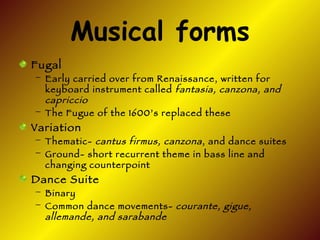
Musical forms Fugal Early carried over from Renaissance, written for keyboard instrument called  fantasia, canzona, and capriccio The Fugue of the 1600’s replaced these Variation Thematic-  cantus firmus, canzona , and dance suites Ground- short recurrent theme in bass line and changing counterpoint Dance Suite Binary  Common dance movements-  courante, gigue, allemande, and sarabande
Musical forms Chorale Prelude Organ music Used for church Improvisatory Lacked distinct thematic material Lacked formal unity Sonata Multi-movement work for solo and small chamber groups 3 types-unaccompanied solo, accompanied solo,  and trio solo Church sonata Chamber sonata Tower Sonata Keyboard Sonata
Orchestral Music Composed mainly of strings Basso continuo Not much color definition Solo concerto-written for one instrument and orchestra Concerto grosso-2 or 3 solo instruments playing in opposition of the orchestra
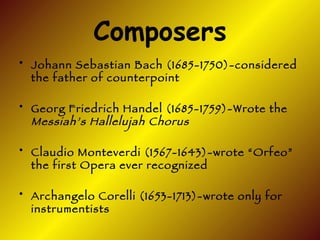
Composers Johann Sebastian Bach (1685-1750)-considered the father of counterpoint Georg Friedrich Handel (1685-1759)-Wrote the  Messiah’s Hallelujah Chorus Claudio Monteverdi (1567-1643)-wrote “Orfeo” the first Opera ever recognized Archangelo Corelli (1653-1713)-wrote only for instrumentists
Composers Henry Purcell (1659-1695)- at age 20 he became the organist for Westminster Abbey Jean-Phillippe Rameau (1683-1764)- always interested in adding flair to his music such as storm scenes Antonio Vivaldi (1680-1743)- felt that the soloist and orchestra should be in conflict with each other

Baroque Period

  • 1.
  • 2.
    Vocal- Opera Developedfrom stories of ancient Greek tragedies Parts of an opera Always opened with an overture Orchestra and chorus Performers and costumes Stage design (lighting and scenery) Some solo part (solo aria, duet, or trio) Aria Recitative
  • 3.
    Opera-Italian Florentine- endof 1500’s group of noblemen wanted to bring back ancient Greek tragedy Roman- focused more on religious subjects rather than Greek tragedy Venetian- less choral and orchestral music, more emphasis on formal arias and elaborate stage machinery Neopolitan- late 1600’s and early 1700’s, orchestra’s role diminished and chorus almost non-existant Castratti- male sopranos Sinfonia- Italian overtures
  • 4.
    Opera-French Didn’t developuntil second half of 1600’s It was inspired by French dramas and court ballet French overture Made less use of virtuosity Accentuation of literature Shorter and simpler-like airs Greater importance on dramas Added ballet Increased the use of the orchestra
  • 5.
    Opera-England Wasn’t verypopular Italian operas were performed in London More involved in theater music forms Three forms of music theater Masque-extravagant play performed privately for nobility Incidental- played during the action scenes in plays Entr’acte- performed between acts or scenes in plays
  • 6.
    Opera- Comic Appearedin the early 1700’s Way to lighten the emotions It had parody, humor, and satire Spoken dialogue replaced recitatives Characters, aria text, and melodies of serious operas were often parodied Subjects were now light, frivolous, and humorous Small ensemble groups and choirs were used Commonplace characters Popular tunes
  • 7.
    Instrumental Became asimportant as vocal music Improvisation increased Basso continuo- figured bass Thematic variation Sequencing Distinction between chamber ensemble and the orchestra Equal tempered tuning of instruments
  • 8.
    Instruments Keyboards- clavichord,harpsichord, organ Strings-violin and bass viol Winds- bassoon, flute, and oboe Brass- trumpets, horns, and trombones Percussion- timpani
  • 9.
    Musical forms FugalEarly carried over from Renaissance, written for keyboard instrument called fantasia, canzona, and capriccio The Fugue of the 1600’s replaced these Variation Thematic- cantus firmus, canzona , and dance suites Ground- short recurrent theme in bass line and changing counterpoint Dance Suite Binary Common dance movements- courante, gigue, allemande, and sarabande
  • 10.
    Musical forms ChoralePrelude Organ music Used for church Improvisatory Lacked distinct thematic material Lacked formal unity Sonata Multi-movement work for solo and small chamber groups 3 types-unaccompanied solo, accompanied solo, and trio solo Church sonata Chamber sonata Tower Sonata Keyboard Sonata
  • 11.
    Orchestral Music Composedmainly of strings Basso continuo Not much color definition Solo concerto-written for one instrument and orchestra Concerto grosso-2 or 3 solo instruments playing in opposition of the orchestra
  • 12.
    Composers Johann SebastianBach (1685-1750)-considered the father of counterpoint Georg Friedrich Handel (1685-1759)-Wrote the Messiah’s Hallelujah Chorus Claudio Monteverdi (1567-1643)-wrote “Orfeo” the first Opera ever recognized Archangelo Corelli (1653-1713)-wrote only for instrumentists
  • 13.
    Composers Henry Purcell(1659-1695)- at age 20 he became the organist for Westminster Abbey Jean-Phillippe Rameau (1683-1764)- always interested in adding flair to his music such as storm scenes Antonio Vivaldi (1680-1743)- felt that the soloist and orchestra should be in conflict with each other