*RELIGION
 Religare- “relationship”
                        - to
 “bind back”
 * is an organized system of beliefs, ceremonies, practices, and worship
 that centers on a supreme God or a deity.

 * Generally, people who follow some form of religion believes that a
 divine power created the world and influences their lives.
 * is a way of life of a particular group of people.

 * sum total of belief and practices.
*REASON
why peoplepracticereligion?
 * It is a part of heritage or their culture, tribe, or family.
 * It gives many people a feeling of security because they believe that a divine
 power watches over them.
 * For help or protection.
 * It promises them salvation and either happiness or the chance to improve
 themselves in a life after death.
 * Brings a sense of individual fulfillment and gives meaning to life.
 * It provides answers to questions of life such as:
            [a] What is the purpose of life?
            [b] What is the final destiny of man?
            [c] What is the difference between right and wrong?
 * They enjoy a sense of kinship with their fellow believers (fellowship).
Eight Major Religions of the World

            Islam                           Taoism


Judaism                                               Hinduism


          Sikhism                           Christianity

                           Buddhism
                                              Jainism
                                            Confucianism
                                               Shinto
*CHIEF
CHARACTERISTICS
 of religion


 [I.] BELIEF IN THE EXISTENCE OF A GOD OR A DEITY
          Most religions are theistic. They teach that deities govern or greatly
 influence the actions of human beings as well as events in nature.

 A. Forms of Beliefs
                 [1] THEISM- generally believes in the existence of a God.
                 [2] ATHEISM- believes that there is no God that exists.
                 [3] AGNOSTICISM- say that the existence of a deity cannot
 be
                                                    proven or disproved.
*CHIEF
CHARACTERISTICS
 of religion
 B. Forms of Theism
          [1] PANTHEISM- believes that everything is God, everything is a
 divine manifestation of God, and finally that nothing really exists that is not
 God.
          [2] PANENTHEISM-believes that God is everywhere. God’s presence
 can be felt anywhere if only we open our eyes to this reality. God is present
 in His creation but Creation is not God.
          [3] POLYTHEISM- those who believe in two or more Gods. The
 ancient Greeks and Romans have Polytheistic religions.
 Examples: Aphrodite- Goddess of Love; Mars- Roman God of War
          [4] HENOTHEISM- worships a supreme God but does not deny the
 existence and power of the other Gods.
          [5] MONOTHEISM- teaches that there is only one God.
*CHIEF
CHARACTERISTICS
  of religion

 [II.] DOCTRINE OF SALVATION
          Most religions stress that salvation is the highest goal of the faithful
 and that all followers should try to achieve.
          A doctrine of salvation is based on the belief that individual are in
 some form of danger from which they must be saved.

 [III.]   CODE OF CONDUCT
          Code of conduct is a set of moral teachings and values that all
 religions have in some form. It tells believers how to conduct their lives. It
 teaches them how to act toward the deity and towards one another.
*CHIEF
CHARACTERISTICS
 of religion


 [IV.] THE USE OF SACRED STORIES CONTAINED IN THE SACRED BOOKS
          Sacred stories or myths are often used by religious leaders to
 dramatize the teaching of their faith.

 [V.]      RELIGIOUS RITUALS
           Rituals include the acts and ceremonies by which believers appeal
 to and serve God, deities, and other sacred powers. The performance of a
 ritual is often called “service”, the most common form of ritual is prayer.
           Through prayer, a believer addresses worship and thoughts to an
 object of worship.
           Prayer includes request, expressions of thanksgivings, confession of
 sins, and praise.
B
U
D   - The “Dharma wheel”, symbolizes Buddhist law, endless cycles of birth
D   and rebirth. Eight spokes represent the “Eightfold path” to enlightenment
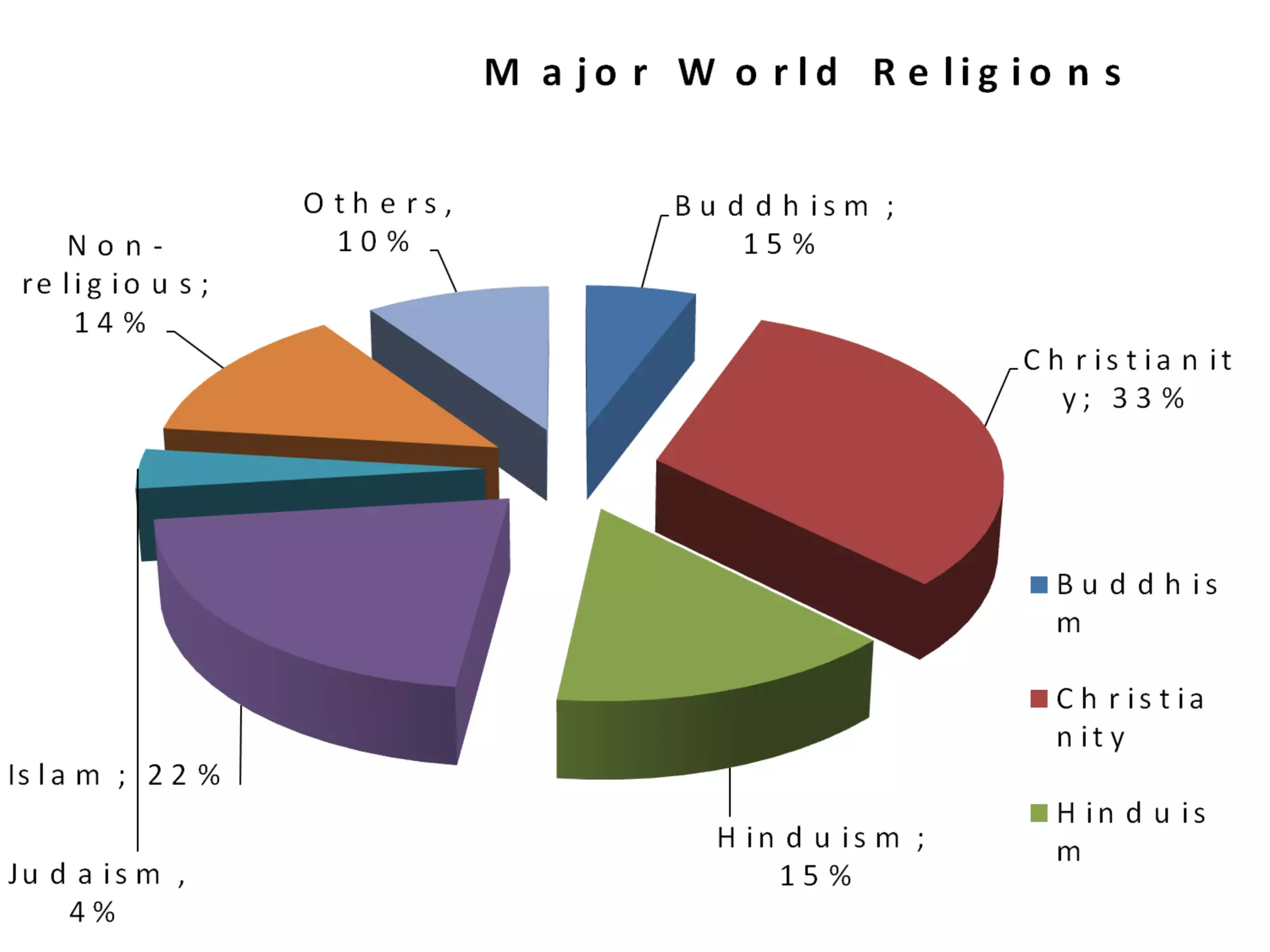
H   - 6%- estimated followers, Buddhist
    - It teaches a way by which men and women, in a devout and confident
I   spirit, maybe able either to acquire that state or perfect liberation, or
S   attain, by their own efforts or through higher help
M
B
U
D
D
H   - Siddhartha Gautama, Hindu around 563 BCE, in Lumbini (now Nepal);
I   16- married; 29- after the birth of his son, left his family; 35- realised
S   ‘Enlightenment’ and became a Buddha (The “Awakened One” or
    “Enlightened One”); 80- died
M
B
U
D
    - Buddhism offers clear rules for its followers
D
    - Four Noble Truths
H   - [1] Life involves suffering (dukkha); [2] The cause of suffering is craving
I   and desire (tanha); [3] To cease suffering is to renounce craving and
S   desire; [4] Desire can be eliminated by following the Eightfold Path
M
B
U
D
D   - The Eightfold Path to liberation involves:
H   [1] Right viewpoint, [2] Right aspiration, [3] Right speech,
I   [4] Right behavior, [5] Right occupation, [6] Right effort,
S   [7] Right mindfulness, [8] Right meditation
M
B
U
D   -CONTRIBUTIONS TO GLOBAL RESPONSIBILITY
D   [1] Interrelatedness rather the Individualism
             - Greed and self-centeredness is the cause of much suffering in
H   our world. Not happy- compete against each other. Ergo, live and act and
I   be together, in a relationships of care and concern.
S            - A nation that is not based on competition, but based on
M   compassion (being with).
B
U
D   -CONTRIBUTIONS TO GLOBAL RESPONSIBILITY
D   [2] The Need for Possibility of Personal Transformation
            - “Your efforts and plans are very important. But, you will not be
H   able to bring about peace in the world, unless you bring about peace
I   within yourself. And to do that, you have to meditate.
S           - Meditation is the key to mind cleansing and thought clarity.
M
[FOUNDER] Gautama Buddha, Siddhartha Gautama (Real Name)
B [PLACE OF ORIGIN] India
U [BOOKS/SACRED TEXTS]Tripitaka- known as the Three Baskets divided
D into three parts namely:
D          The Book of Discipline (VinayaPitaka)
           The Discourses of Lord Buddha (SutthaPitaka)
H
           The Book of Psychological Analysis & Synthesis
I (AdhidhammaPitaka)
S [GOD/S] Dharma
M [BRANCHES]Hinayana (Lesser Vehicle; Conservative), Mahayana (Greater
GOD
     Buddhism denies the existence of a personal God.

                      JESUS CHRIST
    He was a good teacher, less important than Buddha.

                              SIN
Sin is anything which hinders human beings’ progress. Man or
          woman is responsible for his or her own sin.

                     SALVATION
        Man and woman is saved by self-effort only.
H
I   - The “OM”, symbolizes the sound of the universe
N   - 15%- estimated followers, Hindu
D   - It contemplates the divine mystery and expresses it through an
U   inexhaustible abundance of myths and through searching philosophical
I   inquiry
    - They seek freedom from the anguish of our human condition either
S   through ascetical practices or profound meditation or a flight to God with
M   love and trust
H
I
N
    - Oldest living religion in the world; traceable to the Indus Valley c. 4000-
D   2200 BC
U   - In Hinduism, the Divine manifests itself in countless Gods that we are
I   the reflections, emanations of absoluteness, “Brahman”
S   - The divine trinity or Trimutri brings together these aspects of Brahman-
M   Brahma, the Creator, Vishnu, the Sustainer and Shiva, the Destroyer
H
I
N   - Each believer will undergo the process and series of re-incarnations or
D   rebirths. These rebirths are as follows:
    - A person’s Atman (soul) may begin as a worm, then through death &
U   rebirth it goes high and higher in the order of things until it becomes a
I   human being. Once the atman becomes a real human body, it must
S   progress by attaining higher social classes. The human being attains
M   higher social calls by following dharma
H
I
N   -CONTRIBUTIONS TO GLOBAL RESPONSIBILITY
D   [1] The Sacredness of Creation
             - The world is a sacred reality. They see the world as God’s body.
U   [2] The Value of Diversity
I            - Diversity is as essential as unity. The one Divine is expressed in
S   millions ways. Variety is not only the spice of life; it is also the source of
M   life.
H
I
N   -CONTRIBUTIONS TO GLOBAL RESPONSIBILITY
D   [3] The Challenge of Nonviolence
            - Nonviolence comes from Hinduism through Mahatma Gandhi.
U   Our shared oneness with the divine forbids us to be violent to others or
I   to one another.
S
M
H
I   [FOUNDER] No
    [PLACE OF ORIGIN] Indus Valley, India
N   [BOOKS/SACRED TEXTS] Vedas (Eternal Truth), Sama Veda (Verses for
D   Chanting) Yajur Veda (Ritual Instructions), Atharva Veda (Mystical Verse
U   on Healing Matters), Epics (Mahabharata, BhagavadGita)
I   [GOD/S] Brahma (The Creator), Vishnu (The Sustainer/Preserver), Shiva
S   (The Destroyer)
    [BRANCHES] Buddhism, Jainism, Sikhism, Hari Krishna
M
GOD
 Brahman is formless, abstract, eternal being, and without
attributes; takes form in a trinity as well as millions of lesser
                             gods.

                         JESUS CHRIST
   Christ is just one of many incarnations or sons of God.

                            SIN
    Good and evil are relative terms. Whatever helps is
             good, whatever hinders is vice.

                         SALVATION
    Man is justified through devotion, meditation, good
                   works, and self-control.
I
    - The “HILAL” (Crescent moon), symbolically guides people and
S   illuminates their lives
L   - 22%- estimated followers, Moslem/Muslim-“those who submit”
A   - The word “Islam” means “submission” to Allah
M   -Muhammed (570-632), founder
    - To be a muslim is to submit to Allah, to be Allah’s representative or
    Khalifa
I
S   - Their basic beliefs are contain in the Five (5) Pillars
L   [1] There is no God but Allah and Muhammed is his prophet (Shahadah)
A   [2] Pray five times a day (Salat)
    [3] Almsgiving (Zakat)
M
    [4] Fasting during the day of Ramadan (Sawm)
    [5] Pilgrimage to Mecca (Hajj)
-CONTRIBUTIONS TO GLOBAL RESPONSIBILITY
  [1] Realistic Optimism
I
           - In the face of global poverty, violence, and injustice, Islam offers
S the world a message of what we might call R.O.
L [2] Religion and Politics
A          - Religion must influence politics. Religion has something to say
M to the state. According to Qur’an, it is meant not just to change one’
  heart but also to change one’s society. “Religion is “something between
  God and the government.”
I   [FOUNDER] Mohammed
S   [PLACE OF ORIGIN] Mecca,Saudi Arabia
L   [BOOKS/SACRED TEXTS]Qu’ran (The Words of Allah), Hadith (A Collection
A   of the Sayings of Mohammed)
M   [GOD/S] Allah
    [BRANCHES] Sunni Muslims (Mainstream)- Traditionalists, Shi’ite Muslims
    (dispute over the succession)
GOD
                 There is no God but Allah.

                      JESUS CHRIST
     Jesus Christ was only a man, a prophet equal to
 Adam, Noah, Abraham, and Moses, all of whom are below
               Muhammed in importance.

                                SIN
Sin is a failure to do one’s religious duties as outlined in the
                       Five Pillars of faith.

                      SALVATION
Man or woman earns his or her own salvation; pays for his or
                     her own sins.
J
U
D   - Symbolizes the Shield of David, “Menorah” the seven branched
A   candlestick which originally stood in the temple of Jerusalem
    - 4%- estimated followers, Jew
I   - Jews were first called Hebrews
S   - They believed that God made a contract (Covenant) with Abraham-
M   important ancestor
    - Jews see themselves as God’s “Chosen People”
J
U   - Christians acknowledge that the beginnings of faith are found already
D   among the ancestors of Israel, Moses, and the prophets
A   -The church should not forget that she received the OT from the Jewish
I   people; she must also recall that the early disciples who proclaimed Jesus
S   were Jews
    - They were held responsible for the death of Christ
M   - The 10 Commandments outlines the behavior of Jews that all their rules
    come directly from a sense of obeying God’s will
J
U
D
A   - The “Six (6) Rights”: *1+ Right to life; *2+ Right to possessions; *3+ Right to
I   clothing; [4] Right to shelter; [5] Right to work; [6] Right to liberty
    -The Old Testament Bible is their official book specially the Torah or the
S
    “five books of Moses”- Genesis, Exodus, Leviticus, Deuteronomy and the
M   book of Numbers
J   -CONTRIBUTIONS TO GLOBAL RESPONSIBILITY
U   [1] Hope
D           - Judaism keeps a message of optimism and hope alive. No
A   matter the suffering maybe, things can be solved.
I   [2] Human Responsibility
            - Jews remind us that we can rely on the presence of God, it also
S   reminds us that God is relying on us. The Torah constantly calls Jews to
M   act responsibly as coworkers of God in bringing creation to even greater
    beauty.
J
U
D   -CONTRIBUTIONS TO GLOBAL RESPONSIBILITY
A   [3] Centrality of Justice
            - Yahweh is not only a God who created the world but also a God
I   who calls for justice within this world. Humanity will never attain shalom
S   (peace) without humans who act for justice.
M
J
U
D   [FOUNDER] Abraham
A   [PLACE OF ORIGIN] Palestine, Israel
I   [BOOKS/SACRED TEXTS] Bible (OT), Torah (5 Books of Moses), Mishnah
    (Ethical and Ritual teachings), Talmud (Collection of Traditions)
S   [GOD/S] YHWH (Too holy to be spoken)
M   [BRANCHES] Conservative Judaism, Humanistic Judaism, Orthodox
    Judaism, Reform Judaism, Mystical Judaism, Zionism
GOD
 There is only one God. They called their God Yahweh or Elohim.

                         JESUS CHRIST
    While some Jews may accept Jesus as a good teacher of
          ethics, they do not accept Him as Messiah.

                               SIN
 Man or woman is not born in original sin nor is he or she born
 good. Human beings are born free, with the capacity to choose
between evil and good. Each is accountable for himself or herself.

                          SALVATION
Anyone, Jew or not, may gain salvation through commitment to
                the one God and moral living.
C
H
R
I
S
T   - The “Cross”, is a symbol of the Crucifixion of Jesus, suffering, and the
I   deliverance from suffering
A   - 33%- estimated followers, Christian
N   - Christianity maybe likened to a tree with many branches
    - Christianity comprises 1/3 of the world population (33%).
I   - Within Christianity, the following churches are: Roman Catholics-
T   50%, Protestants- 21%, Orthodox- 11%, Anglicans- 4%, others- 14% of the
Y   world population
C
H
R
I
S
T
I   - How this division within Christianity happened?
A            - Disagreements on issues mostly about interpretation of the
N   Bible and on the basis of faith
    - The 10 Commandments spell out Christian ethics
I   - The emphasis is salvation
T   - Christians believe that God is actively interested in them and that by
Y   worship they can receive guidance and release from their sins
C
H
R
I
S
T
    -CONTRIBUTIONS TO GLOBAL RESPONSIBILITY
I   [1] Jesus’ Ethic of Love
A            - Jesus radically focused on “love of neighbors” as the central
N   concern not only to Christianity but to all religions. The whole law is
I   summed up in a single commandment: “You shall love your neighbors as
T   yourself”. Jesus teaches us to care and to share, to be able to forgive and
    to repent, to practice mercy and renunciation, and to give help.
Y
C
H
R
I
S   -CONTRIBUTIONS TO GLOBAL RESPONSIBILITY
T   [2] A House of all Nations
I            - The Roman Catholic and the Protestant Churches are united in
A   witnessing how the world can become one home for all nations.
N            - Hopefully, his example will continue to inspire us, as we create a
    home where all are welcomed because we can share with one another
I   the light we all received from the one who received many names, like
T   God, Allah, Brahman, and so many others.
Y
C
H
R
I
S
T
I
A
N   [PLACE OF ORIGIN] Israel
    [BOOKS/SACRED TEXTS] Bible & Tradition
I   [GOD/S] Trinity (God the Father, Son J.C., Holy Spirit)
T   [BRANCHES] Catholic, Protestant, Lutheran, Anglican, Methodist, and
Y   Baptist
ROMAN CATHOLIC

                          GOD
Believe in One God, revealed Himself in Three personages
                        (Trinity).

                       JESUS CHRIST
       Jesus Christ is both God and man (Jn 1:14).

                         SIN
All men and women are born in sin and naturally separated
                      from God.

                        SALVATION
      Salvation is secured by faith plus good works.
ORTHODOX

                             GOD
             Accepts the mystery of the Holy Trinity.

                           JESUS CHRIST
          Christ is God that He died for humanity’s sins.

                               SIN
By nature man or woman is sinful, spiritually dead, and that his or
     her only hope of salvation is faith in Christ’s death and
                          resurrection.

                          SALVATION
 When Christ died on the cross, he rendered satisfaction to the
Holy standard of God and paid the penalty for the sins of all men
                         and women.
PROTESTANT

                              GOD
                Accepts the doctrine of the Trinity.

                         JESUS CHRIST
     They believe the virginal birth and divinity of Jesus.
However, devotion to the Virgin Mary is not part of their liturgical
                            services.

                                SIN
Agrees with Catholics that all men and women are born in sin and
                 naturally separated from God.

                            SALVATION
    God gives eternal life when the believer has faith in Jesus

Religions.Theology

  • 2.
    *RELIGION Religare- “relationship” - to “bind back” * is an organized system of beliefs, ceremonies, practices, and worship that centers on a supreme God or a deity. * Generally, people who follow some form of religion believes that a divine power created the world and influences their lives. * is a way of life of a particular group of people. * sum total of belief and practices.
  • 3.
    *REASON why peoplepracticereligion? *It is a part of heritage or their culture, tribe, or family. * It gives many people a feeling of security because they believe that a divine power watches over them. * For help or protection. * It promises them salvation and either happiness or the chance to improve themselves in a life after death. * Brings a sense of individual fulfillment and gives meaning to life. * It provides answers to questions of life such as: [a] What is the purpose of life? [b] What is the final destiny of man? [c] What is the difference between right and wrong? * They enjoy a sense of kinship with their fellow believers (fellowship).
  • 4.
    Eight Major Religionsof the World Islam Taoism Judaism Hinduism Sikhism Christianity Buddhism Jainism Confucianism Shinto
  • 5.
    *CHIEF CHARACTERISTICS of religion [I.] BELIEF IN THE EXISTENCE OF A GOD OR A DEITY Most religions are theistic. They teach that deities govern or greatly influence the actions of human beings as well as events in nature. A. Forms of Beliefs [1] THEISM- generally believes in the existence of a God. [2] ATHEISM- believes that there is no God that exists. [3] AGNOSTICISM- say that the existence of a deity cannot be proven or disproved.
  • 6.
    *CHIEF CHARACTERISTICS of religion B. Forms of Theism [1] PANTHEISM- believes that everything is God, everything is a divine manifestation of God, and finally that nothing really exists that is not God. [2] PANENTHEISM-believes that God is everywhere. God’s presence can be felt anywhere if only we open our eyes to this reality. God is present in His creation but Creation is not God. [3] POLYTHEISM- those who believe in two or more Gods. The ancient Greeks and Romans have Polytheistic religions. Examples: Aphrodite- Goddess of Love; Mars- Roman God of War [4] HENOTHEISM- worships a supreme God but does not deny the existence and power of the other Gods. [5] MONOTHEISM- teaches that there is only one God.
  • 7.
    *CHIEF CHARACTERISTICS ofreligion [II.] DOCTRINE OF SALVATION Most religions stress that salvation is the highest goal of the faithful and that all followers should try to achieve. A doctrine of salvation is based on the belief that individual are in some form of danger from which they must be saved. [III.] CODE OF CONDUCT Code of conduct is a set of moral teachings and values that all religions have in some form. It tells believers how to conduct their lives. It teaches them how to act toward the deity and towards one another.
  • 8.
    *CHIEF CHARACTERISTICS of religion [IV.] THE USE OF SACRED STORIES CONTAINED IN THE SACRED BOOKS Sacred stories or myths are often used by religious leaders to dramatize the teaching of their faith. [V.] RELIGIOUS RITUALS Rituals include the acts and ceremonies by which believers appeal to and serve God, deities, and other sacred powers. The performance of a ritual is often called “service”, the most common form of ritual is prayer. Through prayer, a believer addresses worship and thoughts to an object of worship. Prayer includes request, expressions of thanksgivings, confession of sins, and praise.
  • 9.
    B U D - The “Dharma wheel”, symbolizes Buddhist law, endless cycles of birth D and rebirth. Eight spokes represent the “Eightfold path” to enlightenment H - 6%- estimated followers, Buddhist - It teaches a way by which men and women, in a devout and confident I spirit, maybe able either to acquire that state or perfect liberation, or S attain, by their own efforts or through higher help M
  • 10.
    B U D D H - Siddhartha Gautama, Hindu around 563 BCE, in Lumbini (now Nepal); I 16- married; 29- after the birth of his son, left his family; 35- realised S ‘Enlightenment’ and became a Buddha (The “Awakened One” or “Enlightened One”); 80- died M
  • 11.
    B U D - Buddhism offers clear rules for its followers D - Four Noble Truths H - [1] Life involves suffering (dukkha); [2] The cause of suffering is craving I and desire (tanha); [3] To cease suffering is to renounce craving and S desire; [4] Desire can be eliminated by following the Eightfold Path M
  • 12.
    B U D D - The Eightfold Path to liberation involves: H [1] Right viewpoint, [2] Right aspiration, [3] Right speech, I [4] Right behavior, [5] Right occupation, [6] Right effort, S [7] Right mindfulness, [8] Right meditation M
  • 13.
    B U D -CONTRIBUTIONS TO GLOBAL RESPONSIBILITY D [1] Interrelatedness rather the Individualism - Greed and self-centeredness is the cause of much suffering in H our world. Not happy- compete against each other. Ergo, live and act and I be together, in a relationships of care and concern. S - A nation that is not based on competition, but based on M compassion (being with).
  • 14.
    B U D -CONTRIBUTIONS TO GLOBAL RESPONSIBILITY D [2] The Need for Possibility of Personal Transformation - “Your efforts and plans are very important. But, you will not be H able to bring about peace in the world, unless you bring about peace I within yourself. And to do that, you have to meditate. S - Meditation is the key to mind cleansing and thought clarity. M
  • 15.
    [FOUNDER] Gautama Buddha,Siddhartha Gautama (Real Name) B [PLACE OF ORIGIN] India U [BOOKS/SACRED TEXTS]Tripitaka- known as the Three Baskets divided D into three parts namely: D The Book of Discipline (VinayaPitaka) The Discourses of Lord Buddha (SutthaPitaka) H The Book of Psychological Analysis & Synthesis I (AdhidhammaPitaka) S [GOD/S] Dharma M [BRANCHES]Hinayana (Lesser Vehicle; Conservative), Mahayana (Greater
  • 16.
    GOD Buddhism denies the existence of a personal God. JESUS CHRIST He was a good teacher, less important than Buddha. SIN Sin is anything which hinders human beings’ progress. Man or woman is responsible for his or her own sin. SALVATION Man and woman is saved by self-effort only.
  • 17.
    H I - The “OM”, symbolizes the sound of the universe N - 15%- estimated followers, Hindu D - It contemplates the divine mystery and expresses it through an U inexhaustible abundance of myths and through searching philosophical I inquiry - They seek freedom from the anguish of our human condition either S through ascetical practices or profound meditation or a flight to God with M love and trust
  • 18.
    H I N - Oldest living religion in the world; traceable to the Indus Valley c. 4000- D 2200 BC U - In Hinduism, the Divine manifests itself in countless Gods that we are I the reflections, emanations of absoluteness, “Brahman” S - The divine trinity or Trimutri brings together these aspects of Brahman- M Brahma, the Creator, Vishnu, the Sustainer and Shiva, the Destroyer
  • 19.
    H I N - Each believer will undergo the process and series of re-incarnations or D rebirths. These rebirths are as follows: - A person’s Atman (soul) may begin as a worm, then through death & U rebirth it goes high and higher in the order of things until it becomes a I human being. Once the atman becomes a real human body, it must S progress by attaining higher social classes. The human being attains M higher social calls by following dharma
  • 20.
    H I N -CONTRIBUTIONS TO GLOBAL RESPONSIBILITY D [1] The Sacredness of Creation - The world is a sacred reality. They see the world as God’s body. U [2] The Value of Diversity I - Diversity is as essential as unity. The one Divine is expressed in S millions ways. Variety is not only the spice of life; it is also the source of M life.
  • 21.
    H I N -CONTRIBUTIONS TO GLOBAL RESPONSIBILITY D [3] The Challenge of Nonviolence - Nonviolence comes from Hinduism through Mahatma Gandhi. U Our shared oneness with the divine forbids us to be violent to others or I to one another. S M
  • 22.
    H I [FOUNDER] No [PLACE OF ORIGIN] Indus Valley, India N [BOOKS/SACRED TEXTS] Vedas (Eternal Truth), Sama Veda (Verses for D Chanting) Yajur Veda (Ritual Instructions), Atharva Veda (Mystical Verse U on Healing Matters), Epics (Mahabharata, BhagavadGita) I [GOD/S] Brahma (The Creator), Vishnu (The Sustainer/Preserver), Shiva S (The Destroyer) [BRANCHES] Buddhism, Jainism, Sikhism, Hari Krishna M
  • 23.
    GOD Brahman isformless, abstract, eternal being, and without attributes; takes form in a trinity as well as millions of lesser gods. JESUS CHRIST Christ is just one of many incarnations or sons of God. SIN Good and evil are relative terms. Whatever helps is good, whatever hinders is vice. SALVATION Man is justified through devotion, meditation, good works, and self-control.
  • 24.
    I - The “HILAL” (Crescent moon), symbolically guides people and S illuminates their lives L - 22%- estimated followers, Moslem/Muslim-“those who submit” A - The word “Islam” means “submission” to Allah M -Muhammed (570-632), founder - To be a muslim is to submit to Allah, to be Allah’s representative or Khalifa
  • 25.
    I S - Their basic beliefs are contain in the Five (5) Pillars L [1] There is no God but Allah and Muhammed is his prophet (Shahadah) A [2] Pray five times a day (Salat) [3] Almsgiving (Zakat) M [4] Fasting during the day of Ramadan (Sawm) [5] Pilgrimage to Mecca (Hajj)
  • 26.
    -CONTRIBUTIONS TO GLOBALRESPONSIBILITY [1] Realistic Optimism I - In the face of global poverty, violence, and injustice, Islam offers S the world a message of what we might call R.O. L [2] Religion and Politics A - Religion must influence politics. Religion has something to say M to the state. According to Qur’an, it is meant not just to change one’ heart but also to change one’s society. “Religion is “something between God and the government.”
  • 27.
    I [FOUNDER] Mohammed S [PLACE OF ORIGIN] Mecca,Saudi Arabia L [BOOKS/SACRED TEXTS]Qu’ran (The Words of Allah), Hadith (A Collection A of the Sayings of Mohammed) M [GOD/S] Allah [BRANCHES] Sunni Muslims (Mainstream)- Traditionalists, Shi’ite Muslims (dispute over the succession)
  • 28.
    GOD There is no God but Allah. JESUS CHRIST Jesus Christ was only a man, a prophet equal to Adam, Noah, Abraham, and Moses, all of whom are below Muhammed in importance. SIN Sin is a failure to do one’s religious duties as outlined in the Five Pillars of faith. SALVATION Man or woman earns his or her own salvation; pays for his or her own sins.
  • 29.
    J U D - Symbolizes the Shield of David, “Menorah” the seven branched A candlestick which originally stood in the temple of Jerusalem - 4%- estimated followers, Jew I - Jews were first called Hebrews S - They believed that God made a contract (Covenant) with Abraham- M important ancestor - Jews see themselves as God’s “Chosen People”
  • 30.
    J U - Christians acknowledge that the beginnings of faith are found already D among the ancestors of Israel, Moses, and the prophets A -The church should not forget that she received the OT from the Jewish I people; she must also recall that the early disciples who proclaimed Jesus S were Jews - They were held responsible for the death of Christ M - The 10 Commandments outlines the behavior of Jews that all their rules come directly from a sense of obeying God’s will
  • 31.
    J U D A - The “Six (6) Rights”: *1+ Right to life; *2+ Right to possessions; *3+ Right to I clothing; [4] Right to shelter; [5] Right to work; [6] Right to liberty -The Old Testament Bible is their official book specially the Torah or the S “five books of Moses”- Genesis, Exodus, Leviticus, Deuteronomy and the M book of Numbers
  • 32.
    J -CONTRIBUTIONS TO GLOBAL RESPONSIBILITY U [1] Hope D - Judaism keeps a message of optimism and hope alive. No A matter the suffering maybe, things can be solved. I [2] Human Responsibility - Jews remind us that we can rely on the presence of God, it also S reminds us that God is relying on us. The Torah constantly calls Jews to M act responsibly as coworkers of God in bringing creation to even greater beauty.
  • 33.
    J U D -CONTRIBUTIONS TO GLOBAL RESPONSIBILITY A [3] Centrality of Justice - Yahweh is not only a God who created the world but also a God I who calls for justice within this world. Humanity will never attain shalom S (peace) without humans who act for justice. M
  • 34.
    J U D [FOUNDER] Abraham A [PLACE OF ORIGIN] Palestine, Israel I [BOOKS/SACRED TEXTS] Bible (OT), Torah (5 Books of Moses), Mishnah (Ethical and Ritual teachings), Talmud (Collection of Traditions) S [GOD/S] YHWH (Too holy to be spoken) M [BRANCHES] Conservative Judaism, Humanistic Judaism, Orthodox Judaism, Reform Judaism, Mystical Judaism, Zionism
  • 35.
    GOD There isonly one God. They called their God Yahweh or Elohim. JESUS CHRIST While some Jews may accept Jesus as a good teacher of ethics, they do not accept Him as Messiah. SIN Man or woman is not born in original sin nor is he or she born good. Human beings are born free, with the capacity to choose between evil and good. Each is accountable for himself or herself. SALVATION Anyone, Jew or not, may gain salvation through commitment to the one God and moral living.
  • 36.
    C H R I S T - The “Cross”, is a symbol of the Crucifixion of Jesus, suffering, and the I deliverance from suffering A - 33%- estimated followers, Christian N - Christianity maybe likened to a tree with many branches - Christianity comprises 1/3 of the world population (33%). I - Within Christianity, the following churches are: Roman Catholics- T 50%, Protestants- 21%, Orthodox- 11%, Anglicans- 4%, others- 14% of the Y world population
  • 37.
    C H R I S T I - How this division within Christianity happened? A - Disagreements on issues mostly about interpretation of the N Bible and on the basis of faith - The 10 Commandments spell out Christian ethics I - The emphasis is salvation T - Christians believe that God is actively interested in them and that by Y worship they can receive guidance and release from their sins
  • 38.
    C H R I S T -CONTRIBUTIONS TO GLOBAL RESPONSIBILITY I [1] Jesus’ Ethic of Love A - Jesus radically focused on “love of neighbors” as the central N concern not only to Christianity but to all religions. The whole law is I summed up in a single commandment: “You shall love your neighbors as T yourself”. Jesus teaches us to care and to share, to be able to forgive and to repent, to practice mercy and renunciation, and to give help. Y
  • 39.
    C H R I S -CONTRIBUTIONS TO GLOBAL RESPONSIBILITY T [2] A House of all Nations I - The Roman Catholic and the Protestant Churches are united in A witnessing how the world can become one home for all nations. N - Hopefully, his example will continue to inspire us, as we create a home where all are welcomed because we can share with one another I the light we all received from the one who received many names, like T God, Allah, Brahman, and so many others. Y
  • 40.
    C H R I S T I A N [PLACE OF ORIGIN] Israel [BOOKS/SACRED TEXTS] Bible & Tradition I [GOD/S] Trinity (God the Father, Son J.C., Holy Spirit) T [BRANCHES] Catholic, Protestant, Lutheran, Anglican, Methodist, and Y Baptist
  • 41.
    ROMAN CATHOLIC GOD Believe in One God, revealed Himself in Three personages (Trinity). JESUS CHRIST Jesus Christ is both God and man (Jn 1:14). SIN All men and women are born in sin and naturally separated from God. SALVATION Salvation is secured by faith plus good works.
  • 42.
    ORTHODOX GOD Accepts the mystery of the Holy Trinity. JESUS CHRIST Christ is God that He died for humanity’s sins. SIN By nature man or woman is sinful, spiritually dead, and that his or her only hope of salvation is faith in Christ’s death and resurrection. SALVATION When Christ died on the cross, he rendered satisfaction to the Holy standard of God and paid the penalty for the sins of all men and women.
  • 43.
    PROTESTANT GOD Accepts the doctrine of the Trinity. JESUS CHRIST They believe the virginal birth and divinity of Jesus. However, devotion to the Virgin Mary is not part of their liturgical services. SIN Agrees with Catholics that all men and women are born in sin and naturally separated from God. SALVATION God gives eternal life when the believer has faith in Jesus

Editor's Notes

  • #9  Originally, people told myths to describe how the sacred powers directly influenced the world. Many stories described the creation of the world. Some stories tries to explain the cause of the natural occurrences, such as thunderstorm or change in religion.
  • #17 After discussing the B- tackle he basic facts about the religion: