WIFI SSID:Spark+AISummit | Password: UnifiedDataAnalytics
Will Manning + Matt Cheah, Palantir Technologies
Reliable Performance at Scale
with Spark on Kubernetes
#UnifiedDataAnalytics #SparkAISummit
Joined Palantir
First production adopter of
YARN & Parquet
Helped form our Data Flows
& Analytics product groups
Responsible for Engineering
and Architecture for Compute
(including Spark)
3
Will Manning
About us
2013
2015
2016
Joined Palantir
Migrated Spark cluster management
from standalone to YARN, and later
from YARN to Kubernetes
Spark committer / open source
Spark developer
4
Matt Cheah
About us
2014
2018
Agenda
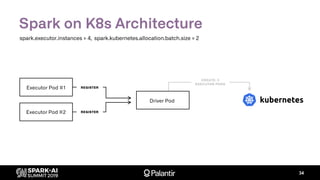
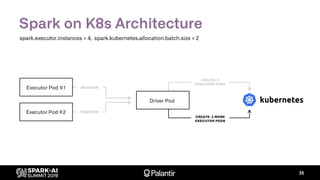
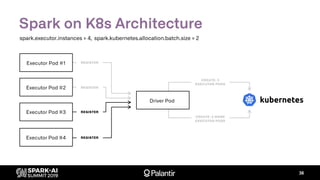
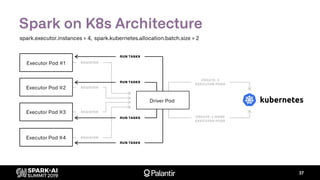
1. A (Very) Quick Primer on Palantir
2. Why We Moved from YARN
3. Spark on Kubernetes
4. Key Production Challenges
Ø Kubernetes Scheduling
Ø Shuffle Resiliency
5
A (Very) Quick Primer on Palantir
… and how Spark on Kubernetes helps power Palantir Foundry
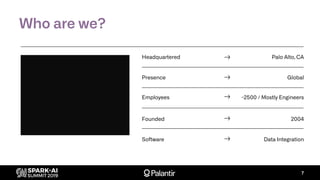
Who are we?
7
Headquartered
Presence
Employees
Palo Alto, CA
Global
~2500 / Mostly Engineers
Founded 2004
Software Data Integration
8
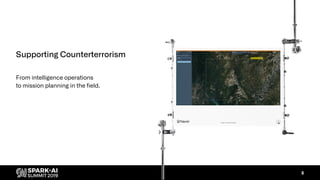
Supporting Counterterrorism
From intelligence operations
to mission planning in the field.
9
Energy
Institutions must evolve or die.
Technology and data are driving
this evolution.
10
Manufacturing
Ferrari uses Palantir Foundry
to increase performance + reliability.
11
Aviation Safety
Palantir and Airbus founded
Skywise to help make air travel
safer and more economical.
12
Cancer Research
Syntropy brings together the greatest
minds and institutions to advance
research toward the common goal
of improving human lives.
13
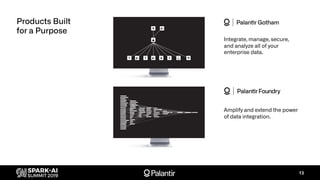
Products Built
for a Purpose
Integrate, manage, secure,
and analyze all of your
enterprise data.
Amplify and extend the power
of data integration.
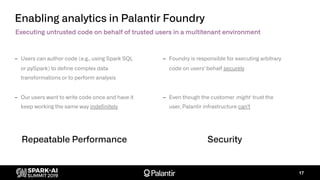
Enabling analytics in Palantir Foundry
Executing untrusted code on behalf of trusted users in a multitenant environment
14
– Users can author code (e.g., using Spark SQL
or pySpark) to define complex data
transformations or to perform analysis
– Our users want to write code once and have it
keep working the same way indefinitely
Enabling analytics in Palantir Foundry
Executing untrusted code on behalf of trusted users in a multitenant environment
15
– Users can author code (e.g., using Spark SQL
or pySpark) to define complex data
transformations or to perform analysis
– Our users want to write code once and have it
keep working the same way indefinitely
– Foundry is responsible for executing arbitrary
code on users’ behalf securely
– Even though the customer might trust the
user, Palantir infrastructure can’t
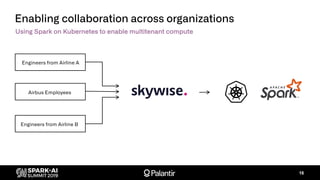
Enabling collaboration across organizations
Using Spark on Kubernetes to enable multitenant compute
16
Engineers from Airline A
Airbus Employees
Engineers from Airline B
Enabling analytics in Palantir Foundry
Executing untrusted code on behalf of trusted users in a multitenant environment
17
– Users can author code (e.g., using Spark SQL
or pySpark) to define complex data
transformations or to perform analysis
– Our users want to write code once and have it
keep working the same way indefinitely
– Foundry is responsible for executing arbitrary
code on users’ behalf securely
– Even though the customer might trust the
user, Palantir infrastructure can’t
Repeatable Performance Security
Why We Moved from YARN
Hadoop/YARN Security
Two modes
1. Kerberos
19
Hadoop/YARN Security
Two modes
1. Kerberos
2. None (only mode until Hadoop 2.x)
NB: I recommend reading Steve Loughran’s “Madness Beyond the Gate” to learn more
20
Hadoop/YARN Security
Containerization as of 3.1.1 (late 2018)
21
Performance in YARN
22
YARN’s scheduler attempts to maximize utilization
Performance in YARN
23
YARN’s scheduler attempts to maximize utilization
Spark on YARN with dynamic allocation is great at:
– extracting maximum performance from static resources
– providing bursts of resources for one-off batch work
– running “just one more thing”
Performance in YARN
24
YARN’s scheduler attempts to maximize utilization
Spark on YARN with dynamic allocation is great at:
– extracting maximum performance from static resources
– providing bursts of resources for one-off batch work
– running “just one more thing”
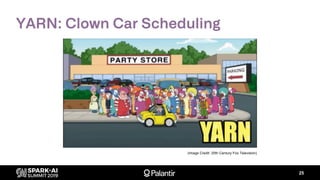
YARN: Clown Car Scheduling
25
(Image Credit: 20th Century Fox Television)
Performance in YARN
26
YARN’s scheduler attempts to maximize utilization
Spark on YARN with dynamic allocation is terrible at:
– providing consistency from run to run
– isolating performance between different users/tenants
(i.e., if you kick off a big job, then my job is likely to run slower)
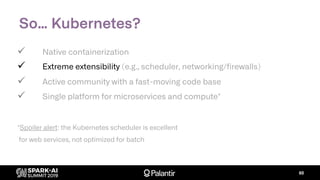
So… Kubernetes?
27
ü Native containerization
ü Extreme extensibility (e.g., scheduler, networking/firewalls)
ü Active community with a fast-moving code base
ü Single platform for microservices and compute*
*Spoiler alert: the Kubernetes scheduler is excellent
for web services, not optimized for batch
Spark on Kubernetes
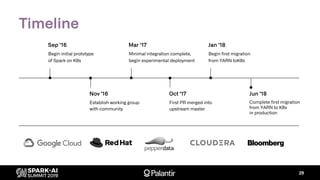
Timeline
29
Sep ‘16 Mar ‘17 Jan ‘18
Nov ‘16 Oct ‘17 Jun ‘18
Begin initial prototype
of Spark on K8s
Minimal integration complete,
begin experimental deployment
Begin first migration
from YARN toK8s
Establish working group
with community
First PR merged into
upstream master
Complete first migration
from YARN to K8s
in production
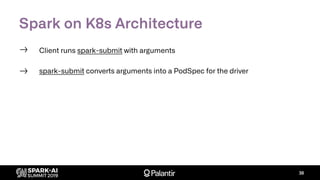
Spark on K8s Architecture
30
Client runs spark-submit with arguments
spark-submit converts arguments into a PodSpec for the driver
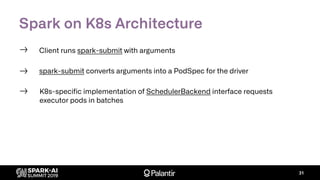
Spark on K8s Architecture
31
Client runs spark-submit with arguments
spark-submit converts arguments into a PodSpec for the driver
K8s-specific implementation of SchedulerBackend interface requests
executor pods in batches
Spark on K8s Architecture
32
CREATE
DRIVER POD
spark-submit input:
…
--master k8s://example.com:8443
--conf spark.kubernetes.image=example.com/appImage
--conf …
com.palantir.spark.app.main.Main
spark-submit output:
…
spec:
containers:
- name: example
image: example.com/appImage
command: [”/opt/spark/entrypoint.sh"]
args: [”--driver", ”--class”, “com.palantir.spark.app.main.Main”]
…
spark-submit
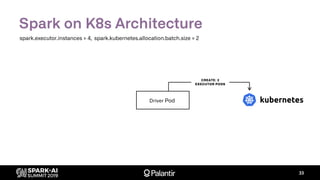
Spark on K8s Architecture
33
Driver Pod
CREATE: 2
EXECUTOR PODS
spark.executor.instances = 4, spark.kubernetes.allocation.batch.size = 2
Spark on K8s Architecture
34
spark.executor.instances = 4, spark.kubernetes.allocation.batch.size = 2
Executor Pod #1
Executor Pod #2
Driver Pod
REGISTER
REGISTER
CREATE: 2
EXECUTOR PODS
Spark on K8s Architecture
35
Executor Pod #1
Executor Pod #2
Driver Pod
REGISTER
REGISTER
CREATE: 2
EXECUTOR PODS
CREATE: 2 MORE
EXECUTOR PODS
spark.executor.instances = 4, spark.kubernetes.allocation.batch.size = 2
Spark on K8s Architecture
36
Executor Pod #1
Executor Pod #2
Executor Pod #3
Executor Pod #4
Driver Pod
REGISTER
REGISTER
REGISTER
REGISTER
CREATE: 2
EXECUTOR PODS
CREATE: 2 MORE
EXECUTOR PODS
spark.executor.instances = 4, spark.kubernetes.allocation.batch.size = 2
Spark on K8s Architecture
37
Executor Pod #1
Executor Pod #2
Executor Pod #3
Executor Pod #4
Driver Pod
RUN TASKS
REGISTER
REGISTER
REGISTER
REGISTER
RUN TASKS
RUN TASKS
RUN TASKS
CREATE: 2
EXECUTOR PODS
CREATE: 2 MORE
EXECUTOR PODS
spark.executor.instances = 4, spark.kubernetes.allocation.batch.size = 2
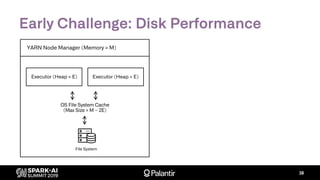
Early Challenge: Disk Performance
38
Executor (Heap = E) Executor (Heap = E)
OS File System Cache
(Max Size = M – 2E)
YARN Node Manager (Memory = M)
File System
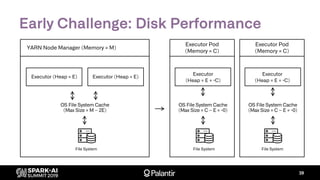
Early Challenge: Disk Performance
39
Executor (Heap = E) Executor (Heap = E)
OS File System Cache
(Max Size = M – 2E)
YARN Node Manager (Memory = M)
OS File System Cache
(Max Size = C – E = ~0)
Executor Pod
(Memory = C)
Executor
(Heap = E = ~C)
OS File System Cache
(Max Size = C – E = ~0)
Executor Pod
(Memory = C)
Executor
(Heap = E = ~C)
File System File System File System
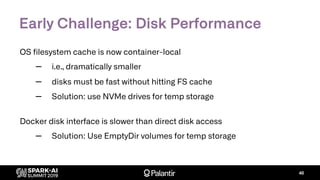
Early Challenge: Disk Performance
OS filesystem cache is now container-local
– i.e., dramatically smaller
– disks must be fast without hitting FS cache
– Solution: use NVMe drives for temp storage
Docker disk interface is slower than direct disk access
– Solution: Use EmptyDir volumes for temp storage
40
Key Production Challenges
Challenge I: Kubernetes Scheduling
42
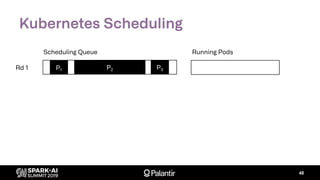
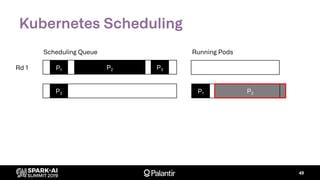
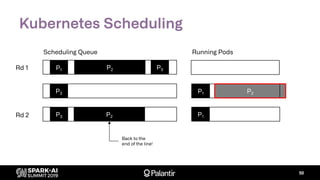
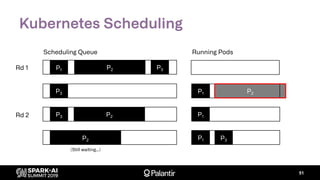
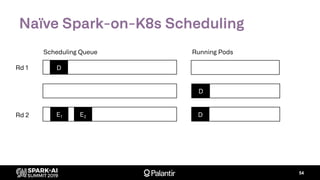
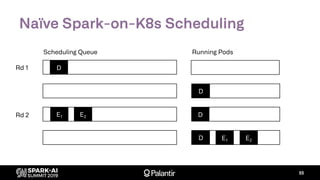
– The built-in Kubernetes scheduler isn’t really designed
for distributed batch workloads (e.g., MapReduce)
– Historically, optimized for microservice instances or
single-pod, one-off jobs (what k8s natively supports)
Challenge II: Shuffle Resiliency
43
– External Shuffle Service is unavailable in Kubernetes
– Jobs must be written more carefully to avoid executor
failure (e.g., OOM) and the subsequent need to
recompute lost blocks
Kubernetes Scheduling
Reliable, Repeatable Runtimes
45
A key goal is to make runtimes of the same workload
consistent from run to run
Recall
Reliable, Repeatable Runtimes
46
A key goal is to make runtimes of the same workload
consistent from run to run
When a driver is deployed, wants to do work, it should
receive the same resources from run to run
Recall
Corollary
Reliable, Repeatable Runtimes
47
A key goal is to make runtimes of the same workload
consistent from run to run
When a driver is deployed, wants to do work, it should
receive the same resources from run to run
Using vanilla k8s scheduler led to partial starvation
as the cluster became saturated
Recall
Corollary
Problem
Kubernetes Scheduling
48
Scheduling Queue
P2
Running Pods
Rd 1 P1 P3
Kubernetes Scheduling
49
Scheduling Queue
P2
Running Pods
P1
Rd 1 P1 P3
P3 P2
Kubernetes Scheduling
50
Scheduling Queue
P2
P2
Running Pods
P1
P1
Rd 1
Rd 2
P1 P3
P3
P3
P2
Back to the
end of the line!
Kubernetes Scheduling
51
Scheduling Queue
P2
P2
Running Pods
P1
P1
P3
Rd 1
Rd 2
P1
P1 P3
P3
P3
P2
P2
(Still waiting…)
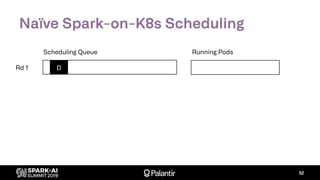
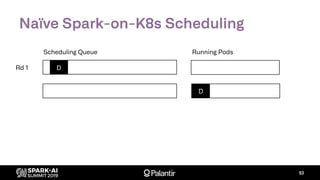
Naïve Spark-on-K8s Scheduling
52
Scheduling Queue Running Pods
Rd 1 D
Naïve Spark-on-K8s Scheduling
53
Scheduling Queue Running Pods
D
Rd 1 D
Naïve Spark-on-K8s Scheduling
54
Scheduling Queue Running Pods
D
D
Rd 1
Rd 2
D
E2E1
Naïve Spark-on-K8s Scheduling
55
Scheduling Queue Running Pods
D
D
Rd 1
Rd 2
D
D
E2E1
E2E1
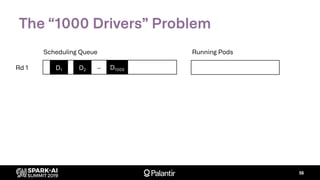
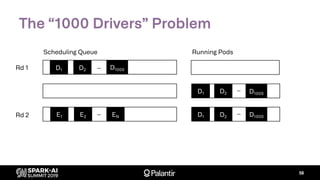
The “1000 Drivers” Problem
56
Scheduling Queue Running Pods
Rd 1 D1 D2
…D1 D2
… D1000
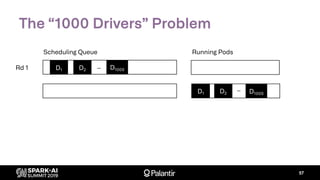
The “1000 Drivers” Problem
57
Scheduling Queue Running Pods
D1
Rd 1 D1 D2
…D1 D2
… D1000
D2 D1000
…
The “1000 Drivers” Problem
58
Scheduling Queue Running Pods
D1
Rd 1
Rd 2
D1
E2E1
D2
…D1 D2
… D1000
D2 D1000
…
… EN D2 D1000
…D1
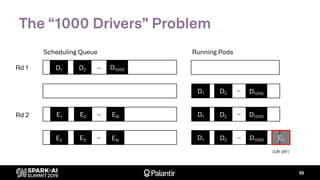
The “1000 Drivers” Problem
59
Scheduling Queue Running Pods
D1
Rd 1
Rd 2
D1
E2E1
D2
…D1 D2
… D1000
D2 D1000
…
… EN D2 D1000
…
E3E2
… EN D2 D1000
…D1
D1
(Uh oh!)
E1
60
ü Native containerization
ü Extreme extensibility (e.g., scheduler, networking/firewalls)
ü Active community with a fast-moving code base
ü Single platform for microservices and compute*
*Spoiler alert: the Kubernetes scheduler is excellent
for web services, not optimized for batch
So… Kubernetes?
K8s Spark Scheduler
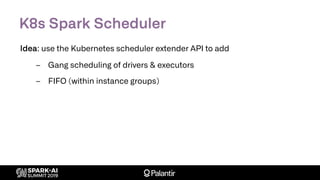
Idea: use the Kubernetes scheduler extender API to add
– Gang scheduling of drivers & executors
– FIFO (within instance groups)
K8s Spark Scheduler
Goal: build entirely with native K8s extension points
– Scheduler extender API: fn(pod, [node]) -> Option[node]
– Custom resource definition: ResourceReservation
– Driver annotations for resource requests (executors)
K8s Spark Scheduler
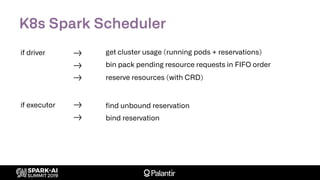
get cluster usage (running pods + reservations)
bin pack pending resource requests in FIFO order
reserve resources (with CRD)
if driver
find unbound reservation
bind reservation
if executor
K8s Spark Scheduler
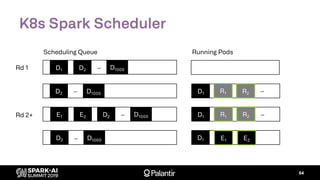
64
Scheduling Queue Running Pods
D1
Rd 1
Rd 2+
D1
E2E1
D2
…D1 D2
… D1000
…
D1
D1
R2R1D2
… D1000
D2
… D1000
…R2R1
E2E1D2
… D1000
Spark-Aware Autoscaling
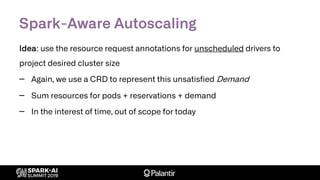
Idea: use the resource request annotations for unscheduled drivers to
project desired cluster size
– Again, we use a CRD to represent this unsatisfied Demand
– Sum resources for pods + reservations + demand
– In the interest of time, out of scope for today
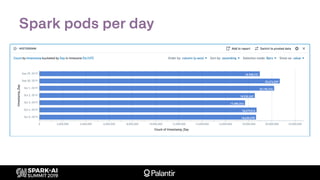
Spark pods per day
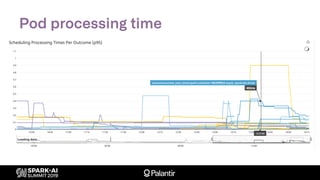
Pod processing time
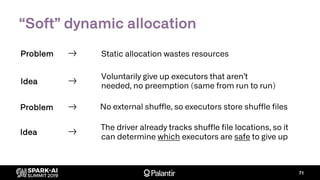
“Soft” dynamic allocation
68
Static allocation wastes resourcesProblem
“Soft” dynamic allocation
69
Static allocation wastes resourcesProblem
Idea
Voluntarily give up executors that aren’t
needed, no preemption (same from run to run)
“Soft” dynamic allocation
70
Static allocation wastes resources
No external shuffle, so executors store shuffle files
Problem
Idea
Problem
Voluntarily give up executors that aren’t
needed, no preemption (same from run to run)
“Soft” dynamic allocation
71
Static allocation wastes resources
No external shuffle, so executors store shuffle files
Problem
Idea
Problem
The driver already tracks shuffle file locations, so it
can determine which executors are safe to give up
Idea
Voluntarily give up executors that aren’t
needed, no preemption (same from run to run)
“Soft” dynamic allocation
72
– Saves $$$$, ~no runtime variance if consistent from run to run
– Inspired by a 2018 Databricks blog post [1]
– Merged into our fork in ~January 2019
– Recently adapted by @vanzin (thanks!) and merged upstream [2]
[1] https://databricks.com/blog/2018/05/02/introducing-databricks-optimized-auto-
scaling.html
[2] https://github.com/apache/spark/pull/24817
K8s Spark Scheduler
See our engineering blog on Medium
– https://medium.com/palantir/spark-scheduling-in-kubernetes-
4976333235f3
Or, check out the source for yourself! (Apache v2 license)
– https://github.com/palantir/k8s-spark-scheduler
Shuffle Resiliency
Shuffle Resiliency
75
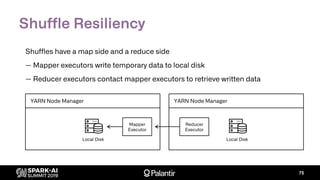
Shuffles have a map side and a reduce side
— Mapper executors write temporary data to local disk
— Reducer executors contact mapper executors to retrieve written data
YARN Node Manager
Mapper
Executor
Reducer
Executor
YARN Node Manager
Local Disk Local Disk
Shuffle Resiliency
76
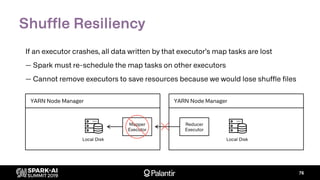
If an executor crashes, all data written by that executor’s map tasks are lost
— Spark must re-schedule the map tasks on other executors
— Cannot remove executors to save resources because we would lose shuffle files
YARN Node Manager
Mapper
Executor
Reducer
Executor
YARN Node Manager
Local Disk Local Disk
Shuffle Resiliency
77
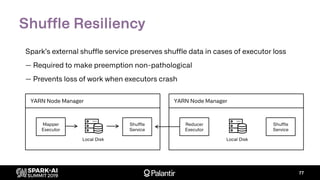
Spark’s external shuffle service preserves shuffle data in cases of executor loss
— Required to make preemption non-pathological
— Prevents loss of work when executors crash
Mapper
Executor
YARN Node Manager
Shuffle
Service
Reducer
Executor
YARN Node Manager
Shuffle
Service
Local Disk Local Disk
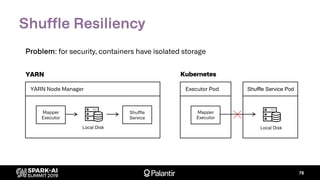
Problem: for security, containers have isolated storage
Shuffle Resiliency
78
YARN Node Manager
Shuffle
Service
Mapper
Executor
Executor Pod
Local Disk Local Disk
Mapper
Executor
Shuffle Service Pod
YARN Kubernetes
Shuffle Resiliency
79
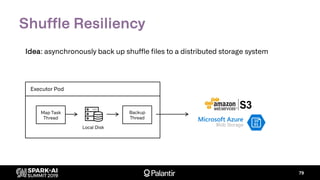
Idea: asynchronously back up shuffle files to a distributed storage system
Backup
Thread
Executor Pod
Local Disk
Map Task
Thread
Shuffle Resiliency
80
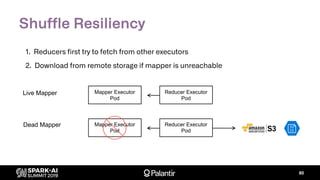
1. Reducers first try to fetch from other executors
2. Download from remote storage if mapper is unreachable
Mapper Executor
Pod
Mapper Executor
Pod
Live Mapper
Dead Mapper
Reducer Executor
Pod
Reducer Executor
Pod
Shuffle Resiliency
– Wanted to generalize the framework for storing shuffle data in arbitrary
storage systems
– API In Progress: https://issues.apache.org/jira/browse/SPARK-25299
– Goal: Open source asynchronous backup strategy by end of 2019
Thanks to the team!
Q&A
DON’T FORGET TO RATE
AND REVIEW THE SESSIONS
SEARCH SPARK + AI SUMMIT

Reliable Performance at Scale with Apache Spark on Kubernetes

  • 1.
    WIFI SSID:Spark+AISummit |Password: UnifiedDataAnalytics
  • 2.
    Will Manning +Matt Cheah, Palantir Technologies Reliable Performance at Scale with Spark on Kubernetes #UnifiedDataAnalytics #SparkAISummit
  • 3.
    Joined Palantir First productionadopter of YARN & Parquet Helped form our Data Flows & Analytics product groups Responsible for Engineering and Architecture for Compute (including Spark) 3 Will Manning About us 2013 2015 2016
  • 4.
    Joined Palantir Migrated Sparkcluster management from standalone to YARN, and later from YARN to Kubernetes Spark committer / open source Spark developer 4 Matt Cheah About us 2014 2018
  • 5.
    Agenda 1. A (Very)Quick Primer on Palantir 2. Why We Moved from YARN 3. Spark on Kubernetes 4. Key Production Challenges Ø Kubernetes Scheduling Ø Shuffle Resiliency 5
  • 6.
    A (Very) QuickPrimer on Palantir … and how Spark on Kubernetes helps power Palantir Foundry
  • 7.
    Who are we? 7 Headquartered Presence Employees PaloAlto, CA Global ~2500 / Mostly Engineers Founded 2004 Software Data Integration
  • 8.
    8 Supporting Counterterrorism From intelligenceoperations to mission planning in the field.
  • 9.
    9 Energy Institutions must evolveor die. Technology and data are driving this evolution.
  • 10.
    10 Manufacturing Ferrari uses PalantirFoundry to increase performance + reliability.
  • 11.
    11 Aviation Safety Palantir andAirbus founded Skywise to help make air travel safer and more economical.
  • 12.
    12 Cancer Research Syntropy bringstogether the greatest minds and institutions to advance research toward the common goal of improving human lives.
  • 13.
    13 Products Built for aPurpose Integrate, manage, secure, and analyze all of your enterprise data. Amplify and extend the power of data integration.
  • 14.
    Enabling analytics inPalantir Foundry Executing untrusted code on behalf of trusted users in a multitenant environment 14 – Users can author code (e.g., using Spark SQL or pySpark) to define complex data transformations or to perform analysis – Our users want to write code once and have it keep working the same way indefinitely
  • 15.
    Enabling analytics inPalantir Foundry Executing untrusted code on behalf of trusted users in a multitenant environment 15 – Users can author code (e.g., using Spark SQL or pySpark) to define complex data transformations or to perform analysis – Our users want to write code once and have it keep working the same way indefinitely – Foundry is responsible for executing arbitrary code on users’ behalf securely – Even though the customer might trust the user, Palantir infrastructure can’t
  • 16.
    Enabling collaboration acrossorganizations Using Spark on Kubernetes to enable multitenant compute 16 Engineers from Airline A Airbus Employees Engineers from Airline B
  • 17.
    Enabling analytics inPalantir Foundry Executing untrusted code on behalf of trusted users in a multitenant environment 17 – Users can author code (e.g., using Spark SQL or pySpark) to define complex data transformations or to perform analysis – Our users want to write code once and have it keep working the same way indefinitely – Foundry is responsible for executing arbitrary code on users’ behalf securely – Even though the customer might trust the user, Palantir infrastructure can’t Repeatable Performance Security
  • 18.
    Why We Movedfrom YARN
  • 19.
  • 20.
    Hadoop/YARN Security Two modes 1.Kerberos 2. None (only mode until Hadoop 2.x) NB: I recommend reading Steve Loughran’s “Madness Beyond the Gate” to learn more 20
  • 21.
  • 22.
    Performance in YARN 22 YARN’sscheduler attempts to maximize utilization
  • 23.
    Performance in YARN 23 YARN’sscheduler attempts to maximize utilization Spark on YARN with dynamic allocation is great at: – extracting maximum performance from static resources – providing bursts of resources for one-off batch work – running “just one more thing”
  • 24.
    Performance in YARN 24 YARN’sscheduler attempts to maximize utilization Spark on YARN with dynamic allocation is great at: – extracting maximum performance from static resources – providing bursts of resources for one-off batch work – running “just one more thing”
  • 25.
    YARN: Clown CarScheduling 25 (Image Credit: 20th Century Fox Television)
  • 26.
    Performance in YARN 26 YARN’sscheduler attempts to maximize utilization Spark on YARN with dynamic allocation is terrible at: – providing consistency from run to run – isolating performance between different users/tenants (i.e., if you kick off a big job, then my job is likely to run slower)
  • 27.
    So… Kubernetes? 27 ü Nativecontainerization ü Extreme extensibility (e.g., scheduler, networking/firewalls) ü Active community with a fast-moving code base ü Single platform for microservices and compute* *Spoiler alert: the Kubernetes scheduler is excellent for web services, not optimized for batch
  • 28.
  • 29.
    Timeline 29 Sep ‘16 Mar‘17 Jan ‘18 Nov ‘16 Oct ‘17 Jun ‘18 Begin initial prototype of Spark on K8s Minimal integration complete, begin experimental deployment Begin first migration from YARN toK8s Establish working group with community First PR merged into upstream master Complete first migration from YARN to K8s in production
  • 30.
    Spark on K8sArchitecture 30 Client runs spark-submit with arguments spark-submit converts arguments into a PodSpec for the driver
  • 31.
    Spark on K8sArchitecture 31 Client runs spark-submit with arguments spark-submit converts arguments into a PodSpec for the driver K8s-specific implementation of SchedulerBackend interface requests executor pods in batches
  • 32.
    Spark on K8sArchitecture 32 CREATE DRIVER POD spark-submit input: … --master k8s://example.com:8443 --conf spark.kubernetes.image=example.com/appImage --conf … com.palantir.spark.app.main.Main spark-submit output: … spec: containers: - name: example image: example.com/appImage command: [”/opt/spark/entrypoint.sh"] args: [”--driver", ”--class”, “com.palantir.spark.app.main.Main”] … spark-submit
  • 33.
    Spark on K8sArchitecture 33 Driver Pod CREATE: 2 EXECUTOR PODS spark.executor.instances = 4, spark.kubernetes.allocation.batch.size = 2
  • 34.
    Spark on K8sArchitecture 34 spark.executor.instances = 4, spark.kubernetes.allocation.batch.size = 2 Executor Pod #1 Executor Pod #2 Driver Pod REGISTER REGISTER CREATE: 2 EXECUTOR PODS
  • 35.
    Spark on K8sArchitecture 35 Executor Pod #1 Executor Pod #2 Driver Pod REGISTER REGISTER CREATE: 2 EXECUTOR PODS CREATE: 2 MORE EXECUTOR PODS spark.executor.instances = 4, spark.kubernetes.allocation.batch.size = 2
  • 36.
    Spark on K8sArchitecture 36 Executor Pod #1 Executor Pod #2 Executor Pod #3 Executor Pod #4 Driver Pod REGISTER REGISTER REGISTER REGISTER CREATE: 2 EXECUTOR PODS CREATE: 2 MORE EXECUTOR PODS spark.executor.instances = 4, spark.kubernetes.allocation.batch.size = 2
  • 37.
    Spark on K8sArchitecture 37 Executor Pod #1 Executor Pod #2 Executor Pod #3 Executor Pod #4 Driver Pod RUN TASKS REGISTER REGISTER REGISTER REGISTER RUN TASKS RUN TASKS RUN TASKS CREATE: 2 EXECUTOR PODS CREATE: 2 MORE EXECUTOR PODS spark.executor.instances = 4, spark.kubernetes.allocation.batch.size = 2
  • 38.
    Early Challenge: DiskPerformance 38 Executor (Heap = E) Executor (Heap = E) OS File System Cache (Max Size = M – 2E) YARN Node Manager (Memory = M) File System
  • 39.
    Early Challenge: DiskPerformance 39 Executor (Heap = E) Executor (Heap = E) OS File System Cache (Max Size = M – 2E) YARN Node Manager (Memory = M) OS File System Cache (Max Size = C – E = ~0) Executor Pod (Memory = C) Executor (Heap = E = ~C) OS File System Cache (Max Size = C – E = ~0) Executor Pod (Memory = C) Executor (Heap = E = ~C) File System File System File System
  • 40.
    Early Challenge: DiskPerformance OS filesystem cache is now container-local – i.e., dramatically smaller – disks must be fast without hitting FS cache – Solution: use NVMe drives for temp storage Docker disk interface is slower than direct disk access – Solution: Use EmptyDir volumes for temp storage 40
  • 41.
  • 42.
    Challenge I: KubernetesScheduling 42 – The built-in Kubernetes scheduler isn’t really designed for distributed batch workloads (e.g., MapReduce) – Historically, optimized for microservice instances or single-pod, one-off jobs (what k8s natively supports)
  • 43.
    Challenge II: ShuffleResiliency 43 – External Shuffle Service is unavailable in Kubernetes – Jobs must be written more carefully to avoid executor failure (e.g., OOM) and the subsequent need to recompute lost blocks
  • 44.
  • 45.
    Reliable, Repeatable Runtimes 45 Akey goal is to make runtimes of the same workload consistent from run to run Recall
  • 46.
    Reliable, Repeatable Runtimes 46 Akey goal is to make runtimes of the same workload consistent from run to run When a driver is deployed, wants to do work, it should receive the same resources from run to run Recall Corollary
  • 47.
    Reliable, Repeatable Runtimes 47 Akey goal is to make runtimes of the same workload consistent from run to run When a driver is deployed, wants to do work, it should receive the same resources from run to run Using vanilla k8s scheduler led to partial starvation as the cluster became saturated Recall Corollary Problem
  • 48.
  • 49.
  • 50.
    Kubernetes Scheduling 50 Scheduling Queue P2 P2 RunningPods P1 P1 Rd 1 Rd 2 P1 P3 P3 P3 P2 Back to the end of the line!
  • 51.
    Kubernetes Scheduling 51 Scheduling Queue P2 P2 RunningPods P1 P1 P3 Rd 1 Rd 2 P1 P1 P3 P3 P3 P2 P2 (Still waiting…)
  • 52.
  • 53.
  • 54.
    Naïve Spark-on-K8s Scheduling 54 SchedulingQueue Running Pods D D Rd 1 Rd 2 D E2E1
  • 55.
    Naïve Spark-on-K8s Scheduling 55 SchedulingQueue Running Pods D D Rd 1 Rd 2 D D E2E1 E2E1
  • 56.
    The “1000 Drivers”Problem 56 Scheduling Queue Running Pods Rd 1 D1 D2 …D1 D2 … D1000
  • 57.
    The “1000 Drivers”Problem 57 Scheduling Queue Running Pods D1 Rd 1 D1 D2 …D1 D2 … D1000 D2 D1000 …
  • 58.
    The “1000 Drivers”Problem 58 Scheduling Queue Running Pods D1 Rd 1 Rd 2 D1 E2E1 D2 …D1 D2 … D1000 D2 D1000 … … EN D2 D1000 …D1
  • 59.
    The “1000 Drivers”Problem 59 Scheduling Queue Running Pods D1 Rd 1 Rd 2 D1 E2E1 D2 …D1 D2 … D1000 D2 D1000 … … EN D2 D1000 … E3E2 … EN D2 D1000 …D1 D1 (Uh oh!) E1
  • 60.
    60 ü Native containerization üExtreme extensibility (e.g., scheduler, networking/firewalls) ü Active community with a fast-moving code base ü Single platform for microservices and compute* *Spoiler alert: the Kubernetes scheduler is excellent for web services, not optimized for batch So… Kubernetes?
  • 61.
    K8s Spark Scheduler Idea:use the Kubernetes scheduler extender API to add – Gang scheduling of drivers & executors – FIFO (within instance groups)
  • 62.
    K8s Spark Scheduler Goal:build entirely with native K8s extension points – Scheduler extender API: fn(pod, [node]) -> Option[node] – Custom resource definition: ResourceReservation – Driver annotations for resource requests (executors)
  • 63.
    K8s Spark Scheduler getcluster usage (running pods + reservations) bin pack pending resource requests in FIFO order reserve resources (with CRD) if driver find unbound reservation bind reservation if executor
  • 64.
    K8s Spark Scheduler 64 SchedulingQueue Running Pods D1 Rd 1 Rd 2+ D1 E2E1 D2 …D1 D2 … D1000 … D1 D1 R2R1D2 … D1000 D2 … D1000 …R2R1 E2E1D2 … D1000
  • 65.
    Spark-Aware Autoscaling Idea: usethe resource request annotations for unscheduled drivers to project desired cluster size – Again, we use a CRD to represent this unsatisfied Demand – Sum resources for pods + reservations + demand – In the interest of time, out of scope for today
  • 66.
  • 67.
  • 68.
    “Soft” dynamic allocation 68 Staticallocation wastes resourcesProblem
  • 69.
    “Soft” dynamic allocation 69 Staticallocation wastes resourcesProblem Idea Voluntarily give up executors that aren’t needed, no preemption (same from run to run)
  • 70.
    “Soft” dynamic allocation 70 Staticallocation wastes resources No external shuffle, so executors store shuffle files Problem Idea Problem Voluntarily give up executors that aren’t needed, no preemption (same from run to run)
  • 71.
    “Soft” dynamic allocation 71 Staticallocation wastes resources No external shuffle, so executors store shuffle files Problem Idea Problem The driver already tracks shuffle file locations, so it can determine which executors are safe to give up Idea Voluntarily give up executors that aren’t needed, no preemption (same from run to run)
  • 72.
    “Soft” dynamic allocation 72 –Saves $$$$, ~no runtime variance if consistent from run to run – Inspired by a 2018 Databricks blog post [1] – Merged into our fork in ~January 2019 – Recently adapted by @vanzin (thanks!) and merged upstream [2] [1] https://databricks.com/blog/2018/05/02/introducing-databricks-optimized-auto- scaling.html [2] https://github.com/apache/spark/pull/24817
  • 73.
    K8s Spark Scheduler Seeour engineering blog on Medium – https://medium.com/palantir/spark-scheduling-in-kubernetes- 4976333235f3 Or, check out the source for yourself! (Apache v2 license) – https://github.com/palantir/k8s-spark-scheduler
  • 74.
  • 75.
    Shuffle Resiliency 75 Shuffles havea map side and a reduce side — Mapper executors write temporary data to local disk — Reducer executors contact mapper executors to retrieve written data YARN Node Manager Mapper Executor Reducer Executor YARN Node Manager Local Disk Local Disk
  • 76.
    Shuffle Resiliency 76 If anexecutor crashes, all data written by that executor’s map tasks are lost — Spark must re-schedule the map tasks on other executors — Cannot remove executors to save resources because we would lose shuffle files YARN Node Manager Mapper Executor Reducer Executor YARN Node Manager Local Disk Local Disk
  • 77.
    Shuffle Resiliency 77 Spark’s externalshuffle service preserves shuffle data in cases of executor loss — Required to make preemption non-pathological — Prevents loss of work when executors crash Mapper Executor YARN Node Manager Shuffle Service Reducer Executor YARN Node Manager Shuffle Service Local Disk Local Disk
  • 78.
    Problem: for security,containers have isolated storage Shuffle Resiliency 78 YARN Node Manager Shuffle Service Mapper Executor Executor Pod Local Disk Local Disk Mapper Executor Shuffle Service Pod YARN Kubernetes
  • 79.
    Shuffle Resiliency 79 Idea: asynchronouslyback up shuffle files to a distributed storage system Backup Thread Executor Pod Local Disk Map Task Thread
  • 80.
    Shuffle Resiliency 80 1. Reducersfirst try to fetch from other executors 2. Download from remote storage if mapper is unreachable Mapper Executor Pod Mapper Executor Pod Live Mapper Dead Mapper Reducer Executor Pod Reducer Executor Pod
  • 81.
    Shuffle Resiliency – Wantedto generalize the framework for storing shuffle data in arbitrary storage systems – API In Progress: https://issues.apache.org/jira/browse/SPARK-25299 – Goal: Open source asynchronous backup strategy by end of 2019
  • 82.
  • 83.
  • 84.
    DON’T FORGET TORATE AND REVIEW THE SESSIONS SEARCH SPARK + AI SUMMIT