Reliable vs. Unreliable Sources
■ Reliable Sources =TRUSTWORTHY SOURCES
– Written by experts in that particular field
■ Unreliable Sources = SOURCESTHAT CAN BE
ALTERED BY ANYONE
– sources, such asWikipedia, are not reliable because the
authors may not have a thorough knowledge or full
understanding of a topic
Example of Reliable Sources
• Book
• Newspapers and magazines
• Peer reviewed journals
• Peer reviewed articles
• PhD or MBA dissertations and research
• Public library
• Scholarly articles
How will I KNOW if its RELIABLE??
■ To determine reliability of online sites and organizations, look
at the URL’s ending:
– If the site ends in .edu, it is most likely a reliable educational institution.
– If the site ends in .gov, it is most likely a reliable government website.These
sites usually provide good sources for statistics and objective reports.
– If the site ends in .org, it is usually a reliable non-profit organization.
■ News sources:
– Every television and print news source has a website
– Beware! Sometimes their focus is to entertain rather than inform**
WITH ANY SOURCEYOU MUST CHECKTHE AUTHORTO DETERMINE
RELIABILITY
Examples of Unreliable Sources
• Wikipedia: although this is a good starting point for finding initial ideas about a topic,
some of their information and attached resources may not be reliable
• Blogs, tweets
• Personal websites
• Forums
• Sites created by organizations that may have political or biased agendas
• Sites that provide biased information
• Self-published sources
• Opinionated articles such as editorials
• Online sources with an URL that ends in html, which is the basic building blocks of web
pages
• Some online sources with an URL that end in .com are unreliable:
• Sites of companies that conduct their business over the internet. Some of these sites are
unreliable because they have hidden agendas.
• THINK: are they trying to sell me something?A product? An idea?
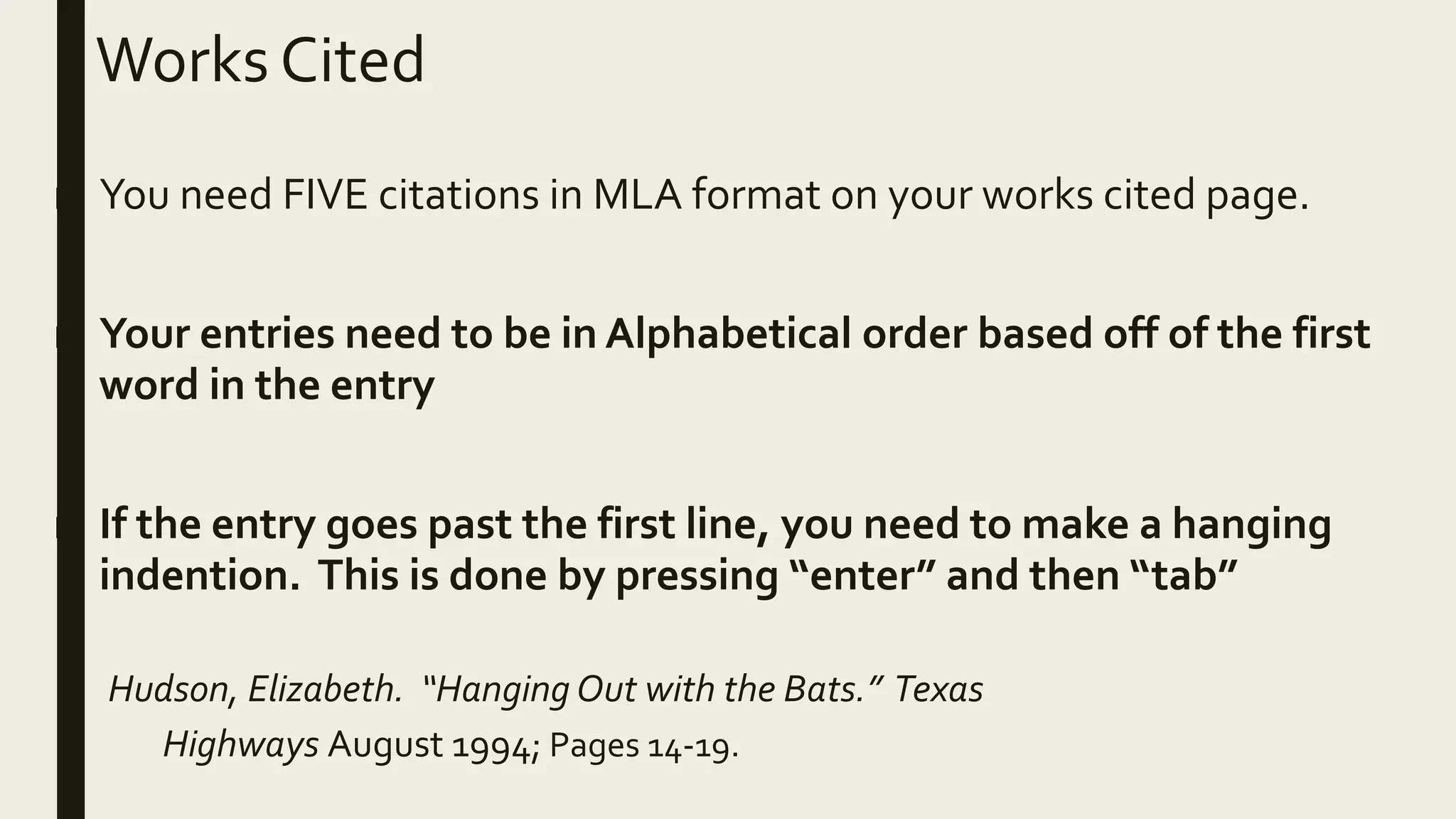
Works Cited
■ You need FIVE citations in MLA format on your works cited page.
■ Your entries need to be in Alphabetical order based off of the first
word in the entry
■ If the entry goes past the first line, you need to make a hanging
indention. This is done by pressing “enter” and then “tab”
Hudson, Elizabeth. “Hanging Out with the Bats.” Texas
Highways August 1994; Pages 14-19.
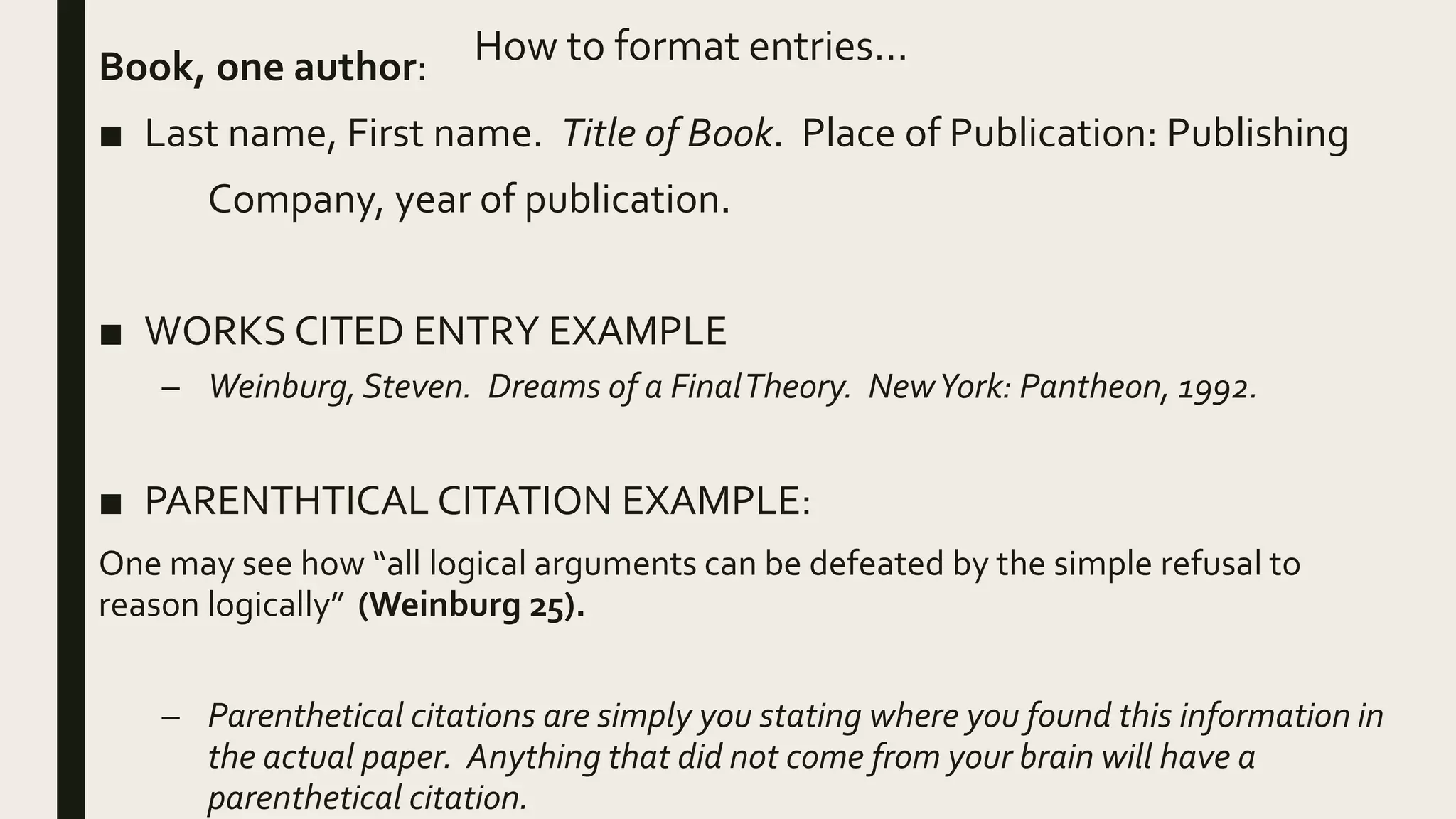
How to format entries…
Book, one author:
■ Last name, First name. Title of Book. Place of Publication: Publishing
Company, year of publication.
■ WORKS CITED ENTRY EXAMPLE
– Weinburg, Steven. Dreams of a FinalTheory. NewYork: Pantheon, 1992.
■ PARENTHTICAL CITATION EXAMPLE:
One may see how “all logical arguments can be defeated by the simple refusal to
reason logically” (Weinburg 25).
– Parenthetical citations are simply you stating where you found this information in
the actual paper. Anything that did not come from your brain will have a
parenthetical citation.
How to format entries…
GeneralWebpage:
■ Title of Page. Date page was published. Organization or Owner of Page. Date you
accessed the page. <entire URL>
■ WORKS CITED ENTRY EXAMPLE:
SpaceTelescope Science Institute Home Page. 20 November, 1997. NASA. 28 October, 2004.
<http://www.stici.edu>.
– NOTE: If you are struggling to identify a page title, look at the internet tab at the top of your page.
■ PARENTHETICAL CITATION EXAMPLE:
Through ample research, one will discover how the goal of the Office of Public Outreach is to “[meet]
the needs of the general public and science communicators by connecting to three user communities:
news media, online audiences, and venues offering in-person interactions” (SpaceTelescope Science).
– This should be the first word for few words in theWorks Cited Entry, which will usually be the title
of the page.
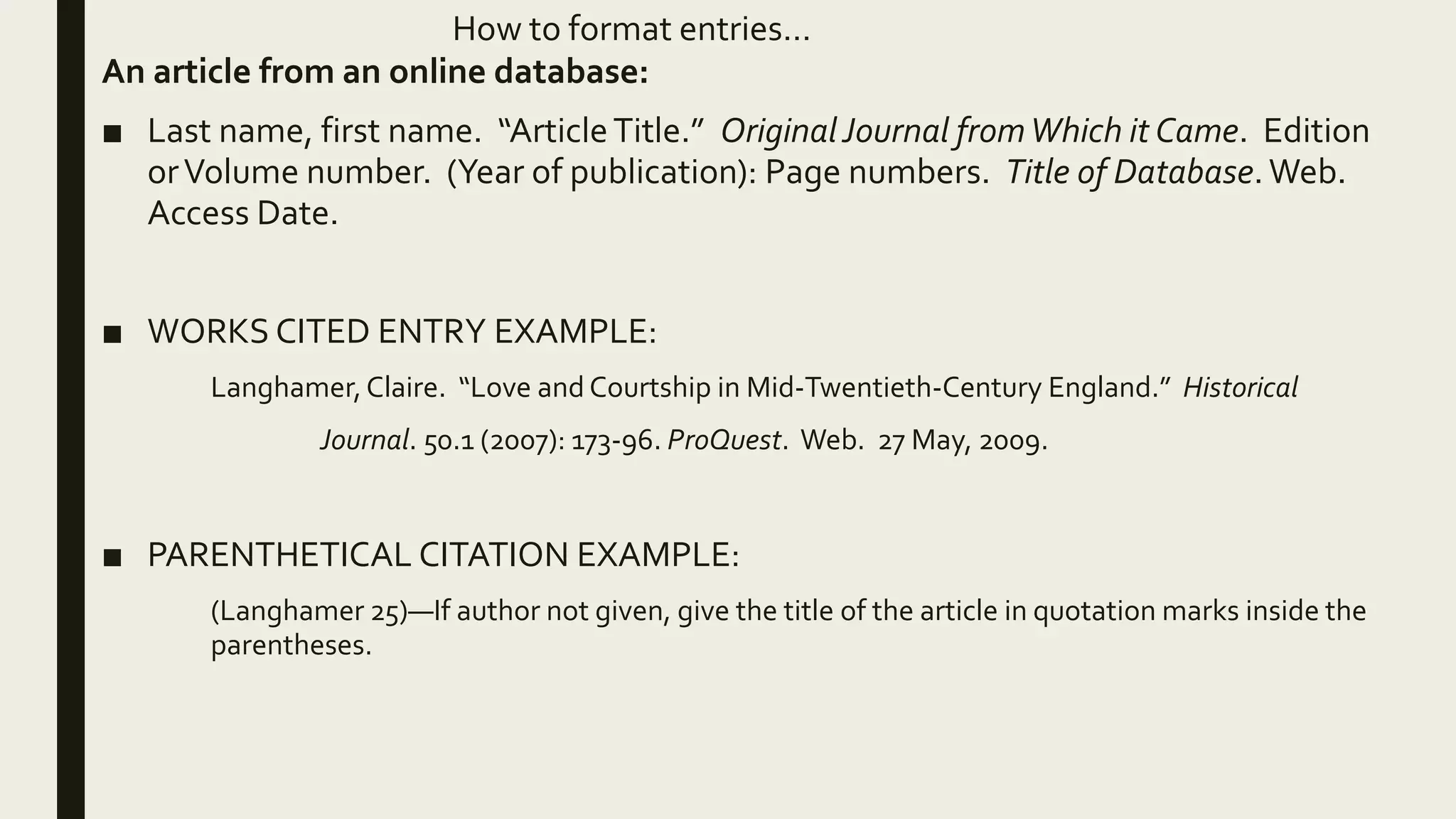
How to format entries…
An article from an online database:
■ Last name, first name. “ArticleTitle.” OriginalJournal fromWhich it Came. Edition
orVolume number. (Year of publication): Page numbers. Title of Database. Web.
Access Date.
■ WORKS CITED ENTRY EXAMPLE:
Langhamer,Claire. “Love and Courtship in Mid-Twentieth-Century England.” Historical
Journal. 50.1 (2007): 173-96. ProQuest. Web. 27 May, 2009.
■ PARENTHETICAL CITATION EXAMPLE:
(Langhamer 25)—If author not given, give the title of the article in quotation marks inside the
parentheses.
WHATYOU NEED IN LAB
■ Google Scholar
■ Destiny
■ NCWise Owl
PAY ATTENTIONTOTHEWEBSITES MRS. STRANGE SHOWSYOU
Scholarly, peer-reviewed articles and books
Work Cited
Austin Peay State University. “Reliable and Unreliable
Sources”. Academic Support CenterWriting Lab. Oct 29
2012. Web.

Reliable and Unreliable Sources

  • 1.
    Reliable vs. UnreliableSources ■ Reliable Sources =TRUSTWORTHY SOURCES – Written by experts in that particular field ■ Unreliable Sources = SOURCESTHAT CAN BE ALTERED BY ANYONE – sources, such asWikipedia, are not reliable because the authors may not have a thorough knowledge or full understanding of a topic
  • 2.
    Example of ReliableSources • Book • Newspapers and magazines • Peer reviewed journals • Peer reviewed articles • PhD or MBA dissertations and research • Public library • Scholarly articles
  • 3.
    How will IKNOW if its RELIABLE?? ■ To determine reliability of online sites and organizations, look at the URL’s ending: – If the site ends in .edu, it is most likely a reliable educational institution. – If the site ends in .gov, it is most likely a reliable government website.These sites usually provide good sources for statistics and objective reports. – If the site ends in .org, it is usually a reliable non-profit organization. ■ News sources: – Every television and print news source has a website – Beware! Sometimes their focus is to entertain rather than inform** WITH ANY SOURCEYOU MUST CHECKTHE AUTHORTO DETERMINE RELIABILITY
  • 4.
    Examples of UnreliableSources • Wikipedia: although this is a good starting point for finding initial ideas about a topic, some of their information and attached resources may not be reliable • Blogs, tweets • Personal websites • Forums • Sites created by organizations that may have political or biased agendas • Sites that provide biased information • Self-published sources • Opinionated articles such as editorials • Online sources with an URL that ends in html, which is the basic building blocks of web pages • Some online sources with an URL that end in .com are unreliable: • Sites of companies that conduct their business over the internet. Some of these sites are unreliable because they have hidden agendas. • THINK: are they trying to sell me something?A product? An idea?
  • 5.
    Works Cited ■ Youneed FIVE citations in MLA format on your works cited page. ■ Your entries need to be in Alphabetical order based off of the first word in the entry ■ If the entry goes past the first line, you need to make a hanging indention. This is done by pressing “enter” and then “tab” Hudson, Elizabeth. “Hanging Out with the Bats.” Texas Highways August 1994; Pages 14-19.
  • 6.
    How to formatentries… Book, one author: ■ Last name, First name. Title of Book. Place of Publication: Publishing Company, year of publication. ■ WORKS CITED ENTRY EXAMPLE – Weinburg, Steven. Dreams of a FinalTheory. NewYork: Pantheon, 1992. ■ PARENTHTICAL CITATION EXAMPLE: One may see how “all logical arguments can be defeated by the simple refusal to reason logically” (Weinburg 25). – Parenthetical citations are simply you stating where you found this information in the actual paper. Anything that did not come from your brain will have a parenthetical citation.
  • 7.
    How to formatentries… GeneralWebpage: ■ Title of Page. Date page was published. Organization or Owner of Page. Date you accessed the page. <entire URL> ■ WORKS CITED ENTRY EXAMPLE: SpaceTelescope Science Institute Home Page. 20 November, 1997. NASA. 28 October, 2004. <http://www.stici.edu>. – NOTE: If you are struggling to identify a page title, look at the internet tab at the top of your page. ■ PARENTHETICAL CITATION EXAMPLE: Through ample research, one will discover how the goal of the Office of Public Outreach is to “[meet] the needs of the general public and science communicators by connecting to three user communities: news media, online audiences, and venues offering in-person interactions” (SpaceTelescope Science). – This should be the first word for few words in theWorks Cited Entry, which will usually be the title of the page.
  • 8.
    How to formatentries… An article from an online database: ■ Last name, first name. “ArticleTitle.” OriginalJournal fromWhich it Came. Edition orVolume number. (Year of publication): Page numbers. Title of Database. Web. Access Date. ■ WORKS CITED ENTRY EXAMPLE: Langhamer,Claire. “Love and Courtship in Mid-Twentieth-Century England.” Historical Journal. 50.1 (2007): 173-96. ProQuest. Web. 27 May, 2009. ■ PARENTHETICAL CITATION EXAMPLE: (Langhamer 25)—If author not given, give the title of the article in quotation marks inside the parentheses.
  • 9.
    WHATYOU NEED INLAB ■ Google Scholar ■ Destiny ■ NCWise Owl PAY ATTENTIONTOTHEWEBSITES MRS. STRANGE SHOWSYOU Scholarly, peer-reviewed articles and books
  • 10.
    Work Cited Austin PeayState University. “Reliable and Unreliable Sources”. Academic Support CenterWriting Lab. Oct 29 2012. Web.