AVOIDING PLAGIARISM How to use APA Style Guidelines  to Cite Your Sources Created by: Jill Robinson Learning Resource Center ITT Technical Institute Morrisville, NC January 2009 Updated by: Jennifer Joyner and Sarah Jenkins Learning Resource Center ITT Technical Institute  Morrisville, NC September 2009
Plagiarism can come  in many forms… Sources cited but still plagiarized (incorrectly using Citation Style Guidelines) Sources used but not cited Copy/Paste Word Switch Idea (those not accepted as general knowledge)
To cite or not to cite? Take the Quiz:   www.infolit4techstudents.pbwiki.com/Citation-Quiz If in doubt… CITE IT! Use a set of style guidelines, such as those offered by the APA (American Psychological Association) to correctly cite your sources. This presentation offers advice on writing using APA Style.
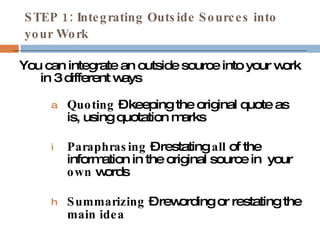
STEP 1: Integrating Outside Sources into your Work You can integrate an outside source into your work in 3 different ways Quoting  – keeping the original quote as is, using quotation marks Paraphrasing  – restating  all  of the information in the original source in  your  own  words Summarizing  – rewording or restating the  main idea
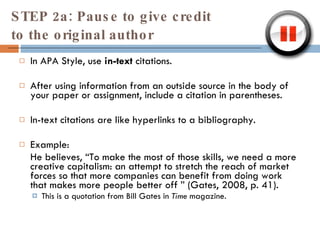
STEP 2a: Pause   to give credit  to the original author In APA Style, use  in-text  citations. After using information from an outside source in the body of your paper or assignment, include a citation in parentheses. In-text citations are like hyperlinks to a bibliography. Example:  He believes, “To make the most of those skills, we need a more creative capitalism: an attempt to stretch the reach of market forces so that more companies can benefit from doing work that makes more people better off ” (Gates, 2008, p. 41). This is a quotation from Bill Gates in  Time  magazine .
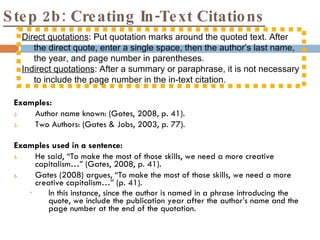
Step 2b: Creating In-Text Citations Examples: Author name known: (Gates, 2008, p. 41). Two Authors: (Gates & Jobs, 2003, p. 77). Examples used in a sentence: He said, “To make the most of those skills, we need a more creative capitalism…” (Gates, 2008, p. 41). Gates (2008) argues, “To make the most of those skills, we need a more creative capitalism…” (p. 41). In this instance, since the author is named in a phrase introducing the quote, we include the publication year after the author’s name and the page number at the end of the quotation.  Direct quotations : Put quotation marks around the quoted text. After the direct quote, enter a single space, then the author’s last name, the year, and page number in parentheses.  Indirect quotations : After a summary or paraphrase, it is not necessary to include the page number in the in-text citation.
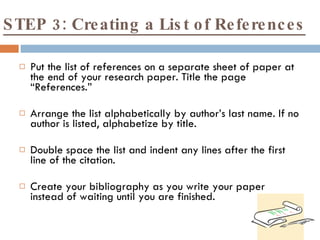
STEP 3: Creating a List of References Put the list of references on a separate sheet of paper at the end of your research paper. Title the page “References.” Arrange the list alphabetically by author’s last name. If no author is listed, alphabetize by title. Double space the list and indent any lines after the first line of the citation. Create your bibliography as you write your paper instead of waiting until you are finished.
Citing Websites When citing a website, include the following information when available: Author’s name Date of publication Title of document in italics  Date you accessed the source Electronic address (URL)
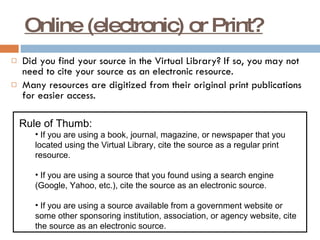
Online (electronic) or Print? Did you find your source in the Virtual Library? If so, you may not need to cite your source as an electronic resource. Many resources are digitized from their original print publications for easier access. Rule of Thumb: If you are using a book, journal, magazine, or newspaper that you located using the Virtual Library, cite the source as a regular print resource.  If you are using a source that you found using a search engine (Google, Yahoo, etc.), cite the source as an electronic source. If you are using a source available from a government website or some other sponsoring institution, association, or agency website, cite the source as an electronic source.
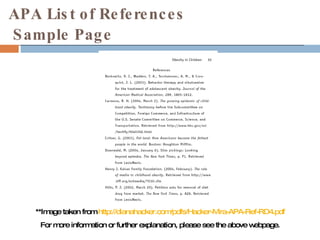
APA List of References  Sample Page **Image taken from  http://dianahacker.com/pdfs/Hacker-Mira-APA-Ref-RD4.pdf For more information or further explanation, please see the above webpage.
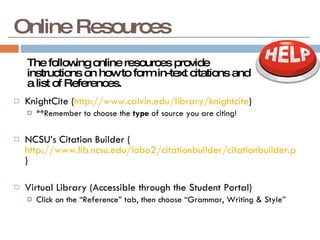
Online Resources KnightCite ( http://www.calvin.edu/library/knightcite ) **Remember to choose the  type  of source you are citing! NCSU’s Citation Builder ( http://www.lib.ncsu.edu/lobo2/citationbuilder/citationbuilder.php ) Virtual Library (Accessible through the Student Portal) Click on the “Reference” tab, then choose “Grammar, Writing & Style” The following online resources provide instructions on how to form in-text citations and a list of References.

Avoiding Plagiariarism and using APA Citation

  • 1.
    AVOIDING PLAGIARISM Howto use APA Style Guidelines to Cite Your Sources Created by: Jill Robinson Learning Resource Center ITT Technical Institute Morrisville, NC January 2009 Updated by: Jennifer Joyner and Sarah Jenkins Learning Resource Center ITT Technical Institute Morrisville, NC September 2009
  • 2.
    Plagiarism can come in many forms… Sources cited but still plagiarized (incorrectly using Citation Style Guidelines) Sources used but not cited Copy/Paste Word Switch Idea (those not accepted as general knowledge)
  • 3.
    To cite ornot to cite? Take the Quiz: www.infolit4techstudents.pbwiki.com/Citation-Quiz If in doubt… CITE IT! Use a set of style guidelines, such as those offered by the APA (American Psychological Association) to correctly cite your sources. This presentation offers advice on writing using APA Style.
  • 4.
    STEP 1: IntegratingOutside Sources into your Work You can integrate an outside source into your work in 3 different ways Quoting – keeping the original quote as is, using quotation marks Paraphrasing – restating all of the information in the original source in your own words Summarizing – rewording or restating the main idea
  • 5.
    STEP 2a: Pause to give credit to the original author In APA Style, use in-text citations. After using information from an outside source in the body of your paper or assignment, include a citation in parentheses. In-text citations are like hyperlinks to a bibliography. Example: He believes, “To make the most of those skills, we need a more creative capitalism: an attempt to stretch the reach of market forces so that more companies can benefit from doing work that makes more people better off ” (Gates, 2008, p. 41). This is a quotation from Bill Gates in Time magazine .
  • 6.
    Step 2b: CreatingIn-Text Citations Examples: Author name known: (Gates, 2008, p. 41). Two Authors: (Gates & Jobs, 2003, p. 77). Examples used in a sentence: He said, “To make the most of those skills, we need a more creative capitalism…” (Gates, 2008, p. 41). Gates (2008) argues, “To make the most of those skills, we need a more creative capitalism…” (p. 41). In this instance, since the author is named in a phrase introducing the quote, we include the publication year after the author’s name and the page number at the end of the quotation. Direct quotations : Put quotation marks around the quoted text. After the direct quote, enter a single space, then the author’s last name, the year, and page number in parentheses. Indirect quotations : After a summary or paraphrase, it is not necessary to include the page number in the in-text citation.
  • 7.
    STEP 3: Creatinga List of References Put the list of references on a separate sheet of paper at the end of your research paper. Title the page “References.” Arrange the list alphabetically by author’s last name. If no author is listed, alphabetize by title. Double space the list and indent any lines after the first line of the citation. Create your bibliography as you write your paper instead of waiting until you are finished.
  • 8.
    Citing Websites Whenciting a website, include the following information when available: Author’s name Date of publication Title of document in italics Date you accessed the source Electronic address (URL)
  • 9.
    Online (electronic) orPrint? Did you find your source in the Virtual Library? If so, you may not need to cite your source as an electronic resource. Many resources are digitized from their original print publications for easier access. Rule of Thumb: If you are using a book, journal, magazine, or newspaper that you located using the Virtual Library, cite the source as a regular print resource. If you are using a source that you found using a search engine (Google, Yahoo, etc.), cite the source as an electronic source. If you are using a source available from a government website or some other sponsoring institution, association, or agency website, cite the source as an electronic source.
  • 10.
    APA List ofReferences Sample Page **Image taken from http://dianahacker.com/pdfs/Hacker-Mira-APA-Ref-RD4.pdf For more information or further explanation, please see the above webpage.
  • 11.
    Online Resources KnightCite( http://www.calvin.edu/library/knightcite ) **Remember to choose the type of source you are citing! NCSU’s Citation Builder ( http://www.lib.ncsu.edu/lobo2/citationbuilder/citationbuilder.php ) Virtual Library (Accessible through the Student Portal) Click on the “Reference” tab, then choose “Grammar, Writing & Style” The following online resources provide instructions on how to form in-text citations and a list of References.