ì	
  
Build	
  &	
  Release	
  Engineering	
  
By:	
  Pranesh	
  Vi.al	
  CG	
  
h.p://linkedin.com/in/praneshvi.al	
  	
  
Main	
  Agenda	
  of	
  this	
  session	
  
h"p://linkedin.com/in/praneshvi"al	
  
2	
  
Key	
  Takeaways	
  from	
  this	
  session	
  	
  
ì  So<ware	
  Release	
  Principles	
  &	
  its	
  importance.	
  
ì  Not	
  to	
  expect	
  results	
  from	
  “Day	
  1”.	
  It’s	
  a	
  slow	
  process.	
  Takes	
  months	
  or	
  at	
  
Lmes	
  even	
  years	
  to	
  reach	
  perfecLon	
  levels.	
  	
  
ì  What	
  is	
  “ConLnuous	
  IntegraLon”?	
  
ì  Steps	
  associated	
  with	
  “ConLnuous	
  IntegraLon”?	
  
ì  What	
  is	
  a	
  “ConLnuous	
  Delivery”?	
  
ì  Steps	
  associated	
  with	
  “ConLnuous	
  Delivery”?	
  
ì  What	
  is	
  a	
  “ConLnuous	
  Deployment”?	
  
ì  Release	
  Engineering	
  Steps.	
  
ì  Main	
  Focus	
  of	
  Release	
  Engineering.	
  
h"p://linkedin.com/in/praneshvi"al	
  
3	
  
Key	
  Takeaways	
  from	
  this	
  session	
  	
  
ì  ConfiguraLon	
  Management.	
  
ì  Principles	
  of	
  Managing	
  ApplicaLon	
  ConfiguraLon.	
  
ì  Its	
  not	
  just	
  about	
  the	
  tools.	
  Its	
  about	
  the	
  big	
  “Cultural	
  Change”	
  that	
  
everyone	
  has	
  to	
  go	
  through	
  .	
  
ì  Release	
  Engineering	
  Architecture.	
  
ì  Deep	
  dive	
  into	
  commit	
  /	
  component	
  builds.	
  
ì  AnL-­‐Pa.erns	
  in	
  commit	
  /	
  component	
  builds.	
  
ì  Aim	
  of	
  Deployment	
  Pipeline.	
  
ì  AnL-­‐Pa.erns	
  of	
  Deployment	
  Pipeline.	
  
ì  Best	
  qualiLes	
  of	
  a	
  Deployment	
  Pipeline.	
  
h"p://linkedin.com/in/praneshvi"al	
  
4	
  
Key	
  Takeaways	
  from	
  this	
  session	
  	
  
ì  Deployment	
  on	
  Large	
  Scale	
  ProducLon	
  Environments.	
  
ì  Why	
  Automated	
  Deployment	
  is	
  an	
  indispensable	
  goal	
  ???	
  
ì  Deep	
  dive	
  into	
  TesLng	
  Quadrant.	
  
ì  Deep	
  Dive	
  into	
  Automated	
  Acceptance	
  Tests.	
  
ì  Few	
  more	
  Generic	
  AnL-­‐Pa.erns.	
  
ì  AdapLon	
  of	
  Release	
  Engineering.	
  
ì  Tools	
  Used	
  at	
  each	
  of	
  the	
  stages.	
  
ì  Managing	
  Environments.	
  
ì  Managing	
  Releases	
  of	
  complex	
  systems.	
  
h"p://linkedin.com/in/praneshvi"al	
  
5	
  
Key	
  Takeaways	
  from	
  this	
  session	
  	
  
ì  Steps	
  involved	
  to	
  build	
  a	
  deployment	
  pipeline.	
  
ì  Everyone	
  is	
  an	
  equal	
  contributor	
  to	
  reach	
  “ConLnuous	
  Deployment”	
  stage.	
  	
  
ì  MulL-­‐Tenancy	
  Cloud.	
  
ì  MulL-­‐Instance	
  ApplicaLons.	
  
ì  Zero	
  DownLme	
  Deployment.	
  
ì  ExtracLng	
  the	
  server	
  logs.	
  
ì  Next	
  generaLon	
  tools	
  in	
  the	
  DevOps	
  world.	
  
ì  PreparaLon	
  for	
  the	
  Release.	
  
ì  Maturity	
  of	
  a	
  “Deployment	
  Pipeline”.	
  
h"p://linkedin.com/in/praneshvi"al	
  
6	
  
Target	
  Audience	
  
ì  Product	
  Managers	
  /	
  Business	
  Analysts.	
  
ì  Engineering	
  Managers.	
  
ì  Development	
  Teams.	
  
ì  Quality	
  Engineering	
  Teams.	
  
ì  System	
  Admins.	
  
ì  Service	
  Engineering	
  /	
  ProducLon	
  Engineering	
  Teams.	
  
ì  On-­‐site	
  Coordinators.	
  
h"p://linkedin.com/in/praneshvi"al	
  
7	
  
Software	
  Release	
  Principles	
  &	
  its	
  importance.	
  
ì  Should	
  be	
  Fast	
  /	
  Predictable	
  /	
  Repeatable.	
  
ì  Automate	
  almost	
  everything.	
  
ì  Keep	
  everything	
  in	
  Version	
  Control.	
  
ì  If	
  it	
  hurts,	
  do	
  it	
  more	
  o<en.	
  
ì  Improve	
  the	
  quality	
  of	
  the	
  Builds.	
  Push	
  the	
  boundaries	
  of	
  test	
  
automaLon	
  so	
  that	
  quality	
  is	
  not	
  compromised.	
  
ì  Done	
  means	
  the	
  so<ware	
  is	
  released	
  and	
  has	
  reached	
  the	
  
producLon.	
  
h"p://linkedin.com/in/praneshvi"al	
  
8	
  
What	
  is	
  Deployment?	
  
ì  Run	
  the	
  same	
  commands	
  in	
  several	
  hosts.	
  
ì  Install	
  the	
  required	
  so<ware	
  from	
  a	
  central	
  repository	
  so	
  that	
  
the	
  end	
  state	
  of	
  every	
  host	
  is	
  same.	
  
ì  Based	
  on	
  the	
  host-­‐type,	
  install	
  the	
  required	
  packages.	
  
ì  End	
  goal	
  is	
  to	
  bring	
  all	
  the	
  hosts	
  of	
  the	
  respecLve	
  host-­‐type	
  in	
  
the	
  same	
  state.	
  
h"p://linkedin.com/in/praneshvi"al	
  
9	
  
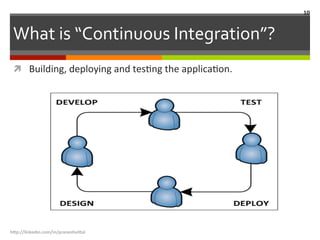
What	
  is	
  “Continuous	
  Integration”?	
  
ì  Building,	
  deploying	
  and	
  tesLng	
  the	
  applicaLon.	
  
h"p://linkedin.com/in/praneshvi"al	
  
10	
  
Steps	
  associated	
  with	
  “Continuous	
  
Integration”?	
  
ì  Integrate	
  all	
  the	
  components	
  at	
  regular	
  intervals.	
  
ì  Binaries	
  built	
  only	
  once	
  and	
  used	
  in	
  all	
  the	
  environments.	
  
ì  Execute	
  Unit	
  Tests	
  before	
  the	
  packages	
  are	
  generated.	
  
ì  Deploy	
  the	
  latest	
  packages	
  onto	
  an	
  INT	
  environment.	
  
ì  Run	
  the	
  automated	
  tests,	
  validate	
  the	
  test	
  results.	
  
ì  Track	
  the	
  Code	
  quality	
  criteria	
  such	
  as	
  staLc	
  code	
  analysis,	
  test	
  coverage.	
  
ì  Deploying	
  to	
  other	
  environments	
  with	
  a	
  pre-­‐defined	
  frequency.	
  
ì  Repeat	
  the	
  process.	
  
ì  It’s	
  a	
  pracGce,	
  not	
  a	
  tool	
  
h"p://linkedin.com/in/praneshvi"al	
  
11	
  
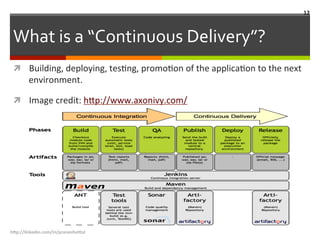
What	
  is	
  a	
  “Continuous	
  Delivery”?	
  
ì  Building,	
  deploying,	
  tesLng,	
  promoLon	
  of	
  the	
  applicaLon	
  to	
  the	
  next	
  
environment.	
  
ì  Image	
  credit:	
  h.p://www.axonivy.com/	
  	
  
h"p://linkedin.com/in/praneshvi"al	
  
12	
  
Steps	
  associated	
  with	
  “Continuous	
  
Delivery”?	
  
ì  Steps	
  followed	
  in	
  “ConLnuous	
  IntegraLon”.	
  
ì  AutomaLc	
  promoLon	
  /	
  deployment	
  to	
  other	
  environments	
  (QA,	
  
Staging,	
  Performance	
  etc…)	
  upon	
  successful	
  execuLon	
  of	
  
automated	
  tests.	
  
ì  ApplicaLon	
  is	
  always	
  ready	
  to	
  deploy	
  to	
  producLon	
  through	
  a	
  
largely	
  automated	
  process.	
  
h"p://linkedin.com/in/praneshvi"al	
  
13	
  
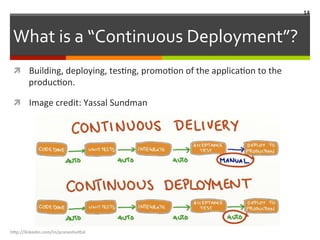
What	
  is	
  a	
  “Continuous	
  Deployment”?	
  
ì  Building,	
  deploying,	
  tesLng,	
  promoLon	
  of	
  the	
  applicaLon	
  to	
  the	
  
producLon.	
  
ì  Image	
  credit:	
  Yassal	
  Sundman	
  
h"p://linkedin.com/in/praneshvi"al	
  
14	
  
Release	
  Engineering	
  Principles	
  &	
  its	
  importance.	
  
ì  Minimize	
  Cycle	
  Time	
  from	
  check-­‐in	
  to	
  producLon	
  push.	
  
ì  Everybody	
  is	
  responsible	
  for	
  the	
  Delivery	
  Process.	
  
ì  ConLnuous	
  Improvement.	
  
ì  AcLviLes	
   such	
   as	
   SCM,	
   Release	
   planning,	
   Automated	
  
Deployment,	
  Acceptance	
  TesLng,	
  Performance	
  TesLng	
  are	
  NOT	
  
SECONDARY.	
  
ì  Generates	
  no	
  revenue	
  Lll	
  its	
  in	
  the	
  hands	
  of	
  the	
  end-­‐users.	
  
ì  Customer	
   SaLsfacLon	
   through	
   early	
   &	
   conLnuous	
   delivery	
   of	
  
so<ware.	
  
h"p://linkedin.com/in/praneshvi"al	
  
15	
  
Release	
  Engineering	
  Steps	
  
ì  SCM	
  (Git,	
  SVN,	
  Clearcase).	
  
ì  Automated	
  Commit	
  /	
  Component	
  Builds	
  (Generate	
  Binaries).	
  
ì  Generate	
  Code	
  Quality	
  Metrics.	
  
ì  Build	
  Deployment	
  Pipeline.	
  
ì  Automated	
  Acceptance	
  TesLng.	
  
ì  Automated	
  PromoLon	
  to	
  subsequent	
  Environments.	
  
ì  Single	
  click	
  or	
  automated	
  push	
  to	
  producLon.	
  
h"p://linkedin.com/in/praneshvi"al	
  
16	
  
Main	
  Focus	
  of	
  Release	
  Engineering	
  
ì  Build	
  -­‐>	
  Deploy	
  -­‐>	
  Test	
  -­‐>	
  Release	
  
ì  Every	
  single	
  check-­‐in	
  should	
  potenLally	
  be	
  in	
  a	
  releasable	
  state.	
  	
  
h"p://linkedin.com/in/praneshvi"al	
  
17	
  
Configuration	
  Management	
  
ì  Using	
  Version	
  Control	
  and	
  commit	
  everything.	
  
ì  Check-­‐in	
  the	
  changes	
  at	
  regular	
  frequency.	
  
ì  Use	
  meaningful	
  messages	
  for	
  every	
  commit.	
  
ì  Managing	
  Dependencies	
  (External	
  Libraries,	
  Components).	
  
ì  Managing	
  the	
  Infrastructure	
  (Consistent	
  network	
  topology,	
  firewall,	
  
OS	
  configuraLon,	
  patches	
  etc...	
  across	
  all	
  the	
  environments).	
  
ì  Managing	
  the	
  Environments	
  &	
  the	
  tools	
  to	
  be	
  used	
  for	
  the	
  same.	
  
ì  Managing	
  the	
  Change	
  Process.	
  
h"p://linkedin.com/in/praneshvi"al	
  
18	
  
Principles	
  of	
  Managing	
  Application	
  
Configuration	
  
ì  Good	
  understanding	
  of	
  the	
  stage	
  in	
  which	
  the	
  configuraLon	
  should	
  
be	
  injected	
  (Assembly,	
  Deployment,	
  Restart	
  etc…)	
  
ì  ConfiguraLon	
  sefngs	
  for	
  the	
  applicaLon	
  to	
  be	
  in	
  the	
  project’s	
  root	
  
directory.	
  
ì  Should	
  always	
  be	
  automated	
  and	
  values	
  checked	
  into	
  repository.	
  
ì  Use	
  clear	
  naming	
  convenLon.	
  
ì  Avoid	
  Over-­‐engineering.	
  Keep	
  it	
  as	
  simple	
  as	
  possible.	
  
ì  Ensure	
  that	
  the	
  configuraLon	
  is	
  tested	
  properly	
  a<er	
  deployment.	
  
h"p://linkedin.com/in/praneshvi"al	
  
19	
  
Release	
  Engineering	
  Architecture	
  
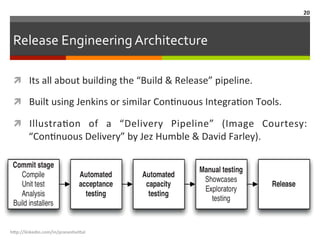
ì  Its	
  all	
  about	
  building	
  the	
  “Build	
  &	
  Release”	
  pipeline.	
  
ì  Built	
  using	
  Jenkins	
  or	
  similar	
  ConLnuous	
  IntegraLon	
  Tools.	
  
ì  IllustraLon	
   of	
   a	
   “Delivery	
   Pipeline”	
   (Image	
   Courtesy:	
  
“ConLnuous	
  Delivery”	
  by	
  Jez	
  Humble	
  &	
  David	
  Farley).	
  
h"p://linkedin.com/in/praneshvi"al	
  
20	
  
Deep	
  dive	
  into	
  commit	
  /	
  component	
  builds:	
  
ì  Aim:	
  
ì  Eliminate	
  builds	
  that	
  are	
  unfit	
  for	
  producLon.	
  	
  
ì  Steps:	
  
ì  Compile	
  the	
  code.	
  
ì  Run	
  a	
  set	
  of	
  commit	
  tests.	
  
ì  Run	
  Lint	
  based	
  tests	
  or	
  some	
  of	
  the	
  basic	
  staLc	
  code	
  analysis	
  tasks.	
  
ì  Publish	
  the	
  results.	
  
ì  Once	
  above	
  steps	
  are	
  done,	
  build	
  the	
  package	
  and	
  upload	
  the	
  binary	
  to	
  
a	
  centralized	
  repository.	
  	
  
ì  Add	
  tests	
  on	
  an	
  ongoing	
  basis.	
  
ì  Keep	
  a	
  watch	
  on	
  the	
  build	
  execuLon	
  Lme	
  and	
  opLmize	
  frequently.	
  
ì  Explore	
  the	
  ‘Pre-­‐Commit’	
  or	
  ‘Pre-­‐Flight’	
  build	
  opLons	
  provided	
  by	
  some	
  
of	
  the	
  CI	
  tools.	
  
h"p://linkedin.com/in/praneshvi"al	
  
21	
  
Anti-­‐Patterns	
  in	
  commit	
  /	
  component	
  builds:	
  
ì  Don’t	
  check-­‐in	
  new	
  code	
  on	
  a	
  broken	
  build.	
  The	
  only	
  fix	
  that	
  has	
  to	
  go	
  are	
  the	
  changes	
  
that	
  fix	
  the	
  broken	
  build.	
  
ì  Always	
  run	
  commit	
  tests	
  locally	
  before	
  the	
  commit.	
  
ì  Always	
  wait	
  for	
  commit	
  tests	
  to	
  pass	
  before	
  next	
  check-­‐in.	
  
ì  Developers	
   who	
   have	
   commi.ed	
   their	
   code	
   are	
   responsible	
   for	
   the	
   build	
   process	
   to	
  
succeed.	
  
ì  Never	
  go	
  home	
  on	
  a	
  broken	
  build.	
  	
  
ì  Time-­‐box	
   during	
   every	
   failed	
   build.	
   Give	
   about	
   10-­‐20	
   minutes	
   to	
   fix,	
   else	
   rollback	
   the	
  
changes.	
  
ì  Don’t	
  EVER	
  comment	
  failing	
  tests.	
  
ì  Take	
   ownership	
   for	
   all	
   the	
   breakages	
   that	
   result	
   from	
   your	
   changes	
   and	
   fix	
   them	
  
accordingly.	
  	
  
h"p://linkedin.com/in/praneshvi"al	
  
22	
  
Aim	
  of	
  Deployment	
  Pipeline	
  
ì  Every	
  Step	
  should	
  be	
  visible	
  (Results	
  in	
  be.er	
  collaboraLon).	
  
ì  Deliver	
  useful,	
  working	
  so<ware	
  to	
  the	
  users	
  as	
  early	
  as	
  possible.	
  	
  
ì  Early	
  feedback	
  (IdenLfy	
  &	
  resolve	
  issues	
  in	
  the	
  early	
  stages).	
  
ì  Enable	
  teams	
  to	
  deploy	
  &	
  release	
  any	
  version	
  of	
  their	
  so<ware	
  at	
  any	
  point	
  to	
  
any	
  of	
  the	
  environments.	
  
ì  Avoid	
  last	
  day	
  heroics	
  on	
  the	
  release	
  day.	
  
ì  Release	
  in	
  small	
  chunks	
  (Avoid	
  “Big	
  Bang”	
  release).	
  
ì  Should	
  be	
  driven	
  by	
  tools	
  &	
  not	
  by	
  sviduals.	
  
ì  Ability	
   for	
   every	
   change	
   to	
   be	
   transparent	
   &	
   propagate	
   them	
   through	
   the	
  
pipeline.	
  
ì  Ability	
  to	
  roll-­‐back	
  to	
  a	
  previous	
  stable	
  state	
  in	
  case	
  of	
  any	
  failures.	
  
h"p://linkedin.com/in/praneshvi"al	
  
23	
  
Anti-­‐Patterns	
  of	
  Deployment	
  Pipeline	
  
ì  Manual	
  Deployment	
  of	
  So<ware.	
  
ì  Deployment	
  performed	
  by	
  mulLple	
  teams.	
  
ì  The	
  order	
  of	
  steps	
  are	
  not	
  defined.	
  
ì  No	
  proper	
  “Run	
  books”	
  for	
  failures.	
  
ì  Too	
  much	
  of	
  reliance	
  of	
  manual	
  tesLng.	
  
ì  CorrecLon	
  to	
  the	
  release	
  process	
  during	
  the	
  actual	
  producLon	
  release.	
  
ì  ConfiguraLon	
  across	
  all	
  the	
  environments	
  varies	
  to	
  a	
  large	
  extent.	
  
ì  Manual	
  ConfiguraLon	
  management	
  of	
  ProducLon	
  Environment.	
  
ì  Deployment	
  to	
  a	
  producLon-­‐like	
  environment	
  is	
  done	
  only	
  development	
  is	
  
100%	
  complete.	
  
h"p://linkedin.com/in/praneshvi"al	
  
24	
  
Best	
  qualities	
  of	
  a	
  Deployment	
  Pipeline	
  
ì  Deployments	
  should	
  be	
  automated.	
  
ì  Deployments	
  should	
  be	
  done	
  frequently	
  (If	
  possible,	
  for	
  every	
  
single	
  check-­‐in).	
  
ì  Provide	
  early	
  feedback	
  so	
  that	
  the	
  development	
  team	
  can	
  act	
  
on	
  the	
  failures	
  in	
  a	
  faster	
  way.	
  
ì  Good	
  AutomaLon	
  Coverage	
  to	
  test	
  early.	
  
ì  Should	
  be	
  scalable.	
  
ì  Should	
  enable	
  one-­‐click	
  deployment.	
  
h"p://linkedin.com/in/praneshvi"al	
  
25	
  
Deployment	
  on	
  Large	
  Scale	
  Production	
  
Environments	
  
ì  What	
  are	
  host-­‐types?	
  
ì  What	
  are	
  recipes	
  /	
  cookbooks?	
  
ì  Tools	
  like	
  Pogo	
  OR	
  other	
  agent	
  based	
  deployment	
  tools.	


$	
  ssh	
  <target-­‐host-­‐name>	
  'whoami;’	
  
praneshv	
  
h"p://linkedin.com/in/praneshvi"al	
  
26	
  
Why	
  Automated	
  Deployment	
  is	
  an	
  indispensable	
  goal	
  ???	
  
ì  On	
  most	
  occasions,	
  the	
  deployment	
  documentaLon	
  is	
  outdated.	
  
ì  Logging	
  all	
  the	
  steps	
  in	
  the	
  form	
  of	
  scripts	
  is	
  very	
  beneficial	
  for	
  book	
  keeping	
  
purposes.	
  
ì  Works	
  seamlessly	
  if	
  all	
  the	
  steps	
  are	
  taken	
  care	
  of.	
  
ì  Even	
  non-­‐experts	
  should	
  be	
  able	
  to	
  deploy	
  effortlessly.	
  
ì  Every	
   team	
   using	
   automated	
   deployment	
   scripts	
   results	
   in	
   its	
   maturity	
   &	
   less	
  
prone	
  to	
  errors.	
  
ì  Take	
  off	
  the	
  dependency	
  from	
  the	
  deployment	
  expert	
  and	
  uLlize	
  them	
  for	
  more	
  
challenging	
  tasks.	
  
ì  Its	
  fast,	
  cheap.	
  Facilitates	
  in	
  early	
  tesLng	
  &	
  faster	
  feedback	
  cycles.	
  
ì  Deployment	
  Logs	
  are	
  auditable	
  for	
  future	
  references.	
  
h"p://linkedin.com/in/praneshvi"al	
  
27	
  
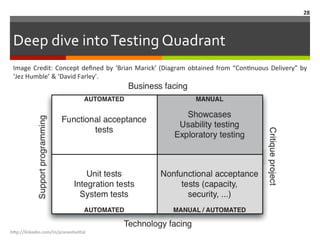
Deep	
  dive	
  into	
  Testing	
  Quadrant	
  
Image	
  Credit:	
  Concept	
  defined	
  by	
  ‘Brian	
  Marick’	
  (Diagram	
  obtained	
  from	
  “ConLnuous	
  Delivery”	
  by	
  	
  
‘Jez	
  Humble’	
  &	
  ‘David	
  Farley’.	
  
h"p://linkedin.com/in/praneshvi"al	
  
28	
  
Deep	
  Dive	
  into	
  Automated	
  Acceptance	
  Tests	
  
ì  Aim:	
  
ì  Avoid	
  manual	
  tests	
  to	
  whatever	
  extent	
  possible.	
  
ì  Steps	
  to	
  be	
  followed:	
  
ì  Tests	
  to	
  be	
  performed	
  in	
  producLon-­‐like	
  environment.	
  
ì  If	
   sefng	
   up	
   environment	
   is	
   expensive,	
   use	
   a	
   scaled-­‐down	
  
environment.	
  
ì  Setup	
  the	
  actual	
  user’s	
  environment	
  on	
  a	
  grid.	
  
ì  Use	
  Business	
  language	
  in	
  the	
  scripts	
  instead	
  of	
  technical	
  jargon	
  
(‘Place	
  Order’	
  instead	
  of	
  ‘Clicking	
  on	
  bu.on	
  XYZ’).	
  
ì  Well-­‐defined	
  exit	
  criteria	
  for	
  Pass	
  /	
  Fail	
  of	
  tests.	
  
ì  Don’t	
  fail	
  the	
  test	
  due	
  to	
  minor	
  issues.	
  
h"p://linkedin.com/in/praneshvi"al	
  
29	
  
Deep	
  Dive	
  into	
  Automated	
  Acceptance	
  Tests	
  
continued…	
  
ì  Steps	
  to	
  be	
  followed:	
  
ì  Include	
  a	
  few	
  tests	
  to	
  assert	
  external	
  systems.	
  
ì  If	
  you	
  don’t	
  care	
  about	
  a	
  parLcular	
  field,	
  don’t	
  bother	
  tesLng	
  it.	
  
ì  These	
  tests	
  should	
  be	
  run	
  a<er	
  every	
  deployment.	
  
ì  Block	
  the	
  pipeline	
  when	
  there	
  are	
  massive	
  failures.	
  
ì  Parallelize	
  the	
  tests	
  to	
  whatever	
  extent	
  possible.	
  
ì  Outcome	
  of	
  this	
  step	
  are	
  the	
  so<ware	
  packages	
  that	
  have	
  fought	
  
against	
  all	
  the	
  tests	
  &	
  challenges	
  like	
  a	
  mythical	
  hero	
  and	
  ready	
  
to	
  take	
  on	
  the	
  world	
  !!!	
  
h"p://linkedin.com/in/praneshvi"al	
  
30	
  
Few	
  more	
  Generic	
  Anti-­‐Patterns	
  
ì  TesLng	
  done	
  on	
  developer	
  machines.	
  
ì  Service	
  Engineering	
  team	
  hasn’t	
  even	
  seen	
  the	
  applicaLon	
  Lll	
  the	
  
actual	
  release	
  date.	
  
ì  Installers,	
  ConfiguraLons	
  etc…	
  not	
  done	
  Lll	
  the	
  release	
  date.	
  
ì  No	
  collaboraLon	
  between	
  development	
  team	
  &	
  SE	
  teams.	
  
ì  Late	
  setup	
  of	
  Staging	
  Environment.	
  
ì  Release	
  too	
  many	
  changes,	
  unable	
  to	
  figure	
  out	
  what	
  caused	
  the	
  
failure.	
  
ì  Changing	
  the	
  configuraLons	
  directly	
  on	
  ProducLon	
  o<en	
  resulLng	
  in	
  
disasters.	
  
h"p://linkedin.com/in/praneshvi"al	
  
31	
  
Adaption	
  of	
  Release	
  Engineering	
  
ì  Change	
  in	
  the	
  mindset	
  of	
  the	
  team	
  members.	
  
ì  All	
  aspects	
  of	
  development,	
  tesLng,	
  staging,	
  producLon	
  environments	
  (most	
  
importantly	
  configuraLon	
  management)	
  to	
  be	
  managed	
  through	
  a	
  VCS.	
  
ì  Integrate	
  development,	
  tesLng,	
  release	
  teams	
  as	
  a	
  part	
  of	
  the	
  development	
  
process.	
  
ì  Manage	
  the	
  Infrastructure	
  to	
  build	
  environments	
  in	
  no	
  Lme.	
  
ì  Beef	
  up	
  the	
  test	
  automaLon	
  coverage	
  so	
  that	
  there’s	
  not	
  much	
  reliance	
  on	
  
Manual	
  tesLng.	
  
ì  Rehearse	
  the	
  release	
  &	
  rollback	
  process	
  so	
  that	
  its	
  easy	
  to	
  do	
  it	
  Lme	
  &	
  
again.	
  
ì  Reach	
  a	
  stage	
  wherein	
  “So<ware	
  Release”	
  is	
  in	
  self-­‐service	
  mode.	
  
h"p://linkedin.com/in/praneshvi"al	
  
32	
  
Tools	
  Used	
  at	
  each	
  of	
  the	
  stages.	
  
ì  Version	
  control	
  –	
  Git	
  
ì  Build	
  Tools	
  –	
  Ant,	
  Nant,	
  MSBuild,	
  gmake,	
  Maven,	
  Buildr,	
  Psake.	
  
ì  Agile	
  /	
  Scrum	
  –	
  Jira.	
  
ì  StaLc	
  validaLon	
  –	
  Coverity,	
  SonarQube	
  
ì  Unit	
  tesLng	
  –	
  junit	
  
ì  Test	
  automaLon	
  –	
  Protractor,	
  Selenium	
  
ì  ConLnuous	
  IntegraLon	
  –	
  Jenkins,	
  Atlassian	
  Bamboo,	
  Thoughtworks	
  Go,	
  UrbanCode	
  
AntHillPro	
  
ì  Deployment	
  –	
  Pogo,	
  Chef	
  
ì  Environment	
  provisioning	
  –	
  Puppet,	
  Chef	
  
ì  IAAS,	
  PAAS	
  –	
  AWS,	
  Azure,	
  Docker,	
  Vagrant	
  
h"p://linkedin.com/in/praneshvi"al	
  
33	
  
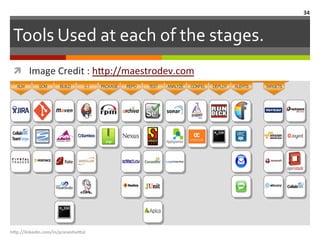
Tools	
  Used	
  at	
  each	
  of	
  the	
  stages.	
  
ì  Image	
  Credit	
  :	
  h.p://maestrodev.com	
  	
  
h"p://linkedin.com/in/praneshvi"al	
  
34	
  
Managing	
  Environments	
  
ì  No	
  ApplicaLon	
  is	
  an	
  Island.	
  
ì  Poor	
  ConfiguraLon	
  Management	
  results	
  in	
  significant	
  waste	
  of	
  Lme,	
  
addiLonal	
  costs,	
  tech	
  debt	
  etc…	
  
ì  Should	
  always	
  be	
  cheaper	
  to	
  create	
  a	
  new	
  environment	
  than	
  repairing	
  a	
  
broken	
  environment.	
  
ì  Few	
  of	
  the	
  names	
  used	
  for	
  Environments	
  
ì  Development	
  
ì  IntegraLon	
  
ì  QA	
  /	
  TesLng	
  
ì  Staging	
  /	
  Pre-­‐ProducLon	
  
ì  Performance	
  
ì  Canary	
  /	
  Bucket	
  TesLng	
  
ì  ProducLon	
  
h"p://linkedin.com/in/praneshvi"al	
  
35	
  
Managing	
  Releases	
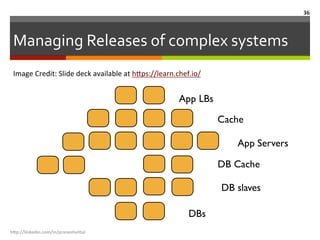
  of	
  complex	
  systems	
  
h"p://linkedin.com/in/praneshvi"al	
  
36	
  
Image	
  Credit:	
  Slide	
  deck	
  available	
  at	
  h.ps://learn.chef.io/	
  	
  
Managing	
  Releases	
  of	
  complex	
  systems	
  
h"p://linkedin.com/in/praneshvi"al	
  
37	
  
OrchestraLon:	
  	
  
ì  Automated	
  arrangement,	
  coordinaLon,	
  and	
  management	
  of	
  complex	
  computer	
  systems,	
  
middleware,	
  and	
  services.	
  	
  
ì  Aligning	
  the	
  business	
  request	
  with	
  the	
  applicaLons,	
  data,	
  and	
  infrastructure	
  
ì  Deployment	
  Rhythm	
  
ì  Its	
  about	
  gefng	
  the	
  perfect	
  configuraLon,	
  checking	
  in	
  these	
  values	
  and	
  automate	
  the	
  
release	
  using	
  these	
  values.	
  
ì  Have	
  the	
  right	
  sequence	
  of	
  steps	
  in	
  the	
  configuraLon	
  file.	
  
ì  Have	
  the	
  right	
  kind	
  of	
  checks	
  &	
  balances	
  at	
  every	
  stage.	
  
ì  PracLce	
  roll-­‐backs	
  in	
  case	
  of	
  issues.	
  
ì  Implement	
  fail-­‐safe	
  methodologies	
  in	
  case	
  of	
  issues.	
  
ì  Build	
  environments	
  wherein	
  the	
  ProducLon	
  traffic	
  can	
  be	
  replayed	
  (Use	
  of	
  access	
  logs	
  to	
  
simulate	
  user	
  acLons).	
  
Steps	
  involved	
  to	
  build	
  a	
  deployment	
  pipeline	
  
ì  Model	
  your	
  value	
  stream	
  &	
  create	
  a	
  walking	
  skeleton.	
  
ì  Automate	
  the	
  build	
  &	
  deployment	
  process.	
  
ì  Automate	
  unit	
  tests	
  &	
  code	
  analysis.	
  
ì  Automate	
  Acceptance	
  Tests.	
  
ì  Automate	
  Releases.	
  
h"p://linkedin.com/in/praneshvi"al	
  
38	
  
Multi-­‐Tenant	
  Applications	
  
ì  Customers	
  share	
  the	
  same	
  cloud	
  plavorm	
  and	
  infrastructure	
  and	
  their	
  data	
  
is	
  commingled.	
  
ì  Single	
  code-­‐base	
  for	
  the	
  applicaLon.	
  
ì  Upgrades	
  are	
  executed	
  easily	
  by	
  the	
  SaaS	
  provider.	
  
ì  All	
  the	
  tenants	
  are	
  using	
  the	
  same	
  version.	
  
ì  Data	
  of	
  different	
  tenants	
  is	
  stored	
  in	
  the	
  same	
  place,	
  however,	
  measures	
  
taken	
  to	
  make	
  it	
  inaccessible	
  to	
  other	
  tenants.	
  
ì  BuckeLze	
  the	
  access	
  based	
  on	
  the	
  IP	
  Range	
  /	
  Cookie	
  range	
  /	
  Header	
  
InformaLon	
  etc...	
  
ì  Toggle	
  a	
  Feature	
  using	
  configuraLon.	
  	
  
ì  Hard	
  to	
  maintain	
  different	
  versions	
  for	
  different	
  tenants.	
  
h"p://linkedin.com/in/praneshvi"al	
  
39	
  
Multi-­‐Instance	
  Applications	
  
ì  MulLple	
  customers	
  run	
  their	
  own	
  separate	
  instance	
  of	
  an	
  
applicaLon	
  and	
  OS	
  running	
  on	
  a	
  separate	
  VM.	
  
ì  Avoid	
  comingling	
  of	
  data.	
  
ì  Develop	
  &	
  use	
  their	
  own	
  logical	
  piece	
  of	
  the	
  cloud	
  service.	
  
ì  Allows	
  for	
  greater	
  flexibility	
  and	
  control	
  of	
  configuraLon,	
  
customizaLon,	
  updates	
  and	
  upgrades.	
  
ì  Ability	
  to	
  migrate	
  instance	
  to	
  an	
  on-­‐premise	
  server,	
  or	
  to	
  
another	
  cloud	
  hosLng	
  provider	
  
h"p://linkedin.com/in/praneshvi"al	
  
40	
  
Zero	
  Downtime	
  Deployment	
  
ì  What	
  is	
  ‘Zero	
  DownLme	
  Deployment’?	
  
ì  What	
  is	
  ‘Out	
  Of	
  RotaLon’	
  (OOR)	
  ?	
  
ì  What	
  is	
  ‘Concurrency’	
  ?	
  
ì  Colo	
  (Data-­‐Center)	
  based	
  deployments.	
  
h"p://linkedin.com/in/praneshvi"al	
  
41	
  
Extracting	
  the	
  server	
  logs	
  
ì  Standardize	
  the	
  logging	
  messages.	
  Involves	
  lot	
  of	
  effort	
  from	
  
the	
  development	
  teams.	
  
ì  Setup	
  Splunk	
  alerts	
  for	
  ‘FATAL’	
  errors	
  in	
  the	
  code.	
  
h"p://linkedin.com/in/praneshvi"al	
  
42	
  
Next	
  generation	
  tools	
  in	
  the	
  DevOps	
  world	
  
ì  Chef	
  
ì  Puppet	
  
ì  Cfengine	
  
ì  Salt	
  
h"p://linkedin.com/in/praneshvi"al	
  
43	
  
Preparation	
  for	
  the	
  Release	
  
ì  Any	
  issues	
  during	
  the	
  release,	
  stop	
  or	
  postpone	
  the	
  release.	
  
Stability	
  takes	
  the	
  highest	
  priority.	
  
ì  Prepare	
  Release	
  Plan	
  or	
  Runbook	
  with	
  correct	
  sets	
  and	
  if	
  
possible	
  automate	
  them.	
  
ì  IdenLfy	
  the	
  error-­‐prone	
  steps	
  and	
  automate	
  them.	
  
ì  Perform	
  the	
  drill	
  for	
  performing	
  rolling	
  back	
  of	
  the	
  releases.	
  
ì  Should	
  be	
  as	
  simple	
  as	
  selecLng	
  a	
  value	
  and	
  clicking	
  a	
  bu.on.	
  
ì  Let	
  one	
  team	
  perform	
  all	
  the	
  releases.	
  (Too	
  many	
  cooks	
  spoil	
  
the	
  broth).	
  	
  
h"p://linkedin.com/in/praneshvi"al	
  
44	
  
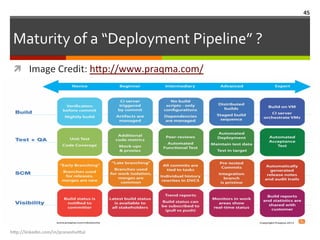
Maturity	
  of	
  a	
  “Deployment	
  Pipeline”	
  ?	
  
h"p://linkedin.com/in/praneshvi"al	
  
45	
  
ì  Image	
  Credit:	
  h.p://www.praqma.com/	
  	
  
Q	
  &	
  A	
  
h"p://linkedin.com/in/praneshvi"al	
  
46	
  
Thank	
  You	
  
h"p://linkedin.com/in/praneshvi"al	
  
47	
  
References:	
  
ì  Details	
  about	
  each	
  of	
  the	
  phases	
  from	
  “ConLnuous	
  Delivery”	
  by	
  Jez	
  Humble,	
  
David	
  Farley	
  
ì  Source	
  of	
  some	
  of	
  the	
  generic	
  images	
  used	
  –	
  “Unknown”.	
  
ì  RespecLve	
  credits	
  given	
  to	
  the	
  images	
  used	
  in	
  the	
  same	
  slide.	
  
ì  h.ps://gigaom.com/2014/01/26/mulL-­‐tenant-­‐or-­‐mulL-­‐instance-­‐cloud-­‐lets-­‐
do-­‐both/	
  	
  
ì  h.p://diginomica.com/2013/12/20/mulL-­‐tenant-­‐mulL-­‐instance-­‐saas-­‐
spectrum/	
  	
  
ì  h.ps://msdn.microso<.com/en-­‐us/library/hh534478.aspx	
  	
  
ì  h.ps://www.youtube.com/watch?v=CE4hLYhfmBE	
  -­‐	
  Deployment	
  using	
  
pogo.	
  
h"p://linkedin.com/in/praneshvi"al	
  
48	
  

Build & Release Engineering

  • 1.
    ì   Build  &  Release  Engineering   By:  Pranesh  Vi.al  CG   h.p://linkedin.com/in/praneshvi.al    
  • 2.
    Main  Agenda  of  this  session   h"p://linkedin.com/in/praneshvi"al   2  
  • 3.
    Key  Takeaways  from  this  session     ì  So<ware  Release  Principles  &  its  importance.   ì  Not  to  expect  results  from  “Day  1”.  It’s  a  slow  process.  Takes  months  or  at   Lmes  even  years  to  reach  perfecLon  levels.     ì  What  is  “ConLnuous  IntegraLon”?   ì  Steps  associated  with  “ConLnuous  IntegraLon”?   ì  What  is  a  “ConLnuous  Delivery”?   ì  Steps  associated  with  “ConLnuous  Delivery”?   ì  What  is  a  “ConLnuous  Deployment”?   ì  Release  Engineering  Steps.   ì  Main  Focus  of  Release  Engineering.   h"p://linkedin.com/in/praneshvi"al   3  
  • 4.
    Key  Takeaways  from  this  session     ì  ConfiguraLon  Management.   ì  Principles  of  Managing  ApplicaLon  ConfiguraLon.   ì  Its  not  just  about  the  tools.  Its  about  the  big  “Cultural  Change”  that   everyone  has  to  go  through  .   ì  Release  Engineering  Architecture.   ì  Deep  dive  into  commit  /  component  builds.   ì  AnL-­‐Pa.erns  in  commit  /  component  builds.   ì  Aim  of  Deployment  Pipeline.   ì  AnL-­‐Pa.erns  of  Deployment  Pipeline.   ì  Best  qualiLes  of  a  Deployment  Pipeline.   h"p://linkedin.com/in/praneshvi"al   4  
  • 5.
    Key  Takeaways  from  this  session     ì  Deployment  on  Large  Scale  ProducLon  Environments.   ì  Why  Automated  Deployment  is  an  indispensable  goal  ???   ì  Deep  dive  into  TesLng  Quadrant.   ì  Deep  Dive  into  Automated  Acceptance  Tests.   ì  Few  more  Generic  AnL-­‐Pa.erns.   ì  AdapLon  of  Release  Engineering.   ì  Tools  Used  at  each  of  the  stages.   ì  Managing  Environments.   ì  Managing  Releases  of  complex  systems.   h"p://linkedin.com/in/praneshvi"al   5  
  • 6.
    Key  Takeaways  from  this  session     ì  Steps  involved  to  build  a  deployment  pipeline.   ì  Everyone  is  an  equal  contributor  to  reach  “ConLnuous  Deployment”  stage.     ì  MulL-­‐Tenancy  Cloud.   ì  MulL-­‐Instance  ApplicaLons.   ì  Zero  DownLme  Deployment.   ì  ExtracLng  the  server  logs.   ì  Next  generaLon  tools  in  the  DevOps  world.   ì  PreparaLon  for  the  Release.   ì  Maturity  of  a  “Deployment  Pipeline”.   h"p://linkedin.com/in/praneshvi"al   6  
  • 7.
    Target  Audience   ì Product  Managers  /  Business  Analysts.   ì  Engineering  Managers.   ì  Development  Teams.   ì  Quality  Engineering  Teams.   ì  System  Admins.   ì  Service  Engineering  /  ProducLon  Engineering  Teams.   ì  On-­‐site  Coordinators.   h"p://linkedin.com/in/praneshvi"al   7  
  • 8.
    Software  Release  Principles  &  its  importance.   ì  Should  be  Fast  /  Predictable  /  Repeatable.   ì  Automate  almost  everything.   ì  Keep  everything  in  Version  Control.   ì  If  it  hurts,  do  it  more  o<en.   ì  Improve  the  quality  of  the  Builds.  Push  the  boundaries  of  test   automaLon  so  that  quality  is  not  compromised.   ì  Done  means  the  so<ware  is  released  and  has  reached  the   producLon.   h"p://linkedin.com/in/praneshvi"al   8  
  • 9.
    What  is  Deployment?   ì  Run  the  same  commands  in  several  hosts.   ì  Install  the  required  so<ware  from  a  central  repository  so  that   the  end  state  of  every  host  is  same.   ì  Based  on  the  host-­‐type,  install  the  required  packages.   ì  End  goal  is  to  bring  all  the  hosts  of  the  respecLve  host-­‐type  in   the  same  state.   h"p://linkedin.com/in/praneshvi"al   9  
  • 10.
    What  is  “Continuous  Integration”?   ì  Building,  deploying  and  tesLng  the  applicaLon.   h"p://linkedin.com/in/praneshvi"al   10  
  • 11.
    Steps  associated  with  “Continuous   Integration”?   ì  Integrate  all  the  components  at  regular  intervals.   ì  Binaries  built  only  once  and  used  in  all  the  environments.   ì  Execute  Unit  Tests  before  the  packages  are  generated.   ì  Deploy  the  latest  packages  onto  an  INT  environment.   ì  Run  the  automated  tests,  validate  the  test  results.   ì  Track  the  Code  quality  criteria  such  as  staLc  code  analysis,  test  coverage.   ì  Deploying  to  other  environments  with  a  pre-­‐defined  frequency.   ì  Repeat  the  process.   ì  It’s  a  pracGce,  not  a  tool   h"p://linkedin.com/in/praneshvi"al   11  
  • 12.
    What  is  a  “Continuous  Delivery”?   ì  Building,  deploying,  tesLng,  promoLon  of  the  applicaLon  to  the  next   environment.   ì  Image  credit:  h.p://www.axonivy.com/     h"p://linkedin.com/in/praneshvi"al   12  
  • 13.
    Steps  associated  with  “Continuous   Delivery”?   ì  Steps  followed  in  “ConLnuous  IntegraLon”.   ì  AutomaLc  promoLon  /  deployment  to  other  environments  (QA,   Staging,  Performance  etc…)  upon  successful  execuLon  of   automated  tests.   ì  ApplicaLon  is  always  ready  to  deploy  to  producLon  through  a   largely  automated  process.   h"p://linkedin.com/in/praneshvi"al   13  
  • 14.
    What  is  a  “Continuous  Deployment”?   ì  Building,  deploying,  tesLng,  promoLon  of  the  applicaLon  to  the   producLon.   ì  Image  credit:  Yassal  Sundman   h"p://linkedin.com/in/praneshvi"al   14  
  • 15.
    Release  Engineering  Principles  &  its  importance.   ì  Minimize  Cycle  Time  from  check-­‐in  to  producLon  push.   ì  Everybody  is  responsible  for  the  Delivery  Process.   ì  ConLnuous  Improvement.   ì  AcLviLes   such   as   SCM,   Release   planning,   Automated   Deployment,  Acceptance  TesLng,  Performance  TesLng  are  NOT   SECONDARY.   ì  Generates  no  revenue  Lll  its  in  the  hands  of  the  end-­‐users.   ì  Customer   SaLsfacLon   through   early   &   conLnuous   delivery   of   so<ware.   h"p://linkedin.com/in/praneshvi"al   15  
  • 16.
    Release  Engineering  Steps   ì  SCM  (Git,  SVN,  Clearcase).   ì  Automated  Commit  /  Component  Builds  (Generate  Binaries).   ì  Generate  Code  Quality  Metrics.   ì  Build  Deployment  Pipeline.   ì  Automated  Acceptance  TesLng.   ì  Automated  PromoLon  to  subsequent  Environments.   ì  Single  click  or  automated  push  to  producLon.   h"p://linkedin.com/in/praneshvi"al   16  
  • 17.
    Main  Focus  of  Release  Engineering   ì  Build  -­‐>  Deploy  -­‐>  Test  -­‐>  Release   ì  Every  single  check-­‐in  should  potenLally  be  in  a  releasable  state.     h"p://linkedin.com/in/praneshvi"al   17  
  • 18.
    Configuration  Management   ì Using  Version  Control  and  commit  everything.   ì  Check-­‐in  the  changes  at  regular  frequency.   ì  Use  meaningful  messages  for  every  commit.   ì  Managing  Dependencies  (External  Libraries,  Components).   ì  Managing  the  Infrastructure  (Consistent  network  topology,  firewall,   OS  configuraLon,  patches  etc...  across  all  the  environments).   ì  Managing  the  Environments  &  the  tools  to  be  used  for  the  same.   ì  Managing  the  Change  Process.   h"p://linkedin.com/in/praneshvi"al   18  
  • 19.
    Principles  of  Managing  Application   Configuration   ì  Good  understanding  of  the  stage  in  which  the  configuraLon  should   be  injected  (Assembly,  Deployment,  Restart  etc…)   ì  ConfiguraLon  sefngs  for  the  applicaLon  to  be  in  the  project’s  root   directory.   ì  Should  always  be  automated  and  values  checked  into  repository.   ì  Use  clear  naming  convenLon.   ì  Avoid  Over-­‐engineering.  Keep  it  as  simple  as  possible.   ì  Ensure  that  the  configuraLon  is  tested  properly  a<er  deployment.   h"p://linkedin.com/in/praneshvi"al   19  
  • 20.
    Release  Engineering  Architecture   ì  Its  all  about  building  the  “Build  &  Release”  pipeline.   ì  Built  using  Jenkins  or  similar  ConLnuous  IntegraLon  Tools.   ì  IllustraLon   of   a   “Delivery   Pipeline”   (Image   Courtesy:   “ConLnuous  Delivery”  by  Jez  Humble  &  David  Farley).   h"p://linkedin.com/in/praneshvi"al   20  
  • 21.
    Deep  dive  into  commit  /  component  builds:   ì  Aim:   ì  Eliminate  builds  that  are  unfit  for  producLon.     ì  Steps:   ì  Compile  the  code.   ì  Run  a  set  of  commit  tests.   ì  Run  Lint  based  tests  or  some  of  the  basic  staLc  code  analysis  tasks.   ì  Publish  the  results.   ì  Once  above  steps  are  done,  build  the  package  and  upload  the  binary  to   a  centralized  repository.     ì  Add  tests  on  an  ongoing  basis.   ì  Keep  a  watch  on  the  build  execuLon  Lme  and  opLmize  frequently.   ì  Explore  the  ‘Pre-­‐Commit’  or  ‘Pre-­‐Flight’  build  opLons  provided  by  some   of  the  CI  tools.   h"p://linkedin.com/in/praneshvi"al   21  
  • 22.
    Anti-­‐Patterns  in  commit  /  component  builds:   ì  Don’t  check-­‐in  new  code  on  a  broken  build.  The  only  fix  that  has  to  go  are  the  changes   that  fix  the  broken  build.   ì  Always  run  commit  tests  locally  before  the  commit.   ì  Always  wait  for  commit  tests  to  pass  before  next  check-­‐in.   ì  Developers   who   have   commi.ed   their   code   are   responsible   for   the   build   process   to   succeed.   ì  Never  go  home  on  a  broken  build.     ì  Time-­‐box   during   every   failed   build.   Give   about   10-­‐20   minutes   to   fix,   else   rollback   the   changes.   ì  Don’t  EVER  comment  failing  tests.   ì  Take   ownership   for   all   the   breakages   that   result   from   your   changes   and   fix   them   accordingly.     h"p://linkedin.com/in/praneshvi"al   22  
  • 23.
    Aim  of  Deployment  Pipeline   ì  Every  Step  should  be  visible  (Results  in  be.er  collaboraLon).   ì  Deliver  useful,  working  so<ware  to  the  users  as  early  as  possible.     ì  Early  feedback  (IdenLfy  &  resolve  issues  in  the  early  stages).   ì  Enable  teams  to  deploy  &  release  any  version  of  their  so<ware  at  any  point  to   any  of  the  environments.   ì  Avoid  last  day  heroics  on  the  release  day.   ì  Release  in  small  chunks  (Avoid  “Big  Bang”  release).   ì  Should  be  driven  by  tools  &  not  by  sviduals.   ì  Ability   for   every   change   to   be   transparent   &   propagate   them   through   the   pipeline.   ì  Ability  to  roll-­‐back  to  a  previous  stable  state  in  case  of  any  failures.   h"p://linkedin.com/in/praneshvi"al   23  
  • 24.
    Anti-­‐Patterns  of  Deployment  Pipeline   ì  Manual  Deployment  of  So<ware.   ì  Deployment  performed  by  mulLple  teams.   ì  The  order  of  steps  are  not  defined.   ì  No  proper  “Run  books”  for  failures.   ì  Too  much  of  reliance  of  manual  tesLng.   ì  CorrecLon  to  the  release  process  during  the  actual  producLon  release.   ì  ConfiguraLon  across  all  the  environments  varies  to  a  large  extent.   ì  Manual  ConfiguraLon  management  of  ProducLon  Environment.   ì  Deployment  to  a  producLon-­‐like  environment  is  done  only  development  is   100%  complete.   h"p://linkedin.com/in/praneshvi"al   24  
  • 25.
    Best  qualities  of  a  Deployment  Pipeline   ì  Deployments  should  be  automated.   ì  Deployments  should  be  done  frequently  (If  possible,  for  every   single  check-­‐in).   ì  Provide  early  feedback  so  that  the  development  team  can  act   on  the  failures  in  a  faster  way.   ì  Good  AutomaLon  Coverage  to  test  early.   ì  Should  be  scalable.   ì  Should  enable  one-­‐click  deployment.   h"p://linkedin.com/in/praneshvi"al   25  
  • 26.
    Deployment  on  Large  Scale  Production   Environments   ì  What  are  host-­‐types?   ì  What  are  recipes  /  cookbooks?   ì  Tools  like  Pogo  OR  other  agent  based  deployment  tools.     $  ssh  <target-­‐host-­‐name>  'whoami;’   praneshv   h"p://linkedin.com/in/praneshvi"al   26  
  • 27.
    Why  Automated  Deployment  is  an  indispensable  goal  ???   ì  On  most  occasions,  the  deployment  documentaLon  is  outdated.   ì  Logging  all  the  steps  in  the  form  of  scripts  is  very  beneficial  for  book  keeping   purposes.   ì  Works  seamlessly  if  all  the  steps  are  taken  care  of.   ì  Even  non-­‐experts  should  be  able  to  deploy  effortlessly.   ì  Every   team   using   automated   deployment   scripts   results   in   its   maturity   &   less   prone  to  errors.   ì  Take  off  the  dependency  from  the  deployment  expert  and  uLlize  them  for  more   challenging  tasks.   ì  Its  fast,  cheap.  Facilitates  in  early  tesLng  &  faster  feedback  cycles.   ì  Deployment  Logs  are  auditable  for  future  references.   h"p://linkedin.com/in/praneshvi"al   27  
  • 28.
    Deep  dive  into  Testing  Quadrant   Image  Credit:  Concept  defined  by  ‘Brian  Marick’  (Diagram  obtained  from  “ConLnuous  Delivery”  by     ‘Jez  Humble’  &  ‘David  Farley’.   h"p://linkedin.com/in/praneshvi"al   28  
  • 29.
    Deep  Dive  into  Automated  Acceptance  Tests   ì  Aim:   ì  Avoid  manual  tests  to  whatever  extent  possible.   ì  Steps  to  be  followed:   ì  Tests  to  be  performed  in  producLon-­‐like  environment.   ì  If   sefng   up   environment   is   expensive,   use   a   scaled-­‐down   environment.   ì  Setup  the  actual  user’s  environment  on  a  grid.   ì  Use  Business  language  in  the  scripts  instead  of  technical  jargon   (‘Place  Order’  instead  of  ‘Clicking  on  bu.on  XYZ’).   ì  Well-­‐defined  exit  criteria  for  Pass  /  Fail  of  tests.   ì  Don’t  fail  the  test  due  to  minor  issues.   h"p://linkedin.com/in/praneshvi"al   29  
  • 30.
    Deep  Dive  into  Automated  Acceptance  Tests   continued…   ì  Steps  to  be  followed:   ì  Include  a  few  tests  to  assert  external  systems.   ì  If  you  don’t  care  about  a  parLcular  field,  don’t  bother  tesLng  it.   ì  These  tests  should  be  run  a<er  every  deployment.   ì  Block  the  pipeline  when  there  are  massive  failures.   ì  Parallelize  the  tests  to  whatever  extent  possible.   ì  Outcome  of  this  step  are  the  so<ware  packages  that  have  fought   against  all  the  tests  &  challenges  like  a  mythical  hero  and  ready   to  take  on  the  world  !!!   h"p://linkedin.com/in/praneshvi"al   30  
  • 31.
    Few  more  Generic  Anti-­‐Patterns   ì  TesLng  done  on  developer  machines.   ì  Service  Engineering  team  hasn’t  even  seen  the  applicaLon  Lll  the   actual  release  date.   ì  Installers,  ConfiguraLons  etc…  not  done  Lll  the  release  date.   ì  No  collaboraLon  between  development  team  &  SE  teams.   ì  Late  setup  of  Staging  Environment.   ì  Release  too  many  changes,  unable  to  figure  out  what  caused  the   failure.   ì  Changing  the  configuraLons  directly  on  ProducLon  o<en  resulLng  in   disasters.   h"p://linkedin.com/in/praneshvi"al   31  
  • 32.
    Adaption  of  Release  Engineering   ì  Change  in  the  mindset  of  the  team  members.   ì  All  aspects  of  development,  tesLng,  staging,  producLon  environments  (most   importantly  configuraLon  management)  to  be  managed  through  a  VCS.   ì  Integrate  development,  tesLng,  release  teams  as  a  part  of  the  development   process.   ì  Manage  the  Infrastructure  to  build  environments  in  no  Lme.   ì  Beef  up  the  test  automaLon  coverage  so  that  there’s  not  much  reliance  on   Manual  tesLng.   ì  Rehearse  the  release  &  rollback  process  so  that  its  easy  to  do  it  Lme  &   again.   ì  Reach  a  stage  wherein  “So<ware  Release”  is  in  self-­‐service  mode.   h"p://linkedin.com/in/praneshvi"al   32  
  • 33.
    Tools  Used  at  each  of  the  stages.   ì  Version  control  –  Git   ì  Build  Tools  –  Ant,  Nant,  MSBuild,  gmake,  Maven,  Buildr,  Psake.   ì  Agile  /  Scrum  –  Jira.   ì  StaLc  validaLon  –  Coverity,  SonarQube   ì  Unit  tesLng  –  junit   ì  Test  automaLon  –  Protractor,  Selenium   ì  ConLnuous  IntegraLon  –  Jenkins,  Atlassian  Bamboo,  Thoughtworks  Go,  UrbanCode   AntHillPro   ì  Deployment  –  Pogo,  Chef   ì  Environment  provisioning  –  Puppet,  Chef   ì  IAAS,  PAAS  –  AWS,  Azure,  Docker,  Vagrant   h"p://linkedin.com/in/praneshvi"al   33  
  • 34.
    Tools  Used  at  each  of  the  stages.   ì  Image  Credit  :  h.p://maestrodev.com     h"p://linkedin.com/in/praneshvi"al   34  
  • 35.
    Managing  Environments   ì No  ApplicaLon  is  an  Island.   ì  Poor  ConfiguraLon  Management  results  in  significant  waste  of  Lme,   addiLonal  costs,  tech  debt  etc…   ì  Should  always  be  cheaper  to  create  a  new  environment  than  repairing  a   broken  environment.   ì  Few  of  the  names  used  for  Environments   ì  Development   ì  IntegraLon   ì  QA  /  TesLng   ì  Staging  /  Pre-­‐ProducLon   ì  Performance   ì  Canary  /  Bucket  TesLng   ì  ProducLon   h"p://linkedin.com/in/praneshvi"al   35  
  • 36.
    Managing  Releases  of  complex  systems   h"p://linkedin.com/in/praneshvi"al   36   Image  Credit:  Slide  deck  available  at  h.ps://learn.chef.io/    
  • 37.
    Managing  Releases  of  complex  systems   h"p://linkedin.com/in/praneshvi"al   37   OrchestraLon:     ì  Automated  arrangement,  coordinaLon,  and  management  of  complex  computer  systems,   middleware,  and  services.     ì  Aligning  the  business  request  with  the  applicaLons,  data,  and  infrastructure   ì  Deployment  Rhythm   ì  Its  about  gefng  the  perfect  configuraLon,  checking  in  these  values  and  automate  the   release  using  these  values.   ì  Have  the  right  sequence  of  steps  in  the  configuraLon  file.   ì  Have  the  right  kind  of  checks  &  balances  at  every  stage.   ì  PracLce  roll-­‐backs  in  case  of  issues.   ì  Implement  fail-­‐safe  methodologies  in  case  of  issues.   ì  Build  environments  wherein  the  ProducLon  traffic  can  be  replayed  (Use  of  access  logs  to   simulate  user  acLons).  
  • 38.
    Steps  involved  to  build  a  deployment  pipeline   ì  Model  your  value  stream  &  create  a  walking  skeleton.   ì  Automate  the  build  &  deployment  process.   ì  Automate  unit  tests  &  code  analysis.   ì  Automate  Acceptance  Tests.   ì  Automate  Releases.   h"p://linkedin.com/in/praneshvi"al   38  
  • 39.
    Multi-­‐Tenant  Applications   ì Customers  share  the  same  cloud  plavorm  and  infrastructure  and  their  data   is  commingled.   ì  Single  code-­‐base  for  the  applicaLon.   ì  Upgrades  are  executed  easily  by  the  SaaS  provider.   ì  All  the  tenants  are  using  the  same  version.   ì  Data  of  different  tenants  is  stored  in  the  same  place,  however,  measures   taken  to  make  it  inaccessible  to  other  tenants.   ì  BuckeLze  the  access  based  on  the  IP  Range  /  Cookie  range  /  Header   InformaLon  etc...   ì  Toggle  a  Feature  using  configuraLon.     ì  Hard  to  maintain  different  versions  for  different  tenants.   h"p://linkedin.com/in/praneshvi"al   39  
  • 40.
    Multi-­‐Instance  Applications   ì MulLple  customers  run  their  own  separate  instance  of  an   applicaLon  and  OS  running  on  a  separate  VM.   ì  Avoid  comingling  of  data.   ì  Develop  &  use  their  own  logical  piece  of  the  cloud  service.   ì  Allows  for  greater  flexibility  and  control  of  configuraLon,   customizaLon,  updates  and  upgrades.   ì  Ability  to  migrate  instance  to  an  on-­‐premise  server,  or  to   another  cloud  hosLng  provider   h"p://linkedin.com/in/praneshvi"al   40  
  • 41.
    Zero  Downtime  Deployment   ì  What  is  ‘Zero  DownLme  Deployment’?   ì  What  is  ‘Out  Of  RotaLon’  (OOR)  ?   ì  What  is  ‘Concurrency’  ?   ì  Colo  (Data-­‐Center)  based  deployments.   h"p://linkedin.com/in/praneshvi"al   41  
  • 42.
    Extracting  the  server  logs   ì  Standardize  the  logging  messages.  Involves  lot  of  effort  from   the  development  teams.   ì  Setup  Splunk  alerts  for  ‘FATAL’  errors  in  the  code.   h"p://linkedin.com/in/praneshvi"al   42  
  • 43.
    Next  generation  tools  in  the  DevOps  world   ì  Chef   ì  Puppet   ì  Cfengine   ì  Salt   h"p://linkedin.com/in/praneshvi"al   43  
  • 44.
    Preparation  for  the  Release   ì  Any  issues  during  the  release,  stop  or  postpone  the  release.   Stability  takes  the  highest  priority.   ì  Prepare  Release  Plan  or  Runbook  with  correct  sets  and  if   possible  automate  them.   ì  IdenLfy  the  error-­‐prone  steps  and  automate  them.   ì  Perform  the  drill  for  performing  rolling  back  of  the  releases.   ì  Should  be  as  simple  as  selecLng  a  value  and  clicking  a  bu.on.   ì  Let  one  team  perform  all  the  releases.  (Too  many  cooks  spoil   the  broth).     h"p://linkedin.com/in/praneshvi"al   44  
  • 45.
    Maturity  of  a  “Deployment  Pipeline”  ?   h"p://linkedin.com/in/praneshvi"al   45   ì  Image  Credit:  h.p://www.praqma.com/    
  • 46.
    Q  &  A   h"p://linkedin.com/in/praneshvi"al   46  
  • 47.
  • 48.
    References:   ì  Details  about  each  of  the  phases  from  “ConLnuous  Delivery”  by  Jez  Humble,   David  Farley   ì  Source  of  some  of  the  generic  images  used  –  “Unknown”.   ì  RespecLve  credits  given  to  the  images  used  in  the  same  slide.   ì  h.ps://gigaom.com/2014/01/26/mulL-­‐tenant-­‐or-­‐mulL-­‐instance-­‐cloud-­‐lets-­‐ do-­‐both/     ì  h.p://diginomica.com/2013/12/20/mulL-­‐tenant-­‐mulL-­‐instance-­‐saas-­‐ spectrum/     ì  h.ps://msdn.microso<.com/en-­‐us/library/hh534478.aspx     ì  h.ps://www.youtube.com/watch?v=CE4hLYhfmBE  -­‐  Deployment  using   pogo.   h"p://linkedin.com/in/praneshvi"al   48