Relational Capabilities in Projects

Maria Kapsali
Umeå School of Business and Economics
What is a Relational Capability
• Relational capabilities (the set of routines that support
exchange and interaction)
• They are the basis for other project capabilities (e.g.
learning, knowledge management, product development)
• Depend on the routinization of relational activities (formal,
informal communication, negotiation, exchange of ideas,
aligning interests etc. more on appendix)
The problem
•

The gap: we do not know which relational activities at the micro level get
routinized and become significant to build relational capabilities
– Routines have been difficult to measure since we did not have analytical
tools to find complicated combinations of activities

•

The question: which relational activities become routinized into relational
capabilities

•

The contribution: This study shows how empirical research using
qualitative comparative analysis can measure systematic and valid patterns
of routines at the micro level, an area of research that is significantly weak
in both the strategy and the project literatures. The identification and
explanation of routine formation will enhance the theoretical
conceptualization of capabilities and explain their use in the practice of
project management.
What we know
•

Main themes in previous studies: learning, network ties, trust, culture,
participation-dominance, consent-negotiation, network characteristics,
stability, reflexivity and hierarchy
– Relationships are important to develop project capabilities (learning and
knowledge)
– Relational competence and interaction processes in intra or interorganizational relationships, client-contractor relations, learning processes
and stakeholder interaction

– Intra-organizational networks focus on supply relations to create a
competitive advantage (more embedded less ephemeral)
– Inter-organizational networks show how projects become relational
‘bridges’ across networks of organizations (lack a hierarchical structure
and activities span across boundaries and rely on trust and opportunism)

– Weak ties in projects rely on segment pools and the exercise of controlled
redundancy
The method
• Qualitative Comparative Analysis (QCA) is a configurational set
theoretic method to measure the combination of activities within
relational routines that is significant
• Used in strategic management research to explain the complex
interdependencies between industrial, corporate and business-unit
attributes that underlie business performance (Greckhamer et al.,
2008)
• QCA is used here to investigate which (combinations of ) relational
activities are significantly routinized to become relational capabilities
• 17 multiple cases, based on healthcare innovation consortium projects
funded by the EU FP program, based on interviews with project
managers and participants, project reports and evaluations
The metrics: measuring routinization of relational
activities
•

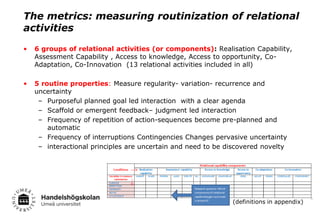
6 groups of relational activities (or components): Realisation Capability,
Assessment Capability , Access to knowledge, Access to opportunity, CoAdaptation, Co-Innovation (13 relational activities included in all)

•

5 routine properties: Measure regularity- variation- recurrence and
uncertainty
– Purposeful planned goal led interaction with a clear agenda
– Scaffold or emergent feedback– judgment led interaction
– Frequency of repetition of action-sequences become pre-planned and
automatic
– Frequency of interruptions Contingencies Changes pervasive uncertainty
– interactional principles are uncertain and need to be discovered novelty

(definitions in appendix)
Result

Relational capability
components
Realization capability
Assessment capability

No of
projects
10
16

Activities
MARKET
PRIOREX

No of
projects
9
14

Access to opportunity

9

ALIGN
IDEAS

11
9

Co-adaptation

9

ADJUST
DESIGN

3
8

Configurations
purpose*repetition*novel*situatedact
purpose*repetition*~interrupt*situatedact
purpose*repetition*~novel*situatedact
purpose*repetition*~interrupt*situatedact
purpose*repetition*~interrupt*~novel*sit
uatedact
purpose*repetition*~interrupt*situatedact

Consist
ency
1
1
1
1
1

Cover
age
0.44
0.78
0.71
0.72
0.66

1
1

0.75
0.5

Finding: three out of the six relational components (realization, access to
opportunity and assessment capability, whilst the co-adaptation component was
borderline) were routinized by four significantly repeatable activities (alignment of
interests, contact with key market people, prior experience and exchange of ideas) out
of the 13 mentioned in theory
Conclusion
•

The gap: we do not know which relational activities at the micro level get
routinized and become significant to build relational capabilities
– Routines have been difficult to measure since we did not have analytical
tools to find complicated combinations between activities

•

The question: which relational activities become routinized into relational
capabilities

•

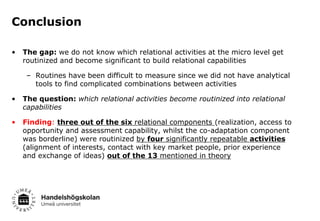
Finding: three out of the six relational components (realization, access to
opportunity and assessment capability, whilst the co-adaptation component
was borderline) were routinized by four significantly repeatable activities
(alignment of interests, contact with key market people, prior experience
and exchange of ideas) out of the 13 mentioned in theory
Conclusion
•

In contrast to prior studies, projects do not need long-term learning and
trust to develop relational routines into capabilities, but instead
these four activities were systematically planned within an expedient
turnaround of problem solving cycles, where they exchange ideas, exploit
market relations, adapt processes and co-design approaching tasks as
problems

•

If you have a large project with a diverse stakeholders you would benefit from
planning problem solving cycles where people focus on tasks as problems and
use alignment of interests, contact with key market people, prior experience and
exchange of ideas to exploit their interaction
Thank you
Any questions

Appendix
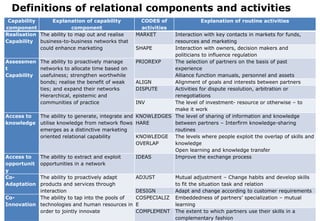
Definitions of relational components and activities
Capability
Explanation of capability
component
component
Realisation The ability to map out and realise
Capability
business-to-business networks that
could enhance marketing

CODES of
activities
MARKET

Explanation of routine activities

Interaction with key contacts in markets for funds,
resources and marketing
SHAPE
Interaction with owners, decision makers and
politicians to influence regulation
Assessmen The ability to proactively manage
PRIOREXP
The selection of partners on the basis of past
t
networks to allocate time based on
experience
Capability
usefulness; strengthen worthwhile
Alliance function manuals, personnel and assets
bonds; realise the benefit of weak
ALIGN
Alignment of goals and interests between partners
ties; and expand their networks
DISPUTE
Activities for dispute resolution, arbitration or
Hierarchical, epistemic and
renegotiations
communities of practice
INV
The level of investment- resource or otherwise – to
make it work
Access to
The ability to generate, integrate and KNOWLEDGES The level of sharing of information and knowledge
knowledge utilise knowledge from network flows HARE
between partners – Interfirm knowledge-sharing
emerges as a distinctive marketing
routines
oriented relational capability
KNOWLEDGE The levels where people exploit the overlap of skills and
OVERLAP
knowledge
Open learning and knowledge transfer
Access to
The ability to extract and exploit
IDEAS
Improve the exchange process
opportunit opportunities in a network
y
CoThe ability to proactively adapt
ADJUST
Mutual adjustment – Change habits and develop skills
Adaptation products and services through
to fit the situation task and relation
interaction
DESIGN
Adapt and change according to customer requirements
CoThe ability to tap into the pools of
COSPECIALIZ Embeddedness of partners’ specialization – mutual
Innovation technologies and human resources in E
learning
order to jointly innovate
COMPLEMENT The extent to which partners use their skills in a
complementary fashion

Relational capabilities in projects egos2013

  • 1.
    Relational Capabilities inProjects Maria Kapsali Umeå School of Business and Economics
  • 2.
    What is aRelational Capability • Relational capabilities (the set of routines that support exchange and interaction) • They are the basis for other project capabilities (e.g. learning, knowledge management, product development) • Depend on the routinization of relational activities (formal, informal communication, negotiation, exchange of ideas, aligning interests etc. more on appendix)
  • 3.
    The problem • The gap:we do not know which relational activities at the micro level get routinized and become significant to build relational capabilities – Routines have been difficult to measure since we did not have analytical tools to find complicated combinations of activities • The question: which relational activities become routinized into relational capabilities • The contribution: This study shows how empirical research using qualitative comparative analysis can measure systematic and valid patterns of routines at the micro level, an area of research that is significantly weak in both the strategy and the project literatures. The identification and explanation of routine formation will enhance the theoretical conceptualization of capabilities and explain their use in the practice of project management.
  • 4.
    What we know • Mainthemes in previous studies: learning, network ties, trust, culture, participation-dominance, consent-negotiation, network characteristics, stability, reflexivity and hierarchy – Relationships are important to develop project capabilities (learning and knowledge) – Relational competence and interaction processes in intra or interorganizational relationships, client-contractor relations, learning processes and stakeholder interaction – Intra-organizational networks focus on supply relations to create a competitive advantage (more embedded less ephemeral) – Inter-organizational networks show how projects become relational ‘bridges’ across networks of organizations (lack a hierarchical structure and activities span across boundaries and rely on trust and opportunism) – Weak ties in projects rely on segment pools and the exercise of controlled redundancy
  • 5.
    The method • QualitativeComparative Analysis (QCA) is a configurational set theoretic method to measure the combination of activities within relational routines that is significant • Used in strategic management research to explain the complex interdependencies between industrial, corporate and business-unit attributes that underlie business performance (Greckhamer et al., 2008) • QCA is used here to investigate which (combinations of ) relational activities are significantly routinized to become relational capabilities • 17 multiple cases, based on healthcare innovation consortium projects funded by the EU FP program, based on interviews with project managers and participants, project reports and evaluations
  • 6.
    The metrics: measuringroutinization of relational activities • 6 groups of relational activities (or components): Realisation Capability, Assessment Capability , Access to knowledge, Access to opportunity, CoAdaptation, Co-Innovation (13 relational activities included in all) • 5 routine properties: Measure regularity- variation- recurrence and uncertainty – Purposeful planned goal led interaction with a clear agenda – Scaffold or emergent feedback– judgment led interaction – Frequency of repetition of action-sequences become pre-planned and automatic – Frequency of interruptions Contingencies Changes pervasive uncertainty – interactional principles are uncertain and need to be discovered novelty (definitions in appendix)
  • 7.
    Result Relational capability components Realization capability Assessmentcapability No of projects 10 16 Activities MARKET PRIOREX No of projects 9 14 Access to opportunity 9 ALIGN IDEAS 11 9 Co-adaptation 9 ADJUST DESIGN 3 8 Configurations purpose*repetition*novel*situatedact purpose*repetition*~interrupt*situatedact purpose*repetition*~novel*situatedact purpose*repetition*~interrupt*situatedact purpose*repetition*~interrupt*~novel*sit uatedact purpose*repetition*~interrupt*situatedact purpose*repetition*~interrupt*situatedact Consist ency 1 1 1 1 1 Cover age 0.44 0.78 0.71 0.72 0.66 1 1 0.75 0.5 Finding: three out of the six relational components (realization, access to opportunity and assessment capability, whilst the co-adaptation component was borderline) were routinized by four significantly repeatable activities (alignment of interests, contact with key market people, prior experience and exchange of ideas) out of the 13 mentioned in theory
  • 8.
    Conclusion • The gap: wedo not know which relational activities at the micro level get routinized and become significant to build relational capabilities – Routines have been difficult to measure since we did not have analytical tools to find complicated combinations between activities • The question: which relational activities become routinized into relational capabilities • Finding: three out of the six relational components (realization, access to opportunity and assessment capability, whilst the co-adaptation component was borderline) were routinized by four significantly repeatable activities (alignment of interests, contact with key market people, prior experience and exchange of ideas) out of the 13 mentioned in theory
  • 9.
    Conclusion • In contrast toprior studies, projects do not need long-term learning and trust to develop relational routines into capabilities, but instead these four activities were systematically planned within an expedient turnaround of problem solving cycles, where they exchange ideas, exploit market relations, adapt processes and co-design approaching tasks as problems • If you have a large project with a diverse stakeholders you would benefit from planning problem solving cycles where people focus on tasks as problems and use alignment of interests, contact with key market people, prior experience and exchange of ideas to exploit their interaction
  • 10.
  • 11.
    Definitions of relationalcomponents and activities Capability Explanation of capability component component Realisation The ability to map out and realise Capability business-to-business networks that could enhance marketing CODES of activities MARKET Explanation of routine activities Interaction with key contacts in markets for funds, resources and marketing SHAPE Interaction with owners, decision makers and politicians to influence regulation Assessmen The ability to proactively manage PRIOREXP The selection of partners on the basis of past t networks to allocate time based on experience Capability usefulness; strengthen worthwhile Alliance function manuals, personnel and assets bonds; realise the benefit of weak ALIGN Alignment of goals and interests between partners ties; and expand their networks DISPUTE Activities for dispute resolution, arbitration or Hierarchical, epistemic and renegotiations communities of practice INV The level of investment- resource or otherwise – to make it work Access to The ability to generate, integrate and KNOWLEDGES The level of sharing of information and knowledge knowledge utilise knowledge from network flows HARE between partners – Interfirm knowledge-sharing emerges as a distinctive marketing routines oriented relational capability KNOWLEDGE The levels where people exploit the overlap of skills and OVERLAP knowledge Open learning and knowledge transfer Access to The ability to extract and exploit IDEAS Improve the exchange process opportunit opportunities in a network y CoThe ability to proactively adapt ADJUST Mutual adjustment – Change habits and develop skills Adaptation products and services through to fit the situation task and relation interaction DESIGN Adapt and change according to customer requirements CoThe ability to tap into the pools of COSPECIALIZ Embeddedness of partners’ specialization – mutual Innovation technologies and human resources in E learning order to jointly innovate COMPLEMENT The extent to which partners use their skills in a complementary fashion