REL404 Exploring Faith
Introduction to the Old Testament
             Session 2
         Dr Clint Heacock
      www.preachersforum.org
Learning Outcomes

1.Explore various critical views
  of biblical studies.
2.Understand the aims behind
  these various methods.
3.Evaluate them for your own
  studies and preaching where
  and when appropriate.
What are you attempting to
 accomplish when you read the
 Bible?
• Does the answer to that
 question change if you are
 reading the Bible for...
 • the preparation of a sermon?
 • devotional reading for
   yourself?
 • preparing to teach it to a
   class?
 • writing an exegesis of a
   passage?
Bible Study Methods
•What is meant by the term
‘hermeneutics’?
•“Hermeneutics explores how we
read, understand, and handle
texts, especially those written
in another time or in a context
of life different than our own.
•Biblical hermeneutics
investigates more specifically
how we read, understand, apply,
and respond to biblical texts.”
(Thiselton, Hermeneutics: An Introduction, 1).
• Should hermeneutics be thought
 of as applying rigid ‘rules of
 interpretation’ to the Bible?
• What does this notion of
 ‘rules’ do for those
 Christians who are committed
 to a notion of an inerrant
 text, yet who admit that
 biblical authors (and
 Christian interpreters!) are
 fallible humans?
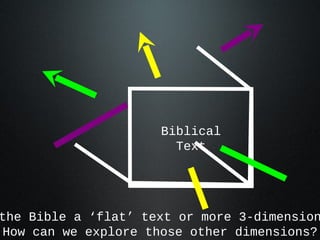
Biblical
                       Text


the Bible a ‘flat’ text or more 3-dimension
How can we explore those other dimensions?
Historical Criticism
• What is meant by the term
 ‘historical biblical
 criticism’?
• Should we approach historical
 criticism as a negative or a
 positive?
• We will briefly examine 3
 types of historical criticism:
 form, source and redaction
 criticism.
•
       Form Criticism the
    Form criticism is associated with
    German scholar Hermann Gunkel (1862-
    1932).

• Gunkel sought to analyze biblical
    literary forms in order to rediscover
    the history of their development.

• It explores how the various stories from
    eyewitness (oral) accounts were passed
    on and shaped in the time period prior
    to when the books were committed to
    writing.

• Each literary type or genre emerges from
    a specific setting in the life of a
    people (Sitz Im Leben).
• Appeared in the 17-18th centuries
  Source Criticism
  when scholars began reading the
  Bible from an Enlightenment (more
  secular) perspective.

• Alleged contradictions,
  repetitions, doublets and apparent
  changes in the text were explained
  by the presence of written sources
  that lay behind--and pre-dated--the
  OT texts.

• This discipline seeks to
  reconstruct the historical context
  of the written sources used by OT
  authors, as well as tracing the
  history of ancient Israel and its
Redaction Criticism
• Served as a needed corrective to
  some of the imbalances and
  speculations of form criticism.

• Explores the theology and values of
  the actual writer/editors as they
  put their own unique account
  together utilizing both written and
  oral sources in the editing
  process.

• Seeks to understand how and why the
  biblical authors/editors put the
  final text together in the ways
  they did, and treats them as
Newer Approaches
• Narrative Criticism
• Rhetorical Criticism
• Reader-Response Criticism
• Feminist Criticism
• Marxist Criticism
• Post-Colonial Readings
• Etc.
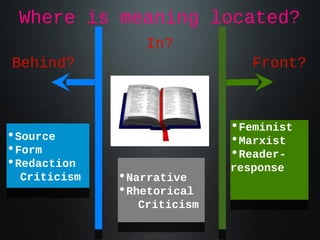
Where is meaning located?
                  In?
Behind?                         Front?


                             •Feminist
•Source                      •Feminist
                             •Marxist
•Source
•Form                        •Marxist
•Form                        •Reader-
•Redaction                   •Reader-
                             response
•Redaction
  Criticism   •Narrative     response
 Criticism    •Narrative
              •Rhetorical
              •Rhetorical
                 Criticism
                Criticism
• The history of Ezekiel studies roughly
    Ezekiel Studies
  correlates to these three possible
  ‘worlds of meaning.’

• Pre-and turn of the century, the book
  was read uncritically as ‘the product of
  a single mind’: Ezekiel the prophet.

• Turn of the century to the mid-1950s,
  scholars applied increasingly radical
  historical criticism to the text of
  Ezekiel (behind the text).

• Post 1950s-present has resulted in a
  more balanced view: while not
  discounting its various sources,
  scholars are viewing the text as a
  literary unity and also are exploring
  the dynamics between the text and the
Reflection
1.How does this information
  impact the ways in which you
  view and read Scripture?
2.Does this information change
  your perspective on the
  ‘single author’ view of OT
  texts?
3.What does the potential impact
  of differing critical methods
  have on your preaching of OT
  texts?

REL404 Exploring Faith Session 2: Biblical Critical Methods

  • 1.
    REL404 Exploring Faith Introductionto the Old Testament Session 2 Dr Clint Heacock www.preachersforum.org
  • 2.
    Learning Outcomes 1.Explore variouscritical views of biblical studies. 2.Understand the aims behind these various methods. 3.Evaluate them for your own studies and preaching where and when appropriate.
  • 3.
    What are youattempting to accomplish when you read the Bible? • Does the answer to that question change if you are reading the Bible for... • the preparation of a sermon? • devotional reading for yourself? • preparing to teach it to a class? • writing an exegesis of a passage?
  • 4.
    Bible Study Methods •Whatis meant by the term ‘hermeneutics’? •“Hermeneutics explores how we read, understand, and handle texts, especially those written in another time or in a context of life different than our own. •Biblical hermeneutics investigates more specifically how we read, understand, apply, and respond to biblical texts.” (Thiselton, Hermeneutics: An Introduction, 1).
  • 5.
    • Should hermeneuticsbe thought of as applying rigid ‘rules of interpretation’ to the Bible? • What does this notion of ‘rules’ do for those Christians who are committed to a notion of an inerrant text, yet who admit that biblical authors (and Christian interpreters!) are fallible humans?
  • 6.
    Biblical Text the Bible a ‘flat’ text or more 3-dimension How can we explore those other dimensions?
  • 7.
    Historical Criticism • Whatis meant by the term ‘historical biblical criticism’? • Should we approach historical criticism as a negative or a positive? • We will briefly examine 3 types of historical criticism: form, source and redaction criticism.
  • 8.
    Form Criticism the Form criticism is associated with German scholar Hermann Gunkel (1862- 1932). • Gunkel sought to analyze biblical literary forms in order to rediscover the history of their development. • It explores how the various stories from eyewitness (oral) accounts were passed on and shaped in the time period prior to when the books were committed to writing. • Each literary type or genre emerges from a specific setting in the life of a people (Sitz Im Leben).
  • 9.
    • Appeared inthe 17-18th centuries Source Criticism when scholars began reading the Bible from an Enlightenment (more secular) perspective. • Alleged contradictions, repetitions, doublets and apparent changes in the text were explained by the presence of written sources that lay behind--and pre-dated--the OT texts. • This discipline seeks to reconstruct the historical context of the written sources used by OT authors, as well as tracing the history of ancient Israel and its
  • 10.
    Redaction Criticism • Servedas a needed corrective to some of the imbalances and speculations of form criticism. • Explores the theology and values of the actual writer/editors as they put their own unique account together utilizing both written and oral sources in the editing process. • Seeks to understand how and why the biblical authors/editors put the final text together in the ways they did, and treats them as
  • 11.
    Newer Approaches • NarrativeCriticism • Rhetorical Criticism • Reader-Response Criticism • Feminist Criticism • Marxist Criticism • Post-Colonial Readings • Etc.
  • 12.
    Where is meaninglocated? In? Behind? Front? •Feminist •Source •Feminist •Marxist •Source •Form •Marxist •Form •Reader- •Redaction •Reader- response •Redaction Criticism •Narrative response Criticism •Narrative •Rhetorical •Rhetorical Criticism Criticism
  • 13.
    • The historyof Ezekiel studies roughly Ezekiel Studies correlates to these three possible ‘worlds of meaning.’ • Pre-and turn of the century, the book was read uncritically as ‘the product of a single mind’: Ezekiel the prophet. • Turn of the century to the mid-1950s, scholars applied increasingly radical historical criticism to the text of Ezekiel (behind the text). • Post 1950s-present has resulted in a more balanced view: while not discounting its various sources, scholars are viewing the text as a literary unity and also are exploring the dynamics between the text and the
  • 14.
    Reflection 1.How does thisinformation impact the ways in which you view and read Scripture? 2.Does this information change your perspective on the ‘single author’ view of OT texts? 3.What does the potential impact of differing critical methods have on your preaching of OT texts?