REGULATORY REQUIREMENTS OF EU, MHRA,
TGA AND ROW COUNTRIES
Presented by – Himanshu singh baghel. Presented to – Hemanta Pathak sir
M.pharm 1st semester (Assistant professor)
Branch – Pharmaceutics Department of pharmaceutical
Date - Science
Content —
 Regulatory requirements of (EU) european union
 Regulatory requirements of MHRA
 Regulatory requirements of TGA
 Regulatory requirements of ROW Countries
European Union (EU) —
 A intergovermental political and economical union
comprises of 28 European countries which having single
internal market through the standardized system of laws.
 Established in 1992 under the name by the treaty of
European union (The maastricht treaty).
 European Medicines Agency (EMA) is a decentralized
agency of the European union.
 The European medicines regulatory system is based on a
network of around 50 regulatory authorities from the 30
EEA countries (27 EU Member States plus Iceland,
Liechtenstein and Norway), the European Commission and
EMA.
European Medicines Agency (EMA) –
–EMA is responsible for the scientific evaluation, primarily of
innovative and high-technology medicines developed by
pharmaceutical companies for use in the EU.
– EMA was established in 1995 to ensure the best use of
scientific resources across Europe for the evaluation,
supervision and pharmacovigilance of medicines
Market Authorization –
 To protect public health and ensure the availability of
high-quality, safe and effective medicines for European
citizens, all medicines must be authorised before they can
be placed on the market in the EU.
 The centralized procedure allows the marketing of a
medicine on the basis of a single EU-wide assessment and
marketing authorization which is valid throughout the EU.
 Pharmaceutical companies submit a single authorization
application to EMA.
 The Agency’s Committee for Medicinal Products for Human
Use (CHMP) or Committee for Veterinary Medicinal
Products (CVMP) then carries out a scientific assessment
of the application and gives a recommendation to the
European Commission on whether or not to grant a
marketing authorisation.
 Once granted by the European Commission, the
centralized marketing authorization is automatically valid
in all EU Member States.
 The use of the centralized procedure is compulsory for
most innovative medicines, including medicines for rare
diseases and advanced-therapy medicines.
 EMA enables one application, one assessment, one market
authorisation for the whole of the EU.
 Not all medicines authorized in the EU fall within the
scope of the centralized procedure, as most are
authorized by national competent authorities (NCAs) in
the Member States.
 Transparency about how the system works and how it reaches
its decisions is an important feature of the EU regulatory
system for medicines.
 A European Public Assessment Report, or EPAR, is published for
every human or veterinary medicine that has been granted or
refused a marketing authorization following an assessment by
EMA. For a medicine that is authorized by a Member State,
details on the assessment of the medicine are also available in
a Public Assessment Report. All EPARs are translated into all 24
official EU languages.
 EMA also publishes clinical data submitted by pharmaceutical
companies to support their regulatory applications for human
medicines under the centralized procedure
THE ROLE OF EMA
 EMA plays a important role in the regulation of medicines in the
EU. On the basis of scientific assessment carried out, it grants
or refuses, amends or suspends marketing authorisations for
medicines that have been submitted via the centralised
procedure.
 The European Commission can also take action concerning other
aspects of medicine regulation:
· Right of initiative – it can propose new or amended v.
Legislation for the pharmaceutical sector.
· Implementation – - it can adopt implementing measures as well
as oversee the correct application of EU law on pharmaceuticals
Guidelines and Scientific Advice
 EMA prepares scientific guidelines in cooperation with
experts from its scientific committees and working
groups, and in consultation with patients and healthcare
professionals.
 These guidelines reflect the latest thinking on
developments in biomedical science.
 They are available to guide the development programmes
of all medicine developers who wish to submit an
application for a marketing authorisation in the EU, and to
ensure that medicines are developed consistently and to
the highest quality
AUTHORISATION AND SUPERVISION OF
MANUFACTURERS
 Manufacturers, importers and distributors of medicines in the
EU must be licensed before they can carry out medicine-related
activities.
 The regulatory authorities of each Member State are
responsible for granting licences for such activities taking place
within their respective territories.
 All manufacturing and importing licenses are entered into
EudraGMDP, the publicly-available European database operated
by EMA.
 Manufacturers listed in the application of a medicine to be
marketed in the EU are inspected by an EU competent authority
 In order to be imported into the EU, an active
pharmaceutical ingredient needs to be accompanied by a
Written Confirmation issued by the competent authority
of the country where it is produced, confirming that the
good manufacturing practice (GMP) applied is at least
equivalent to the recognized EU GMP standards.
 Every batch of medicines must be certified as having been
manufactured and tested in accordance with GMP and in
conformance with the marketing authorization before it
can be released onto the market in the EU.
SAFETY MONITORING OF MEDICINES
 The European regulatory system for medicines monitors
the safety of all medicines that are available on the
European market throughout their life span.
 All suspected side effects that are reported by patients
and healthcare professionals must be entered into
EudraVigilance, the EU database operated by EMA to
collect, manage and analyze reports of suspected side
effects of medicines.
 These data are continuously monitored by EMA and the
Member States in order to identify any new safety
information.
Regulatory Requirement Of MHRA —
 Medicines and Healthcare Products Regulatory Agency is a
executive agency of the department of health of United
Kingdom.
 MHRA was setup in April, 2003 bringing together the
function of medicines control agency (MCA) and medical
devices agency (MDA).
 MHRA is responsible for ensuring that medicines and
medical devices work, and are acceptably safe.
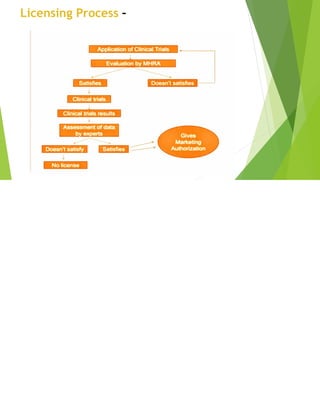
Licensing Process –
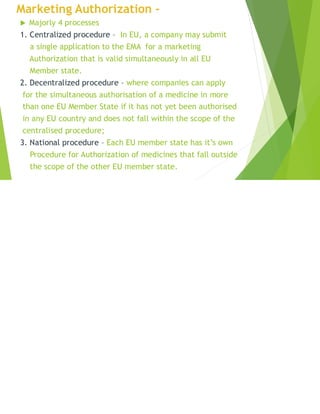
Marketing Authorization –
 Majorly 4 processes
1. Centralized procedure – In EU, a company may submit
a single application to the EMA for a marketing
Authorization that is valid simultaneously in all EU
Member state.
2. Decentralized procedure – where companies can apply
for the simultaneous authorisation of a medicine in more
than one EU Member State if it has not yet been authorised
in any EU country and does not fall within the scope of the
centralised procedure;
3. National procedure – Each EU member state has it’s own
Procedure for Authorization of medicines that fall outside
the scope of the other EU member state.
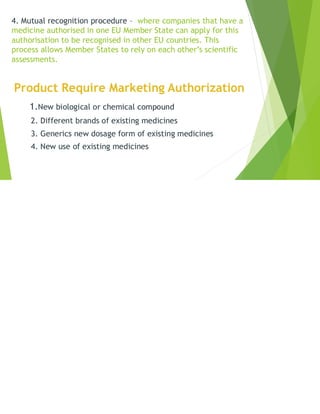
4. Mutual recognition procedure – where companies that have a
medicine authorised in one EU Member State can apply for this
authorisation to be recognised in other EU countries. This
process allows Member States to rely on each other’s scientific
assessments.
Product Require Marketing Authorization
1.New biological or chemical compound
2. Different brands of existing medicines
3. Generics new dosage form of existing medicines
4. New use of existing medicines
Renewal of License –
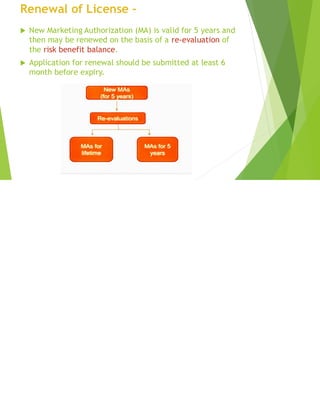
 New Marketing Authorization (MA) is valid for 5 years and
then may be renewed on the basis of a re-evaluation of
the risk benefit balance.
 Application for renewal should be submitted at least 6
month before expiry.
Regulatory Requirement Of TGA —
 The Therapeutic Goods Administration (TGA) is the
regulatory authority for therapeutic goods in Australia. It
ensures that medicines, medical devices, and other
therapeutic products meet appropriate standards of
quality, safety, and efficacy before they can be made
available to the public.
key regulatory requirements of the TGA:
1. Registration of Products:
Medicines : Prescription medicines, over-the-counter
(OTC) medicines, and complementary medicines must be
evaluated and registered on the Australian Register of
Therapeutic Goods (ARTG) before being marketed
Medical Devices : All medical devices must also be included
in the ARTG before they can be legally supplied in Australia.
They are classified according to the risk level, from Class I
(low risk) to Class III (high risk).
ARTH is a computer database of information about
therapeutic good for human use approved for supply in , or
export from Australia.
2. Clinical Evidence and Trials : Before approval, the TGA
requires clinical evidence to demonstrate the safety, quality,
and efficacy of a product. This may involve reviewing data
from clinical trials, which must be conducted in accordance
with Good Clinical Practice (GCP).
For new or high-risk products, clinical trials need to be
registered with the TGA before they can be initiated in
Australia.
3. Pre-Marketing assessment :
– Product assessed as having a high level of risk are
Evaluated for quality, safety and efficacy.
– once approved for marketing in Australia these products
Are included in ARTG as registered product and are
Identified by an AUSTR number.
– Once approved for marketing in Australia these products
Are included in ARTG as listed product and are identified
by an AUSTL number.
– In assessing the level of risk, factors are to be considered
Such as : Strength of product, side effect, Toxicity,
Potential harm through prolong use.
4. Post-Market Surveillance :
After a product is available on the market, the TGA monitors its
safety through adverse event reporting and risk management
programs.
Manufacturers and sponsors are required to report adverse events
and conduct post-market studies if needed.
5. Good Manufacturing Practice (GMP):
Manufacturers of therapeutic goods must comply with GMP
standards. This ensures that products are consistently produced
and controlled according to quality standards.
TGA conducts inspections and audits of manufacturing facilities to
ensure compliance with GMP
.
6. Licensing and audit of manufacturer :
Each Australian manufacturer of medicinal product for human
Use to hold a manufacturing license. License holder are require
to comply with the manufacturing principles of the act,
Including compliance with GMP.
Regulatory Requirement of Row
Countries –
 ROW countries means a country which is not included
in the major market countries. “ROW” mean all of the
non-major market countries
 ROW = REST OF THE WORLD
 ROW countries typically exclude major market
countries like USA, CANADA, EUROPE, AUSTRALIA,
JAPAN.
Registration Requirement For ROW -
 Administrative Documents :
- certification of pharmaceutical product
- Product permission
- Manufacturing license
- WHO-GMP certificate
- Free sale certificate/Export certificate
- Art work (cartoon, label and package leaflet)
API Drug master file (DMF) :
- Nomenclature
- General properties
- Name of manufacturer and site of manufacture
- Route of synthesis
- structure elucidation
- Impurities
- container closure system
Market Authorization -
 Most countries require market authorization from their
local regulatory bodies before pharmaceutical products
can be sold.
 This often includes the submission of clinical data, quality
testing, and manufacturing processes.
WHO Prequalification –
Some ROW countries may follow the World Health
Organization's prequalification program, especially for
vaccines and essential medicines.
Local Clinical Trials:
 Many ROW countries may require local clinical trials to
validate safety and efficacy data for their populations.
This can be time-consuming and costly.
References :
1. https://www.tga.gov.au/tga-regulatory-framework
2. https://ecpc.org
3. https://pharma–iq.com
4. https://www.europa.eu.com