Regression
Michael
2016/12/16
This is a sample file for regression analysis from CSDN.
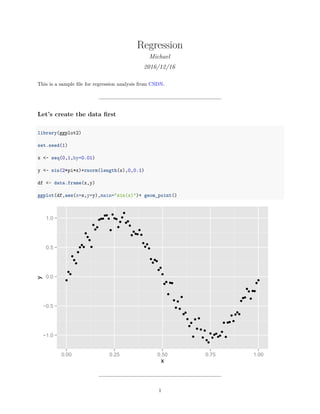
Let’s create the data first
library(ggplot2)
set.seed(1)
x <- seq(0,1,by=0.01)
y <- sin(2*pi*x)+rnorm(length(x),0,0.1)
df <- data.frame(x,y)
ggplot(df,aes(x=x,y=y),main="sin(x)")+ geom_point()
−1.0
−0.5
0.0
0.5
1.0
0.00 0.25 0.50 0.75 1.00
x
y
1
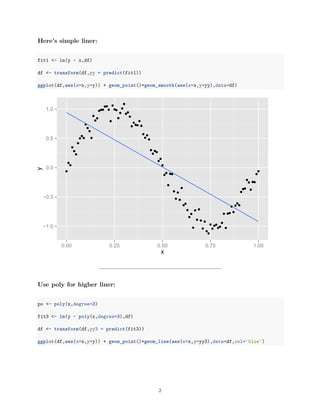
Here’s simple liner:
fit1 <- lm(y ~ x,df)
df <- transform(df,yy = predict(fit1))
ggplot(df,aes(x=x,y=y)) + geom_point()+geom_smooth(aes(x=x,y=yy),data=df)
−1.0
−0.5
0.0
0.5
1.0
0.00 0.25 0.50 0.75 1.00
x
y
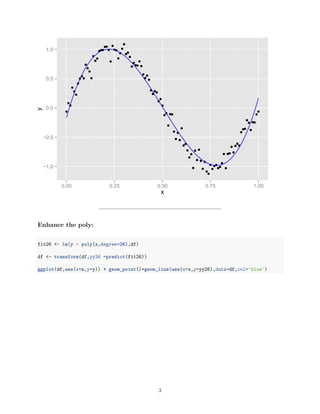
Use poly for higher liner:
po <- poly(x,degree=3)
fit3 <- lm(y ~ poly(x,degree=3),df)
df <- transform(df,yy3 = predict(fit3))
ggplot(df,aes(x=x,y=y)) + geom_point()+geom_line(aes(x=x,y=yy3),data=df,col='blue')
2
−1.0
−0.5
0.0
0.5
1.0
0.00 0.25 0.50 0.75 1.00
x
y
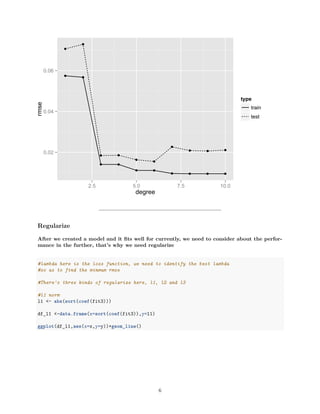
Enhance the poly:
fit26 <- lm(y ~ poly(x,degree=26),df)
df <- transform(df,yy26 =predict(fit26))
ggplot(df,aes(x=x,y=y)) + geom_point()+geom_line(aes(x=x,y=yy26),data=df,col='blue')
3
−1.0
−0.5
0.0
0.5
1.0
0.00 0.25 0.50 0.75 1.00
x
y
Higher poly doesn’t enjoy better performance, we use RMSE to cross-validation
model:
#Create rmse function:
rmse <- function(y,ry)
{
return(sqrt(sum((y-ry)^ 2))/length(ry))
}
#Create split function for cross-validation
split <- function(df,rate)
{
n <- length(df[,1])
index <- sample(1:n,round(rate * n))
train <- df[index,]
test <- df[-index,]
df <- list(train=train,test=test,data=df)
4
return(df)
}
#Create function to plot output
performance_Gen <- function(df,n){
performance <- data.frame()
for(index in 1:n){
fit <- lm(y ~ poly(x,degree=index),data = df$train)
performance <- rbind(performance,data.frame(degree =index,type='train',rmse=rmse(df$train['y'],predic
performance <- rbind(performance,data.frame(degree = index,type='test',rmse=rmse(df$test['y'],predict
}
return(performance)
}
Plot output about train & test dataset:
df_split <- split(df,0.5)
performance<- performance_Gen(df_split,10)
ggplot(performance,aes(x=degree,y=rmse,linetype=type))+geom_point()+geom_line()
5
0.02
0.04
0.06
2.5 5.0 7.5 10.0
degree
rmse
type
train
test
Regularize
After we created a model and it fits well for currently, we need to consider about the perfor-
mance in the further, that’s why we need regularize
#lambda here is the loss function, we need to identify the best lambda
#so as to find the minmum rmse
#There's three kinds of regularize here, l1, l2 and l3
#l1 norm
l1 <- abs(sort(coef(fit3)))
df_l1 <-data.frame(x=sort(coef(fit3)),y=l1)
ggplot(df_l1,aes(x=x,y=y))+geom_line()
6
0
2
4
−5.0 −2.5 0.0 2.5
x
y
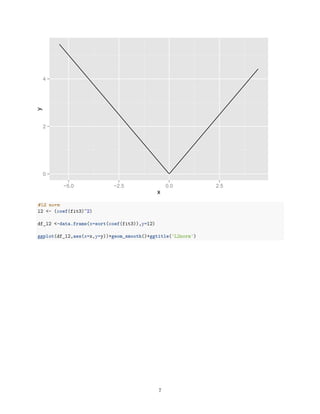
#l2 norm
l2 <- (coef(fit3)^2)
df_l2 <-data.frame(x=sort(coef(fit3)),y=l2)
ggplot(df_l2,aes(x=x,y=y))+geom_smooth()+ggtitle('L2norm')
7
−200
−100
0
100
200
−5.0 −2.5 0.0 2.5
x
y L2norm
#Use cross-validation to find the best lambda
library(glmnet)
getperform <- function(df){
fit<- with(df$train,glmnet(poly(x,degree=10),y))
lambdas <- fit$lambda
performance <- data.frame()
for( lambda in lambdas){
performance <- rbind(performance,data.frame(
lambda=lambda,
rmse=rmse(df$test['y'],with(df$test,predict(fit,poly(x,degree=10),s=lambda)))))
}
return(performance)
}
8
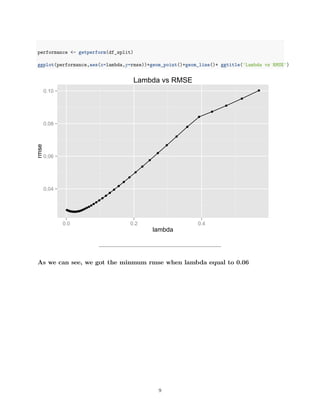
performance <- getperform(df_split)
ggplot(performance,aes(x=lambda,y=rmse))+geom_point()+geom_line()+ ggtitle('Lambda vs RMSE')
0.04
0.06
0.08
0.10
0.0 0.2 0.4
lambda
rmse
Lambda vs RMSE
As we can see, we got the minmum rmse when lambda equal to 0.06
9

Regression_Sample

  • 1.
    Regression Michael 2016/12/16 This is asample file for regression analysis from CSDN. Let’s create the data first library(ggplot2) set.seed(1) x <- seq(0,1,by=0.01) y <- sin(2*pi*x)+rnorm(length(x),0,0.1) df <- data.frame(x,y) ggplot(df,aes(x=x,y=y),main="sin(x)")+ geom_point() −1.0 −0.5 0.0 0.5 1.0 0.00 0.25 0.50 0.75 1.00 x y 1
  • 2.
    Here’s simple liner: fit1<- lm(y ~ x,df) df <- transform(df,yy = predict(fit1)) ggplot(df,aes(x=x,y=y)) + geom_point()+geom_smooth(aes(x=x,y=yy),data=df) −1.0 −0.5 0.0 0.5 1.0 0.00 0.25 0.50 0.75 1.00 x y Use poly for higher liner: po <- poly(x,degree=3) fit3 <- lm(y ~ poly(x,degree=3),df) df <- transform(df,yy3 = predict(fit3)) ggplot(df,aes(x=x,y=y)) + geom_point()+geom_line(aes(x=x,y=yy3),data=df,col='blue') 2
  • 3.
    −1.0 −0.5 0.0 0.5 1.0 0.00 0.25 0.500.75 1.00 x y Enhance the poly: fit26 <- lm(y ~ poly(x,degree=26),df) df <- transform(df,yy26 =predict(fit26)) ggplot(df,aes(x=x,y=y)) + geom_point()+geom_line(aes(x=x,y=yy26),data=df,col='blue') 3
  • 4.
    −1.0 −0.5 0.0 0.5 1.0 0.00 0.25 0.500.75 1.00 x y Higher poly doesn’t enjoy better performance, we use RMSE to cross-validation model: #Create rmse function: rmse <- function(y,ry) { return(sqrt(sum((y-ry)^ 2))/length(ry)) } #Create split function for cross-validation split <- function(df,rate) { n <- length(df[,1]) index <- sample(1:n,round(rate * n)) train <- df[index,] test <- df[-index,] df <- list(train=train,test=test,data=df) 4
  • 5.
    return(df) } #Create function toplot output performance_Gen <- function(df,n){ performance <- data.frame() for(index in 1:n){ fit <- lm(y ~ poly(x,degree=index),data = df$train) performance <- rbind(performance,data.frame(degree =index,type='train',rmse=rmse(df$train['y'],predic performance <- rbind(performance,data.frame(degree = index,type='test',rmse=rmse(df$test['y'],predict } return(performance) } Plot output about train & test dataset: df_split <- split(df,0.5) performance<- performance_Gen(df_split,10) ggplot(performance,aes(x=degree,y=rmse,linetype=type))+geom_point()+geom_line() 5
  • 6.
    0.02 0.04 0.06 2.5 5.0 7.510.0 degree rmse type train test Regularize After we created a model and it fits well for currently, we need to consider about the perfor- mance in the further, that’s why we need regularize #lambda here is the loss function, we need to identify the best lambda #so as to find the minmum rmse #There's three kinds of regularize here, l1, l2 and l3 #l1 norm l1 <- abs(sort(coef(fit3))) df_l1 <-data.frame(x=sort(coef(fit3)),y=l1) ggplot(df_l1,aes(x=x,y=y))+geom_line() 6
  • 7.
    0 2 4 −5.0 −2.5 0.02.5 x y #l2 norm l2 <- (coef(fit3)^2) df_l2 <-data.frame(x=sort(coef(fit3)),y=l2) ggplot(df_l2,aes(x=x,y=y))+geom_smooth()+ggtitle('L2norm') 7
  • 8.
    −200 −100 0 100 200 −5.0 −2.5 0.02.5 x y L2norm #Use cross-validation to find the best lambda library(glmnet) getperform <- function(df){ fit<- with(df$train,glmnet(poly(x,degree=10),y)) lambdas <- fit$lambda performance <- data.frame() for( lambda in lambdas){ performance <- rbind(performance,data.frame( lambda=lambda, rmse=rmse(df$test['y'],with(df$test,predict(fit,poly(x,degree=10),s=lambda))))) } return(performance) } 8
  • 9.
    performance <- getperform(df_split) ggplot(performance,aes(x=lambda,y=rmse))+geom_point()+geom_line()+ggtitle('Lambda vs RMSE') 0.04 0.06 0.08 0.10 0.0 0.2 0.4 lambda rmse Lambda vs RMSE As we can see, we got the minmum rmse when lambda equal to 0.06 9