REGIONAL
ANESTHESIA
Dr. Ali Mujtaba
(Resident Urology)
Department of Urology
SIUT , Karachi
What are local anesthetics?
Local anesthetic: produce loss of sensation to pain in a specific
area of the body without the loss of consciousness.
• In 1884, Carl Koller used the first local anesthetic on a
patient with glaucoma.
• “Koller” became addicted to the drug through self-
experimentation.
Local anesthetics - Mechanism
Limit influx of sodium, thereby limiting propagation of the
action potential.
Mechanism
• Local anesthetics block the conduction in peripheral nerves, that
inhibited the nerve to excite.
• The anesthetics reversibley binds to sodium channels and
inactivates the sodium channels.
• As a result, the nerve loses depolarization and the capacity to create
the impulse, the patient loses sensation in the area supplied by the
nerve.
Classes of Local Anaesthetics
Two classes of local anaesthetics are
 Amino amides
 Amino esters
Esters:--Metabolized in plasma
Amides:--Metabolized in liver
Classes Of Local Anaesthetics
Esters
Cocaine , Chloroprocaine , Procaine, Tetracai
Amides (Am”i”des…Rule of “i’s”)
Bupivacaine , Lidocaine, Ropivacaine, Mepivacaine
DOSE AND DURATION
Differences of Esters and Amides
All local anaesthetics are weak bases.
Chemical structure of local anaesthetics have an amine group on
one end & an aromatic ring on the other.
The amine end is hydrophilic (soluble in water),
 and the aromatic end is lipophilic (soluble in lipids)
Lidocaine
 In 1940, the first modern local anaesthetic agent was lidocaine, trade
name Xylocaine
 cause little allergic reaction.
 Sets on quickly and produces a desired anaesthesia effect for several
hours
 It’s accepted broadly as the local anaesthetic in United States &
worldwide today.
Procaine replaced cocaine
Procaine is the first derivative of cocaine, also known as the
first synthetic local anaesthetic drug
Trade name is Novocaine®
Local anaesthetics - Formulation
LA are administered as very dilute solutions which can be
expressed as parts of active drug per 100 parts of solution (grams
percent)
Ex.: 2% solution =
_2 grams = _2000 mg_ = 20 mg
100 cc’s 100 cc’s 1 cc
Factors Affect the Reaction of Local
Anaesthetics
Lipid solubility
Increasing the lipid solubility leads to faster nerve penetration,
block sodium channels, and speed up the onset of action.
pH influence
Usually at range 7.6 – 8.9
Lower pH, solution more acidic, gives slower onset of action.
Vasoconstrictors
Vasoconstrictor is a substance used to keep the anaesthetic
solution in place at a longer period and prolongs the action of
the drug
Local Anaesthetics -Vasoconstrictors
 Vasoconstrictors should NOT be used in the following
locations
Fingers
Toes
Nose
Ear lobes
Penis
The amount of dose also varied based on the type of solution used
and the presence of vasoconstrictor
Maximum dose for an individual is usually between 70mg to
500mg(lidocaine 4-7 mg/kg & bupivacaine 2-3mg/kg)
Toxicity
Some common toxic effects:
Light headedness
Shivering or twitching
Seizures
Hypotension (low blood pressure)
Numbness
Tinnitus
Local Anaesthetics - Allergy
True allergy is very rare
Most reactions are from ester class
Patient reports of “allergy” are frequently due to
previous intravascular injections
Tissue toxicity
• Tissue toxicity is Rare
• Can occur if administered in high enough concentrations
(greater than those used clinically)
• Usually related to preservatives added to solution
Local Anaesthetics - Duration
Determined by rate of elimination of agent from site injected
Factors include lipid solubility, dose given, blood flow at site,
addition of vasoconstrictors (does not reliably prolong all agents)
Some techniques allow multiple injections over time to
increase duration, e.g. epidural catheter
REGIONAL
ANESTHESIA
Regional anesthesia
Rendering a specific area of the body.
e.g. foot, arm, lower extremities
Regional anesthesia - Uses
 Provide anesthesia for a surgical procedure
 Provide analgesia post-operatively or during labor and delivery
 Diagnosis or therapy for patients with chronic pain syndromes
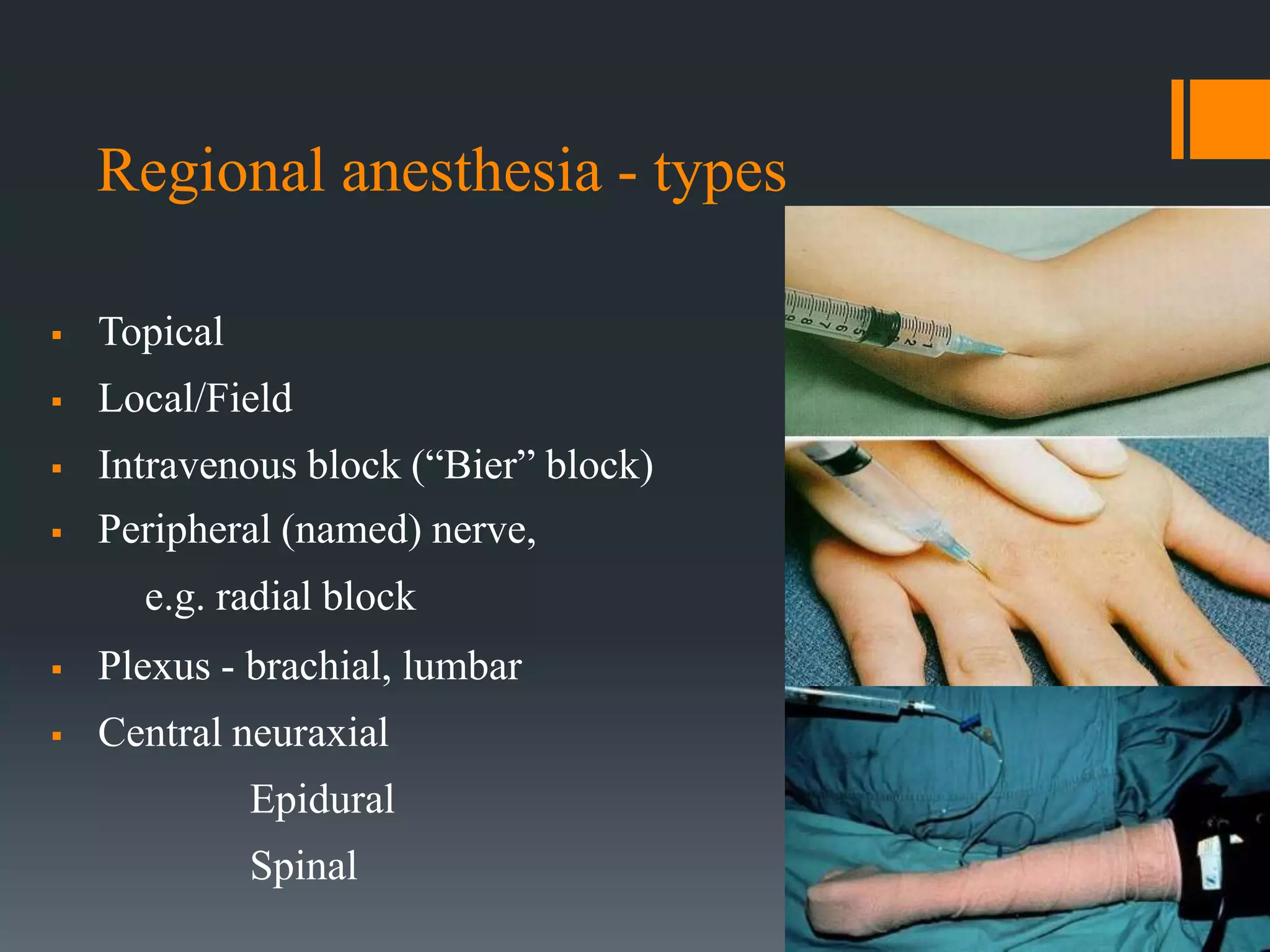
Regional anesthesia - types
 Topical
 Local/Field
 Intravenous block (“Bier” block)
 Peripheral (named) nerve,
e.g. radial block
 Plexus - brachial, lumbar
 Central neuraxial
Epidural
Spinal
Complications Of Local Anaesthesia
Local Complications
Needle Breakage
Soft Tissue Injury
Hematoma
Infection
Paraesthesia
Nerve Paralysis
Pain on Injection
Systemic Complications
Overdose
Allergy
Overdose
Overdose reaction is occurring when the drug access to
the circulatorysystem.
Normally there is constant absorption of the drug from
its site of admission into the circulatory system and a
steady removal from the blood by the liver.
Prevention
Use aspirationsyringe.
Use appropriate size needle (25gauge).
Aspirate in at least two planes before injection.
Slowly injectthe drug.
Clinical Manifestation
Sweating , Talkativeness ,Vomiting
Apprehension, Failure to follow commands , Excitability
Elevated blood pressure, heart and respiratory rate
Slurred speech
Tonic-clonic seizure in highly overdose
CNS depression
Cardiac arrest
Management
Reassure the patient.
Basic Emergency Management i.e. ABC
Administer oxygen
Monitor and record vital signs
IV anticonvulsants (diazepam 5 mgmin. or midazolam 1
mmin.)
Vasopressor and IV fluid is recommended for
management of hypotension.
Allergy
Clinical Manifestation
1. Dermatological reaction
Angioedema
Urticaria
2. Respiratory reactions
Bronchospasm
Laryngeal edema
3. Generalized Anaphylaxis
 Skin reactions
 Smooth muscle spasm (gastrointestinal, genitourinary tracts
and bronchospasm)
 Respiratory distress.
 Cardiovascular collapse.
Treatment of the entire reaction maybe terminated rapidly,
but hypotension and laryngeal edema maypersist for hours
to days.
Management
Skin reaction:
Oral/ IV histamine blocker
Observation for 1hour
Medical consultation
Epinpherine 0.3 mg IM.
Respiratory reaction:
(Bronchospasm)
Administer oxygen at flow 5-6 litersmin
Epinpherine 0.3 IM or Bronchodilator “albuterol”
Observation for 1 hour.
IV histamine blocker
Medical consultation
Generalized Anaphylaxis :
(unconscious patient)
 Administer oxygen
 Monitor vital signs, recorded every 5 min
 Summon medical assistance
 Epinpherine 0.3 IM, dose repeated 10-15 min
 IV histamine blocker
 Corticosteroid IM or IV
Regional anesthesia by Dr. Ali Mujtaba

Regional anesthesia by Dr. Ali Mujtaba

  • 1.
    REGIONAL ANESTHESIA Dr. Ali Mujtaba (ResidentUrology) Department of Urology SIUT , Karachi
  • 2.
    What are localanesthetics? Local anesthetic: produce loss of sensation to pain in a specific area of the body without the loss of consciousness.
  • 3.
    • In 1884,Carl Koller used the first local anesthetic on a patient with glaucoma. • “Koller” became addicted to the drug through self- experimentation.
  • 4.
    Local anesthetics -Mechanism Limit influx of sodium, thereby limiting propagation of the action potential.
  • 5.
    Mechanism • Local anestheticsblock the conduction in peripheral nerves, that inhibited the nerve to excite. • The anesthetics reversibley binds to sodium channels and inactivates the sodium channels. • As a result, the nerve loses depolarization and the capacity to create the impulse, the patient loses sensation in the area supplied by the nerve.
  • 6.
    Classes of LocalAnaesthetics Two classes of local anaesthetics are  Amino amides  Amino esters Esters:--Metabolized in plasma Amides:--Metabolized in liver
  • 7.
    Classes Of LocalAnaesthetics Esters Cocaine , Chloroprocaine , Procaine, Tetracai Amides (Am”i”des…Rule of “i’s”) Bupivacaine , Lidocaine, Ropivacaine, Mepivacaine
  • 8.
  • 9.
    Differences of Estersand Amides All local anaesthetics are weak bases. Chemical structure of local anaesthetics have an amine group on one end & an aromatic ring on the other. The amine end is hydrophilic (soluble in water),  and the aromatic end is lipophilic (soluble in lipids)
  • 10.
    Lidocaine  In 1940,the first modern local anaesthetic agent was lidocaine, trade name Xylocaine  cause little allergic reaction.  Sets on quickly and produces a desired anaesthesia effect for several hours  It’s accepted broadly as the local anaesthetic in United States & worldwide today.
  • 11.
    Procaine replaced cocaine Procaineis the first derivative of cocaine, also known as the first synthetic local anaesthetic drug Trade name is Novocaine®
  • 12.
    Local anaesthetics -Formulation LA are administered as very dilute solutions which can be expressed as parts of active drug per 100 parts of solution (grams percent) Ex.: 2% solution = _2 grams = _2000 mg_ = 20 mg 100 cc’s 100 cc’s 1 cc
  • 13.
    Factors Affect theReaction of Local Anaesthetics Lipid solubility Increasing the lipid solubility leads to faster nerve penetration, block sodium channels, and speed up the onset of action. pH influence Usually at range 7.6 – 8.9 Lower pH, solution more acidic, gives slower onset of action.
  • 14.
    Vasoconstrictors Vasoconstrictor is asubstance used to keep the anaesthetic solution in place at a longer period and prolongs the action of the drug
  • 15.
    Local Anaesthetics -Vasoconstrictors Vasoconstrictors should NOT be used in the following locations Fingers Toes Nose Ear lobes Penis
  • 16.
    The amount ofdose also varied based on the type of solution used and the presence of vasoconstrictor Maximum dose for an individual is usually between 70mg to 500mg(lidocaine 4-7 mg/kg & bupivacaine 2-3mg/kg)
  • 17.
    Toxicity Some common toxiceffects: Light headedness Shivering or twitching Seizures Hypotension (low blood pressure) Numbness Tinnitus
  • 18.
    Local Anaesthetics -Allergy True allergy is very rare Most reactions are from ester class Patient reports of “allergy” are frequently due to previous intravascular injections
  • 19.
    Tissue toxicity • Tissuetoxicity is Rare • Can occur if administered in high enough concentrations (greater than those used clinically) • Usually related to preservatives added to solution
  • 20.
    Local Anaesthetics -Duration Determined by rate of elimination of agent from site injected Factors include lipid solubility, dose given, blood flow at site, addition of vasoconstrictors (does not reliably prolong all agents) Some techniques allow multiple injections over time to increase duration, e.g. epidural catheter
  • 21.
  • 22.
    Regional anesthesia Rendering aspecific area of the body. e.g. foot, arm, lower extremities
  • 23.
    Regional anesthesia -Uses  Provide anesthesia for a surgical procedure  Provide analgesia post-operatively or during labor and delivery  Diagnosis or therapy for patients with chronic pain syndromes
  • 24.
    Regional anesthesia -types  Topical  Local/Field  Intravenous block (“Bier” block)  Peripheral (named) nerve, e.g. radial block  Plexus - brachial, lumbar  Central neuraxial Epidural Spinal
  • 25.
    Complications Of LocalAnaesthesia Local Complications Needle Breakage Soft Tissue Injury Hematoma Infection Paraesthesia Nerve Paralysis Pain on Injection
  • 26.
  • 27.
    Overdose Overdose reaction isoccurring when the drug access to the circulatorysystem. Normally there is constant absorption of the drug from its site of admission into the circulatory system and a steady removal from the blood by the liver.
  • 28.
    Prevention Use aspirationsyringe. Use appropriatesize needle (25gauge). Aspirate in at least two planes before injection. Slowly injectthe drug.
  • 29.
    Clinical Manifestation Sweating ,Talkativeness ,Vomiting Apprehension, Failure to follow commands , Excitability Elevated blood pressure, heart and respiratory rate Slurred speech Tonic-clonic seizure in highly overdose CNS depression Cardiac arrest
  • 30.
    Management Reassure the patient. BasicEmergency Management i.e. ABC Administer oxygen Monitor and record vital signs IV anticonvulsants (diazepam 5 mgmin. or midazolam 1 mmin.) Vasopressor and IV fluid is recommended for management of hypotension.
  • 31.
    Allergy Clinical Manifestation 1. Dermatologicalreaction Angioedema Urticaria 2. Respiratory reactions Bronchospasm Laryngeal edema
  • 32.
    3. Generalized Anaphylaxis Skin reactions  Smooth muscle spasm (gastrointestinal, genitourinary tracts and bronchospasm)  Respiratory distress.  Cardiovascular collapse. Treatment of the entire reaction maybe terminated rapidly, but hypotension and laryngeal edema maypersist for hours to days.
  • 33.
    Management Skin reaction: Oral/ IVhistamine blocker Observation for 1hour Medical consultation Epinpherine 0.3 mg IM.
  • 34.
    Respiratory reaction: (Bronchospasm) Administer oxygenat flow 5-6 litersmin Epinpherine 0.3 IM or Bronchodilator “albuterol” Observation for 1 hour. IV histamine blocker Medical consultation
  • 35.
    Generalized Anaphylaxis : (unconsciouspatient)  Administer oxygen  Monitor vital signs, recorded every 5 min  Summon medical assistance  Epinpherine 0.3 IM, dose repeated 10-15 min  IV histamine blocker  Corticosteroid IM or IV