CONTEMPORARY
PHILIPPINE ART FROM THE
REGIONS
GROUP 5 – ST.
MAXIMILIAN KOLBE
Bello – Chang – Amper –
Dimaculangan – Perez
ARTS FROM REGION 4 – A
REGION 4 – A
(CALABARZON)
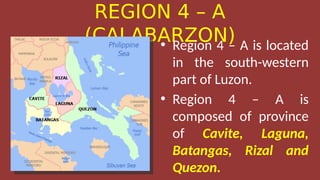
• Region 4 – A is located
in the south-western
part of Luzon.
• Region 4 – A is
composed of province
of Cavite, Laguna,
Batangas, Rizal and
Quezon.
Province Capital (City)
Cavite Trece Martires City
Laguna Calamba
Batangas Batangas City
Rizal Antipolo
Quezon Lucena
KALAYAAN FESTIVAL
KALAYAAN FESTIVAL
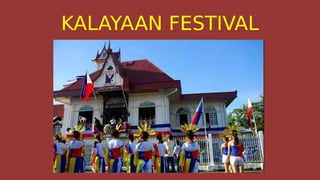
• Is a celebration of Philippine Independence.
• Kalayaan Festival is a 2 week-long, province-
wide event held annually from May 28 to June
12
• To promote the rich history of the province of
Cavite
ANGONO, RIZAL
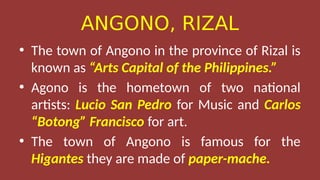
• The town of Angono in the province of Rizal is
known as “Arts Capital of the Philippines.”
• Agono is the hometown of two national
artists: Lucio San Pedro for Music and Carlos
“Botong” Francisco for art.
• The town of Angono is famous for the
Higantes they are made of paper-mache.
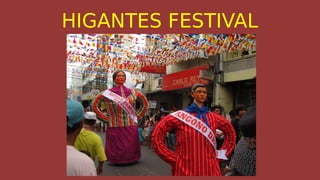
HIGANTES FESTIVAL
HIGANTES FESTIVAL
• Enlarging the image of St. Clement, the
fisherman’s patron saint to project beautiful
marine harvest.
• The image is carried by male devotees during a
procession accompanied by “pahadores”
(dressed in colorful and local costumes)
• Celebrated every 23rd
of November in Agono,
Rizal
PAETE WOODCARVING
• Skilled craftsmen and
artisans have
practiced woodcarving
in Paete since the
Spanish times, so that
their products have
primarily religious
themes.
PAETE WOODCARVING
(cont.)
Many residents of Paete
are woodcarvers. It is
believed that the
name “Paete” comes
from the word “Paet”
meaning chisel.
BARONG TAGALOG
• Common work of Art of
people from Southern
Tagalog
• Very lightweight and worn
untucked
• Barong Tagalog is still
popular formal attire not
just by men but also
women.
PAHIYAS FESTIVAL
PAHIYAS FESTIVAL
• These are the Philippines best known
harvest festivals to honor San Isidro
Labrador, the patron saint of farmers.
Known as the “Pahiyas”, the festival is
deeply rooted in the traditional celebration
of the townsfolk in thanksgiving for bounty
harvest. (Lucban, Quezon)
FAMOUS ARTISTS FROM
REGION 4-A
• Carlos “Botong” V. Francisco (Angono, Rizal) –
He is known for historically themed murals
such as the Filipino Struggles through History
which is displayed at Manila City Hall.
• Lucio D. San Pedro (Angono, Rizal) – His
compositions include band music concertos
for violin, orchestra, choral works, cantatas,
chamber music etc.
FIRST MASS AT LIMASAWA
CHARACTERISTICS OF ART IN REGION 4-A
• The arts visualizes the history of their
provinces.
• Paete wood carving uses different principles of
shapes.
• People use of the available materials to make
an art.
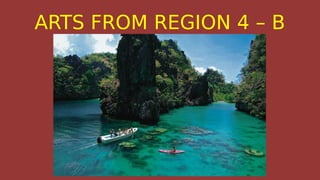
ARTS FROM REGION 4 – B
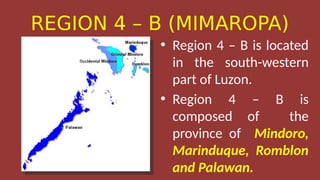
REGION 4 – B (MIMAROPA)
• Region 4 – B is located
in the south-western
part of Luzon.
• Region 4 – B is
composed of the
province of Mindoro,
Marinduque, Romblon
and Palawan.
Province Capital (City)
Occidental Mindoro Mamburao
Oriental Mindoro Calapan
Palawan Puerto Princesa
Romblon Romblon
Marinduque Boac
MINDORO
• The Mangyans are the
indigenous people of
Mindoro.
• Malasimbo Festival upholds
sustain eco-cultural
development and the
preservation of the
indigenous culture and
heritage of Mangyan tribes.
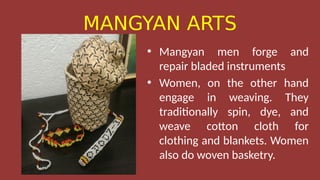
MANGYAN ARTS
• Mangyan men forge and
repair bladed instruments
• Women, on the other hand
engage in weaving. They
traditionally spin, dye, and
weave cotton cloth for
clothing and blankets. Women
also do woven basketry.
MARINDUQUE
The Moriones
Festival are the men
and women in
costumes and masks
replicating the garb of
biblical roman soldiers
as interpreted by local
folks.
MARINDUQUE (cont.)
Pottery and ceramic
is seen as a viable
project that will
encourage
entrepreneurship
especially women.
ROMBLON
• Rombloanon comes from the Visayan “Domblon”
or “Lamyon” which means “sitting”.
• The major industry in Romblon is basketry.
Romblon baskets are source of aesthetic pride.
They are unique in material they used which is
the kokolongkoy and in the weaving technique
called roping.
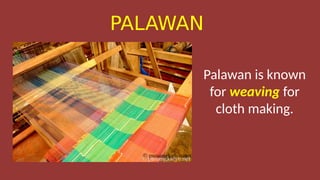
PALAWAN
Palawan is known
for weaving for
cloth making.
FAMOUS ARTISTS FROM
REGION 4-B
• Nestor Vicente Madali Gonzalez / N.V.M.
Gonzalez (Romblon, Romblon) – A writer that
specialized in fiction. His works depicted the
trials and avail of the Filipino in both rural and
urban settings.
• Ginaw Bilog (Panaytayan, Oriental Mindoro) –
promoter of ambahan (a seven syllable line that
uses metaphors to send a point or message.)
CHARACTERISTICS OF ART IN REGION 4-B
• Weaving is most common to all provinces in
Region 4-B
• Mangyan Arts observes patterns and
repetition of designs.
• The harmony of different art principles is
observed.
• Multifunctional
ARTS FROM REGION 13
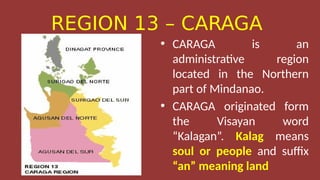
REGION 13 – CARAGA
• CARAGA is an
administrative region
located in the Northern
part of Mindanao.
• CARAGA originated form
the Visayan word
“Kalagan”. Kalag means
soul or people and suffix
“an” meaning land
Province Capital (City)
Surigao del Norte Surigao City
Surigao del Sur Tandag City
Agusan del Norte Butuan City
Agusan del Sur Prosperidad
Dinagat Island San Jose
REGION 13 – CARAGA
• Region 13 is known for abundance in
production of fisheries and aquatic products
• Caraga region also known for rich mineral
deposits
• Caraga region is also known for attractive
tourist spots and infrastructures.
KAHIMUNAN FESTIVAL
KAHIMUNAN FESTIVAL
• Local version of Sinulog festival in Cebu, it is
highlighted by street dancing focusing on
the indigenous tribes of Bayugan.
• Way of showing gratitude towards one of
its patron saints, the Sto. Nino also known
as child Jesus.
SUMAJAYAW FESTIVAL
SUMAJAYAW FESTIVAL
• Showcases ethnic attire and colorful props. It
shows the world the creativity of the people in
showing the Almighty for the blessings
received.
• Annually celebrated in Jabonga every 15th
of
August in the feast of Our Lady of Assumption.
CHARACTERISTICS OF ART IN REGION 13
• Highly Expressive
• Festivals celebrated in this region uses
the principle of color harmony.
• Polychromatic
SOURCES:
• Ganzon, J.C. (2017). Journey: Contemporary Arts of
the Philippines. Quezon City. Phoenix Publishing
• Lacia, G. MAPEH in Action 7. Manila: Rex Publishing
• https://www.slideshare.net/bokie12/region-4a-
48365152
• https://www.slideshare.net/Cedrock/grade-7-art-in-
mimaropa

Region_4_A.pptx.pdf

  • 1.
    CONTEMPORARY PHILIPPINE ART FROMTHE REGIONS GROUP 5 – ST. MAXIMILIAN KOLBE Bello – Chang – Amper – Dimaculangan – Perez
  • 2.
  • 3.
    REGION 4 –A (CALABARZON) • Region 4 – A is located in the south-western part of Luzon. • Region 4 – A is composed of province of Cavite, Laguna, Batangas, Rizal and Quezon.
  • 4.
    Province Capital (City) CaviteTrece Martires City Laguna Calamba Batangas Batangas City Rizal Antipolo Quezon Lucena
  • 5.
  • 6.
    KALAYAAN FESTIVAL • Isa celebration of Philippine Independence. • Kalayaan Festival is a 2 week-long, province- wide event held annually from May 28 to June 12 • To promote the rich history of the province of Cavite
  • 7.
    ANGONO, RIZAL • Thetown of Angono in the province of Rizal is known as “Arts Capital of the Philippines.” • Agono is the hometown of two national artists: Lucio San Pedro for Music and Carlos “Botong” Francisco for art. • The town of Angono is famous for the Higantes they are made of paper-mache.
  • 8.
  • 9.
    HIGANTES FESTIVAL • Enlargingthe image of St. Clement, the fisherman’s patron saint to project beautiful marine harvest. • The image is carried by male devotees during a procession accompanied by “pahadores” (dressed in colorful and local costumes) • Celebrated every 23rd of November in Agono, Rizal
  • 10.
    PAETE WOODCARVING • Skilledcraftsmen and artisans have practiced woodcarving in Paete since the Spanish times, so that their products have primarily religious themes.
  • 11.
    PAETE WOODCARVING (cont.) Many residentsof Paete are woodcarvers. It is believed that the name “Paete” comes from the word “Paet” meaning chisel.
  • 12.
    BARONG TAGALOG • Commonwork of Art of people from Southern Tagalog • Very lightweight and worn untucked • Barong Tagalog is still popular formal attire not just by men but also women.
  • 13.
  • 14.
    PAHIYAS FESTIVAL • Theseare the Philippines best known harvest festivals to honor San Isidro Labrador, the patron saint of farmers. Known as the “Pahiyas”, the festival is deeply rooted in the traditional celebration of the townsfolk in thanksgiving for bounty harvest. (Lucban, Quezon)
  • 15.
    FAMOUS ARTISTS FROM REGION4-A • Carlos “Botong” V. Francisco (Angono, Rizal) – He is known for historically themed murals such as the Filipino Struggles through History which is displayed at Manila City Hall. • Lucio D. San Pedro (Angono, Rizal) – His compositions include band music concertos for violin, orchestra, choral works, cantatas, chamber music etc.
  • 16.
    FIRST MASS ATLIMASAWA
  • 17.
    CHARACTERISTICS OF ARTIN REGION 4-A • The arts visualizes the history of their provinces. • Paete wood carving uses different principles of shapes. • People use of the available materials to make an art.
  • 18.
  • 19.
    REGION 4 –B (MIMAROPA) • Region 4 – B is located in the south-western part of Luzon. • Region 4 – B is composed of the province of Mindoro, Marinduque, Romblon and Palawan.
  • 20.
    Province Capital (City) OccidentalMindoro Mamburao Oriental Mindoro Calapan Palawan Puerto Princesa Romblon Romblon Marinduque Boac
  • 21.
    MINDORO • The Mangyansare the indigenous people of Mindoro. • Malasimbo Festival upholds sustain eco-cultural development and the preservation of the indigenous culture and heritage of Mangyan tribes.
  • 22.
    MANGYAN ARTS • Mangyanmen forge and repair bladed instruments • Women, on the other hand engage in weaving. They traditionally spin, dye, and weave cotton cloth for clothing and blankets. Women also do woven basketry.
  • 23.
    MARINDUQUE The Moriones Festival arethe men and women in costumes and masks replicating the garb of biblical roman soldiers as interpreted by local folks.
  • 24.
    MARINDUQUE (cont.) Pottery andceramic is seen as a viable project that will encourage entrepreneurship especially women.
  • 25.
    ROMBLON • Rombloanon comesfrom the Visayan “Domblon” or “Lamyon” which means “sitting”. • The major industry in Romblon is basketry. Romblon baskets are source of aesthetic pride. They are unique in material they used which is the kokolongkoy and in the weaving technique called roping.
  • 26.
    PALAWAN Palawan is known forweaving for cloth making.
  • 27.
    FAMOUS ARTISTS FROM REGION4-B • Nestor Vicente Madali Gonzalez / N.V.M. Gonzalez (Romblon, Romblon) – A writer that specialized in fiction. His works depicted the trials and avail of the Filipino in both rural and urban settings. • Ginaw Bilog (Panaytayan, Oriental Mindoro) – promoter of ambahan (a seven syllable line that uses metaphors to send a point or message.)
  • 28.
    CHARACTERISTICS OF ARTIN REGION 4-B • Weaving is most common to all provinces in Region 4-B • Mangyan Arts observes patterns and repetition of designs. • The harmony of different art principles is observed. • Multifunctional
  • 29.
  • 30.
    REGION 13 –CARAGA • CARAGA is an administrative region located in the Northern part of Mindanao. • CARAGA originated form the Visayan word “Kalagan”. Kalag means soul or people and suffix “an” meaning land
  • 31.
    Province Capital (City) Surigaodel Norte Surigao City Surigao del Sur Tandag City Agusan del Norte Butuan City Agusan del Sur Prosperidad Dinagat Island San Jose
  • 32.
    REGION 13 –CARAGA • Region 13 is known for abundance in production of fisheries and aquatic products • Caraga region also known for rich mineral deposits • Caraga region is also known for attractive tourist spots and infrastructures.
  • 33.
  • 34.
    KAHIMUNAN FESTIVAL • Localversion of Sinulog festival in Cebu, it is highlighted by street dancing focusing on the indigenous tribes of Bayugan. • Way of showing gratitude towards one of its patron saints, the Sto. Nino also known as child Jesus.
  • 35.
  • 36.
    SUMAJAYAW FESTIVAL • Showcasesethnic attire and colorful props. It shows the world the creativity of the people in showing the Almighty for the blessings received. • Annually celebrated in Jabonga every 15th of August in the feast of Our Lady of Assumption.
  • 37.
    CHARACTERISTICS OF ARTIN REGION 13 • Highly Expressive • Festivals celebrated in this region uses the principle of color harmony. • Polychromatic
  • 38.
    SOURCES: • Ganzon, J.C.(2017). Journey: Contemporary Arts of the Philippines. Quezon City. Phoenix Publishing • Lacia, G. MAPEH in Action 7. Manila: Rex Publishing • https://www.slideshare.net/bokie12/region-4a- 48365152 • https://www.slideshare.net/Cedrock/grade-7-art-in- mimaropa