PHYSICS INVESTIGATORY PROJECT
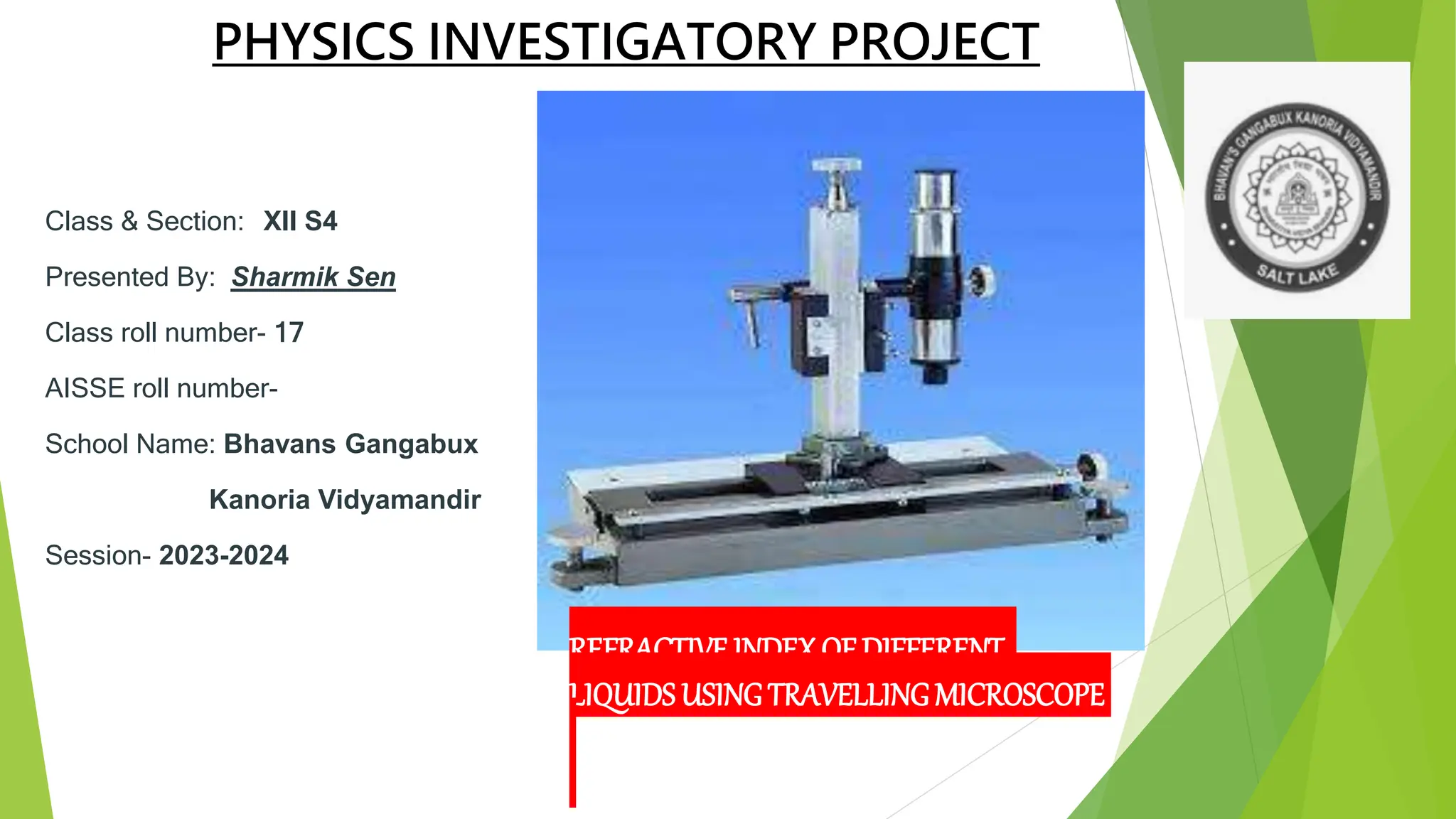
REFRACTIVEINDEXOF DIFFERENT
LIQUIDS USINGTRAVELLINGMICROSCOPE
Class & Section: XII S4
Presented By: Sharmik Sen
Class roll number- 17
AISSE roll number-
School Name: Bhavans Gangabux
Kanoria Vidyamandir
Session- 2023-2024
SERIAL
NUMBER
TOPIC PAGE
NUMBER
SIGNATURE
1 TEACHER’S
CERTIFICATE
3
2 ACKNOWLEDGEMENT 4
3 INTRODUCTION 5
4 AIM 9
5 APPARATUS 9
6 THEORY 9
7 PROCEDURE 10
8 OBSERVATION 11
9 PRECAUTION 12
10 SOURCES OF ERROR 12
11 CONCLUSION 12
12 BIBLIOGRAPHY 13
External Examiner’s Sign
Teacher’s Sign
TEACHER’S CERTIFICATE
To whoever it may concern, this is to certify that the project titled
REFRACTIVE INDEX OF DIFFERENT LIQUIDS USING TRAVELLING MICROSCOPE
has been submitted by SHARMIK SEN of class 12-S4
and that he has performed this project under my guidance
Sincere thanks to our teachers Abhijit Raha Sir, Debayan Kundu Sir
and lab assistant Sanju Sir for their endless support and unconditional
help in explaining and guiding us through the entire procedure.
We would also like to thank our Principal , Mr. Arun Kumar Dasgupta sir
and our Vice Principal Monami Chattopadhay for constantly inspiring us,
and providing us with all the facilities required for the experiment
ACKNOWLEDGEMENT
A travelling microscope is an instrument for measuring length with a resolution
typically in the order of 0.01mm. The precision is such that better-quality instruments
have measuring scales made from Invar to avoid misreading due to thermal effects.
The instrument comprises a microscope mounted on two rails fixed to, or part of a
very rigid bed. The position of the microscope can be varied coarsely by sliding along
the rails, or finely by turning a screw. The eyepiece is fitted with fine crosshairs to fix
a precise position, which is then read off the vernier scale. Some instruments, such as
that produced in the 1960s by the Precision Tool and Instrument Company of Thornton
Heath, Surrey, England, also measure vertically. The purpose of the microscope is to
aim at reference marks with much higher accuracy than is possible using the naked
eye. It is used in laboratories to measure the refractive index of liquids using the
geometrical concepts of ray optics. It is also used to measure very short distances
precisely, for example the diameter of a capillary tube. This mechanical instrument
has now largely been superseded by electronic- and optically-based measuring devices
that are both very much more accurate and considerably cheaper to produce
INTRODUCTION
A) Refraction – it is a phenomenon of bending a ray of light at the boundary (interface) of
two optical media when light ray is going from one optical medium to another medium.
The cause of refraction is the difference of speed of light from one medium to another
Laws of Refraction
There are two laws:-
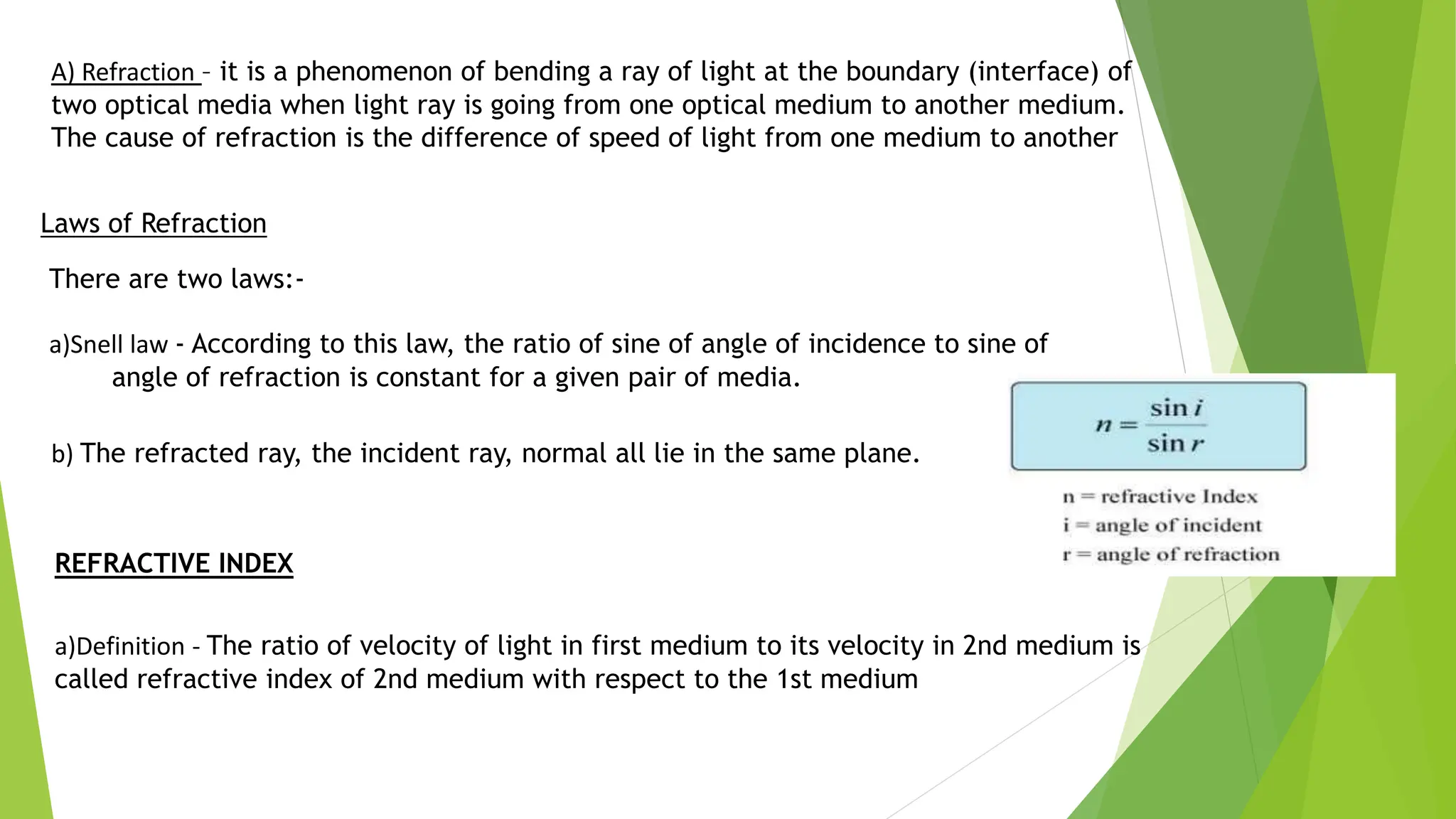
a)Snell law - According to this law, the ratio of sine of angle of incidence to sine of
angle of refraction is constant for a given pair of media.
b) The refracted ray, the incident ray, normal all lie in the same plane.
REFRACTIVE INDEX
a)Definition - The ratio of velocity of light in first medium to its velocity in 2nd medium is
called refractive index of 2nd medium with respect to the 1st medium
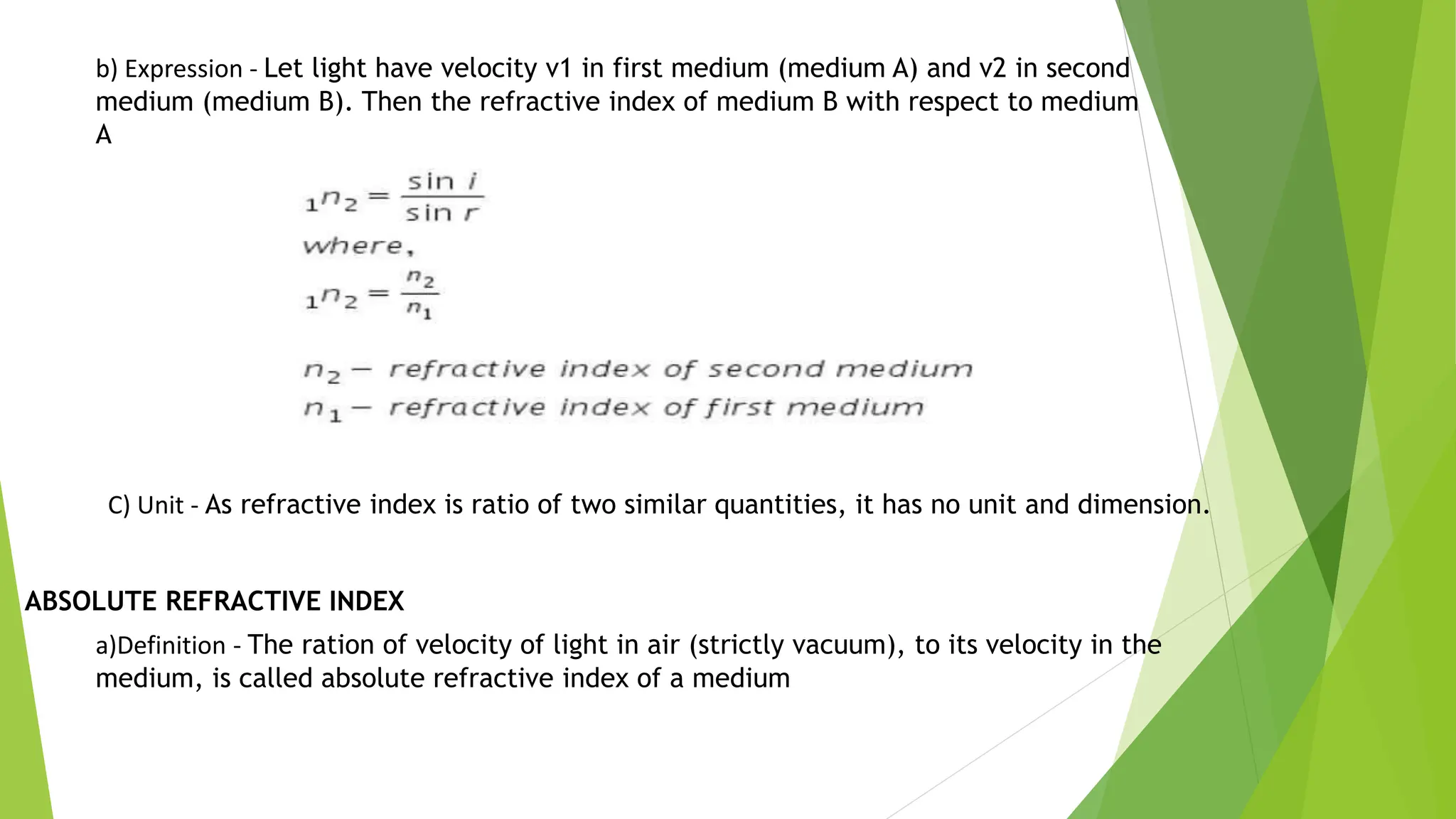
b) Expression - Let light have velocity v1 in first medium (medium A) and v2 in second
medium (medium B). Then the refractive index of medium B with respect to medium
A
C) Unit - As refractive index is ratio of two similar quantities, it has no unit and dimension.
ABSOLUTE REFRACTIVE INDEX
a)Definition - The ration of velocity of light in air (strictly vacuum), to its velocity in the
medium, is called absolute refractive index of a medium
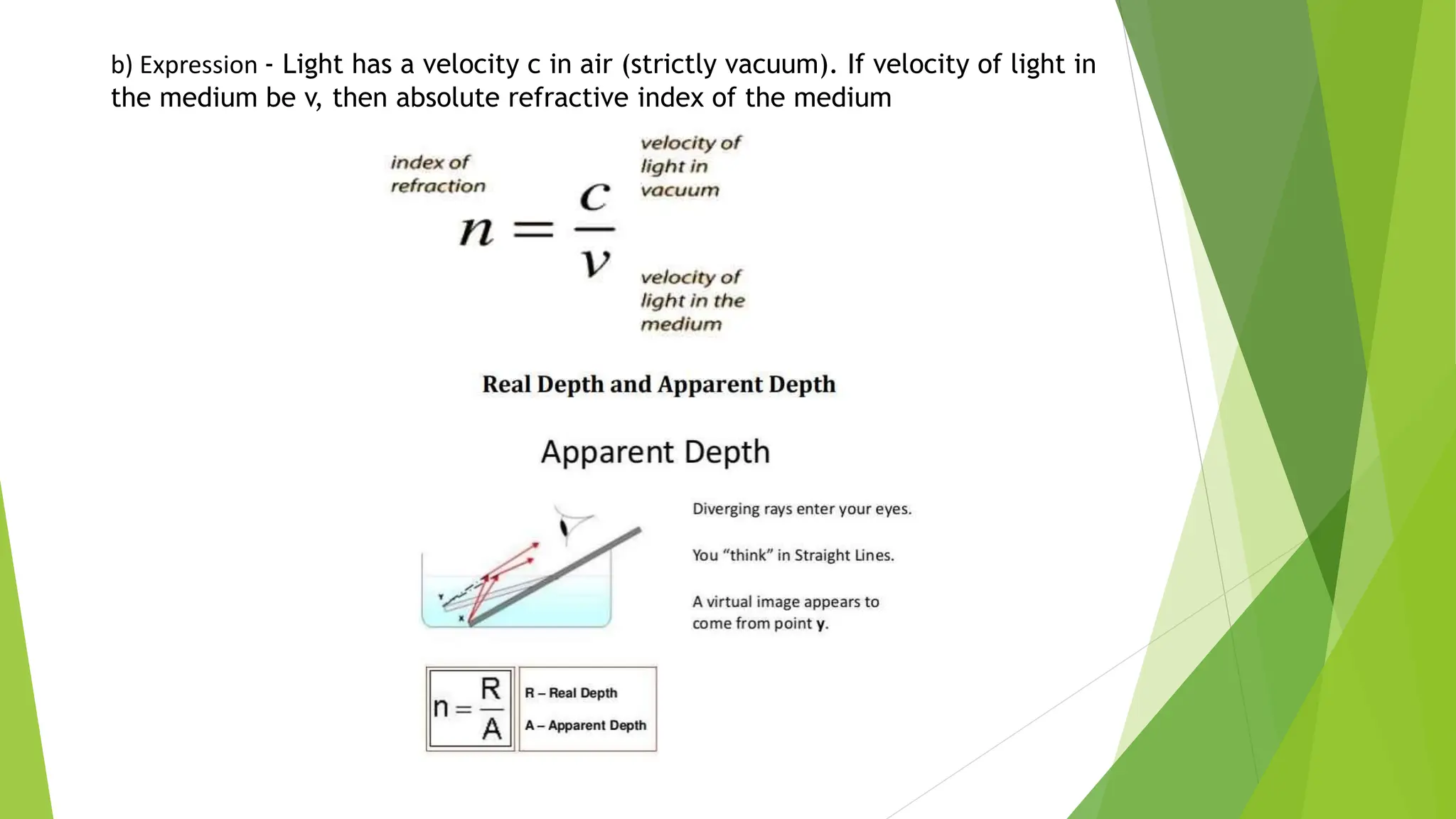
b) Expression - Light has a velocity c in air (strictly vacuum). If velocity of light in
the medium be v, then absolute refractive index of the medium
Apparatus
 Travelling microscope
 Magnifying glass
 Set of liquids (acetone, glycerin, water)
Experiment
Aim :
To find out refractive index of different liquids using travelling microscope.
Theory -
Different liquids have different densities. So, they refract a monochromatic ray of light
differently, at different angles. The refractive index of the liquids can be determined using
this experiment
1. Place the travelling microscope on the table near a window on the table so that
sufficient amount of light falls on it
2. Adjust the levelling screws so that the base of the microscope becomes horizontal.
3. Make microscope horizontal. Adjust the position of the eye piece so that the cross
wires are clearly visible.
4. Determine the Vernier constant of the vertical scale
5. Make a black cross on the base of the microscope which serves as a point for focus.
there should be no parallax between the cross wires and the image of the cross
6. Note the main scale and Vernier scale readings on the vertical scale
7. Place the liquids (acetone, water, glycerine) over the cross mark.
8. Raise the microscope accordingly to focus on the image of the cross mark
9. Note the reading again on the vertical scale.
10.Sprinkle a few particles of lycopodium powder on the surface of the liquids and
note the reading on the vertical scale
Procedure
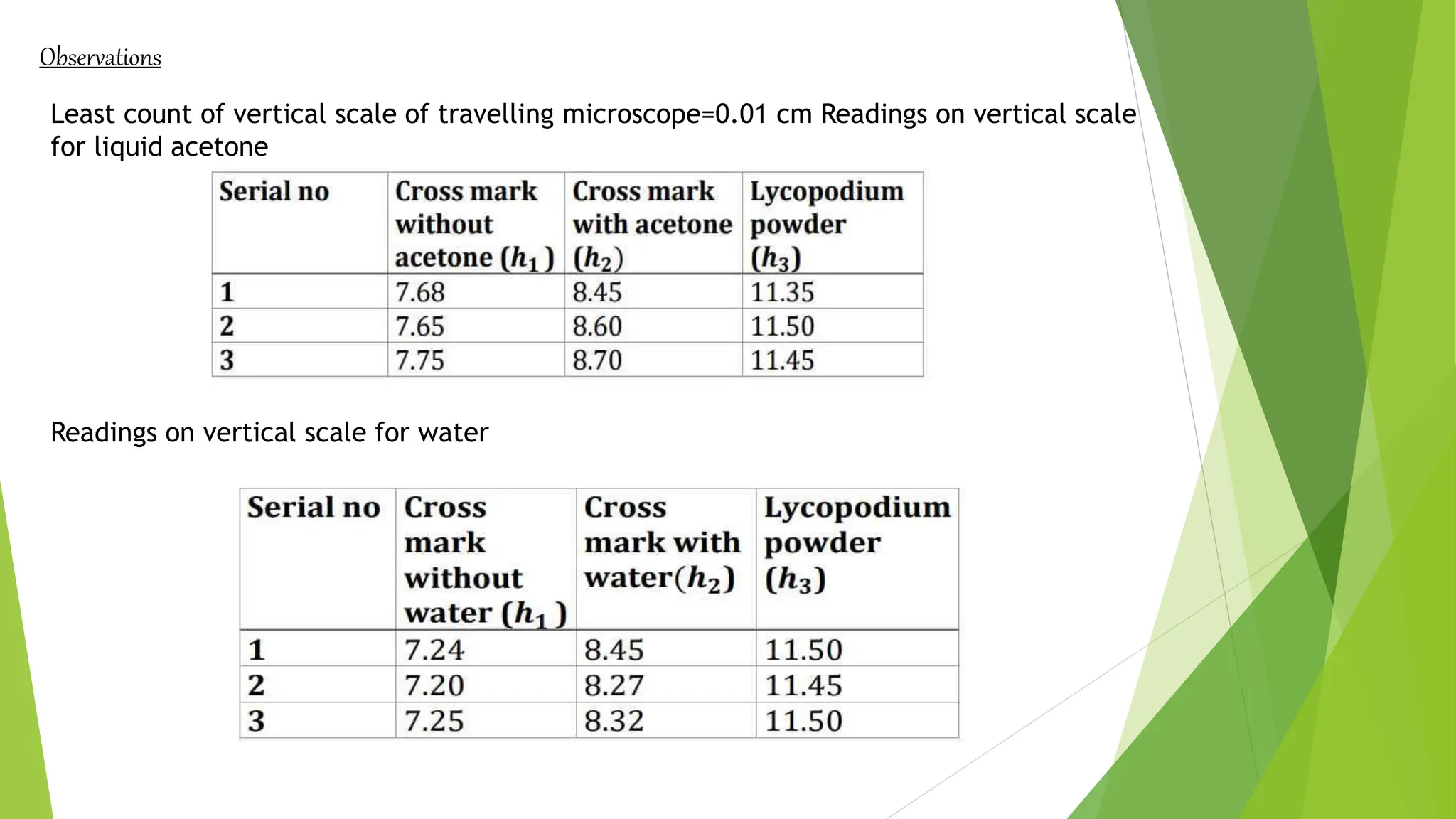
Observations
Least count of vertical scale of travelling microscope=0.01 cm Readings on vertical scale
for liquid acetone
Readings on vertical scale for water
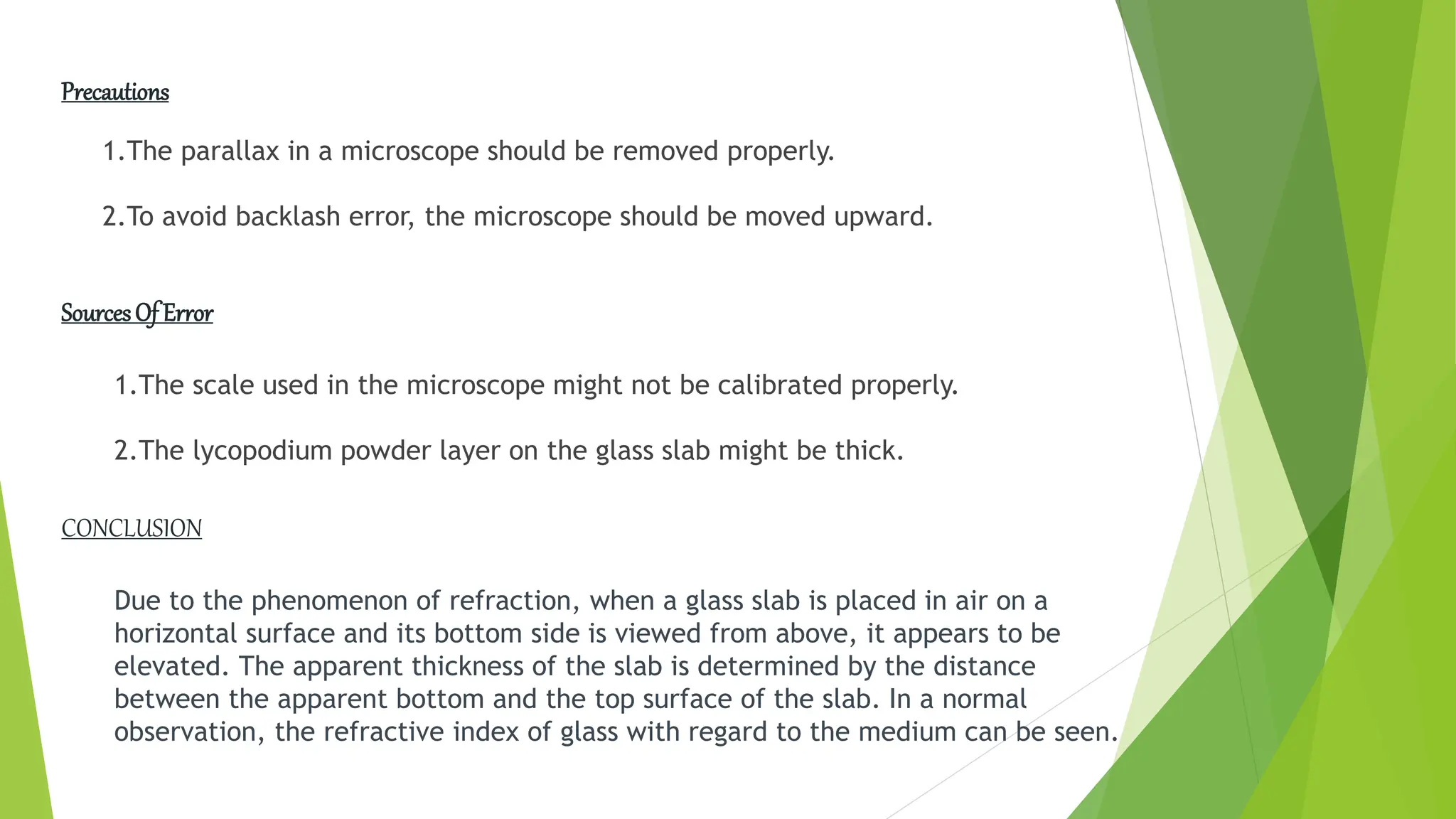
Precautions
1.The parallax in a microscope should be removed properly.
2.To avoid backlash error, the microscope should be moved upward.
SourcesOf Error
1.The scale used in the microscope might not be calibrated properly.
2.The lycopodium powder layer on the glass slab might be thick.
Due to the phenomenon of refraction, when a glass slab is placed in air on a
horizontal surface and its bottom side is viewed from above, it appears to be
elevated. The apparent thickness of the slab is determined by the distance
between the apparent bottom and the top surface of the slab. In a normal
observation, the refractive index of glass with regard to the medium can be seen.
CONCLUSION
BIBLIOGRAPHY
All the information used apart from observations are from
1) COMPREHENSIVE PRACTICAL PHYSICS BY LAXMI
PUBLICATIONS
2) WIKIPEDIA
3) RESEARCHGATE.NET

Refractive index of liquids using travelling microscope

  • 1.
    PHYSICS INVESTIGATORY PROJECT REFRACTIVEINDEXOFDIFFERENT LIQUIDS USINGTRAVELLINGMICROSCOPE Class & Section: XII S4 Presented By: Sharmik Sen Class roll number- 17 AISSE roll number- School Name: Bhavans Gangabux Kanoria Vidyamandir Session- 2023-2024
  • 2.
    SERIAL NUMBER TOPIC PAGE NUMBER SIGNATURE 1 TEACHER’S CERTIFICATE 3 2ACKNOWLEDGEMENT 4 3 INTRODUCTION 5 4 AIM 9 5 APPARATUS 9 6 THEORY 9 7 PROCEDURE 10 8 OBSERVATION 11 9 PRECAUTION 12 10 SOURCES OF ERROR 12 11 CONCLUSION 12 12 BIBLIOGRAPHY 13
  • 3.
    External Examiner’s Sign Teacher’sSign TEACHER’S CERTIFICATE To whoever it may concern, this is to certify that the project titled REFRACTIVE INDEX OF DIFFERENT LIQUIDS USING TRAVELLING MICROSCOPE has been submitted by SHARMIK SEN of class 12-S4 and that he has performed this project under my guidance
  • 4.
    Sincere thanks toour teachers Abhijit Raha Sir, Debayan Kundu Sir and lab assistant Sanju Sir for their endless support and unconditional help in explaining and guiding us through the entire procedure. We would also like to thank our Principal , Mr. Arun Kumar Dasgupta sir and our Vice Principal Monami Chattopadhay for constantly inspiring us, and providing us with all the facilities required for the experiment ACKNOWLEDGEMENT
  • 5.
    A travelling microscopeis an instrument for measuring length with a resolution typically in the order of 0.01mm. The precision is such that better-quality instruments have measuring scales made from Invar to avoid misreading due to thermal effects. The instrument comprises a microscope mounted on two rails fixed to, or part of a very rigid bed. The position of the microscope can be varied coarsely by sliding along the rails, or finely by turning a screw. The eyepiece is fitted with fine crosshairs to fix a precise position, which is then read off the vernier scale. Some instruments, such as that produced in the 1960s by the Precision Tool and Instrument Company of Thornton Heath, Surrey, England, also measure vertically. The purpose of the microscope is to aim at reference marks with much higher accuracy than is possible using the naked eye. It is used in laboratories to measure the refractive index of liquids using the geometrical concepts of ray optics. It is also used to measure very short distances precisely, for example the diameter of a capillary tube. This mechanical instrument has now largely been superseded by electronic- and optically-based measuring devices that are both very much more accurate and considerably cheaper to produce INTRODUCTION
  • 6.
    A) Refraction –it is a phenomenon of bending a ray of light at the boundary (interface) of two optical media when light ray is going from one optical medium to another medium. The cause of refraction is the difference of speed of light from one medium to another Laws of Refraction There are two laws:- a)Snell law - According to this law, the ratio of sine of angle of incidence to sine of angle of refraction is constant for a given pair of media. b) The refracted ray, the incident ray, normal all lie in the same plane. REFRACTIVE INDEX a)Definition - The ratio of velocity of light in first medium to its velocity in 2nd medium is called refractive index of 2nd medium with respect to the 1st medium
  • 7.
    b) Expression -Let light have velocity v1 in first medium (medium A) and v2 in second medium (medium B). Then the refractive index of medium B with respect to medium A C) Unit - As refractive index is ratio of two similar quantities, it has no unit and dimension. ABSOLUTE REFRACTIVE INDEX a)Definition - The ration of velocity of light in air (strictly vacuum), to its velocity in the medium, is called absolute refractive index of a medium
  • 8.
    b) Expression -Light has a velocity c in air (strictly vacuum). If velocity of light in the medium be v, then absolute refractive index of the medium
  • 9.
    Apparatus  Travelling microscope Magnifying glass  Set of liquids (acetone, glycerin, water) Experiment Aim : To find out refractive index of different liquids using travelling microscope. Theory - Different liquids have different densities. So, they refract a monochromatic ray of light differently, at different angles. The refractive index of the liquids can be determined using this experiment
  • 10.
    1. Place thetravelling microscope on the table near a window on the table so that sufficient amount of light falls on it 2. Adjust the levelling screws so that the base of the microscope becomes horizontal. 3. Make microscope horizontal. Adjust the position of the eye piece so that the cross wires are clearly visible. 4. Determine the Vernier constant of the vertical scale 5. Make a black cross on the base of the microscope which serves as a point for focus. there should be no parallax between the cross wires and the image of the cross 6. Note the main scale and Vernier scale readings on the vertical scale 7. Place the liquids (acetone, water, glycerine) over the cross mark. 8. Raise the microscope accordingly to focus on the image of the cross mark 9. Note the reading again on the vertical scale. 10.Sprinkle a few particles of lycopodium powder on the surface of the liquids and note the reading on the vertical scale Procedure
  • 11.
    Observations Least count ofvertical scale of travelling microscope=0.01 cm Readings on vertical scale for liquid acetone Readings on vertical scale for water
  • 12.
    Precautions 1.The parallax ina microscope should be removed properly. 2.To avoid backlash error, the microscope should be moved upward. SourcesOf Error 1.The scale used in the microscope might not be calibrated properly. 2.The lycopodium powder layer on the glass slab might be thick. Due to the phenomenon of refraction, when a glass slab is placed in air on a horizontal surface and its bottom side is viewed from above, it appears to be elevated. The apparent thickness of the slab is determined by the distance between the apparent bottom and the top surface of the slab. In a normal observation, the refractive index of glass with regard to the medium can be seen. CONCLUSION
  • 13.
    BIBLIOGRAPHY All the informationused apart from observations are from 1) COMPREHENSIVE PRACTICAL PHYSICS BY LAXMI PUBLICATIONS 2) WIKIPEDIA 3) RESEARCHGATE.NET